
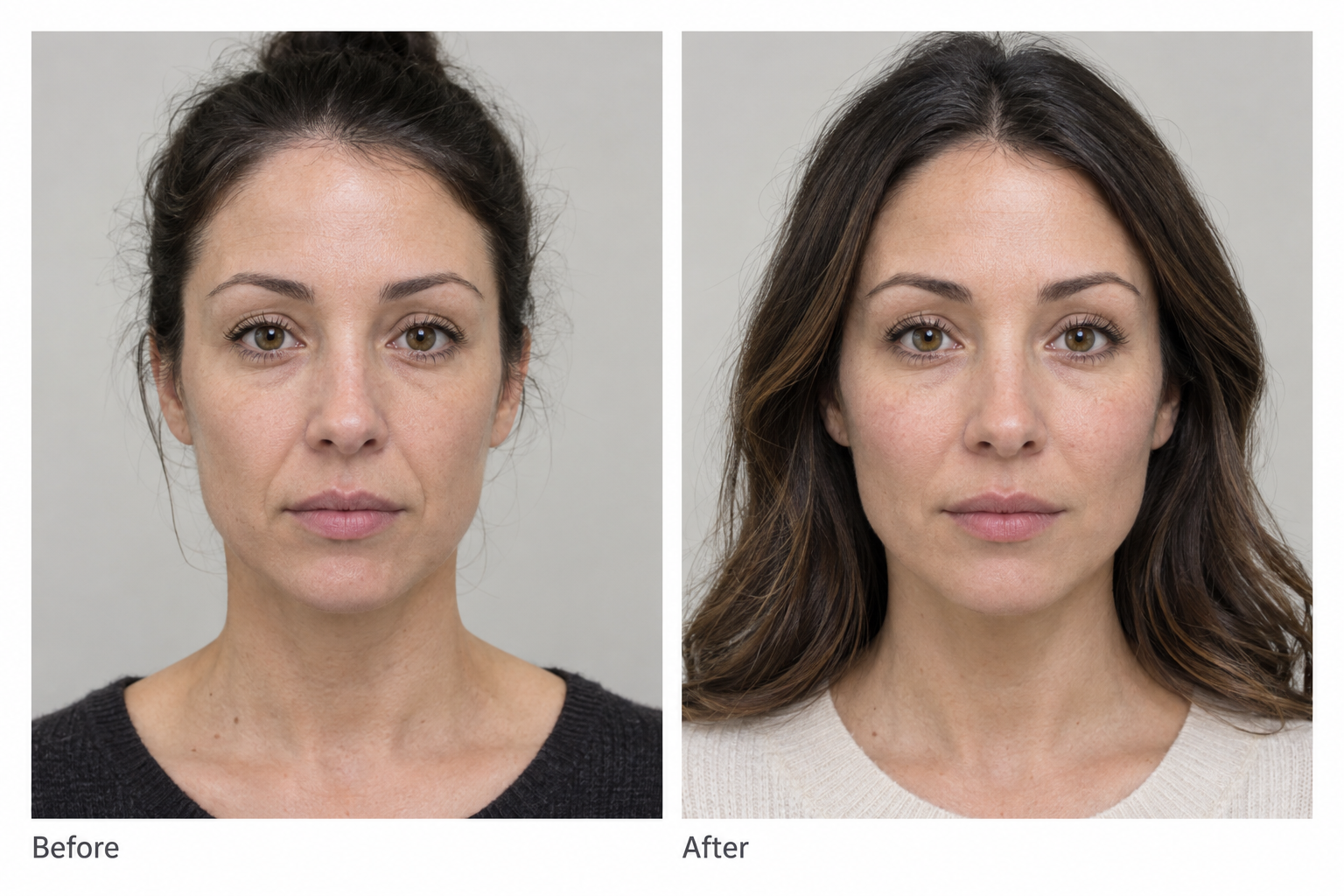

Cheek filler before and after photos are everywhere online, but understanding what those images actually show — and what they don't — is essential before deciding whether the treatment is right for you. This guide explains what changes are realistic, how results develop over time, which filler products are commonly used, who tends to benefit most, and what risks to weigh before booking a consultation.
Key Takeaways
- Cheek filler results are not fully visible immediately — swelling in the first few days can make the outcome look exaggerated, while settled results at around two weeks give a more accurate picture.
- The most common goals are midface volume restoration, improved cheekbone projection, and softening of nasolabial folds — not dramatic transformation.
- Hyaluronic acid fillers such as Juvederm Voluma and Restylane Lyft are the most widely used options and are reversible with hyaluronidase if needed.
- Results typically last 12–24 months depending on the product, volume used, placement, and individual factors such as metabolism.
- Overfilling carries real aesthetic risks, including the appearance sometimes called pillow face; a conservative, staged approach generally produces more natural-looking results.
What Cheek Filler Actually Changes
Cheek filler works by adding volume beneath the skin, typically in the fat compartments above the zygomatic arch or at the periosteal level near the cheekbone itself. The practical effect depends on what the patient is starting with. In someone experiencing age-related volume loss, the treatment can restore the gentle convexity of the midface that tends to flatten with time. In a younger patient with naturally flat or undefined cheekbones, it can create cheekbone projection and improve the overall proportions of the face.
One anatomical concept that helps explain the goal of cheek filler is the triangle of youth — the idea that a youthful face has its widest point at the cheeks, tapering toward the jaw. As facial fat pads descend and diminish with age, this triangle can invert, making the jaw appear wider relative to the midface. Restoring volume to the cheeks can partially re-establish that proportion. Filler placed well also improves how light reflects off the face, creating a subtle highlight at the cheekbone that reads as lift and definition rather than added bulk.
A secondary effect that is often overlooked is the indirect improvement in surrounding areas. Adequate midface volume can reduce the depth of nasolabial folds by providing structural support to the tissue above them, and it can improve the appearance of the lid-cheek junction — the transition zone between the lower eyelid and the upper cheek — by reducing the hollowed look that develops when midface volume is lost.
The Before and After Timeline: What to Expect Week by Week
One of the most important things to understand about cheek filler before and after results is that the appearance changes significantly in the days following treatment. Comparing a photo taken immediately after injection to one taken two weeks later can look like two different outcomes — because in a meaningful sense, they are.
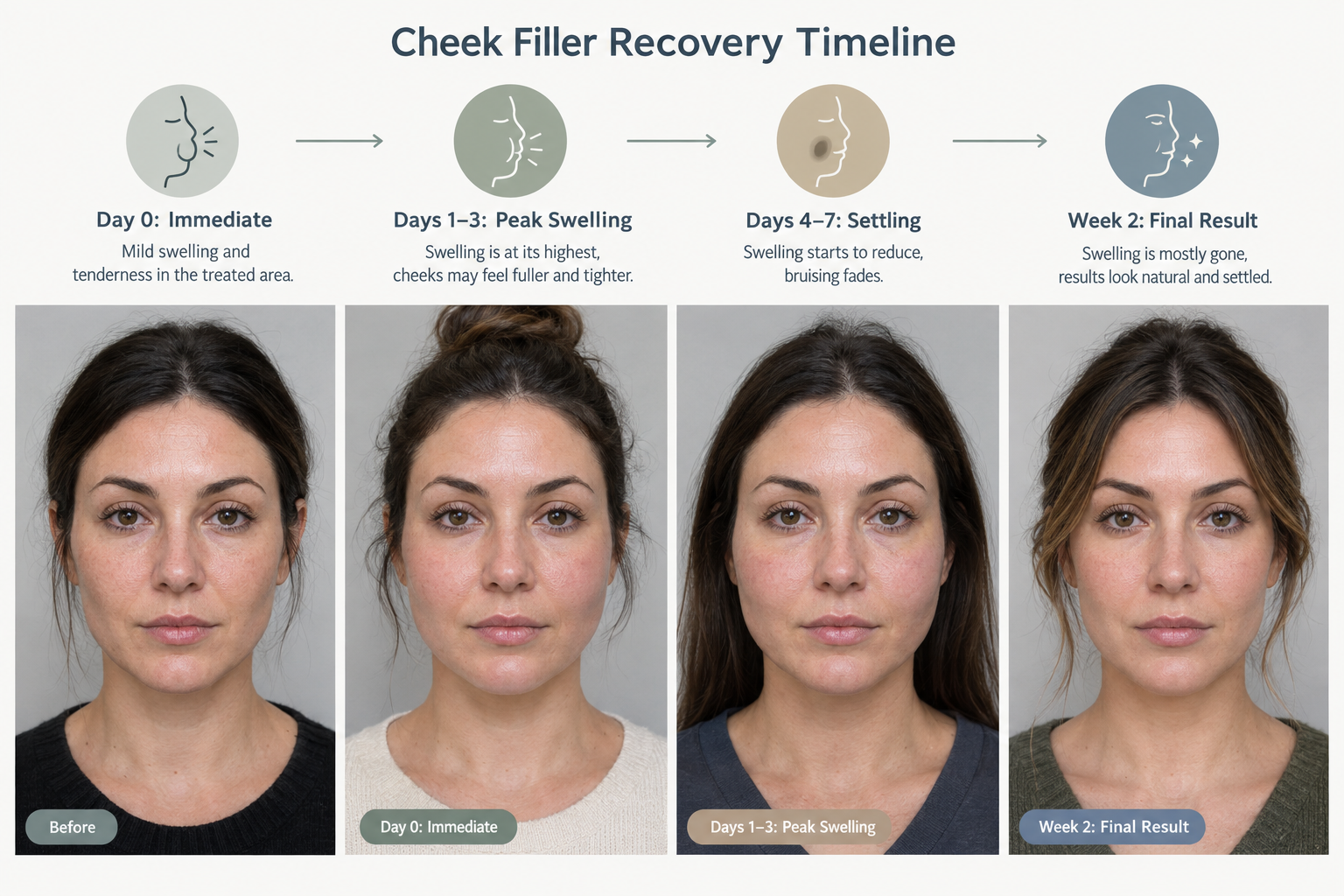
Immediately After Treatment
Volume is visible right away, but the area will also be swollen from the injection process itself. The cheeks may look fuller than the intended final result, and there may be mild redness or tenderness at the injection sites. Some patients experience bruising, particularly if small blood vessels were disrupted during the procedure. This is normal and does not indicate a problem with the treatment.
Days 1–3
Swelling typically peaks within the first 48–72 hours. During this period, the treated area may feel firm or slightly uneven, and the result can look more pronounced than intended. Sleeping with the head slightly elevated and avoiding strenuous exercise can help reduce swelling more quickly. Applying a cold compress gently to the area may also help, though patients should follow their provider's specific aftercare instructions.
Days 4–7
Swelling begins to subside noticeably during the first week. Bruising, if present, typically fades within 7–10 days. The filler starts to integrate with surrounding tissue and the result begins to look more natural. Most patients feel comfortable returning to normal social activities within a few days, though this varies.
Two Weeks: Settled Results
At approximately two weeks, the filler has fully settled and any residual swelling has resolved. This is the point at which the true outcome of the treatment becomes visible — what practitioners refer to as settled results. A follow-up appointment at this stage allows the injector to assess symmetry, volume distribution, and whether any refinement is needed. Comparing before and after photos at this stage gives a far more accurate representation of the treatment's effect than same-day images.
Why Same-Day Before and After Photos Can Be Misleading
Many before and after images shared online or in clinic marketing are taken on the day of treatment. While these can show an immediate change, they often capture the result at its most swollen and therefore most exaggerated point. A responsible provider will photograph patients before treatment and again at the two-week follow-up to show the actual settled outcome. When evaluating before and after photos, it is worth checking whether the timing is stated and whether lighting and angles are consistent between images.
Cheek Filler Results by Goal and Patient Profile
Age-Related Volume Loss (Typically 40s and Older)
Patients in their 40s, 50s, and beyond often seek cheek filler primarily to address age-related volume loss. The midface tends to flatten as facial fat pads thin and descend over time, and the overlying skin loses some of its structural support. In these patients, cheek filler before and after results typically show a restoration of the midface contour, a subtle lift in the lower face as the structural support is rebuilt, and a reduction in the depth of nasolabial folds. The goal is generally to restore a rested, refreshed appearance rather than to dramatically alter facial structure.
Younger Patients Seeking Contouring (Typically 20s–30s)
Younger patients who have naturally flat or undefined cheekbones may seek cheek filler for contouring rather than restoration. In these cases, the before and after difference tends to be more about definition and facial harmony than volume replacement. Results can include improved cheekbone projection, a more sculpted midface appearance, and better overall facial balance. Because these patients have not yet experienced significant volume loss, smaller amounts of filler — often 1ml per side or less — may be sufficient to achieve the desired effect.
Men: Different Goals, Different Placement
Male cheek filler results differ from female results in important ways that are rarely discussed. Male facial anatomy typically features a more angular zygomatic arch, a flatter midface, and a stronger jaw. The aesthetic goal for men is generally to enhance angularity and definition rather than to create the rounded apple cheek appearance that may be appropriate for some female patients. Placement tends to be more lateral and higher on the cheekbone, and the injector should have experience with male facial proportions to avoid feminizing the result. Men considering cheek filler should specifically discuss these anatomical differences during their consultation.
Filler Products Used for Cheeks
Not all dermal fillers are suitable for the cheek area. The midface requires a product with sufficient structural support — measured as G-prime, or stiffness — to lift and project tissue rather than simply adding soft volume. The following products are among those most commonly used.
| Product | Type | Typical Duration | Key Characteristic |
|---|---|---|---|
| Juvederm Voluma XC | Hyaluronic acid (Vycross technology) | Up to 24 months | High G-prime; strong lift capacity |
| Restylane Lyft | Hyaluronic acid (NASHA technology) | Up to 18 months | Firm consistency; good projection |
| Restylane Contour | Hyaluronic acid (XpresHAn technology) | 12–18 months | Flexible; natural movement |
| RHA 4 | Hyaluronic acid (resilient HA) | 12–15 months | Designed for dynamic areas |
| Radiesse | Calcium hydroxylapatite | 12–18 months | Immediate volume plus collagen stimulation |
| Sculptra | Poly-L-lactic acid (PLLA) | Up to 24+ months | Gradual collagen stimulator; multiple sessions needed |
Hyaluronic acid fillers such as Voluma and Restylane Lyft are the most commonly chosen options because they offer predictable results and can be dissolved with hyaluronidase if the outcome is unsatisfactory or if a complication occurs. Radiesse and Sculptra are not reversible in the same way, which is an important consideration for patients who are new to cheek filler or uncertain about how much volume they want.
A secondary benefit of hyaluronic acid filler that is often underappreciated is its potential to stimulate fibroblast activity in the surrounding tissue, which may contribute to modest improvements in skin quality over time. This collagen stimulation effect is more pronounced with biostimulators like Sculptra, but some evidence suggests that HA fillers also have a mild tissue-stimulating effect. This does not replace dedicated skin treatments, but it is a meaningful secondary benefit for patients concerned about skin quality alongside volume.
How Much Filler Is Typically Used?
The volume of filler needed varies considerably between patients. A younger patient seeking subtle contouring may achieve their goal with 1ml per side, while someone with significant age-related volume loss may require 2–3ml per side to achieve a meaningful improvement. Using too little filler may produce a result that is barely noticeable, while using too much — particularly in a single session — increases the risk of an unnatural appearance.
The concept of a staged approach is worth understanding here. Rather than placing the maximum volume in a single appointment, an experienced injector may recommend starting conservatively — perhaps 1ml per side — and reassessing at the two-week follow-up before deciding whether additional volume is needed. This approach tends to produce more natural-looking results because it allows both the patient and the injector to evaluate the settled outcome before committing to more product. It also reduces the risk of overcorrection, which is much harder to manage than undercorrection.
Risks, Side Effects, and the Overfilling Problem
Cheek filler is a minimally invasive procedure, but it carries real risks that patients should understand before proceeding. Common side effects include swelling, bruising, tenderness, and temporary asymmetry — most of which resolve within one to two weeks. Less common but more significant risks include lumps or nodules beneath the skin, filler migration over time, and infection, which is rare but possible with any injectable procedure.
The most discussed aesthetic risk is overfilling. When too much filler is placed in the cheeks — either in a single session or cumulatively over multiple treatments — the result can be an unnaturally rounded, puffy appearance sometimes described as pillow face or chipmunk cheeks. This outcome is more likely when large volumes are placed without adequate assessment of the patient's existing facial structure, or when filler accumulates over repeated sessions without dissolving previous product first. Choosing an experienced provider and committing to a conservative treatment philosophy significantly reduces this risk.
The most serious risks associated with any facial filler are vascular in nature. If filler is inadvertently injected into or compresses a blood vessel, it can restrict blood flow to surrounding tissue. This is a rare but serious complication that requires immediate treatment. Providers trained in facial anatomy and emergency management of vascular events are better equipped to recognize and respond to these situations. The cannula technique — using a blunt-tipped cannula rather than a sharp needle — is preferred by many injectors for cheek treatment because it may reduce the risk of vascular injury, though technique alone does not eliminate this risk entirely.
Because hyaluronic acid fillers can be dissolved using hyaluronidase, they offer a meaningful safety advantage over non-reversible options. If a result is unsatisfactory or a complication occurs, the filler can be partially or fully dissolved. This reversibility is one reason HA fillers remain the most commonly recommended starting point for patients new to cheek augmentation.
How to Evaluate Before and After Photos Critically
Before and after galleries are a useful tool for setting expectations, but they require careful interpretation. When reviewing cheek filler before and after images, consider the following factors. First, check whether the photos were taken under consistent lighting — dramatic changes in lighting between the before and after image can create the illusion of more lift and definition than the filler actually produced. Second, confirm that the angle and head position are the same in both images; even a slight tilt can make cheekbones appear more or less prominent. Third, note when the after photo was taken — images captured on the day of treatment reflect swelling, not settled results. Finally, consider whether the patient's starting point is similar to your own, since the same volume of filler will produce very different results depending on existing facial structure.
Cheek Filler vs. Alternative Treatments
Cheek filler is not the only option for improving midface volume and definition. Understanding the alternatives helps patients make a more informed decision about which approach may suit their goals.
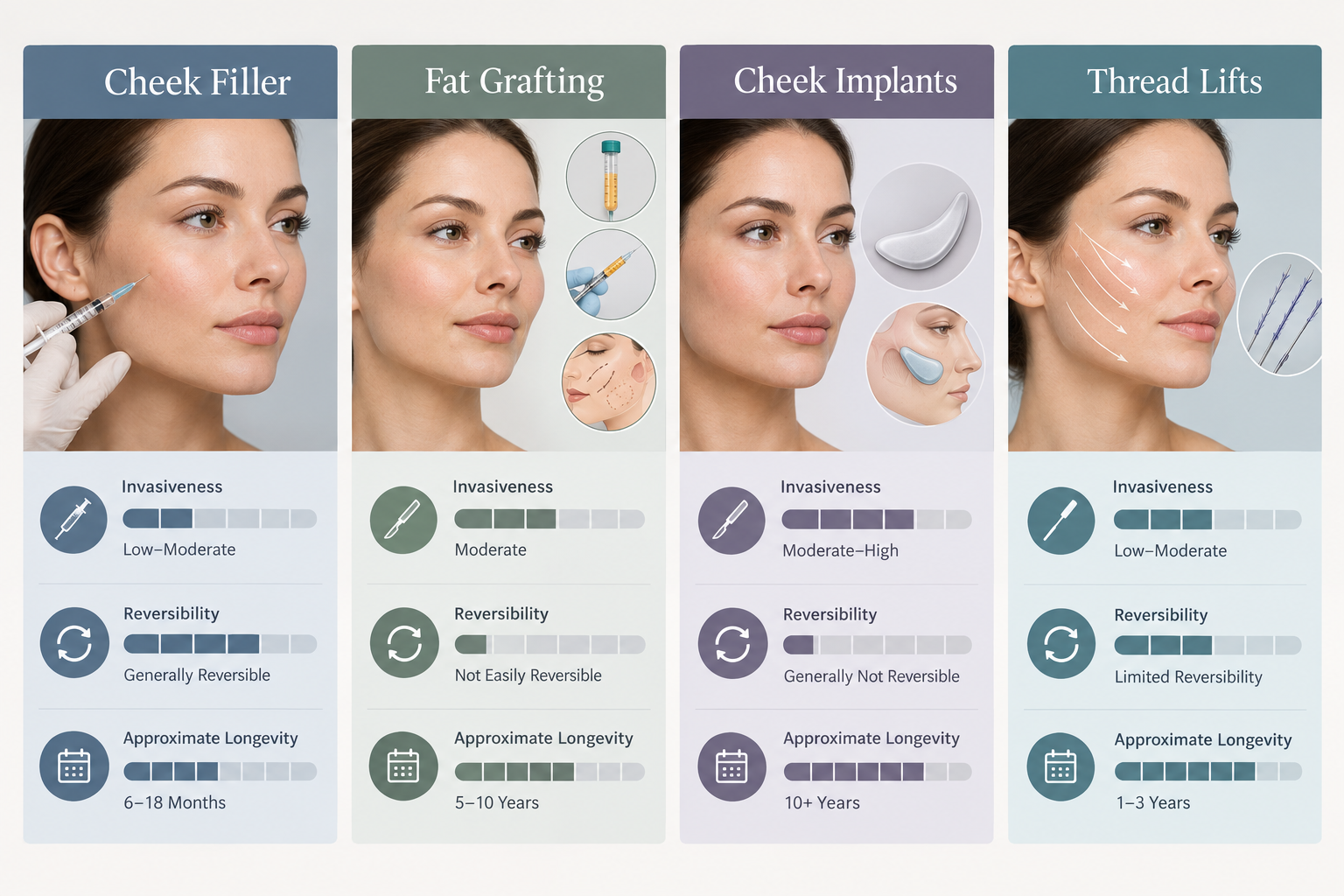
- Fat grafting: Uses the patient's own fat, harvested from another area of the body, to restore facial volume. Results can be long-lasting but the procedure involves a surgical component, recovery time, and some unpredictability in how much of the transferred fat survives.
- Cheek implants: Solid silicone implants placed surgically to augment the cheekbone area. Results are permanent and highly predictable in terms of projection, but the procedure carries surgical risks and recovery is more significant than with injectable treatments.
- Thread lifts: Dissolvable threads inserted beneath the skin to mechanically lift soft tissue. Results are typically more modest than filler for volume restoration, and the evidence base for long-term efficacy is less established.
- Sculptra or Radiesse: Biostimulators that work gradually by triggering the body's own collagen production. These may be preferred for patients who want a more gradual, diffuse improvement in facial volume rather than immediate targeted augmentation.
For most patients seeking a non-surgical option with predictable, reversible results, hyaluronic acid cheek filler remains the most commonly recommended starting point. Surgical alternatives may be worth discussing with a plastic surgeon for patients who want permanent structural change or who have not achieved satisfactory results with injectable treatments.
How Long Do Cheek Filler Results Last?
Most hyaluronic acid cheek fillers last between 12 and 24 months, with products like Juvederm Voluma often cited as lasting toward the longer end of that range. However, longevity varies considerably between individuals. Factors that may shorten the duration of results include a faster metabolic rate, high levels of physical activity, significant sun exposure, and smoking. Factors that may extend results include slower metabolism, careful sun protection, and maintaining a stable weight.
It is also worth noting that filler does not disappear all at once. Results tend to fade gradually, and many patients choose to have a maintenance treatment before the filler has fully dissolved in order to maintain a consistent appearance. A touch-up appointment — typically using a smaller volume than the original treatment — can extend the overall result without requiring a full re-treatment.
Frequently Asked Questions
Does cheek filler hurt?
Most cheek filler treatments involve the application of a topical numbing cream before the procedure, and many filler products also contain lidocaine, a local anaesthetic, within the formulation. Most patients describe the sensation as mild pressure or a brief sting rather than significant pain. The cheek area is generally well tolerated compared to more sensitive areas such as the lips.
How do I know how much filler I need?
The appropriate volume depends on your existing facial structure, the degree of volume loss or desired augmentation, and your aesthetic goals. A qualified injector will assess your facial anatomy during a consultation and recommend a starting volume. For most patients, beginning conservatively and reviewing the settled result before adding more is a sensible approach.
Can cheek filler be reversed?
Hyaluronic acid fillers can be dissolved using an enzyme called hyaluronidase, which breaks down the filler material. This makes HA fillers reversible if the result is unsatisfactory or if a complication occurs. Non-HA fillers such as Radiesse and Sculptra cannot be dissolved in the same way.
Will cheek filler make me look unnatural?
When placed conservatively by an experienced injector with a thorough understanding of facial anatomy, cheek filler should produce natural-looking results that enhance your existing features rather than alter them dramatically. The risk of an unnatural appearance increases with excessive volume, repeated treatments without adequate assessment, or placement that does not account for the patient's individual facial structure.
Are there ethnic or skin-tone considerations for cheek filler?
Yes, and this is an area that deserves more attention than it typically receives. Different facial structures — including those common in East Asian, South Asian, and African American patients — may have different ideal placement zones, volume requirements, and aesthetic goals. For example, some East Asian patients may have a naturally flatter midface with different zygomatic arch prominence, which affects where filler is most effectively placed. Choosing a provider with experience treating diverse facial structures is important for achieving results that are appropriate for your individual anatomy.
What aftercare is needed after cheek filler?
Most providers recommend avoiding strenuous exercise, alcohol, and significant heat exposure (such as saunas or hot yoga) for 24–48 hours after treatment. These activities can increase blood flow to the face and worsen swelling or bruising. Avoiding blood-thinning medications and supplements in the days before treatment, where medically appropriate, can also reduce bruising. Following aftercare guidance carefully can have a meaningful impact on how quickly the result settles and how the final outcome looks.
Is Cheek Filler the Right Choice for Your Goals?
Cheek filler can produce meaningful, natural-looking improvements in midface volume, cheekbone definition, and overall facial balance — but it works best when the goals are realistic, the volume is chosen conservatively, and the provider has genuine expertise in facial anatomy. The before and after timeline matters: settled results at two weeks are the true measure of the treatment's effect, not same-day photographs taken while swelling is still present.
The treatment is most likely to be appropriate for patients experiencing age-related volume loss in the midface, those with naturally flat or undefined cheekbones who want subtle contouring, or anyone whose facial proportions would benefit from improved structural support in the cheek area. It is less likely to be the right approach for patients seeking permanent structural change, those with unrealistic expectations about the degree of transformation possible, or those who are not prepared to commit to maintenance treatments as results gradually fade.
If you are considering cheek filler, a thorough consultation with a qualified and experienced injector is the essential first step. A good consultation should include an assessment of your facial anatomy, a discussion of realistic outcomes, an honest conversation about risks, and a clear treatment plan that prioritizes your long-term facial harmony over short-term volume. Bring your questions, ask to see before and after photos of the provider's own patients taken at the two-week mark, and do not feel pressured to proceed with more volume than you are comfortable with at the outset.
