

Crow's feet are the fine lines and wrinkles that form at the outer corners of the eyes. They are one of the earliest and most noticeable signs of facial ageing, and they are also among the most commonly treated concerns in aesthetic medicine. Understanding why crow's feet develop, which treatments have the strongest evidence, and what realistic improvement looks like can help you approach any consultation with clearer expectations.
Key Takeaways
- Crow's feet develop through a combination of repeated muscle movement, collagen loss, and cumulative sun exposure — no single factor acts alone.
- Botulinum toxin injections are the most established and widely studied treatment for dynamic crow's feet, with effects typically lasting three to four months.
- Static lines — wrinkles visible at rest — may require additional approaches such as skin resurfacing, dermal filler, or collagen-stimulating treatments.
- Results vary between individuals depending on skin quality, line depth, muscle activity, and lifestyle factors.
- A qualified practitioner assessment is essential before choosing any treatment, as the most appropriate option depends on the specific type and severity of lines present.
Why Crow's Feet Form at the Eye Corners
The skin around the eyes is significantly thinner than skin elsewhere on the face — roughly 0.5 mm compared with approximately 2 mm on the cheeks. This structural difference makes the periorbital area particularly vulnerable to the changes that drive wrinkle formation. Crow's feet develop through several overlapping mechanisms rather than a single cause, which is why treatment often needs to address more than one factor.
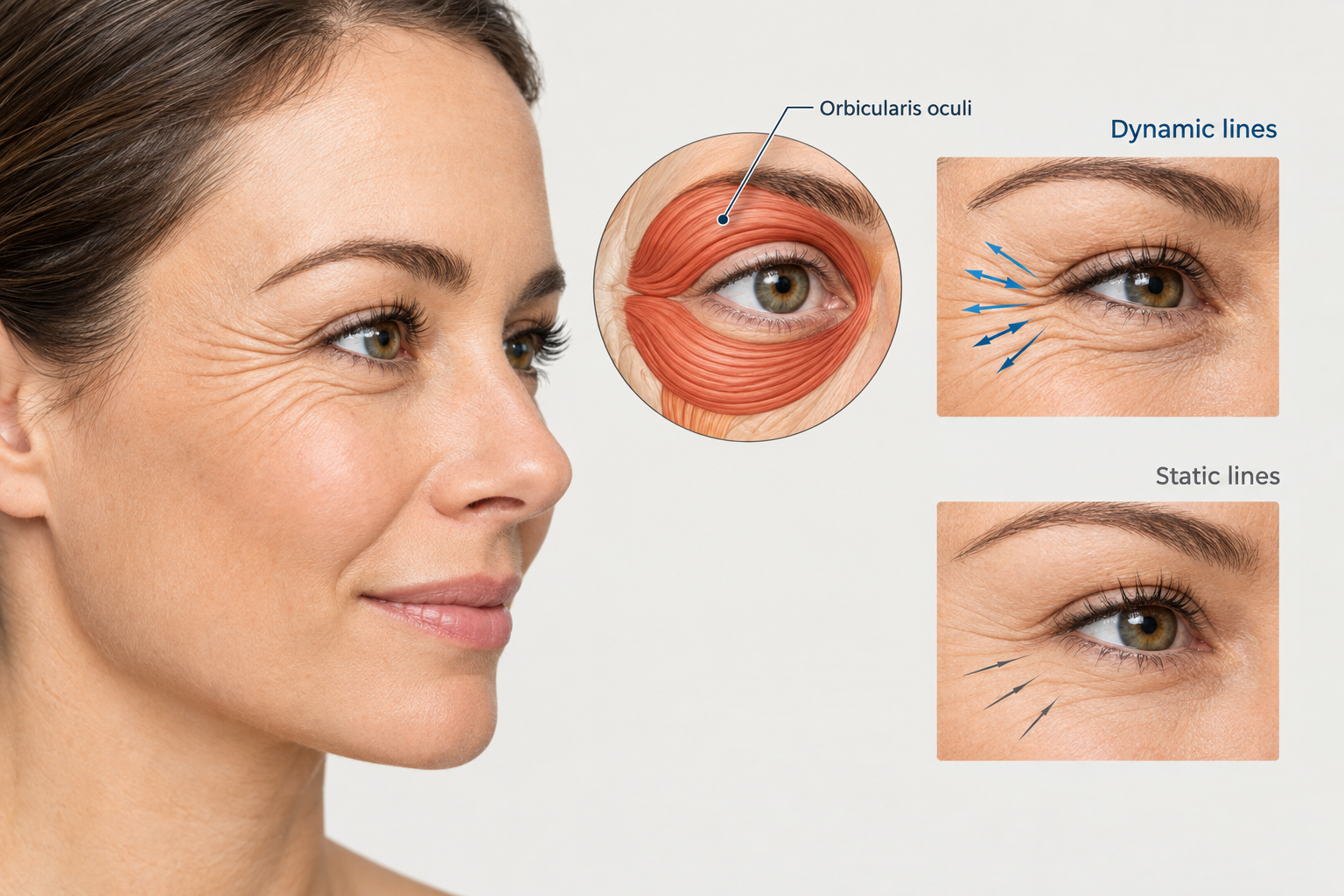
The orbicularis oculi is the circular muscle that surrounds the eye and controls blinking, squinting, and smiling. Every contraction of this muscle folds the overlying skin. In youth, skin has sufficient elasticity to spring back after each movement. Over time, repeated folding — combined with a gradual decline in collagen and elastin production — means the skin no longer fully recovers between expressions. The creases that were once visible only during smiling begin to remain visible at rest. These are described clinically as dynamic lines (present during movement) and static lines (present even without expression).
Ultraviolet radiation accelerates this process by degrading collagen fibres and generating free radicals that damage the extracellular matrix. Cumulative sun exposure is one of the strongest environmental contributors to periorbital wrinkling. Smoking, dehydration, and disrupted sleep also impair skin repair mechanisms and can worsen the appearance of lines around the eyes. Genetic factors influence how quickly these changes occur and how deeply lines eventually set.
Classifying Crow's Feet: Dynamic Versus Static Lines
Distinguishing between dynamic and static crow's feet is clinically important because the two types respond differently to treatment. A practitioner will typically assess the eye area both at rest and during a natural smile or squint to understand the relative contribution of muscle activity versus structural skin change.
Dynamic crow's feet are primarily driven by orbicularis oculi contraction. They appear or deepen significantly during expression and may be minimal or absent at rest, particularly in younger patients or those with good skin quality. Botulinum toxin treatment is well suited to this pattern because it reduces the muscle contractions that create the folds.
Static crow's feet are present at rest and reflect more established changes in skin structure — reduced collagen density, loss of dermal thickness, and decreased elasticity. These lines are less responsive to muscle-relaxing treatments alone and may benefit from approaches that address skin quality directly, such as resurfacing, radiofrequency, or collagen-stimulating injectables.
Many patients present with a combination of both types, particularly from their mid-thirties onwards. In these cases, a practitioner may recommend a combined approach rather than a single treatment.
Botulinum Toxin for Crow's Feet: How It Works and What to Expect
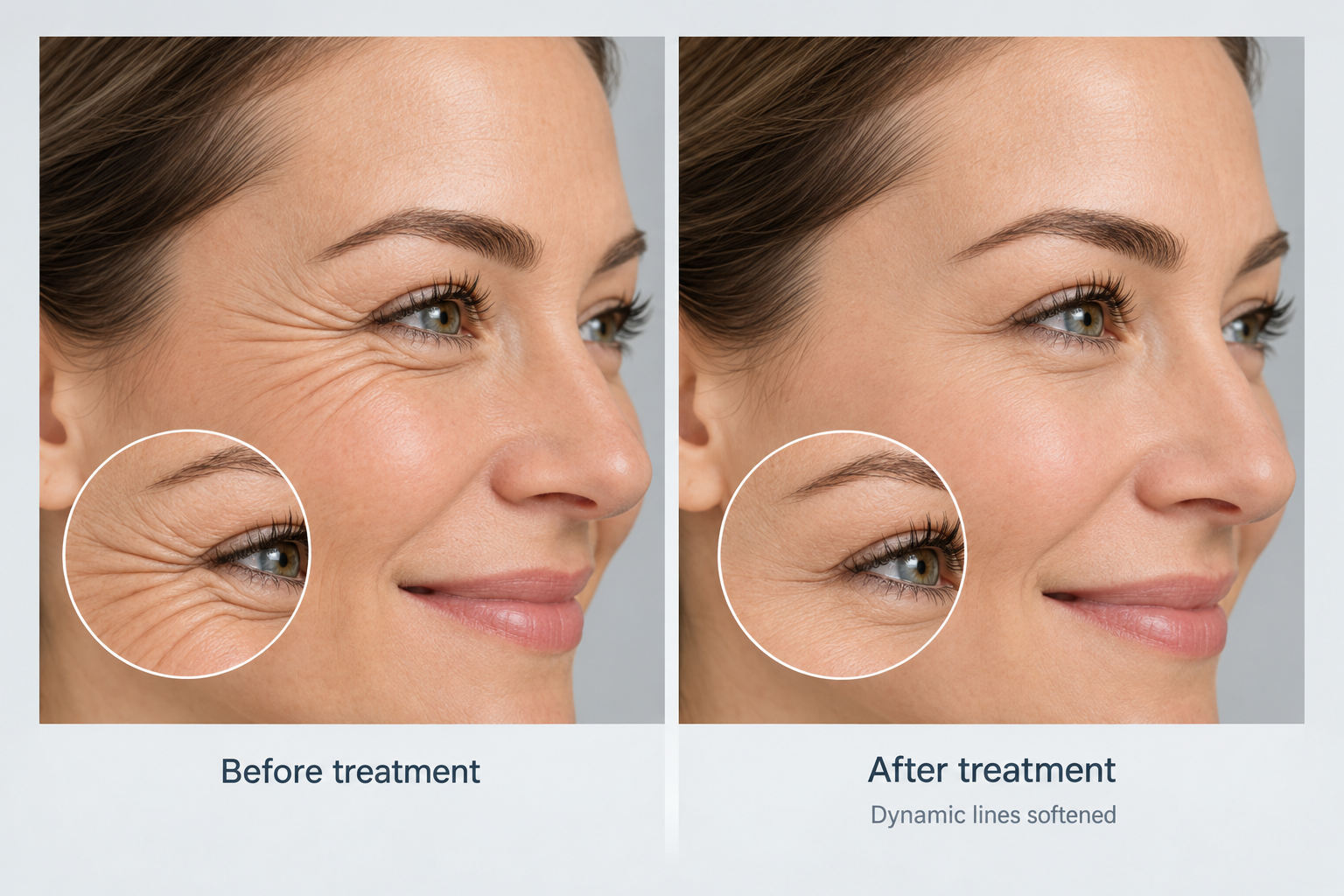
Botulinum toxin injections are the most established non-surgical treatment for dynamic crow's feet and are licensed for this indication in many countries. The treatment works by temporarily blocking the nerve signals that trigger orbicularis oculi contractions. With reduced muscle activity, the skin at the outer eye corners is folded less frequently, allowing existing dynamic lines to soften and reducing the formation of new creases during expression.
Several botulinum toxin formulations are used in aesthetic practice, including products marketed under brand names such as Botox, Dysport, and Azzalure. These products share the same active mechanism but differ in their formulation, unit measurement, and diffusion characteristics. Units are not interchangeable between brands, and the appropriate product and dose for a given patient depends on clinical assessment by a qualified practitioner. Providing specific unit doses or injection maps falls outside the scope of patient education and should be discussed directly with a treating clinician.
What the Appointment Involves
A botulinum toxin appointment for crow's feet is typically brief. The practitioner will assess the eye area at rest and during expression, discuss the patient's goals, and review medical history and any contraindications. Small amounts of the product are injected into specific points around the outer eye area using a fine needle. Topical anaesthetic cream is not always required, though it may be offered. Most patients describe the sensation as a mild sting. The appointment itself usually takes around 15 to 30 minutes including consultation time.
Onset, Duration, and Maintenance
Botulinum toxin does not produce immediate results. Initial softening of crow's feet lines typically becomes noticeable within three to five days, with the full effect usually apparent by two weeks. Results generally last between three and four months, though individual variation is common — some patients notice effects fading sooner, while others find results persist for closer to five or six months. Factors influencing duration include the specific product used, the dose administered, individual metabolism, and the degree of muscle activity in the treatment area.
Repeat treatment is required to maintain the effect. With consistent treatment over time, some patients report that lines appear less deep even between appointments, possibly because the skin has had extended periods of reduced folding. However, this is not a universal outcome and should not be assumed.
Risks and Side Effects
Botulinum toxin treatment for crow's feet carries a generally well-documented safety profile when performed by a qualified and experienced practitioner, but it is not without risk. Common and usually temporary side effects include redness, mild swelling, and bruising at injection sites. These typically resolve within a few days.
More significant but less common complications include eyelid heaviness or drooping (ptosis), which can occur if the product migrates to muscles controlling eyelid elevation. This is temporary and resolves as the product wears off, but it can be visually noticeable for several weeks. Asymmetry between the two sides is another possible outcome, particularly if muscle anatomy differs between sides or if the patient has pre-existing asymmetry. Dry eye symptoms or increased tearing have also been reported in some patients following periorbital botulinum toxin treatment.
Botulinum toxin is not suitable during pregnancy or breastfeeding, in the presence of certain neuromuscular conditions, or in patients taking specific medications that interact with neuromuscular transmission. A thorough medical history review before treatment is essential.
Dermal Fillers Around the Eye Area
Dermal fillers are not typically the first-line treatment for crow's feet lines themselves, but they may be considered in specific circumstances — particularly when volume loss in the temple or lateral cheek area is contributing to the appearance of lines and skin laxity around the outer eye. Hyaluronic acid fillers can restore volume to adjacent areas, which may indirectly improve the appearance of the periorbital region by providing better structural support to the overlying skin.
Direct injection of filler into crow's feet lines is technically possible but carries meaningful risks in this area, including the potential for visible lumps, the Tyndall effect (a bluish discolouration caused by superficial filler placement), and vascular complications. The periorbital region has a complex vascular anatomy, and filler treatment near the eyes should only be undertaken by practitioners with advanced training and a thorough understanding of the relevant anatomy. This is not a treatment to approach casually, and patients should ask specifically about a practitioner's experience with periorbital filler before proceeding.
Skin Resurfacing and Energy-Based Treatments
For static crow's feet — lines present at rest — treatments that target skin quality and collagen production may offer meaningful improvement. Several approaches are used in clinical practice, each with a different mechanism and evidence base.
Laser Resurfacing
Ablative laser treatments, such as fractional CO2 or erbium lasers, remove controlled layers of skin and stimulate collagen remodelling in the dermis. Clinical evidence supports their use for periorbital wrinkles, and they can produce noticeable improvement in fine lines and skin texture around the eyes. However, ablative resurfacing involves a recovery period of one to two weeks or longer, with redness, swelling, and crusting during healing. The risk of pigmentation changes — both hyperpigmentation and hypopigmentation — is relevant, particularly in patients with darker skin tones. Non-ablative fractional lasers offer a milder alternative with less downtime but typically require multiple sessions and produce more modest results.
Radiofrequency and Microneedling
Radiofrequency (RF) energy delivered through microneedles or surface applicators heats the dermis to stimulate collagen and elastin production. Microneedling with radiofrequency (sometimes called RF microneedling) has been used for periorbital wrinkles and may improve skin texture and fine line depth over a course of treatments. Results develop gradually over several months as new collagen forms. Evidence for these devices is growing but remains less extensive than for established laser treatments. Multiple sessions are usually required, and results are generally more subtle than ablative resurfacing.
Chemical Peels
Medium-depth chemical peels using agents such as trichloroacetic acid (TCA) can improve fine lines and skin texture around the eyes. Superficial peels produce minimal improvement in established crow's feet but may help with overall skin quality and early fine lines. Deeper peels carry greater risk of pigmentation changes and require careful patient selection. Chemical peels are typically used as part of a broader skin treatment plan rather than as a standalone solution for significant crow's feet.
Collagen-Stimulating Injectables
Treatments such as polynucleotides (PDRN or PN) and skin boosters containing hyaluronic acid or other bioactive ingredients are sometimes used in the periorbital area to improve skin hydration, texture, and fine line appearance. These treatments work by supporting the skin's own repair and regeneration processes rather than by relaxing muscles or adding volume. Evidence for polynucleotides in periorbital skin quality is developing, and while early clinical data is encouraging, larger long-term studies are still needed. These treatments are generally considered complementary to rather than replacements for botulinum toxin in patients with significant dynamic crow's feet.
Topical Treatments and Their Role
Topical skincare cannot replicate the results of injectable or energy-based treatments for established crow's feet, but it plays a meaningful supporting role in both prevention and maintenance. Retinoids — including prescription tretinoin and over-the-counter retinol — have the strongest evidence base among topical anti-ageing ingredients. They stimulate collagen synthesis, accelerate cell turnover, and can improve the appearance of fine lines with consistent long-term use. The periorbital area is sensitive, and retinoid products formulated for this region or used cautiously near the eye corners are preferable to applying standard facial retinoids directly to the eyelid skin.
Broad-spectrum sunscreen applied daily to the periorbital area is one of the most evidence-supported strategies for slowing the progression of crow's feet. Ultraviolet radiation is a primary driver of collagen degradation, and consistent photoprotection reduces cumulative damage. Antioxidant serums containing vitamin C may offer additional protection against UV-induced oxidative stress, though the evidence for topical antioxidants in wrinkle prevention is less robust than for retinoids and sunscreen.
Peptide-containing eye creams and hydrating formulations may temporarily improve the appearance of fine lines by plumping the skin with moisture, but these effects are cosmetic rather than structural and do not persist after the product is washed off.
Who May Be Suitable for Crow's Feet Treatment
Suitability for any crow's feet treatment depends on the type and severity of lines present, overall skin quality, medical history, and individual goals. Botulinum toxin is generally most effective for patients whose crow's feet are predominantly dynamic — visible mainly during expression — and who have reasonable skin elasticity. Patients with very deep static lines, significant skin laxity, or sun-damaged skin may see less dramatic improvement from botulinum toxin alone and may benefit from a combined approach.
Age is not a strict criterion, but the treatment approach may differ between younger patients with early dynamic lines and older patients with more established static wrinkling. Patients who are pregnant or breastfeeding should not receive botulinum toxin. Those with a history of certain neuromuscular disorders, relevant allergies, or active skin infections in the treatment area are not suitable candidates. Patients taking blood-thinning medications may have an increased risk of bruising and should discuss this with their practitioner before treatment.
Realistic expectations are an important part of suitability. Botulinum toxin can meaningfully soften dynamic crow's feet but will not eliminate all lines, particularly those that are deeply set at rest. Patients seeking complete elimination of all periorbital lines may find that no currently available non-surgical treatment fully meets that expectation.
Combining Treatments for Crow's Feet
In clinical practice, crow's feet are often addressed with a combination of treatments rather than a single modality. A common approach involves botulinum toxin to reduce dynamic muscle activity alongside a skin quality treatment — such as a skin booster, polynucleotide injection, or resurfacing procedure — to address the static component and improve overall periorbital skin texture. This layered strategy may produce more comprehensive improvement than either treatment alone, though it also involves greater cost, more appointments, and a cumulative risk profile that should be discussed in full before proceeding.

The sequence and timing of combined treatments matters. Some practitioners prefer to establish the botulinum toxin effect first before assessing residual static lines, as the degree of improvement from muscle relaxation alone can influence what additional treatment, if any, is warranted. Others may recommend concurrent approaches depending on the patient's presentation and goals. There is no universally agreed protocol, and the optimal combination varies between individuals.
Frequently Asked Questions
At what age do crow's feet typically start to appear?
Dynamic crow's feet — lines visible during smiling or squinting — can appear in the mid-to-late twenties in some individuals, particularly those with fair skin or significant sun exposure. Static lines that remain visible at rest more commonly develop from the mid-thirties onwards, though this varies considerably depending on genetics, lifestyle, and photoprotection habits.
Can crow's feet be prevented?
Complete prevention is not realistic, as some degree of periorbital wrinkling is a natural part of ageing. However, consistent daily sunscreen use, avoiding smoking, maintaining skin hydration, and using evidence-based topical ingredients such as retinoids from an early age may slow the rate at which lines develop and deepen. Wearing UV-protective sunglasses reduces squinting in bright light, which may also help.
How many botulinum toxin sessions are needed before results are noticeable?
Most patients notice softening of dynamic crow's feet after a single treatment session, with the full effect visible within two weeks. Repeat sessions are needed to maintain the result, typically every three to four months. Some patients find that lines appear progressively less deep over time with consistent treatment, but this is not guaranteed.
Will botulinum toxin make my smile look unnatural?
When administered by an experienced practitioner at an appropriate dose, botulinum toxin for crow's feet should soften lines without significantly altering the natural appearance of a smile. Over-treatment or incorrect placement can affect the shape of the smile or cause asymmetry. This is one reason why choosing a qualified and experienced injector matters, and why starting with a conservative dose is often advisable for first-time patients.
Is there any downtime after crow's feet treatment?
Botulinum toxin injections for crow's feet typically involve minimal downtime. Most patients return to normal activities immediately. Mild redness, swelling, or small bumps at injection sites usually resolve within a few hours. Bruising is possible and may take several days to fade. Laser resurfacing and deeper chemical peels involve more significant recovery periods and should be planned accordingly.
Can crow's feet come back worse after stopping botulinum toxin?
There is no clinical evidence that crow's feet worsen beyond their natural progression if botulinum toxin treatment is stopped. When the product wears off, muscle activity returns to its previous level and lines reappear as they were before treatment. The skin does not become more wrinkled as a direct result of having had injections.
Are there non-injectable options that genuinely work for crow's feet?
For mild to moderate fine lines, non-injectable options including fractional laser resurfacing, radiofrequency microneedling, and consistent use of prescription retinoids can produce meaningful improvement, particularly in skin texture and early static lines. These approaches are generally less effective than botulinum toxin for dynamic crow's feet but may be appropriate for patients who prefer to avoid injections or who have contraindications to botulinum toxin.
Deciding on the Right Approach for Your Crow's Feet
Crow's feet at the eye corners are a common and well-understood aesthetic concern, and a range of treatments with varying levels of evidence are available. Botulinum toxin remains the most established option for dynamic lines and is supported by extensive clinical use and regulatory approval in many countries. For static lines and broader skin quality concerns, resurfacing treatments, radiofrequency, and collagen-stimulating injectables may offer complementary benefit, though results are more gradual and variable.
The right approach depends on the specific pattern of lines present, skin quality, individual goals, and medical suitability — factors that can only be properly assessed in person by a qualified practitioner. A thorough consultation should include an honest discussion of what each treatment can and cannot achieve, realistic timelines, maintenance requirements, and the full risk profile. Patients who approach treatment with accurate expectations and a clear understanding of the options are generally better placed to make decisions they feel confident about. If you are considering treatment for crow's feet, a consultation with a qualified aesthetic medicine practitioner is the appropriate starting point.
