
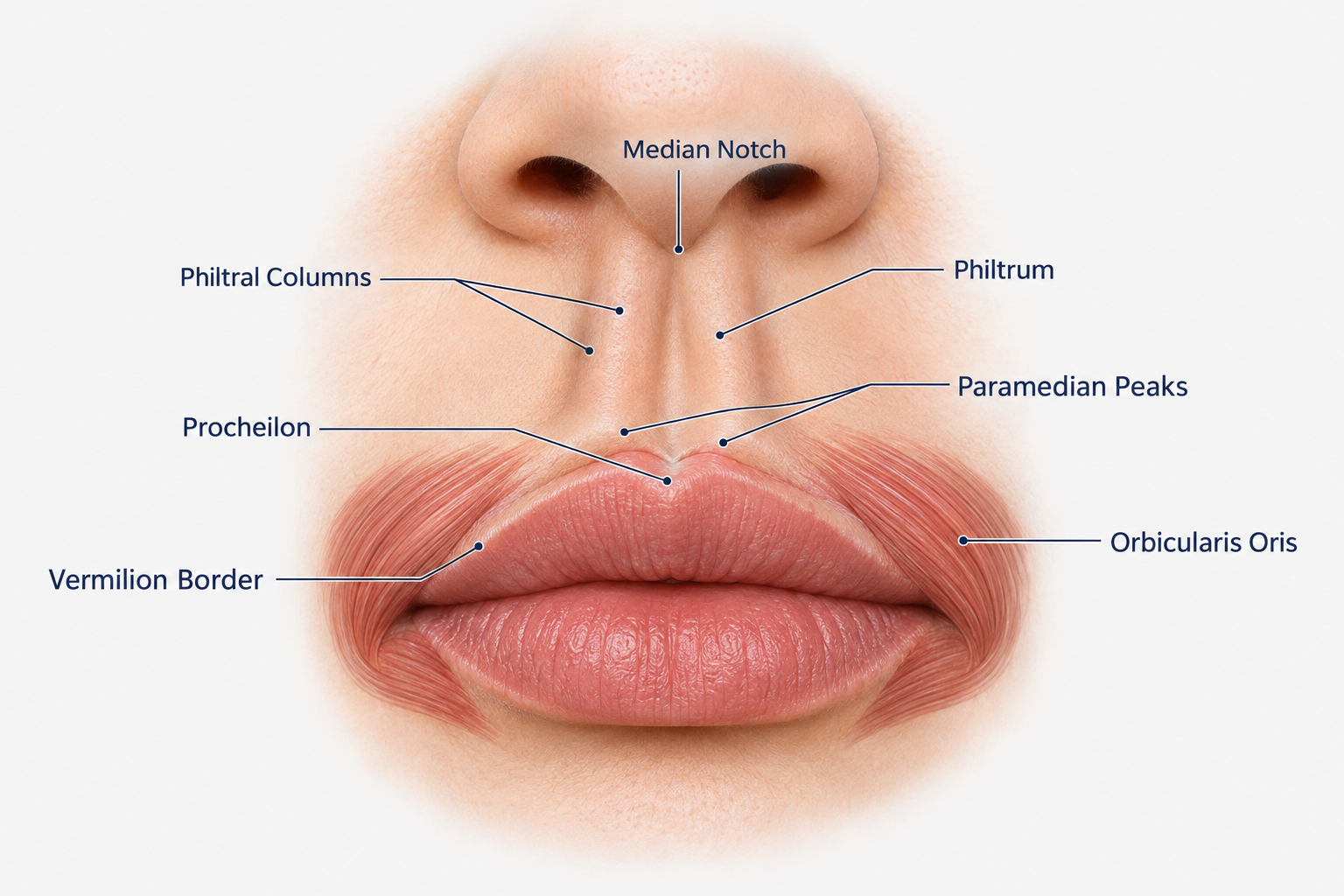

The cupid's bow is the double-curved shape formed by the upper lip's edge — one of the most recognisable and discussed features in facial aesthetics. Whether yours is sharply defined, softly rounded, or barely visible, its appearance is determined by a precise arrangement of anatomical structures that vary considerably from person to person. This article explains the anatomy behind cupid's bow lips, the main shape variations, what causes them to change over time, and what enhancement options — from makeup to medical procedures — may realistically achieve.
Key Takeaways
- The cupid's bow is formed by the vermilion border of the upper lip and is shaped by underlying structures including the philtral columns, procheilon, and orbicularis oris muscle.
- Lip shape varies widely and is largely determined by genetics, though aging, tissue changes, and certain medical conditions can alter the appearance of the bow over time.
- Several types of cupid's bow exist — from sharply defined to flat or absent — and each responds differently to enhancement techniques.
- Non-surgical options such as hyaluronic acid filler and makeup techniques can refine or define the bow, but results depend heavily on existing anatomy.
- A clinical assessment is necessary before any procedure, as individual anatomy, skin quality, and treatment goals all influence what is achievable.
What Is the Cupid's Bow?
The cupid's bow refers to the curved outline at the top of the upper lip, named for its resemblance to the double-curved bow carried by Cupid in Roman mythology. When viewed from the front, the upper lip contour rises to two peaks — known as the paramedian peaks — separated by a central dip called the median notch, before curving outward toward the corners of the mouth. This creates the characteristic M-shape or lazy-M silhouette that defines bow-shaped lips.
The term is used both anatomically and aesthetically. In clinical morphology, the cupid's bow is a recognised landmark used to assess lip structure in conditions affecting facial development. In aesthetic medicine, it is a key reference point for lip augmentation, filler placement, and surgical planning. The sharpness, symmetry, and prominence of the bow vary considerably between individuals and across different ethnic groups, and no single shape is considered universally standard.
The Anatomy Behind the Shape
Understanding why the cupid's bow looks the way it does requires familiarity with several overlapping structures. These landmarks work together to create the upper lip's distinctive outline, and changes to any one of them can alter the overall appearance of the bow.
The Vermilion Border
The vermilion border — sometimes called the mucocutaneous line or white roll — is the boundary between the pink-red lip tissue (the vermilion zone) and the surrounding skin. It is this border that traces the cupid's bow shape across the top of the upper lip. A well-defined vermilion border creates a crisp, visible outline; a less distinct border produces a softer or flatter appearance. The border is formed partly by a subtle ridge of tissue and partly by the optical contrast between the lip's colour and the surrounding skin tone.
The Philtrum and Philtral Columns
The philtrum is the vertical groove running from the base of the nose to the upper lip. On either side of this groove, two raised ridges called philtral columns descend toward the lip. These columns terminate at the two paramedian peaks of the cupid's bow — the high points of the M-shape. The depth and definition of the philtral columns directly influence how pronounced the bow appears: well-defined columns tend to produce sharper, more elevated peaks, while flatter columns contribute to a less defined bow. The philtral dimple — the central depression between the columns — corresponds to the median notch at the top of the lip.
The Procheilon and Labial Tubercle
The procheilon, also called the labial tubercle or central tubercle, is the small forward-projecting area of tissue at the centre of the upper lip, sitting just below the median notch. It contributes to the three-dimensional fullness of the upper lip and helps define the transition between the bow's central dip and the body of the lip. A prominent procheilon gives the lip a fuller, more sculpted appearance; a flattened procheilon can make the bow look less defined even when the vermilion border itself is reasonably clear.
The Orbicularis Oris Muscle
The orbicularis oris muscle encircles the mouth and forms the muscular foundation of the lips. Its tone and volume influence the overall shape and projection of the upper lip. With age, this muscle can weaken and lose tone, contributing to a flattening of the lip contour and a reduction in the definition of the cupid's bow. The muscle also plays a role in lip movement during speech and expression, which is relevant when considering certain enhancement procedures such as the lip flip.
Glogau-Klein Points
The Glogau-Klein points — also referred to as the Cupid's bow apex points — are the two highest points of the cupid's bow, corresponding to the paramedian peaks. These points are used as anatomical reference markers in aesthetic practice to guide filler placement, lip liner application, and surgical planning. Identifying their precise location is important for achieving symmetrical results during any enhancement procedure.
Types of Cupid's Bow Lips
The cupid's bow is not a single fixed shape. Several distinct variations exist, each with different aesthetic characteristics and different responses to enhancement techniques.
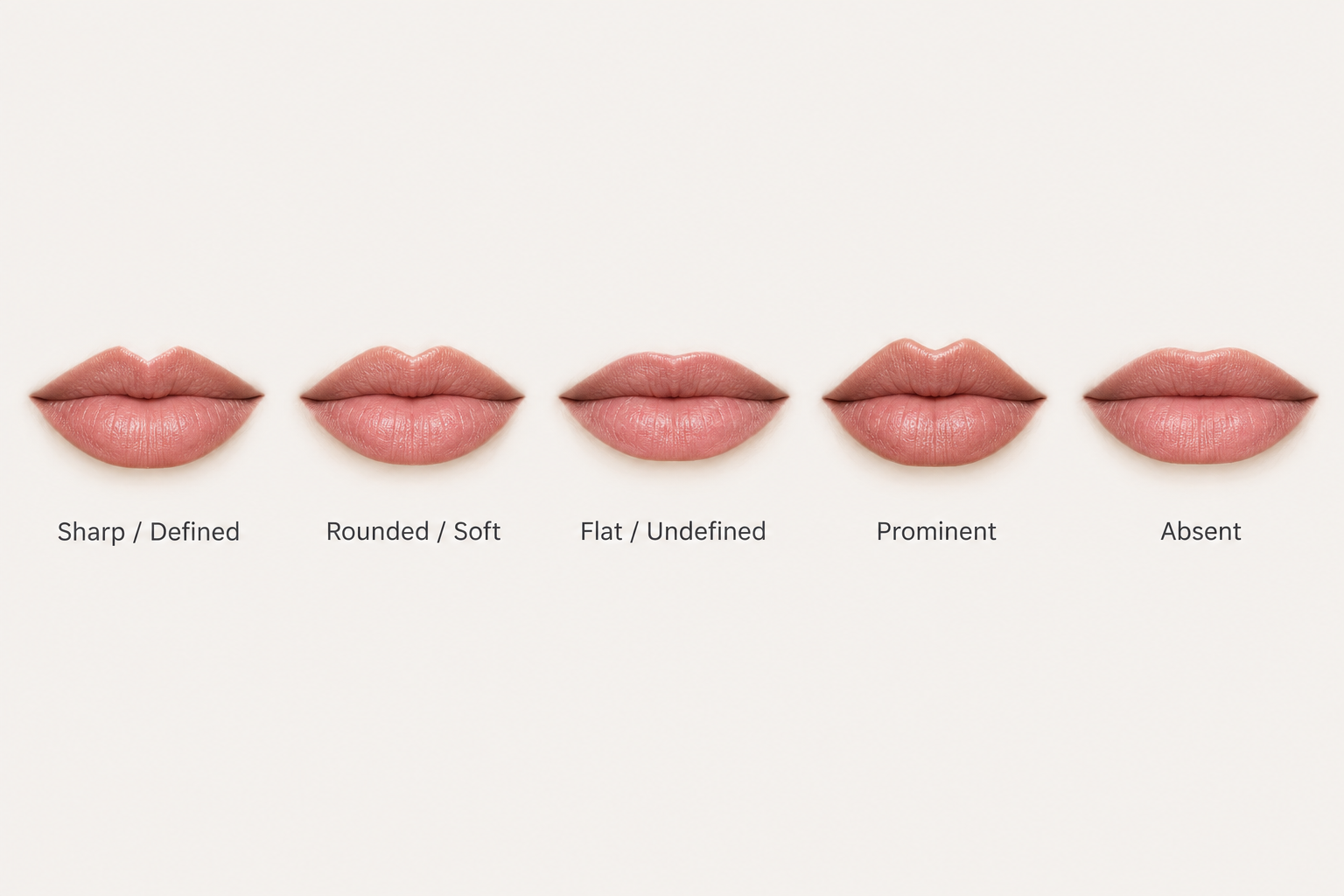
- Sharp or defined cupid's bow: The paramedian peaks are clearly elevated and the median notch is deep, creating a pronounced M-shape. The vermilion border is crisp and well-delineated. This type is often associated with youthfulness and is frequently cited as an aesthetic ideal in many cultural contexts.
- Rounded or soft cupid's bow: The peaks are present but less angular, giving the upper lip a gentler curve. The overall shape reads as heart-shaped lips rather than a strict M. This variation is common and considered attractive across many facial types.
- Flat or undefined cupid's bow: The peaks are low or barely visible, and the upper lip edge follows a relatively straight or gently curved line. The vermilion border may be less distinct. This is a normal anatomical variation, not a deficiency, though some individuals seek definition through makeup or filler.
- Prominent or exaggerated cupid's bow: The peaks are very high and the central dip is deep, creating a strongly accentuated M. This can appear striking but may look disproportionate depending on the rest of the facial structure.
- Absent cupid's bow: In clinical morphology, an absent cupid's bow describes a lip where the characteristic double curve is not present and the upper lip vermilion follows a nearly straight or tented line. This is a recognised clinical finding associated with certain conditions including fetal alcohol syndrome and DiGeorge syndrome, and is documented in the medical literature on facial morphology. In the general population, a very flat bow is sometimes informally described this way, though true absence is uncommon outside specific clinical contexts.
What Determines Your Cupid's Bow Shape?
Genetics
Lip shape is substantially heritable. Genome-wide association studies (GWAS) have identified specific genetic variants — including single nucleotide polymorphisms (SNPs) — associated with lip morphology traits such as the depth of the philtrum, the height of the vermilion border, and the sharpness of the cupid's bow. Research published in peer-reviewed genetics journals has linked variants near genes involved in craniofacial development to measurable differences in upper lip shape, including V-shaped versus flatter bow profiles. This means that the basic architecture of your cupid's bow is largely set before birth, though environmental and lifestyle factors can modify its appearance over time.
Ethnicity and Facial Proportion
The prominence of the cupid's bow varies across ethnic groups, reflecting differences in lip volume, tissue thickness, and underlying skeletal structure. Individuals of East Asian heritage often have a well-defined, sharply peaked bow with a relatively thin upper lip. Those of African descent frequently have fuller lips with a broader vermilion zone, where the bow may appear softer due to greater overall lip volume. Caucasian lip anatomy tends to show moderate variation. These differences are relevant in aesthetic consultations because enhancement techniques that work well for one lip type may not translate directly to another. Practitioners experienced in treating diverse facial types will approach cupid's bow definition differently depending on the patient's baseline anatomy and aesthetic goals.
Aging and Tissue Changes
The cupid's bow changes measurably across the decades. In the twenties and thirties, collagen loss begins gradually, and the vermilion border may start to lose some of its crispness. By the forties and fifties, several processes accelerate simultaneously: collagen and elastin reduction softens the white roll, the philtrum lengthens as the overlying skin loses support, the philtral columns flatten, and the orbicularis oris muscle weakens. Together, these changes reduce the height of the paramedian peaks, flatten the procheilon, and blur the mucocutaneous line — all of which diminish the definition of the cupid's bow. Volume loss within the lip itself further reduces the three-dimensional projection that makes the bow appear prominent. UV exposure and smoking can accelerate collagen breakdown and contribute to earlier or more pronounced changes.
Does the Cupid's Bow Have a Functional Role?
Most discussions of the cupid's bow focus on aesthetics, but the shape of the upper lip does have functional relevance. The precise contour of the vermilion border and the underlying muscular structure influence the production of bilabial sounds — consonants such as /p/, /b/, and /m/ — which require the lips to meet and seal. Significant structural changes to the upper lip, such as those following cleft lip repair, can affect speech articulation and require specialist input from both surgical and speech therapy teams. In the general population, natural variation in bow shape does not typically affect speech, but this functional dimension is worth noting when considering any procedure that alters lip structure.
Cupid's Bow Lips in Cultural and Historical Context
The association between a defined cupid's bow and beauty has deep historical roots. Ancient Greek sculpture idealised symmetrical, well-proportioned lips as part of broader concepts of facial harmony and the golden ratio. Renaissance painters frequently depicted subjects with clearly delineated upper lip curves. In 18th-century Japan, a small, defined mouth with a prominent bow was considered a mark of refinement. The 1920s brought the cupid's bow into popular culture through the exaggerated "bee-stung" lip look associated with actresses such as Clara Bow, who used dark lip liner to dramatically overline the peaks. Contemporary beauty trends — amplified by social media and celebrity influence — have renewed interest in defined, symmetrical bow-shaped lips, driving demand for both makeup techniques and clinical enhancement procedures.
Enhancing or Defining the Cupid's Bow
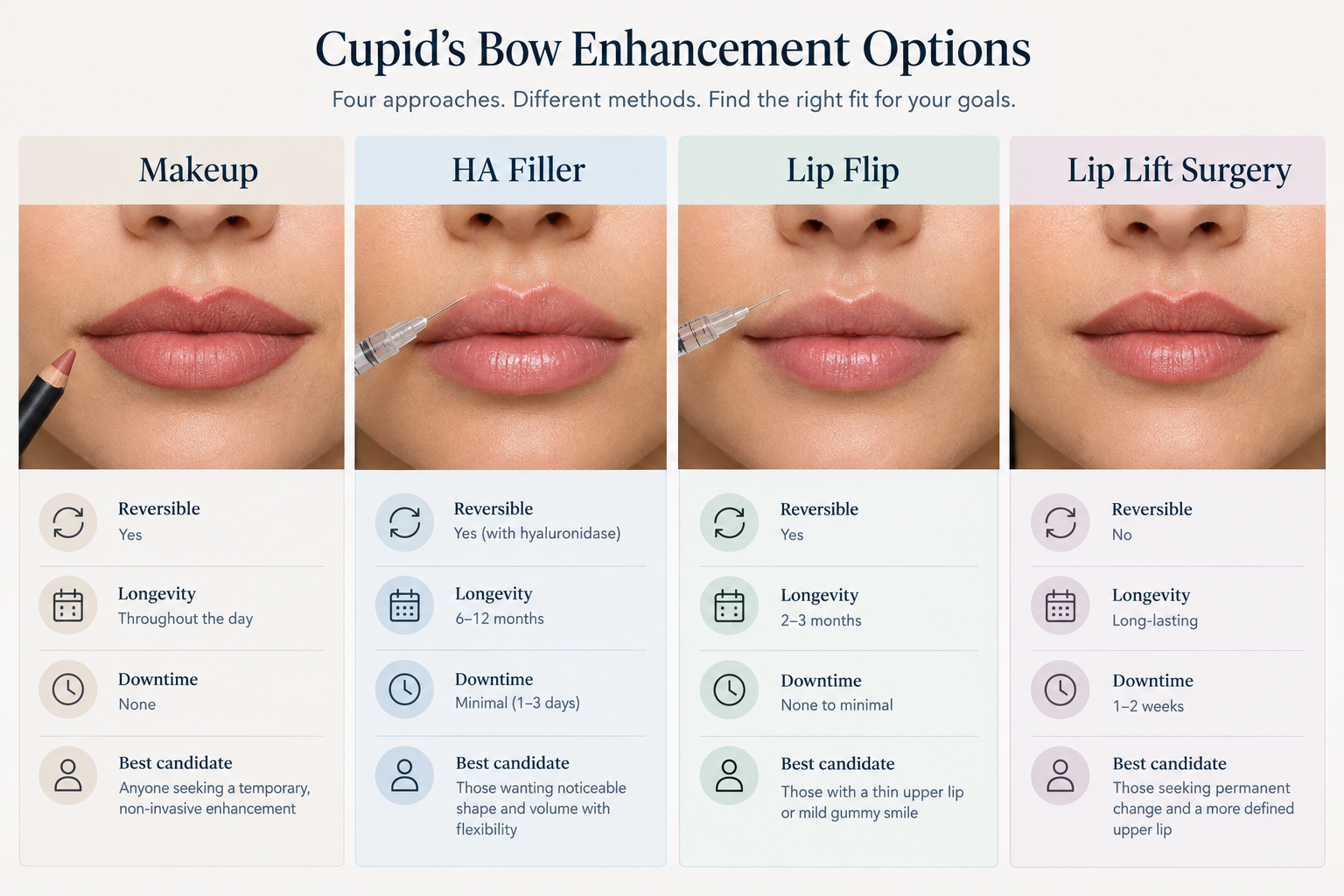
Several approaches exist for those who wish to define, refine, or augment their cupid's bow. The right option depends on the individual's existing anatomy, the degree of change desired, and their tolerance for procedure-related considerations such as downtime and maintenance.
Makeup Techniques
Makeup remains the most accessible and reversible way to alter the appearance of the cupid's bow. The key principle is precise placement relative to the anatomical landmarks rather than simply tracing the existing lip edge. To define or slightly overline the bow, a lip liner should be applied starting at the Glogau-Klein points — the two peaks — and drawn outward toward the corners of the mouth, then inward to meet at the median notch. The central dip should be kept sharp rather than rounded to maintain the M-shape. A small amount of highlighter or a light-reflecting gloss placed on the procheilon — the central tubercle just below the median notch — adds the illusion of three-dimensional projection. For a flat or undefined bow, slightly overlining the peaks by one to two millimetres can create the appearance of greater definition, though overlining beyond this tends to look unnatural in daylight.
Hyaluronic Acid Filler
Hyaluronic acid filler is the most commonly used non-surgical approach for enhancing the cupid's bow. Products such as Restylane Silk, Restylane Kysse, Juvéderm Volbella, and Revanesse Lips+ are formulated specifically for lip tissue, offering varying degrees of softness and structural support. Filler can be used to sharpen the vermilion border along the bow, add subtle volume to the paramedian peaks, support the philtral columns to increase peak height, and enhance the procheilon for greater central projection. Results typically last between six and twelve months depending on the product, the volume used, and individual metabolism.
It is important to understand what hyaluronic acid filler cannot reliably achieve. Filler cannot create a sharply defined cupid's bow where the underlying anatomy — particularly the philtral columns and vermilion border — does not support one. Attempting to build excessive peak height in a lip with flat philtral columns risks an unnatural, overfilled appearance. Filler also cannot permanently alter lip shape; results require maintenance. Potential side effects include bruising, swelling, asymmetry, and, in rare cases, vascular complications. A thorough consultation with a qualified and experienced practitioner is essential before proceeding.
Lip Flip
The lip flip involves injecting a small amount of botulinum toxin (such as Botox) into the orbicularis oris muscle along the upper lip border. This causes the muscle to relax slightly, allowing the upper lip to roll outward and upward, which can make the vermilion border — including the cupid's bow — more visible. The lip flip does not add volume; it changes the position of the lip edge. It may suit individuals whose upper lip rolls inward when relaxed, partially concealing the bow. Results typically last two to three months and require regular maintenance. The procedure carries a risk of temporary difficulty with certain lip movements if too much product is used.
Lip Lift Surgery
Lip lift surgery — most commonly a subnasal lip lift or central lip lift — is a surgical procedure that shortens the philtrum by removing a small strip of skin beneath the nose. This elevates the upper lip, increases the show of the vermilion, and can make the cupid's bow appear more defined and prominent. Lip lift surgery produces permanent results and is particularly relevant for individuals whose philtrum has lengthened with age or who have a naturally long philtrum that obscures the bow. Recovery involves swelling and bruising for one to two weeks, with final results visible after several months as scar tissue matures. As with any surgical procedure, risks include scarring, asymmetry, and changes to lip sensation. Surgical candidacy requires a thorough assessment by a qualified surgeon.
Cupid's Bow in Men
Male lip anatomy tends to differ from female lip anatomy in several ways: the philtrum is typically longer, the vermilion zone is narrower, and the cupid's bow is often less pronounced. Cultural norms have historically meant that men rarely seek cupid's bow enhancement, but interest in subtle lip definition among male patients is growing. The same principles of anatomy apply, though aesthetic goals and the degree of enhancement considered appropriate will differ. Practitioners should approach male lip treatment with an understanding of gender-specific proportions to avoid results that appear incongruous with the patient's overall facial structure.
Frequently Asked Questions
Is a cupid's bow rare?
A clearly defined cupid's bow is not rare — the majority of people have some degree of double-curved shape to their upper lip. What varies is the sharpness and prominence of the bow. A very sharply defined, symmetrical bow with deep philtral columns is less common, while a softer or flatter bow is more typical across the general population.
Does everyone have a cupid's bow?
Most people have at least a subtle cupid's bow shape to their upper lip. A truly absent cupid's bow — where the characteristic double curve is entirely missing — is uncommon in the general population and is more often associated with specific medical conditions or congenital differences. A flat or barely visible bow is a normal anatomical variation.
Can lip filler create a cupid's bow where I don't have one?
Hyaluronic acid filler can enhance and define an existing bow, but it cannot reliably create a sharply defined cupid's bow where the underlying anatomy — particularly the philtral columns and vermilion border structure — does not support one. Attempting to do so risks an unnatural result. A practitioner will assess your baseline anatomy before advising on what is realistically achievable.
Will lip filler make my cupid's bow look unnatural?
When placed conservatively and by an experienced practitioner, filler can refine the cupid's bow without looking artificial. The risk of an unnatural result increases with excessive volume, inappropriate product selection, or placement that does not respect the existing anatomical landmarks. Choosing a practitioner with specific experience in lip anatomy significantly reduces this risk.
Does the cupid's bow change with age?
Yes. Collagen loss, philtrum lengthening, weakening of the orbicularis oris muscle, and reduction in lip volume all contribute to a gradual flattening and blurring of the cupid's bow over time. These changes typically become more noticeable from the forties onward, though the rate varies between individuals depending on genetics, sun exposure, and lifestyle factors.
Is lip lift surgery permanent?
Lip lift surgery produces long-lasting results by physically shortening the philtrum and elevating the upper lip. While the effects are considered permanent in terms of the structural change, the natural aging process continues after surgery, meaning the lip will continue to change over time. Results are significantly more durable than injectable treatments.
Can an absent cupid's bow indicate a medical condition?
In clinical morphology, an absent cupid's bow is a recognised finding associated with certain conditions affecting facial development, including fetal alcohol syndrome and DiGeorge syndrome. In these contexts, the lip shape is assessed alongside other features as part of a broader clinical evaluation. In the general population, a very flat or poorly defined bow is simply an anatomical variation and does not indicate an underlying medical condition.
Understanding Your Lip Shape Before Seeking Enhancement
The cupid's bow is shaped by a precise interplay of anatomical structures — the vermilion border, philtral columns, procheilon, and orbicularis oris muscle — and its appearance is largely determined by genetics, modified by aging, and influenced by ethnic variation in lip anatomy. Understanding these foundations helps set realistic expectations about what enhancement can and cannot achieve. Makeup offers immediate, reversible definition. Hyaluronic acid filler can refine and subtly augment the bow for those with suitable anatomy, but works best when it respects existing structure rather than attempting to override it. Lip lift surgery offers a more permanent solution for those whose philtrum length or lip position is the primary concern. If you are considering any form of cupid's bow enhancement, a consultation with a qualified aesthetic practitioner or surgeon who can assess your individual anatomy, discuss your goals, and explain the realistic range of outcomes is the appropriate first step.
