


Quick Comparison
| Characteristic | Baby Botox | Regular Botox |
|---|---|---|
| Active ingredient | Botulinum toxin type A | Botulinum toxin type A |
| Dosage approach | Micro-doses (approx. 5–10 units per area) | Standard doses (approx. 15–35+ units per area) |
| Injection technique | Hyper-localized injections across more points | Targeted injections at fewer, higher-volume sites |
| Primary goal | Subtle softening; preventative treatment | Corrective treatment of established wrinkles |
| Facial movement | Largely preserved facial expressions | More significant muscle relaxation; movement reduced |
| Results appearance | Subtle, natural-looking results | Noticeably smoother; more dramatic correction |
| Duration | Approximately 2–3 months | Approximately 3–6 months |
| Typical cost per session | Lower (fewer units used) | Higher (more units required) |
| Touch-up frequency | More frequent maintenance appointments needed | Less frequent maintenance schedule |
| Ideal candidate | Early fine lines; preventative goals; first-time patients | Established dynamic or static wrinkles; stronger muscle activity |
| Frozen appearance risk | Lower | Higher if overdosed |
| Undertreating risk | Higher — may be insufficient for deeper lines | Lower when correctly dosed |
Both baby Botox and regular Botox use the same active ingredient — botulinum toxin type A — but they differ meaningfully in dosage, injection technique, the results they can achieve, and who they suit best. Understanding these differences helps you have a more informed conversation with a qualified practitioner before committing to either approach.
What Is Regular Botox?
Botox is the most widely recognised brand name for onabotulinumtoxinA, a purified form of botulinum toxin type A. It was first approved by the FDA for cosmetic use in 2002 for the treatment of moderate-to-severe glabellar lines — the vertical frown lines between the eyebrows, sometimes called "11 lines." Since then, its licensed cosmetic indications have expanded to include forehead lines and crow’s feet around the eyes.
When injected into a targeted muscle, botulinum toxin temporarily blocks the release of acetylcholine, the chemical signal that triggers muscle contraction. The result is a controlled relaxation of the treated muscle, which smooths overlying skin. Standard doses are calibrated to achieve meaningful, visible reduction in established dynamic wrinkles — lines that form when you make facial expressions — and, over time, can also help improve static wrinkles that are visible even at rest. Results from a standard treatment typically last approximately 3 to 6 months, after which muscle activity gradually returns and a maintenance appointment is needed.
What Is Baby Botox?
Baby Botox — also referred to as mini Botox or micro-Botox — is not a different product. It uses the same botulinum toxin type A but delivered through micro-doses spread across a greater number of injection points. The term describes a technique rather than a distinct formulation: the injector administers smaller amounts of the neuromodulator at each site, often using hyper-localized injections to achieve a light, diffuse effect across the treatment area.
The goal of baby Botox is subtle, natural-looking results rather than dramatic muscle relaxation. Because the dose per area is lower — roughly 5 to 10 units compared to 15 to 35 or more units for standard treatment — facial muscles retain more of their ability to move. Most patients report that their natural facial expressions feel largely preserved, with only a gentle softening of fine lines. Results typically last approximately 2 to 3 months, which is shorter than regular Botox, meaning more frequent touch-ups are usually required to maintain the effect.
How Dosage and Technique Differ
The core difference between the two approaches comes down to units of Botox per treatment area and where those units are placed. With standard treatment, a practitioner typically injects a concentrated dose at a small number of anatomically targeted points to achieve reliable muscle relaxation. The forehead may receive 10 to 25 units across 4 to 5 sites; the glabella commonly requires 20 to 30 units; crow’s feet around each eye may use 10 to 15 units per side, though these figures vary considerably by individual anatomy, muscle strength, and the practitioner’s clinical judgement.
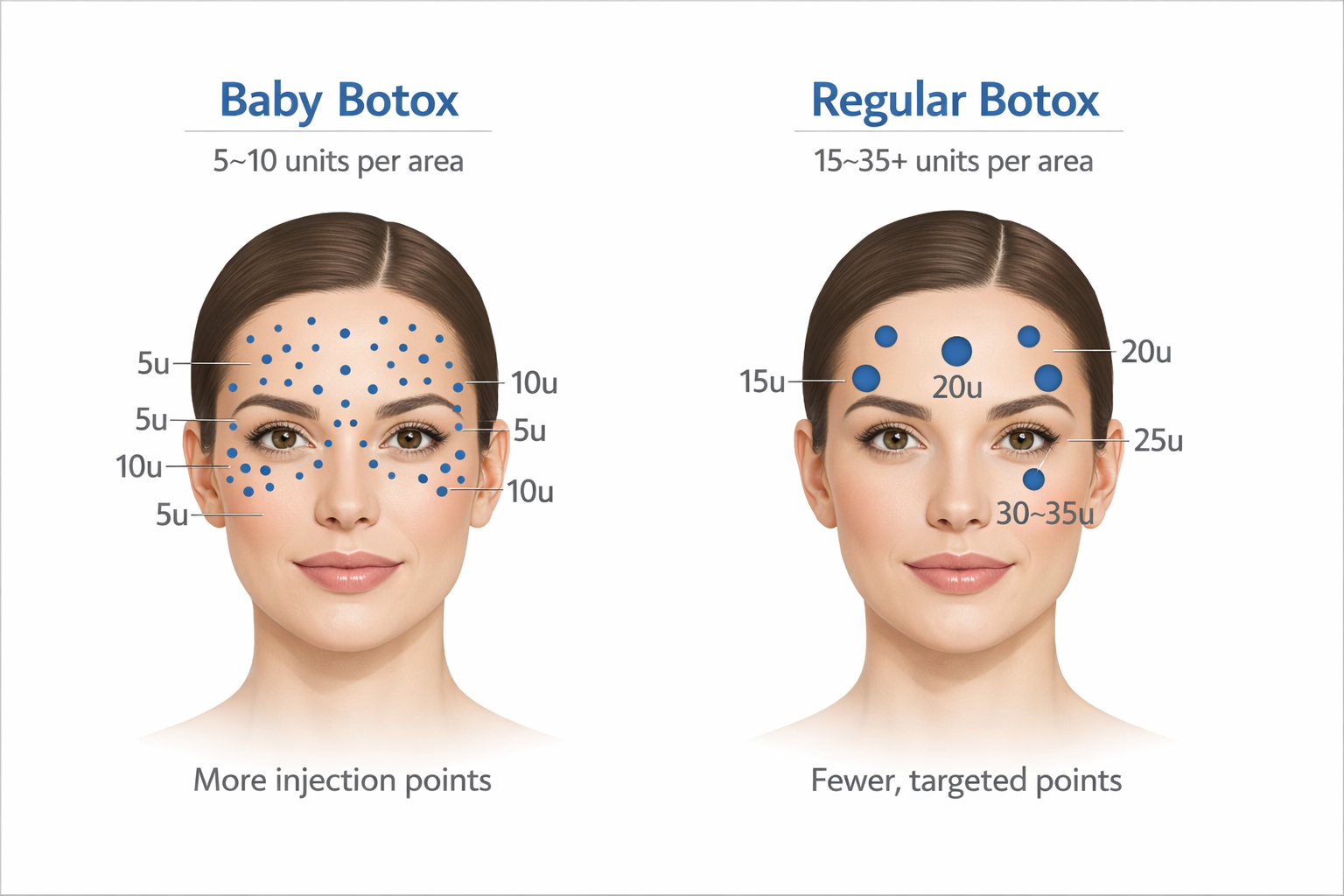
Baby Botox distributes smaller amounts — perhaps 5 to 10 units per area — across a greater number of injection points. This broader, more diffuse placement reduces the depth of muscle relaxation while still reducing the frequency and intensity of muscle contractions. The technique demands considerable precision. Because there is less margin for error at lower doses, the skill and experience of the injector matters at least as much as it does with standard treatment, arguably more so when the therapeutic window is narrow.
It is worth noting that alternative neuromodulators such as Dysport and Xeomin use the same mechanism of action as Botox, and practitioners may apply a similar reduced-dose philosophy to those products as well. Units between different botulinum toxin brands are not directly interchangeable, so dosing is always brand-specific.
Preventative vs Corrective: Which Approach Serves Which Goal?
One of the clearest ways to think about baby Botox vs regular Botox is through the lens of preventative versus corrective treatment. Baby Botox is commonly used as a preventative approach, particularly by patients in their mid-to-late twenties and thirties who notice early fine lines and wrinkles forming during facial expressions but have little or no resting skin texture change yet. By gently reducing the frequency and force of repetitive muscle contractions, smaller doses may slow the progression of expression lines into permanent static wrinkles over time — though robust long-term evidence for this is still developing.
Regular Botox, in contrast, tends to function as a corrective treatment. It is better suited to patients who already have established dynamic wrinkles, deeper resting lines, or stronger facial muscles that require higher doses to achieve a visible result. Patients with prominent frown lines, forehead creases, or well-established crow’s feet are more likely to see a meaningful improvement from standard dosing than from micro-doses alone.
An important nuance that is often overlooked: some younger patients seeking a preventative effect may actually have naturally strong or large facial muscles that require close to a standard dose to see any functional reduction in muscle activity. In these cases, baby Botox may amount to undertreating the area — producing minimal visible benefit while still carrying the costs and risks of the procedure. A thorough assessment of individual facial anatomy and muscle strength by an experienced, licensed injector is therefore essential before deciding on the dose.
Results: What Each Approach Actually Looks Like
The visual difference between baby Botox and regular Botox reflects the difference in muscle relaxation. After standard treatment, there is a clear, often significant reduction in muscle movement in the treated area. Lines soften noticeably, and at higher doses, movement may be substantially restricted. When overdone — particularly in the forehead — this can result in the frozen appearance that many patients are anxious to avoid. A skilled practitioner avoids this by dosing carefully for the individual, but the risk is inherently higher when more units are used.
Baby Botox produces a subtler outcome. Lines appear softened rather than erased, and the face continues to move expressively. For patients whose priority is looking refreshed without appearing "done," this is often the more appealing result. However, patients with deeper-set lines or more prominent wrinkles should have realistic expectations: micro-doses are unlikely to produce the same degree of smoothing as a standard treatment and may not address established static wrinkles at all.
How Long Do Results Last?
Duration is one area where regular Botox has a practical advantage. Standard doses typically maintain their effect for approximately 3 to 6 months, depending on the individual’s metabolism, muscle mass, and the specific area treated. Baby Botox, because it uses smaller amounts of the toxin, generally wears off sooner — results tend to last around 2 to 3 months.
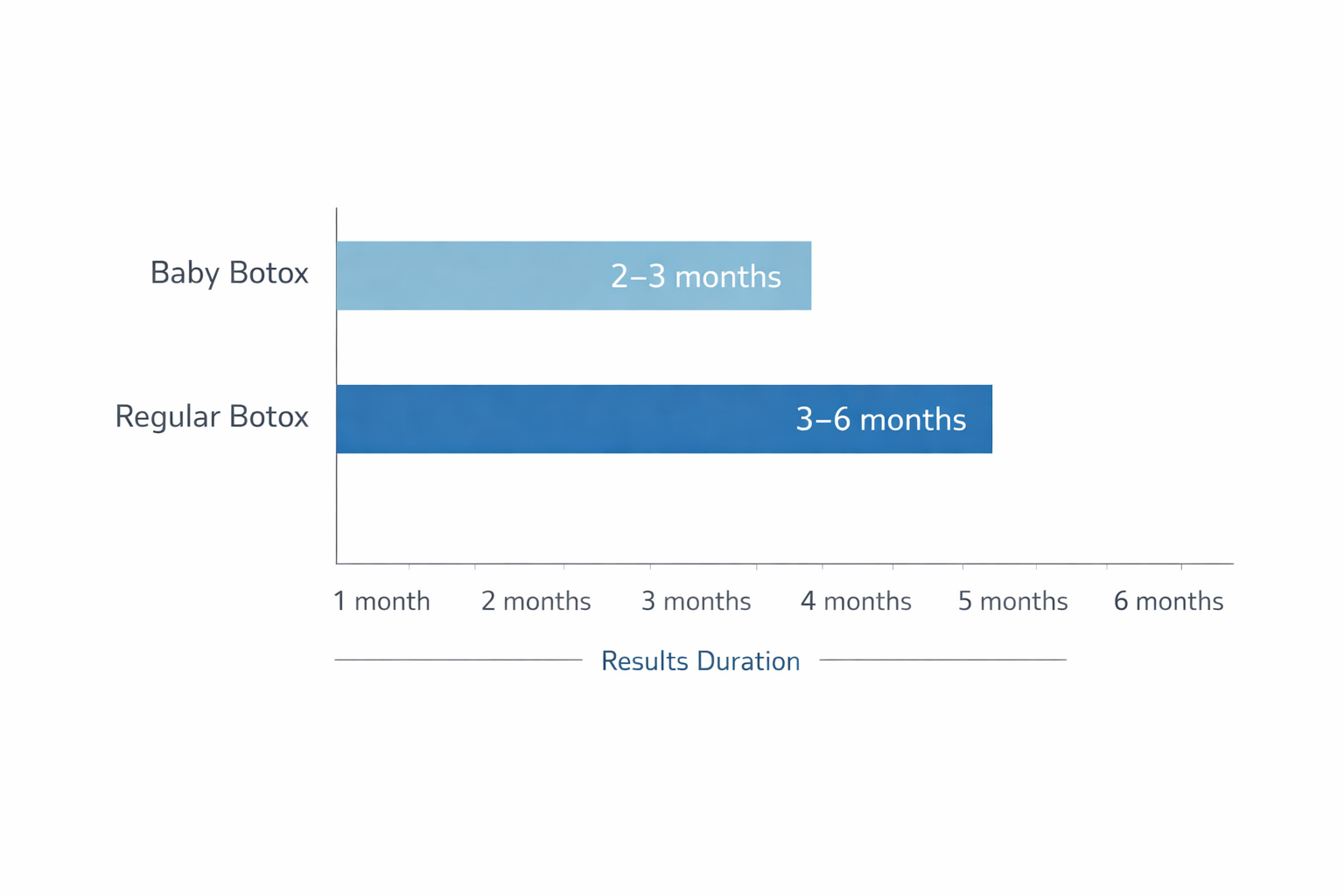
This shorter duration affects the long-term cost comparison. Baby Botox costs less per session because fewer units are used, but a patient may need four or more sessions per year compared to two or three for standard treatment. Over a full year, the total expenditure can be comparable or even higher for baby Botox, depending on how many areas are treated and how quickly an individual metabolises the product. Anyone budgeting for either approach should factor in the full annual maintenance schedule rather than the cost of a single session alone.
Cost: Per Session and Over Time
The cost per unit of botulinum toxin in aesthetic practice typically ranges from approximately £8 to £20 per unit in the UK (or roughly $10 to $25 per unit in the US), though pricing varies significantly by location, clinic, and practitioner. A baby Botox session using 10 to 20 total units across one or two areas may cost considerably less per appointment than a full standard treatment using 40 to 80 or more units across multiple areas.
However, the long-term cost comparison is less straightforward. If baby Botox requires maintenance appointments every 8 to 10 weeks rather than every 16 to 20 weeks, the annual cost gap narrows. Patients who plan to use baby Botox as part of an ongoing preventative strategy should discuss the realistic total annual cost with their practitioner upfront, rather than comparing only the headline price per session.
Who May Be a Good Candidate for Baby Botox?
Baby Botox may be worth discussing with a practitioner if you:
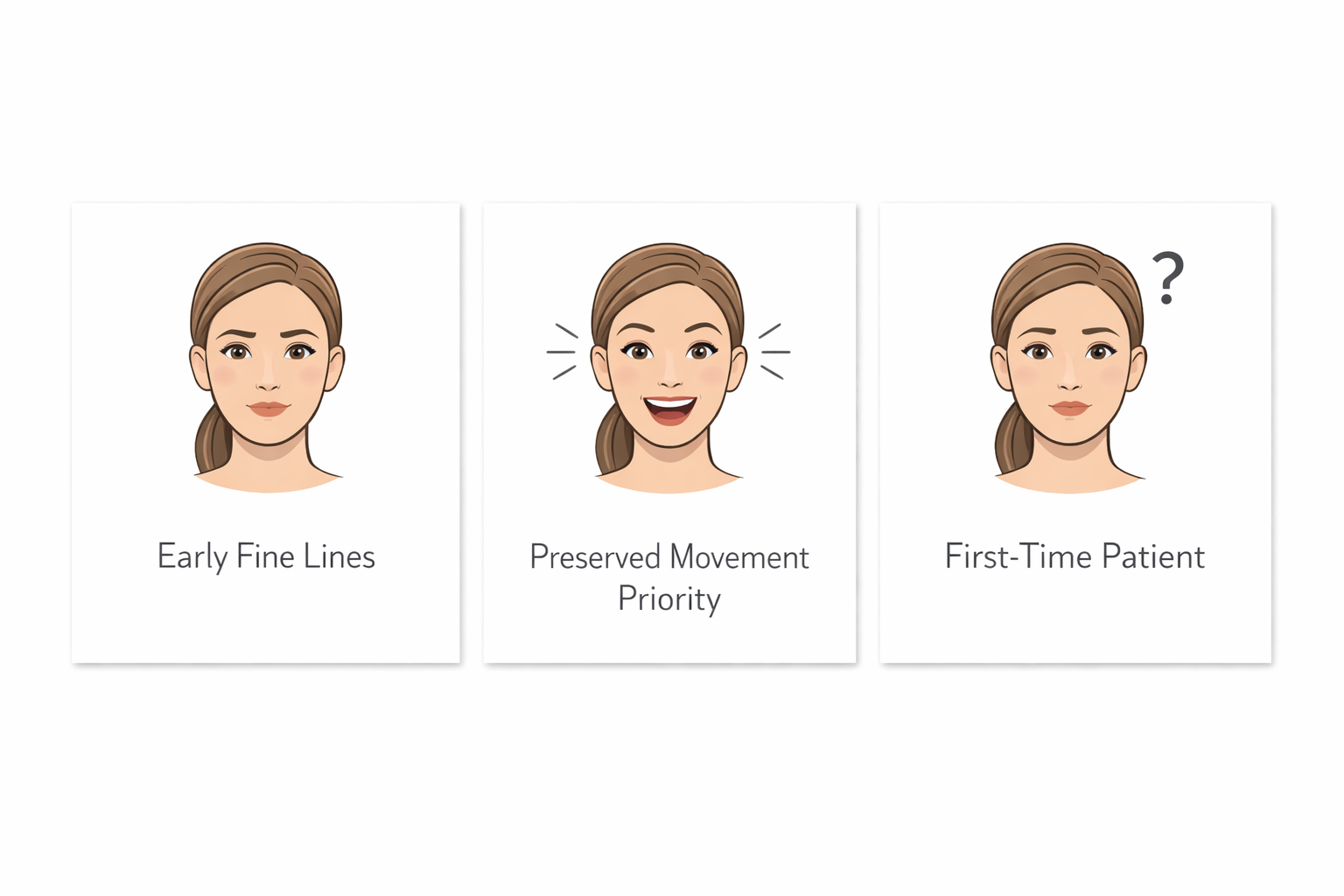
- Are a first-time Botox patient who wants to try a lighter introduction to neuromodulator treatment
- Have early or mild expression lines that have not yet set into resting wrinkles
- Have a strong preference for preserved facial movement and natural-looking results
- Are in your mid-to-late twenties or thirties and are interested in a preventative approach
- Have smaller or less active facial muscles that respond well to lower doses
- Treat areas where subtlety is particularly important, such as around the eyes or near the mouth
Baby Botox is generally less suitable for patients with deep-set static wrinkles, very strong or large facial muscles, or whose primary goal is significant, visible smoothing. These patients are more likely to achieve their intended result with a standard dose as part of a personalized treatment plan developed with their practitioner.
Who May Be Better Suited to Regular Botox?
- Patients with established moderate-to-severe dynamic wrinkles on the forehead, glabella, or around the eyes
- Those with static wrinkles visible at rest that require meaningful muscle relaxation to improve
- Patients with naturally strong facial muscles where low doses produce little functional effect
- Anyone seeking a longer interval between maintenance appointments
- Patients who have tried baby Botox and found the results insufficient for their goals
Risks, Side Effects, and Longer-Term Considerations
Both baby Botox and regular Botox share the same general risk profile because they use the same active ingredient. Common and usually temporary side effects include localised bruising, mild swelling, redness at injection sites, and occasional headache in the hours following treatment. More significant but less frequent risks include temporary drooping of the eyelid or eyebrow (ptosis), asymmetry, and muscle weakness in areas adjacent to the injection site. These risks are present with both techniques, though the likelihood of pronounced muscle weakness is generally lower with micro-doses.
Two longer-term considerations are particularly relevant for younger patients considering baby Botox as an early or preventative strategy. First, there is a theoretical concern about muscle atrophy risk with prolonged and repeated use starting in the twenties — sustained reduction in muscle activity over many years could lead to gradual muscle thinning, though the clinical significance of this in cosmetic dosing ranges remains unclear and is not well established by current evidence. Second, some practitioners and researchers have raised the possibility of botulinum resistance developing over time, where the body produces antibodies that reduce responsiveness to the toxin. This appears to be more likely at higher cumulative doses and may be less of a concern with the smaller amounts used in baby Botox, but starting treatment at a young age means a longer cumulative exposure period overall.
A 2025 CDC advisory also highlighted serious risks associated with counterfeit or non-medical-grade botulinum toxin products and self-injection — practices that carry a risk of severe, potentially life-threatening botulism. These dangers apply equally to any botulinum toxin use outside a licensed clinical setting and serve as a strong reminder that both baby Botox and regular Botox must only be administered by a qualified, licensed practitioner using pharmaceutical-grade, approved products.
Suitability for either treatment should be assessed individually. People who are pregnant or breastfeeding, have certain neurological conditions, take specific medications such as aminoglycosides, or have a known allergy to botulinum toxin or its excipients should not receive treatment. A thorough medical and aesthetic consultation is essential before proceeding.
What to Expect During and After Treatment
Both treatments are typically performed as short outpatient appointments. The practitioner will first assess your facial anatomy, discuss your goals, and agree on a dosing approach. The skin may be cleansed and a topical numbing cream applied, though many patients find the injections tolerable without anaesthetic. Treatment itself usually takes 15 to 30 minutes. Baby Botox may involve more individual injection points due to the distributed technique, though the discomfort profile is broadly similar to standard treatment.
Downtime for both approaches is minimal. Some redness, minor swelling, or pinpoint bruising at injection sites is common and typically resolves within a day or two. Results do not appear immediately — botulinum toxin takes time to inhibit nerve signalling, and most patients notice the effect developing over 3 to 7 days, with the full result visible at around 2 weeks.
After treatment, practitioners generally advise avoiding vigorous exercise, excessive heat (saunas, hot baths), lying flat, and rubbing or massaging the treated areas for the first 24 hours. A follow-up or review appointment a couple of weeks after the initial session is useful to assess the result and discuss any adjustments for future treatments.
Baby Botox and Preventative Botox: Are They the Same?
The terms baby Botox and preventative Botox are often used interchangeably, but they describe overlapping rather than identical concepts. Preventative Botox refers to the strategy of beginning neuromodulator treatment before wrinkles become permanent — using the treatment to interrupt the repetitive muscle contractions that eventually etch lines into the skin. Baby Botox describes the technique of using micro-doses to achieve subtle results. In practice, many preventative treatments use baby Botox doses, but not always: a younger patient with strong muscles may require standard dosing to achieve any meaningful preventative effect. Conversely, an older patient seeking a natural refreshed look might choose a baby Botox technique for aesthetic reasons rather than preventative ones. Clarifying your actual goal — prevention, subtle correction, or significant smoothing — helps a practitioner recommend the most appropriate dosing strategy.
Frequently Asked Questions
Is baby Botox safer than regular Botox?
Both approaches carry the same general risks because they use the same botulinum toxin type A. The lower dose used in baby Botox reduces the likelihood of pronounced muscle over-relaxation or a frozen appearance, but does not eliminate risks such as bruising, asymmetry, or eyelid drooping. Safety depends significantly on the skill of the injector and whether treatment is performed in a proper clinical setting.
Can baby Botox replace regular Botox for deep wrinkles?
Generally not. Micro-doses are designed to soften early or mild lines rather than correct established deeper wrinkles. Patients with significant static wrinkles — lines visible at rest — are unlikely to achieve their goals with baby Botox doses alone. A standard dose or a combination approach may be more appropriate.
Does baby Botox last as long as regular Botox?
No. Baby Botox typically lasts approximately 2 to 3 months, compared to approximately 3 to 6 months for standard treatment. This means more frequent maintenance appointments are usually needed to sustain the effect.
Is the annual cost of baby Botox lower than regular Botox?
Not necessarily. While each baby Botox session costs less due to fewer units, the shorter duration means more sessions per year. Depending on how many areas are treated and how quickly an individual responds, the total annual spend can be comparable or even higher than standard treatment.
At what age should someone consider baby Botox?
There is no universally agreed minimum age for cosmetic botulinum toxin, and suitability depends on individual anatomy, goals, and clinical assessment rather than age alone. Some practitioners see patients in their mid-to-late twenties with early preventative goals. Starting any cosmetic injectable treatment is a significant decision and should always follow a thorough in-person consultation with a licensed medical professional.
Can baby Botox cause botulinum resistance?
Botulinum resistance — where the body develops antibodies that reduce responsiveness to the toxin — is a recognised though relatively uncommon concern. It appears more likely with higher cumulative doses. Baby Botox uses smaller amounts per session, which may theoretically reduce this risk per treatment, but starting at a younger age extends the total duration of exposure. This is worth discussing with your practitioner as part of a long-term treatment plan.
What areas are typically treated with baby Botox?
The most common areas are the same as regular Botox — the forehead, glabella (frown lines between the brows), and crow’s feet around the eyes. Baby Botox technique is also sometimes used in more delicate areas such as the periorbital region, around the lips, or along the jaw, where a very light touch is particularly important for natural-looking results.
Baby Botox or Regular Botox: Which May Be Right for Your Goals?
The choice between baby Botox and regular Botox is not simply about preferring subtle results over dramatic ones. It depends on the depth and type of your wrinkles, the strength of your facial muscles, your priorities around facial movement, how often you are prepared to attend maintenance appointments, and your realistic budget over the course of a year.
Baby Botox is a genuinely useful option for patients with early fine lines, a strong preference for preserved natural expressions, or those cautiously exploring neuromodulator treatment for the first time. However, it is not a universally superior or lower-risk alternative — it involves the same substance, similar potential side effects, and in some patients may simply be insufficient to produce any meaningful result.
Regular Botox remains the better-evidenced choice for correcting established wrinkles and achieving visible, lasting smoothing in patients with moderate-to-significant skin texture changes or strong muscle activity. A well-dosed standard treatment by an experienced injector does not automatically produce a frozen appearance — that risk is associated with over-treatment rather than with standard dosing per se.
The most practical step is a face-to-face consultation with an experienced, licensed practitioner who can assess your individual facial anatomy, discuss your aesthetic goals honestly, and recommend a dosing strategy — whether that is baby Botox, a standard approach, or a combination — that is genuinely appropriate for you rather than simply fashionable.
