
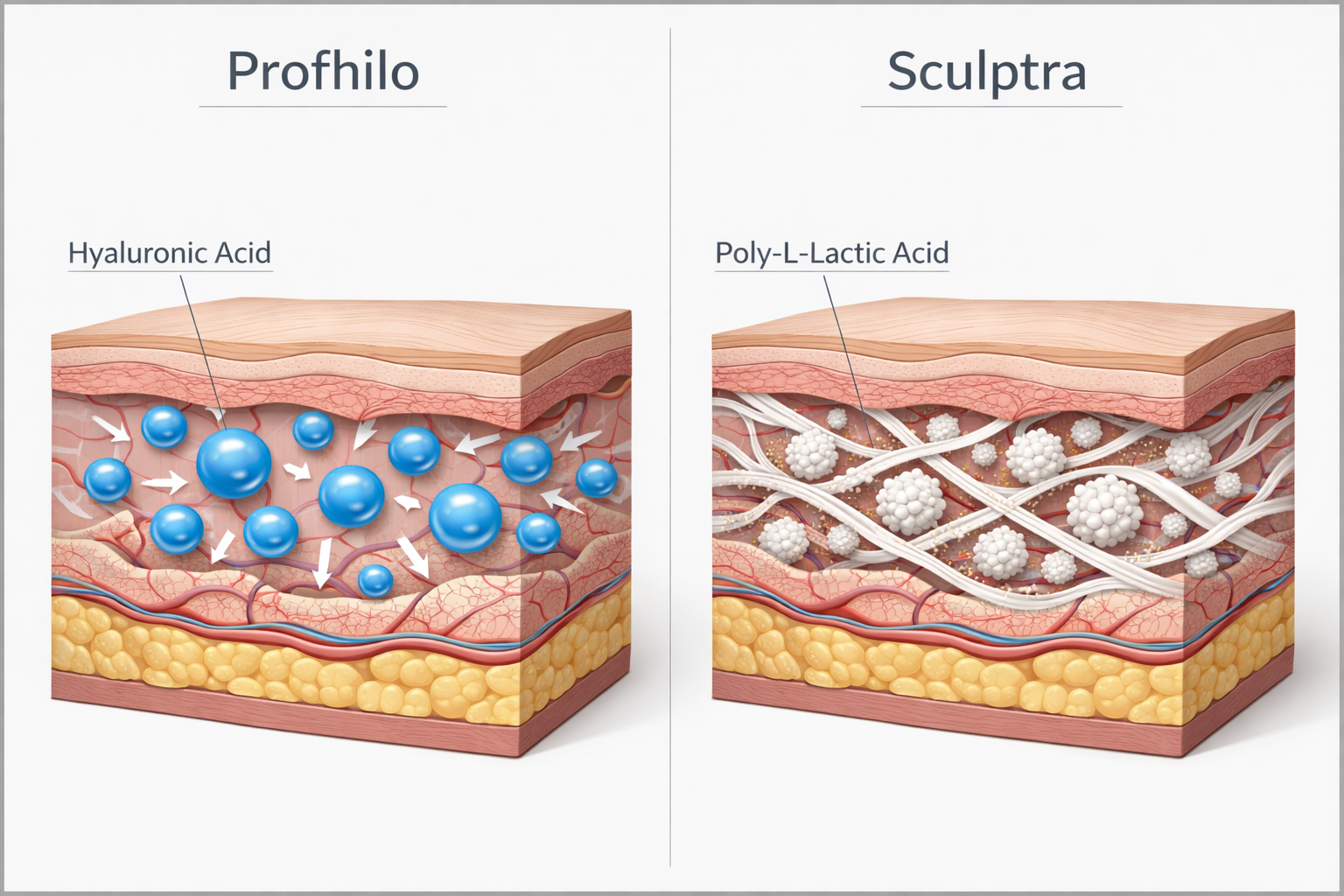

Quick Comparison
| Feature | Profhilo | Sculptra |
|---|---|---|
| Active ingredient | Hyaluronic acid (HA) | Poly-L-lactic acid (PLLA) |
| Treatment category | Bio-remodelling treatment / skin booster | Collagen biostimulator / volumiser |
| Primary mechanism | Spreads through tissue to deeply hydrate and stimulate collagen and elastin | PLLA microparticles trigger fibroblast response and gradual collagen synthesis |
| Main goals | Skin quality, hydration, texture, early laxity | Structural volume restoration, moderate-to-severe laxity |
| Cross-linking agents | None (NAHYCO® Hybrid Technology) | Not applicable |
| Typical sessions | 2 sessions, 4 weeks apart | 2–4 sessions, 4–6 weeks apart |
| Onset of visible results | 2–4 weeks | 3–6 months |
| Longevity | 6–12 months | Up to 2–3 years |
| Key treatment areas | Face, neck, décolletage, hands, upper arms | Face, temples, cheeks, jawline, arms, knees |
| Post-treatment massage | Not required | Required (5x5x5 protocol) |
| Downtime | Minimal | Minimal to mild |
| Notable risks | Redness, swelling, bruising | Redness, swelling, bruising, nodule risk |
| Contains anaesthetic | No | Yes (lidocaine) |
What Is Profhilo?
Profhilo is a bio-remodelling treatment containing one of the highest concentrations of hyaluronic acid available in an injectable product. Unlike traditional dermal fillers, it does not add structural volume or remain localised at the injection site. Instead, Profhilo uses NAHYCO® Hybrid Technology — a patented process that stabilises both high and low molecular weight hyaluronic acid without any cross-linking agents. This allows the product to flow evenly through the deeper layers of the skin, providing deep hydration while simultaneously stimulating collagen and elastin production.
The absence of cross-linking agents is a meaningful differentiator. Most HA-based fillers use chemical cross-linking to hold their shape and resist breakdown, which gives them their volumising properties. Profhilo is intentionally designed not to do this, making it a skin booster rather than a volumiser. The result is an improvement in skin quality, tone, and texture rather than a change in facial contours.
A newer formulation called Profhilo Structura has also been developed for areas requiring slightly more tissue support, such as the mid-face and jawline. It uses the same NAHYCO® technology but with a firmer consistency suited to deeper tissue planes, making it an option for patients who want something between a traditional skin booster and a structural filler.
What Is Sculptra?
Sculptra is an injectable collagen biostimulator made from poly-L-lactic acid (PLLA), a biodegradable and biocompatible synthetic compound that has been used in medicine for decades in absorbable sutures. When injected, Sculptra does not immediately add volume. Instead, PLLA microparticles are gradually absorbed by the body over several months, triggering a fibroblast response that stimulates the production of new collagen within the deep dermis. This scaffolding effect builds volume from within, resulting in a gradual, natural-looking improvement in areas affected by significant volume loss.
Because Sculptra works through gradual collagen stimulation rather than immediate filling, the results take time to become visible — typically three to six months after the treatment course is complete. This makes it fundamentally different from both traditional dermal fillers and hyaluronic acid skin boosters. It is best understood as a structural volume restoration treatment rather than a quick-fix injectable.
Sculptra contains lidocaine as a built-in anaesthetic, which helps manage discomfort during injection. Post-treatment massage is an important aftercare requirement — practitioners typically advise the 5-5-5 protocol (massaging five times a day for five minutes for five days) to help distribute the product evenly and reduce the risk of nodule formation.
How Each Treatment Works: A Closer Look at the Mechanism
Understanding the mechanism of action for each treatment helps clarify why they suit different concerns and produce different types of results.
Profhilo works by spreading evenly through the tissue once injected at specific bio-aesthetic points on the face or body. The high-molecular-weight component of the HA provides immediate deep hydration and cushioning, while the low-molecular-weight component penetrates more superficially to improve skin quality at a cellular level. Together, they stimulate collagen and elastin production, which gradually improves skin elasticity and firmness over the weeks following treatment. The results are visible relatively quickly — many patients notice improved skin texture and a hydrated glow within two to four weeks.
Sculptra’s mechanism is slower and more structural. The PLLA microparticles are suspended in water for injection. Once injected, the water component is absorbed within days, leaving the microparticles behind. Over the following months, the body’s immune system identifies the PLLA particles and responds by sending fibroblasts, the cells responsible for producing collagen. As new collagen fibres form around the microparticle scaffolding, volume gradually returns to areas that have become hollow or sunken. This process continues long after the treatment course ends, which is why the results of Sculptra can last considerably longer than those of Profhilo.
Ideal Candidates: Who Benefits Most from Each Treatment?
Matching the right treatment to the right concern is more important than choosing the more popular or more expensive option. Both Profhilo and Sculptra can produce excellent outcomes, but they target different aspects of the ageing process.

Profhilo may be a better fit if you:
- Have dehydrated or dull skin that lacks glow and radiance
- Notice crepey skin on the face, neck, décolletage, or upper arms
- Have fine lines and early skin laxity but have not yet experienced significant volume loss
- Want to improve overall skin texture and firmness without changing facial contours
- Are in your late 20s to early 40s and looking for preventive or early-intervention treatment
- Have sensitive skin and want a treatment with a straightforward safety profile
Sculptra may be a better fit if you:
- Have noticeable volume loss in the cheeks, temples, or jawline
- Are concerned about hollow cheeks and temples that make you look drawn or tired
- Have moderate-to-severe facial laxity or deeper wrinkles
- Have experienced significant weight loss that has affected facial volume
- Are in your 40s, 50s, or beyond and want gradual, long-lasting structural restoration
- Are comfortable with a slower treatment timeline and can commit to multiple sessions
Age-based guidance is useful but not absolute. Some patients in their late 30s may be better suited to Sculptra if they have significant hollow cheeks, while patients in their 50s with good structural volume but poor skin quality may benefit more from Profhilo. A qualified aesthetic practitioner can assess your specific anatomy and concerns to guide the decision.
Treatment Areas
Both treatments can be used across multiple areas of the face and body, though their suitability for specific sites differs based on how each product behaves in tissue.
Profhilo is commonly used on the face — particularly the cheeks, perioral area, and under-eye region — as well as the neck, décolletage, hands, and upper arms. It is particularly well suited to areas with crepey or thinning skin where hydration and skin quality are the primary concern rather than volume replacement. Profhilo Structura extends this further by offering mid-face support for patients who need something more than surface skin quality improvement.
Sculptra can be used on the face, including the cheeks, temples, jawline, and nasolabial folds, where volume loss creates a drawn or aged appearance. It is also one of the few collagen biostimulators with established use in body areas such as the upper arms, knees, and buttocks (for non-surgical lifting), making it a more versatile option for patients interested in body treatments alongside facial rejuvenation.
Results: Speed, Appearance, and Longevity
One of the most frequently asked questions when comparing these two treatments is how quickly results appear and how long they last. The answers are quite different, and understanding this helps set realistic expectations.
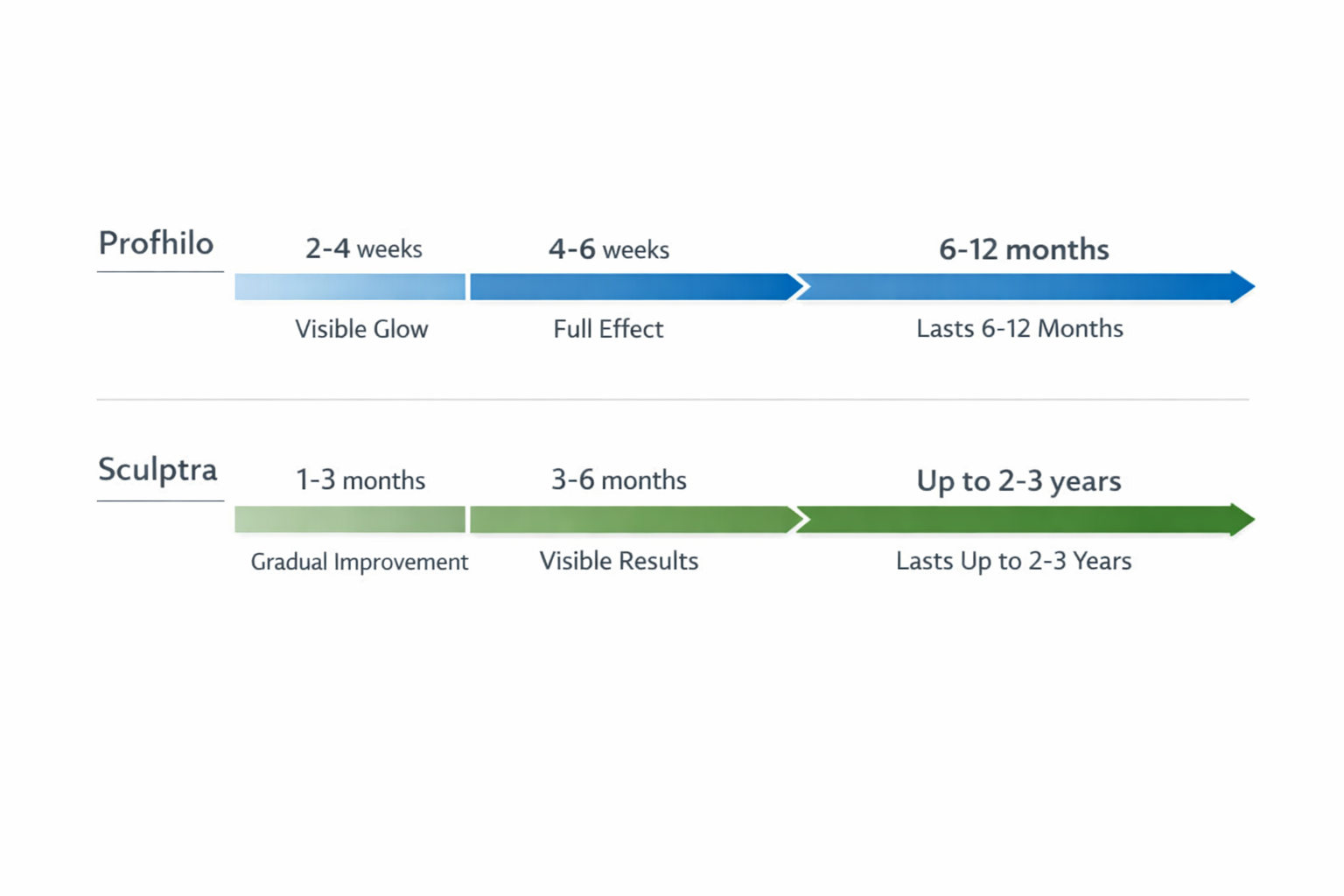
Profhilo produces visible improvements relatively quickly. Most patients begin to notice improved skin hydration, a more refreshed appearance, and better skin texture within two to four weeks of the first treatment session. After the standard two-session course, the full effect typically becomes apparent at around four to six weeks. Results generally last six to twelve months, after which a maintenance session or repeat course is usually recommended.
Sculptra produces changes gradually over a longer period. Because results depend on the body building new collagen — a biological process that takes time — visible improvement typically becomes noticeable around three to six months after the final treatment session. The payoff for this slower timeline is significantly greater longevity: results from a full Sculptra course can last up to two to three years in many patients, reducing the frequency of maintenance treatment over the long term.
This difference has practical implications for planning. Patients who want visible results before a specific occasion may find Profhilo more suitable given its faster onset. Those thinking about long-term facial rejuvenation and willing to invest time in the process may find Sculptra’s extended longevity more appealing from a cost-effectiveness perspective.
Treatment Protocols and Aftercare
The number of sessions and aftercare requirements differ meaningfully between the two treatments and are worth considering when making a decision.
A standard Profhilo treatment course consists of two sessions spaced approximately four weeks apart. Aftercare is straightforward — patients are typically advised to avoid strenuous exercise, heat, and makeup for a short period following treatment. No post-treatment massage is required, and downtime is generally minimal, with any redness or swelling usually resolving within a day or two.
Sculptra typically requires between two and four treatment sessions spaced four to six weeks apart, depending on the degree of volume loss and the areas being treated. The post-treatment massage protocol is an important part of the Sculptra aftercare routine. Patients are asked to massage the treated areas multiple times daily for several days following each session to help distribute the PLLA microparticles evenly through the tissue. Failing to complete this massage routine is associated with a higher risk of nodule formation, which is one of Sculptra’s more notable potential complications. An experienced, qualified aesthetic practitioner will explain the massage technique clearly before treatment.
Side Effects and Safety Considerations
Both Profhilo and Sculptra are considered safe when administered by a qualified aesthetic practitioner using appropriate technique. However, neither is without risk, and understanding the possible side effects helps patients make an informed choice and know what to watch for after treatment.
Common side effects for both treatments include temporary redness, swelling, tenderness, and bruising at the injection sites. These effects are typically mild and resolve within a few days.
Sculptra carries a specific risk of subcutaneous nodule formation — small lumps that can develop under the skin if the product is not distributed evenly or if the post-treatment massage protocol is not followed correctly. Nodules are generally not dangerous but can be visible or palpable, and some may require additional treatment to manage. The risk of nodules is significantly reduced when Sculptra is injected by an experienced practitioner who understands correct dilution, injection depth, and injection technique, and when patients adhere to the aftercare massage routine.
Profhilo’s safety profile is generally considered straightforward due to its composition of pure hyaluronic acid without cross-linking agents. Serious adverse events are uncommon, though as with any injectable treatment, vascular complications and infection remain theoretical risks that underline the importance of choosing a medically trained and experienced practitioner.
Both treatments are contraindicated during pregnancy and breastfeeding, in patients with active skin infections at or near the treatment site, and in those with known hypersensitivity to the product components. Anyone with a history of autoimmune conditions, bleeding disorders, or who is taking blood-thinning medication should discuss their medical history in full during consultation.
Cost and Long-Term Value
Cost is a practical factor for most patients, and comparing these treatments on price alone can be misleading. The more useful comparison considers the full treatment course and how frequently maintenance is needed.
Profhilo typically costs less per session than Sculptra, but the standard course of two sessions means the initial outlay is relatively modest. Because results last six to twelve months, annual or biannual maintenance is usually needed to sustain the improvement.
Sculptra has a higher upfront cost per session and typically requires more sessions to complete a course, making the initial investment greater. However, because results can last two to three years, the long-term cost-effectiveness of Sculptra may compare favourably with Profhilo for patients who are committed to ongoing treatment. Fewer maintenance sessions over several years can offset the higher initial spend.
Exact pricing varies by clinic, practitioner experience, treatment area, and the number of vials required. Patients should request a full cost breakdown during consultation, including the expected number of sessions and recommended maintenance frequency, before comparing prices between clinics.
Can Profhilo and Sculptra Be Used Together?
A combination approach using both treatments is increasingly popular and can address the ageing process more comprehensively than either treatment alone. The two products are not in competition — they work on different aspects of skin ageing and can complement each other effectively when used as part of a thoughtfully sequenced plan.

A common strategy is to use Sculptra to restore structural volume and deep facial scaffolding, then follow with Profhilo to improve the quality of the skin sitting on top of that foundation. Sculptra addresses the hollow cheeks and temples and deeper laxity; Profhilo addresses the surface texture, hydration, and fine crepey lines that Sculptra alone does not target. Together, they can produce a more complete non-surgical skin rejuvenation outcome.
Sequencing matters. In most cases, practitioners recommend completing the Sculptra treatment course and allowing the collagen response to develop before layering Profhilo on top. However, the optimal timing and sequencing should be determined by a qualified aesthetic practitioner based on individual assessment. Combining treatments should never be approached as a shortcut — it requires careful planning and an understanding of how each product behaves in tissue.
Alternatives Worth Knowing About
Profhilo and Sculptra are not the only injectable options for patients researching non-surgical skin rejuvenation. Depending on the concern, other treatments may be worth discussing with a practitioner.
Polynucleotides (such as Nucleofill or Pluryal Silk) are biostimulants derived from DNA fragments that stimulate fibroblast activity and tissue repair. They are particularly popular for delicate areas such as the under-eye region, where they may improve skin quality, reduce hollowness, and address dehydration. They offer a different mechanism to both Profhilo and Sculptra and may be suitable for patients with specific localised concerns.
Traditional hyaluronic acid dermal fillers such as those in the Juvederm or Restylane ranges are an option for patients who want immediate, predictable volume in specific areas such as the cheeks or lips. Unlike Profhilo, these are cross-linked and remain localised at the injection site. Unlike Sculptra, results are visible immediately but typically last twelve to eighteen months.
For patients with skin laxity as a primary concern, energy-based devices such as radiofrequency microneedling, focused ultrasound (HIFU), or laser resurfacing may be considered alongside or instead of injectable treatments, depending on the degree of laxity and the patient’s overall goals.
Frequently Asked Questions
Is Sculptra the same as Profhilo?
No. Profhilo is a hyaluronic acid skin booster that improves skin quality and hydration through bio-remodelling. Sculptra is a poly-L-lactic acid collagen biostimulator that gradually rebuilds structural volume. They work differently, suit different concerns, and produce different types of results.
Which treatment lasts longer?
Sculptra generally lasts longer. Results from a Sculptra course can persist for up to two to three years in many patients. Profhilo results typically last six to twelve months, after which maintenance treatment is usually needed.
Which produces faster results?
Profhilo produces visible improvement more quickly — often within two to four weeks of the first session. Sculptra results develop gradually over three to six months as new collagen forms, meaning visible improvement takes considerably longer to appear.
Can you have both Profhilo and Sculptra at the same time?
It is possible to use both treatments as part of a planned combination approach, but they are usually not administered at the same session. Most practitioners recommend completing one treatment course before introducing the other. The sequencing and timing depend on your individual assessment and goals.
What is Profhilo Structura, and how does it differ from standard Profhilo?
Profhilo Structura is a firmer formulation of Profhilo designed for deeper tissue planes, such as the mid-face and jawline. It uses the same NAHYCO® Hybrid Technology as standard Profhilo but offers slightly more structural support, making it suitable for patients who need more than surface-level skin quality improvement but do not want a traditional volumising filler.
Is Sculptra painful?
Sculptra contains lidocaine as a built-in anaesthetic, which helps reduce discomfort during injection. Most patients describe the sensation as manageable. Topical anaesthetic cream may also be applied beforehand if required. Some tenderness in the treated area in the days following treatment is normal.
What causes nodules with Sculptra, and how are they prevented?
Nodules can form if the PLLA microparticles cluster together rather than distributing evenly through the tissue. The risk is reduced by using correct dilution, appropriate injection depth, and by following the post-treatment massage protocol consistently. Choosing a practitioner with specific experience in Sculptra administration is one of the most important factors in minimising this risk.
Profhilo or Sculptra: Matching the Treatment to Your Concern
Profhilo and Sculptra are both well-established injectable treatments that work through collagen stimulation, but they are designed to solve different problems. Profhilo excels at improving skin quality — hydration, texture, and early laxity — with a fast onset and a simple treatment course. It is a strong choice for patients who want a refreshed, natural-looking improvement in skin quality without changing their facial structure.
Sculptra is the stronger option when the concern is meaningful structural volume loss — hollow cheeks and temples, deeper facial laxity, or the gradual deflation that comes with significant ageing or weight change. Its slower onset requires patience, but the longevity of results and the depth of structural restoration it can achieve make it a compelling long-term investment for the right patient.
For many patients, the most complete outcome may come from a thoughtful combination approach that addresses both structural volume and surface skin quality. A consultation with a qualified aesthetic practitioner is the most reliable way to assess which treatment — or which combination — is genuinely appropriate for your anatomy, your concerns, and your goals.
