


Key Takeaways
- IPL stands for Intense Pulsed Light — a broad-spectrum light technology that targets melanin in the hair follicle to inhibit regrowth.
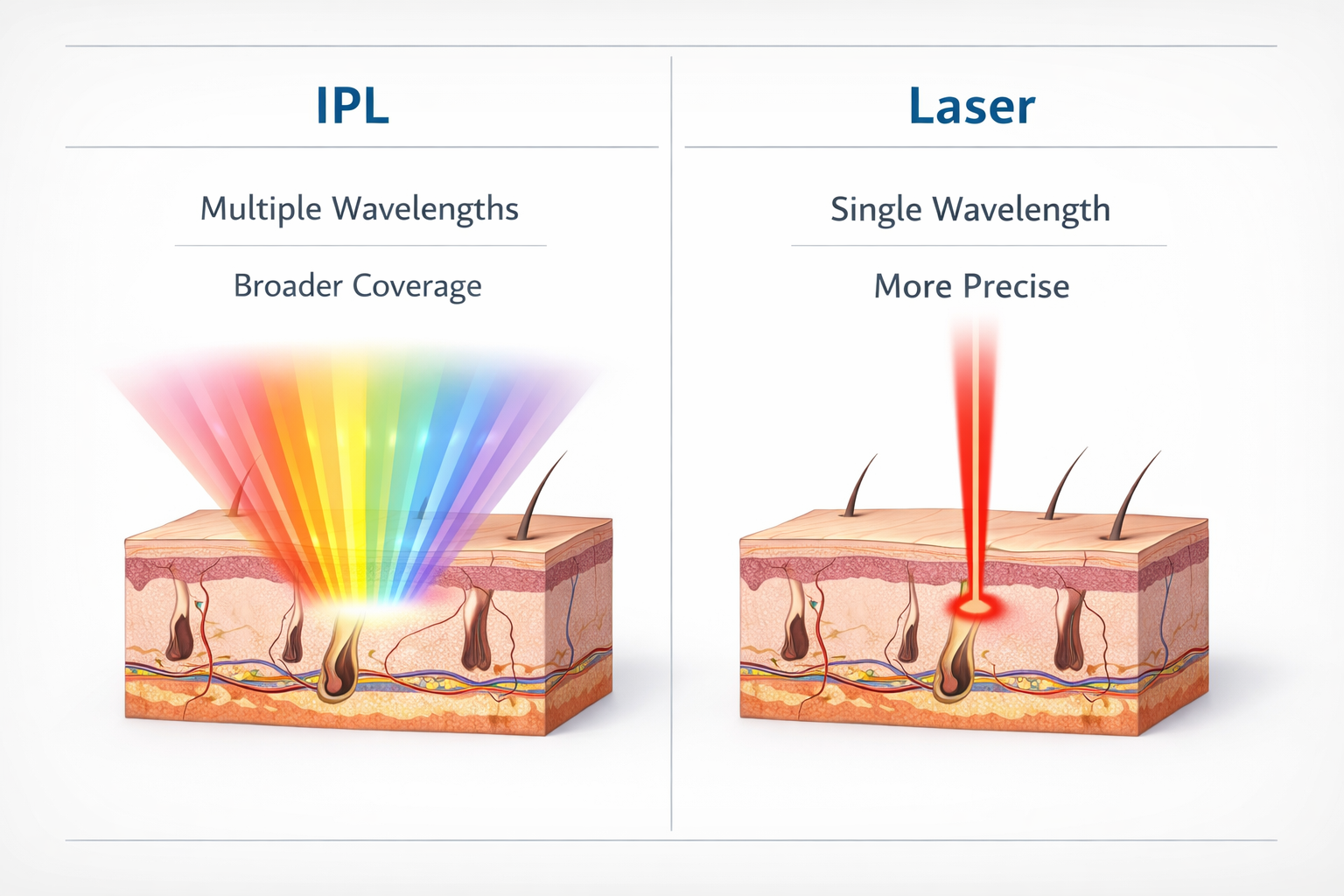
- IPL is not the same as laser hair removal. Lasers emit a single wavelength of monochromatic coherent light; IPL uses multiple wavelengths across a broader spectrum.
- Best results occur in people with dark hair and light-to-medium skin tone, where the contrast between hair pigment and skin allows more precise energy targeting.
- IPL typically requires more sessions than laser to achieve comparable long-term hair reduction, and results are described as permanent hair reduction rather than permanent removal.
- Both professional clinic devices and at-home IPL devices are available, with meaningful differences in power, safety features, and expected outcomes.
What Does IPL Mean in Hair Removal?
IPL stands for Intense Pulsed Light. In the context of hair removal, it refers to a non-invasive light-based technology that delivers controlled pulses of broad-spectrum light into the skin to disrupt the hair growth cycle and progressively reduce unwanted hair. The term photoepilation is sometimes used interchangeably, describing any light-based method of hair reduction.
Unlike a surgical procedure or a topical product, IPL works at the level of the hair follicle itself. The device emits rapid flashes of light across a range of wavelengths — typically spanning approximately 500 to 1200 nanometres — which penetrate the outer layers of skin and are absorbed by the pigment (melanin) present in the hair shaft and follicle. This absorption converts light energy into heat, which damages the follicle and reduces its ability to produce new hair.
IPL technology was originally developed for skin rejuvenation and pigmentation concerns, but its ability to target melanin made it well-suited for hair reduction applications. Today it is one of the most widely used light-based hair removal approaches, available both in professional clinic settings and as consumer at-home IPL devices.
How Does IPL Hair Removal Work?
The scientific principle behind IPL hair removal is called selective photothermolysis — the selective destruction of a specific tissue target (in this case the hair follicle) using light-generated heat, while limiting damage to the surrounding skin. Understanding this mechanism helps explain both why IPL works and why it has limitations.
When an IPL handpiece is pressed against the skin and a flash is delivered, broadband pulsed light penetrates into the dermis. Melanin — the natural pigment that gives hair and skin their colour — acts as a chromophore, meaning it selectively absorbs the light energy. This absorption heats the melanin within the hair shaft, which transfers that heat to the surrounding hair follicle tissue. If sufficient heat reaches the follicle’s growth cells, it disrupts or disables them, pushing the follicle into a resting (telogen) phase or impairing its capacity to regrow hair.
This is why the hair growth cycle matters so much in IPL treatment. Hair follicles cycle through three phases: the active growth phase (anagen), a transitional phase (catagen), and a resting phase (telogen). IPL is most effective during the anagen phase, when the follicle is actively producing hair and is richest in melanin. Because follicles on any given area of the body are at different stages simultaneously, multiple treatment sessions are required to target a sufficient proportion of follicles during their active phase. This is not a limitation unique to IPL — it applies to laser hair removal as well, and is the biological reason why a full course of treatment always involves a series of sessions spaced weeks apart.
IPL vs. Laser Hair Removal: Key Differences
IPL and laser hair removal are often confused or used interchangeably in conversation, but they are meaningfully different technologies. The most important distinction lies in the nature of the light itself.
| Characteristic | IPL | Laser Hair Removal |
|---|---|---|
| Light type | Broad-spectrum, multiple wavelengths | Single wavelength (monochromatic coherent light) |
| Typical wavelength range | ~500–1200 nm (filtered) | Fixed (e.g. ~810 nm diode; ~1064 nm Nd:YAG) |
| Targeting precision | Less precise; broader coverage per flash | More precise; concentrated energy |
| Coverage per flash | Larger treatment window | Smaller spot size per pulse |
| Sessions typically needed | 6–12 or more | 4–8 depending on area and device |
| Skin tone suitability | Best for Fitzpatrick types I–III | Wider range; Nd:YAG suitable for darker tones |
| Hair colour suitability | Dark hair only | Dark hair optimal; limited options for lighter hair |
| At-home availability | Yes — consumer devices widely available | Primarily clinic-based |
| Typical cost | Lower per session; home devices cost-effective long term | Higher per session; fewer sessions may offset cost |
| Common side effects | Redness, mild warmth, temporary sensitivity | Redness, mild swelling, temporary sensitivity |
A laser emits monochromatic coherent light — a single, precise wavelength that can be matched specifically to the absorption characteristics of melanin in the hair follicle. This makes laser energy more concentrated and targeted per pulse. IPL, by contrast, emits a broader band of wavelengths simultaneously, using filters to exclude the shortest (most superficial) wavelengths. The result is a less concentrated but wider-area flash that covers more skin surface per treatment.
In clinical practice, this difference has practical consequences. Laser tends to deliver more energy per unit area to the intended target, which can translate into fewer sessions for comparable results. IPL’s broader spectrum means some energy is absorbed by surrounding tissues rather than solely by the follicle, potentially requiring more treatment sessions to achieve similar hair reduction. However, IPL’s larger flash window can make treating larger body areas — such as legs or the back — faster in terms of time per session.
Neither technology is universally superior. The right choice depends on your hair colour, skin tone, the area being treated, and whether you are pursuing professional treatment or considering an at-home device.
Who Is IPL Hair Removal Suitable For?
Patient selection is one of the most important factors in whether IPL hair removal delivers satisfactory results. The technology relies on skin tone contrast — specifically, the difference in melanin concentration between the hair and the surrounding skin — to work safely and effectively.
IPL produces the most reliable results in people with dark brown or black hair and light-to-medium skin. This combination provides the high contrast that allows the device to target follicle melanin without delivering excessive heat to the surrounding skin. Using the Fitzpatrick skin type scale (which classifies skin from Type I — very fair — through to Type VI — very dark), IPL is generally considered most appropriate for Fitzpatrick Types I through III, with some modern devices extending cautious suitability to Type IV.
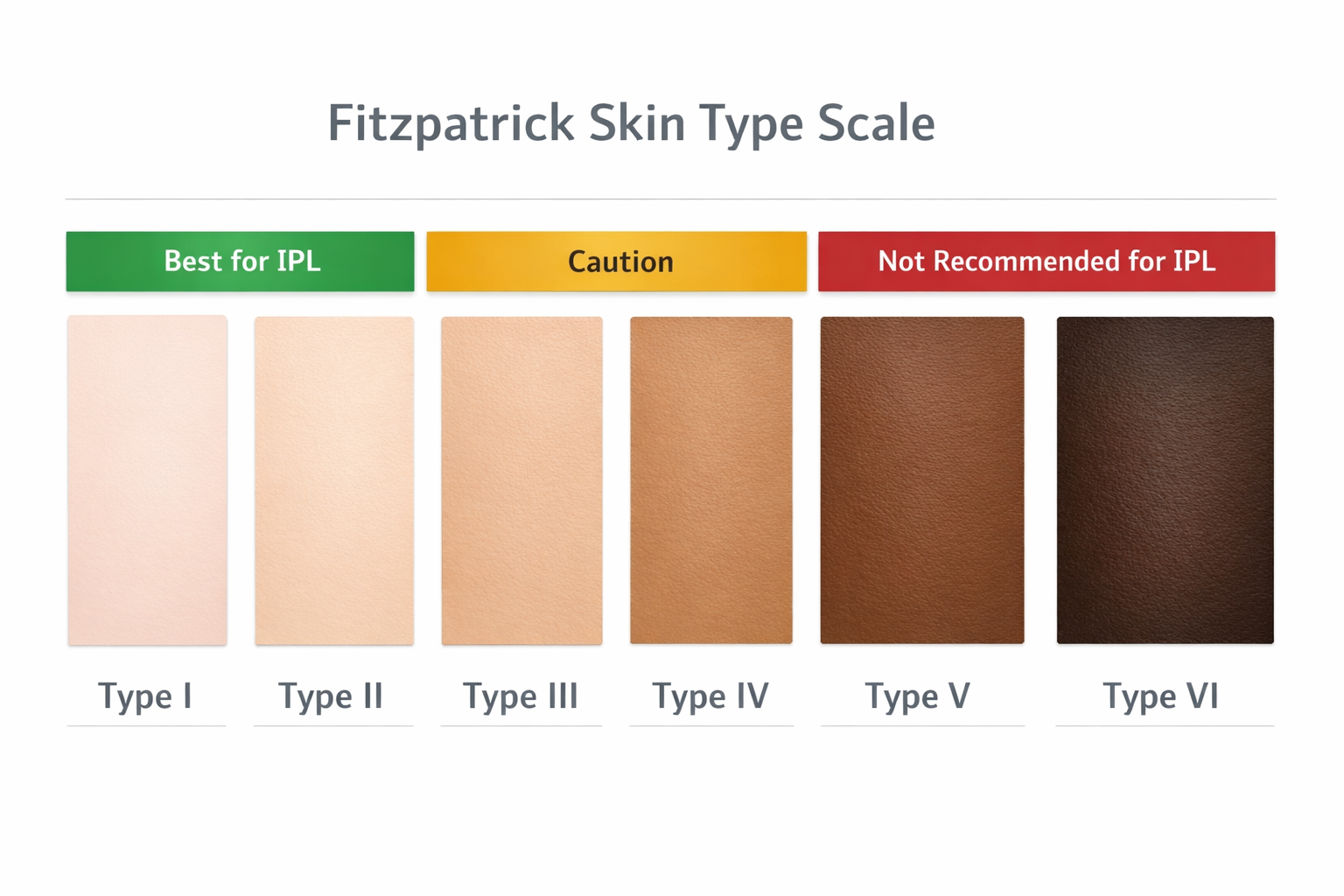
For people with darker skin tones (Fitzpatrick Types V and VI), the risk of IPL treatment increases significantly. Because dark skin contains more melanin throughout the dermis, the light energy may be absorbed by the skin itself rather than being directed primarily at the follicle. This raises the risk of burns, blistering, post-inflammatory hyperpigmentation, or hypopigmentation. In clinical settings, practitioners may use IPL devices with specific filters and reduced fluence (energy settings) for darker skin, but many will recommend a longer-wavelength laser such as the Nd:YAG (1064 nm) as a safer and more effective alternative for these skin tones.
IPL is unlikely to produce meaningful results for people with very light blonde, grey, red, or white hair. These hair colours contain insufficient melanin to absorb enough light energy to heat the follicle adequately. This is a fundamental limitation of the technology and applies equally to laser hair removal — it is not a device quality issue, but a physical constraint of light-based photoepilation.
At-Home IPL Devices vs. Professional Clinic Treatment
One of the notable differences between IPL and laser hair removal is the widespread availability of at-home IPL devices. Brands such as Philips Lumea and Braun Silk-expert Pro have made consumer-grade IPL widely accessible, offering a long-term cost alternative to repeated clinic appointments.
At-home IPL devices are intentionally designed to operate at lower energy levels than professional clinic machines. This is a deliberate safety measure — consumer devices must be safe to use without clinical training or skin assessment by a practitioner, and regulatory standards in most markets require them to stay within limits that minimize the risk of skin injury in untrained hands. Many modern devices include built-in skin tone sensors that automatically adjust the energy output or prevent activation if the skin is judged too dark for safe use.
Professional clinic IPL devices operate at significantly higher fluence levels, which typically means more effective energy delivery to the follicle per session. A trained practitioner can also adjust settings precisely based on a formal skin assessment, hair type, and treatment area — a degree of customisation that consumer devices cannot replicate. As a result, professional IPL treatment generally produces faster and more consistent results, though it comes at a higher per-session cost.
The practical trade-off is straightforward. A professional clinic course of IPL may produce noticeable long-term hair reduction more quickly, while a quality at-home IPL device represents a larger upfront cost that may offer savings over time for people who use it consistently and for whom it is suitable. Consistency is the key variable with home devices — irregular use significantly reduces their effectiveness, because interrupting the treatment schedule means missing follicles in their anagen phase.
What to Expect During an IPL Hair Removal Course
Whether you are attending a clinic or using a home device, the general treatment process for IPL hair removal follows a similar structure.
Preparation
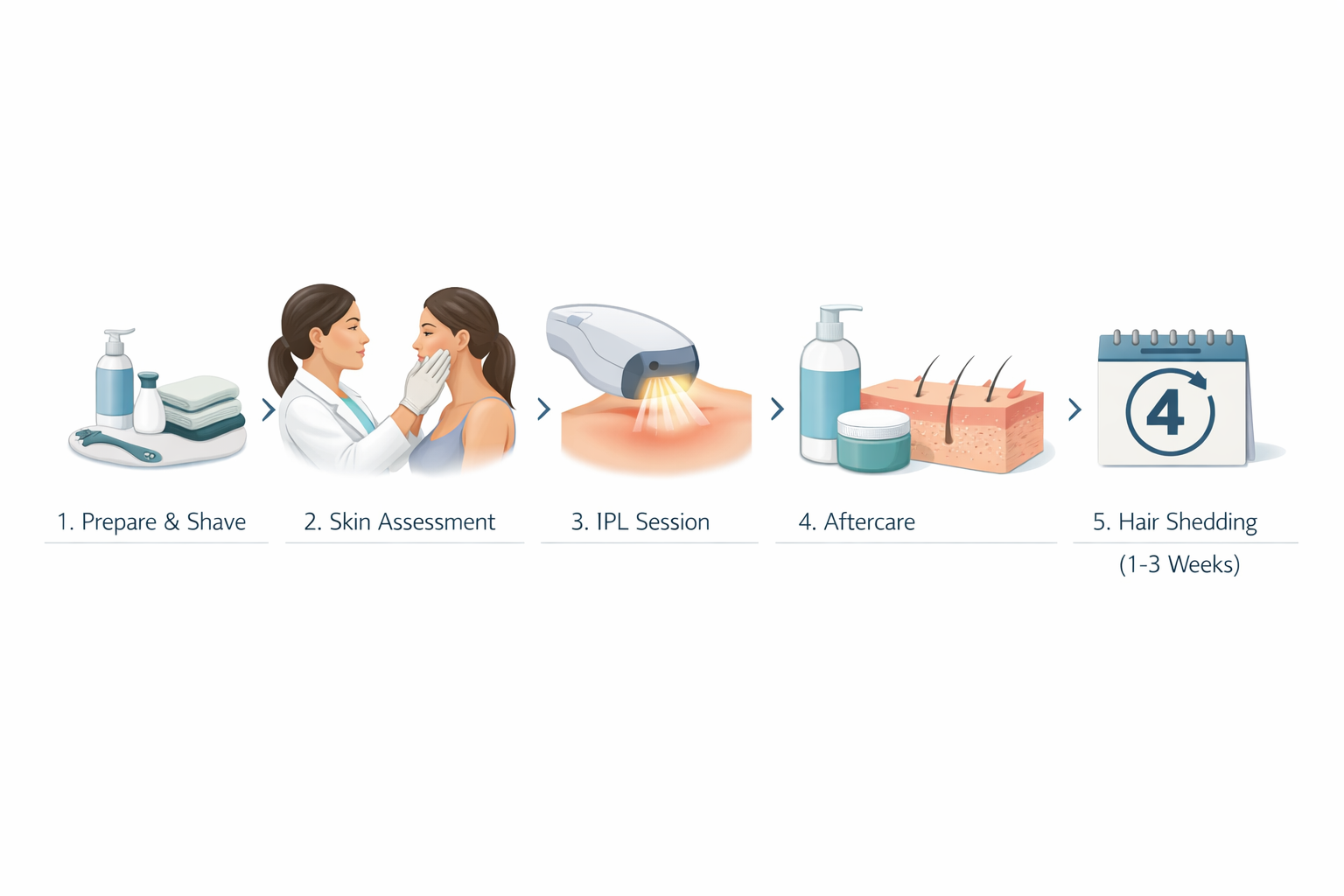
The standard preparation for IPL is to shave the treatment area before each session — typically 24 hours beforehand. Shaving leaves the hair shaft below the skin surface, which allows the IPL energy to travel down the shaft to the follicle without being absorbed by surface hair above the skin. Waxing, threading, or epilating should be avoided in the weeks before treatment, as these methods remove the hair from the follicle and leave no shaft for the energy to travel along. Sun exposure and fake tan should also be avoided before and after sessions, as tanned skin has elevated surface melanin that increases the risk of skin reactions.
During the Session
During an IPL session, the handpiece is pressed flat against the skin and a series of light pulses are delivered across the treatment area. Most people describe the sensation as a mild snapping or warm flicking feeling with each flash. The level of discomfort varies depending on the area being treated, the energy settings used, and individual sensitivity. Areas with thinner skin — such as the upper lip or bikini line — tend to be more sensitive than areas such as the legs or arms.
After Treatment
After IPL, it is normal to experience mild redness and a sensation of warmth in the treated area for a few hours. Some people notice slight swelling around the follicles, which typically resolves within 24 hours. Treated hairs do not fall out immediately — they typically shed gradually over one to three weeks as the follicle releases them. Sun protection is important in the days following treatment, and any skincare products containing active ingredients such as retinoids or acids should be used cautiously on treated skin until sensitivity resolves.
Number of Sessions and Maintenance
A typical IPL course involves between 6 and 12 treatment sessions, spaced approximately four weeks apart. The exact number depends on the area, hair density, hair growth cycle speed, and individual response. After completing a full course, most people require periodic top-up sessions — often once or twice a year — to maintain their level of long-term hair reduction, as a small proportion of follicles may recover function over time.
IPL Safety and Potential Side Effects
IPL is generally considered a low-risk, non-invasive treatment when performed on appropriate candidates using correctly calibrated equipment. However, it is not without risks, and the potential for adverse effects increases when devices are used on unsuitable skin tones, by insufficiently trained operators, or on contraindicated areas.
The most commonly reported side effects are mild and temporary: redness, a sensation of warmth, and minor sensitivity in the treated area for several hours after a session. These typically resolve without intervention. Less commonly, some people experience temporary changes in skin pigmentation — either lightening (hypopigmentation) or darkening (hyperpigmentation) — particularly if the treatment is used on darker skin tones or if the skin is recently tanned.
Burns are a risk when IPL is used on skin types for which it is not suited, when energy settings are too high, or when the handpiece is held stationary rather than moved correctly. This underscores the importance of a skin assessment before beginning treatment, whether in a clinic or with a home device.
IPL should generally be avoided during pregnancy, over tattooed skin, over areas with active skin infections or inflammatory skin conditions, around the eye area (which requires appropriate eye protection during all treatments), and over areas where skin cancer is known or suspected. People taking certain photosensitising medications may also need to avoid or delay IPL treatment. A thorough consultation with a qualified practitioner is important before starting any course of professional treatment.
IPL Beyond Hair Removal
While hair removal is the most widely recognised application of IPL, the same technology is used in aesthetic medicine for a broader range of skin concerns. Because IPL targets melanin and haemoglobin — the red pigment in blood — it can also be directed at superficial pigmentation irregularities and visible blood vessels in the skin.
In clinic settings, IPL is used for skin rejuvenation and photorejuvenation — addressing concerns such as sun-induced age spots, freckles, uneven skin tone, and diffuse redness associated with rosacea. Some practitioners use IPL to reduce the visibility of fine surface blood vessels (telangiectasia). These applications use similar technology but different device settings and treatment protocols to those used for hair reduction, and results and suitability vary between individuals.
Frequently Asked Questions
Is IPL hair removal permanent?
IPL is classified as a permanent hair reduction technology, not permanent hair removal. This is an important regulatory and clinical distinction. A full course of IPL can significantly reduce hair density and slow regrowth to the point where many people require little or no routine maintenance for extended periods. However, hormonal changes, certain medications, and individual biological variation mean that some follicles may partially recover over time. Periodic top-up sessions help maintain results.
Does IPL hurt?
Most people find IPL tolerable. The sensation is commonly described as a mild snapping feeling or a brief flash of warmth with each pulse. More sensitive areas — such as the upper lip, underarms, or bikini line — may cause greater discomfort than larger body areas. Professional clinic devices may feel stronger than at-home devices due to their higher energy output.
Does IPL work on dark skin?
IPL is not recommended for darker Fitzpatrick skin types (V and VI) due to the elevated risk of burns, hyperpigmentation, or hypopigmentation. For people with darker skin tones who wish to pursue light-based hair reduction, an Nd:YAG laser (1064 nm) is generally considered a safer and more clinically appropriate option and should be discussed with a qualified practitioner.
How long do IPL results last?
Results vary between individuals, but many people see significant and lasting hair reduction after completing a full course of treatment. The reduced hair that remains is often finer and lighter. Most people benefit from one or two top-up sessions per year to maintain their results, though some require no maintenance for longer periods.
Can IPL be used on any body area?
IPL can be used on most body areas including legs, arms, underarms, the bikini line, back, chest, and the face (excluding the area immediately around the eyes). It should never be used directly over the eyes, over tattooed skin, on areas with active skin lesions, or over areas where there is any known or suspected skin pathology. Always follow device guidance or your practitioner’s recommendation for specific areas.
How is IPL different from laser if both use light?
Both use light energy, but the nature of that light differs fundamentally. Laser emits monochromatic coherent light at a single specific wavelength, concentrating energy very precisely. IPL emits broadband pulsed light across a spectrum of multiple wavelengths simultaneously, covering more surface area per flash but with less concentrated energy per target. This makes laser generally more precise and often more effective per session, while IPL covers larger areas more quickly and is available for home use.
Is IPL the Right Hair Removal Approach for You?
IPL is a well-established, non-invasive approach to long-term hair reduction that suits a broad range of people — particularly those with dark hair and light-to-medium skin who are looking for a gradual, progressive reduction in unwanted hair without the commitment of more intensive clinical laser treatment.
It is not, however, the right choice for everyone. People with lighter hair colours, darker skin tones, or specific medical contraindications may find that IPL either will not work effectively or carries an unacceptable risk profile. In those cases, alternative approaches — including specific laser wavelengths such as the Nd:YAG for darker skin — are worth discussing with a qualified practitioner.
The decision between at-home IPL and professional treatment ultimately comes down to your budget, how quickly you want results, and whether your skin and hair type falls comfortably within the safe range for self-administered use. Home devices can deliver meaningful results with consistent use, but professional treatment offers greater power, practitioner oversight, and a more tailored approach.
If you are uncertain whether IPL is appropriate for your skin tone, hair type, or medical history, a consultation with a qualified aesthetic practitioner or dermatologist is the most reliable first step. A formal skin assessment can determine whether IPL, a specific laser modality, or another approach is most likely to deliver safe and effective results for your individual situation.
