


Key Takeaways
- Botox for drooping mouth corners works by relaxing the depressor anguli oris (DAO) muscle, allowing the muscles that lift the corners of the mouth to have greater influence on the resting expression.
- This is an off-label use of botulinum toxin type A, meaning it is not a licensed indication but is widely performed by experienced aesthetic practitioners using established injection techniques.
- Results are typically visible within two to five days, reach their full effect at around fourteen days, and generally last three to four months before a repeat appointment is needed.
- A thorough facial anatomy assessment is essential before treatment, as the DAO sits close to muscles that control smiling — incorrect placement can cause temporary asymmetry or smile distortion.
- For some patients, dermal fillers, a combination approach, or an alternative treatment may be more appropriate depending on what is driving the downturned appearance.
What Causes Drooping Mouth Corners?
Downturned mouth corners develop through a combination of aging, muscle activity, and individual anatomy. Understanding which factors are at play matters because the treatment approach differs depending on the cause — and in many patients, more than one factor is contributing at the same time.
Muscle overactivity is one of the most direct causes. The depressor anguli oris (DAO) muscle runs from the lower jawbone up toward each corner of the mouth. When this muscle contracts, it pulls the oral commissures — the corners where the upper and lower lips meet — downward. In some people, the DAO muscle is chronically or excessively active, creating a persistent downward pull on the mouth corners even when the face is at rest. This is what produces the characteristic sad, tired, or stern resting expression that many patients describe as bothering them.
Age-related changes compound the effect. Collagen and volume loss in the lower face reduces the structural support that once held the skin and soft tissue upright. As skin elasticity decreases and the fat compartments of the mid and lower face diminish, the corners of the mouth begin to descend simply because there is less scaffolding holding them in place. Gravity accelerates this process over time.
Genetics also play a distinct role. Some patients notice downturned oral commissures from a relatively young age — even in their twenties or thirties — not because of significant volume loss but because of inherited muscle anatomy or facial bone structure. For these individuals, the DAO muscle is often the primary driver, and the aging changes that matter to older patients are not yet relevant.
Repeated facial expressions over many years, lifestyle factors such as smoking, and sun damage that degrades collagen can all accelerate the process. In some patients, jowling — the descent of soft tissue along the jawline — also contributes by pulling the area around the mouth corners downward. Identifying which combination of factors applies to a given individual is the starting point for any effective treatment plan.
What Is the DAO Muscle and Why Does It Matter?
The depressor anguli oris is one of several mimetic muscles — the muscles responsible for facial expression. It originates along the lower border of the mandible and inserts into the corner of the mouth. Its primary function is to pull the mouth corners downward, which is a natural part of expressions such as frowning or displaying sadness or displeasure.
The key to understanding DAO Botox lies in what might be called muscle antagonist balance. The DAO acts as a depressor — it pulls the oral commissures down. Several other muscles in the lower face act as elevators, pulling the corners of the mouth upward. Under normal circumstances, these opposing muscle groups create a balanced resting position. When the DAO is overactive, the downward pull exceeds the upward pull from the elevator muscles, and the corners of the mouth settle lower than they would otherwise.
Closely related muscles share the same territory. The mentalis muscle, which controls the chin and lower lip, sits nearby. The orbicularis oris encircles the mouth. The platysmal bands run down the neck from the lower face. All of these can interact with the DAO, which is part of why precise injection placement in this area requires detailed knowledge of facial anatomy — the muscles are close together and the margin for error is smaller than it is for, say, the forehead.
How Does Botox Treat Drooping Mouth Corners?
Botulinum toxin type A — marketed under brand names including Botox, Dysport, Xeomin, and Jeuveau — works by temporarily blocking the nerve signals that tell a muscle to contract. When a small amount is injected into the DAO muscle, the muscle’s ability to pull the mouth corners downward is reduced. This tips the balance in favour of the elevator muscles, allowing them to have greater influence on the position of the oral commissures at rest.
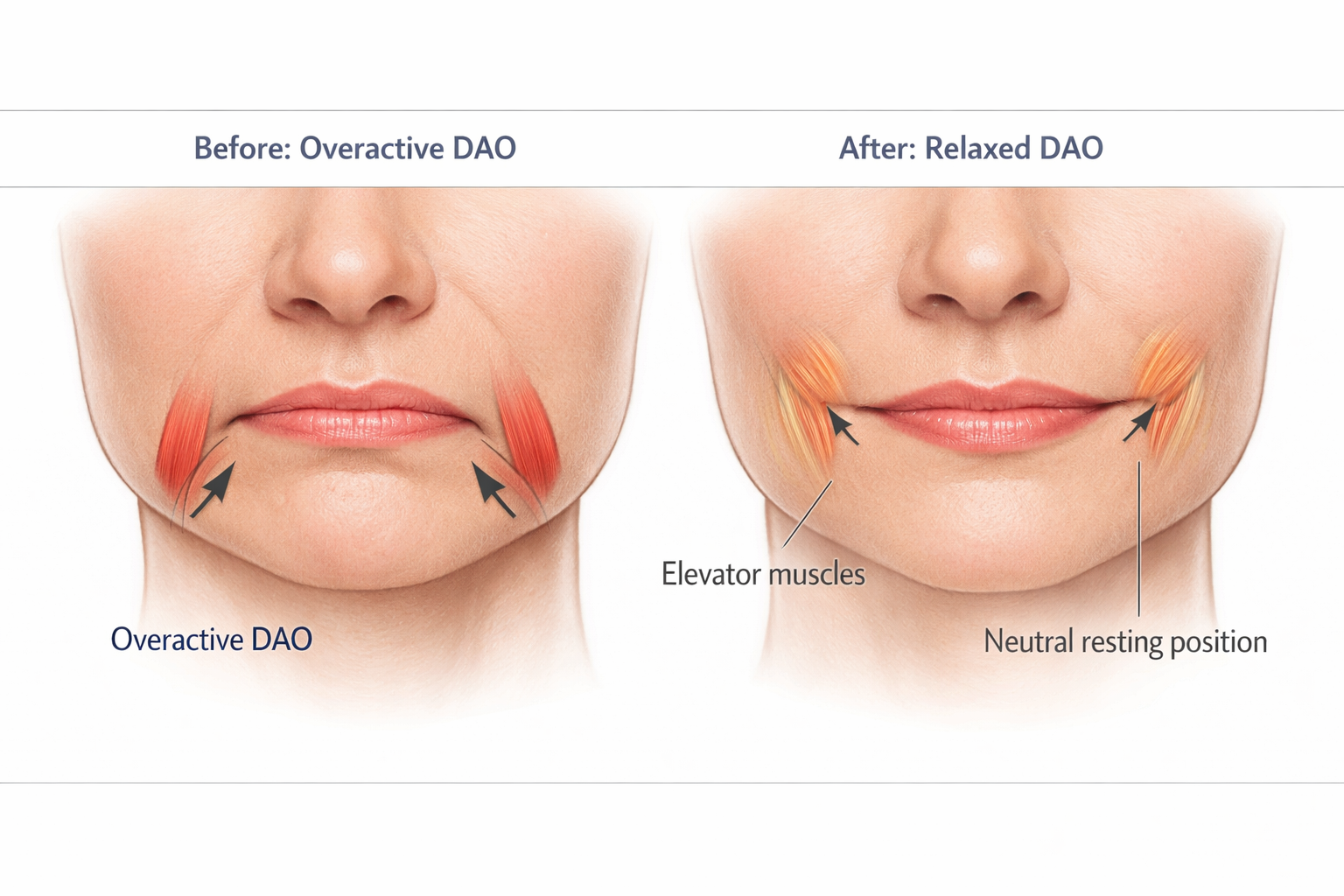
The result is a subtle upward shift in the resting position of the mouth corners — what practitioners sometimes describe as a non-surgical smile lift. The change is typically modest rather than dramatic. The goal is a more neutral or gently positive resting expression, not an artificially wide smile. Patients who respond well often report that people stop asking whether they are feeling tired or unhappy.
This is an off-label use of botulinum toxin. Regulatory bodies in most countries have approved botulinum toxin for specific facial areas such as the glabellar lines between the eyebrows and the forehead, but not for the DAO specifically. Off-label use is legal and common in aesthetic medicine, and experienced practitioners use established techniques based on a growing body of clinical evidence. However, patients should understand that the off-label status means they are relying on their practitioner’s expertise and clinical judgment rather than a formally licensed protocol.
The neuromodulator effect is temporary. The nerve signals gradually resume as the botulinum toxin is metabolised, and the DAO muscle regains its normal function. This is why ongoing maintenance appointments are needed to sustain the result.
What to Expect During the Appointment
A DAO Botox appointment typically takes between five and fifteen minutes once the preparation is complete. A numbing cream may be applied beforehand, though many patients find the injections tolerable without it given the small needle gauge used. The number of injection points is usually one per side, making this a bilateral injection — the same dose is placed symmetrically on both sides of the face to maintain facial balance and avoid asymmetry.
Before any injection is given, a practitioner should conduct a thorough facial anatomy assessment. This involves observing the face at rest and during movement, assessing how the mouth corners behave when smiling and when the face is neutral, and identifying the precise location of the DAO on each side. Because facial anatomy varies between individuals, the exact injection point should be determined per patient rather than applied from a fixed template.
The practitioner will typically ask the patient to contract the DAO — by pulling the mouth corners downward — to help identify the muscle’s location before marking the site. The injection is then placed carefully to target the DAO while avoiding the nearby muscles that control smiling and lip movement.
There is usually little or no downtime immediately after the appointment. Some patients experience mild redness, minor swelling, or small bruises at the injection site, all of which tend to resolve within a few days.
Results: What to Expect and How Long They Last
Most patients begin to notice a change within two to five days as the botulinum toxin starts to take effect. The full result is generally visible at around fourteen days. During the first week or two, the effect may feel unfamiliar — patients sometimes notice a slight change in how certain expressions feel, particularly exaggerated downward movements — though everyday smiling and talking are not usually affected when the injection has been placed correctly.
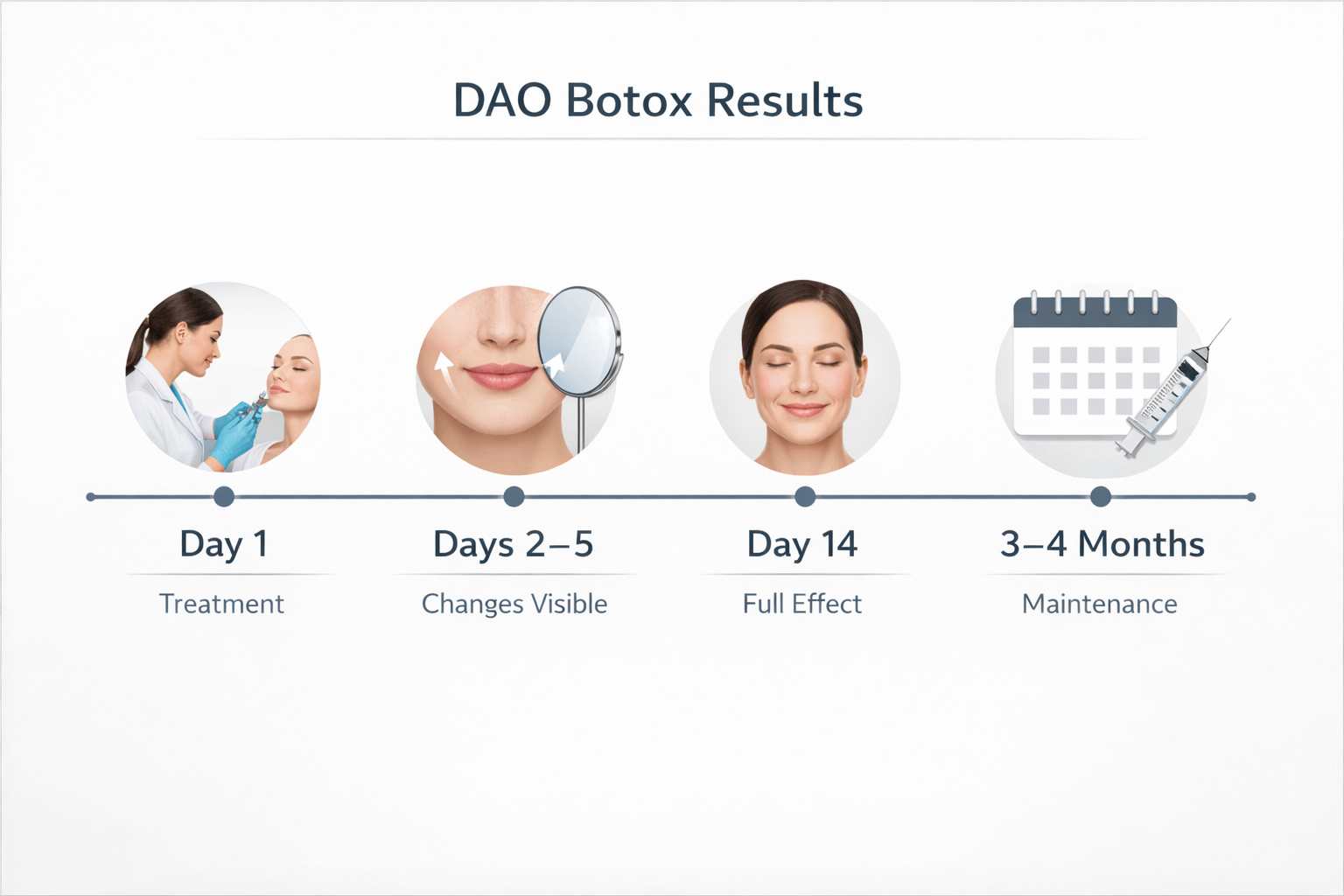
At full effect, the intended outcome is a natural-looking mouth corner lift: the corners sit slightly higher at rest, softening the downturned appearance without looking frozen or artificial. The face should still be able to move expressively; the aim is a more neutral resting baseline, not immobility.
Results typically last three to four months, though some patients report effects persisting up to six months. Duration depends on individual metabolism, the dose used, and how active the DAO muscle is. Patients who have repeated treatments over time sometimes find that the DAO muscle becomes less dominant with consistent relaxation, though this varies and should not be assumed.
Maintenance appointments every three to four months are usually needed to sustain the result. Missing an appointment simply means the muscle gradually returns to its previous level of activity and the downturned appearance slowly returns — there is no rebound or worsening beyond the original baseline.
Risks and Side Effects
DAO Botox is considered a low-risk procedure when performed by a qualified and experienced injector, but it carries a meaningful set of potential side effects that patients should understand before proceeding.
- Temporary asymmetry: If the dose or placement differs slightly between the two sides, one mouth corner may appear slightly higher or lower than the other. Mild asymmetry often resolves as the product settles; significant asymmetry may require a small corrective dose at a follow-up appointment.
- Smile distortion: The DAO sits close to the muscles that elevate the corners of the mouth during smiling. If botulinum toxin diffuses into these adjacent muscles, it can temporarily weaken the smile on the affected side, producing an uneven or altered smile. This is one of the most commonly cited complications specific to this injection site and is why precise placement is critical.
- Difficulty with certain mouth movements: Some patients notice mild difficulty with exaggerated lip movements, such as playing a wind instrument or drinking through a straw, particularly in the first few weeks. This is usually temporary.
- Bruising, swelling, and redness: These are common to all injection-based treatments and typically resolve within a few days.
- Overcorrection: Using too many units per side can produce an unnatural lifted appearance at the mouth corners, an overly taut lower face, or visible restriction of facial movement. Experienced practitioners use conservative doses and assess the result at a follow-up before adding more product.
Contraindications include pregnancy, breastfeeding, active infection at the injection site, certain neurological conditions such as myasthenia gravis or Lambert-Eaton syndrome, and known hypersensitivity to botulinum toxin. Patients taking blood-thinning medications should discuss this with their practitioner ahead of treatment.
This injection area carries a higher risk profile than more forgiving sites such as the forehead, which is why choosing a practitioner with specific experience in lower face anatomy is particularly important.
Botox vs. Dermal Fillers for Drooping Mouth Corners
| Factor | DAO Botox | Dermal Filler |
|---|---|---|
| Mechanism | Relaxes the depressor muscle to reduce downward pull | Adds volume to support and lift the oral commissure area |
| Best suited for | Overactive DAO muscle; genetically or muscle-driven drooping | Volume loss, deep marionette lines, structural deflation |
| Onset | 2–5 days; full effect at 14 days | Immediate, with minor settling over 1–2 weeks |
| Duration | 3–4 months typically | 6–18 months depending on product and area |
| Reversibility | Wears off naturally | Hyaluronic acid fillers can be dissolved with hyaluronidase |
| Risk of overcorrection | Possible with excessive dosing | Possible; overfilling can look unnatural |
| Maintenance | Every 3–4 months | Every 6–18 months |
The right choice — or combination — depends on what is causing the drooping. When the DAO muscle is the primary driver, Botox addresses the problem at its source by reducing the muscle’s downward pull. When collagen and volume loss have caused the tissue around the oral commissures to deflate and descend, adding hyaluronic acid filler such as Juvederm or Restylane to the area restores structural support and can lift the corners more directly.
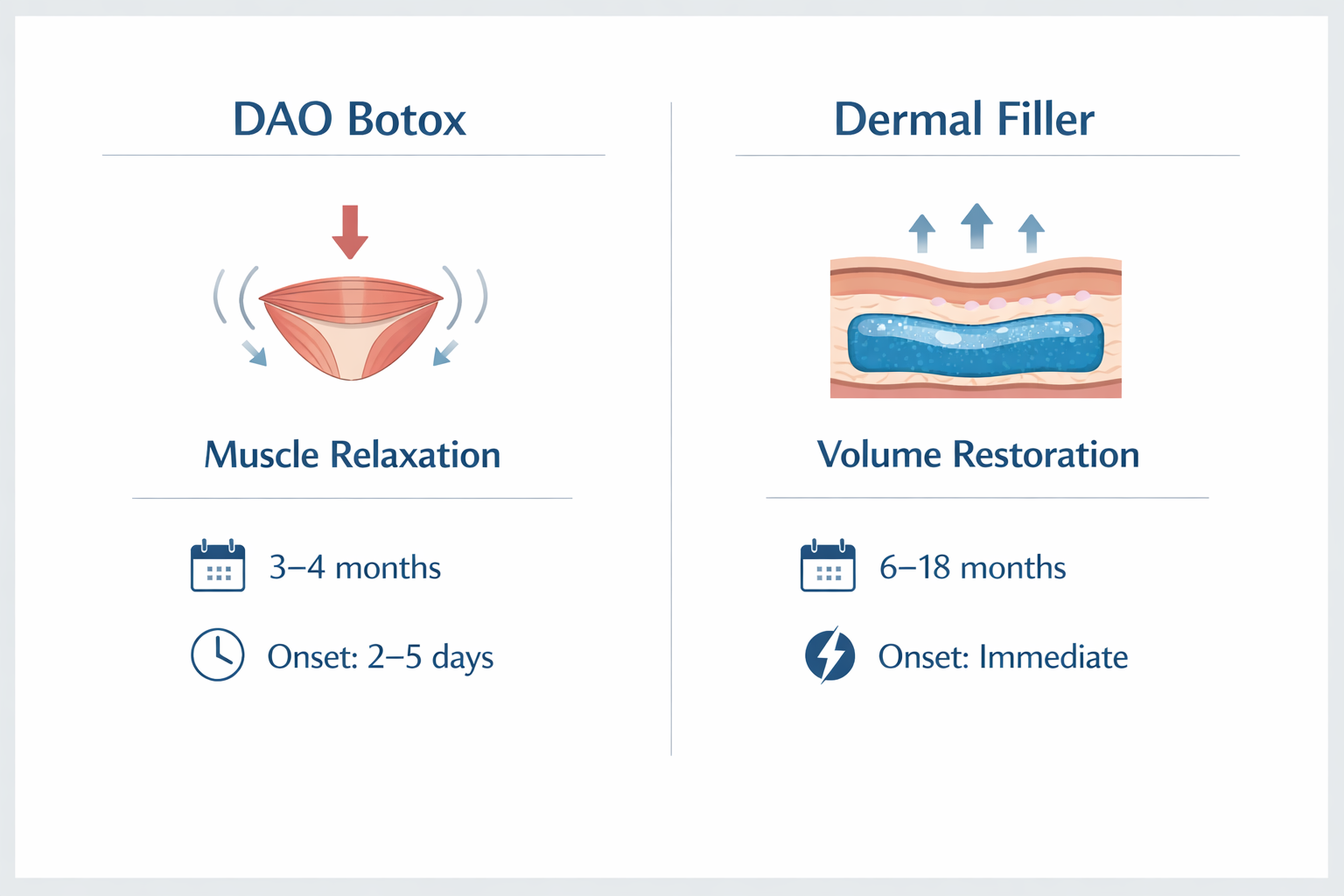
Many practitioners find that a combination approach works well for patients with both muscle overactivity and volume-related changes: a small amount of botulinum toxin to reduce DAO activity, paired with filler to restore the lost support structure. This is particularly relevant when marionette lines — the vertical creases running from the mouth corners down toward the chin — are also a concern, as filler placed along these lines can address both the lines themselves and contribute to lifting the corners.
Filler alone is generally preferred when the patient’s primary issue is structural deflation rather than muscle dominance. Botox alone may be sufficient when the patient is younger, has limited volume loss, and the DAO is clearly the dominant factor. A facial anatomy assessment by an experienced practitioner is the appropriate way to determine which strategy fits a given patient’s anatomy and goals.
Who May Be a Suitable Candidate?
- Adults who notice that their mouth corners turn downward at rest, creating a sad, stern, or permanently unhappy resting expression
- Younger patients (twenties or thirties) where the drooping is genetically influenced and not primarily driven by volume loss
- Patients with a clearly overactive DAO muscle — identifiable when the practitioner assesses how the corners move during facial expressions
- Those seeking a subtle, non-surgical improvement without significant downtime
- Patients with realistic expectations who understand that the result is a modest improvement in resting position, not a dramatic transformation
- Those who are not pregnant, breastfeeding, or subject to relevant contraindications
DAO Botox is less likely to be the primary recommendation for patients whose main concern is significant volume loss, deep marionette lines from tissue deflation, or heavy jowling, where structural treatments such as fillers, thread lifts, or surgical options would address the underlying cause more directly.
Aftercare Instructions
Following aftercare instructions after DAO Botox helps reduce the risk of the product migrating to adjacent muscles and supports a smooth, even result. Most practitioners recommend the following for the first twenty-four hours after treatment:
- Avoid touching, rubbing, or massaging the injection sites
- Stay upright and avoid lying face-down for several hours post-treatment
- Avoid strenuous exercise, saunas, steam rooms, and exposure to high temperatures
- Avoid alcohol and blood-thinning medications or supplements where clinically appropriate (discuss with your practitioner before stopping any prescribed medication)
- Do not undergo facial massage, microneedling, or other skin treatments in the area for at least two weeks
A follow-up appointment at two weeks is advisable to assess the result, identify any asymmetry, and make minor corrections if needed before the practitioner and patient both evaluate the final outcome.
Choosing a Qualified Practitioner
The lower face is a more technically demanding injection zone than the upper face. The DAO sits in close proximity to muscles that produce smiling and lip movement, and the consequences of misplaced botulinum toxin — even a small diffusion error — can be more visible and more functionally disruptive than a comparable error in the forehead or glabella region.
When selecting a practitioner, relevant considerations include formal medical or dental qualification, specific training in lower face aesthetics, demonstrable experience with DAO injections, and a clear commitment to a preliminary facial anatomy assessment before any treatment is agreed. A practitioner who is willing to decline treatment or recommend an alternative if DAO Botox is not appropriate for a patient’s anatomy is a positive sign of clinical integrity.
Red flags include practitioners who offer a fixed injection point without individual assessment, do not discuss the off-label nature of the treatment, or are unable to explain what they would do if a complication arose. This is not a treatment to seek on the basis of price alone.
Frequently Asked Questions
Is DAO Botox painful?
Most patients describe the injection as a brief, mild sting. A fine-gauge needle is used, and the volume injected per site is small. Numbing cream can be applied beforehand if a patient prefers additional comfort, though many find it unnecessary.
Can DAO Botox affect my smile?
When placed correctly, DAO Botox should not meaningfully alter the appearance of a natural smile. However, if the botulinum toxin diffuses into the nearby elevator muscles — particularly the zygomaticus — it can temporarily weaken or alter the smile on that side. This is one of the key reasons why precise placement and conservative dosing matter in this area. Any smile-related change from this cause is temporary and resolves as the product wears off.
How many units are typically used?
Dosing in this area is generally conservative. The range commonly discussed in clinical practice is approximately two to four units per side for a bilateral injection, though the appropriate amount for a given patient depends on DAO muscle size, activity level, and the practitioner’s assessment. Units are not interchangeable between botulinum toxin brands — Dysport, for example, uses a different unit scale to Botox — so dosing should always be discussed in the context of the specific product being used.
Will the treatment look natural?
A well-executed result should look natural. The goal is a more neutral or gently positive resting expression, not a fixed or exaggerated lift. Starting with a conservative dose and reviewing at two weeks helps ensure the outcome remains proportionate to the patient’s face.
How often will I need repeat treatments?
Most patients return every three to four months to maintain the result. Some find that with consistent treatment over time the DAO muscle becomes somewhat less dominant, though this should not be relied upon as a guaranteed outcome.
Is DAO Botox suitable if I also have marionette lines?
It can be, but marionette lines that are driven primarily by volume loss may respond better to hyaluronic acid filler or a combination approach. A practitioner assessment will determine whether Botox alone, filler alone, or a combined strategy is the most appropriate plan for a given patient’s lower face anatomy and concerns.
Are there any long-term risks from repeated treatment?
Long-term use of botulinum toxin in facial muscles is generally considered well-tolerated based on available clinical experience, but long-term data specific to DAO injection is more limited than for areas such as the forehead. Some practitioners note a gradual reduction in DAO muscle activity with repeated relaxation over time, which could theoretically reduce the dose needed. Patients should discuss their individual treatment history and any concerns at each appointment.
Is Drooping Mouth Corner Botox Worth Discussing with a Practitioner?
For patients whose downturned mouth corners are driven primarily by an overactive DAO muscle — particularly those who are younger or have limited volume loss — botulinum toxin treatment offers a non-surgical, low-downtime option that can meaningfully improve the resting expression. The results are temporary and require ongoing maintenance, and the treatment carries a higher technical demand than forehead injections, but when performed by a skilled and experienced practitioner following a proper facial anatomy assessment, it can deliver a subtle, natural-looking improvement that many patients find worthwhile.
The treatment is less straightforwardly appropriate for patients whose drooping is primarily structural — driven by collagen and volume loss, jowling, or significant marionette lines. These patients may see better results from fillers, a combination approach, or a different treatment altogether. There is no single universal recommendation: the right path depends on individual anatomy, the underlying cause of the concern, and what the patient is trying to achieve.
A consultation with a qualified aesthetic practitioner who can assess the lower face in detail, explain the realistic benefits and limitations of each option, and tailor a treatment plan to the individual is the appropriate starting point. Approaching this treatment with realistic expectations — a modest, natural improvement rather than a dramatic transformation — tends to produce the most satisfied outcomes.
