
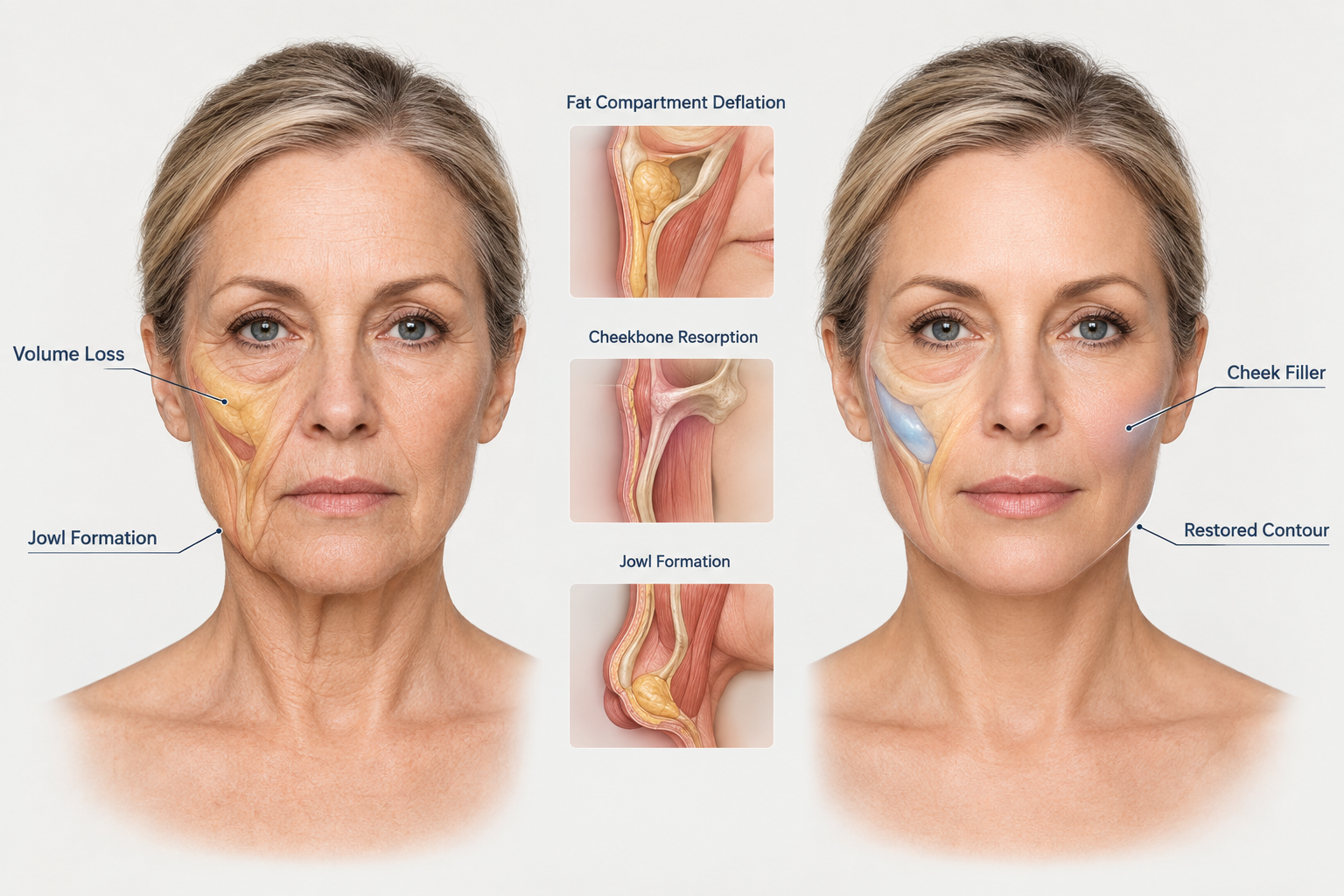

Jowling — the gradual descent of soft tissue along the lower face — is one of the most common concerns patients raise during aesthetic consultations. While surgical options exist, many people first explore whether dermal filler placed in the cheeks can provide a meaningful lift to the jowl area without surgery. The short answer is that strategic cheek volumising can improve the appearance of mild to moderate jowling in suitable candidates, though results depend heavily on individual anatomy, the degree of tissue laxity, and the skill of the practitioner performing the treatment.
Key Takeaways
- Placing hyaluronic acid filler in the mid-cheek and cheekbone area can create a subtle lifting effect that may reduce the appearance of mild to moderate jowls.
- This approach works by restoring lost volume and improving structural support in the midface, rather than directly targeting the jowl itself.
- Results are temporary, typically lasting 12 to 18 months depending on the product used, the area treated, and individual factors.
- Cheek filler is not a substitute for surgical intervention in cases of significant skin laxity or pronounced jowling.
- A thorough consultation with a qualified practitioner is essential to assess suitability and set realistic expectations.
Why Jowls Develop: The Role of Midface Volume Loss
Understanding why jowls form helps explain why cheek filler can be a relevant treatment option. Facial ageing is not simply a matter of skin sagging downward under gravity. It involves a combination of bone resorption, fat compartment deflation, ligament laxity, and changes in skin elasticity — all occurring simultaneously across different facial layers. The cheeks are particularly significant in this process.
The midface contains several distinct fat compartments that provide structural support to the overlying skin and soft tissue. As these compartments lose volume with age, the scaffolding that holds the lower face in position weakens. The malar fat pad — the rounded fullness of the cheek — descends, and the tissue that was once supported by a full midface begins to collect along the jawline, forming what is commonly called a jowl. Bone resorption in the cheekbone and orbital rim area further reduces the projection that once kept soft tissue elevated.
This anatomical understanding is the basis for using cheek filler as a jowl-lifting strategy. By restoring volume to the depleted midface, a practitioner can re-establish some of the structural support that has been lost, which may allow descended tissue to appear more elevated and the jawline to look more defined.
How Cheek Filler Creates a Lifting Effect
Dermal filler placed in the cheek region does not physically pull tissue upward in the way a surgical facelift does. Instead, the mechanism is one of structural support and volumetric repositioning. When hyaluronic acid filler is injected into the deep fat compartments or along the cheekbone, it adds projection and lift to the midface scaffold. This can reduce the downward pull on the lower face and create the visual impression of a more elevated, defined cheek contour.
The effect on jowling is indirect. A fuller, more projected midface creates a smoother transition from the cheek to the lower face, which can make jowls appear less prominent. In some patients, restoring midface volume also reduces the depth of the nasolabial folds — the lines running from the nose to the corners of the mouth — which contributes to an overall more youthful lower-face appearance.
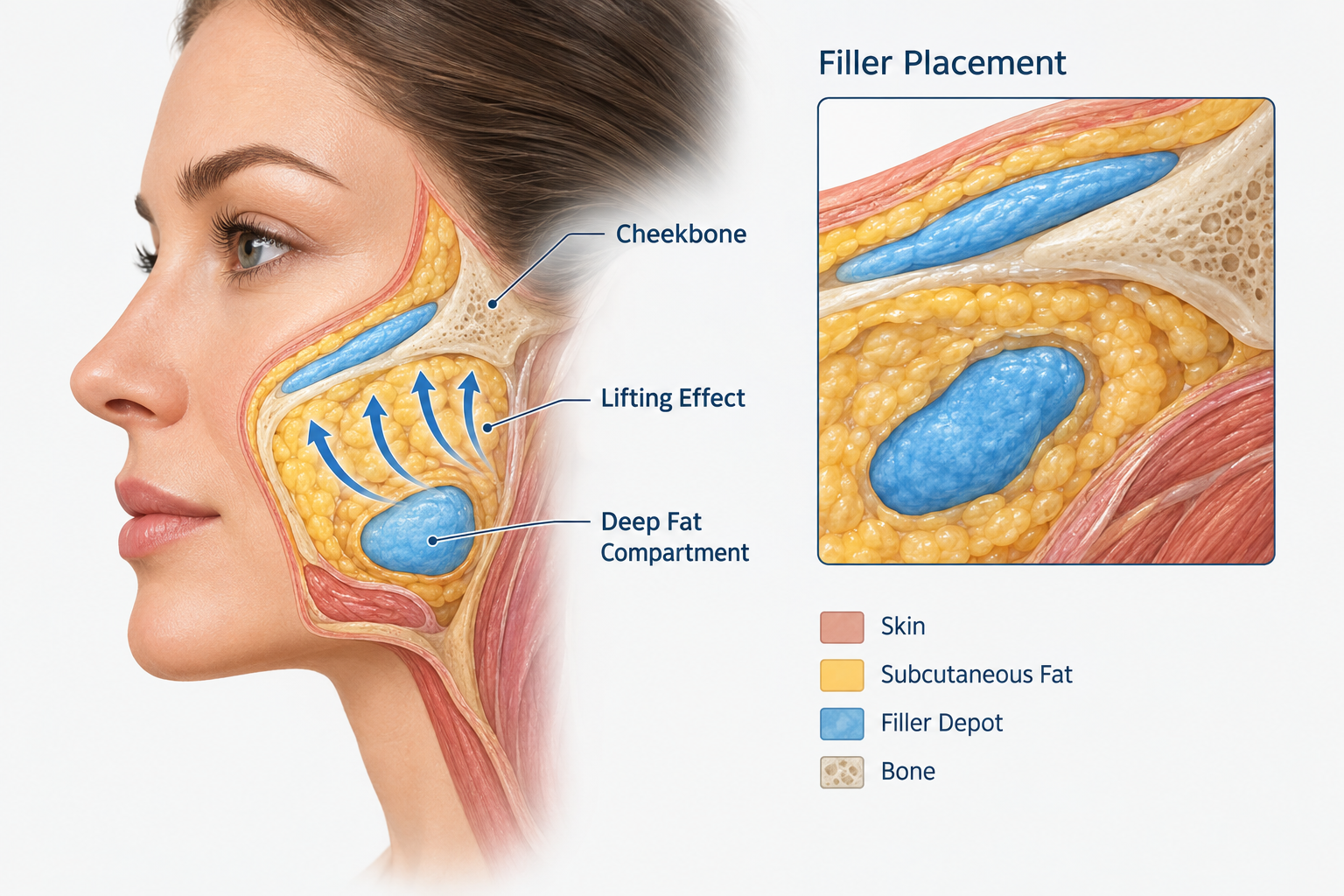
Practitioners may also combine cheek filler with small amounts of filler placed directly along the jawline or prejowl sulcus — the depression just in front of the jowl — to further improve jawline definition. This combination approach addresses both the structural deficit in the midface and the contour irregularity at the jaw.
What Happens During a Cheek Filler Appointment
A cheek filler appointment for jowl improvement typically begins with a detailed consultation, during which the practitioner assesses facial anatomy, skin quality, the degree of volume loss, and the extent of jowling. Photographs are usually taken, and the practitioner will discuss realistic outcomes based on individual anatomy rather than generic before-and-after images.
The treatment itself is generally performed using either a fine needle or a blunt-tipped cannula, depending on the injection site and the practitioner’s technique. A cannula is often preferred for deeper cheek injections because it reduces the risk of bruising and allows the filler to be placed more precisely within the target tissue plane. Most hyaluronic acid fillers used in the cheek area contain a local anaesthetic (lidocaine) within the formulation, which helps manage discomfort during the procedure.
The appointment usually takes between 30 and 60 minutes, including consultation time. Patients can typically return to normal daily activities the same day, though some swelling and tenderness in the treated area is expected in the first 24 to 72 hours. Bruising is possible, particularly if a needle technique is used or if the patient takes blood-thinning medications.
Which Fillers Are Used for Cheek Volumising?
Hyaluronic acid (HA) fillers are the most commonly used products for cheek volumising and midface lifting. Hyaluronic acid is a naturally occurring substance found in the skin and connective tissue, and HA-based fillers are reversible using an enzyme called hyaluronidase — an important safety consideration for a treatment area close to significant blood vessels.
Different HA filler products vary in their rheological properties — essentially their thickness, elasticity, and ability to withstand compression. Cheek treatments typically require a firmer, more cohesive filler that can provide structural lift and maintain its shape in a high-movement area. Products such as Juvederm Voluma, Restylane Lyft, and Teosyal RHA 4 are examples of HA fillers formulated for volumising and lifting in the midface, though product availability varies by country and clinical context.
Some practitioners use calcium hydroxylapatite (CaHA) fillers, such as Radiesse, for cheek volumising. CaHA fillers have a different mechanism of action, providing immediate volume while also stimulating collagen production over time. These products are not reversible with hyaluronidase, which is a relevant consideration when assessing risk. The choice of product should be made by the treating practitioner based on the patient’s anatomy, goals, and medical history.
Realistic Results: What Cheek Filler Can and Cannot Do for Jowls
Cheek filler can produce a meaningful improvement in the appearance of mild to moderate jowling, particularly in patients whose primary issue is midface volume loss rather than significant skin laxity. In these candidates, restoring cheek projection and midface fullness can visibly soften the jowl contour and improve the overall balance of the lower face.
However, cheek filler has clear limitations. In patients with pronounced jowling, significant skin laxity, or substantial descent of the SMAS (the deeper muscular layer of the face), volumising the cheeks alone is unlikely to produce a dramatic improvement. Adding more filler to compensate for inadequate lift can result in an overfilled, unnatural appearance — sometimes described as a heavy or puffy midface — without meaningfully addressing the jowl. Experienced practitioners are careful to avoid this outcome by assessing the underlying cause of jowling before recommending treatment.
Results from cheek filler are also temporary. Hyaluronic acid fillers in the cheek area typically last between 12 and 18 months, though this varies depending on the specific product, the volume used, the patient’s metabolism, and lifestyle factors. Maintenance treatments are required to sustain the effect over time.
Who May Be Suitable for Cheek Filler to Address Jowling
Cheek volumising for jowl improvement tends to produce the most satisfying results in patients who meet certain anatomical and clinical criteria. Suitable candidates are generally those who:
- Have mild to moderate jowling rather than severe soft tissue descent
- Show visible midface volume loss or flattening of the cheek contour
- Have reasonable skin quality with some residual elasticity
- Are not seeking the degree of correction that only surgery can provide
- Have realistic expectations about the nature and longevity of results
- Are in good general health with no contraindications to injectable treatments
Younger patients in their late thirties or forties who are beginning to notice early jowling and midface deflation are often good candidates, as their skin still retains sufficient elasticity to respond well to volumising. Older patients with more advanced laxity may still benefit, but the degree of improvement is likely to be more modest, and a combination approach or surgical referral may be more appropriate.
Who May Not Be Suitable
Cheek filler for jowl lifting is not appropriate for everyone. A practitioner will assess suitability carefully before recommending treatment. Factors that may affect suitability include:
- Severe skin laxity or significant jowling that is unlikely to respond adequately to volumising alone
- Active skin infection, inflammation, or cold sore outbreak in or near the treatment area
- Known allergy to hyaluronic acid or any filler component
- Pregnancy or breastfeeding
- Certain autoimmune conditions or bleeding disorders
- Use of anticoagulant medications (which may increase bruising risk — discuss with the practitioner)
- Previous permanent filler in the area, which may complicate placement and increase complication risk
- Unrealistic expectations about the degree of lift achievable without surgery
A thorough medical history and facial assessment at consultation will help determine whether cheek filler is an appropriate option or whether an alternative approach would better serve the patient’s goals.
Risks and Side Effects
Dermal filler injections in the cheek area carry a range of possible side effects and risks, which vary from common and temporary to rare but serious. Patients should be fully informed before consenting to treatment.
Common and expected side effects include swelling, redness, tenderness, and bruising at the injection sites. These typically resolve within a few days to two weeks. Some patients experience temporary asymmetry as swelling settles unevenly, which usually improves as the filler integrates with surrounding tissue.
Less common side effects include prolonged swelling, nodule formation, or visible irregularities if the filler is not placed evenly. These may require massage, hyaluronidase dissolution (for HA fillers), or further treatment to correct.
Rare but serious complications include vascular occlusion — where filler inadvertently enters or compresses a blood vessel, potentially compromising blood supply to surrounding tissue. The cheek and midface area contains important vascular structures, and vascular occlusion in this region can, in rare cases, lead to skin necrosis or, extremely rarely, vision changes if the ophthalmic circulation is affected. This underscores the importance of choosing a practitioner with appropriate medical training, a thorough knowledge of facial anatomy, and access to hyaluronidase for emergency reversal.
Infection is another rare risk. Delayed-onset nodules — sometimes called biofilm-related reactions — can occur weeks or months after treatment and may require antibiotic treatment or filler dissolution. Patients should report any unusual swelling, pain, or skin changes to their practitioner promptly.
Alternatives to Cheek Filler for Jowl Improvement
Cheek volumising is one of several approaches that may be considered for jowl improvement, and the most appropriate option depends on the severity of the concern, the patient’s anatomy, and their goals.
Thread lifting uses absorbable sutures with small cones or barbs to physically reposition descended tissue. PDO (polydioxanone) and PLLA (poly-L-lactic acid) threads can be placed along the cheek and jawline to provide a mechanical lift. Thread lifting may be more appropriate than filler alone in patients with moderate laxity, and the two approaches can sometimes be combined. Results typically last 12 to 24 months depending on the thread type.
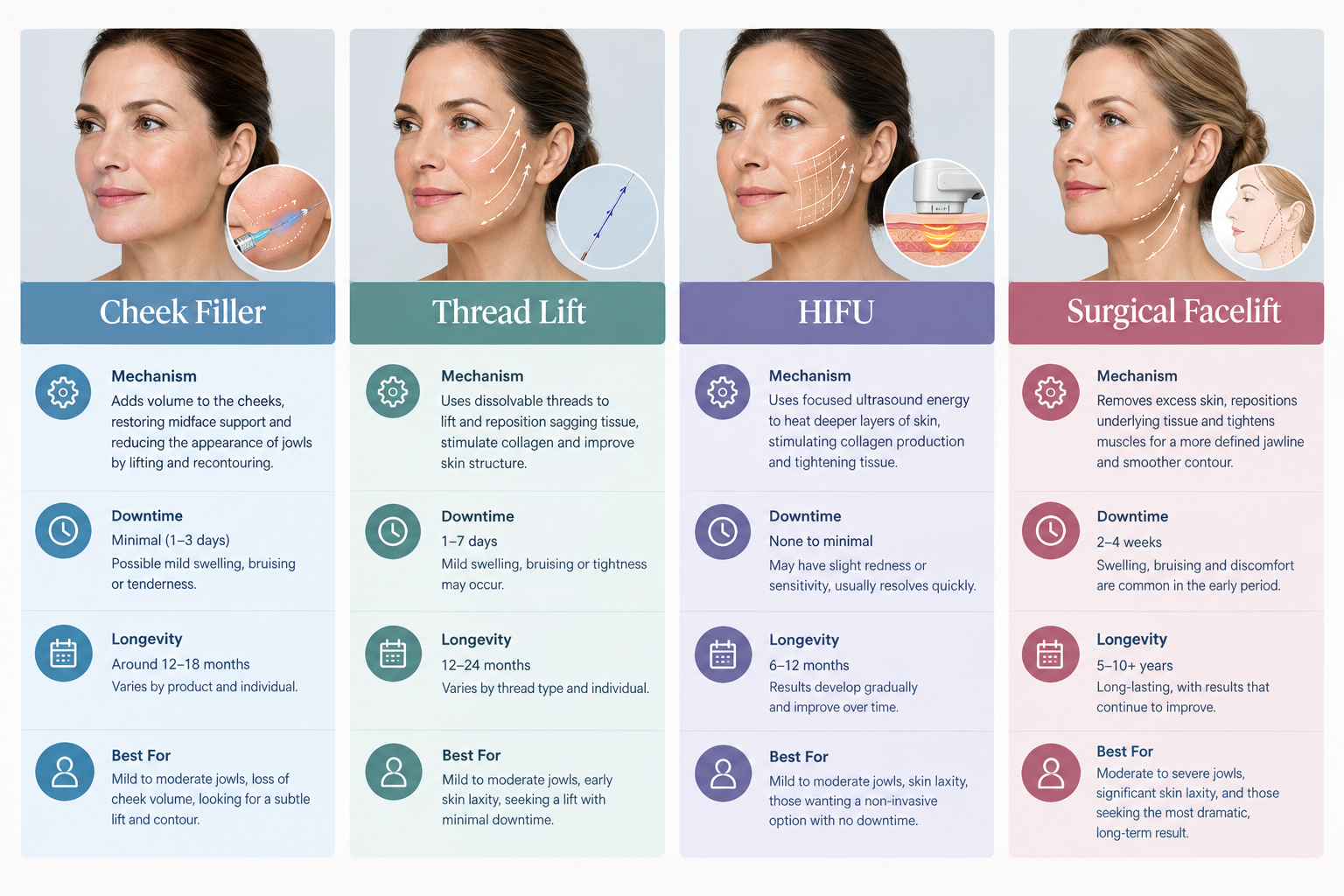
Skin tightening devices such as high-intensity focused ultrasound (HIFU) and radiofrequency (RF) treatments work by stimulating collagen production in the deeper skin layers and SMAS, which can gradually improve skin firmness and reduce mild laxity. These treatments are non-invasive but require multiple sessions and produce more gradual results than filler or threads. They may be useful as a complementary or maintenance approach.
Botulinum toxin injected into the platysma muscle (the broad muscle of the neck and lower face) can reduce downward pull on the lower face and may subtly improve jawline definition. This is sometimes called a Nefertiti lift. The effect is modest and temporary, lasting approximately three to four months, but it can complement cheek filler in a comprehensive lower-face treatment plan.
Surgical facelift (rhytidectomy) remains the most effective intervention for significant jowling and skin laxity. A facelift directly addresses the SMAS and removes or repositions excess skin, producing results that non-surgical treatments cannot replicate. Patients with advanced jowling who are seeking substantial, long-lasting correction may be better served by a surgical consultation.
Combining Treatments for Better Lower-Face Results
In clinical practice, a single treatment modality rarely addresses all aspects of lower-face ageing. Many practitioners take a combination approach, using cheek filler to restore midface volume and structural support, jawline filler to refine the lower border of the face, and botulinum toxin to relax muscles that contribute to downward pull. Skin quality treatments such as medical-grade skincare, chemical peels, or laser resurfacing may also be incorporated to address surface texture and skin laxity that volumising alone cannot improve.
The advantage of a combination approach is that it targets multiple contributing factors simultaneously, which can produce a more natural and balanced result than any single treatment. The disadvantage is increased cost, treatment time, and cumulative risk. A practitioner experienced in full-face assessment can help determine which combination of treatments is most likely to achieve the patient’s goals safely and efficiently.
Frequently Asked Questions
How much filler is typically needed in the cheeks to see a lifting effect on jowls?
The volume required varies considerably between individuals depending on the degree of volume loss and the patient’s facial anatomy. A practitioner will assess this at consultation and recommend an appropriate amount. Overfilling the cheeks in an attempt to maximise lift can produce an unnatural result, so a conservative, staged approach is often preferable.
Will the results look natural?
When performed by an experienced practitioner with a thorough understanding of facial anatomy and proportions, cheek filler can produce a natural-looking improvement. Results that appear overdone are usually the result of excessive volume, incorrect placement, or an unsuitable product choice. Reviewing a practitioner’s portfolio of work and discussing your aesthetic goals in detail at consultation can help set appropriate expectations.
How long before I see the full result?
Initial swelling after cheek filler can temporarily exaggerate the result. Most patients see a more accurate representation of their outcome after one to two weeks, once swelling has fully resolved. The filler continues to integrate with surrounding tissue over the following weeks, and the final result is usually apparent by four weeks post-treatment.
Can cheek filler make jowls worse?
Poorly placed or excessive cheek filler can occasionally worsen the appearance of jowling by adding weight to the midface without providing adequate lift, or by creating an unbalanced facial profile. This is one reason why practitioner selection and a thorough pre-treatment assessment are important.
Is cheek filler painful?
Most patients describe the procedure as mildly uncomfortable rather than painful. The filler product typically contains lidocaine, and practitioners may apply a topical anaesthetic cream beforehand. Discomfort varies depending on the injection technique, the area treated, and individual pain tolerance.
Can cheek filler be dissolved if I am unhappy with the result?
Hyaluronic acid fillers can be dissolved using hyaluronidase, an enzyme that breaks down hyaluronic acid. This provides an important safety option if the result is unsatisfactory or if a complication occurs. Calcium hydroxylapatite fillers cannot be dissolved in the same way, which is a relevant consideration when choosing a product.
How does cheek filler for jowls compare to a surgical facelift?
Cheek filler offers a non-surgical, lower-risk option with minimal downtime, but it cannot replicate the degree of correction achievable with a facelift. Filler results are temporary and require maintenance, whereas a surgical facelift produces more substantial and longer-lasting improvement in significant jowling and skin laxity. The right choice depends on the severity of the concern, the patient’s goals, and their willingness to accept the risks and recovery associated with surgery.
Is Cheek Filler the Right Approach for Your Jowls?
Cheek volumising with dermal filler is a clinically rational approach to mild and moderate jowling in patients whose primary issue is midface volume loss and structural deflation. By restoring projection and support to the cheek area, filler can create a meaningful improvement in lower-face contour without surgery, with minimal downtime and a reversible safety profile when hyaluronic acid products are used.
The treatment has real limitations. It is not a substitute for surgery in patients with significant skin laxity or advanced jowling, and results require ongoing maintenance. The risk of serious complications, while low in experienced hands, is not negligible in the midface region, and practitioner selection matters considerably.
If you are considering filler in the cheeks to address jowling, a consultation with a qualified medical practitioner — ideally one with specific training in facial anatomy and injectable treatments — is the appropriate starting point. A thorough assessment of your facial structure, skin quality, and goals will determine whether cheek filler alone, a combination approach, or an alternative treatment is most likely to meet your expectations safely and effectively.
