
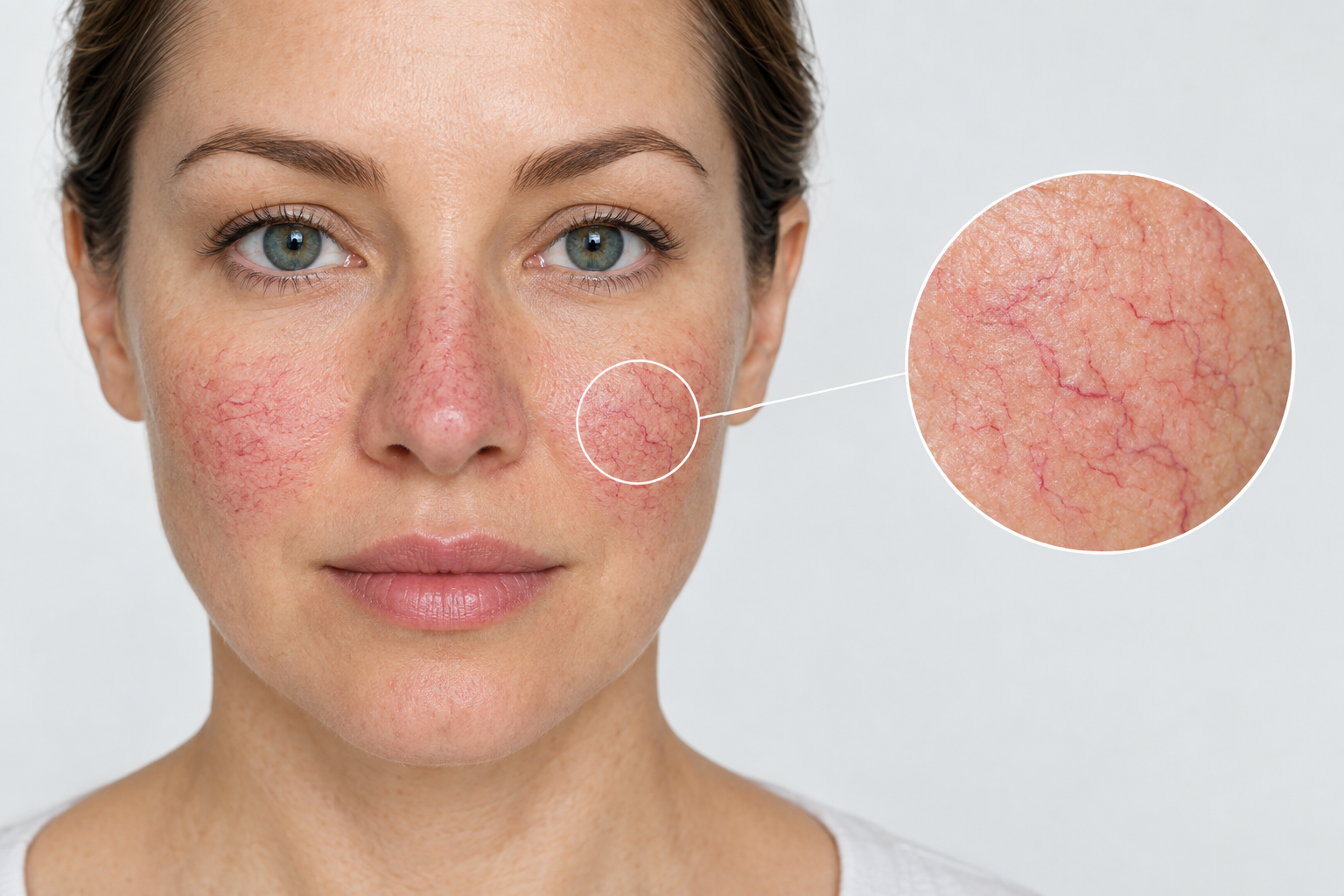

Broken capillaries on the face are one of the most common cosmetic concerns seen in aesthetic clinics. These small, dilated blood vessels sit close to the skin's surface and appear as fine red, pink, or purple lines — most often across the nose, cheeks, and chin. While they are not medically dangerous, many people find them difficult to conceal and seek professional advice about reducing their appearance. This article explains what broken capillaries are, why they develop, which treatments are currently used, and what realistic outcomes look like.
Key Takeaways
- Broken capillaries are permanently dilated superficial blood vessels, not vessels that have literally ruptured — they do not resolve on their own without treatment.
- Common causes include sun damage, rosacea, genetics, and repeated skin flushing; identifying the underlying cause helps guide treatment choice.
- Laser and intense pulsed light (IPL) treatments are the most widely used professional options and can significantly reduce the visible appearance of facial thread veins in suitable candidates.
- Multiple sessions are often required, and maintenance treatments may be needed over time, particularly if the underlying cause persists.
- A thorough skin assessment by a qualified practitioner is important before treatment, as some skin types and conditions require a different approach.
What Are Broken Capillaries?
The term "broken capillaries" is commonly used but slightly misleading. These vessels have not actually broken or ruptured — they are capillaries and small venules that have become permanently dilated and are now visible through the skin. The medical term is telangiectasia, and when they appear in a web-like pattern they are sometimes called spider veins or thread veins. On the face, they most frequently appear on the nose, cheeks, and around the chin, though they can develop anywhere on the face or neck.
Healthy capillaries expand and contract in response to temperature, exercise, and emotion. When the vessel wall loses its elasticity over time, the capillary remains in a dilated state and becomes permanently visible. The vessels themselves are still intact and functional — they simply no longer contract back to their resting diameter. This distinction matters because it explains why topical skincare products alone cannot eliminate them: the structural change within the vessel wall requires a targeted treatment to close or destroy the dilated vessel.
What Causes Broken Capillaries on the Face?
Several factors can contribute to the development of facial telangiectasia, and in many people more than one cause is present simultaneously. Understanding the likely cause is useful when planning treatment, because addressing an ongoing trigger can reduce the chance of new vessels forming after treatment.

Sun Damage
Cumulative ultraviolet exposure is one of the most significant contributors to broken capillaries on the face. UV radiation damages the collagen and elastin that support the vessel walls, reducing their ability to contract. People with a history of significant sun exposure or those who have spent many years outdoors without adequate sun protection are particularly likely to develop facial thread veins on the cheeks and nose.
Rosacea
Rosacea is a chronic inflammatory skin condition characterised by persistent facial redness, flushing, and the development of visible blood vessels. Broken capillaries are a hallmark feature of rosacea, particularly in its vascular subtype. In people with rosacea, treating the visible vessels can improve the cosmetic appearance, but the underlying condition requires ongoing management to prevent new vessels from forming. A dermatologist or experienced practitioner should assess whether rosacea is present before treatment begins.
Genetics and Skin Type
A tendency to develop facial telangiectasia can run in families. People with fair skin and a Celtic or Northern European background are statistically more likely to develop visible facial vessels, partly because the skin is thinner and the vessels are closer to the surface, and partly because fair skin is more susceptible to UV damage. Skin type also influences which treatments are safest and most effective.
Repeated Flushing and Temperature Extremes
Frequent and repeated flushing — triggered by heat, spicy food, alcohol, exercise, or emotional response — places repeated stress on capillary walls. Over time this can contribute to permanent dilation. Exposure to extreme cold or wind can have a similar effect. Reducing known flushing triggers does not reverse existing broken capillaries but may slow the development of new ones.
Trauma and Skin Injury
Physical trauma to the skin, including aggressive facial massage, harsh exfoliation, or injury, can damage superficial vessels. Certain medical procedures and skin conditions that cause chronic inflammation may also contribute. Acne rosacea and other inflammatory skin conditions are associated with a higher incidence of facial telangiectasia.
Hormonal Changes and Pregnancy
Hormonal fluctuations, including those associated with pregnancy, oral contraceptive use, and menopause, can affect vascular tone and contribute to the development of visible facial vessels in some individuals. Pregnancy-related broken capillaries sometimes improve after delivery, though this is not guaranteed.
Professional Treatment Options for Broken Capillaries
Several professional treatments are used to reduce the appearance of broken capillaries on the face. The most appropriate option depends on the size and location of the vessels, the patient's skin type, the presence of any underlying skin condition, and the practitioner's assessment. No single treatment is universally superior for every patient.

Laser Treatment
Laser therapy is one of the most established approaches for treating facial telangiectasia. Vascular lasers — including the pulsed dye laser (PDL) and Nd:YAG laser — work through a process called selective photothermolysis. The laser emits a specific wavelength of light that is preferentially absorbed by oxyhaemoglobin, the pigment in red blood cells. This absorption generates heat within the vessel, causing it to coagulate and collapse. The body then gradually reabsorbs the treated vessel over the following weeks.
Pulsed dye laser is widely regarded as effective for superficial facial vessels and rosacea-related redness. The Nd:YAG laser penetrates more deeply and may be more suitable for larger or deeper vessels, and it can be used on a broader range of skin tones. The choice between laser types depends on the vessel characteristics and the patient's skin type, and a qualified practitioner will assess which device is most appropriate.
Most patients require between one and three sessions, spaced several weeks apart, though the number varies depending on the extent of the vessels and individual response. Results are generally visible within two to six weeks of each session as the treated vessels fade. Laser treatment for broken capillaries is associated with a good safety profile in suitable candidates, but risks include temporary redness, bruising, swelling, and — less commonly — changes in skin pigmentation. These risks are higher in darker skin tones, which is why skin type assessment is essential before treatment.
Intense Pulsed Light (IPL)
Intense pulsed light therapy uses broad-spectrum light filtered to target haemoglobin in superficial blood vessels. IPL is not a laser — it emits multiple wavelengths simultaneously rather than a single coherent wavelength — but it works through a similar principle of selective light absorption and thermal damage to the vessel wall. IPL is commonly used for diffuse facial redness, rosacea-associated flushing, and scattered fine thread veins across the cheeks and nose.
IPL tends to be well suited to patients with fair to medium skin tones and diffuse redness rather than isolated, prominent vessels. It is generally less precise than a dedicated vascular laser for treating individual thread veins, but it can be effective for improving overall facial redness and skin tone at the same time. A course of three to five sessions is typical, and maintenance treatments are often recommended, particularly for patients with rosacea. Side effects are generally mild and may include temporary redness, warmth, and minor swelling.
Nd:YAG Laser for Facial Vessels
The long-pulsed Nd:YAG laser operates at a 1064 nm wavelength, which penetrates deeper into the skin than shorter wavelengths used in pulsed dye lasers. This makes it particularly useful for treating larger facial vessels, vessels on the nose, and thread veins that have not responded adequately to other treatments. The Nd:YAG laser is also considered safer for use on medium to darker skin tones compared with shorter-wavelength vascular lasers, because the longer wavelength is less likely to be absorbed by melanin in the epidermis.
Sclerotherapy
Sclerotherapy involves injecting a sclerosing solution directly into the affected vessel, causing it to collapse and be reabsorbed. This technique is the standard treatment for leg veins and is highly effective in that context. For facial vessels, sclerotherapy is used less frequently than laser or IPL because the vessels are smaller, the face has a richer blood supply, and the risk of complications — including skin necrosis if the solution enters an artery — is considered higher on the face than on the legs. Some practitioners use microsclerotherapy for specific facial vessels that have not responded to light-based treatments, but this requires significant expertise and careful patient selection.
Electrocautery and Diathermy
Electrocautery uses a fine electrical current to heat and destroy individual vessels. It can be effective for isolated, fine thread veins but is generally less precise than laser treatment for larger areas and carries a risk of scarring if not performed carefully. Diathermy is sometimes used for very small, superficial vessels and spider naevi (small central vessels with radiating branches). These techniques are less commonly used as a first-line option in modern aesthetic practice, where laser and IPL have largely become the preferred approaches.
What Happens During a Broken Capillary Treatment?
Before any treatment, a qualified practitioner should carry out a thorough skin assessment. This typically includes reviewing the patient's medical history, current medications, skin type, and any previous treatments. Certain medications — including blood thinners and some topical retinoids — may need to be paused before treatment, and the practitioner will advise on this. Patients with active skin infections, open wounds, or certain inflammatory skin conditions in the treatment area are generally not suitable for treatment until those issues have resolved.
During a laser or IPL session, protective eyewear is worn by both the patient and the practitioner. A cooling gel or integrated cooling device is typically used to protect the skin surface and reduce discomfort. The sensation during treatment is often described as a brief snap or sting with each pulse of light. Most facial treatments take between fifteen and forty-five minutes depending on the area being treated. Topical anaesthetic cream is not always required but may be offered for patients who are more sensitive.
Immediately after treatment, the skin is likely to appear red and feel warm, similar to mild sunburn. Some patients experience minor swelling or bruising, particularly around the nose. These effects typically settle within a few days. Treated vessels may initially appear darker before fading over the following two to six weeks as the body reabsorbs them. Sun protection is essential after treatment, and most practitioners advise avoiding direct sun exposure and using a broad-spectrum SPF 30 or higher daily.
How Many Sessions Are Needed and How Long Do Results Last?
The number of sessions required varies considerably between patients. Isolated fine thread veins may respond well after a single treatment, while more extensive facial redness or vessels associated with rosacea typically require a course of three to five sessions. Sessions are usually spaced four to eight weeks apart to allow the skin to recover and the treated vessels to be fully reabsorbed before the next treatment.
Results from laser and IPL treatment for broken capillaries can be long-lasting, but they are not necessarily permanent. The treated vessels are destroyed and do not return, but new vessels can develop over time — particularly if the underlying cause, such as sun exposure or rosacea, continues. Patients with rosacea often benefit from periodic maintenance treatments to manage new vessel formation. Consistent daily sun protection and avoiding known flushing triggers can help to slow the development of new broken capillaries after treatment.
Risks and Limitations of Treatment
All professional treatments for broken capillaries carry some degree of risk, and patients should have a realistic understanding of both the potential benefits and the limitations before proceeding.
Common side effects of laser and IPL treatment include temporary redness, warmth, swelling, and bruising in the treated area. These effects are generally mild and resolve within a few days to a week. Less common risks include blistering, crusting, and temporary changes in skin pigmentation — either darkening (post-inflammatory hyperpigmentation) or lightening (hypopigmentation). The risk of pigmentation changes is higher in patients with medium to dark skin tones, which is why skin type assessment and appropriate device selection are important. Scarring is rare when treatment is performed by an experienced practitioner using appropriate settings, but it remains a possibility.
Not all broken capillaries respond equally well to treatment. Very fine vessels may be more difficult to target precisely, and vessels in certain locations — such as very close to the eye — require particular care. Patients with active rosacea may find that their skin is more reactive during and after treatment. Results are not guaranteed, and individual response varies. A realistic consultation should include an honest discussion of what improvement is likely for that specific patient.
Who May Be Suitable for Treatment?
Laser and IPL treatments for broken capillaries are generally most suitable for adults with fair to medium skin tones who have visible facial thread veins or diffuse redness that has not responded to skincare alone. Suitable candidates are typically in good general health, are not pregnant or breastfeeding, and do not have active skin infections or inflammatory conditions in the treatment area.
Patients with darker skin tones can be treated, but the choice of device and settings requires careful consideration to minimise the risk of pigmentation changes. An experienced practitioner with access to appropriate technology — such as a long-pulsed Nd:YAG laser — and experience treating a range of skin tones is important in this context.
People with rosacea can benefit from treatment for their visible vessels, but they should understand that rosacea is a chronic condition requiring ongoing management. Treatment can improve the cosmetic appearance significantly, but it does not cure the underlying condition. A dermatologist's input may be helpful for patients with moderate to severe rosacea before cosmetic treatment is undertaken.
Skincare and Lifestyle Factors That May Help
While professional treatment is the only reliable way to eliminate existing broken capillaries, certain skincare and lifestyle habits may help to slow the development of new ones. Daily broad-spectrum sun protection with SPF 30 or higher is consistently recommended by dermatologists as one of the most effective measures for protecting the skin's vascular integrity over time. Avoiding prolonged exposure to extreme heat, reducing alcohol intake, and managing known rosacea triggers can also be beneficial for patients prone to facial flushing.
Topical products containing niacinamide, azelaic acid, or green tea extract are sometimes used to support skin barrier function and reduce redness in people with sensitive or rosacea-prone skin. These ingredients do not eliminate existing broken capillaries, but they may help to calm reactive skin and reduce the frequency of flushing episodes. Vitamin C serums and retinoids support collagen production and may contribute to overall skin resilience, though they should be introduced carefully in sensitive skin and paused before laser or IPL treatment as directed by the practitioner.
Frequently Asked Questions
Can broken capillaries on the face go away on their own?
Established broken capillaries — permanently dilated vessels — do not resolve without treatment. The structural change in the vessel wall means the capillary remains visible indefinitely. Some temporary redness from flushing or irritation will settle on its own, but true telangiectasia requires professional treatment to reduce its appearance.
Is laser treatment for broken capillaries painful?
Most patients describe the sensation as a brief snap or sting with each pulse, similar to a small elastic band flicking against the skin. Discomfort is generally tolerable, and cooling devices used during treatment help to manage it. Topical anaesthetic cream can be applied beforehand for patients who are more sensitive.
How soon will I see results after laser or IPL treatment?
Treated vessels typically darken initially before gradually fading over two to six weeks as the body reabsorbs them. Improvement is usually visible within a few weeks of each session, with the full result becoming apparent after the recommended course of treatments is complete.
Will broken capillaries come back after treatment?
Treated vessels are destroyed and do not return. However, new broken capillaries can develop over time, particularly if the underlying cause — such as sun exposure, rosacea, or repeated flushing — continues. Maintenance treatments and protective skincare can help to manage this over the long term.
Are there any treatments I should avoid if I have broken capillaries?
Aggressive physical exfoliation, very hot steam treatments, and harsh scrubs can aggravate sensitive skin and may contribute to further vessel dilation. It is advisable to discuss your full skincare routine with a practitioner before treatment, as some active ingredients may need to be paused in the days before a laser or IPL session.
Can broken capillaries be prevented?
Prevention is not always possible, particularly when genetics or rosacea are contributing factors. However, consistent daily sun protection, avoiding prolonged heat exposure, moderating alcohol intake, and managing rosacea with appropriate medical care can all reduce the likelihood of new broken capillaries developing over time.
Is IPL or laser better for broken capillaries on the face?
Both IPL and vascular laser treatments can be effective, and the better option depends on the individual patient. Laser tends to be more precise for isolated or prominent vessels, while IPL may be more suitable for diffuse redness and overall skin tone improvement. A qualified practitioner will assess which approach is most appropriate based on the vessel characteristics, skin type, and treatment goals.
Deciding Whether Treatment for Broken Capillaries Is Right for You
Broken capillaries on the face are a common and treatable cosmetic concern. Laser and IPL treatments have a well-established track record for reducing the appearance of facial thread veins and diffuse redness, and many patients see meaningful improvement after a course of sessions. Results are not guaranteed, and individual response varies depending on the extent of the vessels, skin type, and whether an underlying condition such as rosacea is present.
Treatment is generally well tolerated, with most side effects being mild and temporary. The main limitations are the need for multiple sessions, the possibility that new vessels may develop over time, and the importance of ongoing sun protection and trigger management to maintain results. For patients with rosacea, professional treatment for visible vessels works best as part of a broader skin management plan rather than as a standalone solution.
If you are considering treatment for broken capillaries, a consultation with a qualified aesthetic practitioner or dermatologist is the appropriate starting point. A thorough assessment of your skin type, the nature of the vessels, and any contributing factors will help to determine which treatment approach is most likely to be safe and effective for your specific situation.
