


Breast reduction surgery — clinically known as reduction mammoplasty — is one of the most consistently high-satisfaction procedures in plastic surgery, yet the cost picture is rarely straightforward. The total out-of-pocket cost can range from under $1,000 with full insurance approval to well over $15,000 for an elective procedure in a high-cost city. Understanding what drives that range before your consultation helps you plan realistically and ask the right questions.
Key Takeaways
- The national average cost for elective breast reduction surgery is approximately $9,000–$10,000, but the true all-inclusive total — including anesthesia, facility, and post-operative expenses — typically falls between $8,000 and $19,500 depending on location, technique, and surgeon experience.
- When a breast reduction is deemed medically necessary, insurance may cover the majority of costs; average out-of-pocket expenses drop to roughly $870–$875 with full approval and around $4,050 with partial coverage.
- The Schnur Sliding Scale is the most widely used tool insurers use to determine whether enough breast tissue will be removed to qualify as medically necessary — understanding it before your consultation can significantly affect your planning.
- Surgeon's fee, anesthesia fee, and facility fee are the three largest cost components; each varies independently based on geography, provider credentials, and surgical setting.
- Financing options including CareCredit, HSA/FSA funds, and in-house payment plans can make the procedure more accessible, but each carries different terms and risks worth understanding in advance.
What Does Breast Reduction Surgery Actually Cost?
The most frequently cited national average for elective reduction mammoplasty sits around $9,600, but this figure typically reflects the surgeon's fee alone. When anesthesia, operating room time, pre-operative testing, post-operative garments, and prescription medications are added, the realistic all-inclusive cost for a patient paying entirely out of pocket generally falls between $8,000 and $19,500. Patients in high-cost metropolitan areas such as New York City, Los Angeles, and Miami tend to sit at the upper end of that range, while those in the Midwest or smaller cities may find pricing closer to the lower end.
It is worth noting that these figures apply to cosmetic or elective procedures. When a breast reduction qualifies as medically necessary — meaning it is performed to relieve documented physical symptoms rather than for aesthetic reasons alone — insurance coverage can dramatically reduce what a patient pays directly.
Breaking Down the Total Cost
Breast reduction pricing is not a single fee. Several independent components combine to form the total, and each can vary significantly depending on your provider, location, and surgical plan.
| Cost Component | What It Covers | Typical Price Range |
|---|---|---|
| Surgeon's fee | Operative time, surgical skill, pre- and post-op consultations | $5,000 – $10,000 |
| Anesthesia fee | Anesthesiologist or CRNA services during surgery | $800 – $2,500 |
| Facility fee (OR fee) | Operating room, nursing staff, equipment, sterile supplies | $1,500 – $3,500 |
| Pre-operative testing | Blood work, mammogram or imaging, ECG if required | $200 – $500 |
| Post-operative compression garment | Surgical bra or compression garment worn during recovery | $50 – $200 |
| Prescription medications | Pain relief, antibiotics, anti-nausea medication | $50 – $300 |
| Follow-up appointments | Wound checks, suture removal, progress reviews | $0 – $500 |
Some practices bundle follow-up visits into the surgeon's fee; others bill separately. Always ask for an itemized quote during your consultation so you can compare providers on a like-for-like basis.
Factors That Affect Breast Reduction Cost
Several variables interact to determine where your total cost lands within the broad national range. None of these factors operates in isolation — a highly experienced surgeon in an accredited surgical center in a mid-tier city may cost less overall than a less experienced surgeon operating in a hospital in a major metropolitan area.
Surgeon Experience and Credentials
A board-certified plastic surgeon with subspecialty training and a strong track record in breast surgery will typically charge higher surgeon's fees than a general surgeon or a provider with less specific experience. While it may be tempting to prioritize cost, choosing a less experienced provider to save money carries a meaningful risk: revision surgery — which may be needed to correct asymmetry, scarring, or unsatisfactory results — can cost as much as or more than the original procedure. Factoring in the potential cost of revision surgery makes the case for investing in a qualified, experienced surgeon from the outset.
Geographic Location
Geographic location is one of the strongest predictors of price. Practices in New York City, Los Angeles, and Miami routinely charge 40–60% more than practices in comparable Midwestern or Southern cities. This reflects differences in overhead, cost of living, and local market demand rather than necessarily differences in surgical quality. Some patients consider traveling to a lower-cost city for surgery, which can save several thousand dollars — but travel, accommodation, and the logistical challenges of post-operative care away from home should be factored into any honest cost comparison.
Surgical Technique
The technique used to perform the reduction affects both operative time and complexity, which in turn affects cost. The three main approaches differ in incision pattern, the amount of tissue that can be removed, and the degree of reshaping possible.
| Technique | Best Suited For | Relative Cost |
|---|---|---|
| Anchor (inverted-T) incision | Significant reductions; maximum reshaping | Highest |
| Vertical (lollipop) incision | Moderate reductions; less scarring than anchor | Moderate |
| Liposuction-only reduction | Smaller reductions; good skin elasticity required | Lowest |
| Free nipple graft technique | Very large or significantly ptotic breasts | High (specialized) |
The anchor (inverted-T) incision is the most commonly performed technique for substantial reductions and typically involves the longest operative time. A liposuction-only reduction is less invasive and generally less expensive, but it is only appropriate for patients with good skin elasticity and a relatively modest reduction goal. Your surgeon will recommend the technique most appropriate for your anatomy and goals — cost alone should not drive that decision.
Surgical Setting: Accredited Surgical Center vs. Hospital
Where the surgery takes place has a significant impact on the facility fee. An accredited surgical center (also called an ambulatory surgery center or ASC) typically charges 30–40% less for the operating room component than an outpatient hospital setting. Both can be appropriate for breast reduction surgery in healthy patients; your surgeon will advise on the safest setting based on your medical history and the complexity of the planned procedure.

Does Insurance Cover Breast Reduction Surgery?
Insurance coverage for reduction mammoplasty depends entirely on whether the procedure is classified as medically necessary rather than cosmetic. Many major insurers — including Blue Cross Blue Shield, Cigna, Anthem, Medicare, Medicaid, and Tricare — do cover breast reduction when specific clinical criteria are met. The key is understanding what those criteria are and how to document them properly before submitting a claim.
What Qualifies as Medically Necessary?
Symptomatic macromastia — a condition in which excessively large breasts cause documented physical symptoms — is the primary basis for a medically necessary breast reduction. Qualifying symptoms typically include chronic back pain, neck pain, and shoulder pain that have not resolved with conservative treatment; bra strap grooving (deep grooves in the shoulder from bra straps); intertrigo or recurrent skin rashes in the inframammary fold; nerve pain or numbness in the arms or hands; and postural problems. Insurers generally require that these symptoms have been present for a meaningful period and that conservative treatment — such as physical therapy, supportive bra fitting, and anti-inflammatory medications — has been tried and documented for at least three to six months without adequate relief.
The Schnur Sliding Scale Explained
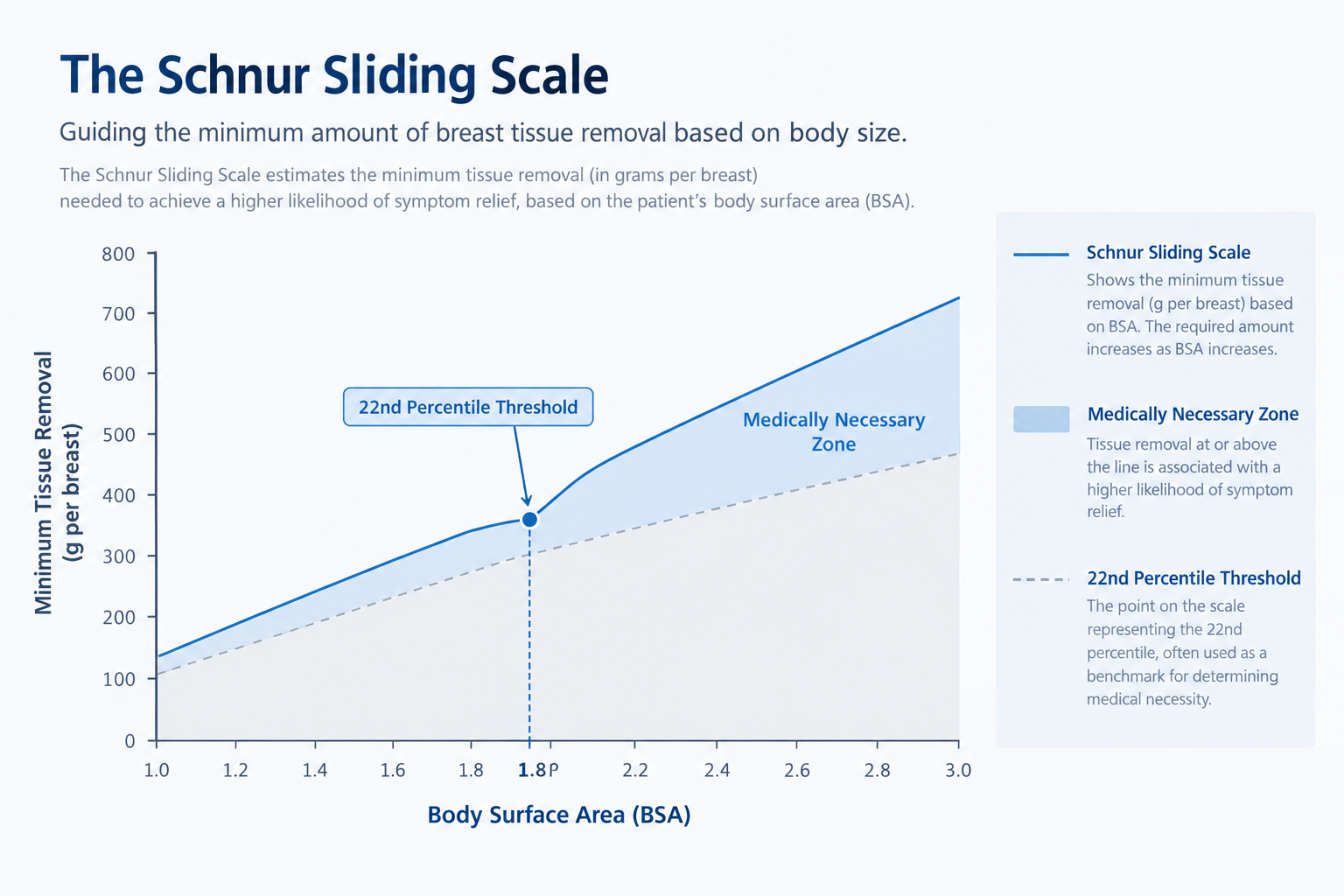
The Schnur Sliding Scale is the most widely used tool for determining whether a proposed breast reduction meets the tissue removal threshold required for insurance coverage. The scale works by correlating a patient's body surface area (BSA) — calculated from height and weight — with a minimum weight of breast tissue that must be removed per breast to qualify. Patients with a larger BSA are required to have more tissue removed to meet the threshold. The commonly cited benchmark is the 22nd percentile of the scale: a surgeon must plan to remove at least that much tissue per breast for the procedure to be considered medically necessary under most insurer criteria. Your surgeon will calculate your BSA and estimate the planned tissue removal to determine whether your case is likely to meet this threshold before submitting for pre-authorization.
How to Navigate the Insurance Approval Process
Getting insurance to cover a breast reduction involves a structured submission process. Understanding each step in advance reduces delays and improves the likelihood of approval.
- Document your symptoms thoroughly. Ensure your primary care physician and any relevant specialists (physiotherapist, dermatologist, neurologist) have recorded your symptoms, their duration, and the treatments already attempted.
- Complete conservative treatment documentation. Insurers typically require evidence that physical therapy, supportive bra use, and other non-surgical measures have been tried for the required period without sufficient relief.
- Consult a board-certified plastic surgeon. The surgeon will assess whether your anatomy meets the Schnur Sliding Scale threshold and prepare the clinical case for submission.
- Compile the pre-authorization packet. This typically includes a letter of medical necessity from your surgeon, clinical photographs, relevant medical records, and documentation of conservative treatment.
- Submit for pre-authorization. Your surgeon's office usually manages this submission. Response times vary by insurer, typically ranging from a few days to several weeks.
- Appeal if denied. A first denial is not necessarily final. Many patients successfully appeal with additional documentation or a peer-to-peer review between your surgeon and the insurer's medical reviewer.
Out-of-Pocket Costs With and Without Insurance
The financial difference between an insured and uninsured breast reduction is substantial. With full insurance approval, average out-of-pocket costs — covering deductibles, co-insurance, and copays — typically fall in the range of $870–$875. With partial insurance coverage, patients often pay around $4,050 out of pocket. Without any insurance coverage, the realistic all-inclusive total generally ranges from $8,000 to $19,500 or more depending on location and technique. Even patients with insurance should confirm whether their chosen surgeon is in-network, as out-of-network providers can significantly increase cost-sharing obligations.
Financing Options for Breast Reduction Surgery
For patients who do not have insurance coverage or who face significant out-of-pocket costs, several financing pathways are available. Each has different terms, eligibility requirements, and financial risks that are worth understanding before committing.
Medical Credit Cards and Patient Financing
CareCredit financing is one of the most widely accepted medical credit products and offers promotional periods of 6 to 60 months with 0% APR — provided the balance is paid in full before the promotional period ends. If the balance is not cleared in time, deferred interest charges can be substantial, effectively backdating interest to the original purchase date. Alphaeon Credit offers similar 6–60 month plans. PatientFi is a newer option that uses a soft credit check and may offer low- or no-interest plans depending on the applicant's credit profile. Prosper Healthcare Lending provides personal loan-style financing specifically for medical procedures.
HSA and FSA Funds
HSA/FSA funds — money held in a Health Savings Account or Flexible Spending Account — can be used to pay for breast reduction surgery, but only when the procedure qualifies as medically necessary. A purely cosmetic breast reduction is not an eligible HSA/FSA expense. For patients who have received insurance pre-authorization or who have strong medical necessity documentation, using HSA or FSA funds to cover deductibles, co-insurance, and any remaining out-of-pocket costs is a tax-efficient strategy worth discussing with your benefits administrator before surgery.
In-House Payment Plans and Personal Loans
Some surgeons offer in-house installment plans, which can be a straightforward option if the terms are clearly documented. Personal loans through a bank or credit union may offer lower interest rates than medical credit cards for patients with good credit. General credit cards are an option but typically carry higher interest rates and are best avoided for large balances unless a 0% introductory rate is available and the balance can be cleared within that period.
Hidden and Indirect Costs Worth Anticipating
The quoted surgical price rarely captures the full financial picture of a breast reduction. Several indirect costs are commonly overlooked during the planning phase. Time off work — typically two to four weeks for most patients — represents lost income that can be significant for those without paid medical leave. Childcare or household help during the recovery period adds further expense. Post-operative compression garments may need to be replaced as swelling subsides. Travel costs, parking, and accommodation are relevant for patients who travel to access a lower-cost surgeon or a specialist in another city. Taken together, these indirect costs can add $500 to several thousand dollars to the true total, depending on individual circumstances.
Male Breast Reduction (Gynecomastia): A Different Cost Picture
Gynecomastia — the development of excess breast tissue in men — is treated with a different surgical approach than female reduction mammoplasty, and the cost and insurance landscape differ accordingly. Male breast reduction typically costs between $5,000 and $10,000 all-inclusive, depending on whether liposuction alone or a combination of liposuction and tissue excision is required. Insurance coverage for gynecomastia is rare; most insurers classify it as cosmetic unless a documented hormonal disorder is the underlying cause. Patients with gynecomastia secondary to a confirmed endocrine condition should discuss insurance eligibility with both their endocrinologist and their surgeon before assuming the procedure will be self-funded.
Questions to Ask During Your Consultation
A consultation with a board-certified plastic surgeon is the only way to receive an accurate, personalized cost estimate. Coming prepared with specific questions helps you compare providers fairly and avoid unexpected expenses.
- Is the quoted fee all-inclusive, or are anesthesia, facility, and follow-up visits billed separately?
- Will surgery take place in an accredited surgical center or a hospital, and how does that affect the facility fee?
- Based on my anatomy and symptoms, do you think my case is likely to meet insurance criteria?
- Will your office manage the pre-authorization submission, and what happens if the initial request is denied?
- What is your revision policy if I am not satisfied with the outcome?
- Which financing options does your practice accept, and are in-house payment plans available?
- Are there any additional costs I should anticipate that are not included in the quoted price?
Frequently Asked Questions
How much is a breast reduction if insurance covers it?
With full insurance approval for a medically necessary breast reduction, average out-of-pocket costs — including deductibles, co-insurance, and copays — typically fall around $870–$875. Partial coverage generally leaves patients with approximately $4,050 to pay directly. The exact amount depends on your specific plan, deductible status, and whether your surgeon is in-network.
What is the Schnur Sliding Scale and how does it affect my coverage?
The Schnur Sliding Scale correlates your body surface area (calculated from height and weight) with a minimum weight of breast tissue that must be removed per breast for the procedure to qualify as medically necessary. If your surgeon's planned tissue removal falls below the threshold for your BSA, most insurers will classify the procedure as cosmetic and decline coverage. Your surgeon can calculate this before submitting a pre-authorization request.
Can I use my HSA or FSA for breast reduction surgery?
HSA/FSA funds can be used for breast reduction only when the procedure is medically necessary. A purely elective or cosmetic reduction is not an eligible expense under IRS rules. If your procedure has been pre-authorized by your insurer or is clearly documented as medically necessary, HSA or FSA funds can cover qualifying out-of-pocket costs such as deductibles and co-insurance.
Is a cheaper surgeon always a higher financial risk?
Not automatically, but surgeon experience and credentials matter significantly in breast reduction surgery. Choosing a provider primarily on price — particularly one who is not a board-certified plastic surgeon — increases the risk of complications or unsatisfactory results that may require revision surgery. Revision procedures can cost as much as the original operation, making the apparent saving counterproductive.
Does the surgical technique affect the total cost?
Yes. More complex techniques such as the anchor (inverted-T) incision involve longer operative time and typically higher surgeon's and anesthesia fees than a liposuction-only reduction. However, the appropriate technique is determined by your anatomy and reduction goals, not by cost preference. Choosing a less appropriate technique to reduce cost can compromise results.
What happens if my insurance pre-authorization is denied?
A denial is not necessarily final. Most insurers have a formal appeals process, and many initially denied cases are approved on appeal — particularly when additional clinical documentation is submitted or when your surgeon requests a peer-to-peer review with the insurer's medical reviewer. Your surgeon's office should be able to guide you through the appeals process.
Planning Your Breast Reduction: Making an Informed Financial Decision
The total cost of a breast reduction depends on a combination of factors — surgeon credentials, geographic location, surgical technique, facility type, and whether insurance coverage applies — that interact differently for every patient. For those with documented symptoms of macromastia, pursuing the insurance route through proper conservative treatment documentation and a well-prepared pre-authorization packet can reduce out-of-pocket costs dramatically. For patients pursuing an elective procedure, understanding the full all-inclusive cost — including indirect expenses such as time off work and post-operative supplies — provides a more realistic financial picture than the surgeon's fee alone.
A consultation with a board-certified plastic surgeon is the essential first step. It is the only way to receive an accurate estimate based on your specific anatomy, reduction goals, and insurance situation. Many practices offer complimentary or low-cost consultations, and some will assess your insurance eligibility as part of that initial appointment. Approaching that conversation with a clear understanding of cost components, the Schnur Sliding Scale, and your financing options puts you in a much stronger position to make a decision that is right for both your health and your budget.
