

The Russian lip technique has become one of the most requested lip filler styles, largely because it prioritises shape and definition over volume. Rather than simply adding fullness, the approach aims to create a more lifted, heart-shaped upper lip with a pronounced Cupid's bow — a result that differs noticeably from the rounded, projected look associated with classic lip augmentation. This guide explains how the technique works, what the procedure involves, realistic outcomes, risks, and the factors that determine whether it may be appropriate for you.
Key Takeaways
- The Russian lip technique uses a vertical injection technique to add height and definition to the lips rather than forward projection, reducing the risk of a duck lip appearance.
- Results typically last six to twelve months, though individual metabolism, lifestyle, and filler formulation all influence longevity.
- The procedure carries a higher technical demand than standard lip filler, making injector skill one of the most important safety and outcome factors.
- Swelling can be significant in the first week; final results are generally not visible until three to four weeks after treatment.
- Patients with existing lip filler may need filler dissolution with hyaluronidase before switching to the Russian technique.
What Is the Russian Lip Technique?
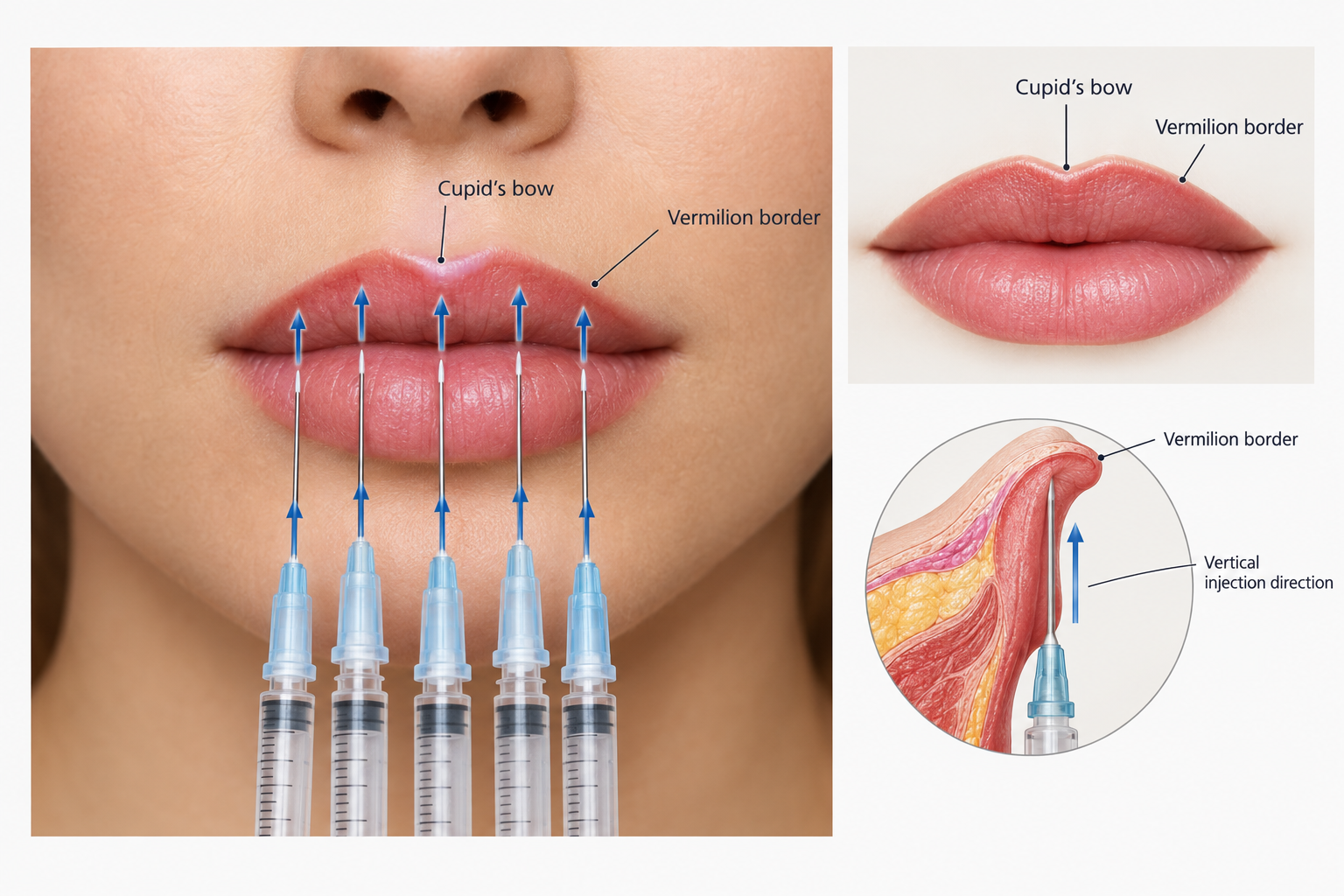
The Russian lip technique is a method of hyaluronic acid filler placement designed to reshape the lips by increasing vertical height and enhancing the definition of the vermilion border — the visible edge that separates the lip from the surrounding skin. The aesthetic goal is a structured, doll-like appearance with a clearly defined Cupid's bow and a lifted upper lip that resembles the exaggerated lip shape associated with traditional Russian matryoshka dolls, which is where the name originates.
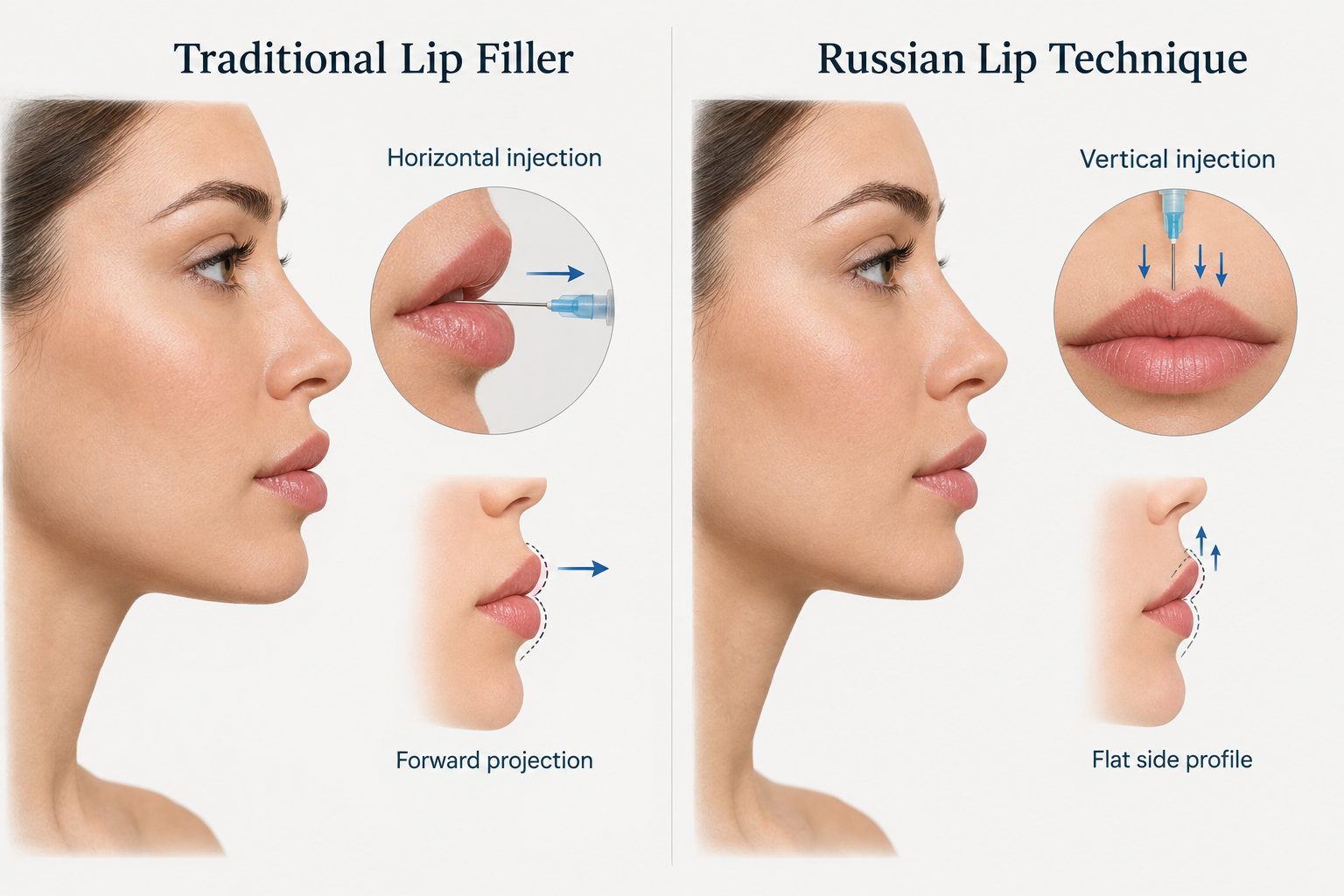
What distinguishes this approach from conventional lip augmentation is not the filler product itself but the direction and depth of injection. In a standard technique, filler is typically placed horizontally along the lip body to add volume and outward projection. The Russian method instead uses a vertical injection technique, delivering small, precise deposits of hyaluronic acid filler from the base of the lip upward toward the vermilion border. This draws the lip tissue upward rather than pushing it forward, creating lip height rather than lip projection.
The result, when performed well, is a flat side profile — meaning the lips do not protrude significantly beyond the natural lip line — combined with a more defined, heart-shaped upper lip. This is particularly appealing to patients who want a refined, structured look without the fullness that can appear unnatural in certain facial proportions.
Russian Lip Filler vs. Traditional Lip Filler
Understanding the differences between the Russian technique and classic lip filler helps clarify which approach may better match a patient's goals. The two methods use the same category of product — hyaluronic acid filler — but differ substantially in injection direction, depth, intended outcome, and technical complexity.
| Characteristic | Russian Lip Technique | Traditional Lip Filler |
|---|---|---|
| Injection direction | Vertical, from base toward vermilion border | Horizontal, along the lip body |
| Primary goal | Lip height, Cupid's bow definition, shape | Volume, fullness, projection |
| Side profile result | Flat, minimal forward projection | More outward projection |
| Injection depth | Superficial dermal layer, multiple small deposits | Submucosal or deeper lip body |
| Instrument typically used | Fine needle | Needle or cannula |
| Procedure time | Longer (approximately 30–60 minutes) | Shorter (approximately 15–30 minutes) |
| Technical complexity | Higher — requires precise zone mapping | Moderate |
| Swelling pattern | Often more pronounced initially | Moderate |
| Results longevity | 6–12 months | 6–12 months |
| Filler migration risk | Higher if technique is imprecise | Lower with correct placement |
One practical consideration is that patients who have had traditional lip filler previously may not be able to transition directly to the Russian technique. Existing filler placed deeper in the lip body can interfere with the precise superficial placement the Russian method requires. In these cases, an experienced injector may recommend filler dissolution using hyaluronidase before proceeding, allowing the lips to return closer to their natural anatomy before the new technique is applied.
How the Procedure Works
A Russian lip filler appointment typically begins with a lip augmentation consultation during which the injector assesses the patient's natural lip anatomy, reviews any history of previous filler, and discusses the patient's aesthetic goals. Lip symmetry, the existing shape of the Cupid's bow, the position of the philtrum, and the proportions of the upper and lower lips are all evaluated before a treatment plan is agreed.
Topical numbing cream is applied to the lip area and left for approximately fifteen to twenty minutes before treatment begins. Some hyaluronic acid filler products also contain lidocaine, which provides additional comfort during injection. Despite these measures, patients should expect some discomfort, as the lips are a sensitive area and the Russian technique involves a higher number of injection points than a standard treatment.
The injector then divides the lips into zones and works systematically across each area, placing small microdroplets of filler using a fine needle directed vertically into the superficial dermal layer. This approach is sometimes referred to clinically as the tenting technique, because the needle lifts the tissue upward as filler is deposited, creating vertical height rather than horizontal spread. The number of injection points is typically higher than in a conventional treatment, which contributes to the longer procedure time of roughly thirty to sixty minutes.
Immediately after treatment, the lips will appear swollen and the result will look more exaggerated than the intended final outcome. This is normal and expected. The injector may gently assess symmetry at the end of the appointment but will generally advise against judging the result until swelling has fully resolved.
What Results Look Like and When They Appear
The Russian lip technique is designed to produce a defined, structured lip shape with a clearly lifted Cupid's bow, enhanced vermilion border definition, and a heart-shaped upper lip. The lower lip typically receives less product than the upper, maintaining a natural proportion while complementing the lifted upper shape. Because the filler is placed to increase lip height rather than projection, the lips appear fuller when viewed from the front but retain a relatively flat side profile.
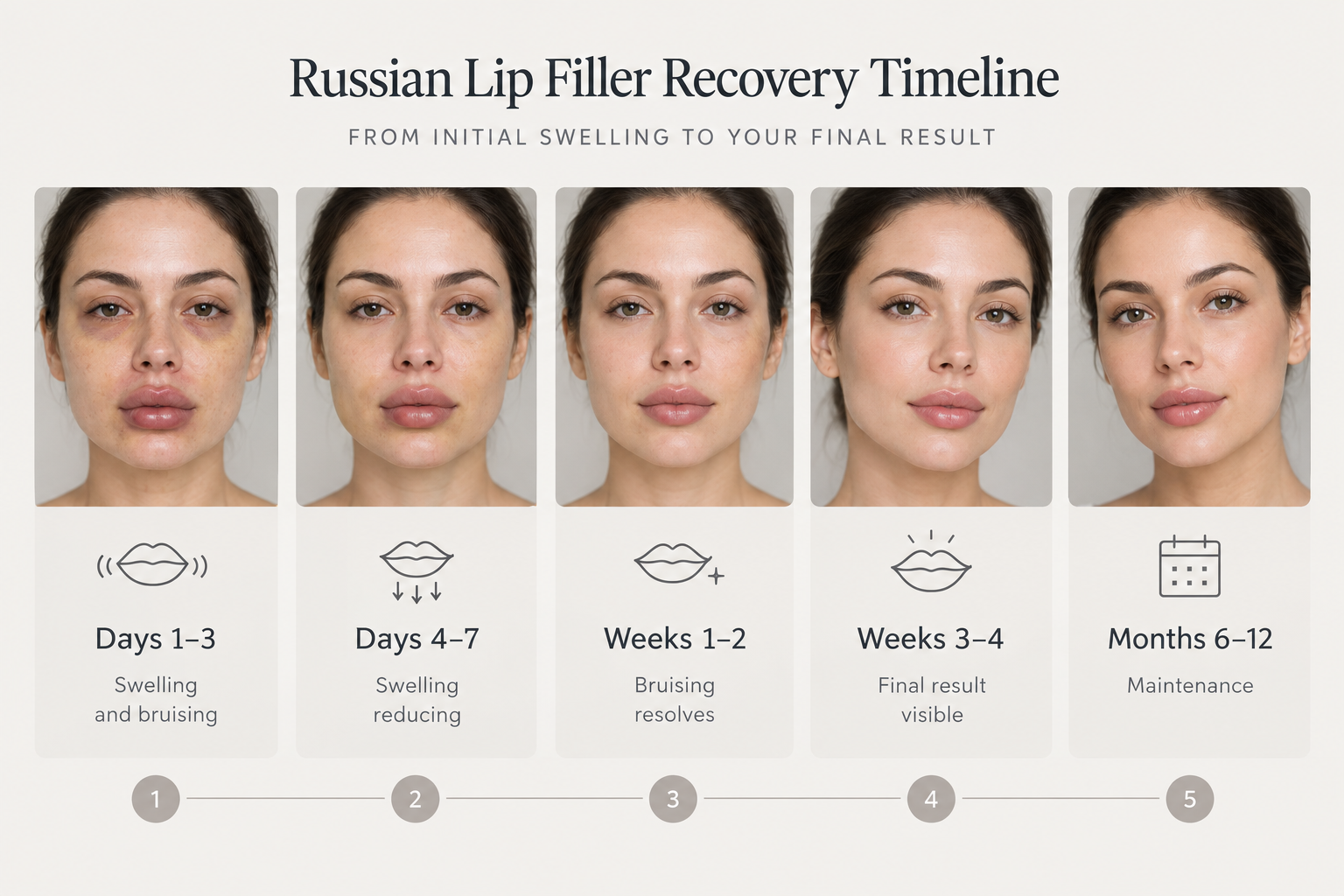
Results do not appear immediately in their final form. The first three to seven days involve noticeable swelling and often some bruising, which can make the lips look uneven or overfilled. This is a normal part of the healing process and does not reflect the final outcome. Most of the initial swelling resolves within one to two weeks, but the filler continues to integrate with the surrounding tissue and settle into its final position over the following weeks. Before and after results are most accurately assessed at three to four weeks post-treatment, when swelling has fully resolved and the filler has stabilised.
| Timeframe | What to Expect |
|---|---|
| Days 1–3 | Significant swelling, possible bruising, lips appear larger than intended |
| Days 4–7 | Swelling begins to reduce; shape becomes more visible but still not final |
| Weeks 1–2 | Most bruising resolves; lips look closer to the intended result |
| Weeks 3–4 | Filler fully settled; final shape and definition visible |
| Months 3–6 | Results stable; some gradual softening of definition may begin |
| Months 6–12 | Filler gradually metabolised; touch-up or maintenance session may be considered |
Patients who feel anxious about their appearance in the first week should be reassured that the swelling phase is temporary and does not indicate a poor result. Contacting the clinic if swelling is severe, asymmetrical, or accompanied by pain beyond the first few days is advisable, as these can occasionally indicate a complication requiring assessment.
Which Filler Products Are Used
The Russian technique is performed using hyaluronic acid filler, the same category of product used in standard lip augmentation. Hyaluronic acid is a naturally occurring substance in the body, which means it can be dissolved with hyaluronidase if a result needs to be corrected or reversed.
Not all hyaluronic acid fillers behave identically. Filler products vary in their rheological properties — particularly G-prime (a measure of firmness or resistance to deformation) and cohesivity (how well the gel holds together). For the Russian technique, injectors typically select a filler with moderate to high cohesivity and sufficient structural support to maintain vertical lift without spreading laterally. A product that is too soft may not hold the defined shape the technique aims to create, while one that is too firm may feel unnatural in the superficial placement depth the method requires. Brands such as Juvederm and Restylane both offer formulations used for lip work, but the specific product choice depends on the injector's assessment of the patient's lip tissue and the desired outcome.
Risks and Potential Complications
The Russian lip technique carries the same category of risks as any lip filler procedure, but some risks are elevated by the specific demands of the technique. Patients should understand these before proceeding.
Filler migration is among the most frequently cited concerns with the Russian technique. Because filler is placed in the superficial dermal layer close to the vermilion border, there is a risk that product moves beyond the intended zone over time, creating a blurred or uneven lip edge. Some ultrasound imaging research has suggested that vertical injections may place filler at a deeper level than intended in certain lip anatomies, which can increase migration risk. Choosing an experienced injector with a thorough understanding of lip anatomy is the most important factor in minimising this outcome.
Vascular occlusion — where filler inadvertently enters or compresses a blood vessel — is a serious but rare complication of any lip filler procedure. The lips have a rich blood supply, and the higher number of injection points in the Russian technique means the risk of encountering a vessel is not negligible. Symptoms include severe pain, blanching, or discolouration of the lip or surrounding skin. This is a medical emergency requiring immediate treatment with hyaluronidase to dissolve the filler and restore blood flow. Patients should only receive treatment at a clinic where hyaluronidase is available on-site and the injector is trained to recognise and manage vascular complications.
Lumps, asymmetry, and uneven results can occur if filler is not distributed evenly across the injection zones. Some minor irregularities may resolve as swelling subsides, but persistent lumps or asymmetry may require a touch-up or, in some cases, partial filler dissolution.
Other risks include bruising, infection, allergic reaction, and reactivation of cold sores in patients with a history of herpes simplex. Patients prone to cold sores should inform their injector before treatment, as antiviral medication is sometimes recommended prophylactically.
Aftercare and Recovery
Following a Russian lip filler treatment, a period of careful aftercare helps minimise complications and supports the best possible result. The lips are more vulnerable in the first twenty-four to forty-eight hours, when the filler is still settling and the tissue is inflamed.
- Apply ice wrapped in a clean cloth to reduce swelling — avoid direct ice contact with the skin.
- Avoid strenuous exercise for at least twenty-four to forty-eight hours, as increased blood flow can worsen swelling and bruising.
- Do not apply makeup to the lip area for at least twenty-four hours to reduce infection risk.
- Avoid alcohol and very salty foods for the first twenty-four to forty-eight hours, as both can increase fluid retention and swelling.
- Avoid hot environments such as saunas, steam rooms, and sunbeds for at least one week.
- Do not use straws or apply significant pressure to the lips for the first twenty-four to forty-eight hours.
- Avoid massaging the lips unless specifically instructed to do so by your injector — unlike some other filler treatments, the Russian technique relies on precise placement that should not be disturbed.
- Sleep with the head slightly elevated in the first night or two to help reduce swelling.
Most patients can return to normal daily activities the day after treatment, though visible swelling and bruising may make some feel self-conscious for the first week. Makeup can generally be used to cover bruising from day two onward, provided the injection sites have closed.
How Long Results Last and Maintenance
Russian lip filler results typically last between six and twelve months, with many patients finding that a touch-up or maintenance session is appropriate at around nine to twelve months. The rate at which hyaluronic acid filler is metabolised varies between individuals and is influenced by factors including metabolic rate, physical activity levels, sun exposure, and the specific filler product used.
The defined, structured quality of the Russian technique result may soften gradually before the filler fully dissolves, as the vertical lift depends on the filler maintaining its structural integrity. Some patients choose to have a maintenance session before the filler has completely gone in order to preserve the shape, rather than waiting for a full redissolution and restart.
Who May Be a Suitable Candidate
The Russian lip technique tends to produce the most satisfying results in patients whose primary concern is lip shape and definition rather than volume. Ideal candidates typically include those with a thin upper lip that lacks vertical height, a flat or poorly defined Cupid's bow, mild lip asymmetry, or a naturally flat lip profile that they would like to enhance without adding significant projection.
Patients who have previously experienced filler migration with traditional lip filler may also find the Russian technique appealing, as the structured placement approach can, when performed correctly, create a more contained result. However, as noted earlier, existing filler may need to be dissolved before the technique can be applied effectively.
The technique is generally less suited to patients who want significant volume or a fuller, more pillowy lip appearance, as the Russian method prioritises height and definition over bulk. Patients with very thin lip tissue may also have limited scope for the technique, as there is less tissue to work with when placing filler in the superficial layer.
Who May Not Be Suitable
Certain factors may make the Russian lip technique inadvisable or require deferral. These include:
- Active cold sores or oral infection — treatment should be postponed until the infection has fully resolved.
- Pregnancy or breastfeeding — cosmetic filler procedures are generally not recommended during these periods.
- Blood-thinning medications or supplements — including aspirin, ibuprofen, warfarin, and high-dose fish oil, which increase bruising risk. Patients should discuss their medication history with their injector before treatment.
- Prior permanent or semi-permanent lip filler — non-hyaluronic acid fillers cannot be dissolved and may interfere with placement; a thorough history and potentially imaging assessment is required.
- Autoimmune conditions or active inflammatory skin disease affecting the lip area.
- Unrealistic expectations — patients seeking dramatic volume increase or a result that does not suit their facial anatomy may not achieve satisfaction with this technique.
A thorough lip augmentation consultation with a qualified practitioner is the appropriate way to assess individual suitability, review medical history, and set realistic expectations before any treatment is agreed.
Choosing the Right Injector
The Russian lip technique is technically more demanding than standard lip filler, and injector skill is a primary determinant of both safety and outcome. The precision required for correct zone mapping, consistent vertical placement, and appropriate filler selection means that the technique is not equally well-suited to all practitioners who offer lip filler.
When evaluating a provider, it is reasonable to ask the following questions before booking:
- How many Russian lip treatments have you performed, and can you show examples of your work?
- What training have you completed specifically in the Russian technique?
- Do you have hyaluronidase available on-site, and are you trained to manage vascular complications?
- What filler product do you use for this technique, and why?
- If I have existing lip filler, will I need it dissolved first?
- What does your aftercare and follow-up process involve?
A practitioner who is willing to discuss these points openly, who does not pressure you to book immediately, and who conducts a thorough consultation before recommending treatment is more likely to deliver a safe and appropriate result.
Frequently Asked Questions
Does the Russian lip technique hurt more than regular lip filler?
The Russian technique typically involves more injection points than standard lip filler, which can mean more discomfort during the procedure. Numbing cream is applied beforehand, and many filler products contain lidocaine to reduce sensation during injection. Most patients describe the experience as tolerable, though individual pain thresholds vary. The lips are inherently sensitive, and some discomfort should be expected regardless of technique.
Can I have the Russian technique if I already have lip filler?
It depends on how much existing filler is present and where it was placed. If previous filler is sitting in the deeper lip body, it may interfere with the precise superficial placement the Russian method requires. In many cases, an injector will recommend dissolving existing filler with hyaluronidase and waiting for the lips to settle — typically two to four weeks — before proceeding with the Russian technique.
Will Russian lip filler look natural?
When performed by an experienced injector using an appropriate amount of product for the patient's anatomy, the Russian technique can produce a defined but natural-looking result. Over-treatment or incorrect placement can lead to an unnatural appearance, including a shelf-like effect at the vermilion border or visible lumps. The amount of filler used and the injector's technique are the most important factors in achieving a proportionate outcome.
How is the Russian technique different from the tenting technique?
The tenting technique is a clinical term used to describe the vertical needle placement method that underpins the Russian lip approach. The needle is inserted at the base of the lip and directed upward, lifting the tissue as filler is deposited — creating the tent-like vertical structure that gives the technique its clinical name. In practice, the terms are often used interchangeably when describing the Russian lip method.
What happens if I don't like the result?
Because the Russian technique uses hyaluronic acid filler, the result can be partially or fully reversed using hyaluronidase, an enzyme that breaks down hyaluronic acid. Filler dissolution is a straightforward procedure, though it requires a follow-up appointment and the lips will need time to settle before any corrective treatment is considered. This reversibility is one of the reasons hyaluronic acid filler is preferred over permanent alternatives for lip augmentation.
How much does Russian lip filler cost?
Pricing varies depending on the clinic, the injector's experience, the amount of product used, and geographic location. In the United Kingdom, Russian lip filler treatments typically start from around £300 to £500 and can be higher at specialist clinics or for more experienced practitioners. In the United States, costs generally range from approximately $500 to $2,000 per session. The higher technical complexity of the Russian technique often means it is priced above standard lip filler at the same clinic.
Is the Russian Lip Technique the Right Choice for Your Goals?
The Russian lip technique offers a genuinely different aesthetic outcome compared to traditional lip filler — one that prioritises shape, definition, and vertical lift over volume and projection. For patients whose primary concern is a flat or undefined Cupid's bow, a lack of lip height, or a desire for a more structured lip appearance without a pronounced side profile, the technique may be well worth exploring with a qualified practitioner.
It is not, however, a universally superior approach. Patients who want fuller, more voluminous lips may find that a conventional technique better serves their goals. The Russian method also carries a higher technical demand, meaning the choice of injector matters considerably — both for achieving the intended result and for managing the elevated risk of filler migration and vascular complications that comes with superficial, multi-point vertical placement.
If you are considering Russian lip filler, a thorough consultation with an experienced injector who can assess your lip anatomy, review your filler history, and discuss realistic outcomes is the appropriate starting point. Understanding what the technique can and cannot achieve — and what the recovery period genuinely involves — will help you make an informed decision rather than one based on social media results alone.
