

Skin laxity is one of the most common concerns patients bring to aesthetic consultations, yet the range of available treatments can be genuinely confusing. Radiofrequency devices, focused ultrasound, RF microneedling, thread lifts, biostimulator injectables, and surgical options all claim to tighten skin — but they work through different mechanisms, suit different patients, and deliver results on very different timelines. This guide compares the leading options honestly, covering how each works, who may benefit, realistic outcomes, and the limitations that are often underplayed.
Quick Comparison
| Treatment | Technology | Invasiveness | Target Depth | Sessions Typically Needed | Results Onset | Duration | Downtime | Best Suited For |
|---|---|---|---|---|---|---|---|---|
| Monopolar RF (Thermage FLX) | Radiofrequency | Non-invasive | Dermis to subcutaneous | 1–2 | 3–6 months | 1–2 years | Minimal | Face, brow, body; mild to moderate laxity |
| Focused Ultrasound / HIFU (Ultherapy, Sofwave) | Micro-focused ultrasound | Non-invasive | SMAS layer (3–4.5 mm) | 1–2 | 3–6 months | 1–2 years | Minimal | Brow lift, jawline, neck; mild to moderate laxity |
| RF Microneedling (Morpheus8, Sylfirm X) | RF + microneedling | Minimally invasive | Dermis to subdermal fat | 3–4 | 4–8 weeks | 12–18 months | 2–5 days redness | Face, neck, body; texture, laxity, scars |
| PDO Thread Lift | Absorbable sutures | Minimally invasive | Subcutaneous / SMAS | 1 (may repeat) | Immediate + gradual | 12–18 months | 3–7 days | Jowls, midface, neck; moderate laxity |
| Biostimulator Injectables (Sculptra, Radiesse) | Injectable collagen stimulator | Minimally invasive | Dermis / subcutaneous | 2–4 | 4–12 weeks | 2+ years | Minimal (bruising possible) | Volume loss with laxity; gradual improvement |
| Ablative Fractional Laser (CO2, Fraxel) | Laser | Minimally invasive | Epidermis + dermis | 1–3 | 2–4 weeks | 1–3 years | 5–10 days | Skin quality, fine lines, mild laxity; lighter skin tones |
| Surgical Facelift / FaceTite | Surgery / RF-assisted surgery | Invasive | SMAS and deeper | 1 | Weeks to months | 5–10 years | Days to weeks | Moderate to severe laxity; definitive repositioning |
How Non-Surgical Skin Tightening Works
Most non-surgical and minimally invasive skin tightening treatments share a common principle: delivering controlled thermal energy or mechanical micro-injury to the dermis and deeper tissue layers to trigger the body's wound-healing response. This response stimulates neocollagenesis — the production of new collagen — and promotes collagen remodeling, gradually improving skin firmness and elasticity over weeks to months. The key variables between treatments are the type of energy used, the depth it reaches, and how precisely it can be delivered.
Collagen and elastin are the structural proteins responsible for skin firmness. From the mid-twenties onward, collagen production slows and existing fibres become less organised, contributing to the gradual development of sagging skin and reduced elasticity. Energy-based treatments aim to accelerate collagen remodeling by creating a controlled stimulus — essentially encouraging the skin to repair and rebuild. Results are therefore gradual rather than immediate, and the degree of improvement depends heavily on the patient's baseline skin laxity, age, skin quality, and biological response to treatment.
Radiofrequency Treatments: Thermage and Monopolar RF
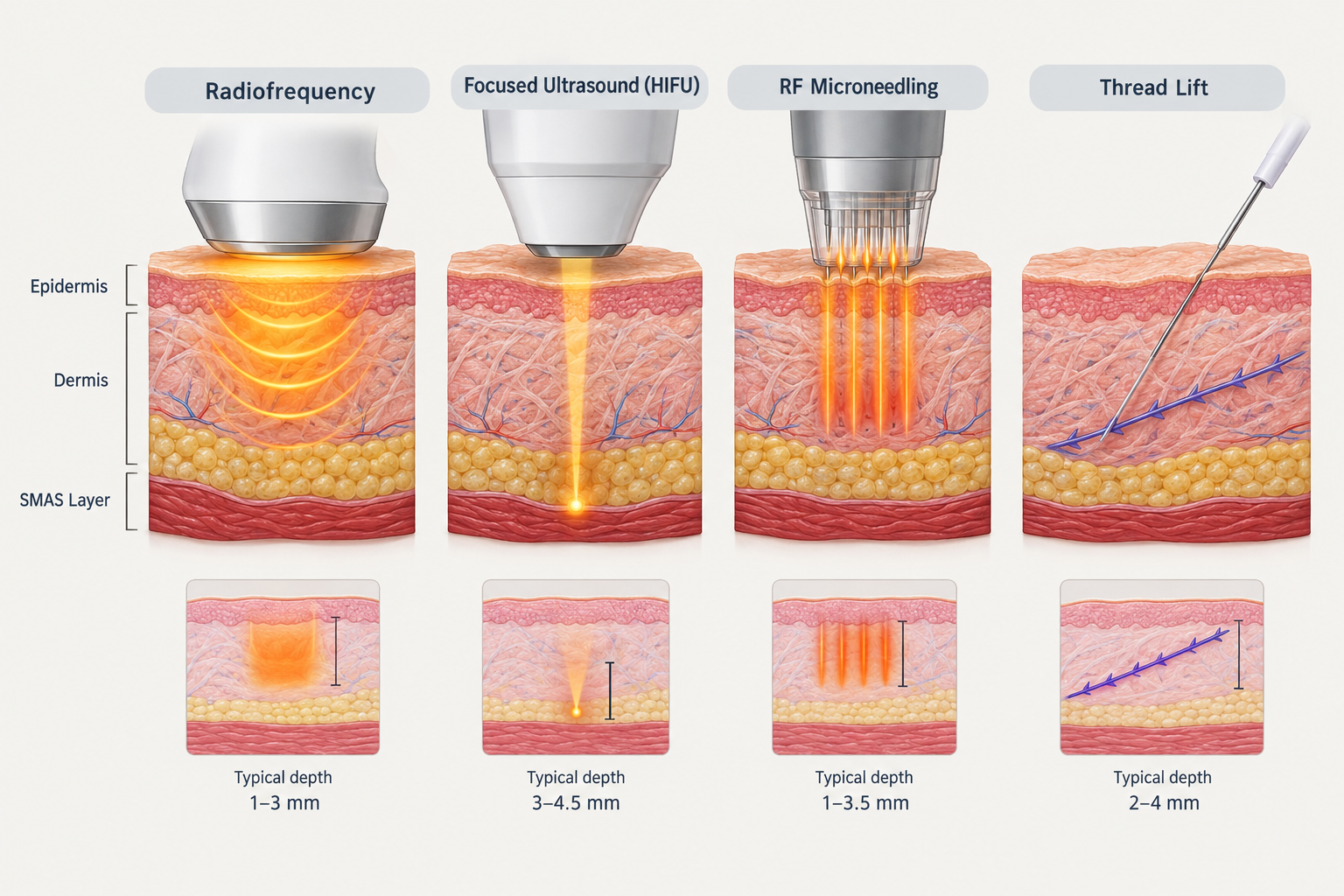
Monopolar radiofrequency, best known through the Thermage FLX platform, delivers RF energy uniformly across the skin surface, heating the dermis and subcutaneous tissue to temperatures that cause immediate collagen fibre contraction and stimulate longer-term neocollagenesis. Because monopolar RF penetrates relatively deeply without requiring needles, it can address mild to moderate sagging on the face, brow, eyelids, and body in a single treatment session for many patients.
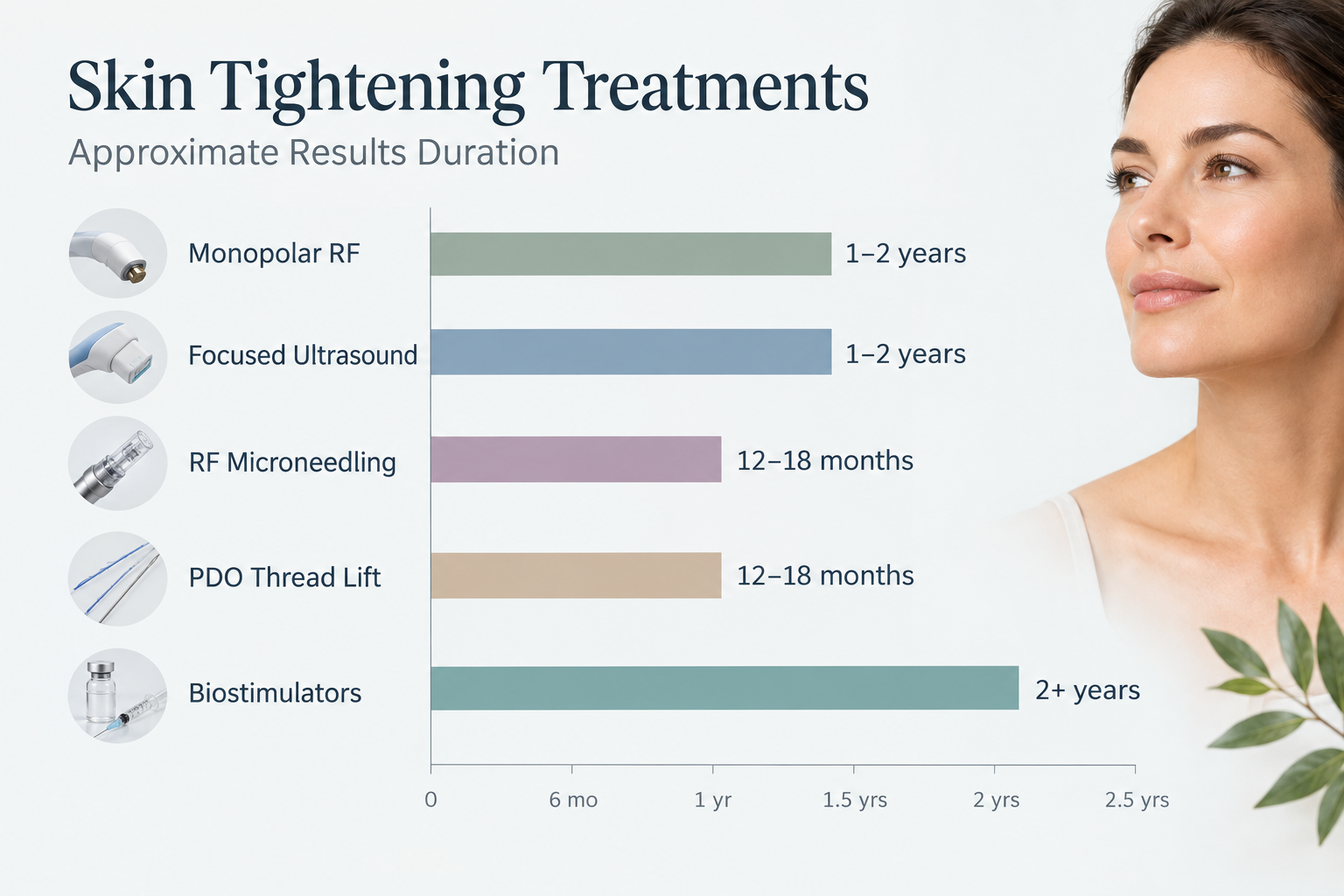
Thermage FLX treatments are typically performed in one session, with results developing gradually over three to six months as new collagen matures. Most patients experience some immediate skin tightening from collagen contraction, followed by progressive improvement. Results may last one to two years, after which a maintenance treatment is often recommended. Downtime is minimal — most patients return to normal activities the same day, with possible temporary redness or mild swelling.
Monopolar RF is generally considered safe across a range of Fitzpatrick skin types because it does not target melanin, reducing the risk of post-inflammatory hyperpigmentation that can occur with some laser treatments. It is not suitable for patients with implanted electronic devices such as pacemakers, and results are less predictable in patients with significant or advanced skin laxity, where surgical options may be more appropriate.
Focused Ultrasound: Ultherapy, HIFU, and Sofwave
High-Intensity Focused Ultrasound (HIFU) and micro-focused ultrasound with visualisation (MFU-V), marketed under the Ultherapy brand, use precisely targeted ultrasound energy to create small thermal injury points at specific depths — including the SMAS layer, the superficial muscular aponeurosis system that surgeons address during a facelift. Reaching this deeper structural layer is a distinguishing feature of focused ultrasound compared with many surface-level energy-based treatments.
Ultherapy is FDA-cleared for lifting the brow, chin, and neck, and for improving lines on the décolletage. Clinical studies, including a peer-reviewed patient satisfaction study on MFU-V, report meaningful improvement in skin laxity for appropriately selected patients, though results vary considerably between individuals. The treatment is typically performed in one to two sessions, with results onset at three to six months and duration of approximately one to two years.
Sofwave is a newer focused ultrasound platform that delivers energy at a shallower depth (1.5 mm into the mid-dermis) using a parallel beam technology, which some practitioners find more comfortable for patients than traditional HIFU. It is FDA-cleared for facial lifting and wrinkle reduction. Evidence for Sofwave is still developing compared with the longer track record of Ultherapy, but early data are encouraging for mild to moderate skin laxity.
Focused ultrasound treatments can be uncomfortable during the procedure, particularly over bony areas. Downtime is minimal, though temporary redness, swelling, or tenderness is common. Like monopolar RF, focused ultrasound is not appropriate for patients with severe laxity, where the degree of tissue repositioning required exceeds what non-surgical energy delivery can achieve.
Radiofrequency Microneedling: Morpheus8, Sylfirm X, and Similar Devices
Radiofrequency microneedling combines two established mechanisms: the micro-channels created by fine needles trigger a wound-healing response and allow RF energy to be delivered precisely into the dermis and, with deeper settings, into the subdermal fat layer. Morpheus8 is the most widely recognised platform in this category; Sylfirm X and Genius RF are alternatives with slightly different needle configurations and RF delivery modes.
Because RF microneedling bypasses the epidermis and delivers energy directly into the dermis, it is generally considered safer for patients with darker Fitzpatrick skin types (IV–VI) compared with ablative laser treatments, which carry a higher risk of post-inflammatory hyperpigmentation in melanin-rich skin. This is a clinically meaningful distinction that is often underemphasised in patient-facing information.
A typical RF microneedling protocol involves three to four treatment sessions spaced four to six weeks apart. Results onset is usually four to eight weeks after the first session, with continued improvement over several months as collagen remodeling progresses. Downtime is typically two to five days of redness, swelling, and pinpoint marks at the needle entry sites. Results may last twelve to eighteen months, with annual maintenance treatments often recommended.
RF microneedling is effective for skin laxity, textural irregularities, acne scarring, and enlarged pores, making it a versatile option for patients with multiple concerns. It is not a substitute for surgical lifting in patients with significant jowling or excess skin, and individual response varies — some patients achieve marked improvement while others see more modest results.
PDO Thread Lifts
PDO (polydioxanone) thread lifts use fine absorbable sutures inserted beneath the skin to physically reposition sagging tissue and stimulate collagen production as the threads dissolve over several months. Barbed threads provide mechanical lift to areas such as the jowls, midface, and neck, while smooth or twisted threads are used primarily for collagen stimulation rather than repositioning.
Thread lifts offer an immediate visible improvement that is not achievable with energy-based treatments alone, making them an option for patients with moderate skin laxity who want a more noticeable short-term result without surgery. However, the degree of lift is more limited than a surgical facelift, and results typically last twelve to eighteen months as the threads dissolve and the collagen stimulus fades. Repeat treatments are usually needed to maintain the effect.
Downtime and recovery after a PDO thread lift is typically three to seven days, with bruising, swelling, and temporary dimpling at insertion points being common. Risks include thread migration, puckering, infection, and asymmetry — outcomes that are closely related to practitioner skill and patient selection. Thread lifts are generally not recommended for patients with very thin skin, significant volume loss, or severe laxity, where the mechanical support of threads is insufficient and surgical correction would be more appropriate.
Biostimulator Injectables: Sculptra and Radiesse
Biostimulator injectables such as Sculptra (poly-L-lactic acid) and dilute Radiesse (calcium hydroxylapatite) work by stimulating the body's own collagen production rather than adding volume directly. Injected into the dermis or subcutaneous tissue, these agents trigger a controlled inflammatory response that leads to gradual neocollagenesis over weeks to months. The result is a diffuse improvement in skin quality, firmness, and subtle volume that develops slowly and looks natural.
Sculptra typically requires two to four treatment sessions spaced four to six weeks apart, with results becoming visible over three to four months and potentially lasting two years or more. Radiesse used in a diluted form for biostimulation follows a similar principle. These treatments are particularly well suited to patients who have both skin laxity and volume loss, as the collagen stimulus addresses both concerns simultaneously. They are not appropriate as a standalone treatment for significant structural sagging.
Side effects are generally mild — bruising, swelling, and tenderness at injection sites — but Sculptra carries a small risk of subcutaneous nodule formation if not injected correctly, underscoring the importance of practitioner experience with the product.
Ablative Fractional Lasers: CO2 and Fraxel
Ablative fractional laser treatments, including fractional CO2 laser and Fraxel Repair, resurface the skin by creating microscopic columns of controlled thermal damage in the epidermis and dermis. This triggers significant collagen remodeling and new collagen formation, improving skin texture, fine lines, and mild skin laxity simultaneously. The ablative vs. non-ablative distinction matters clinically: ablative lasers remove the outer skin layer and require meaningful downtime, while non-ablative lasers heat the dermis without surface disruption and have less downtime but generally more modest results.
Fractional CO2 laser can produce noticeable skin tightening and resurfacing results in one to three sessions, with results onset at two to four weeks and duration of one to three years depending on the depth of treatment and patient skin care. However, downtime is significant — typically five to ten days of redness, peeling, and sensitivity — and the risk of post-inflammatory hyperpigmentation means ablative lasers are generally better suited to patients with lighter Fitzpatrick skin types (I–III). Patients with darker skin tones should discuss this risk carefully with a board-certified dermatologist or qualified practitioner before proceeding.
Skin Tightening by Body Area
Treatment selection often depends on the specific area being addressed, as different technologies are better suited to different anatomical zones.
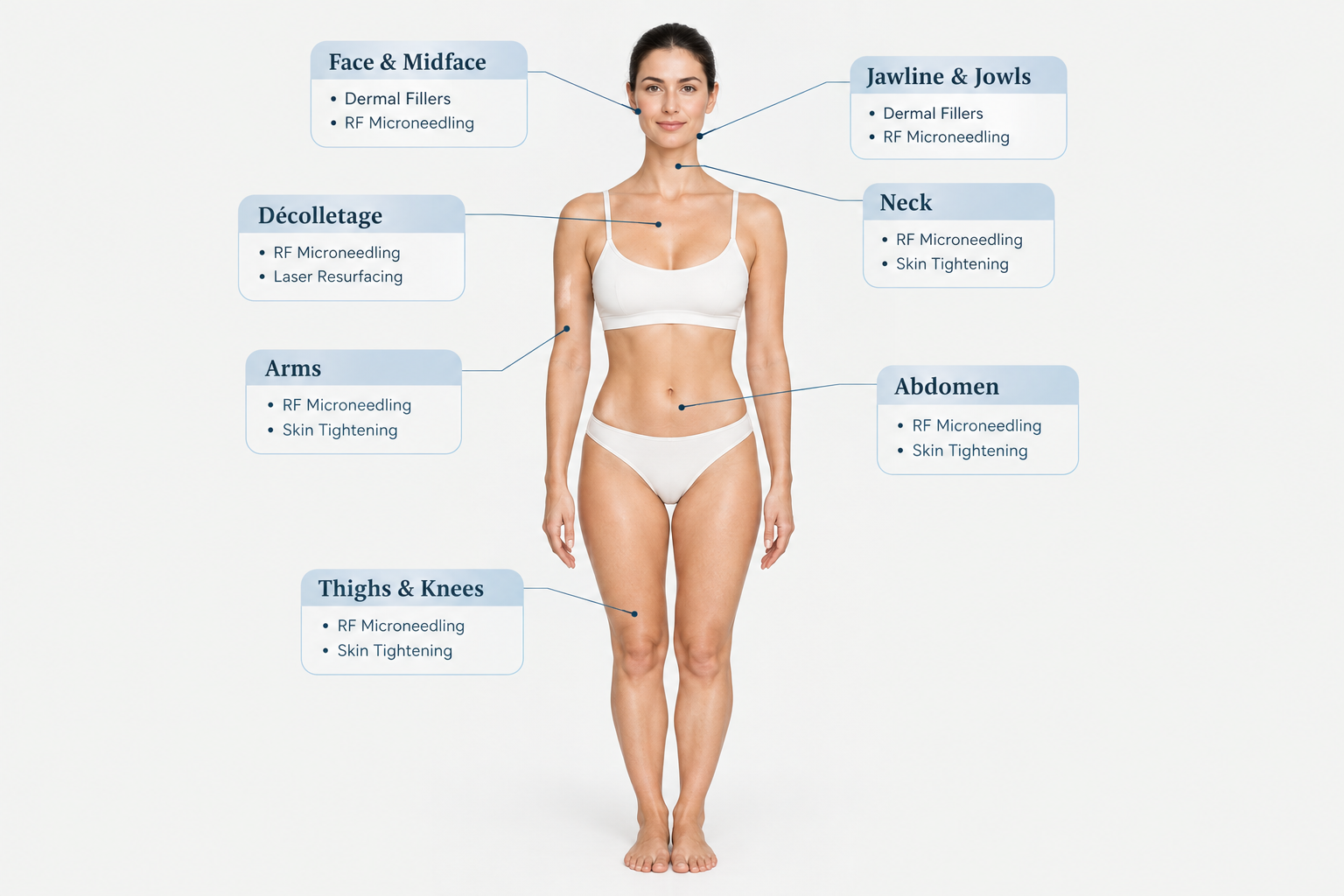
- Face and midface: RF microneedling, monopolar RF, and focused ultrasound are all well-established options. Biostimulator injectables work well when volume loss accompanies laxity.
- Jawline and jowls: Focused ultrasound (HIFU/Ultherapy) targeting the SMAS layer, PDO thread lifts, and RF microneedling are commonly used. Moderate to severe jowling may require surgical assessment.
- Neck and submentum (under chin): Focused ultrasound and monopolar RF are frequently used for neck laxity. PDO threads can provide additional lift. FaceTite (RF-assisted minimally invasive surgery) is an option for patients who want more significant improvement without a full facelift.
- Décolletage: Ultherapy is FDA-cleared for décolletage lines. Non-ablative laser and RF treatments are also used in this area.
- Arms, abdomen, thighs, and knees: Monopolar RF (Thermage) and RF microneedling can address body skin laxity, though results for significant post-weight-loss or post-bariatric skin excess are limited, and surgical skin removal may be the only effective option.
Skin Tone and Fitzpatrick Scale Considerations
Fitzpatrick skin type is a clinically important factor in treatment selection that is often overlooked in general patient information. Ablative lasers and some intense pulsed light (IPL) treatments carry a higher risk of post-inflammatory hyperpigmentation in patients with Fitzpatrick types IV–VI (medium-brown to dark skin). RF-based treatments — including monopolar RF and RF microneedling — are generally considered safer across a wider range of skin tones because they do not target melanin. Focused ultrasound is also generally well tolerated across skin types. Any patient with a darker skin tone should ensure their practitioner has specific experience treating their skin type and can adjust device settings accordingly.
Realistic Results and Honest Limitations
Non-surgical skin tightening treatments can produce meaningful improvements in mild to moderate skin laxity, but they cannot replicate the structural repositioning achieved by a surgical facelift. Patients with significant jowling, excess neck skin, or advanced laxity are unlikely to achieve satisfactory results from energy-based or injectable treatments alone, and an honest consultation should include a discussion of surgical options where appropriate.
Non-responder rates are a real consideration. A proportion of patients — estimates vary by treatment and study — experience minimal improvement despite completing a full treatment protocol. Factors that may influence response include age, skin thickness, degree of laxity, lifestyle factors such as smoking and sun exposure, and individual biological variation in collagen synthesis. Setting realistic expectations before treatment is essential, and before-and-after photographs taken under standardised conditions are the most reliable way to assess actual outcomes.
Combination treatment protocols — for example, pairing focused ultrasound with monopolar RF, or following RF microneedling with biostimulator injectables — are increasingly used in clinical practice to address multiple tissue depths simultaneously. Emerging evidence suggests that multi-modal approaches may produce better outcomes than single-modality treatment for some patients, though this area of research is still developing and protocols vary between practitioners.
At-Home Devices vs. In-Clinic Treatments
Consumer-grade at-home devices — including microcurrent tools, home RF devices, and LED panels — are widely marketed for skin tightening. These devices operate at significantly lower energy levels than clinical equipment for safety reasons, which limits their ability to deliver the thermal stimulus needed for meaningful collagen remodeling. At-home microcurrent devices may help maintain muscle tone and improve product absorption, and some users report modest improvements in skin firmness with consistent use. However, the clinical evidence for at-home RF and ultrasound devices producing comparable results to in-clinic energy-based treatments is limited. They may be a reasonable adjunct to professional treatments or a low-risk option for patients with very mild concerns, but they are not a substitute for clinical-grade procedures in patients with established skin laxity.
Aftercare and Maintenance
Aftercare following skin tightening treatments supports both recovery and the longevity of results. Broad-spectrum sun protection (SPF 30 or higher) is important after any energy-based or laser treatment, as UV exposure accelerates collagen degradation and can worsen hyperpigmentation risk. Keeping the skin well hydrated and avoiding harsh active ingredients such as retinoids and acids for the first few days after treatment is generally advised, though specific aftercare instructions vary by treatment type and practitioner protocol.
Maintenance treatment frequency depends on the modality chosen. Monopolar RF and focused ultrasound treatments are typically repeated annually or every eighteen months. RF microneedling maintenance is often recommended every twelve months after the initial course. Biostimulator injectables may require top-up sessions every one to two years. Patients who invest in a consistent maintenance schedule generally sustain results more effectively than those who treat episodically. Lifestyle factors — including sun protection, a balanced diet, adequate hydration, and avoiding smoking — also meaningfully influence how long results last.
Choosing a Provider
The same device can produce very different outcomes depending on who operates it. Treatment parameters — energy levels, depth settings, handpiece speed, and pattern — require clinical judgement and experience to optimise for each patient's anatomy and skin type. A board-certified dermatologist, plastic surgeon, or appropriately trained aesthetic practitioner with documented experience in the specific device being used is an important factor in both safety and outcome. Patients should ask about the practitioner's training with the specific technology, how many treatments they have performed, and what their approach is when results are not as expected. Clinics that offer a thorough consultation, take standardised photographs, and discuss realistic outcomes — including limitations — are generally more trustworthy than those that focus primarily on selling packages.
Frequently Asked Questions
How many treatment sessions will I need?
This depends on the treatment chosen and the degree of skin laxity being addressed. Monopolar RF and focused ultrasound are often performed as a single annual session. RF microneedling typically requires three to four sessions spaced four to six weeks apart. Biostimulator injectables usually involve two to four sessions. A qualified practitioner can recommend a protocol after assessing your skin in person.
Is non-surgical skin tightening painful?
Comfort levels vary by treatment. Focused ultrasound (HIFU/Ultherapy) can be uncomfortable, particularly over bony areas, and topical anaesthetic is sometimes applied. RF microneedling involves needles and is typically performed with topical numbing cream. Monopolar RF is generally well tolerated with a warming sensation. Biostimulator injections may cause brief stinging. Most patients find in-clinic treatments manageable with appropriate preparation.
Can skin tightening treatments be combined?
Yes, combination protocols are used in clinical practice. Common combinations include focused ultrasound with monopolar RF, RF microneedling followed by biostimulator injectables, or energy-based treatments alongside dermal fillers for volume. Combining modalities can address different tissue depths and concerns simultaneously, though the evidence base for specific combinations is still developing. A practitioner experienced in multi-modal treatment planning can advise on what may be appropriate for your goals.
Are results permanent?
No non-surgical skin tightening treatment produces permanent results. The underlying ageing process continues, and collagen produced in response to treatment will gradually break down over time. Most treatments require maintenance sessions every one to two years to sustain improvement. Surgical options such as a facelift produce longer-lasting results — typically five to ten years — but also involve greater recovery and risk.
Which treatment is safest for darker skin tones?
RF-based treatments, including monopolar RF and RF microneedling, are generally considered safer for patients with darker Fitzpatrick skin types because they do not target melanin and carry a lower risk of post-inflammatory hyperpigmentation compared with ablative lasers. Focused ultrasound is also generally well tolerated across skin tones. Ablative fractional lasers require careful assessment and experienced hands in patients with Fitzpatrick types IV–VI. Always discuss your skin tone and history of hyperpigmentation with your practitioner before treatment.
What is the difference between HIFU and Ultherapy?
Ultherapy is a specific FDA-cleared brand of micro-focused ultrasound with visualisation (MFU-V). HIFU is the broader technology category. Ultherapy uses real-time ultrasound imaging to guide energy delivery, which allows the practitioner to visualise tissue layers before treating. Generic HIFU devices vary widely in quality, calibration, and clinical evidence. When considering focused ultrasound treatment, it is worth asking which specific device will be used and what evidence supports it.
Which Skin Tightening Treatment May Be Right for You?
There is no single best skin tightening treatment — the most appropriate option depends on the degree of skin laxity, the area being treated, skin tone, tolerance for downtime, budget, and individual goals. Patients with mild to moderate laxity and minimal downtime requirements may find monopolar RF or focused ultrasound a practical starting point. Those with textural concerns alongside laxity, or with darker skin tones, may benefit most from RF microneedling. Patients seeking a more immediate visible lift for moderate jowling might consider a PDO thread lift, while those with volume loss alongside laxity may find biostimulator injectables a well-matched option. Significant or advanced skin laxity is unlikely to respond adequately to non-surgical approaches, and a surgical consultation is worth considering in those cases.
A thorough in-person consultation with a qualified and experienced practitioner — ideally a board-certified dermatologist or plastic surgeon, or a practitioner working under appropriate medical supervision — is the most reliable way to identify which treatment or combination of treatments is genuinely suited to your anatomy, skin type, and goals. Realistic expectations, honest discussion of limitations, and a clear maintenance plan are the foundations of a good outcome.
