
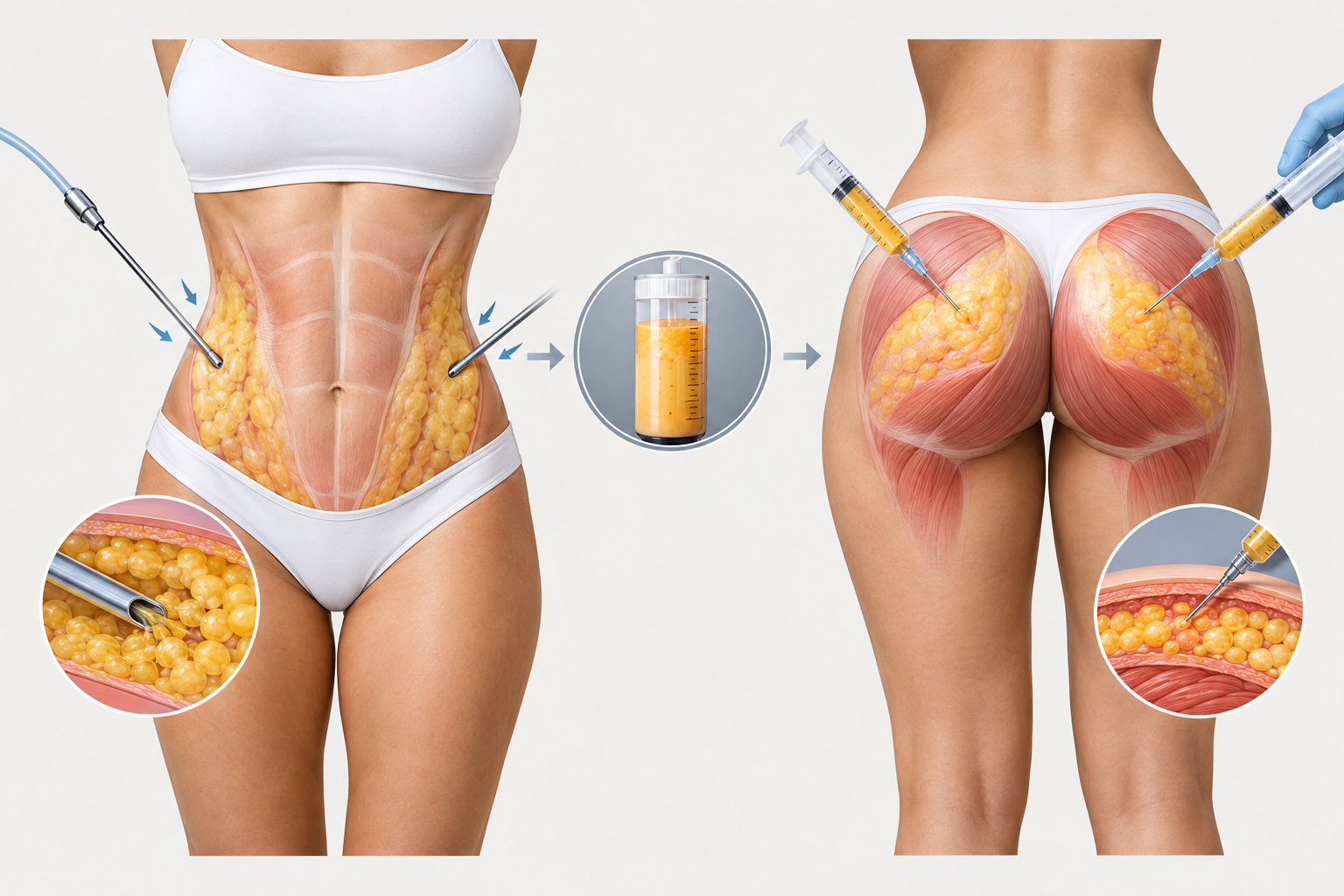

A BBL, or Brazilian Butt Lift, is a surgical body contouring procedure that uses a patient's own fat to reshape and add volume to the buttocks. Unlike implants, a BBL combines liposuction with fat transfer, meaning it simultaneously reduces unwanted fat from donor areas and uses that harvested fat to enhance the shape of the buttocks. It is one of the most searched cosmetic surgery procedures globally, yet it also carries some of the most significant risks of any elective aesthetic operation. Understanding exactly what a BBL involves, who may be a suitable candidate, what realistic results look like, and what the genuine risks are is essential before considering a consultation.
Key Takeaways
- A Brazilian Butt Lift is a surgical fat transfer procedure, not a buttock implant operation, and requires sufficient donor fat from areas such as the abdomen, flanks, or thighs.
- BBL results can look natural when performed by an experienced surgeon, but a significant proportion of transferred fat may not survive long-term, meaning final volume is not fully predictable.
- The BBL has historically carried one of the highest mortality rates among elective cosmetic procedures, primarily due to fat embolism risk; technique refinements have improved safety, but the procedure remains high-risk.
- Recovery involves several weeks of avoiding direct pressure on the buttocks, and patients must follow strict post-operative instructions to support fat survival.
- Non-surgical alternatives exist for those seeking modest improvement without surgery, though they cannot replicate the volume changes achievable with fat transfer.
What Is a BBL and How Does It Work?
The term BBL stands for Brazilian Butt Lift, a name that refers to the aesthetic goal of creating a rounder, fuller, and more lifted buttock contour rather than a literal surgical lift of skin. The procedure has two distinct phases performed during the same operation. In the first phase, a surgeon uses liposuction to remove fat from donor areas, which commonly include the abdomen, waist, flanks, lower back, and thighs. This liposuction step also contributes to the overall body contouring result by slimming the surrounding areas, which can make the buttocks appear more prominent even before the transferred fat is considered.
In the second phase, the harvested fat is processed to remove fluids, blood, and damaged cells, leaving purified fat cells ready for reinjection. The surgeon then carefully injects this processed fat into specific layers of the buttock tissue to build volume and shape. The placement of fat during injection is critically important both for the aesthetic result and for patient safety, a point discussed in detail in the risks section below. The entire procedure is performed under general anaesthesia and typically takes two to four hours depending on the volume of fat being transferred and the number of donor sites involved.
What Results Can a BBL Achieve?
A Brazilian Butt Lift can increase buttock volume, improve projection, enhance the waist-to-hip ratio, and create a more defined contour. Because the procedure uses the patient's own fat rather than synthetic implants, results can appear and feel natural when the technique is well executed. The simultaneous liposuction of surrounding areas often contributes significantly to the overall silhouette change, creating a more hourglass-shaped appearance that patients frequently describe as the primary motivation for the procedure.
However, not all transferred fat survives. Fat graft survival rates vary considerably between patients and depend on factors including the surgeon's technique, how the fat is processed, how it is injected, and how well the patient follows post-operative care instructions. Published estimates suggest that roughly 60 to 80 percent of transferred fat may survive long-term, though individual outcomes vary and some patients experience greater resorption. Surgeons often slightly overfill to account for expected fat loss, but the final volume achieved is not entirely predictable. Patients should have realistic expectations and understand that a second procedure may sometimes be considered if the initial result does not meet their goals after full healing.
Who May Be a Suitable Candidate?
A BBL is not suitable for everyone, and a thorough surgical consultation is required to assess individual suitability. Candidates generally need to have sufficient donor fat available for harvest, since the procedure depends entirely on the patient's own tissue. Very slim individuals with minimal body fat may not have enough donor fat to achieve a meaningful result, and surgeons may advise against the procedure in these cases.
Other factors that a surgeon will typically assess include:
- Overall health and fitness for general anaesthesia
- Skin quality and elasticity in both the donor and recipient areas
- Realistic expectations about the degree of change achievable
- Body mass index and fat distribution
- History of previous liposuction or surgery in the relevant areas
- Absence of active infection, uncontrolled medical conditions, or bleeding disorders
- Non-smoker status or willingness to stop smoking well in advance of surgery, as smoking impairs healing and fat survival
Pregnancy plans are also relevant. Significant weight changes or pregnancy after a BBL can alter the result, and surgeons typically advise patients to consider timing carefully. The procedure is not appropriate during pregnancy or breastfeeding.
What Happens During a BBL Consultation?
A pre-operative consultation with a qualified plastic or cosmetic surgeon involves a detailed discussion of the patient's goals, a physical assessment of donor fat availability and buttock anatomy, a review of medical history and medications, and an explanation of the surgical plan. Surgeons will usually use imaging or body analysis to help set realistic expectations. Patients should feel comfortable asking detailed questions about the surgeon's experience, the specific technique planned, the facility where surgery will take place, and what aftercare support is provided.
Patients are typically advised to stop certain medications and supplements that increase bleeding risk before surgery, and to arrange for someone to assist them during the early recovery period. Pre-operative blood tests and medical clearance may be required depending on age and health status.
The BBL Procedure: What to Expect on the Day
A Brazilian Butt Lift is performed under general anaesthesia in a surgical facility. After anaesthesia is administered, the surgeon marks the donor and recipient areas on the patient's body. Liposuction is performed first using small incisions through which a thin cannula is inserted to loosen and remove fat. The harvested fat is then processed, typically by centrifugation or filtration, to separate viable fat cells from unwanted material.
The purified fat is loaded into syringes and injected into the buttocks through small entry points. The surgeon distributes the fat across multiple tissue planes and locations to build the desired shape and volume. The incisions are small and generally do not require stitches, closing naturally with adhesive strips or left to heal on their own. A compression garment is fitted before the patient leaves the operating area, and this garment is worn throughout the initial recovery period.
Recovery and Downtime After a BBL
Recovery from a Brazilian Butt Lift is more demanding than many patients anticipate, and following post-operative instructions carefully is important both for safety and for optimising fat survival. The most well-known aspect of BBL recovery is the requirement to avoid sitting or lying directly on the buttocks for a period typically ranging from two to six weeks, depending on the surgeon's protocol. Direct pressure on the treated area can compromise blood supply to the newly transferred fat cells and reduce the proportion that survives.
Patients are usually advised to sleep on their stomach or side and to use a specially designed BBL pillow when sitting is unavoidable, such as when using the toilet or travelling. Returning to a desk job may be possible after two to three weeks with appropriate precautions, while more physically demanding work or exercise typically requires a longer break of four to six weeks or more.
Swelling and bruising in both the donor and recipient areas are expected and can be significant in the first two weeks. Compression garments help manage swelling and support the healing tissues. Most patients find that the majority of swelling resolves within six to eight weeks, though subtle changes in contour can continue for up to six months as the surviving fat integrates and the tissues settle. Final results are generally assessed at around six months post-operatively.
Risks and Safety Considerations
The Brazilian Butt Lift has received considerable attention in the medical community due to its safety profile. It has historically been associated with one of the highest mortality rates among elective cosmetic procedures, with fat embolism identified as the primary cause of procedure-related deaths. A fat embolism occurs when fat particles enter the bloodstream and travel to the lungs or other vital organs, which can be rapidly life-threatening. This risk is directly related to injection technique: fat injected into or near the gluteal blood vessels carries a substantially higher risk than fat placed in the subcutaneous layer above the muscle.
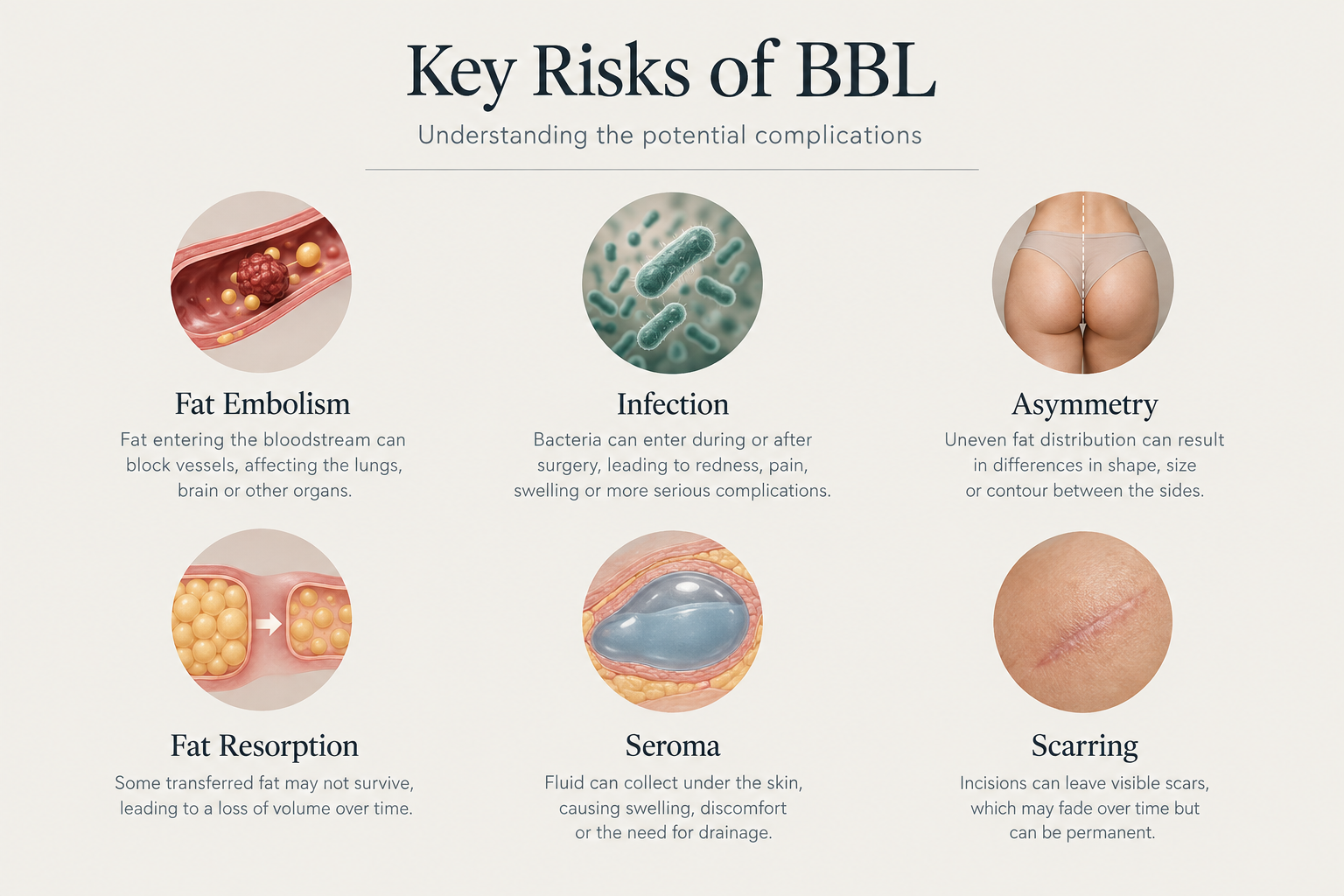
In response to safety concerns, professional bodies including the American Society of Plastic Surgeons and the International Society of Aesthetic Plastic Surgery have issued guidance recommending that fat be injected only into the subcutaneous fat layer and not into or below the gluteal muscle. Surgeons who follow updated safety protocols and use techniques such as ultrasound guidance report lower complication rates, though the procedure remains inherently higher risk than many other cosmetic operations.
Other risks associated with a BBL include:
- Infection at liposuction or injection sites
- Seroma or haematoma formation (fluid or blood accumulation)
- Asymmetry or uneven contour
- Skin irregularities or dimpling in donor areas
- Scarring at incision sites
- Partial or significant fat resorption reducing the final result
- Skin necrosis in rare cases
- Anaesthesia-related complications
- Deep vein thrombosis or pulmonary embolism related to surgery and immobility
Choosing a fully qualified, experienced surgeon operating in an accredited facility with appropriate emergency support is among the most important safety decisions a patient can make. The procedure should not be performed in non-clinical settings or by practitioners without appropriate surgical training and credentials.
How Long Do BBL Results Last?
Once the transferred fat has established a blood supply and survived the initial healing period, it behaves like the patient's own natural fat tissue. This means that results can be long-lasting, and many patients retain a meaningful proportion of their result for many years. However, the surviving fat will respond to significant weight changes in the same way as fat elsewhere in the body. Substantial weight loss after a BBL may reduce the volume of the transferred fat, while significant weight gain may increase it. Maintaining a relatively stable weight after the procedure helps preserve the result.
Ageing, changes in skin elasticity, and hormonal shifts over time will also gradually affect the appearance of the buttocks, as they do with all body areas. A BBL does not halt the natural ageing process. Patients should understand that while results can be durable, they are not permanent in an absolute sense, and the appearance of the treated area will continue to change over the years.
Non-Surgical Alternatives to a BBL
For patients who want to improve buttock shape or projection without surgery, several non-surgical options exist, though none can replicate the volume changes achievable with fat transfer. Understanding what each alternative can and cannot achieve helps set realistic expectations.
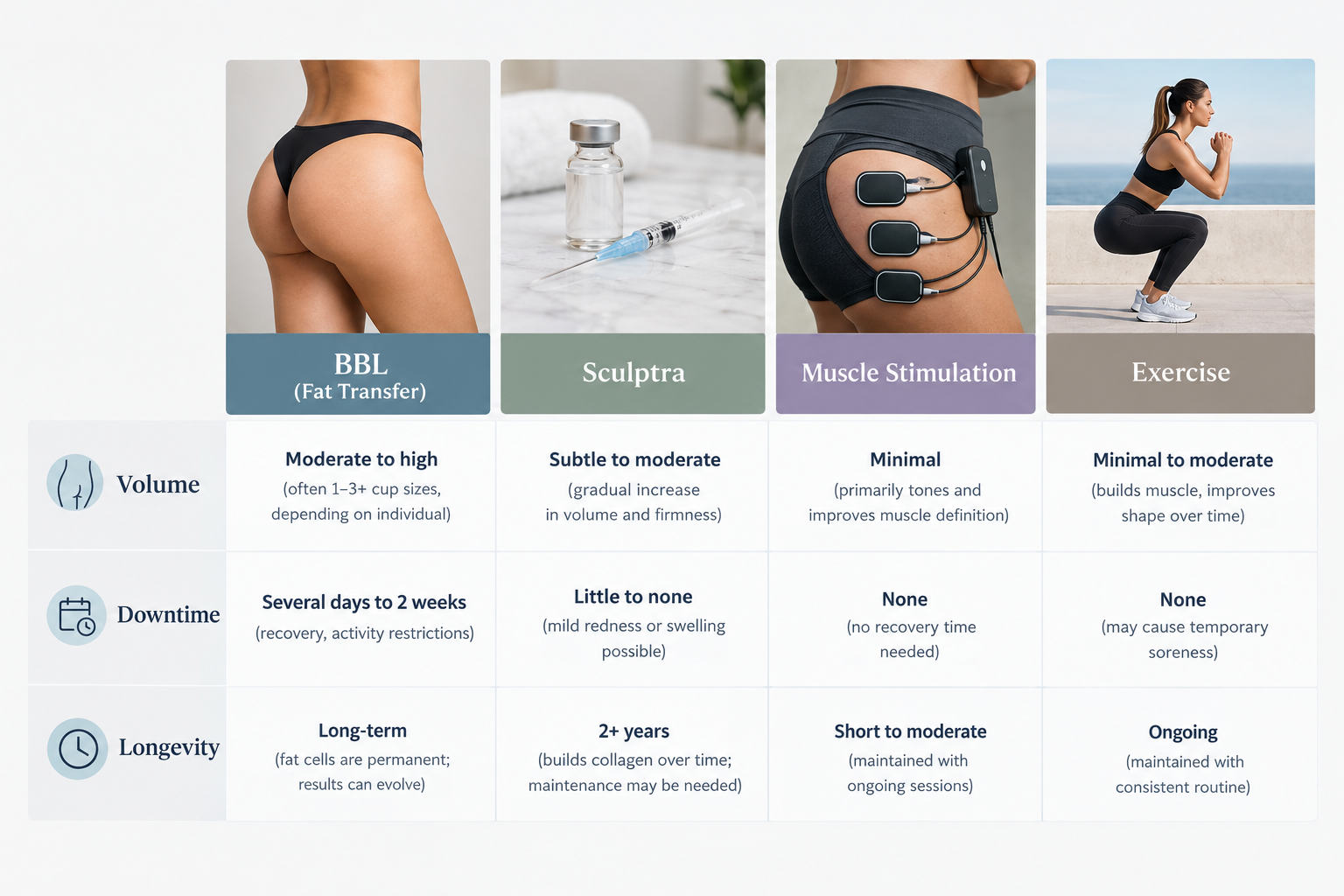
Sculptra for buttock enhancement involves injecting poly-L-lactic acid, a collagen-stimulating filler, into the buttocks to gradually add subtle volume and improve skin quality over several months. Results develop slowly and require multiple sessions, and the degree of volume increase is modest compared to surgical fat transfer. Sculptra is not a fat transfer procedure and works through a different mechanism.
Hyaluronic acid fillers have been used off-label in the buttock area by some practitioners, though this is not a widely standardised approach and carries its own risk profile. The volume achievable is limited, and results are temporary.
Muscle-stimulating body contouring devices such as electromagnetic muscle stimulation treatments can improve gluteal muscle tone and definition, which may create a slightly lifted or more defined appearance. These devices do not add fat volume and are more relevant for patients seeking improved muscle definition rather than increased size.
Exercise and targeted strength training remains the most accessible approach to improving gluteal shape and tone, though it cannot add fat volume to the area and results depend on individual anatomy and genetics.
Non-surgical options may be appropriate for patients who are not surgical candidates, those who want very modest improvement, or those who wish to avoid surgical risk and recovery. A consultation with a qualified practitioner can help determine which approach, if any, is appropriate for a specific patient's goals and anatomy.
BBL vs Buttock Implants: Key Differences
Buttock implants are a surgical alternative to fat transfer for patients who lack sufficient donor fat for a BBL. Silicone implants are placed within or beneath the gluteal muscle to add volume and projection. Unlike a BBL, implants do not require donor fat, making them an option for slimmer patients. However, implants carry their own distinct risk profile, including implant displacement, capsular contracture, infection, and a longer recovery period. The feel and appearance of implants may differ from natural fat transfer results. Some surgeons combine implants with fat transfer to achieve both volume and contouring. The choice between a BBL and implants depends on the patient's anatomy, goals, and risk tolerance, and should be discussed thoroughly with a qualified plastic surgeon.
Frequently Asked Questions
Is a BBL the same as buttock implants?
No. A Brazilian Butt Lift uses the patient's own fat, harvested by liposuction and then injected into the buttocks. Buttock implants use silicone prostheses placed surgically within the gluteal tissue. Both are surgical procedures but involve different techniques, risks, and recovery experiences.
How much fat is needed for a BBL?
The amount of donor fat required varies depending on the desired result and the patient's anatomy. Surgeons generally need enough fat from donor areas such as the abdomen, flanks, or thighs to harvest, process, and inject a meaningful volume. Very slim patients with minimal body fat may not have sufficient donor fat and may not be suitable candidates for the procedure.
Is a BBL painful?
The procedure itself is performed under general anaesthesia, so patients do not feel pain during surgery. Post-operative discomfort is expected in both the liposuction donor areas and the buttocks, and is typically managed with prescribed pain relief. Most patients describe the donor site discomfort as more noticeable than the buttock area in the early days. Discomfort generally improves significantly within the first one to two weeks.
Can I sit after a BBL?
Surgeons typically advise patients to avoid sitting directly on the buttocks for two to six weeks following a BBL to protect the newly transferred fat cells. When sitting is unavoidable, a specially designed BBL pillow that transfers pressure to the thighs rather than the buttocks is recommended. Following these instructions carefully is important for maximising fat survival and the quality of the final result.
How long does it take to see final BBL results?
Initial swelling makes it difficult to assess the true result in the first weeks after surgery. Most swelling resolves within six to eight weeks, but subtle changes in contour continue as the surviving fat integrates and tissues settle. Final results are generally evaluated at around six months post-operatively.
Is a BBL safe?
A BBL carries real and significant risks, including a historically elevated mortality rate compared to other elective cosmetic procedures, primarily due to fat embolism. Safety has improved with updated injection techniques that avoid placing fat near or within gluteal blood vessels. Choosing a fully qualified surgeon operating in an accredited facility with appropriate emergency protocols is essential. The procedure is not without risk, and patients should discuss the full risk profile with their surgeon before making a decision.
Are BBL results permanent?
Once transferred fat survives the initial healing period, it can remain for many years and behaves like the patient's natural fat tissue. However, significant weight changes can affect the volume of the transferred fat, and natural ageing will gradually alter the appearance of the area over time. Results are long-lasting but not permanent in an absolute sense.
Is a BBL the Right Choice to Consider?
A Brazilian Butt Lift can produce meaningful, natural-looking changes to buttock shape and overall body contour for patients who are suitable candidates and who have realistic expectations. The combination of liposuction and fat transfer means the procedure addresses multiple areas simultaneously, which many patients find appealing. When performed by an experienced, qualified surgeon in an appropriate facility using current safety techniques, the procedure can achieve results that are difficult to replicate with non-surgical methods.
At the same time, the BBL is a significant surgical procedure with a risk profile that deserves careful consideration. The historical safety data, the demands of recovery, the variability in fat survival, and the requirement for sufficient donor fat all mean that this procedure is not appropriate for every patient who enquires about it. Non-surgical alternatives may be worth exploring for those seeking modest improvement without surgical risk, though they cannot match the volume changes that fat transfer can achieve.
Anyone considering a BBL should seek a consultation with a fully qualified plastic or cosmetic surgeon who can assess individual anatomy, discuss realistic outcomes, explain the specific risks relevant to their situation, and answer questions honestly. A thorough, unhurried consultation with a practitioner who prioritises patient safety over volume of procedures is the most important first step in making an informed decision.
