
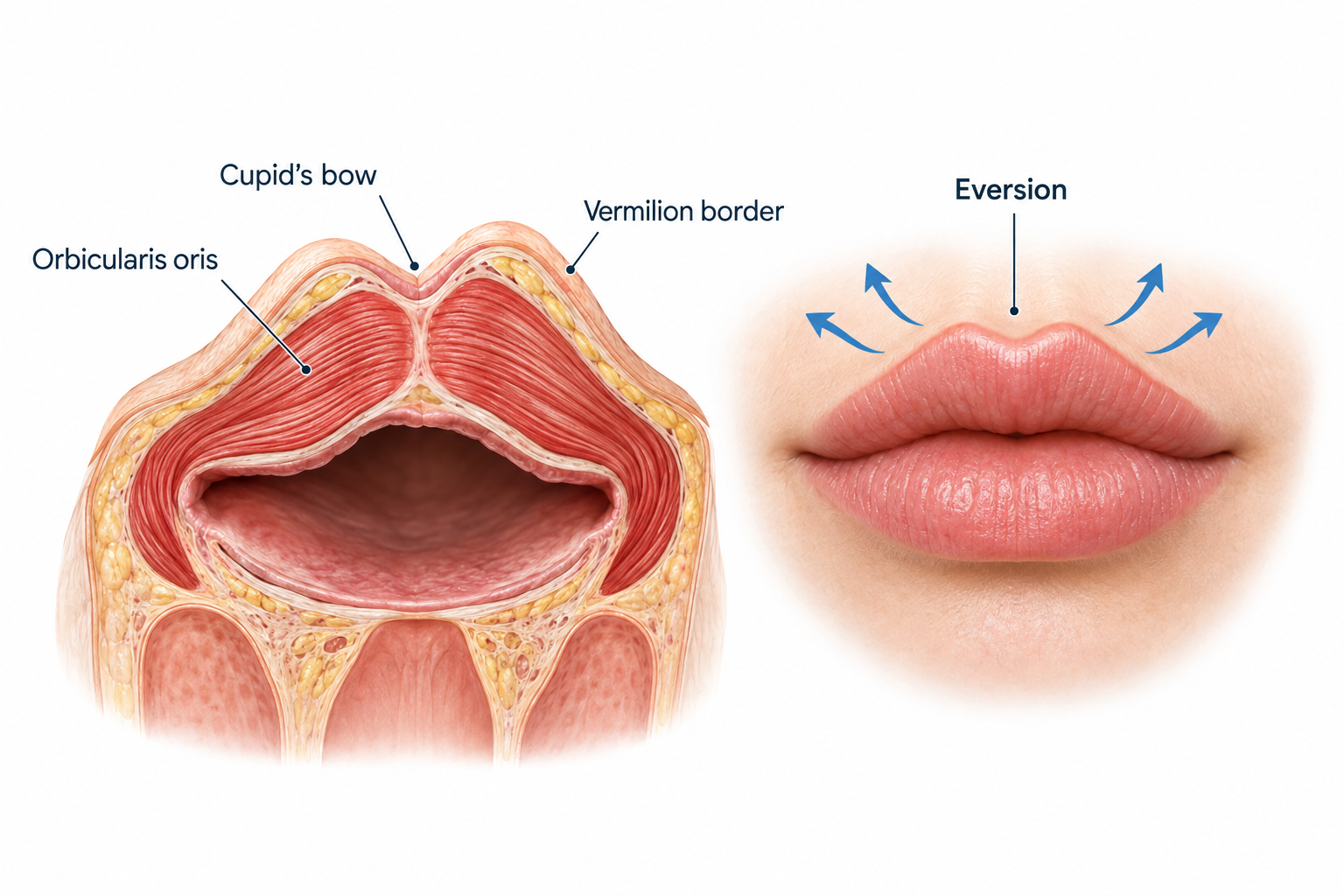

A lip flip is a minimally invasive cosmetic treatment that uses a small amount of botulinum toxin to gently relax the muscle around the upper lip, causing the lip edge to roll slightly outward and appear fuller — without adding any volume. It is one of the most searched non-surgical lip treatments, partly because it is quick and relatively affordable, and partly because many people are unsure whether it is actually right for them. This guide explains how the procedure works, who tends to benefit most, who is unlikely to see meaningful results, and how it compares to lip filler so you can approach a consultation with realistic expectations.
Key Takeaways
- A lip flip relaxes the orbicularis oris muscle to create the appearance of a fuller upper lip through eversion — not by adding volume.
- Ideal candidates typically have lips that roll inward or disappear when smiling, a gummy smile, or early perioral lines — not lips that are simply thin and lack volume.
- Results are subtle and temporary, generally lasting six to twelve weeks, making maintenance treatments necessary for ongoing effect.
- A lip flip is not suitable for everyone; people with very thin lips, neuromuscular disorders, active oral infections, or certain other conditions should discuss alternatives with a qualified practitioner.
- Lip filler and a lip flip serve different goals and can sometimes be combined, but the right approach depends on individual lip anatomy and the outcome you are hoping to achieve.
How a Lip Flip Works: The Anatomy Behind It
To understand why a lip flip suits some people and not others, it helps to understand the muscle involved. The orbicularis oris is a circular muscle that encircles the mouth and controls lip movement — pursing, sealing, and compressing the lips. In some people, this muscle is particularly active or sits in a way that causes the upper lip to curl slightly inward, reducing how much of the lip's pink surface (the vermilion border) is visible, especially when smiling or speaking.
A lip flip involves injecting a small amount of botulinum toxin — most commonly Botox, though other neuromodulator brands may be used — into specific points along the upper lip, typically at the cupid's bow and at the corners of the mouth. The toxin temporarily reduces the muscle's ability to contract fully. As the orbicularis oris relaxes, the upper lip undergoes a gentle eversion: the lip edge rolls outward and upward, revealing more of the vermilion border and creating the impression of a slightly fuller, more defined lip. The procedure does not inject any filler material, so no physical volume is added.
This is technically considered an off-label use of botulinum toxin in many countries, meaning it is not among the formally licensed indications for the product, though it is widely performed by experienced aesthetic practitioners. The number of units used is small — typically in the range of a few units — which is considerably less than what is used for areas such as the forehead or glabellar lines.
Who Is a Good Candidate for a Lip Flip?
Patient selection is the most important factor in whether a lip flip delivers a satisfying result. The procedure works by changing the position of the lip edge, not by increasing tissue volume, so the people who benefit most are those whose lip concerns relate to muscle behaviour or lip position rather than a lack of tissue.
Likely to benefit
- Lips that disappear when smiling: If your upper lip rolls inward or becomes very thin when you smile or laugh, a lip flip can counteract this by reducing the inward pull of the orbicularis oris. This is one of the clearest indicators of suitability.
- Gummy smile: People who show a significant amount of gum above the upper teeth when smiling may find that a lip flip, sometimes combined with injections targeting the lip elevator muscles, helps the upper lip sit slightly lower and cover more of the gum line.
- Desire for subtle lip enhancement: If you want a modest, natural-looking change rather than a dramatic increase in lip size, the lip flip aligns well with that goal. It is not the right choice for someone wanting noticeably larger lips.
- Smoker's lines and perioral lines: The same muscle relaxation that causes eversion can also soften the fine vertical lines that form above the upper lip — sometimes called smoker's lines or straw lines — making the lip flip useful for early signs of perioral ageing even in non-smokers.
- Hyperactive muscle around the mouth: Some people have a naturally more active orbicularis oris that causes the lip to compress more than average. A lip flip can moderate this activity and improve the resting appearance of the lip.
May benefit with caveats
- Mild volume loss with good lip shape: Patients in their thirties or forties who have begun to notice some thinning but still have reasonable lip shape may see a useful improvement from a lip flip, though they may also benefit from a small amount of filler. A practitioner can assess which approach — or a combination — is more appropriate.
- Patients wanting to trial lip enhancement before committing to filler: Because a lip flip is temporary and relatively low-cost, some patients use it as a way to experience subtle lip enhancement before deciding whether to pursue dermal filler. This is a reasonable approach, though the results are different enough that a lip flip should not be treated as a direct preview of what filler would look like.
Unlikely to benefit significantly
- Very thin lips with little tissue volume: If the upper lip is naturally very thin and lacks tissue, relaxing the orbicularis oris will have limited visible effect because there is not enough lip to evert meaningfully. Lip filler is generally a more appropriate option in this case.
- Lips that already evert naturally: Some people's upper lips naturally sit in an everted position. A lip flip would offer little additional change and could potentially cause an unnatural appearance.
- Patients seeking significant volume or projection: A lip flip adds no volume. If the primary goal is noticeably fuller lips with more projection, hyaluronic acid lip filler is the more suitable treatment.
Who Should Not Have a Lip Flip
Certain medical and anatomical factors make a lip flip unsuitable or inadvisable. A thorough consultation with a qualified practitioner should always include a review of the following:
- Pregnancy and breastfeeding: Botulinum toxin treatments are not recommended during pregnancy or while breastfeeding due to insufficient safety data.
- Allergy to botulinum toxin or product components: A known allergy to any ingredient in the botulinum toxin formulation is a contraindication.
- Active oral infection: Cold sores, canker sores, or any active infection around the mouth should be fully resolved before treatment to reduce the risk of spreading infection.
- Neuromuscular disorders: Conditions such as myasthenia gravis, Lambert-Eaton syndrome, or amyotrophic lateral sclerosis (ALS) affect how the body responds to botulinum toxin and can increase the risk of serious adverse effects. These are generally considered contraindications.
- Certain medications: Some antibiotics and muscle relaxants can interact with botulinum toxin. A full medication review is essential before treatment.
- Recent lip surgery or significant lip procedures: Patients who have had recent surgical lip augmentation or other significant procedures in the area should discuss timing carefully with their practitioner.
- Uncontrolled thyroid disease: This may affect how the body metabolises botulinum toxin and should be disclosed during consultation.
Lip Flip vs Lip Filler: Understanding the Difference
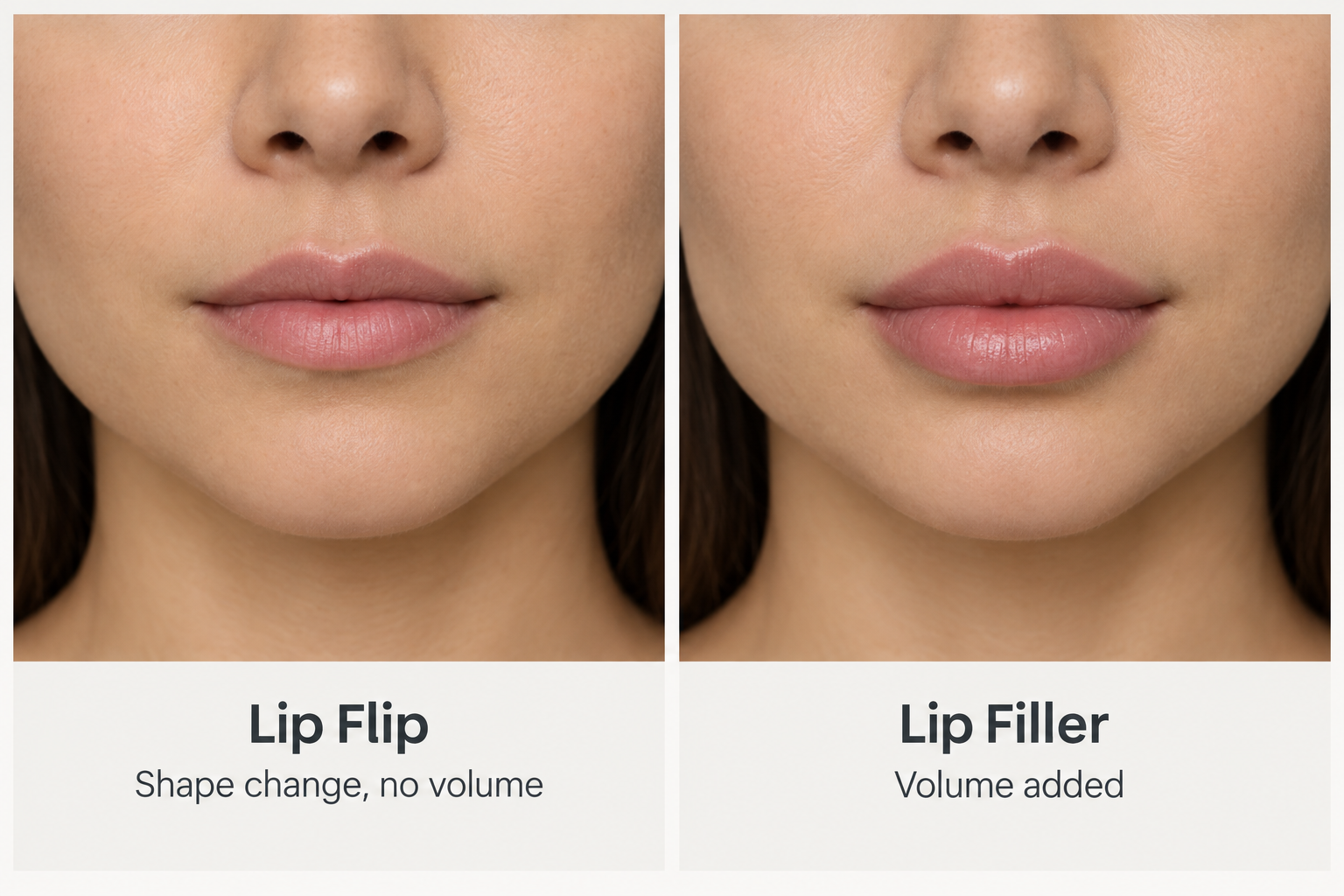
The lip flip vs lip filler comparison is one of the most common questions practitioners encounter, and the distinction matters because the two treatments address fundamentally different concerns.
| Characteristic | Lip Flip | Lip Filler |
|---|---|---|
| Active substance | Botulinum toxin (neuromodulator) | Hyaluronic acid (dermal filler) |
| Mechanism | Muscle relaxation causing eversion | Physical volume addition |
| Volume added | None | Yes — variable amount |
| Typical result | Subtle shape change, more visible lip | Fuller, more projected lips |
| Onset | 3–7 days; full effect at 10–14 days | Immediate, with settling over 2 weeks |
| Duration | Approximately 6–12 weeks | Approximately 6–12 months (varies) |
| Reversibility | Not reversible; must wait for toxin to wear off | Reversible with hyaluronidase enzyme |
| Ideal candidate | Lips that disappear when smiling; gummy smile; perioral lines | Thin lips lacking volume; desire for fuller lips |
| Typical cost range | Lower (fewer units of product used) | Higher (more product required) |
| Maintenance frequency | Every 6–12 weeks | Every 6–12 months approximately |
The key practical distinction is this: lip filler adds physical tissue where there is a deficit, while a lip flip changes how existing tissue sits. A patient with naturally full lips that compress when smiling is a better candidate for a lip flip. A patient with genuinely thin lips who wants more volume is generally better served by filler. Some patients benefit from both treatments used together — the filler provides volume while the lip flip refines the shape and prevents the lip from rolling inward — but this combination approach should be assessed individually by an experienced practitioner.
Age-Related Suitability Considerations
Younger patients in their twenties and early thirties who seek a lip flip are typically motivated by shape optimisation — they may have naturally full lips that disappear when smiling, or they want a subtle enhancement without committing to filler. For this group, the lip flip can be a well-matched, low-commitment option.
Patients in their forties and beyond are more likely to be dealing with genuine volume loss alongside changes in lip position and the development of perioral lines. For these patients, a lip flip alone may address the lines and the rolling-inward tendency, but it will not restore lost volume. A combined approach — or filler as the primary treatment — may be more appropriate depending on the degree of volume loss. Age alone does not determine suitability; lip anatomy and the specific concern are more relevant factors than a patient's decade of life.
Lifestyle and Profession: Practical Considerations Before Treatment
Because a lip flip temporarily reduces the strength and precision of the orbicularis oris muscle, it can affect activities that rely on fine lip control. This is a practical consideration that is rarely discussed in detail but matters for certain patients.
People who play wind instruments — flutes, trumpets, clarinets, oboes — depend on precise lip tension and seal to produce sound. Even a small reduction in orbicularis oris strength can noticeably affect their ability to play, and this effect may persist for the full duration of the treatment. Professional musicians or serious amateurs should factor this into their decision carefully and discuss timing with their practitioner.
Public speakers, singers, actors, and people in client-facing roles may also notice temporary changes in the way they pronounce certain sounds, particularly those requiring firm lip contact such as B, P, and M sounds. These effects are usually mild and resolve as the toxin wears off, but they are worth anticipating. Similarly, using a straw or drinking from a bottle may feel slightly different in the days following treatment. These are not dangerous side effects, but they are relevant to daily life and professional commitments.
What to Expect: The Treatment Experience and Results Timeline
A lip flip appointment is typically brief. After a consultation to confirm suitability and discuss goals, the practitioner will cleanse the area and may apply a topical numbing cream, though many patients find the injections tolerable without it given the small number of injection points involved. The botulinum toxin is administered at targeted points along the upper lip border.
Results do not appear immediately. The botulinum toxin takes time to bind to nerve endings and reduce muscle activity. Most patients begin to notice a change between three and seven days after treatment, with the full effect visible at around ten to fourteen days. The lip flip is not reversible in the way that hyaluronic acid filler can be dissolved — if the result is not what you hoped for, you will need to wait for the toxin to wear off naturally.
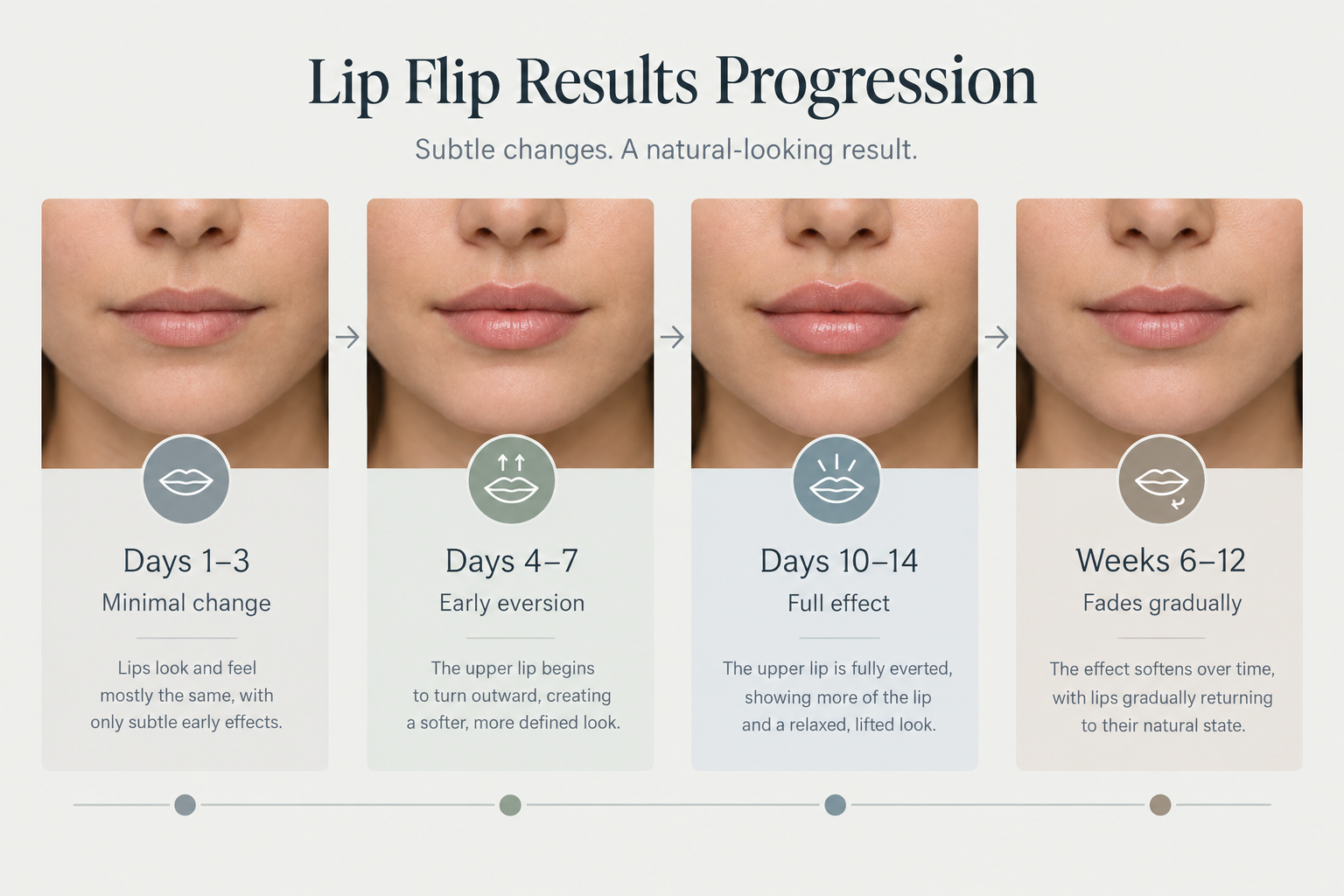
| Timeframe | What to Expect |
|---|---|
| Days 1–3 | Minimal visible change; possible mild swelling or redness at injection sites |
| Days 4–7 | Early eversion begins; lip may start to appear slightly more defined |
| Days 10–14 | Full effect visible; upper lip sits in a more everted position |
| Weeks 6–12 | Effect gradually diminishes as the toxin wears off; maintenance treatment needed to sustain results |
Duration varies between individuals. Patients with faster metabolisms or higher levels of physical activity may find the effect wears off more quickly. Maintenance treatments are typically needed every six to twelve weeks to sustain the result, which is more frequent than most filler treatments and is a meaningful practical and financial consideration.
Risks and Side Effects
A lip flip is generally considered a low-risk procedure when performed by a board-certified injector or appropriately qualified aesthetic practitioner with experience in perioral anatomy. However, side effects and complications are possible and should be understood before treatment.
- Common and temporary: Mild bruising, swelling, and redness at injection sites are the most frequently reported effects and typically resolve within a few days.
- Temporary functional changes: Difficulty using a straw, slight changes in speech (particularly with B, P, and M sounds), and mild difficulty with certain facial expressions can occur and are related to the intended muscle relaxation. These effects resolve as the toxin wears off.
- Asymmetry: Uneven relaxation of the orbicularis oris can result in a slightly asymmetric appearance. This is usually mild and temporary.
- Lip drooping or over-relaxation: If too much toxin is used or placement is imprecise, the lip may appear to droop or the result may look unnatural. Choosing an experienced practitioner significantly reduces this risk.
- Drooling: In some cases, reduced lip muscle control can make it harder to maintain a complete lip seal, which may cause mild drooling, particularly when drinking.
Serious complications are rare but possible with any injectable treatment. Infection, vascular injury, and allergic reactions, while uncommon, are reasons why treatment should always be carried out in a clinical setting by a qualified professional.
Aftercare Following a Lip Flip
Post-treatment care for a lip flip is straightforward. Practitioners typically advise patients to remain upright for several hours after treatment, avoid strenuous exercise for twenty-four hours, and refrain from alcohol for one to two days. Rubbing, massaging, or applying pressure to the treated area should be avoided in the first day or two, as should exposure to significant heat such as saunas or steam rooms. Makeup is generally best avoided on the day of treatment. Blood-thinning medications and supplements such as aspirin, ibuprofen, fish oil, and vitamin E are often recommended to be paused before treatment (with medical guidance where relevant) to reduce bruising risk.
Choosing a Qualified Practitioner
The lip area is anatomically complex, and the margin between a natural-looking result and an over-treated appearance is narrow. Selecting a board-certified injector or a practitioner with specific training and demonstrable experience in perioral botulinum toxin treatments is important. When researching providers, it is reasonable to ask about their qualifications, how frequently they perform lip flip treatments, what their approach is if you are unhappy with the result, and whether they carry out a thorough medical consultation before proceeding. Be cautious of providers who offer very low prices without a proper consultation, or who do not ask about your medical history and medications.
Frequently Asked Questions
Does a lip flip hurt?
Most patients describe the injections as mildly uncomfortable rather than painful. The number of injection points is small, and the needles used are very fine. A topical numbing cream can be applied beforehand if preferred.
Can I use a straw after a lip flip?
Using a straw may feel slightly different or more difficult in the days following treatment because the orbicularis oris muscle is partially relaxed. This effect is temporary and resolves as the toxin wears off. It is not harmful, but it is worth being aware of.
Will a lip flip make my lips look obviously different?
A lip flip produces a subtle change. Most people notice a slightly more defined upper lip and a more visible vermilion border, but the result is generally not dramatic. If you are hoping for a noticeable increase in lip size, lip filler is likely a more appropriate treatment.
How is a lip flip different from lip filler?
A lip flip uses botulinum toxin to relax the muscle around the upper lip, causing it to roll outward slightly. It adds no volume. Lip filler uses hyaluronic acid to physically add volume and shape to the lips. The two treatments address different concerns and suit different candidate profiles, though they can sometimes be used together.
Is a lip flip permanent?
No. The effects of botulinum toxin are temporary. A lip flip typically lasts six to twelve weeks, after which the muscle gradually returns to its normal activity level and the lip returns to its previous appearance. Unlike hyaluronic acid filler, the result cannot be reversed early — you need to wait for the toxin to wear off naturally.
Is it safe to have a lip flip repeatedly over time?
Repeated use of botulinum toxin in the perioral area is generally considered safe when performed by a qualified practitioner at appropriate intervals. There is no strong evidence that repeated treatments cause permanent muscle damage at the low doses used for a lip flip, though long-term data specific to this indication remain limited. Discussing your treatment history and frequency with your practitioner is advisable.
Can a lip flip help with a gummy smile?
A lip flip can contribute to reducing the appearance of a gummy smile by allowing the upper lip to sit slightly lower when smiling. In some cases, additional injections targeting the muscles that elevate the upper lip may be used alongside or instead of a standard lip flip. The degree of improvement depends on the anatomy and the cause of the gummy smile, so a clinical assessment is needed.
Is a Lip Flip the Right Choice for Your Lip Concerns?
A lip flip is a well-suited option for a specific group of patients: those whose upper lip rolls inward, disappears when smiling, or sits in a position that reduces its visible surface area. It can also offer a modest improvement for early perioral lines and a gummy smile. For these concerns, the procedure can deliver a natural, subtle enhancement with minimal downtime and a relatively low cost per treatment.
However, a lip flip is not a universal solution for lip concerns. It adds no volume, lasts only a matter of weeks, requires regular maintenance treatments, and will produce little visible benefit for patients whose primary issue is genuinely thin lips lacking tissue. Understanding this distinction before booking a treatment is the most important step toward a satisfying outcome.
If you are considering a lip flip, a consultation with a board-certified injector or qualified aesthetic practitioner who takes a thorough medical history and assesses your lip anatomy individually is the appropriate starting point. A good practitioner will tell you honestly whether a lip flip, lip filler, a combination of both, or an alternative approach is most likely to meet your goals — and that honest assessment is worth more than any single treatment.
