


Whether lip fillers are haram is one of the most frequently asked religious questions in aesthetic medicine, particularly among Muslim women weighing a cosmetic enhancement against their faith. The answer is not a simple yes or no — it depends on scholarly interpretation, the purpose of the procedure, the ingredients used, and which school of Islamic jurisprudence a person follows. This article examines the Islamic legal framework in depth, maps the positions of different madhabs and named scholars, addresses ingredient concerns, and also covers what Judaism and Christianity say — a perspective almost entirely absent from existing discussions on this topic.
Key Takeaways
- The majority of contemporary Islamic scholars consider purely cosmetic lip fillers impermissible, primarily because they constitute taghyir khalqillah — altering Allah’s creation without necessity.
- Lip fillers performed to correct a genuine deformity, injury, or congenital asymmetry may be permissible under the principle of medical necessity (darura), though individual scholarly guidance is recommended.
- The temporary nature of hyaluronic acid fillers is acknowledged by some scholars but does not, in the majority view, make the procedure automatically permissible.
- Ingredient transparency matters: pig-derived or porcine-sourced components in filler products raise additional concerns, and halal-certified alternatives using bio-fermentation hyaluronic acid exist.
- Jewish and Christian traditions also engage with cosmetic procedures through their own ethical frameworks, with nuanced rather than absolute rulings in most denominations.
The Islamic Legal Framework: Taghyir Khalqillah
The central concept in Islamic jurisprudence (fiqh) when evaluating cosmetic procedures is taghyir khalqillah — the prohibition against altering Allah’s creation. This principle is rooted in Surah An-Nisa (4:119), in which Shaytan declares his intention to command people to alter the creation of Allah. Classical and contemporary scholars have used this verse as the primary textual basis for ruling on cosmetic interventions, including lip augmentation.
Islamic legal scholars distinguish between two broad categories of body-related acts. Tahsin refers to permitted beautification — grooming, hygiene, modest adornment — which is generally encouraged. Taghyir, by contrast, refers to permanent or significant alteration of the body’s natural form, which falls into the impermissible category. Lip fillers, which physically change the shape and volume of the lips beyond their natural state, are assessed under the taghyir category by most scholars. The concept of the body as a trust from God — amanah — reinforces this: the body is not owned by the individual to modify at will, but is held in trust and should be treated with care and respect.
A secondary concern raised by some jurists is muthla, the idea of unnecessary mutilation or harm to the body. While lip fillers are minimally invasive compared to surgery, some scholars apply this concept broadly to any elective procedure that carries risk without medical justification. The principle of tajmil — beautification purely for its own sake — is generally viewed as impermissible when it crosses into altering the body’s natural form, even if the motivation is understandable.
What Islamic Scholars Say: Majority and Minority Positions
There is no single universal fatwa on lip fillers, but a clear majority position has emerged across multiple scholarly bodies and individual muftis. The following table summarises the positions of key scholars and institutions.
| Scholar / Institution | Ruling | Key Reasoning |
|---|---|---|
| Darulifta Azaadville (IslamQA) | Impermissible (haram) | Constitutes taghyir khalqillah; no medical necessity |
| Daruliftaa Birmingham (IslamQA) | Generally impermissible | Alters creation; ingredient concerns also raised |
| SeekersGuidance (Ustadh Tabraze Azam) | Impermissible for cosmetic use | Classified under tajmil and muthla; fiqh academy reference |
| Sheikh Muhammad Salih al-Munajjid (IslamQA.info) | Impermissible | Analogy to prohibited surgical alteration; changing natural form |
| Sheikh Yusuf al-Qaradawi | More permissive (minority view) | Distinguishes between corrective beautification and prohibited alteration; context-dependent |
| Islamic Fiqh Academy | Cosmetic alteration generally impermissible; corrective procedures may be permitted | Medical necessity (darura) as the key distinguishing factor |
| Dar al-Ifta Egypt | Contextual; corrective use may be permissible | Intention (niyyah) and degree of alteration considered |
Sheikh Yusuf al-Qaradawi’s more permissive minority view is worth understanding in full. Al-Qaradawi argued that not every cosmetic act constitutes the prohibited taghyir khalqillah, and that modest beautification — including some corrective or restorative procedures — falls within the permitted scope of tahsin. However, even within this more lenient framework, purely elective lip augmentation to achieve a fuller appearance beyond one’s natural form would not straightforwardly qualify as permitted beautification. His position is a minority one and should not be taken as a general licence for cosmetic lip procedures.
Madhab-by-Madhab Breakdown
The four main Sunni schools of Islamic jurisprudence — Hanafi, Shafi’i, Maliki, and Hanbali — share the foundational prohibition on altering Allah’s creation, but differ in how strictly they apply it to specific cases.
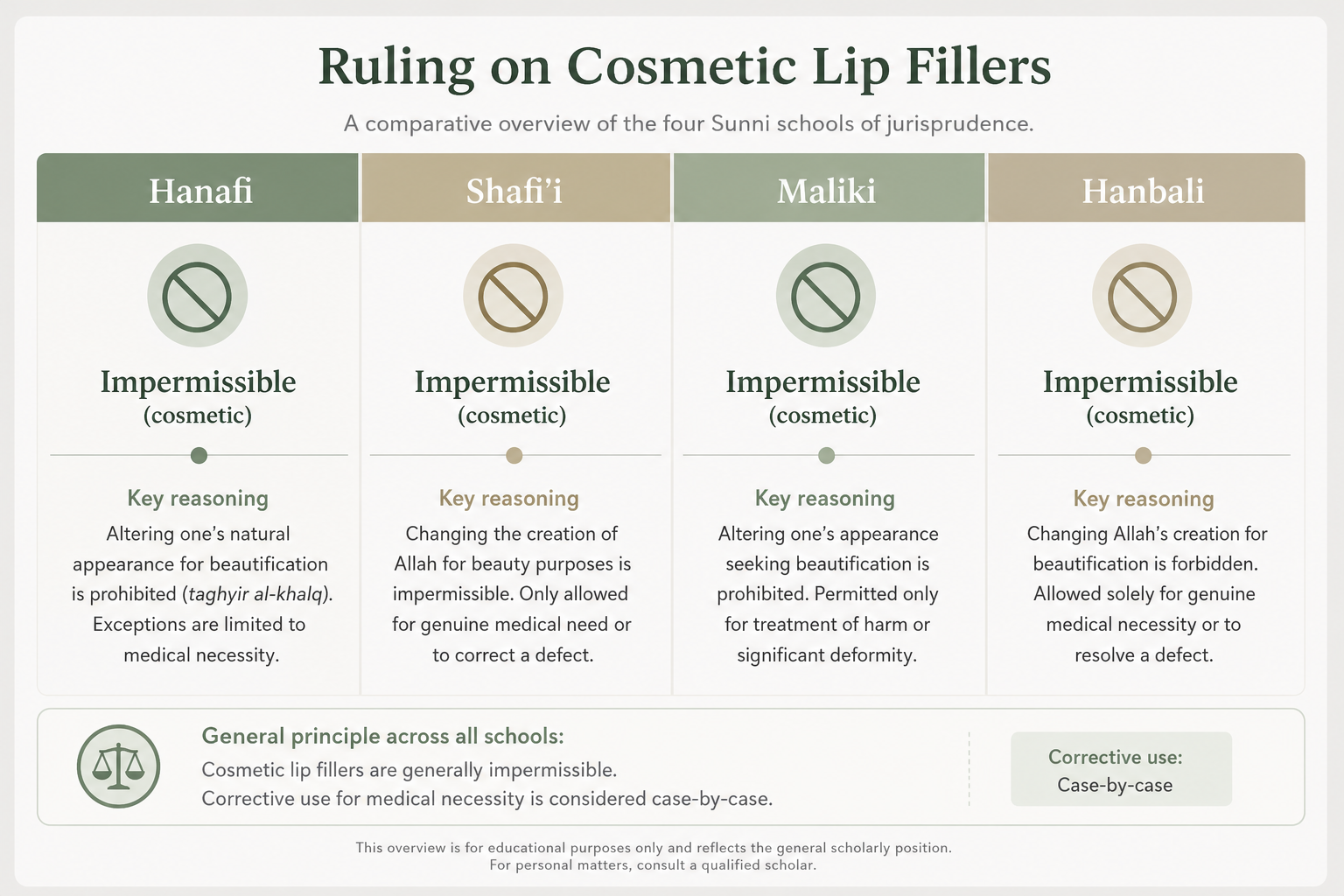
- Hanafi: The majority of Hanafi scholars, including those at Daruliftaa Birmingham and Darulifta Azaadville, rule cosmetic lip fillers as impermissible. The Hanafi school places significant weight on the hadith cursing those who alter the appearance without necessity, and on the principle of avoiding harm to the body.
- Shafi’i: Shafi’i fiqh similarly prohibits cosmetic alteration of the body’s natural form. Corrective procedures for genuine deformity are generally viewed more leniently, with scholars emphasising the role of intention (niyyah) and medical necessity.
- Maliki: The Maliki school tends to apply a contextual analysis, weighing the degree of alteration, the permanence of the change, and the purpose. Purely cosmetic lip augmentation would generally be considered impermissible, while reconstructive use following injury or deformity may be viewed differently.
- Hanbali: The Hanbali position, reflected in the rulings of scholars such as Sheikh al-Munajjid, is among the most restrictive. Cosmetic procedures that alter the natural form of the body are firmly classified as impermissible, with very limited exceptions for genuine medical necessity.
Across all four madhabs, the consistent principle is that cosmetic lip fillers performed purely to enhance appearance beyond the natural form are impermissible, while procedures addressing genuine medical or corrective need may be evaluated differently on a case-by-case basis.
When Lip Fillers May Be Permissible: The Darura Exception
Islamic jurisprudence recognises the principle of darura — necessity — which can render otherwise impermissible acts permissible when genuine need exists. In the context of lip fillers, this exception is most clearly applicable in the following situations:
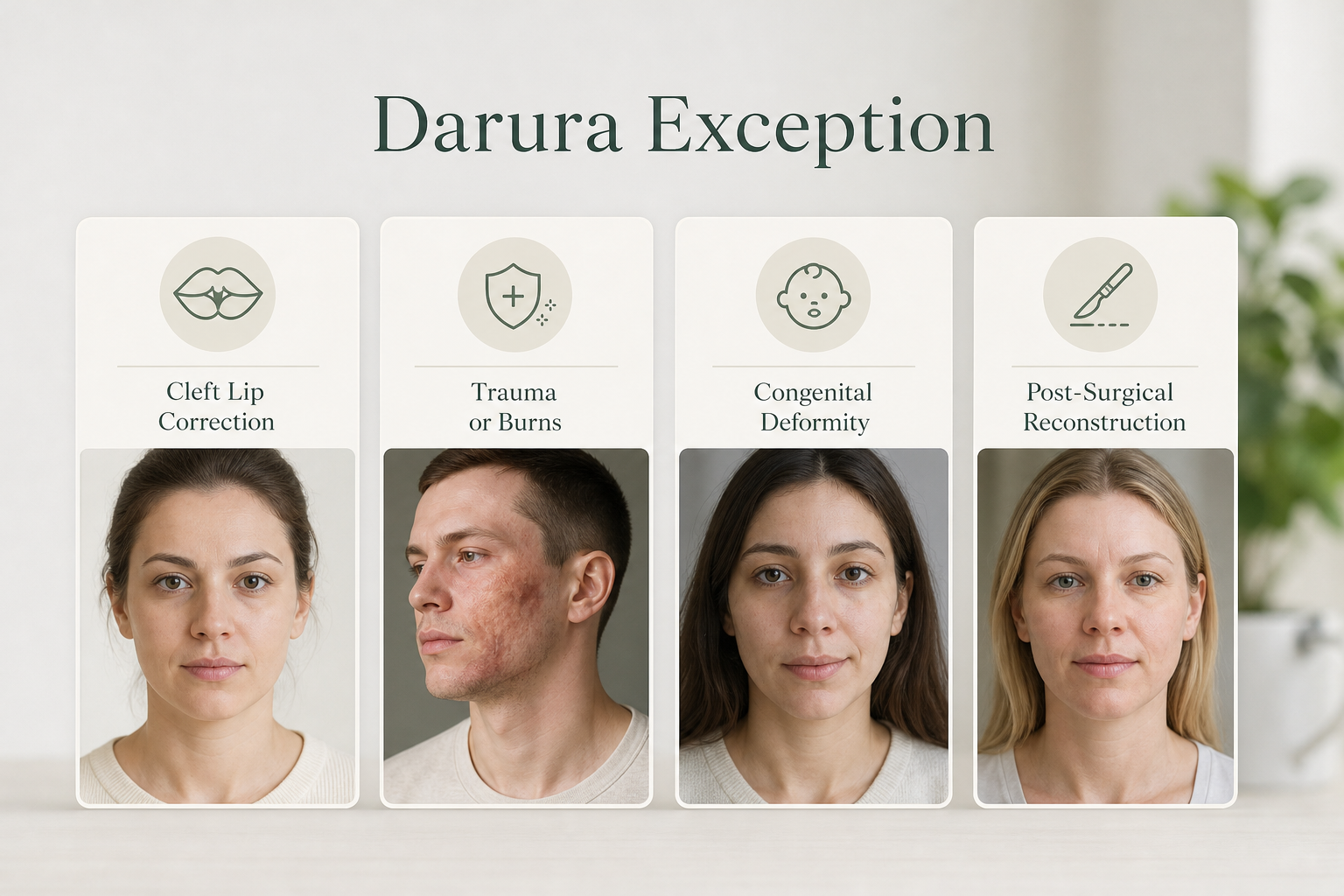
- Cleft lip or palate: Corrective procedures following cleft lip repair, where residual asymmetry or volume loss affects function or causes significant psychological distress, are generally viewed as permissible corrective procedures rather than cosmetic enhancements.
- Trauma or burns: Lip volume loss or deformity resulting from injury, burns, or surgery may justify a corrective procedure under the darura principle.
- Congenital deformity: A significant congenital lip deformity that causes functional difficulty or documented psychological harm may qualify for the medical necessity exception.
- Post-surgical reconstruction: Lip reconstruction following cancer surgery or other medical procedures is generally considered a corrective procedure rather than cosmetic enhancement.
The key distinction scholars draw is between a corrective procedure that restores a person closer to a normal or functional state, and a purely cosmetic enhancement that seeks to improve upon an already healthy and functional appearance. Intention (niyyah) plays a meaningful role here: the same procedure may be evaluated differently depending on whether the motivation is genuine medical or psychological need, or purely aesthetic desire.
Are Hyaluronic Acid Fillers Halal? The Ingredient Question
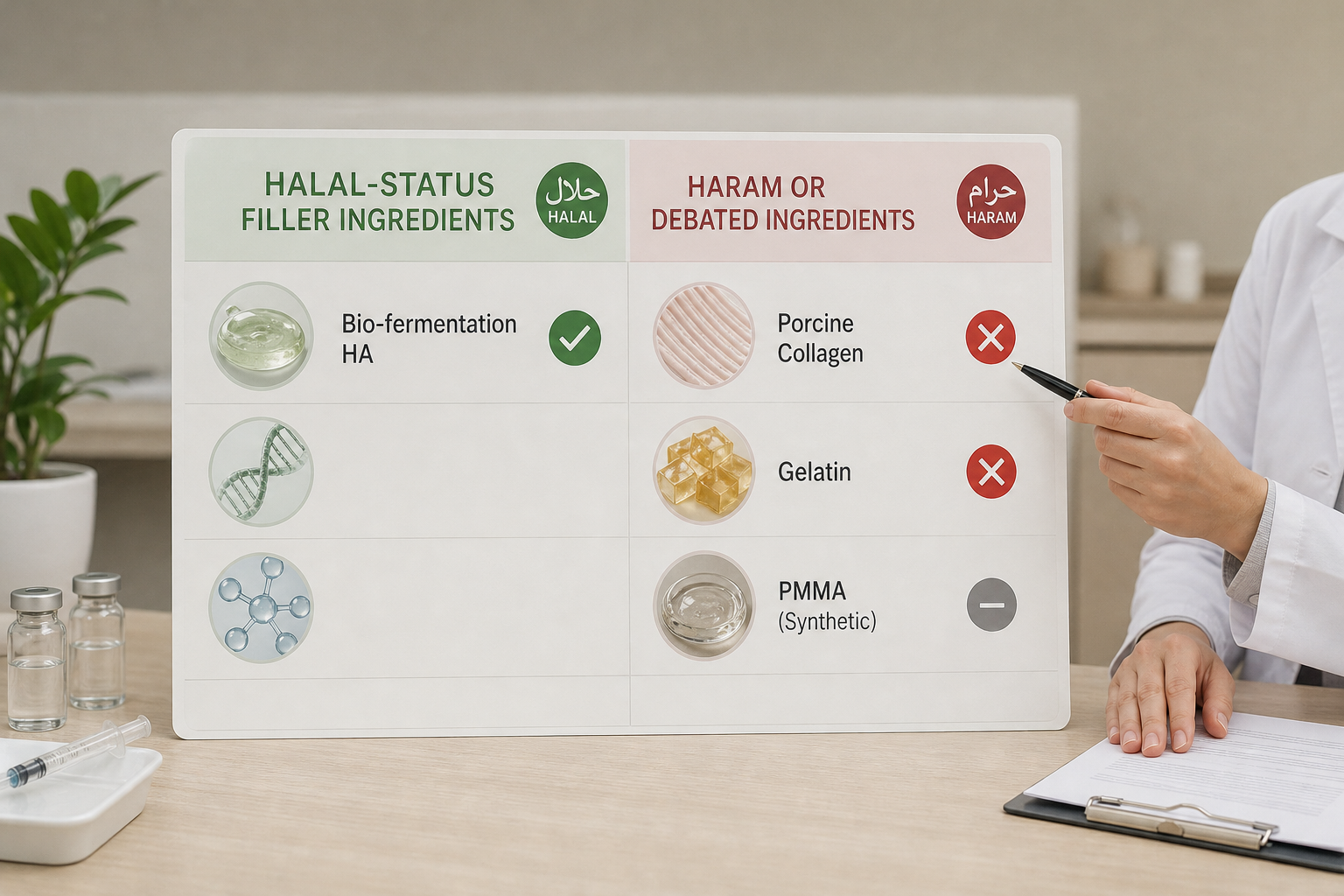
Even if a scholar were to permit lip fillers in a specific context, the ingredients of the filler product itself raise a separate concern. Most modern lip fillers use hyaluronic acid (HA) as their active ingredient. Hyaluronic acid is a naturally occurring substance found in the body, but the source of the HA used in dermal fillers matters from a halal perspective.
| Ingredient / Source | Halal Status | Notes |
|---|---|---|
| Bio-fermentation HA (bacterial synthesis) | Generally considered halal | Most modern HA fillers (e.g. Juvederm, Restylane) use this method |
| Rooster comb–derived HA | Debated; some scholars permit, others do not | Less common in modern fillers; source transparency required |
| Collagen (bovine or porcine) | Porcine collagen is haram; bovine requires halal slaughter certification | Collagen fillers are largely obsolete but still exist |
| Gelatin (porcine) | Haram | Rarely used in modern HA fillers; check product data sheet |
| PMMA (polymethylmethacrylate) | Synthetic; generally no animal-derived concern | Permanent filler; raises separate concerns about permanence |
| Calcium hydroxyapatite | Synthetic mineral; generally considered halal | Semi-permanent; used in products such as Radiesse |
The majority of contemporary HA fillers, including widely used brands such as Juvederm and Restylane, use hyaluronic acid produced through bio-fermentation — a bacterial synthesis process that does not involve pig-derived or porcine ingredients. This means the HA itself is generally considered halal by most scholars. However, patients should ask their practitioner to confirm the specific product being used and request the product data sheet if they wish to verify the ingredient source independently. Some older or less common filler formulations may contain animal-derived components, and alcohol-based preservatives in some products may also be a concern for particularly observant patients. Halal-certified filler products do exist, and a practitioner experienced in serving Muslim patients should be able to advise on available options.
Are Temporary Lip Fillers Less Problematic Than Permanent Ones?
A common question is whether the temporary nature of hyaluronic acid fillers — which typically last six to twelve months before being naturally broken down by the body — changes the religious ruling. Some scholars have acknowledged this distinction, reasoning that a temporary alteration is less severe than a permanent one and therefore may be viewed differently. However, the majority scholarly position holds that the prohibition on taghyir khalqillah applies regardless of whether the alteration is temporary or permanent: the act of changing the creation of Allah is the issue, not solely the duration of the change.
Permanent fillers, such as those containing PMMA, raise additional concerns precisely because of their irreversibility. Most scholars who engage with this question consider permanent cosmetic alteration more clearly impermissible than temporary procedures, but this does not mean temporary fillers are automatically permissible — it means the degree of prohibition may differ in scholarly analysis, while the underlying ruling for purely cosmetic use remains the same in the majority view.
What If I Already Have Lip Fillers?
Many people encounter religious rulings after already having undergone a procedure, sometimes without awareness of the scholarly debate. Islamic jurisprudence addresses this situation through the concept of ignorance of ruling (jahl) and the principle of repentance (tawbah). Scholars generally advise that a person who underwent a procedure in genuine ignorance of its ruling is not held to the same level of accountability as someone who acted with full knowledge. The recommended course of action is sincere repentance, seeking knowledge, and making an informed decision going forward.
Regarding whether to dissolve existing fillers: hyaluronic acid fillers can be dissolved using an enzyme called hyaluronidase, which breaks down the HA and reverses the augmentation. Some scholars advise dissolving fillers if they were obtained impermissibly and the person now wishes to return to their natural state. Others note that the procedure of dissolving fillers itself involves a medical intervention and that the body will naturally reabsorb HA over time without additional intervention. Individual guidance from a trusted scholar is recommended for this specific situation, as rulings may vary.
Jewish Perspectives on Lip Fillers
Jewish law (halacha) does not contain a direct ruling on lip fillers as a modern procedure, but the relevant principles have been applied by contemporary rabbinical authorities. The primary concern in halachic analysis of cosmetic procedures is the prohibition on self-harm (chavalah) and the concept of the body as belonging ultimately to God rather than to the individual — a principle structurally similar to the Islamic concept of amanah.
Rabbi Eliezer Waldenberg, one of the most prominent authorities on Jewish medical ethics, took a generally restrictive view of elective cosmetic surgery, arguing that procedures performed purely for vanity without medical justification raise serious halachic concerns. Rabbi Immanuel Jakobovits similarly emphasised that unnecessary risk to the body is problematic under Jewish law. However, both authorities acknowledged that procedures addressing genuine psychological distress — where a person’s quality of life or mental health is meaningfully affected by their appearance — may be viewed more leniently. Contemporary rabbinical opinion on minimally invasive procedures such as HA lip fillers, which carry lower risk than surgery, tends to be more nuanced, with some authorities permitting them when the motivation is modest self-improvement rather than excessive vanity, and when the procedure does not involve meaningful risk to health.
Christian Perspectives on Lip Fillers
Christian views on cosmetic procedures vary considerably across denominations and do not derive from a single authoritative ruling equivalent to a fatwa or rabbinical responsum.
Catholic teaching draws on the principle that the body is a temple of the Holy Spirit (1 Corinthians 6:19-20) and that unnecessary mutilation of the body is morally problematic. The Catechism of the Catholic Church addresses bodily integrity and the virtue of temperance. Catholic bioethicists generally distinguish between procedures that restore function or address genuine suffering and those motivated purely by vanity. Minimally invasive cosmetic procedures such as lip fillers occupy a grey area: they are not explicitly condemned, but the intention and proportionality of the procedure are considered morally relevant. Procedures driven by excessive vanity or disordered self-image are viewed with concern, while modest self-care is generally not condemned.
Protestant and Evangelical perspectives are more varied, as there is no central doctrinal authority equivalent to the Vatican. Many Protestant traditions emphasise personal conscience, stewardship of the body, and the avoidance of vanity. Some Evangelical communities have engaged actively with the question of cosmetic procedures, particularly as social media has increased their visibility. The debate within Evangelical Christianity often centres on whether cosmetic enhancement reflects a failure to accept God’s design, or whether it is a neutral personal choice within the scope of individual freedom. There is no consensus ruling, and individual Christians are generally encouraged to examine their motivation and seek guidance from their faith community.
Across all three Abrahamic traditions, a common thread emerges: the body is understood as belonging to God rather than solely to the individual, and cosmetic procedures are evaluated through the lens of intention, necessity, and proportionality rather than through an absolute prohibition or permission.
Psychological and Social Dimensions
Research published in peer-reviewed journals, including studies examining Muslim women’s attitudes toward cosmetic procedures, highlights that the decision to seek lip augmentation is rarely made in isolation from social and psychological pressures. Social media exposure, peer influence, and body image concerns interact with religious belief in complex ways. Some individuals report seeking religious rulings specifically because they feel conflicted between social pressure to alter their appearance and their faith values. Others report that a clear religious ruling — in either direction — provides relief from that conflict.
Practitioners working with patients from religious backgrounds benefit from understanding this context. A patient asking about the religious permissibility of a procedure is often also navigating questions of identity, self-worth, and social belonging. Referring patients to appropriate religious guidance, rather than dismissing the question as outside the scope of a clinical consultation, reflects respectful and culturally competent care. Equally, practitioners should be aware that body dysmorphic disorder (BDD) can present in patients seeking cosmetic procedures, and that religious framing does not eliminate the need for appropriate psychological screening where indicated.
Frequently Asked Questions
Is Botox haram for the same reasons as lip fillers?
Botulinum toxin (Botox) is frequently co-discussed with lip fillers in Islamic scholarly rulings. The majority view applies similar reasoning: if the purpose is purely cosmetic alteration of the natural appearance, it is generally considered impermissible. However, Botox used for medical purposes — such as treating hyperhidrosis, migraines, or muscle spasm — is generally viewed as permissible under the darura principle. The ingredient concern is different from fillers, as botulinum toxin is a purified protein rather than an animal-derived structural material.
Are nose, cheek, or jawline fillers also haram?
The same Islamic legal principles that apply to lip fillers apply to other dermal fillers used for purely cosmetic purposes. Taghyir khalqillah is not specific to the lips; it applies to any elective alteration of the body’s natural form. Corrective use following injury, surgery, or for genuine medical need may be evaluated differently across all treatment areas.
Does the ruling differ for men and women?
The prohibition on taghyir khalqillah applies to both men and women in Islamic jurisprudence. Some scholars note that certain beautification acts are specifically addressed in relation to women in classical texts, but the core prohibition on altering the creation of Allah is not gender-specific. Men seeking cosmetic lip augmentation would be subject to the same scholarly analysis as women.
What does it mean if a filler is halal-certified?
A halal-certified filler has been assessed by a recognised halal certification body to confirm that its ingredients do not include prohibited substances such as porcine-derived components, and that its manufacturing process meets halal standards. Halal certification addresses the ingredient concern but does not resolve the separate question of whether the cosmetic procedure itself is permissible — that remains a matter of individual scholarly guidance based on purpose and intention.
Is it haram to dissolve existing lip fillers?
Dissolving hyaluronic acid fillers using hyaluronidase is a medical procedure in its own right. Most scholars who advise dissolving impermissibly obtained fillers do not consider the dissolution procedure itself to be haram, as it is a corrective act returning the body toward its natural state. However, since HA fillers are naturally reabsorbed over time, some scholars suggest waiting for natural reabsorption rather than undergoing an additional procedure. Individual guidance from a qualified scholar is recommended.
Can I get lip fillers if I have a genuine medical reason?
If a lip filler procedure is being considered for a genuine corrective or medical purpose — such as addressing a cleft lip deformity, post-surgical volume loss, or trauma-related asymmetry — the majority of scholars would evaluate this under the darura principle rather than as a purely cosmetic enhancement. Consulting both a qualified medical practitioner and a trusted Islamic scholar is advisable to assess whether the specific situation meets the criteria for a permissible corrective procedure.
Making an Informed Decision About Lip Fillers and Your Faith
The question of whether lip fillers are haram does not have a single universal answer, but the weight of contemporary scholarly opinion points clearly toward impermissibility for purely cosmetic lip augmentation — across all four major Sunni madhabs and among the most widely cited Islamic institutions. The core reasoning is consistent: elective cosmetic enhancement that alters the natural form of the lips constitutes taghyir khalqillah, and the temporary nature of hyaluronic acid fillers does not, in the majority view, change this ruling.
Exceptions exist and are meaningful: procedures addressing genuine deformity, injury, or medical necessity may be permissible under the darura principle, and intention (niyyah) plays a role in how individual cases are evaluated. The ingredient question is largely resolved for modern bio-fermentation HA fillers, but patients should verify the specific product with their practitioner. Jewish and Christian traditions engage with similar questions through their own frameworks, arriving at nuanced rather than absolute positions that emphasise intention, proportionality, and the avoidance of excessive vanity.
If you are considering lip fillers and have religious concerns, the most responsible course is to seek guidance from a qualified scholar within your own tradition before proceeding, and to consult a reputable aesthetic practitioner who can discuss the procedure, ingredients, and realistic outcomes honestly. A practitioner experienced in working with patients from diverse religious backgrounds will be able to answer ingredient questions clearly and support you in making a decision that aligns with both your aesthetic goals and your values.
