
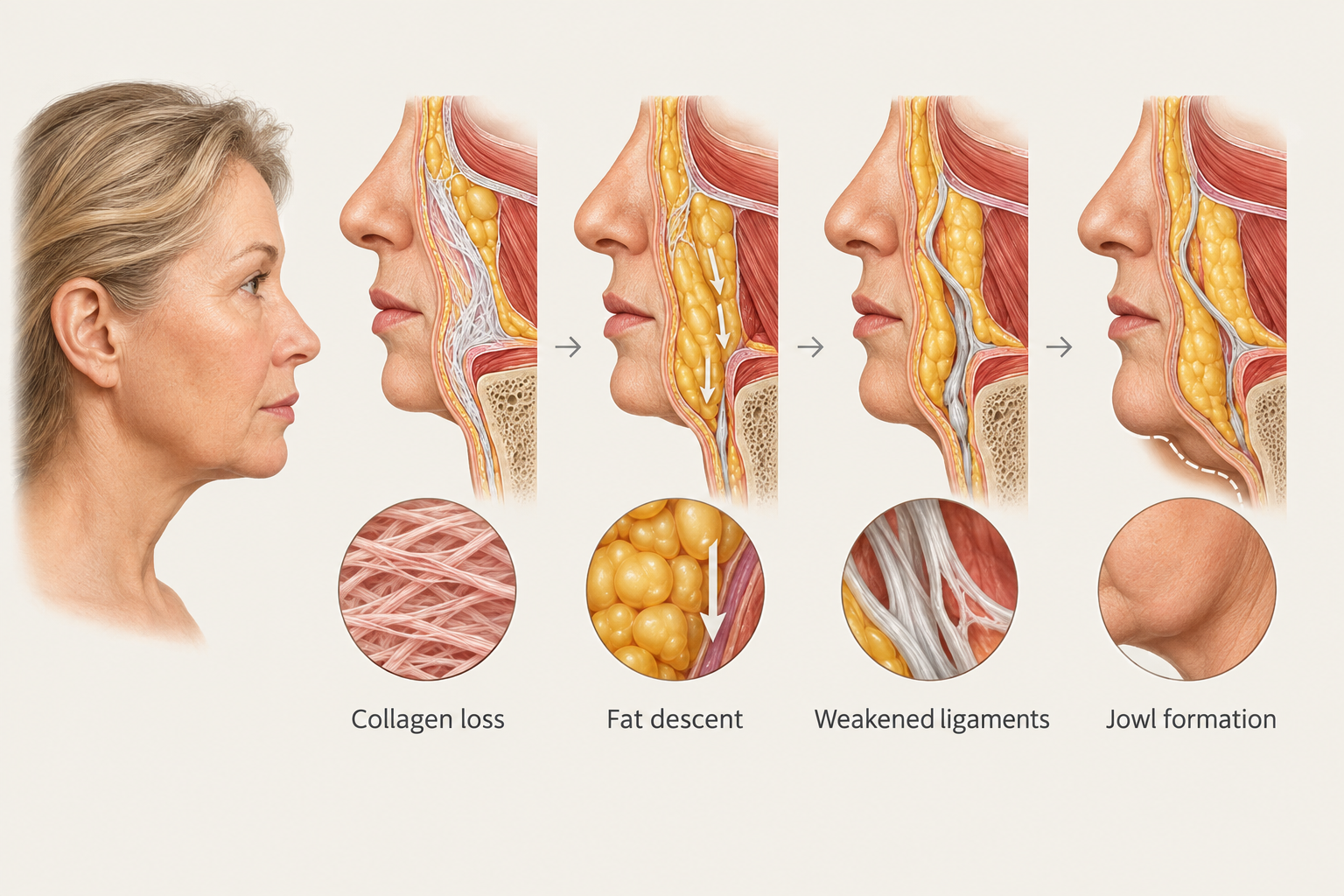

Jowls develop gradually as the skin, fat, and underlying soft tissue of the lower face lose their structural support, causing the jawline to soften and sag. Many people search for natural ways to address this change before considering clinical procedures, and while lifestyle habits and targeted exercises can play a supporting role, it is important to understand what they can realistically achieve and where their limits lie.
Key Takeaways
- Jowls form due to a combination of collagen loss, fat redistribution, bone resorption, and reduced skin elasticity — processes that natural approaches can slow but rarely reverse significantly.
- Facial exercises, skin care, nutrition, and posture habits may offer modest supportive benefits, but evidence for meaningful jowl reduction through these methods alone is limited.
- Non-surgical clinical treatments such as radiofrequency, ultrasound therapy, and dermal fillers can produce more measurable improvements for established jowling.
- The most appropriate approach depends on the degree of jowling, skin quality, age, and individual goals — a qualified practitioner can help assess realistic options.
- No natural method eliminates jowls entirely; managing expectations is essential before committing to any approach.
Why Jowls Form: Understanding the Cause
Jowls are the result of several overlapping changes in facial anatomy that occur with age. From the mid-twenties onward, the body produces progressively less collagen and elastin — the structural proteins that keep skin firm and resilient. As collagen density falls, the skin becomes thinner and less able to resist the constant downward pull of gravity. At the same time, the fat compartments of the face shift: volume is lost in the cheeks and midface, while fat descends toward the lower face and neck, contributing to the appearance of heaviness along the jawline.
Bone resorption is another significant factor that is often overlooked. The mandible and other facial bones gradually lose density and volume with age, reducing the skeletal framework that supports the overlying soft tissue. The retaining ligaments of the face — fibrous bands that anchor skin to deeper structures — also weaken over time, allowing tissue to descend more freely. Genetics, sun exposure, smoking, significant weight fluctuation, and habitual posture can all accelerate or worsen these changes. Understanding these mechanisms matters because it clarifies why purely topical or exercise-based approaches have inherent limitations.
Can You Reduce Jowls Naturally?
The honest answer is that natural approaches are unlikely to eliminate established jowls, but they may help slow progression, improve skin quality, and provide modest toning of the lower face. The degree of benefit depends heavily on how pronounced the jowling is, the individual's skin quality, and how consistently the habits are maintained. For early or mild jowling, a combination of targeted strategies may produce a noticeable but subtle improvement. For moderate to significant jowling, natural methods alone are generally insufficient to create a meaningful visible change.
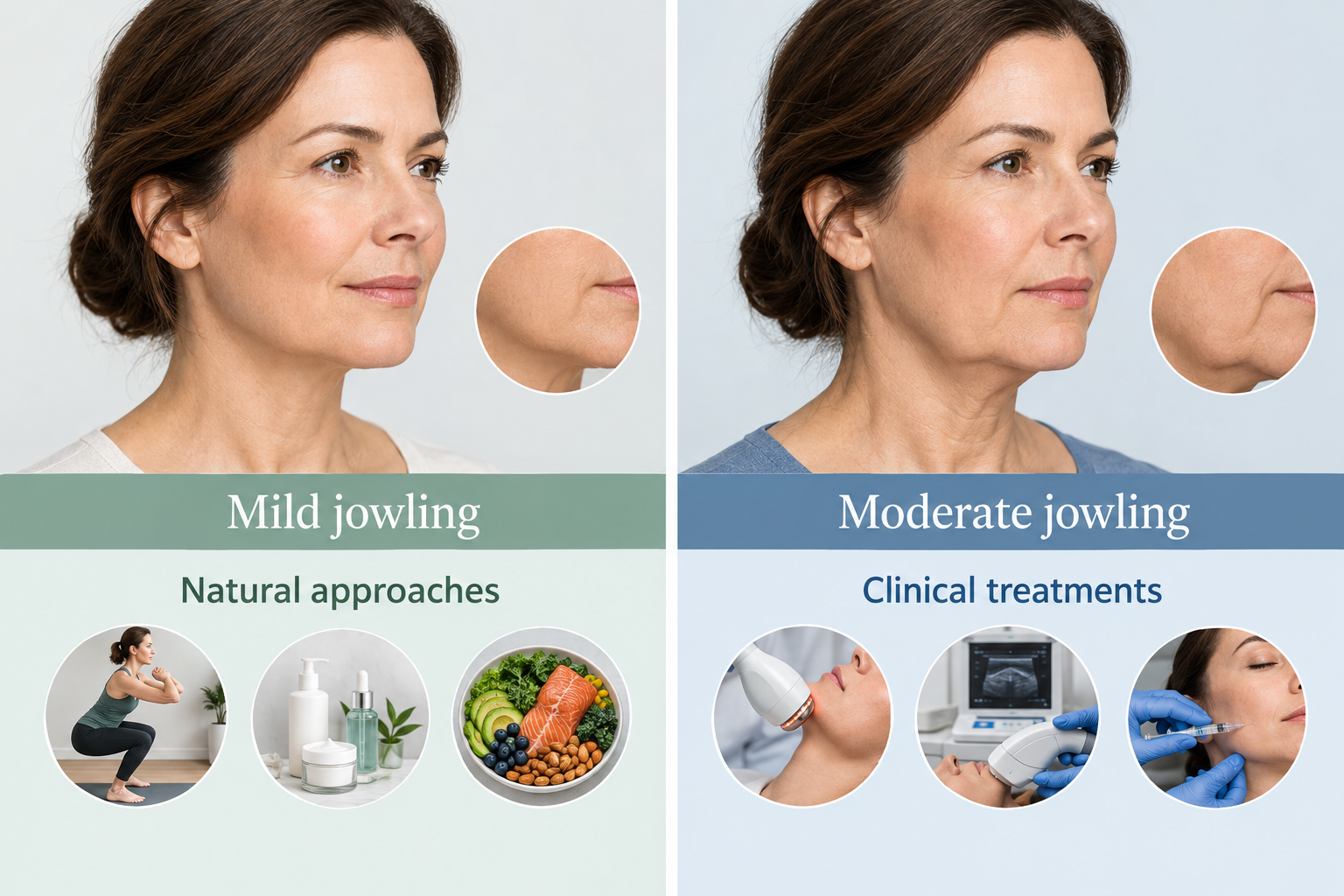
It is also worth distinguishing between approaches that have some scientific rationale and those that are largely anecdotal. The sections below cover the most commonly discussed natural strategies, what the evidence suggests, and where the realistic ceiling of each approach lies.
Facial Exercises and Muscle Toning
Facial exercises — sometimes called facial yoga — are frequently recommended as a way to lift and firm the lower face. The rationale is that strengthening the underlying facial muscles may provide better support for the overlying skin and soft tissue, potentially reducing the appearance of sagging along the jawline. Some small studies have suggested that consistent facial exercise programmes may improve perceived facial fullness and firmness in middle-aged adults, though the research base remains limited and the studies involved are generally small and short in duration.
Exercises commonly suggested for the lower face and jawline include chin lifts, jaw clenches, neck stretches, and movements that engage the platysma muscle of the neck. Performing these consistently over several weeks may contribute to mild toning, but it is important to note that facial muscles are already in near-constant use during daily expression and chewing. The additional stimulus from targeted exercises is therefore relatively modest compared with, for example, resistance training for larger skeletal muscles. Results, if any, are likely to be subtle and gradual, and they will not address the skin laxity or fat redistribution that are central to jowl formation.
Skin Care Ingredients That May Support Skin Firmness
A consistent, evidence-informed skin care routine cannot reverse jowling, but certain ingredients may help maintain skin quality and slow the rate of collagen degradation over time. Topical retinoids — derivatives of vitamin A — have the strongest evidence base for stimulating collagen synthesis and improving skin texture. Prescription-strength tretinoin has been studied more extensively than over-the-counter retinol, though both require consistent long-term use to show benefit and can cause initial irritation.
Vitamin C serums act as antioxidants and may support collagen production when applied topically, though their stability and skin penetration vary considerably between formulations. Peptide-containing products are widely marketed for firming, but clinical evidence for meaningful structural change in the skin from topical peptides remains limited. Broad-spectrum sun protection is arguably the most important daily skin care habit for preserving collagen, as ultraviolet radiation is a primary driver of photoageing and accelerated collagen breakdown. Consistent SPF use from an early age is more effective at preventing jowl formation than any topical ingredient applied after significant laxity has already developed.
Hydration — both topical moisturisation and adequate water intake — supports the skin barrier and may temporarily improve the appearance of fine lines, but it does not alter the structural changes responsible for jowling.
Nutrition, Collagen, and Lifestyle Factors
Diet and lifestyle choices influence skin ageing in meaningful ways, even if they cannot reverse existing structural changes. A diet rich in antioxidants — found in vegetables, fruits, and foods containing vitamins C and E — may help reduce oxidative stress, which contributes to collagen degradation. Adequate dietary protein provides the amino acid building blocks necessary for collagen synthesis. Some people supplement with hydrolysed collagen peptides, and while some studies suggest these may modestly improve skin hydration and elasticity, the evidence is not yet strong enough to make definitive claims about their effect on jowl reduction specifically.
Smoking accelerates skin ageing significantly by reducing blood flow to the skin, increasing oxidative damage, and impairing collagen production. Stopping smoking is one of the most impactful lifestyle changes a person can make for overall skin health. Excessive alcohol consumption can also dehydrate the skin and impair nutrient absorption. Maintaining a stable, healthy body weight is relevant because significant weight loss — particularly rapid loss — can worsen skin laxity and make jowling more pronounced. Conversely, carrying excess weight in the face can stretch the skin over time, contributing to sagging when weight is later lost.
Sleep position is sometimes mentioned in this context. Consistently sleeping face-down or on one side may contribute to the compression and folding of facial skin over many years, though the evidence linking sleep position directly to jowl formation is largely observational.
Posture and the Neck Connection
Forward head posture — the tendency to hold the head forward of the shoulders, often associated with prolonged screen use — places the neck and lower face in a position that may contribute to the appearance of a less defined jawline over time. The platysma muscle, which runs from the lower face down the neck, can become lax with age and with habitual downward-facing posture. Exercises that strengthen the deep neck flexors and encourage an upright head position may help maintain the appearance of a more defined jaw angle, though this is unlikely to address established jowling on its own.
Awareness of posture during daily activities, including when using phones and computers, is a reasonable habit to develop for general musculoskeletal health and may have a modest secondary benefit for the appearance of the lower face and neck.
Massage and Lymphatic Drainage
Facial massage and gua sha — a technique using a smooth tool to apply pressure and strokes to the face — have become popular for their claimed ability to lift and contour the face. These techniques may temporarily improve circulation, reduce puffiness caused by fluid retention, and provide a short-term appearance of improved definition. However, there is no robust clinical evidence that facial massage or gua sha produces lasting structural changes to the soft tissue responsible for jowling. Any visible improvement is likely to be temporary and related to reduced fluid retention rather than genuine tissue repositioning.
Lymphatic drainage massage, performed by a trained therapist, may help reduce facial puffiness in people who retain fluid, which can make the jawline appear slightly more defined. Again, this is a temporary effect and is not a treatment for the underlying causes of jowl formation.
When Natural Approaches Are Not Enough
For many people, natural strategies provide a useful foundation for skin health and may slow the progression of jowling, but they are unlikely to produce the degree of improvement that moderate or significant jowling requires. At this point, non-surgical clinical treatments offer a more evidence-supported path to visible improvement without the recovery associated with surgery.

It is worth understanding the range of options available so that an informed conversation with a qualified practitioner is possible.
Radiofrequency Skin Tightening
Radiofrequency (RF) treatments deliver controlled thermal energy into the deeper layers of the skin and underlying tissue, stimulating collagen remodelling and contraction. Devices used for this purpose include both surface-level RF and microneedling RF, which combines fine needles with radiofrequency energy for deeper delivery. Clinical studies support the use of radiofrequency for mild to moderate skin laxity, including the lower face and jawline, though results vary between individuals and multiple sessions are typically required. Improvement tends to develop gradually over several months as new collagen forms.
High-Intensity Focused Ultrasound (HIFU)
High-intensity focused ultrasound, often referred to as HIFU or by device brand names such as Ultherapy, targets the deeper structural layer of the face — the superficial musculoaponeurotic system (SMAS) — which is the same layer addressed during surgical facelifts. By delivering focused ultrasound energy to this depth, HIFU aims to stimulate collagen production and achieve a degree of tissue lifting. Evidence supports its use for mild to moderate laxity of the lower face and neck, and it is one of the more studied non-surgical options for jawline definition. Results are gradual and typically become most visible three to six months after treatment.
Dermal Fillers for Jawline Definition
Hyaluronic acid dermal fillers placed along the jawline can restore structural support, improve definition, and create a visual lifting effect that reduces the appearance of jowling. This approach works by replacing lost volume and providing a scaffolding effect rather than by tightening the skin itself. Results are immediate and typically last between twelve and eighteen months depending on the product used, the area treated, and individual metabolism. Filler placement in the lower face requires precise anatomical knowledge and should only be performed by an appropriately trained and experienced practitioner.
Botulinum Toxin for the Lower Face and Neck
Botulinum toxin injections into the platysma muscle of the neck — sometimes called a Nefertiti lift — can reduce the downward pull of this muscle on the lower face, contributing to a subtly more defined jawline. This approach does not address skin laxity directly but may complement other treatments. Results are temporary, typically lasting three to four months, and the treatment requires careful assessment of the individual's anatomy and muscle activity.
Surgical Options
For significant jowling, particularly where there is substantial skin excess, surgical intervention such as a lower facelift or neck lift remains the most effective option for durable, meaningful improvement. Surgery directly addresses the SMAS layer, removes or repositions excess skin and fat, and can produce results that non-surgical treatments cannot replicate. Recovery is more significant and the decision requires careful consideration, but for the right candidate it may offer the most proportionate outcome relative to the degree of concern.
Realistic Expectations for Any Approach
Setting realistic expectations is essential regardless of which approach is being considered. Natural methods — including exercise, skin care, nutrition, and lifestyle changes — are most valuable as preventive and supportive measures rather than corrective treatments. They are most likely to be beneficial when started before significant jowling has developed and maintained consistently over time. For people who already have noticeable jowling, these habits remain worthwhile for overall skin health but should not be expected to produce a dramatic visible change.
Non-surgical clinical treatments can produce meaningful improvement for mild to moderate jowling, but they are not equivalent to surgery in terms of the degree of correction achievable. Results from non-surgical treatments are also temporary and require maintenance. The most appropriate option depends on the individual's anatomy, degree of laxity, skin quality, age, health, and personal goals — factors that can only be properly assessed in a face-to-face consultation with a qualified practitioner.
Frequently Asked Questions
Can facial exercises actually lift jowls?
Facial exercises may provide modest toning of the lower face muscles and could contribute to a subtle improvement in definition over time with consistent practice. However, they do not address the skin laxity, fat redistribution, or bone changes that are the primary drivers of jowl formation. Evidence for meaningful jowl reduction through exercise alone is limited, and results are likely to be subtle at best.
How long does it take to see results from natural approaches?
Natural approaches such as skin care, exercise, and dietary changes work slowly. Any improvement in skin quality or subtle toning from facial exercises would typically take several months of consistent effort to become noticeable, and the changes are likely to be modest. There is no natural method that produces rapid or dramatic jowl reduction.
Does losing weight help with jowls?
Weight loss can sometimes make jowling more pronounced rather than less, particularly if the loss is significant or rapid. When facial fat volume decreases, the skin — which may already have reduced elasticity — can appear looser. Maintaining a stable, healthy weight is generally more beneficial for the appearance of the lower face than significant fluctuation in either direction.
At what age do jowls typically start to appear?
The structural changes that eventually lead to jowling begin in the mid-twenties with the gradual decline of collagen production, but visible jowling typically becomes noticeable in the forties and fifties for most people. Genetics, sun exposure history, smoking, and significant weight changes can cause jowling to appear earlier or progress more quickly.
Are non-surgical treatments for jowls safe?
Non-surgical treatments such as radiofrequency, HIFU, dermal fillers, and botulinum toxin carry their own risks and are not without potential side effects. These can include temporary redness, swelling, bruising, discomfort, and — in the case of injectable treatments — more serious but rare complications. Safety depends significantly on the qualifications and experience of the practitioner, the suitability of the treatment for the individual, and the quality of the devices or products used. A thorough consultation and medical history review are essential before any clinical treatment.
Is there a non-surgical treatment that works as well as a facelift?
No currently available non-surgical treatment produces results equivalent to a surgical facelift for significant jowling. Non-surgical options can offer meaningful improvement for mild to moderate laxity and are appropriate for people who are not ready for or suitable for surgery, but they have inherent limitations in the degree of correction they can achieve. For pronounced jowling with significant skin excess, surgery remains the most effective option.
Can I combine natural approaches with clinical treatments?
Yes, and this is often the most sensible approach. Maintaining good skin care habits, sun protection, a balanced diet, and avoiding smoking can support and potentially prolong the results of clinical treatments. A practitioner may also recommend specific skin care alongside professional treatments as part of a broader plan.
Deciding on the Right Approach for Your Jowls
Natural approaches to jowl reduction are most valuable as part of a long-term skin health strategy rather than as a standalone corrective solution. Consistent sun protection, a nutrient-rich diet, avoiding smoking, maintaining skin hydration, and incorporating facial exercises may all contribute to slowing the progression of jowling and supporting overall skin quality — but they are unlikely to reverse established sagging in the lower face on their own.
If jowling is already noticeable and causing concern, a consultation with a qualified aesthetic practitioner or dermatologist is a practical next step. A professional assessment can clarify the degree of laxity, the likely contributing factors, and which combination of approaches — whether non-surgical treatments, surgical options, or a supportive skin care plan — is most likely to match your goals and anatomy. Making an informed decision based on realistic expectations, rather than optimistic claims, is the most reliable path to an outcome you will be satisfied with.
