

Key Takeaways
- DAO Botox relaxes the depressor anguli oris muscle to reduce the downward pull on the oral commissures, creating a subtle lift at the corners of the mouth.
- It is an off-label treatment, meaning it is not specifically licensed for this indication, though it is widely used in aesthetic practice by trained injectors.
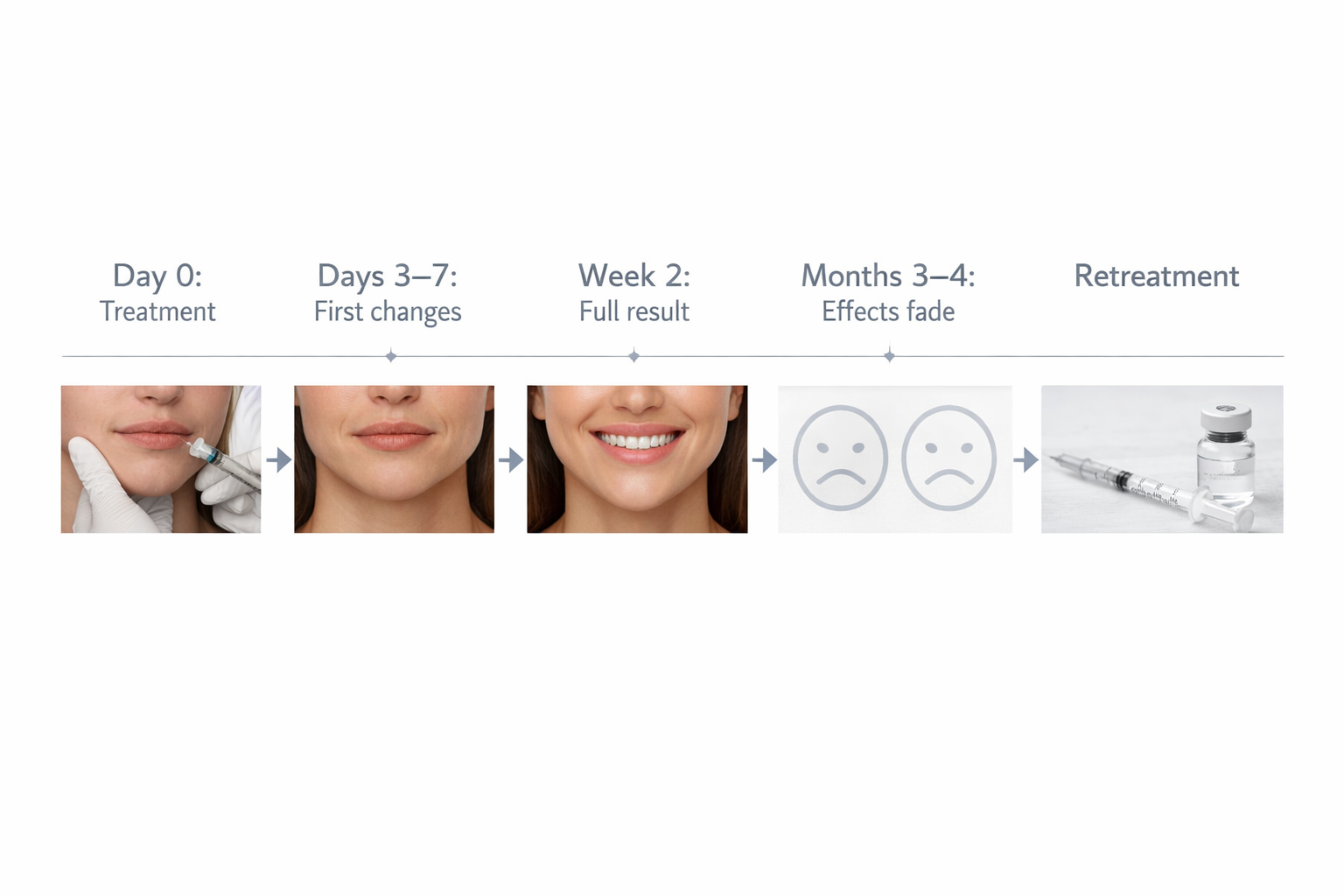
- Results typically become visible within 3–7 days, reach their peak around two weeks, and generally last 3–4 months.
- Not every downturned mouth responds well to botulinum toxin alone — volume-driven downturning usually requires dermal filler, either instead of or alongside DAO Botox.
- Choosing a qualified, experienced injector is essential; the lower face contains several closely interacting muscles, and incorrect placement carries a meaningful risk of asymmetry or smile distortion.
What Is the Depressor Anguli Oris Muscle?
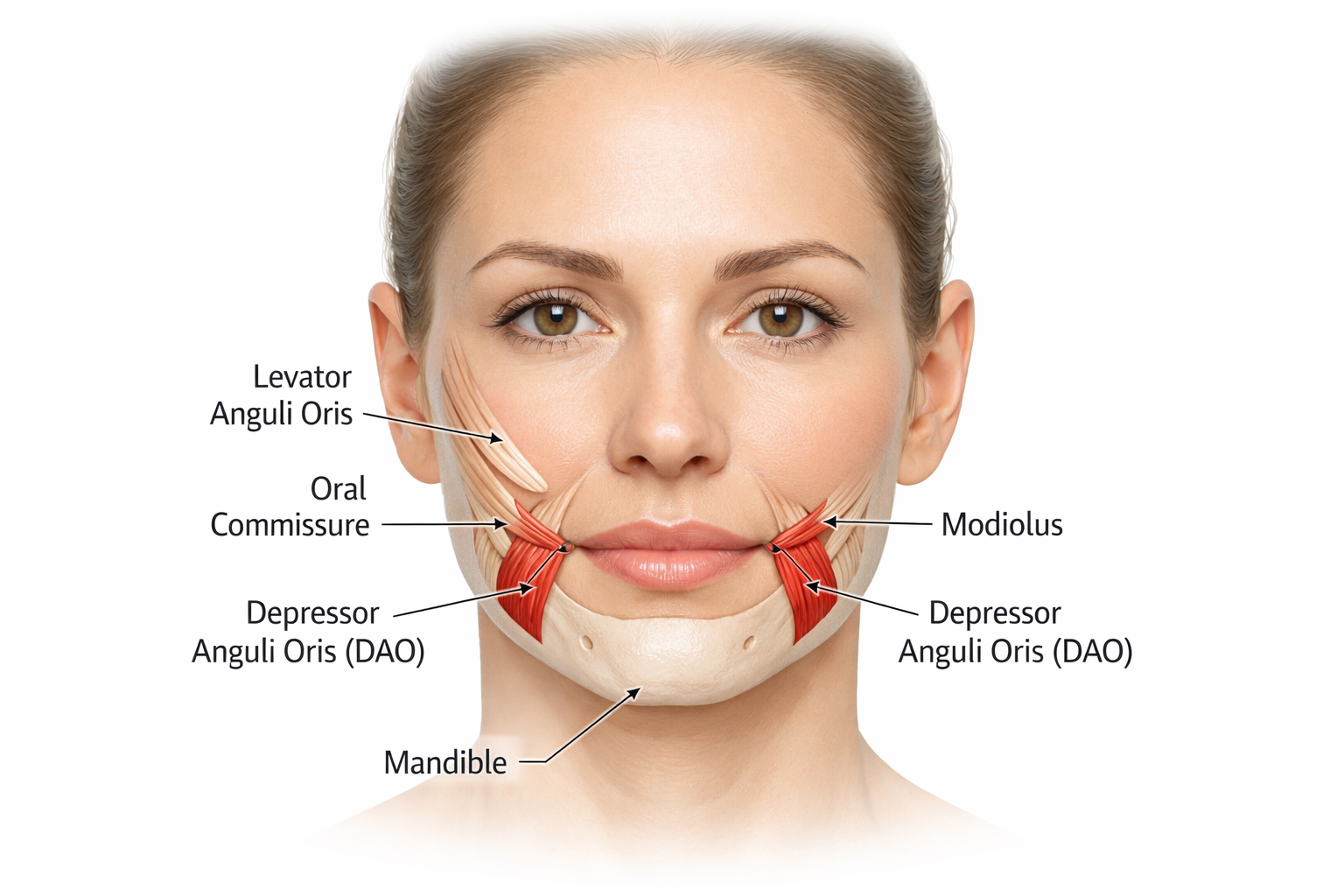
The depressor anguli oris — commonly abbreviated to DAO — is a paired muscle that runs from the lower border of the mandible (jawline) upward to the modiolus, a fibromuscular structure at each corner of the mouth. Its primary function is to pull the oral commissures downward, which is a normal part of facial expression during frowning or expressions of displeasure. In balance with elevator muscles such as the levator anguli oris and zygomaticus major, this downward pull is controlled and appropriate.
Problems arise when the DAO becomes overactive relative to the elevator muscles — whether through genetics, habitual muscle tension, or the gradual weakening of antagonist muscles with age. An overactive DAO tugs the mouth corners downward even at rest, producing a permanently sad or stern resting expression that does not reflect how the person actually feels. This can also create the early illusion of jowling, since the downward pull at the commissure accentuates the soft tissue just below the jawline.
What Causes a Downturned Mouth?
A downturned mouth can develop for several reasons, and correctly identifying the primary cause matters a great deal for choosing the right treatment approach.
Muscle overactivity is the factor DAO Botox directly addresses. When the depressor anguli oris contracts more strongly or more frequently than the muscles that lift the corners of the mouth, the result is a persistently downturned appearance even when the face is relaxed. This is sometimes described as a resting sad face, and it often has a genetic component — some people inherit a naturally stronger or more active DAO.
Age-related volume loss is a separate and very common contributor. As collagen and subcutaneous fat diminish over time, the structural support around the lower face decreases. The oral commissures lose their scaffolding and begin to descend. When this is the dominant cause, botulinum toxin will have limited effect because there is no overactive muscle to relax — the mouth corners have simply lost the tissue volume that once held them in position.
Skin laxity and gravitational changes compound both of the above, particularly from the mid-40s onward. Marionette lines — the vertical grooves that run from the corners of the mouth down toward the chin — often develop alongside a downturned mouth and may reflect a combination of muscle activity, volume loss, and skin changes working together.
A useful self-assessment: if the downturned appearance is more pronounced when your face is in motion (frowning, looking serious) but largely disappears when you smile or consciously relax, the cause is more likely muscle-driven. If the downturn is visible regardless of expression — when smiling, frowning, or fully relaxed — then volume loss or structural change is more likely dominant, and neurotoxin alone is unlikely to produce satisfying results.
How Does DAO Botox Work?
DAO Botox uses a purified form of botulinum toxin type A — the same neuromodulator used for forehead lines, crow’s feet, and other common aesthetic treatments — injected in small, precise amounts into the depressor anguli oris muscle on each side of the face. Botulinum toxin type A works by temporarily blocking the release of acetylcholine at the neuromuscular junction, preventing the nerve signal that would cause the muscle to contract. With the DAO partially relaxed, the elevator muscles — primarily the levator anguli oris and zygomaticus — can exert a relatively greater influence, allowing the mouth corners to rest in a more neutral or gently upturned position.
The treatment does not paralyze the mouth or eliminate movement. The goal is a partial reduction in muscle activity — enough to counteract the excessive downward pull without disrupting natural facial expression. When performed correctly, the result should look like a rested, refreshed version of the patient’s face rather than a visibly treated one.
It is important to understand that DAO Botox is an off-label treatment. This means that while botulinum toxin type A products such as Botox are licensed for several aesthetic indications, treating the depressor anguli oris for a downturned mouth is not among their formally approved uses in most regulatory frameworks. Off-label use of licensed medicines is legal and common in aesthetic and medical practice, but it does mean that the evidence base is derived primarily from clinical experience and smaller studies rather than large-scale regulatory trials. Patients should be aware of this distinction when making their decision.
Who May Be a Suitable Candidate?
DAO Botox tends to produce the most satisfying results for patients whose downturned mouth corners are driven primarily by muscle activity rather than volume depletion. Good candidates generally include:
- People with a persistent resting sad face or stern expression that does not reflect their mood, particularly when this is more pronounced at rest than during smiling
- Those with a genetic predisposition to downturned oral commissures, even at a younger age
- Patients with early marionette lines that are predominantly dynamic (more visible during facial movement than at rest)
- Those with good skin elasticity who can benefit from a subtle positional lift without needing significant volume restoration
- People seeking a non-surgical, minimally invasive option for lower face rejuvenation before considering more involved procedures
DAO Botox is less likely to be the right standalone choice for patients with significant volume loss around the lower face, deep static marionette lines that are equally visible at rest and during movement, or pronounced skin laxity. In these cases, a combination treatment incorporating dermal filler — or filler as the primary approach — is generally more appropriate. A thorough facial assessment with a qualified injector is necessary to distinguish between muscle-driven and volume-driven downturning before any treatment plan is agreed.
Certain medical factors may also affect suitability, including neuromuscular disorders, pregnancy, breastfeeding, known allergy to botulinum toxin components, or active infection at or near the planned injection sites. These should be discussed openly during consultation.
The DAO Botox Procedure: What to Expect
DAO Botox is a brief outpatient procedure that typically takes around 15–30 minutes from start to finish, including the consultation review and aftercare discussion. Numbing cream is not always required given the small number of injection points, though it can be applied if a patient prefers. The injector will first assess facial anatomy, observe how the mouth moves during various expressions, and mark the planned injection sites.
Injections are placed bilaterally — one or two points on each side — targeting the body of the depressor anguli oris muscle below and lateral to each corner of the mouth. Precise placement relative to the mandible and the modiolus is important; injecting too close to the levator anguli oris or the orbicularis oris (the muscle encircling the lips) risks weakening muscles that are needed for a natural smile or for articulating certain sounds. This is why injector experience and knowledge of facial anatomy are so important for this particular treatment.
Discomfort is generally minimal — most patients describe a brief sharp sensation at each injection site. There is typically no meaningful downtime. Minor redness, swelling, or bruising at the injection points may occur and usually resolves within a day or two. Patients are generally advised to avoid rubbing or applying pressure to the treated area, to avoid lying face-down, and to steer clear of strenuous physical activity for 24 hours after treatment. It is also recommended to avoid other lower face procedures, including facial massage, for approximately two weeks to reduce the risk of toxin migration.
How Many Units of Botox Are Needed for the DAO?
The number of units of Botox required for DAO treatment is relatively small compared to areas such as the forehead or masseter. Most patients require somewhere in the range of 2–4 units per side, bringing the typical total to approximately 4–8 units for the full bilateral treatment. Some patients with a particularly strong or active depressor anguli oris muscle may require slightly more.
Dosing is not fixed at a standard amount for every patient. A board-certified injector will assess the strength and activity of the DAO muscle on each side independently. Where one side is more active than the other — a common finding, since facial muscles are rarely perfectly symmetrical — different doses may be used on each side to achieve better facial symmetry. This asymmetry correction dosing requires careful measurement and experienced clinical judgment; giving equal doses to an asymmetric face can worsen rather than improve balance.
It is worth noting that units between different botulinum toxin products are not interchangeable. Dosing guidance for one brand does not automatically translate to another. Your injector should be specific about which product they are using and why.
DAO Botox Results: Timeline and What Changes to Expect
DAO Botox does not produce immediate results. Botulinum toxin type A requires time to bind at the neuromuscular junction and reduce muscle activity. Most patients begin to notice a change within 3–7 days of treatment. The full effect of lower face rejuvenation with DAO Botox typically becomes visible at around two weeks, which is why a follow-up review at this point is standard practice in most clinics — allowing the injector to assess whether the result is balanced and whether any minor adjustment is needed.
When results develop as intended, patients generally notice that the corners of their mouth rest in a more neutral or gently upturned position, their resting expression appears more relaxed and approachable, and any early marionette lines that were dynamic in nature appear softened. Some patients also report a modest improvement in chin dimpling or orange-peel texture on the chin, since the DAO and adjacent perioral muscles contribute to this appearance. A secondary benefit reported by many patients is a reduction in what is informally called resting bitch face (RBF) — the impression of looking unapproachable or displeased at rest despite feeling neutral.
Results are described as subtle and natural-looking rather than dramatic. DAO Botox does not lift the mouth corners to the same degree as a surgical corner lip lift, and it does not restore volume or address deep structural changes. Before and after DAO Botox, the difference is often more noticeable to the patient and to people who know them well than to a stranger looking at the face fresh.
How Long Do DAO Botox Results Last?
Results from DAO Botox typically last 3–4 months before the effects begin to gradually wear off as the depressor anguli oris muscle regains its activity. At this point, the mouth corners will return toward their pre-treatment position unless retreatment is performed.
Several factors influence how long results last in practice. Patients with a naturally stronger or more active DAO muscle may notice the effects wearing off sooner. Conversely, patients who have repeated treatments over an extended period sometimes report that the intervals between treatments can lengthen over time — possibly because the muscle experiences some degree of atrophy with sustained reduced activity, though this varies between individuals and is not guaranteed. Lifestyle factors such as high levels of cardiovascular exercise and a faster metabolic rate are anecdotally associated with shorter duration, though robust clinical data on this point is limited. Sun exposure, smoking, and skin quality do not directly affect the neurotoxin’s duration but may affect the overall appearance of the lower face.
DAO Botox vs. Dermal Filler for a Downturned Mouth
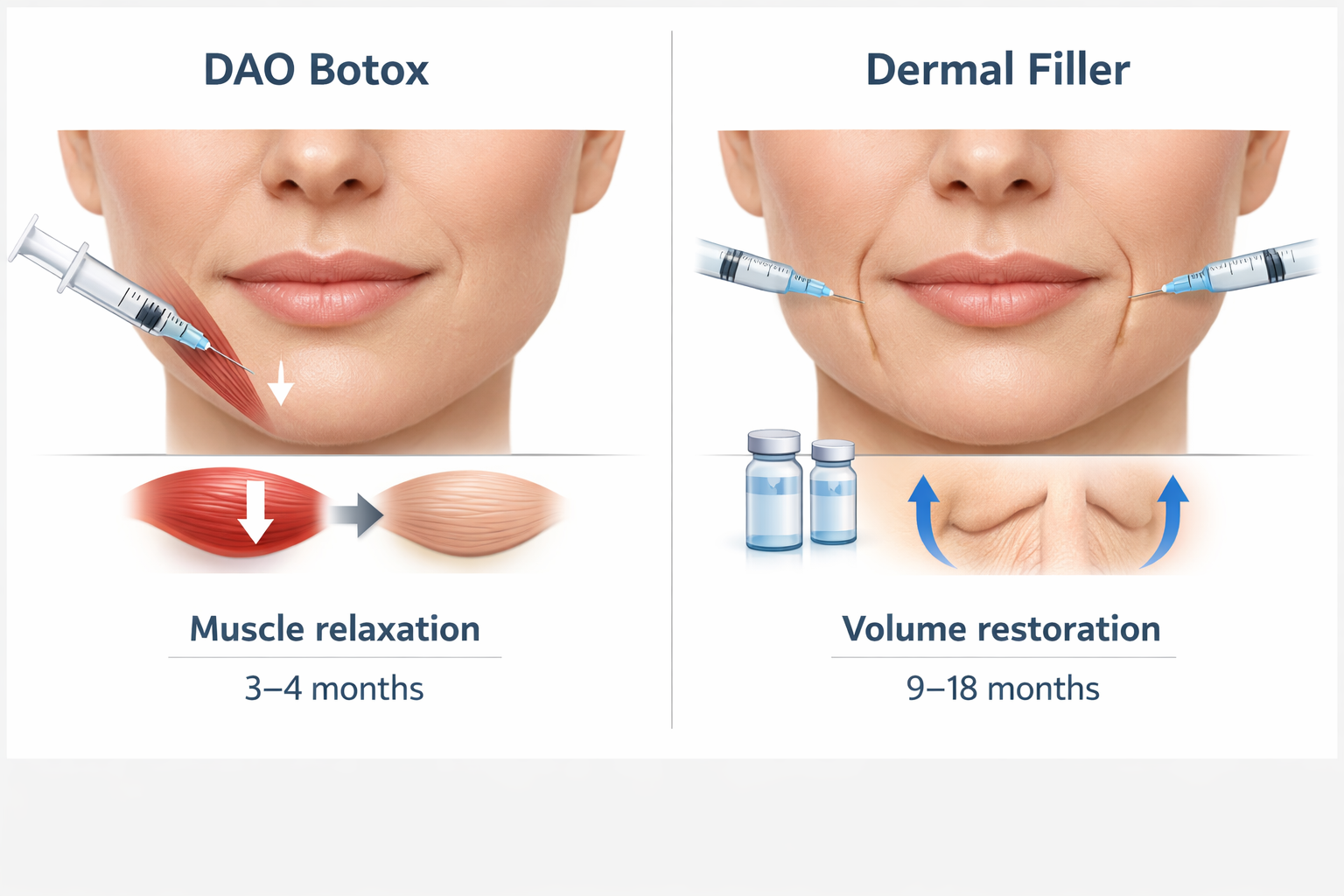
| Feature | DAO Botox | Dermal Filler |
|---|---|---|
| Mechanism | Relaxes the depressor anguli oris muscle to reduce downward pull | Restores volume and structural support at the oral commissures and marionette lines |
| Best suited for | Muscle-driven downturning; dynamic marionette lines; resting sad face | Volume-driven downturning; static marionette lines; structural deflation |
| Onset | 3–7 days; full effect at 2 weeks | Immediate, though some swelling initially present |
| Duration | 3–4 months | Typically 9–18 months depending on product and area |
| Invasiveness | Minimally invasive; fine needle injections | Minimally invasive; fine needle or cannula injections |
| Limitations | Does not restore volume; limited effect on deep static lines | Does not address muscle overactivity; may look unnatural if overused |
| Combination use | Often combined with filler for comprehensive lower face rejuvenation | Often combined with DAO Botox for muscle-plus-volume correction |
The distinction between muscle-driven and volume-driven downturning is central to choosing the right approach. A patient with a strong, overactive DAO but good facial volume may benefit from DAO Botox alone. A patient in their late 40s or 50s with visible hollowing around the mouth, deep marionette lines that are equally present at rest and during movement, and some skin laxity will likely need dermal filler as the primary treatment, with DAO Botox added only if an overactive muscle component is also present.
When combination treatment is appropriate, there is a practical sequencing consideration: many experienced injectors prefer to treat with botulinum toxin first and assess the result before placing filler, since relaxing the DAO can change the volume distribution needed. Others prefer filler first in certain anatomical situations. The right sequence depends on individual anatomy and the injector’s clinical approach — it is worth asking about this during your consultation.
Risks and Side Effects of DAO Botox
DAO Botox is generally well tolerated, but meaningful risks exist and should be understood before proceeding. The lower face is a particularly nuanced area for botulinum toxin injection because several muscles with distinct functions — smiling, speaking, eating, and forming facial expressions — are in close proximity to the DAO injection points.
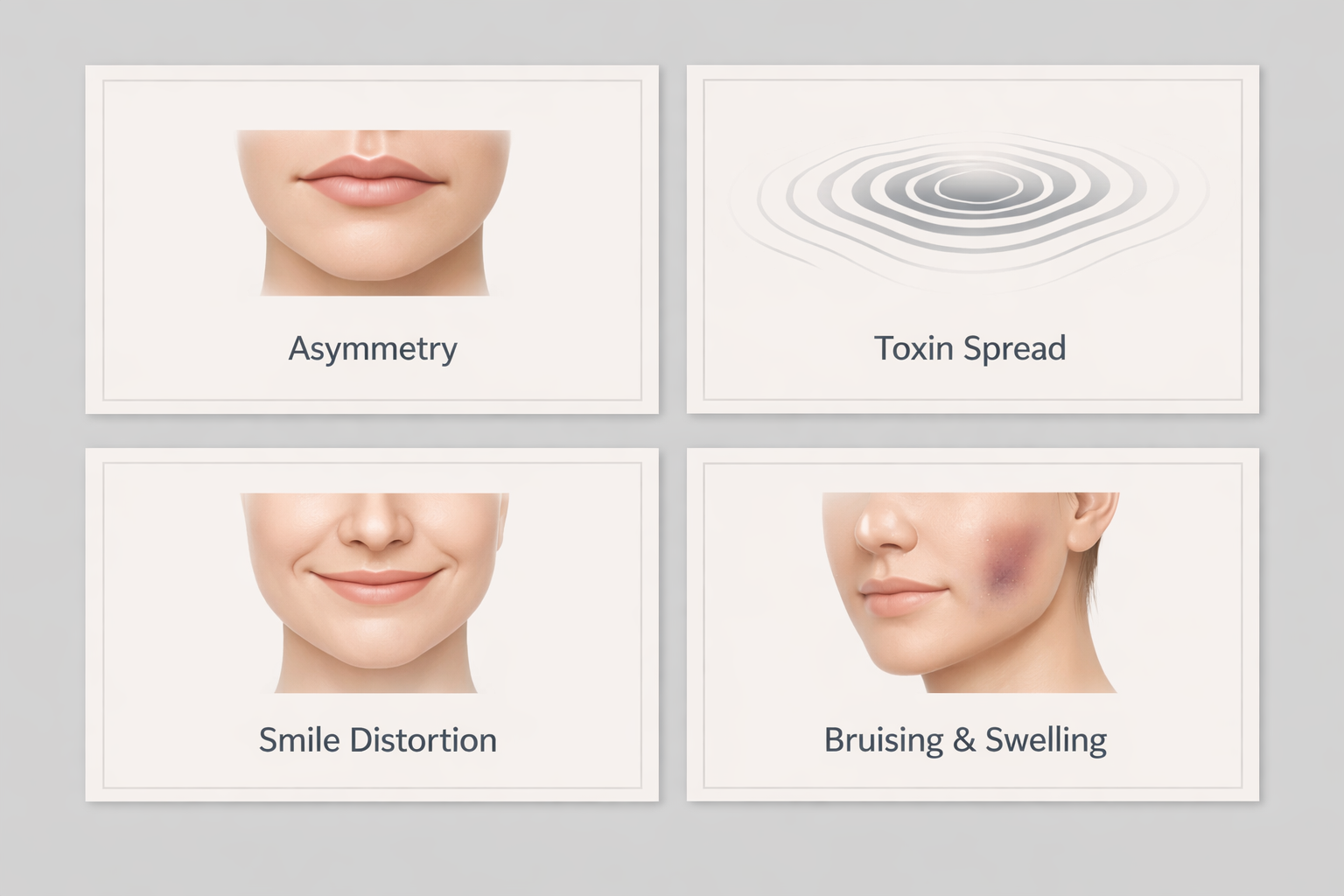
Asymmetry is the most commonly reported complication. If one side receives a slightly different effective dose, or if the muscle anatomy differs between sides in a way that was not fully accounted for during assessment, the result can be an uneven resting position of the mouth corners, or a crooked appearance during smiling. Minor asymmetry sometimes resolves as the toxin settles; in other cases it may need to be addressed by the injector.
Toxin spread is a risk when botulinum toxin diffuses beyond the intended injection site and affects adjacent muscles. In the context of DAO treatment, spread toward the depressor labii inferioris or the orbicularis oris can affect the lower lip, altering its position or mobility. This can temporarily affect speech, eating, or produce an asymmetric or unnatural-looking smile. The risk of toxin spread is increased by inexperienced injection technique, excessive volume, or injection that is placed too superficially.
Smile distortion — sometimes described as a frozen or stiff smile — can occur if the injection inadvertently weakens muscles that contribute to the smile, particularly the zygomaticus major or levator anguli oris. This is why understanding the anatomy of the perioral region and injecting at the correct depth and location is so important.
Common minor side effects include temporary bruising, redness, or swelling at the injection points, which typically resolve within a few days. Headache occasionally occurs after botulinum toxin injections. Serious allergic reactions are rare but possible. All side effects should be discussed with the treating practitioner before the procedure, and any unexpected changes following treatment should be reported promptly.
Frequently Asked Questions
Is DAO Botox painful?
Most patients find DAO Botox well tolerated. The injection involves a fine needle at one or two points on each side of the lower face. Discomfort is typically brief — a sharp pinch lasting a second or two per injection point. Numbing cream can be applied beforehand if preferred, though many patients find it unnecessary for such a small number of injection sites.
How soon will I see results from DAO Botox?
Initial changes usually begin to appear within 3–7 days of treatment. The full result develops over approximately two weeks as the botulinum toxin reaches its maximum effect on the depressor anguli oris muscle. A follow-up review at two weeks allows the injector to assess balance and symmetry and make any minor adjustments if needed.
Can DAO Botox fix marionette lines?
DAO Botox can help reduce dynamic marionette lines — grooves that deepen during facial movement — by reducing the downward pull of the depressor anguli oris. However, it will not significantly improve static marionette lines that are deeply set and visible even when the face is completely relaxed. Static lines typically require dermal filler to restore the volume and support that has been lost over time.
What is the difference between DAO Botox and a lip flip?
A lip flip uses botulinum toxin injected into the orbicularis oris muscle around the upper lip border to cause the lip to roll slightly outward, creating the appearance of a fuller upper lip. DAO Botox targets a completely different muscle — the depressor anguli oris — with the goal of lifting the corners of the mouth. The two treatments address different concerns but can be performed together as part of a broader lower face approach.
How much does DAO Botox cost?
Costs vary between clinics and practitioners, and are influenced by geographic location, the specific botulinum toxin product used, and the injector’s experience level. Because DAO Botox typically uses a relatively small number of units — often 4–8 units in total — it is generally among the more affordable botulinum toxin treatments. Some clinics charge per unit; others charge a fixed fee for the treatment area. Requesting a clear breakdown of pricing and what is included (including any follow-up review) is advisable before booking.
Can DAO Botox be reversed?
Botulinum toxin effects are not reversible with an antidote in the same way that hyaluronic acid filler can be dissolved. If an unwanted effect occurs — such as asymmetry or smile distortion — the options are to wait for the toxin to wear off naturally (typically over 3–4 months) or, in some cases, to use a small corrective dose of toxin in an adjacent muscle to partially counterbalance the effect. This underscores the importance of choosing an experienced injector from the outset.
Is DAO Botox Worth Considering for Your Lower Face?
DAO Botox can be a genuinely useful, minimally invasive option for people whose downturned mouth corners are driven primarily by an overactive depressor anguli oris muscle. When correctly identified as the right treatment for the right patient, it offers a subtle, natural-looking improvement in resting expression — lifting the oral commissures gently and reducing the appearance of a persistent resting sad face — with a low procedural burden and no meaningful downtime.
Its limitations are equally important to understand. DAO Botox works on muscle activity, not on volume or structural anatomy. Patients past the mid-40s with visible volume depletion, deep static marionette lines, or significant skin laxity are unlikely to achieve their goals through neurotoxin alone. In these cases, a combination treatment incorporating dermal filler is a more realistic path to meaningful improvement, and the proportion of each that is appropriate depends on a careful individual assessment.
The lower face is an area where injector skill, anatomical knowledge, and conservative dosing matter more than almost anywhere else. An asymmetric result, a distorted smile, or unwanted lip involvement from toxin spread are genuine risks, not theoretical ones — and they are substantially more likely when treatment is performed by someone without appropriate training and experience. Choosing a board-certified injector or qualified aesthetic practitioner with demonstrable experience in lower face treatments is not an optional extra; it is a meaningful factor in whether the outcome will be what you hoped for.
If a persistently downturned mouth or a resting sad face is something you would like to address, a thorough consultation — one that includes an honest assessment of whether your concern is muscle-driven, volume-driven, or both — is the most useful first step you can take.
