

Key Takeaways
- Dermal filler addresses jowls through two main approaches: restoring midface volume to create an indirect lift, or directly treating the jawline and pre-jowl sulcus to redefine the lower face.
- Hyaluronic acid fillers such as Juvéderm Voluma and Restylane Lyft, along with collagen-stimulating fillers like Radiesse and Sculptra, are among the most commonly used products for this area.
- Results typically last 12–24 months depending on the product and individual factors; multiple syringes and occasional maintenance sessions are usually needed.
- Filler is generally most appropriate for mild to moderate jowling; significant skin laxity may require surgical assessment.
- Choosing a qualified, experienced injector with a thorough understanding of facial anatomy is critical for both safety and outcome.
What Causes Jowls to Form?
Jowls develop as a result of several overlapping changes in facial structure that accumulate gradually over time. Understanding these changes helps explain why filler can be an effective treatment and, equally, where its limitations lie.
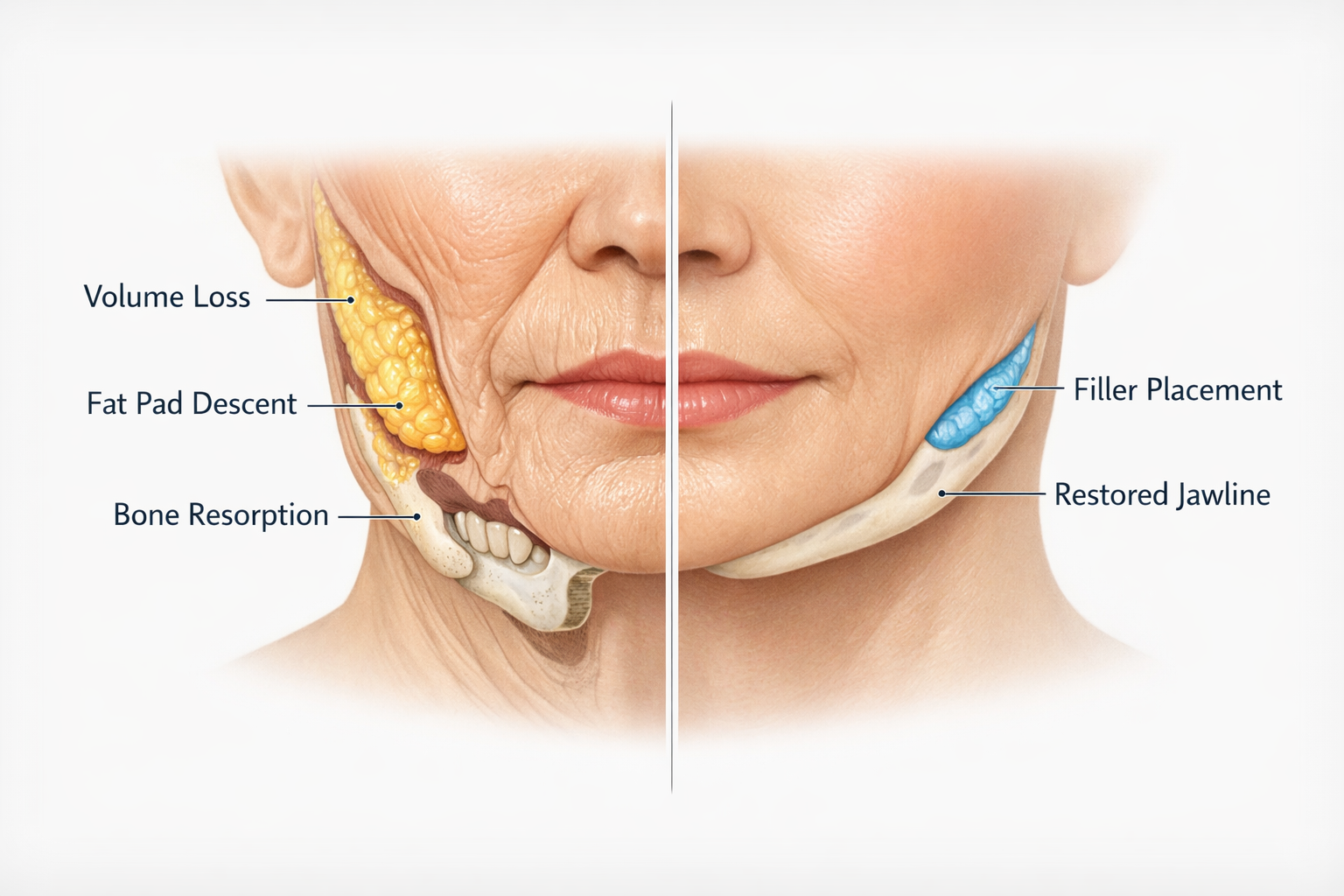
From the mid-twenties onward, the body produces progressively less collagen and elastin — the structural proteins responsible for skin firmness and resilience. As skin loses these proteins, it becomes less able to resist the effects of gravity. Fat pad displacement is another major contributor: the fat compartments of the midface and cheeks shift downward with age, reducing support in the upper and middle face and creating excess soft tissue along the jawline. At the same time, bone resorption in the lower face — including gradual loss of mandibular bone volume — reduces the underlying scaffold that keeps facial tissues elevated. Facial ligament laxity allows soft tissue to descend further than it would in younger skin.
Lifestyle factors can accelerate this process. Prolonged sun exposure, smoking, significant weight fluctuation, and even habitual downward head positioning from prolonged screen use (sometimes called tech neck) may contribute to earlier or more pronounced gravitational descent of facial tissues. Genetics and skin type also play a role in determining how quickly these changes become visible.
How Does Dermal Filler Treat Jowls?
Injectable filler does not physically tighten loose skin. Instead, it works by restoring structural volume that has been lost and by repositioning the soft tissue framework of the face in a way that reduces the appearance of sagging along the jawline. There are two complementary strategies that experienced injectors use, often in combination.
Indirect Lift: Midface Volume Restoration
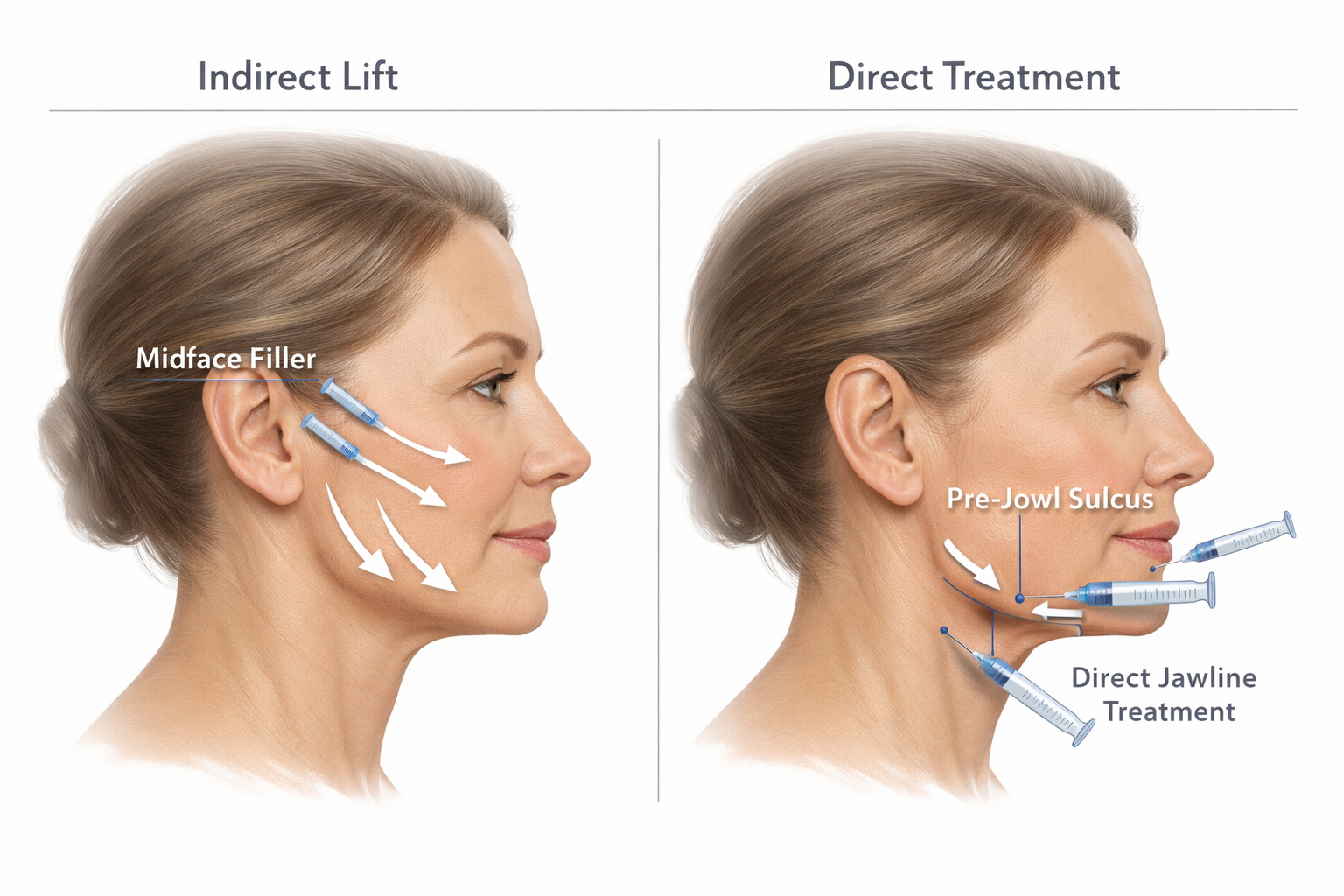
The most established approach to treating jowls with filler is the indirect lift. Because jowling is partly caused by fat pad displacement from the cheek and midface region, replacing that lost volume higher up the face can have a cascading lifting effect on the lower face. When filler is placed in the malar region (over the cheekbones and zygomatic arch), it supports the overlying tissues and reduces the downward pull on the skin below, which can soften jowls and improve the appearance of nasolabial folds and marionette lines simultaneously. This is why cheek filler and midface volume restoration are frequently recommended as a first step in lower face rejuvenation — they address the root structural cause rather than just the visible result.
Direct Treatment: Jawline and Pre-Jowl Sulcus
Direct treatment targets the lower face itself. Filler can be placed along the jawline and at the mandibular angle to create definition and sharpen the jaw’s contour, helping to visually integrate the jowl back into the jawline’s profile. A particularly important injection point is the pre-jowl sulcus — the small depression that forms on either side of the chin, just in front of the jowl. Filling this sulcus reduces the shadow and indentation that make the jowl appear more prominent, creating a smoother, more continuous jaw edge. In some cases, adding volume to the chin also improves overall lower face balance and contributes to better jawline contouring.
Injection depth matters significantly. Filler placed at a supraperiosteal level — close to the bone — provides firm structural support and reduces the risk of superficial irregularities. The decision between cannula and needle technique, and the precise depth and vector of placement, depends on the specific area being treated and the injector’s clinical assessment of local anatomy.
Filler Products Used for Jowls: A Comparison
Several dermal filler products are used in the treatment of jowls, each with different properties, longevity, and mechanisms of action. The right choice depends on the degree of volume loss, the specific area being treated, and whether the patient prioritizes reversibility or long-term stimulation.
| Product | Type | Key Property | Typical Longevity | Reversible? | Best Use Case |
|---|---|---|---|---|---|
| Juvéderm Voluma XC | Hyaluronic acid | High G-prime, volumizing | 12–18 months | Yes (hyaluronidase) | Midface lift, cheek support |
| Juvéderm Volux | Hyaluronic acid | Very high G-prime, firm | Up to 18 months | Yes (hyaluronidase) | Jawline definition, chin |
| Restylane Lyft | Hyaluronic acid | Firm, lifting capacity | 12–18 months | Yes (hyaluronidase) | Cheeks, midface, jawline |
| Restylane Defyne | Hyaluronic acid | Flexible, natural movement | 12 months | Yes (hyaluronidase) | Lower face, marionette lines |
| Radiesse | Calcium hydroxylapatite (CaHA) | Collagen-stimulating, firm | 12–15 months | No | Jawline, chin, midface |
| Sculptra | Poly-L-lactic acid (PLLA) | Gradual collagen stimulation | Up to 2+ years | No | Diffuse volume loss, overall lift |
Hyaluronic Acid Fillers
Hyaluronic acid (HA) fillers are the most commonly used option for jowl treatment. HA is a naturally occurring sugar molecule found in the skin, and HA fillers attract and retain water to add volume and structure. For the lower face, products with a high G-prime — a measure of filler firmness and resistance to deformation — are preferred because they provide the structural support needed to lift and define heavier tissues. Juvéderm Voluma XC is frequently used for midface support, while Juvéderm Volux and Restylane Lyft offer the firmness required for direct jawline work. A key advantage of HA fillers is their reversibility: if results are unsatisfactory or a complication arises, the filler can be dissolved with an enzyme called hyaluronidase.
Collagen-Stimulating Fillers
For patients with more significant volume loss or those seeking longer-lasting results, collagen-stimulating fillers may be considered. Radiesse, made from calcium hydroxylapatite (CaHA) microspheres, provides immediate volumizing effects while also stimulating the body’s own collagen production around the injected area. It is firm enough for jawline and chin work but is not reversible. Sculptra, a poly-L-lactic acid (PLLA) product, works differently: it does not add immediate volume but gradually triggers collagen synthesis over several weeks. Sculptra typically requires a series of sessions and results build slowly, making it better suited to patients who are comfortable with a gradual process and want results that may last two years or more. Neither Radiesse nor Sculptra can be dissolved once injected, so the experience and judgment of the injector matter even more when these products are used.
Who Is a Good Candidate for Jowl Filler?
Dermal filler for jowls tends to produce the most satisfying results in patients with mild to moderate jowling, good residual skin elasticity, and realistic expectations about what a non-surgical treatment can achieve. The typical age range where this approach is most appropriate is roughly 30 to 60, though suitability is always determined by individual anatomy rather than age alone.
Candidates who may benefit include those who:
- Have early to moderate jowl formation with some remaining skin elasticity
- Have noticeable volume loss in the cheeks or midface that is contributing to lower face descent
- Want a non-surgical approach with minimal downtime
- Are willing to maintain results with periodic top-up sessions
- Have no active skin infection, bleeding disorders, or relevant allergies
- Are not pregnant or breastfeeding
Filler is unlikely to be sufficient for patients with significant skin laxity, very heavy jowling, or where the primary issue is excess skin rather than volume loss. In these situations, a surgical consultation for a facelift or lower face lift may provide more meaningful and lasting correction. A thorough assessment by a qualified practitioner is essential to determine which approach, or combination of approaches, is appropriate for a given individual.
The Procedure: What to Expect
A jowl filler appointment typically begins with a detailed consultation and facial assessment. The practitioner will evaluate the degree of jowling, the distribution of volume loss, skin quality, and overall facial proportions before agreeing on a treatment plan. Photographs are usually taken for reference.
The treatment area is cleansed and a topical anaesthetic cream may be applied to improve comfort. Many fillers also contain lidocaine within the formulation itself, which helps reduce discomfort during injection. The procedure usually takes between 30 and 60 minutes depending on the number of areas being treated. The injector may use a fine needle, a blunt-tipped cannula, or both, depending on the anatomy and injection site.
Some swelling, redness, and mild bruising are common immediately after treatment and typically resolve within one to two weeks. Patients are usually advised to avoid strenuous exercise, excessive heat, and alcohol for 24 to 48 hours. Results from HA and CaHA fillers are visible fairly quickly, though final results are best assessed after any initial swelling has settled — usually at a two-week review. Sculptra results develop gradually over several weeks as collagen production increases.
How Long Do Results Last?
Longevity varies by product, injection area, individual metabolism, and lifestyle factors. As a general guide:
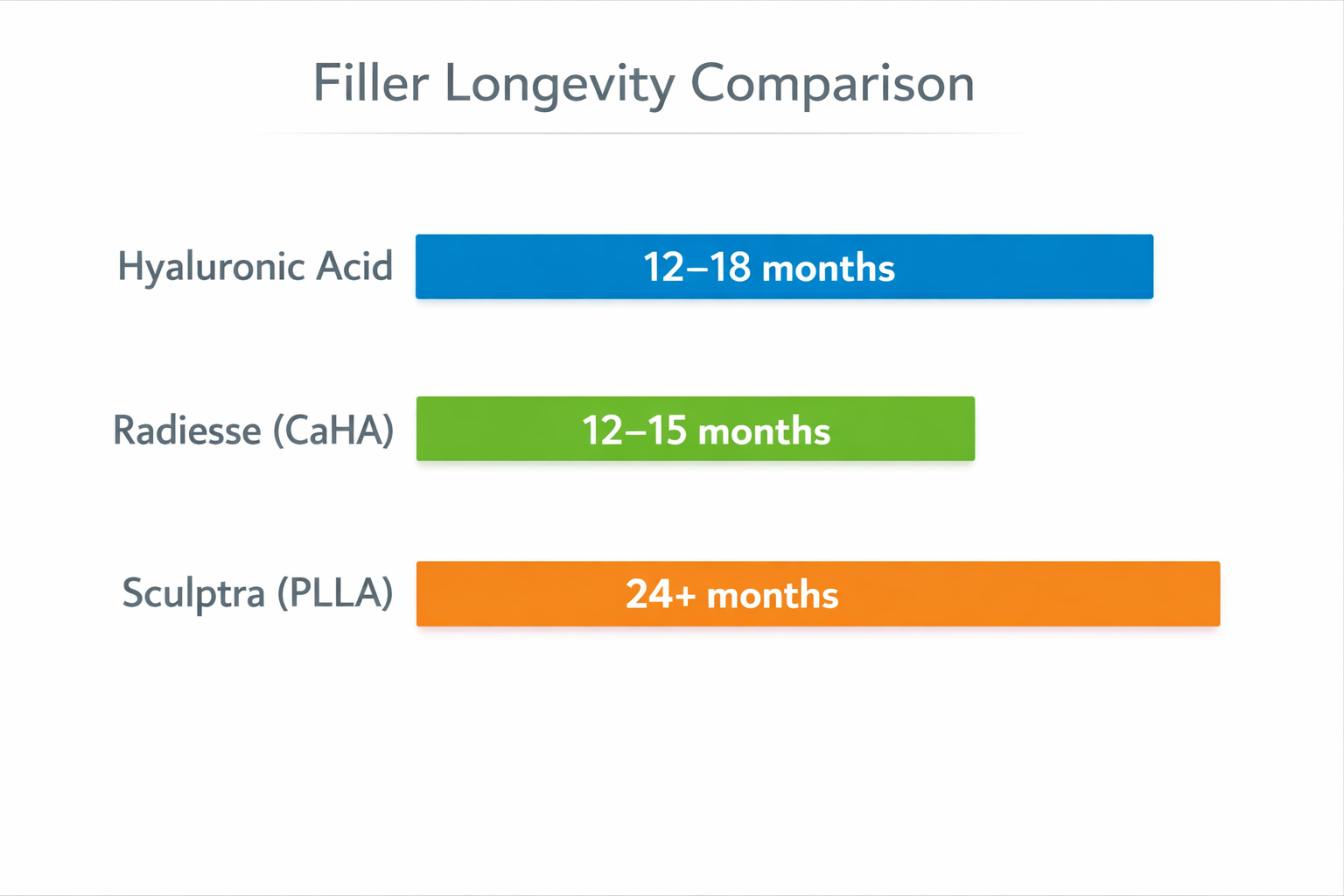
- Hyaluronic acid fillers (Voluma, Lyft, Volux): typically 12–18 months in the lower face and jawline area
- Radiesse (CaHA): approximately 12–15 months, with some collagen stimulation extending the effect
- Sculptra (PLLA): results may last two years or more, though multiple initial sessions are required to build the effect
Areas of higher movement, such as around the mouth, may metabolize filler more quickly than deeper structural areas like the cheeks. Most patients plan a maintenance session every 12 to 18 months to preserve their results, though this varies by individual and product choice.
Combination Approaches for Better Outcomes
Experienced practitioners often use a combination approach rather than treating jowls in isolation. A comprehensive lower face rejuvenation plan might include midface filler to restore cheek structure, direct jawline filler to sharpen the jaw’s edge, pre-jowl sulcus treatment to smooth the contour, and chin augmentation with filler to balance the overall profile. This multi-vector strategy, sometimes referred to as a liquid facelift, can produce more balanced and natural-looking results than treating a single area alone.
Botulinum toxin is sometimes used alongside filler as part of a combination protocol. The Nefertiti lift — a technique involving toxin injections along the lower jawline and into the platysma muscle of the neck — can reduce downward muscular pull on the lower face and complement the lifting effect of filler. Skin-tightening treatments such as radiofrequency, focused ultrasound (HIFU), or radiofrequency microneedling may also be recommended to improve skin quality and elasticity alongside volume restoration, particularly in patients where skin laxity is a contributing factor.
Risks and Safety Considerations
Dermal filler for jowls is a minimally invasive procedure, but it carries real risks that patients should understand before proceeding. Common side effects include temporary swelling, bruising, redness, and tenderness at the injection site. These typically resolve within one to two weeks and are not usually a cause for concern.
More significant risks include asymmetry, lumpiness or nodule formation, and, in rare but serious cases, vascular occlusion — where filler inadvertently enters or compresses a blood vessel. Vascular occlusion in the lower face can compromise blood supply to surrounding tissue and requires immediate treatment. This risk underscores why the choice of injector is not a secondary consideration. A board-certified injector with advanced training in facial anatomy, who uses appropriate techniques and has emergency management protocols in place, substantially reduces this risk compared to an unqualified or undertrained practitioner.
Patients should also be aware of the risks associated with counterfeit or non-FDA-approved filler products, which are occasionally offered at very low prices through unregulated providers. Using only licensed clinics that use named, authenticated products from reputable suppliers is an important safety step. For HA fillers specifically, the option to dissolve the product with hyaluronidase provides an important safety net that collagen-stimulating fillers do not offer.
Filler Versus Facelift for Jowls
The decision between dermal filler and surgery depends on the degree of jowling, skin quality, patient goals, and tolerance for recovery time and cost. Filler is well suited to patients in the earlier stages of facial aging where volume loss is the dominant issue. It offers minimal downtime, is reversible (for HA products), and can be adjusted over time. However, filler cannot tighten genuinely loose or redundant skin and cannot replicate the structural correction of a surgical facelift.
A surgical facelift repositions and removes excess skin and underlying tissue, providing more dramatic and longer-lasting correction for significant jowling. Recovery is considerably longer — typically two to four weeks — and surgical risks apply. For patients with moderate to severe jowling, heavy skin laxity, or who are seeking a result that filler realistically cannot provide, a consultation with a plastic surgeon or maxillofacial surgeon is the more appropriate starting point. A responsible aesthetic practitioner will recognize this boundary and refer accordingly rather than overselling what injectable treatment can achieve.
How Much Does Filler for Jowls Cost?
The cost of jowl filler treatment varies depending on the product used, the number of syringes required, the provider’s experience level, and geographic location. Individual syringes of premium HA filler typically range from around £400 to £800 in the UK, or $600 to $1,000 or more in the United States.
The total treatment cost depends on how many syringes are needed, which in turn depends on the extent of volume loss and whether only the jawline is being treated or a broader combination approach is being used. A conservative treatment addressing one or two areas might require two to three syringes; a more comprehensive liquid facelift protocol addressing the midface, jawline, pre-jowl sulcus, and chin could require four to six or more. Total treatment costs therefore commonly range from approximately £1,000 to £3,500 or more in the UK, and $1,200 to $4,000 or more in the US. Collagen-stimulating fillers like Sculptra are priced per vial and require multiple sessions, which affects overall cost but may offer better value for longevity over time.
When comparing cost against a surgical facelift, filler is considerably less expensive upfront, though the ongoing maintenance cost of repeat sessions over several years should be factored into the comparison.
Choosing the Right Injector
The outcome of jowl filler treatment is highly dependent on the skill and knowledge of the practitioner. The lower face is anatomically complex, with important nerves, arteries, and ligaments in close proximity to the intended injection sites. An injector who understands facial anatomy in depth — including the specific risks at different injection points — is far better positioned to achieve natural results safely than one who does not.
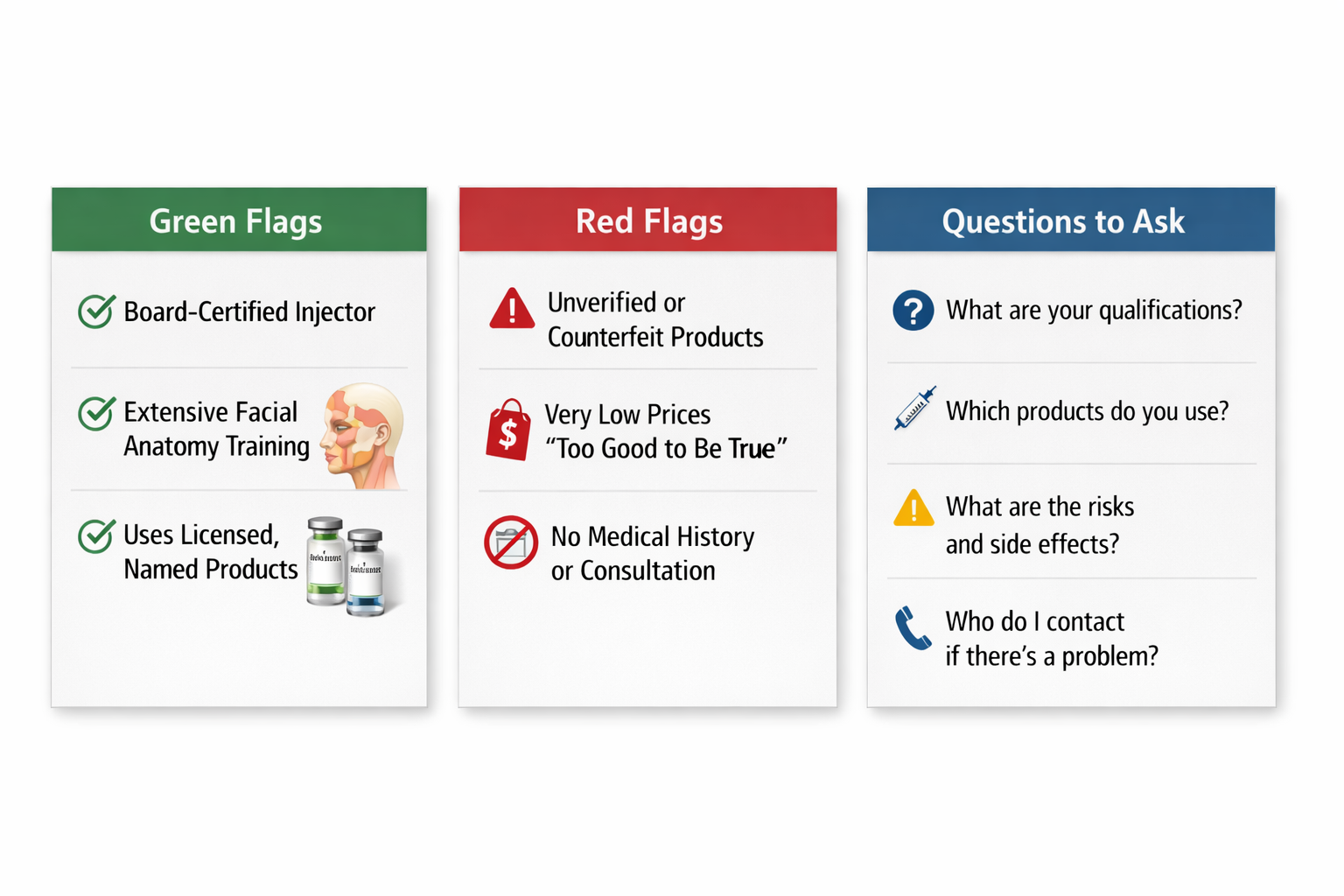
When selecting a provider, look for practitioners who are medically qualified (doctors, dentists, or nurse prescribers with appropriate aesthetic training), who work in a clinical environment, use named and authenticated products, and who take a thorough medical history before treatment. A practitioner who offers a detailed facial assessment, explains the reasoning behind their treatment plan, sets realistic expectations, and discusses both benefits and risks openly is demonstrating the standard of care patients should expect. Be cautious of unusually low pricing, pressure to commit quickly, or providers who are unable to clearly explain what they are injecting and why.
Frequently Asked Questions
Will cheek filler alone lift my jowls?
Cheek filler can produce a meaningful indirect lift on jowls by restoring midface volume and supporting the overlying facial tissues. For mild jowling where fat pad displacement is the main issue, midface volume restoration alone can make a noticeable difference. However, more pronounced jowling usually benefits from a combination approach that also addresses the jawline and pre-jowl sulcus directly.
How many syringes of filler are needed for jowls?
The number depends on the extent of volume loss and the treatment areas included. A targeted jawline treatment might require one to two syringes, while a comprehensive combination approach covering the cheeks, jawline, pre-jowl sulcus, and chin could require four to six or more. Your practitioner should provide a clear estimate after assessing your anatomy in person.
Is jowl filler painful?
Most patients describe the discomfort as mild to moderate. Topical anaesthetic cream applied before treatment, combined with lidocaine present in many filler formulations, makes the procedure tolerable for the majority of patients. The level of discomfort varies depending on the specific injection sites and individual pain sensitivity.
Can filler make jowls look worse?
Poorly placed filler, or filler injected without a thorough understanding of facial anatomy and proportions, can add bulk in the wrong areas and inadvertently accentuate jowling rather than reduce it. This is one of the most important reasons to choose a practitioner with specific experience in lower face and jawline work rather than a generalist with limited anatomical training.
How soon will I see results from jowl filler?
With HA and CaHA fillers such as Voluma, Lyft, or Radiesse, improvement is visible almost immediately, though swelling in the first week or two can temporarily alter the appearance. Most practitioners recommend evaluating final results at a two-week review. Sculptra results develop gradually over six to twelve weeks as collagen production increases, with full results typically visible after two or three sessions spaced several weeks apart.
What happens when jowl filler wears off?
As filler gradually breaks down and is absorbed by the body, the treated areas return toward their pre-treatment appearance over time. The face does not suddenly look worse than it did before treatment. Scheduling a maintenance session before filler has fully degraded helps maintain continuity of results.
Is Filler the Right Approach for Your Jowls?
Dermal filler can be a genuinely effective option for patients with mild to moderate jowling who want a non-surgical approach to lower face rejuvenation. When treatment is planned thoughtfully — using the right products for the right areas, with an understanding of the underlying anatomy — it can restore a more defined jawline, soften the appearance of jowls, and improve overall facial balance without surgery or significant downtime.
The most important factors in a good outcome are candidacy (filler works best when volume loss is the dominant issue, not severe skin laxity), product selection, and the expertise of the injector. Patients with significant jowling, very loose skin, or expectations that exceed what a minimally invasive treatment can deliver are better served by an honest conversation about surgical options.
If you are considering filler for jowls, a consultation with a qualified, experienced practitioner who takes a full facial assessment and explains the treatment rationale clearly is the right starting point. Realistic expectations, combined with the right treatment plan, offer the best chance of results you will be satisfied with.
