
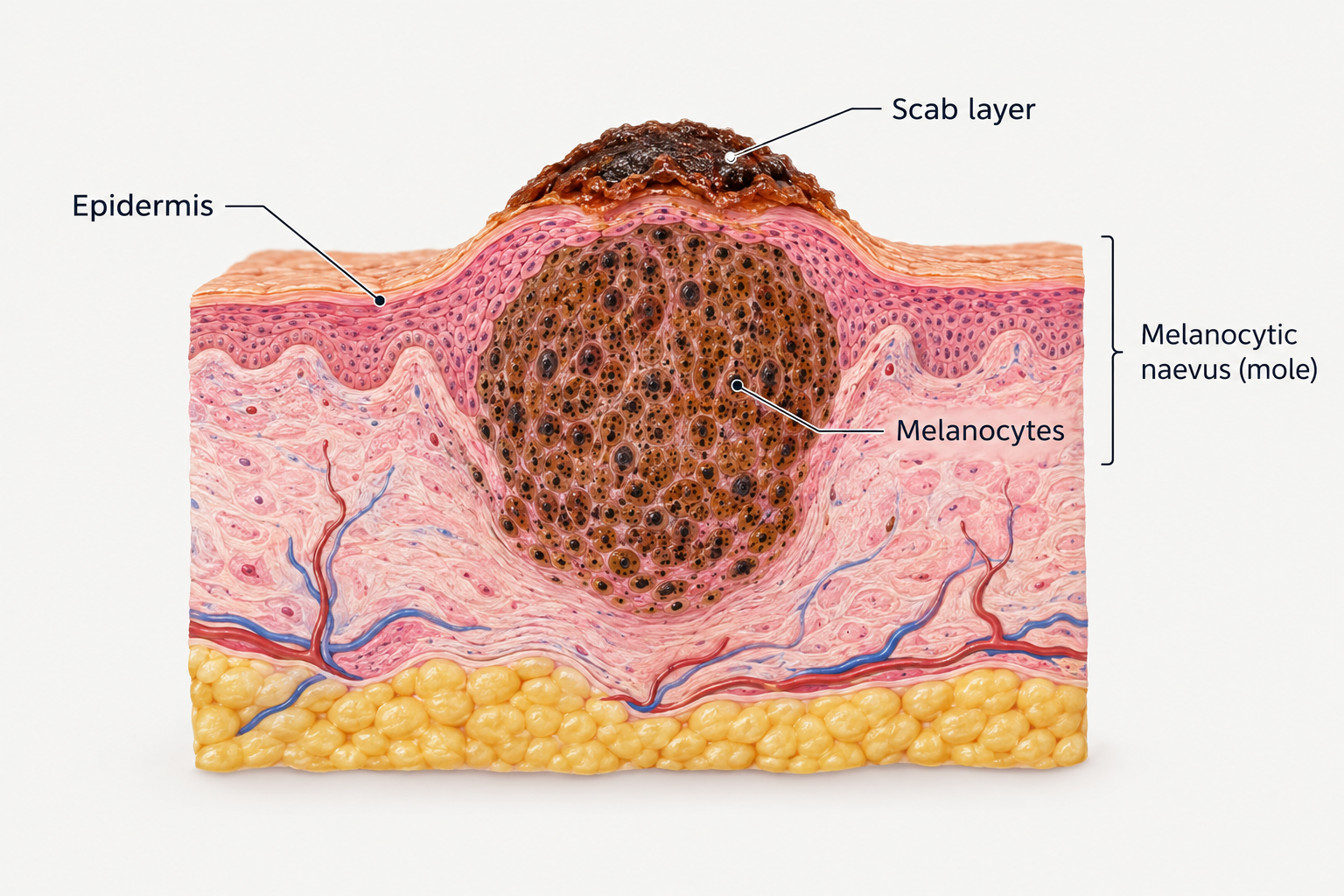

A mole that develops a scab, crust, or rough surface can be unsettling to notice. In many cases, a scabby mole results from minor physical irritation or a small injury that heals without any lasting concern. However, certain changes in a mole — including persistent scabbing, bleeding, or changes in shape and colour — can occasionally indicate something that warrants prompt clinical assessment. Understanding the range of possible causes helps you make an informed decision about whether to monitor the mole at home or seek professional evaluation.
Key Takeaways
- A scabby mole is often caused by minor friction, accidental scratching, or everyday skin trauma, and may heal on its own without treatment.
- Persistent scabbing, bleeding without an obvious cause, or changes in a mole’s size, shape, colour, or border are reasons to seek a clinical assessment promptly.
- Dermatoscopy and, where indicated, biopsy are the standard clinical tools used to evaluate a mole that raises concern.
- Not every change in a mole is dangerous, but self-monitoring using a recognised framework such as the ABCDE criteria can help you identify changes worth reporting.
- Early professional assessment is always preferable to prolonged self-monitoring when a mole’s appearance changes in a way you cannot explain.
What Is a Mole and Why Do They Change?
Moles, known clinically as melanocytic naevi, are clusters of pigment-producing cells called melanocytes that form in or just beneath the skin. Most people develop between 10 and 40 moles during their lifetime, and the majority remain stable and entirely benign throughout life. Moles can appear anywhere on the body, vary in colour from light tan to dark brown, and may be flat or slightly raised. Their appearance can change gradually over decades as a natural part of ageing, and hormonal shifts — such as those during puberty or pregnancy — can also cause moles to darken or enlarge slightly.
A mole’s surface can occasionally become disrupted, leading to scabbing or crusting. This surface change may be temporary and entirely innocent, or it may reflect an underlying process that deserves closer attention. The key is understanding what distinguishes a mole that has simply been irritated from one that may be undergoing a more significant change.
Common Causes of a Scabby Mole
Several everyday factors can cause a mole to develop a scab or crust. Identifying the most likely cause helps determine whether the change is likely to resolve on its own or whether a clinical opinion is needed.
Physical Irritation and Friction
Friction from clothing, jewellery, or accessories is one of the most frequent reasons a mole develops a scab. Raised moles are particularly vulnerable because they protrude above the surrounding skin surface and can catch on fabric, bra straps, waistbands, or collar edges. Repeated rubbing causes the surface of the mole to break down, leading to a small wound that then forms a scab as it heals. Once the source of friction is removed, the mole typically heals within one to two weeks without any lasting change to its appearance.
Accidental Scratching or Picking
Accidentally scratching a mole — for example, while washing, shaving, or applying skincare products — can break the skin surface and trigger scab formation. This is especially common in areas where the skin is handled regularly, such as the face, neck, scalp, and legs. Picking at a mole, even unintentionally, introduces a small wound that the body repairs through normal clotting and scab formation. Provided the mole itself has not changed in other ways, this type of scabbing is generally not a cause for concern, though repeated trauma to the same mole is worth mentioning to a clinician.
Shaving Over a Raised Mole
Shaving is a particularly common cause of mole trauma, especially on the face, neck, and legs. A razor blade can easily nick a raised mole, causing bleeding and subsequent scab formation. This type of injury tends to heal quickly, but it can be alarming if the bleeding is more significant than expected. If a mole is regularly caught during shaving, a dermatologist or aesthetic practitioner can discuss safe options for mole removal to prevent ongoing trauma.
Sunburn and UV Damage
Significant sun exposure or sunburn can affect the skin surface overlying a mole, causing it to peel, crust, or scab as the damaged skin sheds. Ultraviolet radiation is also a recognised risk factor for changes within melanocytes themselves, which is why sun-damaged skin warrants careful monitoring. A mole in an area of sunburned skin that scabs and then returns to its previous appearance after healing is less concerning than one that continues to change after the sunburn has resolved.
Skin Conditions Affecting the Mole Surface
Underlying skin conditions such as eczema, psoriasis, or contact dermatitis can affect the skin in and around a mole, causing dryness, scaling, or crusting that may look like a scabby mole. In these cases, the scabbing is typically part of a broader pattern of skin inflammation rather than a change specific to the mole itself. A clinician can usually distinguish between a mole that is reacting to a surrounding skin condition and one that is changing independently.
Seborrhoeic Keratosis Mimicking a Scabby Mole
Seborrhoeic keratoses are very common benign skin growths that often appear in middle age and beyond. They can closely resemble moles in colour and shape, and their characteristically rough, warty, or crusty surface means they are frequently mistaken for a scabby mole. Seborrhoeic keratoses are not cancerous and do not require treatment unless they are irritated or cosmetically bothersome, but because they can look similar to certain types of melanoma, professional assessment is advisable if you are unsure whether a growth is a mole or a seborrhoeic keratosis.
When a Scabby Mole May Indicate Something More Serious
While most scabby moles have a benign explanation, certain features should prompt a timely clinical assessment. Melanoma — the most serious form of skin cancer — can sometimes present with surface changes including scabbing, bleeding, or ulceration. It is important to emphasise that the presence of a scab alone does not indicate melanoma, but when scabbing occurs alongside other warning signs, professional evaluation becomes important.
The ABCDE Criteria for Mole Assessment
The ABCDE framework is a widely used clinical tool that helps both patients and clinicians identify moles that may warrant further investigation. Applying these criteria to a scabby mole can help you decide whether to seek an assessment.
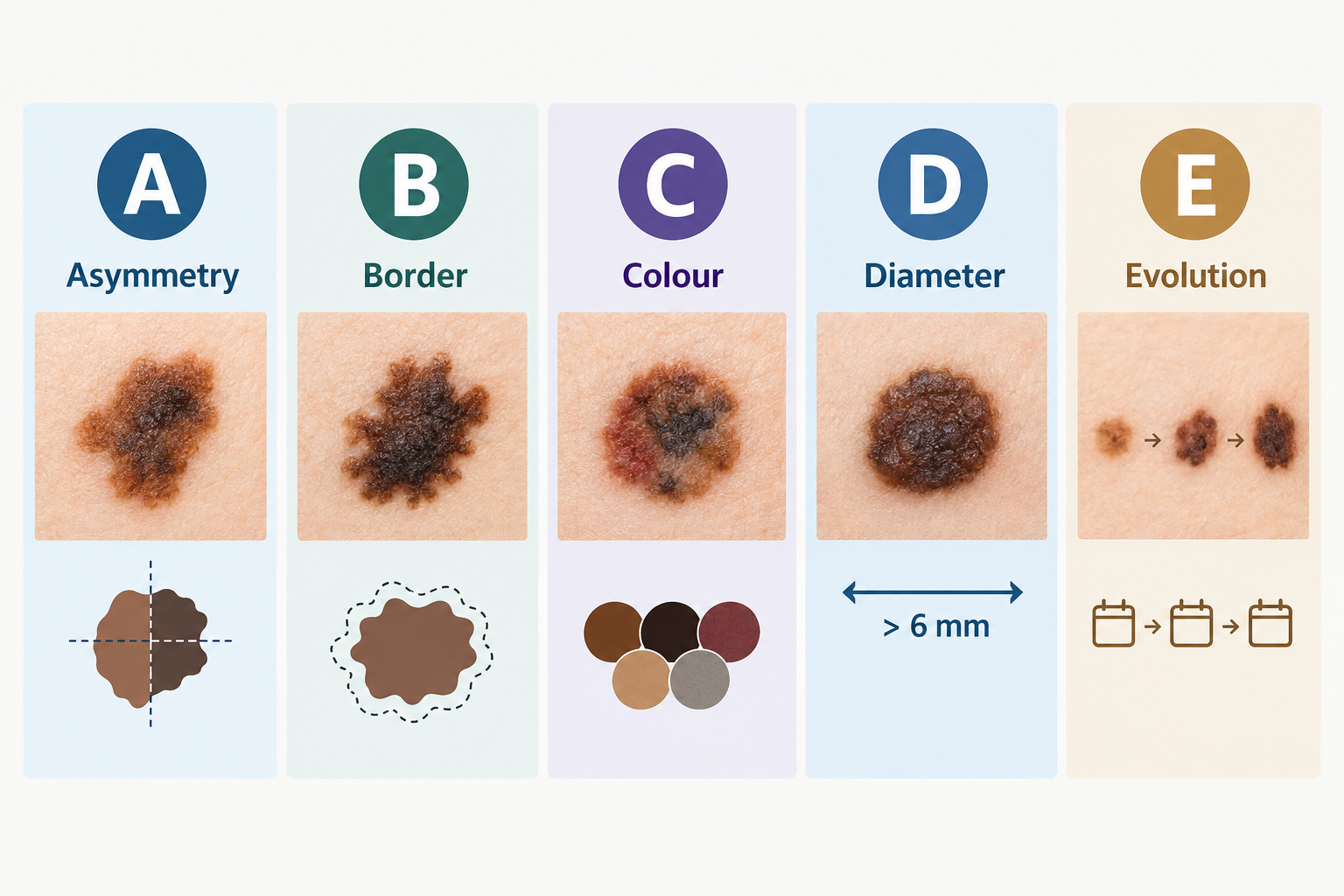
- Asymmetry: One half of the mole does not mirror the other half in shape or appearance.
- Border: The edges of the mole are irregular, ragged, notched, or poorly defined rather than smooth and even.
- Colour: The mole contains more than one shade of brown, black, red, white, or blue, or the colour distribution is uneven.
- Diameter: The mole is larger than approximately 6 millimetres across, roughly the size of a pencil eraser, though melanomas can be smaller.
- Evolution: The mole has changed in size, shape, colour, or surface texture over a period of weeks to months, or has developed new symptoms such as itching, bleeding, or scabbing without an obvious cause.
The evolution criterion is particularly relevant to a scabby mole. A mole that scabs repeatedly without a clear physical cause, or that has changed in other ways alongside the scabbing, should be assessed by a qualified clinician rather than monitored at home indefinitely.
Bleeding Without an Obvious Cause
A mole that bleeds spontaneously — meaning without being scratched, caught on clothing, or otherwise physically disturbed — is a symptom that should be assessed promptly. Spontaneous bleeding from a mole can occasionally be associated with abnormal cell growth within the lesion. This does not automatically mean the mole is malignant, but it is a change that a dermatologist should evaluate without significant delay.
Persistent Scabbing That Does Not Heal
A scab that forms after a clear injury and heals within one to two weeks is generally reassuring. A scab that repeatedly forms, falls off, and reforms on the same mole without a clear physical cause — particularly over a period of several weeks — is a pattern that warrants clinical assessment. This cycle of incomplete healing can occasionally be associated with abnormal cellular activity within the mole.
Itching, Tenderness, or Oozing
New or persistent itching, tenderness, or oozing from a mole, especially when accompanied by scabbing or surface change, are symptoms worth reporting to a clinician. While itching can result from dry skin or mild irritation, itching that is localised specifically to one mole and persists over time is a change worth documenting and discussing with a dermatologist or GP.
How Clinicians Evaluate a Changing Mole
When you present a scabby or changing mole to a clinician, the assessment typically begins with a detailed history of the mole’s appearance over time, any relevant symptoms, your personal and family history of skin cancer, and your history of sun exposure. The clinician will then examine the mole visually and, in most cases, use a dermatoscope — a handheld magnifying device with a light source — to examine the mole’s internal structure in greater detail than is possible with the naked eye. Dermatoscopy significantly improves the accuracy of clinical mole assessment and is now considered standard practice in skin lesion evaluation.
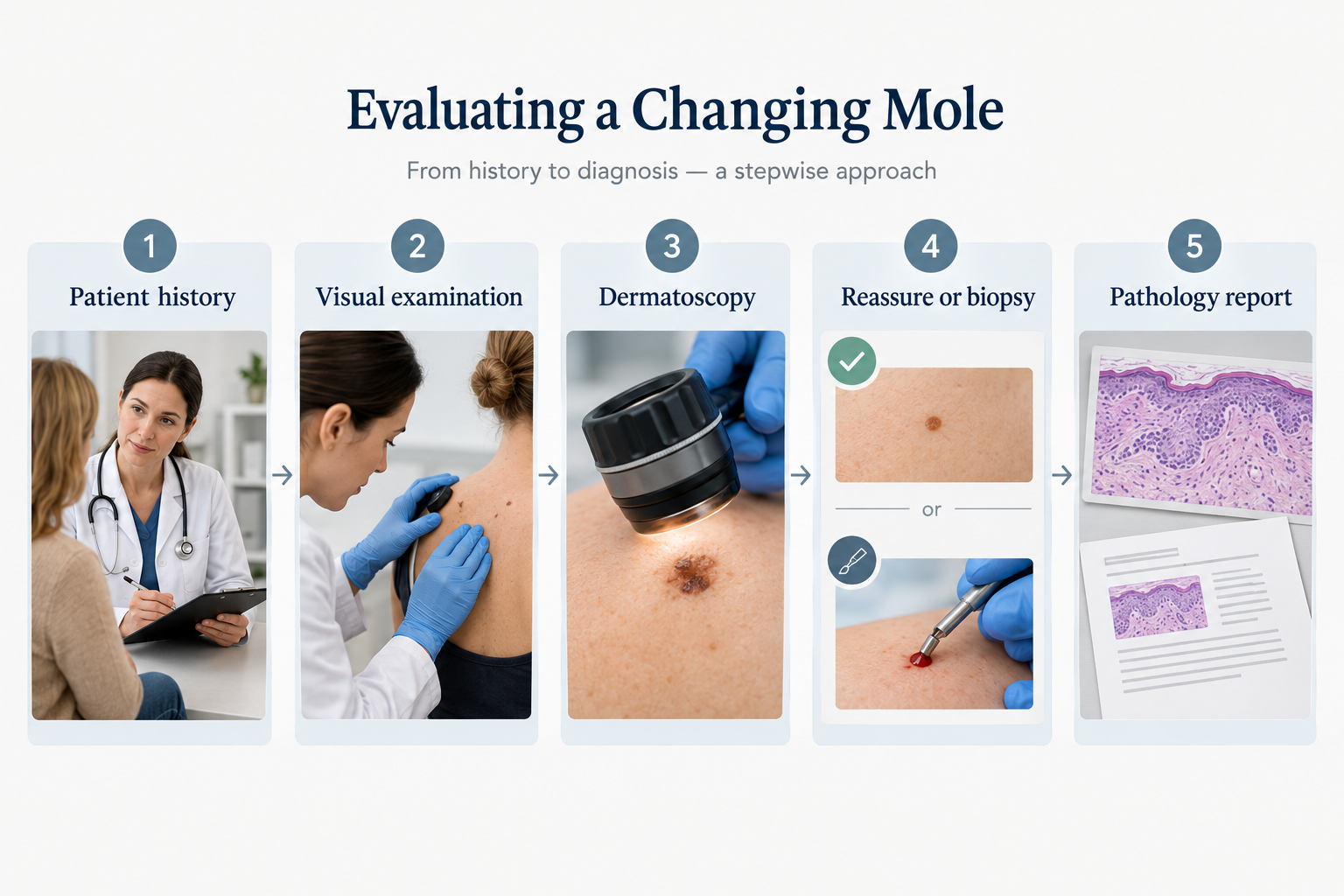
If the dermatoscopic assessment raises concern, or if the mole’s history suggests a meaningful change, the clinician may recommend an excision biopsy. This involves surgically removing the mole under local anaesthetic so that the tissue can be examined by a pathologist. A biopsy is the only definitive way to determine whether a mole contains abnormal or malignant cells. The procedure is straightforward, leaves a small scar, and is performed as an outpatient procedure in most cases.
Self-Monitoring: What to Look For and How to Record It
Regular self-examination of your moles is a practical habit that can help you detect meaningful changes early. The most effective approach is to examine your skin in good lighting, using a full-length mirror and a hand mirror for areas that are difficult to see directly, such as the back, scalp, and backs of the legs. Photographing moles with a smartphone at regular intervals — for example, every one to three months — provides a useful baseline for comparison and makes it easier to identify gradual changes that might otherwise go unnoticed.
When monitoring a mole that has recently scabbed, note whether the scab appeared after a clear physical cause, how long it takes to heal, and whether the mole’s appearance returns to its previous state after healing. If the mole looks different after the scab has resolved — for example, if it appears larger, darker, or has an irregular border that was not previously present — this is a change worth reporting to a clinician rather than continuing to monitor at home.
Risk Factors for Melanoma and Skin Cancer
Understanding your personal risk factors for melanoma can help you decide how closely to monitor your moles and how frequently to seek professional skin checks. Recognised risk factors include a personal or family history of melanoma, a large number of moles (generally more than 50), the presence of atypical or dysplastic moles, a history of significant or repeated sunburn, fair skin that burns easily, red or blonde hair, light-coloured eyes, and a history of using sunbeds. People with any of these risk factors may benefit from more frequent professional skin surveillance, even when individual moles appear stable.
It is important to note that melanoma can also develop in people without obvious risk factors, and that it can arise in areas of the body that receive little or no sun exposure. This is why any mole that changes in a way that cannot be explained by a clear physical cause deserves professional attention, regardless of your perceived risk level.
Mole Removal: Options and Considerations
If a mole is repeatedly irritated by friction or shaving, or if it causes cosmetic concern, removal may be a practical option. Mole removal is also performed when a biopsy is needed to assess a suspicious lesion. The most common removal methods include surgical excision, shave excision, and, for certain benign lesions, laser or radiofrequency ablation. The appropriate method depends on the mole’s size, location, depth, and whether a histological sample is required.
It is important to understand that mole removal for cosmetic reasons should only be performed after a clinician has confirmed that the mole is benign. Removing a mole without prior assessment — or using unregulated at-home removal products — carries risks including incomplete removal, scarring, infection, and, critically, the possibility of missing a diagnosis if the tissue is not sent for pathological examination. Any mole removal procedure should be performed by a qualified medical professional in a clinical setting.
Protecting Your Skin and Reducing Risk
While not all mole changes can be prevented, consistent sun protection is one of the most evidence-supported measures for reducing the risk of UV-related skin damage and melanoma. Applying a broad-spectrum sunscreen with an SPF of 30 or higher to all exposed skin, seeking shade during peak UV hours, wearing protective clothing, and avoiding sunbeds are all practical steps that reduce cumulative UV exposure over time. These measures are particularly important for people with a higher number of moles or a personal or family history of skin cancer.
For moles that are prone to friction from clothing or accessories, covering the area with a soft dressing or adjusting clothing choices can reduce repeated trauma. If a specific mole is consistently irritated by everyday activities, discussing removal with a qualified clinician is a reasonable option.
Frequently Asked Questions
Is it normal for a mole to scab after being scratched?
Yes. A mole that scabs after being accidentally scratched, caught on clothing, or nicked during shaving is responding to a minor physical injury in the same way any other area of skin would. The scab should heal within one to two weeks. If the mole looks different after healing, or if scabbing recurs without a clear cause, a clinical assessment is advisable.
How long should I wait before seeing a doctor about a scabby mole?
If the scabbing followed a clear physical cause and the mole heals normally within two weeks, monitoring at home is reasonable. If the scab persists beyond two to three weeks, recurs repeatedly, or is accompanied by other changes such as bleeding, itching, or a change in the mole’s size, shape, or colour, seek a clinical assessment promptly rather than continuing to wait.
Can I remove a scab from a mole myself?
Picking or forcibly removing a scab from a mole is not advisable. Doing so can delay healing, introduce infection, and cause unnecessary trauma to the mole. Allow the scab to separate naturally. If the mole bleeds easily or repeatedly, this is a reason to seek professional assessment rather than to manage it at home.
Does a scabby mole always mean skin cancer?
No. The majority of scabby moles have a benign cause such as friction, accidental injury, or a surrounding skin condition. However, because certain features of a changing mole can occasionally be associated with melanoma or other skin cancers, it is important not to dismiss a mole that scabs repeatedly or changes in other ways without seeking a professional opinion.
What is the difference between a scabby mole and a seborrhoeic keratosis?
Seborrhoeic keratoses are benign skin growths that often have a rough, crusty, or warty surface and can closely resemble a scabby mole. They are very common in adults over 40 and are not cancerous. However, because they can look similar to certain melanomas, a clinician should assess any growth you are unsure about rather than assuming it is a seborrhoeic keratosis based on appearance alone.
Should I use sunscreen on a mole that has scabbed?
Protecting the skin around a healing mole from UV exposure is sensible, but applying sunscreen directly to an open scab is generally not recommended until the skin has healed. Once the scab has resolved and the skin surface is intact, applying broad-spectrum sunscreen to the area as part of your regular sun protection routine is appropriate.
When to Act on a Scabby Mole: A Practical Guide
A scabby mole that follows a clear physical cause — such as friction, shaving, or accidental scratching — and heals completely within one to two weeks is unlikely to require urgent medical attention. However, the decision to seek a professional assessment should not be delayed if the mole scabs repeatedly without explanation, fails to heal, bleeds spontaneously, or shows any of the ABCDE warning signs alongside the surface change. Early assessment by a dermatologist or qualified clinician is always the safer choice when you are uncertain, and it is far preferable to prolonged self-monitoring of a mole that is behaving unusually.
If you have a mole that concerns you, a consultation with a qualified clinician who can perform a thorough skin examination and dermatoscopic assessment is the most reliable way to determine whether the change is benign or requires further investigation. Skin lesion assessment is a clinical skill, and the reassurance — or early diagnosis — that comes from a professional evaluation is genuinely valuable. Do not allow uncertainty about a changing mole to persist when a straightforward clinical assessment can provide clarity.
