


A lip flip is a botulinum toxin treatment that relaxes the muscle around the upper lip, allowing the lip edge to roll slightly outward and appear fuller without adding volume. For many patients, the key question before booking is a practical one: how long does a lip flip last, and is that duration worth the treatment? The honest answer is that results are noticeably shorter than most other botulinum toxin treatments, typically lasting between six and ten weeks, though individual variation is significant. This article explains why the lip flip has a shorter duration than treatments like forehead lines or crow’s feet, what factors influence how long your results may last, what the treatment experience involves, and how the lip flip compares to lip filler as an alternative.
Key Takeaways
- A lip flip typically lasts between six and ten weeks, making it one of the shorter-duration botulinum toxin treatments available.
- Results depend on the number of units used, individual metabolism, muscle activity, and practitioner technique.
- The lip flip does not add volume; it changes the position of the upper lip edge by relaxing the orbicularis oris muscle.
- Lip filler generally lasts six to twelve months and may be more suitable for patients seeking visible volume or longer-lasting results.
- A qualified practitioner assessment is essential to determine whether a lip flip, lip filler, or a combination approach is appropriate for your anatomy and goals.
What Is a Lip Flip and How Does It Work?
A lip flip involves injecting a small amount of botulinum toxin into the orbicularis oris, the circular muscle that surrounds the mouth. When this muscle is partially relaxed along the upper border, the lip edge rolls gently outward rather than curling inward. The result is a subtle increase in the visible pink portion of the upper lip, sometimes described as making the lip appear slightly fuller or more defined, without any filler material being introduced beneath the skin.
The mechanism is fundamentally different from lip filler. Hyaluronic acid filler physically adds volume and structure beneath the lip tissue. Botulinum toxin for a lip flip works purely by altering muscle tension and lip position. This distinction matters when considering longevity, because botulinum toxin effects are temporary by nature and the orbicularis oris is a highly active muscle used constantly during speaking, eating, drinking, and facial expression. High muscle activity in the treatment area is one of the main reasons the lip flip tends to wear off faster than botulinum toxin injected into less mobile areas such as the forehead.
How Long Does a Lip Flip Last?
Most patients find that a lip flip lasts approximately six to ten weeks. Some practitioners and patients report results closer to eight weeks on average, while a smaller proportion may notice effects fading as early as four to six weeks or persisting slightly beyond ten weeks. These figures are consistent with the general understanding that botulinum toxin effects in highly mobile facial muscles tend to be shorter than in areas with less frequent movement.
For context, botulinum toxin treatments for forehead lines or glabellar lines commonly last three to four months. The lip area sees considerably more muscular activity throughout the day, which accelerates the breakdown and reabsorption of the toxin’s effect at the neuromuscular junction. As the muscle gradually regains its normal function, the lip returns to its original position and the visual effect fades.
It is important to understand that the lip flip does not permanently alter lip anatomy. Once the botulinum toxin effect has worn off completely, the lip returns to its pre-treatment appearance. There is no residual structural change, which is both a limitation and a reassurance for patients who want to try the treatment without long-term commitment.
Why the Lip Flip Lasts Less Time Than Other Botulinum Toxin Treatments
The shorter duration of the lip flip compared to other botulinum toxin treatments comes down to two main factors: the small number of units typically used and the high level of muscular activity in the perioral region. The orbicularis oris contracts repeatedly throughout the day with every word spoken, every sip taken, and every smile or expression made. This constant activity means the neuromuscular junction recovers its signalling capacity more quickly than in areas that move less frequently.
Additionally, the lip flip requires a relatively small number of botulinum toxin units to achieve the desired effect. Using a larger dose to extend duration is not straightforward in this area, because over-relaxing the orbicularis oris can impair lip function, making it difficult to form certain sounds, use a straw, or purse the lips. Practitioners must balance visible effect against functional preservation, which limits how much can be done to extend duration through dosing alone.
Factors That Influence How Long Your Lip Flip Results Last
Several individual and treatment-related factors can affect whether your lip flip results sit at the shorter or longer end of the typical range.

- Individual metabolism: People who metabolise botulinum toxin more quickly tend to see results fade sooner. This is a biological variation that is difficult to predict before a first treatment and becomes clearer with experience over repeat sessions.
- Muscle mass and activity: Patients with stronger or more active orbicularis oris muscles may find results wear off faster. Those who talk extensively for work, play wind instruments, or have naturally strong perioral muscles may notice a shorter duration.
- Number of units used: Within the safe functional range, the amount of botulinum toxin used can influence duration. However, as noted above, there is a ceiling in the lip area beyond which increasing units risks functional side effects rather than simply extending results.
- Practitioner technique and product choice: The specific botulinum toxin product used, the injection placement, and the practitioner’s experience all influence outcomes. Different botulinum toxin formulations, such as those based on onabotulinumtoxinA or abobotulinumtoxinA, have different unit equivalences and diffusion characteristics, which can affect both the aesthetic result and its duration.
- Treatment history: Some patients who have received regular botulinum toxin treatments over time report that results in certain areas become more consistent. However, this is not universally observed and should not be assumed.
- Lifestyle factors: Vigorous exercise, particularly in the days immediately following treatment, may theoretically influence how quickly botulinum toxin disperses, though evidence on this specific point in the perioral area is limited.
When Do Lip Flip Results Appear?
Botulinum toxin does not produce immediate results. After a lip flip treatment, most patients begin to notice a subtle change in lip position within two to four days, as the muscle begins to relax. The full effect of the lip flip is usually visible by one to two weeks after the appointment. Patients are generally advised to attend a review appointment around two weeks after treatment so the practitioner can assess the outcome and determine whether any adjustment is appropriate.
The onset of results is gradual rather than sudden, which means the lip flip does not produce the kind of immediate visible change that some patients expect. This gradual onset can be reassuring for those concerned about looking noticeably different straight away, but it also means patience is required before judging the final result.
What the Lip Flip Treatment Involves
A lip flip appointment is typically brief, often taking less than fifteen minutes once the consultation and assessment are complete. The practitioner will assess the lip anatomy, discuss the patient’s goals, and confirm suitability before proceeding. A topical numbing cream may be applied beforehand to reduce discomfort, though many patients find the injections tolerable without it given the small number of injection points involved.
The botulinum toxin is injected at specific points along the upper lip border, targeting the orbicularis oris muscle. The number of injection points and the precise placement depend on the individual’s anatomy and the practitioner’s technique. Patients may experience mild stinging or pressure during the injections, and some temporary redness, swelling, or small bumps at the injection sites are common immediately afterwards. These typically resolve within a few hours.
There is no significant downtime associated with a lip flip. Most patients return to normal activities the same day. Practitioners commonly advise avoiding vigorous exercise, excessive heat such as saunas or steam rooms, and lying face-down for the remainder of the day following treatment, though specific aftercare instructions vary by clinic and practitioner.
Risks and Limitations of the Lip Flip
The lip flip is generally considered a low-risk procedure when performed by a qualified and experienced practitioner, but it is not without potential side effects and limitations. Understanding these before treatment helps set realistic expectations.
- Functional changes: Because the orbicularis oris is involved in speech and oral function, over-relaxation can temporarily affect the ability to form certain sounds, use a straw, whistle, or purse the lips. These effects are temporary and resolve as the botulinum toxin wears off, but they can be inconvenient.
- Asymmetry: Uneven relaxation of the muscle can result in asymmetry of the upper lip. This may be addressable with a small adjustment at a review appointment, but some asymmetry may persist until the treatment wears off.
- Bruising and swelling: Minor bruising or swelling at injection sites is possible and usually resolves within a few days.
- Underwhelming results: Because the lip flip produces a subtle change rather than a dramatic one, some patients find the result less noticeable than expected, particularly if they were hoping for visible volume increase.
- Short duration: The six-to-ten-week duration means that maintaining results requires repeat treatments approximately every two to three months, which has cost and time implications.
- Not suitable for everyone: Patients with certain neuromuscular conditions, those who are pregnant or breastfeeding, those with active infection near the treatment area, or those with a history of allergy to botulinum toxin products are generally not suitable candidates. A thorough medical history review is essential before treatment.
Lip Flip vs Lip Filler: How Do They Compare?
The lip flip and lip filler are frequently discussed together because both address the appearance of the lips, but they work differently, produce different results, and have very different longevity profiles. Understanding the distinction helps patients choose the approach that better matches their goals.
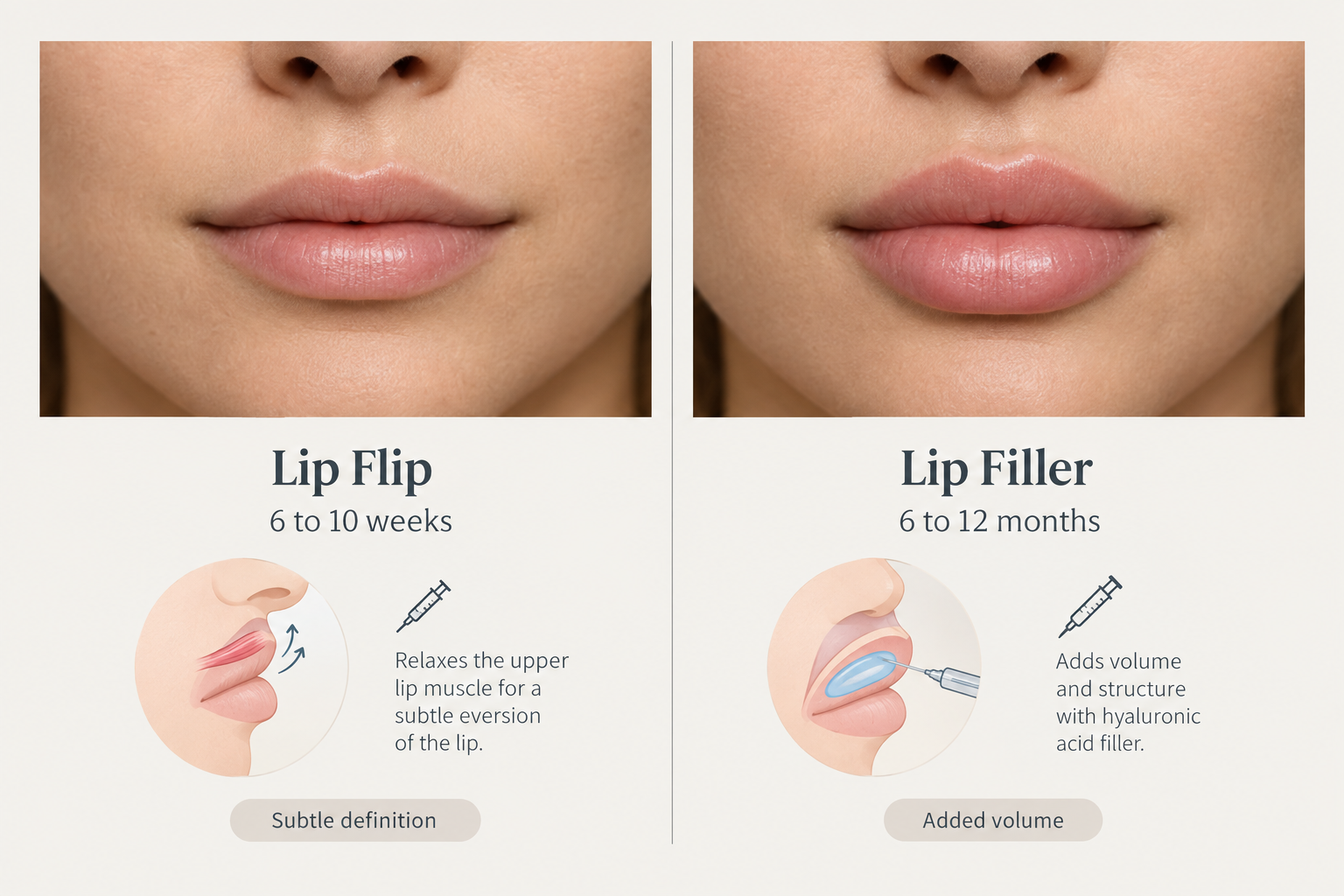
| Characteristic | Lip Flip | Lip Filler |
|---|---|---|
| Active substance | Botulinum toxin | Hyaluronic acid (typically) |
| Mechanism | Relaxes orbicularis oris muscle to evert lip edge | Adds physical volume and structure beneath lip tissue |
| Primary effect | Subtle change in lip position and definition | Visible increase in lip volume and shape |
| Onset of results | Two to four days; full effect at one to two weeks | Immediate, with final result visible after swelling settles |
| Typical duration | Six to ten weeks | Six to twelve months (varies by product and individual) |
| Reversibility | Wears off naturally | Can be dissolved with hyaluronidase; wears off over time |
| Suitable for volume increase | No | Yes |
| Risk of functional side effects | Possible if orbicularis oris is over-relaxed | Different risk profile; includes vascular considerations |
| Typical cost per treatment | Generally lower | Generally higher |
The lip flip may be more appropriate for patients who want a subtle, natural-looking change to the upper lip definition without adding volume, or for those who want to trial a change before committing to filler. Lip filler is generally more suitable for patients seeking a visible increase in lip size, improved symmetry, or longer-lasting results. Some practitioners offer a combination approach, using a small amount of botulinum toxin alongside filler to refine the lip border while adding volume, though this combination requires careful assessment and skilled technique.
Who May Be Suitable for a Lip Flip?
The lip flip may be worth discussing with a qualified practitioner if you are looking for a subtle improvement in upper lip definition, have a lip that appears to thin or disappear when you smile, want to trial a change before considering filler, or prefer a lower-cost option with a shorter commitment period. It tends to work best for patients with good baseline lip volume who want refinement rather than augmentation.
The lip flip is less likely to meet expectations for patients who want a significant increase in lip size, those who have naturally thin lips with minimal volume, or those who need results to last longer than two to three months without repeat treatment. Patients whose work or lifestyle involves frequent public speaking, performance, or playing wind instruments should discuss the potential for temporary functional changes with their practitioner before proceeding.
Maintaining Lip Flip Results Over Time
Because the lip flip lasts only six to ten weeks, maintaining results requires a consistent treatment schedule. Patients who want to keep the effect visible will typically need to return for treatment every two to three months. Over time, some patients find that their practitioner can refine the approach based on how their individual anatomy responds, potentially improving consistency of results across sessions.
There is no evidence that repeated lip flip treatments cause any cumulative harm to the lip tissue or muscle when performed correctly and at appropriate intervals. However, as with any botulinum toxin treatment, it is advisable to allow the previous treatment to wear off fully before reassessing whether and when to retreat, rather than topping up prematurely. Your practitioner is best placed to advise on the appropriate interval for your individual response.
Frequently Asked Questions
Can I make my lip flip last longer?
There is no reliably proven method to significantly extend the duration of a lip flip beyond the typical six-to-ten-week range. Avoiding vigorous exercise immediately after treatment is commonly advised, and some practitioners suggest that consistent repeat treatments over time may lead to more predictable results, but individual variation remains the dominant factor. Increasing the dose of botulinum toxin to extend duration is limited by the risk of functional side effects in the perioral area.
Is a lip flip painful?
Most patients describe the lip flip as mildly uncomfortable rather than painful. The injections involve a fine needle and a small volume of product at a limited number of points. Topical numbing cream can be applied beforehand if desired. Any discomfort during the procedure is brief, and post-treatment soreness is generally mild and short-lived.
Will my lips look unnatural after a lip flip?
When performed by an experienced practitioner using an appropriate amount of botulinum toxin, the lip flip produces a subtle and natural-looking change. Over-treatment can result in an exaggerated eversion of the lip or functional difficulties, which is why choosing a qualified practitioner and having a thorough consultation is important. The effect wears off completely, so any result that does not meet expectations will resolve over time.
Can I have a lip flip and lip filler at the same time?
Some practitioners do offer a combined approach, using botulinum toxin for a lip flip alongside hyaluronic acid filler for volume. Whether this combination is appropriate depends on your anatomy, goals, and the practitioner’s assessment. It is not a standard approach for every patient and requires careful technique to avoid complications. Discuss this option specifically during your consultation.
How soon after a lip flip can I wear lipstick or lip products?
Most practitioners advise waiting at least a few hours after treatment before applying lip products, to avoid any pressure or manipulation of the injection sites while they are settling. Specific aftercare guidance varies by clinic, so follow the instructions provided by your practitioner.
What happens if I don’t like my lip flip results?
Unlike lip filler, which can be dissolved with hyaluronidase, there is no reversal agent for botulinum toxin. If you are unhappy with the result of a lip flip, the most important reassurance is that the effect is temporary and will wear off naturally within weeks. If you experience functional difficulties or significant asymmetry, contact your treating practitioner promptly for assessment.
Is the lip flip suitable if I have had lip filler before?
Having had lip filler previously does not automatically exclude you from a lip flip, but your practitioner will need to assess the current state of any existing filler, your lip anatomy, and your goals before advising whether a lip flip is appropriate. In some cases, a combination approach may be discussed; in others, the practitioner may recommend a different plan based on your individual situation.
Is a Lip Flip Worth It Given Its Short Duration?
Whether the lip flip is worth considering depends largely on what you are hoping to achieve and how the six-to-ten-week duration fits your expectations and lifestyle. For patients who want a subtle, low-commitment change to upper lip definition, the lip flip offers a relatively accessible and reversible option with a lower cost per treatment than lip filler. The short duration can actually be an advantage for those who are uncertain about changing their lip appearance, since any result they dislike will resolve on its own within weeks.
For patients seeking visible volume, longer-lasting results, or a significant change to lip shape, the lip flip is unlikely to deliver what they are looking for, and lip filler or a combination approach may be more appropriate to discuss with a practitioner. The need for repeat treatment every two to three months to maintain results also means that the cumulative cost and time commitment over a year can be comparable to or exceed that of a longer-lasting treatment.
A consultation with a qualified aesthetic practitioner who can assess your lip anatomy, discuss your goals honestly, and explain the realistic outcomes for your individual case is the most reliable way to determine whether a lip flip, lip filler, or another approach is the right choice for you. Results vary between individuals, and no treatment outcome can be guaranteed in advance.
