

Dermal filler injected into the nasolabial folds — the lines that run from the sides of the nose to the corners of the mouth — is one of the most commonly performed facial aesthetic treatments. When carried out by a qualified and experienced practitioner, it can soften deep creases and restore a more rested appearance. However, smile line fillers can go wrong, and understanding what complications look like, why they happen, and what options exist when something does go wrong is important for anyone considering or who has already had this treatment.
Key Takeaways
- Nasolabial fold filler complications range from minor and temporary issues such as bruising and swelling to rare but serious events including vascular occlusion and tissue necrosis.
- Overfilling, incorrect product selection, poor injection technique, and inadequate anatomical knowledge are among the most common reasons smile line fillers go wrong.
- Some complications resolve on their own; others require prompt medical intervention, including hyaluronidase enzyme treatment to dissolve hyaluronic acid filler.
- Choosing a medically qualified practitioner with specific training in facial anatomy significantly reduces — but does not eliminate — the risk of complications.
- If you suspect a serious complication such as skin colour changes, severe pain, or vision disturbance after filler, seek urgent medical attention immediately.
Why Smile Line Filler Complications Happen
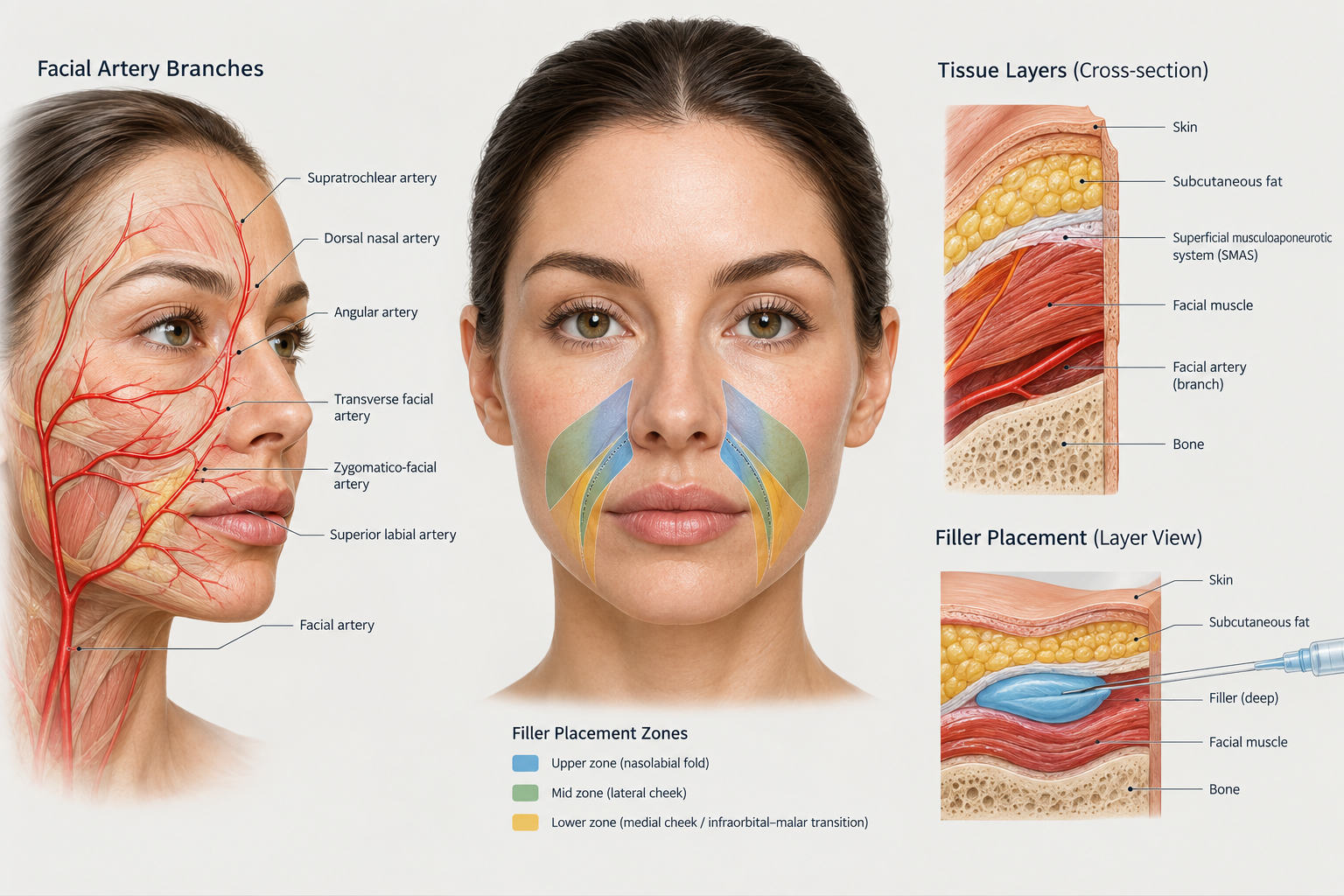
The nasolabial fold area is anatomically complex. The region contains a network of blood vessels, including branches of the facial artery, alongside muscles involved in facial expression and layers of fat that change with age. Filler placed incorrectly — at the wrong depth, in the wrong tissue plane, or in excessive volume — can produce results that look unnatural or, in more serious cases, cause harm to surrounding tissue. Complications in this area are not always the result of negligence; even experienced practitioners can encounter unexpected anatomical variation. However, the risk is meaningfully higher when treatment is performed by someone without adequate training in facial anatomy and injection technique.
The type of filler product used also matters. Most smile line fillers use hyaluronic acid (HA), a substance naturally found in the skin that attracts water and adds volume. HA fillers have the advantage of being dissolvable with an enzyme called hyaluronidase, which is a significant safety benefit. Some practitioners use non-HA fillers such as calcium hydroxylapatite or poly-L-lactic acid in adjacent areas, and these cannot be dissolved if a problem occurs. Understanding which product was used in your treatment is important if complications arise.
Common Complications After Nasolabial Fold Filler
Not all problems after smile line filler are equally serious. Some are predictable, temporary, and manageable, while others require urgent attention. The following covers the range of complications that patients and practitioners may encounter.
Bruising and Swelling
Bruising and swelling are the most frequently reported side effects after nasolabial fold filler and are generally considered normal responses to injection rather than true complications. Swelling typically peaks within 24 to 72 hours and usually resolves within one to two weeks. Bruising can last up to two weeks depending on the individual. These effects are more likely in patients who take blood-thinning medications, aspirin, fish oil supplements, or alcohol before treatment. While uncomfortable and sometimes cosmetically inconvenient, bruising and swelling in isolation are not medically dangerous and do not usually require treatment beyond cold compresses and time.
Asymmetry and Uneven Results
Asymmetry after smile line filler is a relatively common aesthetic concern. The face is naturally asymmetrical, and filler placed in equal volumes on both sides does not always produce a symmetrical result because the underlying anatomy differs. Swelling in the days after treatment can also make results appear uneven before settling. If asymmetry persists after swelling has fully resolved — typically after two weeks — a review appointment with the treating practitioner is appropriate. Minor asymmetry in hyaluronic acid filler can often be corrected with a small additional volume on the less-treated side, or by dissolving a portion of filler on the more prominent side using hyaluronidase.
Lumps, Nodules and Irregularities
Palpable lumps or visible irregularities under the skin after nasolabial fold filler can result from several causes. Filler placed too superficially may be visible as a raised ridge or lump. Uneven distribution of product during or after injection can create an irregular texture. In some cases, small nodules develop as a delayed inflammatory response to the filler material — this is distinct from infection and can occur weeks or months after treatment. Superficial lumps from hyaluronic acid filler can often be gently massaged by a practitioner or dissolved with hyaluronidase. Inflammatory nodules may require a different approach, including corticosteroid treatment in some cases, and should be assessed by a qualified medical professional.
The Tyndall Effect
The Tyndall effect is a bluish discolouration of the skin that occurs when hyaluronic acid filler is placed too close to the surface. Light scatters differently through the filler at a superficial depth, creating a visible blue or grey tint beneath the skin. This is more commonly seen in thinner-skinned areas such as under the eyes, but it can occasionally occur along the nasolabial fold if product is injected too shallowly. The Tyndall effect does not resolve on its own and requires hyaluronidase treatment to dissolve the superficially placed filler.
Overfilling and an Unnatural Appearance
One of the most frequently discussed aesthetic problems with smile line filler is overfilling — using more product than the anatomy can accommodate naturally. Excessive volume in the nasolabial fold area can create a pillow-like or shelf-like appearance along the cheek, sometimes described as a “sausage” effect. This can make the face look heavier or older rather than refreshed. Overfilling may also push the cheek tissue downward, worsening the appearance of jowls. This outcome is not a medical emergency but can be distressing. Hyaluronic acid filler placed in excess can be partially or fully dissolved with hyaluronidase to restore a more natural contour.
Infection
Infection after dermal filler is uncommon but possible. Bacteria can be introduced at the time of injection if sterile technique is not followed, or they can reach the filler through the bloodstream at a later point. Signs of infection include increasing redness, warmth, pain, and swelling that worsens rather than improves in the days after treatment, sometimes accompanied by fever. Filler-related infections can be difficult to treat because the filler material may act as a reservoir for bacteria. Treatment typically involves antibiotics and, in some cases, drainage or dissolution of the filler. Delayed-onset infections — appearing weeks or months after treatment — have been reported and may be triggered by illness, dental procedures, or other events that temporarily affect the immune system.
Biofilm Formation
A biofilm is a structured community of bacteria that adheres to a surface — in this context, the surface of the filler material — and becomes encased in a protective matrix that makes it resistant to standard antibiotic treatment. Biofilm-related complications after dermal filler can present as recurrent swelling, low-grade inflammation, or nodules that appear and disappear over time. This is a recognised but relatively rare complication that requires specialist assessment. Management may involve prolonged antibiotic courses and dissolution of the filler with hyaluronidase.
Vascular Occlusion: The Most Serious Risk
Vascular occlusion — the blockage of a blood vessel by filler material — is the most serious complication associated with nasolabial fold filler and requires immediate medical attention. The facial artery and its branches run through the nasolabial fold region, and filler injected directly into or compressing a vessel can cut off blood supply to the surrounding tissue. Early warning signs include sudden, severe pain during or immediately after injection, skin that turns white (blanching) or develops a mottled, dusky discolouration, and a sensation of pressure or burning. If blood supply is not restored quickly, the affected tissue can progress to necrosis — permanent tissue death — leaving a wound that may heal with scarring.
Vascular occlusion is a medical emergency. If any of these signs occur during or after filler treatment, the practitioner must act immediately using established emergency protocols, which typically include stopping the injection, applying hyaluronidase if an HA filler was used, and following recognised management guidelines. Patients who notice skin colour changes, severe pain, or any unusual symptoms after leaving a clinic should contact their practitioner immediately or attend an emergency department without delay.
Vision Changes and Intracranial Complications
In rare but documented cases, filler injected into facial vessels has travelled retrogradely — against the direction of normal blood flow — toward the eye or brain, causing partial or complete vision loss or, in extremely rare cases, stroke. Vision disturbance after facial filler injection, including sudden blurring, loss of vision in one eye, or double vision, is a medical emergency requiring immediate attendance at an emergency department. This complication, while rare, has been reported in the medical literature and underscores why facial filler should only be administered by practitioners with thorough knowledge of facial vascular anatomy and emergency management protocols.
Why Results Can Look Wrong Even Without a Medical Complication
Not every unsatisfactory outcome after smile line filler involves a medical complication. Sometimes the result simply does not meet the patient’s expectations, or the treatment has been applied in a way that does not suit the individual’s anatomy or the underlying cause of their concern.
Nasolabial folds deepen with age for several reasons: loss of volume in the mid-face and cheeks, descent of facial fat compartments, changes in bone structure, and reduced skin elasticity. Placing filler directly into the fold addresses only one aspect of this process. In many patients, the fold is better improved by restoring volume to the cheeks and mid-face rather than filling the fold itself — a distinction that requires careful assessment. Treating the fold in isolation when the primary cause is mid-face volume loss can produce a result that looks filled but not naturally refreshed. This is a treatment planning issue rather than a technical error, and it highlights the importance of a thorough consultation before any filler is placed.
Warning Signs That Require Urgent Attention
Patients should be aware of the difference between expected post-treatment effects and signs that something may be going wrong. The following warrant prompt contact with a practitioner or, in some cases, immediate emergency care.

- Skin that turns white, grey, or develops a mottled purple discolouration — possible sign of vascular occlusion; requires immediate action.
- Sudden severe pain during or after injection — may indicate vascular involvement.
- Any change in vision, including blurring, loss of vision, or double vision — attend an emergency department immediately.
- Increasing redness, warmth, and swelling that worsens after 48 hours — possible infection.
- Fever alongside local symptoms — possible systemic infection.
- Persistent or worsening pain beyond the first 24 hours — warrants practitioner review.
- A lump or nodule that appears weeks or months after treatment — may indicate delayed inflammatory reaction or biofilm; requires assessment.
What to Do If Your Smile Line Filler Has Gone Wrong
The appropriate response depends on the nature and severity of the problem. For minor concerns such as bruising, swelling, or mild asymmetry in the first two weeks, waiting for the filler to settle and attending a scheduled review appointment is usually the right approach. Avoid massaging the area aggressively without guidance from your practitioner, as this can displace product.
For aesthetic concerns that persist after full settling — such as lumps, asymmetry, overfilling, or an unnatural appearance — contact the clinic where treatment was performed and request a review. A reputable practitioner will assess the result and discuss options, which may include hyaluronidase treatment to dissolve hyaluronic acid filler partially or fully. Hyaluronidase is an enzyme that breaks down HA filler and can significantly improve or fully reverse many aesthetic complications when used appropriately.
If you are concerned about infection, delayed nodules, or any symptom that is worsening rather than improving, seek medical assessment promptly. Do not wait for a scheduled review if symptoms are escalating. In the case of suspected vascular occlusion or vision changes, do not wait at all — contact emergency services or attend an emergency department immediately.
If you are unhappy with the outcome and feel your concerns are not being addressed by the original clinic, you may seek a second opinion from another qualified medical aesthetic practitioner. In the United Kingdom, the Joint Council for Cosmetic Practitioners (JCCP) and the British College of Aesthetic Medicine (BCAM) can provide guidance on finding appropriately qualified practitioners. Regulatory frameworks and professional bodies differ by country, so it is worth identifying the relevant organisation in your region.
Can Smile Line Filler Be Dissolved?
Hyaluronic acid filler — the most widely used type for nasolabial fold treatment — can be dissolved using hyaluronidase, an enzyme that breaks down the HA molecule. Hyaluronidase is injected into the treated area and works relatively quickly, with visible softening often apparent within 24 to 48 hours. Multiple sessions may be needed to fully dissolve a larger volume of filler or to address product that has migrated from its original placement. Hyaluronidase treatment carries its own small risks, including allergic reaction, and should be performed by a qualified practitioner rather than attempted at home or in an unregulated setting.
Non-hyaluronic acid fillers — including calcium hydroxylapatite and poly-L-lactic acid — cannot be dissolved with hyaluronidase. Management of complications from these products is more limited and may involve corticosteroid injections, laser treatment, or surgical removal in severe cases. This is one reason why many practitioners prefer HA fillers for the nasolabial fold area, particularly for patients who have not had filler before.
Reducing the Risk Before Treatment
While no aesthetic treatment is entirely without risk, several factors can meaningfully reduce the likelihood of smile line filler going wrong. Choosing a practitioner who holds a recognised medical qualification — such as a doctor, dentist, or nurse prescriber with specific training in facial aesthetics — and who can demonstrate knowledge of facial anatomy and emergency management is the most important step. In the United Kingdom, regulations around who can legally administer dermal filler have been strengthening, with moves toward requiring a prescription and medical oversight for these treatments.
A thorough consultation before treatment should include a discussion of your medical history, any medications or supplements you take, previous filler treatments, and your specific concerns and goals. A practitioner who takes time to assess your anatomy, explain the realistic outcomes and limitations of treatment, and discuss the risks is more likely to deliver a safe and appropriate result than one who proceeds without this assessment.
Patients can also reduce some modifiable risks by avoiding blood-thinning medications and supplements — such as aspirin, ibuprofen, fish oil, and vitamin E — for a period before treatment if medically appropriate, and by avoiding alcohol in the 24 hours before their appointment. These steps can reduce the likelihood of bruising but do not affect the more serious risks associated with injection technique and anatomy.
Alternatives to Direct Nasolabial Fold Filler
For patients who are concerned about the risks of direct nasolabial fold filler, or who have had an unsatisfactory result from this approach, several alternatives may be worth discussing with a qualified practitioner.
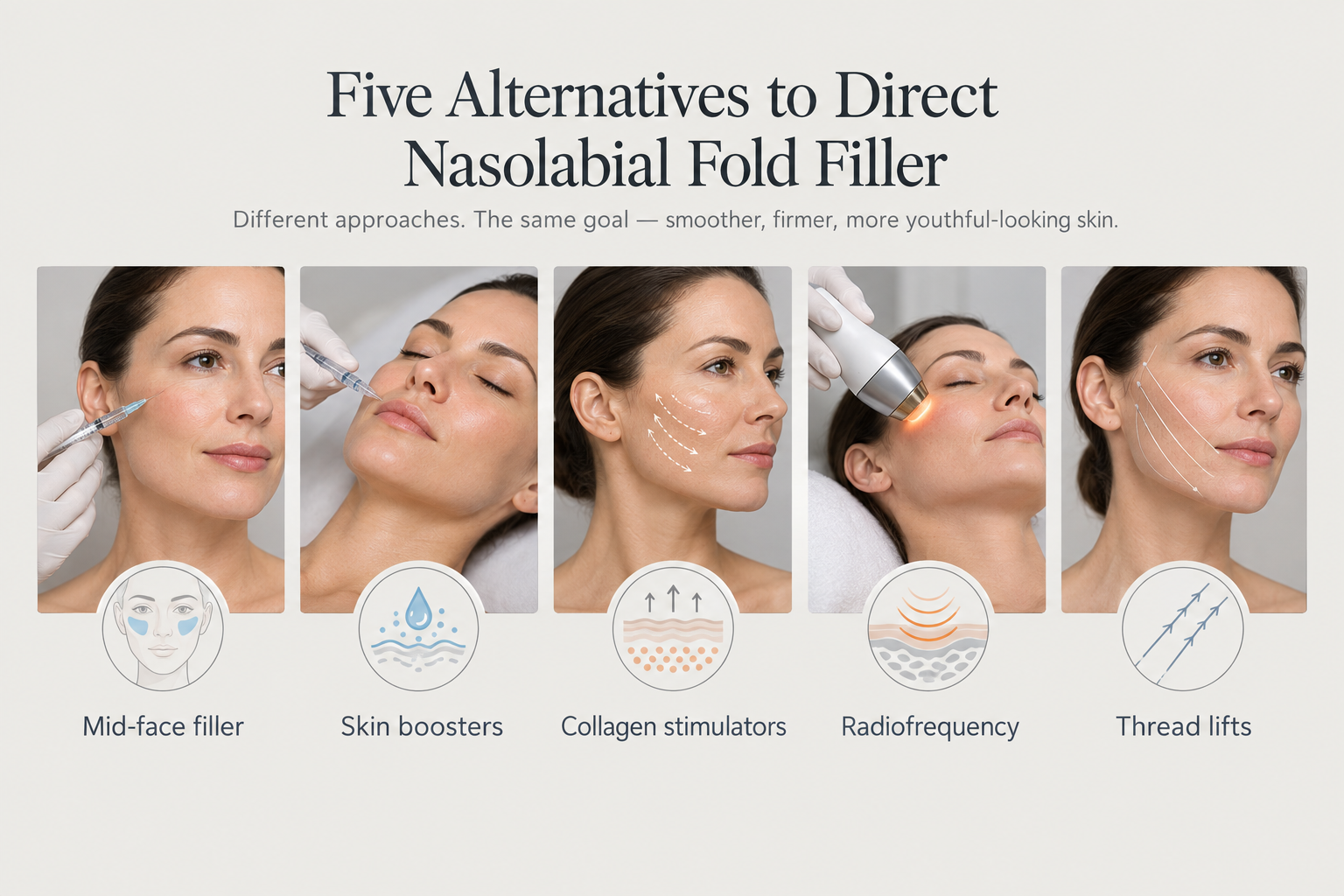
- Mid-face or cheek filler: Restoring volume to the cheeks and mid-face can lift and soften nasolabial folds indirectly, often producing a more natural result than filling the fold directly. This approach addresses the underlying volume loss rather than the fold itself.
- Skin booster injections: Products such as Profhilo or polynucleotide treatments improve skin hydration and quality in the surrounding area, which may soften the appearance of fine lines, though they do not replace lost volume.
- Collagen-stimulating treatments: Poly-L-lactic acid (such as Sculptra) stimulates the body’s own collagen production over time and may be used in the mid-face to gradually restore volume. Results develop slowly and are not immediately reversible.
- Radiofrequency and ultrasound skin tightening: Devices that use radiofrequency energy or focused ultrasound (such as HIFU) can tighten skin and stimulate collagen, which may improve mild to moderate nasolabial folds in suitable candidates. Results are generally more modest than filler for deeper folds.
- Thread lifts: Absorbable threads can be used to lift the mid-face and reduce the appearance of nasolabial folds. This is a more invasive option with its own risk profile and is not suitable for everyone.
The most appropriate alternative depends on the individual’s anatomy, the severity of their concern, their medical history, and their goals. A qualified practitioner can assess which approach — or combination of approaches — is most likely to produce a safe and satisfactory result.
Frequently Asked Questions
How do I know if my smile line filler has gone wrong?
Minor bruising and swelling in the first one to two weeks are expected and not a sign that something has gone wrong. Concerns that warrant attention include skin colour changes (white, grey, or mottled purple) during or after injection, severe or worsening pain, any change in vision, increasing redness and warmth after 48 hours, persistent lumps after two weeks, or results that look significantly uneven or unnatural after swelling has fully settled.
Can smile line filler be reversed?
Hyaluronic acid filler — the most commonly used type — can be dissolved with hyaluronidase enzyme injections. This can reverse or significantly improve many complications and aesthetic concerns. Non-HA fillers cannot be dissolved and require different management approaches. Always confirm which type of filler was used in your treatment.
How long does it take for nasolabial fold filler to settle?
Initial swelling typically peaks within 24 to 72 hours and resolves within one to two weeks. The final result is generally visible after two weeks, once swelling has fully subsided. Assessing the outcome before this point can be misleading, as temporary swelling can make results appear uneven or excessive.
What is vascular occlusion and how serious is it?
Vascular occlusion occurs when filler blocks or compresses a blood vessel, cutting off blood supply to the surrounding tissue. It is the most serious complication associated with facial filler and can lead to tissue death (necrosis) and permanent scarring if not treated immediately. Signs include sudden severe pain, skin blanching, and mottled discolouration. It is a medical emergency requiring immediate intervention.
Is it safe to have smile line filler dissolved and then redone?
In many cases, yes — hyaluronidase can dissolve existing HA filler, and after a suitable waiting period (often four to six weeks to allow full resolution and tissue recovery), filler can be reinjected if appropriate. However, the decision to retreat should involve a careful assessment of why the original result was unsatisfactory and whether the same approach is likely to produce a better outcome.
What should I ask a practitioner before having nasolabial fold filler?
Useful questions include: What qualifications and training do you hold? How do you manage complications, including vascular occlusion? Which filler product will you use and why? What is a realistic outcome for my anatomy? What are the risks specific to my situation? Do you carry hyaluronidase on site? What is your aftercare and review policy?
When Smile Line Filler Goes Wrong: Making an Informed Decision Going Forward
Smile line filler complications exist on a wide spectrum — from temporary bruising that resolves without intervention to rare but serious vascular events that require emergency management. Understanding this range helps patients make more informed decisions before treatment and respond appropriately if something does not go as expected. The majority of patients who have nasolabial fold filler with a qualified, experienced practitioner do not experience serious complications, but no treatment is without risk, and the risks in this anatomical area are meaningful enough to take seriously.
If your filler has already gone wrong, the most important steps are to seek assessment from a qualified medical professional promptly, avoid attempting to manage complications at home, and ensure that any practitioner treating a complication has access to hyaluronidase and the knowledge to use it appropriately. For those considering treatment for the first time, investing time in choosing a practitioner with verifiable medical qualifications, specific facial anatomy training, and a clear approach to complication management is the most effective way to reduce risk. A thorough consultation — one that includes an honest discussion of your anatomy, realistic outcomes, and the limitations of filler in your specific case — is a reasonable expectation before any treatment proceeds.
