

Polynucleotides injections have attracted growing interest in aesthetic medicine as a treatment aimed at improving skin quality from within rather than simply adding volume or relaxing muscles. Derived from purified DNA fragments, these injectable preparations are used to support the skin’s natural repair processes, with clinical applications ranging from fine line reduction to improved hydration and tissue regeneration. This article explains what polynucleotides are, how they work, what the treatment involves, realistic outcomes, limitations, and who may be a suitable candidate.
Key Takeaways
- Polynucleotides injections use purified DNA-derived molecules to stimulate cellular repair and collagen production rather than filling or freezing tissue.
- Results tend to develop gradually over several weeks and typically require a course of treatments rather than a single session.
- The treatment may improve skin hydration, texture, fine lines, and elasticity, but outcomes vary between individuals and are not guaranteed.
- Common side effects are generally mild and temporary, though as with any injectable treatment, more serious risks exist and a thorough consultation is essential.
- Polynucleotides are not a replacement for treatments targeting volume loss, deep wrinkles, or pigmentation, and realistic expectations are important.
What Are Polynucleotides?
Polynucleotides (PNs) are long-chain DNA molecules derived from the sperm cells of salmon or trout, species whose DNA shares a high degree of compatibility with human tissue. During manufacturing, the genetic information is removed through a purification process, leaving only the structural DNA fragments. These fragments are then formulated into an injectable gel or solution. Because the genetic material itself is eliminated, the preparation does not carry the biological identity of the source organism and is considered biocompatible in clinical use.
The term polynucleotide refers to the chemical structure: a chain of nucleotide units linked together. In the context of aesthetic medicine, polynucleotides injections are sometimes referred to as PDRN (polydeoxyribonucleotide) treatments, and several branded formulations exist on the market, including Rejuran, Nucleofill, Plinest, and Plenhyage, among others. These products differ in molecular weight, concentration, and formulation, which may influence their clinical behaviour, though head-to-head comparative evidence between specific brands remains limited.
How Do Polynucleotides Injections Work?
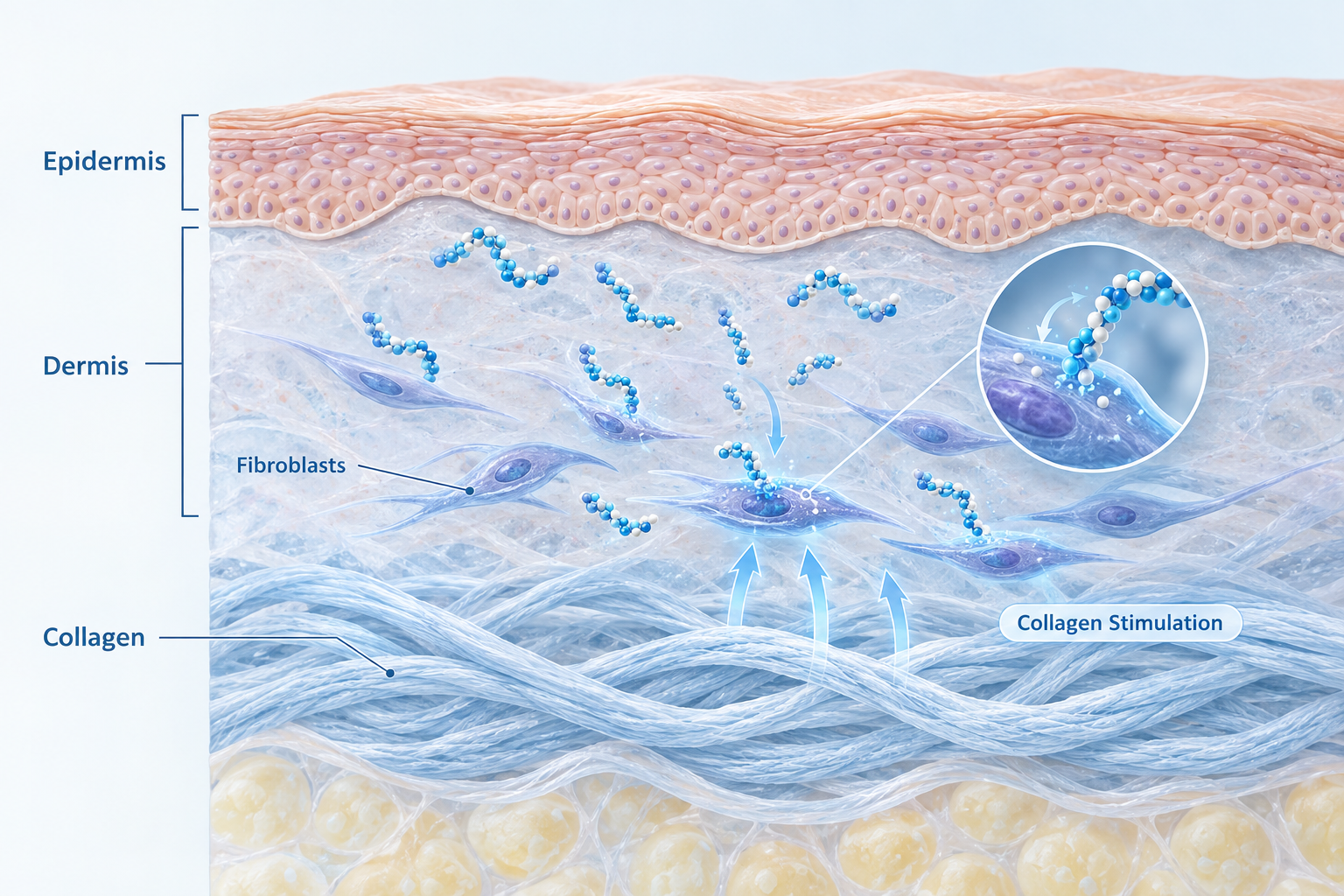
Polynucleotides injections are thought to work through several complementary biological mechanisms. The primary pathway involves interaction with adenosine receptors on skin cells, particularly fibroblasts, which are the cells responsible for producing collagen, elastin, and hyaluronic acid. By stimulating these receptors, polynucleotides may encourage fibroblast activity and support the production of structural proteins that naturally decline with age.
A second mechanism involves the nucleotide salvage pathway. Skin cells can break down the injected DNA fragments and use the resulting nucleotide building blocks to repair their own DNA and support cellular regeneration. This is sometimes described as a tissue repair or biostimulation effect, distinguishing polynucleotides from dermal fillers, which primarily add physical volume, or from skin boosters such as injectable hyaluronic acid, which primarily hydrate tissue.
Polynucleotides also appear to have anti-inflammatory properties, which may contribute to their use in skin that has been damaged by sun exposure, environmental stress, or the natural ageing process. Some research suggests they may support angiogenesis, the formation of new small blood vessels, which could improve local tissue nutrition. However, the clinical significance of each individual mechanism in human skin remains an active area of research, and the overall evidence base, while growing, is still developing compared to more established treatments.
What Skin Concerns May Polynucleotides Address?
Polynucleotides injections are used across a range of skin quality concerns. The treatment is not designed to add volume or reshape facial contours, so it is most relevant for patients whose primary concern is the condition and texture of the skin itself rather than structural changes.
Commonly reported applications include:
- Fine lines and superficial wrinkles — particularly in areas where skin thinning and reduced collagen density contribute to crepey or lined texture, such as around the eyes, mouth, and neck.
- Skin hydration and radiance — polynucleotides may support the skin’s moisture-retaining capacity, contributing to a more hydrated and luminous appearance over time.
- Skin laxity and elasticity — by stimulating collagen and elastin production, the treatment may produce a modest firming effect in areas of mild skin looseness.
- Under-eye skin quality — the periorbital area is a common treatment site, where thin, dehydrated, or crepey skin may respond to the biostimulating effect. It is important to note, however, that polynucleotides do not address all causes of under-eye concerns. Dark circles caused by pigmentation, prominent blood vessels, or significant volume loss may require different or additional treatments.
- Acne scarring and post-inflammatory skin changes — some practitioners use polynucleotides as part of a broader approach to improving scar texture, though evidence in this area is more limited.
- Sun-damaged or prematurely aged skin — the tissue repair properties of polynucleotides may be relevant for skin that shows signs of photoageing, including uneven texture and reduced firmness.
Polynucleotides injections are not a treatment for deep structural wrinkles, significant volume loss, or pronounced skin sagging, and they are not a substitute for treatments such as dermal fillers, botulinum toxin, or surgical procedures where those are clinically indicated.
Treatment Areas
Polynucleotides injections can be administered across multiple areas of the face and body, depending on the patient’s concerns and the practitioner’s assessment. The face is the most common treatment site, with particular focus on the periorbital area (around the eyes), cheeks, forehead, and lower face. The neck, décolletage, and hands are also treated in some patients, as these areas often show early signs of skin ageing and thinning.
The under-eye area deserves specific mention because it is one of the most frequently requested treatment sites. The skin in this region is among the thinnest on the body and is prone to dehydration, fine lines, and a crepey appearance. Polynucleotides injections in this area aim to improve skin quality and hydration rather than to fill hollows or correct dark circles caused by pigmentation or vascular visibility. A thorough assessment by a qualified practitioner is necessary to determine whether polynucleotides are the most appropriate option for a specific under-eye concern.
What Does the Treatment Involve?
A polynucleotides treatment session typically begins with a consultation to assess the patient’s skin, discuss their goals, review their medical history, and confirm suitability. On the day of treatment, the skin is cleansed and a topical anaesthetic cream may be applied to reduce discomfort, particularly in sensitive areas such as around the eyes.
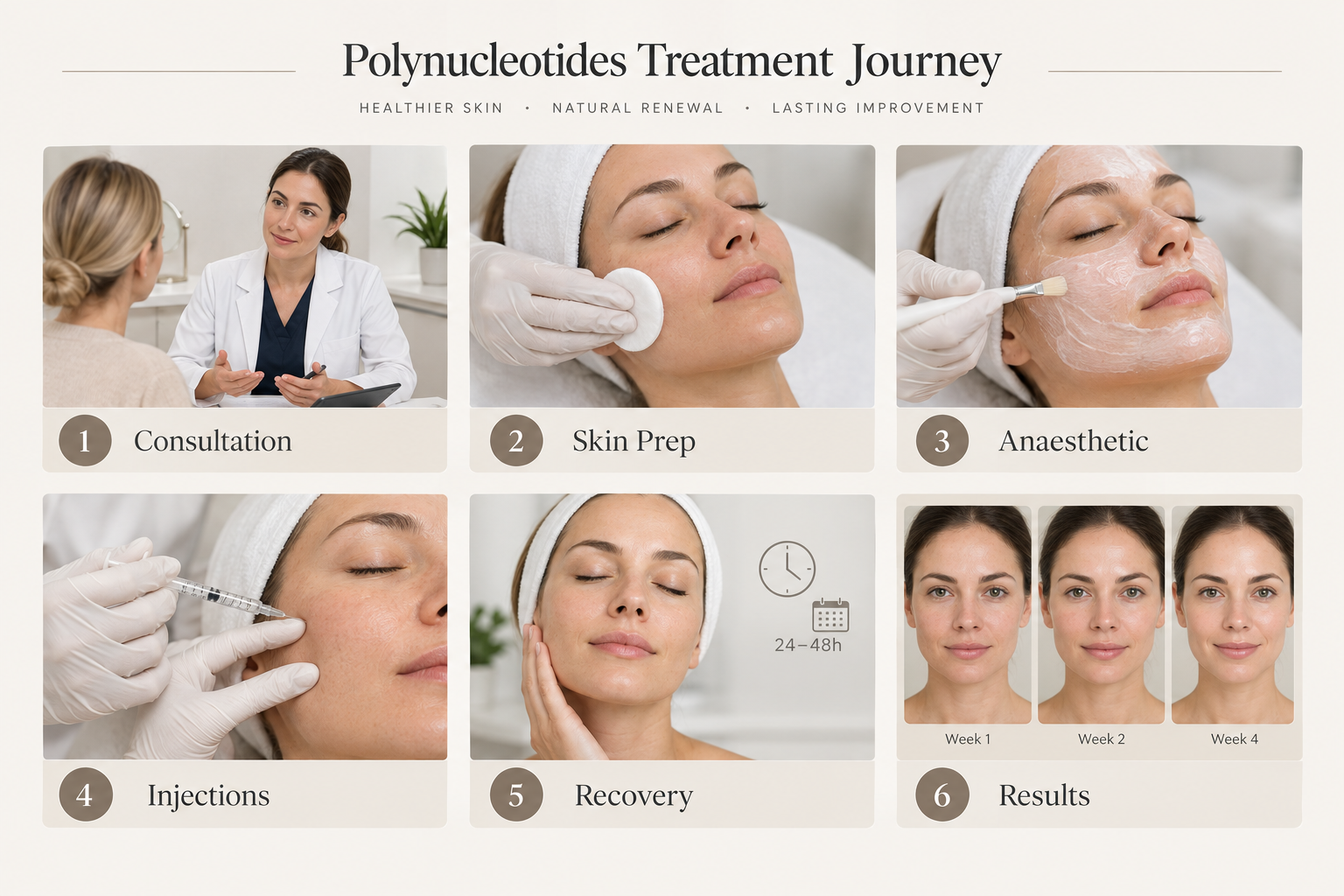
The polynucleotides solution is injected into the skin using a fine needle or cannula, depending on the treatment area and the practitioner’s technique. Injections are typically placed into the superficial dermis or mid-dermis, the layers of skin where fibroblasts are most active. The number of injection points varies depending on the area being treated and the product used.
A single session usually takes between 30 and 60 minutes, including preparation time. Most patients describe the sensation as a series of small pinpricks, with mild stinging or pressure. Discomfort is generally manageable, though individual tolerance varies and the periorbital area tends to be more sensitive than other sites.
After the injections, small raised bumps or wheals may be visible at the injection sites. These typically settle within a few hours to a day. Patients are usually advised to avoid strenuous exercise, alcohol, and excessive heat exposure for 24 to 48 hours following treatment.
How Many Sessions Are Typically Needed?
Polynucleotides injections are rarely a single-session treatment. Most clinical protocols recommend an initial course of two to four sessions, spaced approximately two to four weeks apart, to build the biostimulation effect progressively. The exact number of sessions depends on the patient’s skin condition, the area being treated, the specific product used, and the practitioner’s assessment.
After completing an initial course, maintenance sessions every three to six months are commonly recommended to sustain the results, though individual response varies. Some patients notice meaningful improvement after the first or second session, while others require the full course before visible changes become apparent. Setting realistic expectations about the gradual nature of results is an important part of the pre-treatment discussion.
When Do Results Appear and How Long Do They Last?
Unlike dermal fillers, which produce an immediate volumising effect, polynucleotides injections work by stimulating the skin’s own biological processes. This means results develop gradually over several weeks as collagen production increases and cellular repair progresses. Most patients begin to notice improvements in skin texture, hydration, and radiance within two to four weeks of starting treatment, with more pronounced changes becoming visible after completing the recommended course.
The longevity of results from polynucleotides injections is variable and depends on factors including the patient’s age, skin condition, lifestyle, and the number of sessions completed. Results from a full initial course may last approximately six to twelve months in many patients, though this is not guaranteed and individual outcomes differ. Ongoing maintenance treatments are generally needed to preserve the improvements over time, as the skin continues to age and the biostimulation effect is not permanent.
Potential Benefits of Polynucleotides Injections
The potential benefits of polynucleotides injections, based on available clinical evidence and reported clinical experience, include:
- Gradual, natural-looking improvement — because the treatment works by stimulating the skin’s own repair mechanisms rather than adding foreign volume, results tend to look natural rather than altered.
- Improved skin hydration and texture — many patients report a more hydrated, smoother skin surface following a course of treatment.
- Collagen and elastin stimulation — the biostimulating effect may contribute to modest improvements in skin firmness and elasticity over time.
- Compatibility with other treatments — polynucleotides injections can often be combined with other aesthetic treatments such as dermal fillers, botulinum toxin, or energy-based devices, though timing and sequencing should be discussed with a qualified practitioner.
- Relatively low downtime — most patients can return to normal activities within 24 to 48 hours, making the treatment practical for those with busy schedules.
- Broad treatment area applicability — the treatment can be used across multiple facial and body areas, including sensitive zones such as the periorbital region.
Limitations and Realistic Expectations
Polynucleotides injections are not suitable for every skin concern, and understanding their limitations is as important as understanding their potential benefits. The treatment does not add volume, so it will not correct significant hollowing, deep nasolabial folds, or structural facial changes associated with age-related fat and bone loss. Patients seeking these outcomes may be better served by dermal fillers or other volumising treatments.
The evidence base for polynucleotides injections, while growing, is still developing. Many published studies involve small patient numbers, short follow-up periods, or lack robust control groups. Larger, well-designed randomised controlled trials are needed to establish the full extent of clinical benefit across different patient populations and skin types. Practitioners and patients should approach outcome claims with appropriate caution.
Results are not uniform. Some patients experience meaningful improvements in skin quality, while others notice more modest changes. Factors such as age, skin condition at baseline, lifestyle habits including sun exposure and smoking, and individual biological response all influence outcomes. No treatment can guarantee a specific result, and polynucleotides injections are no exception.
The requirement for multiple sessions and ongoing maintenance also represents a practical and financial commitment. Patients should factor in the full course of treatment when considering whether polynucleotides injections are appropriate for their goals and circumstances.
Risks and Side Effects
Polynucleotides injections are generally considered to have a favourable safety profile when administered by a qualified and experienced practitioner, but as with any injectable treatment, risks and side effects exist and should be discussed before proceeding.
Common and expected side effects following polynucleotides injections include:
- Redness and mild swelling at the injection sites, typically resolving within 24 to 48 hours.
- Small raised bumps or wheals at injection points, which usually settle within hours to a day.
- Bruising, particularly in the periorbital area where blood vessels are more superficial.
- Mild tenderness or sensitivity at treated sites for a short period after treatment.
Less common but possible risks include infection at injection sites, prolonged swelling, and allergic or hypersensitivity reactions. Although polynucleotides are derived from fish DNA, the purification process is designed to remove allergenic proteins; however, patients with known fish allergies should discuss this with their practitioner before treatment.
Serious complications such as vascular occlusion are rare but possible with any facial injectable treatment. The risk is influenced by the injection technique, the depth of placement, and the practitioner’s anatomical knowledge. Choosing a qualified, experienced practitioner who understands facial anatomy is an important safety consideration.
Polynucleotides injections are generally not recommended during pregnancy or breastfeeding, in the presence of active skin infection or inflammation at the treatment site, or in patients with certain autoimmune conditions. A thorough medical history and consultation are essential to identify any contraindications before treatment.
Who May Be a Suitable Candidate?
Polynucleotides injections may be worth discussing with a qualified practitioner for adults who:
- Are concerned primarily with skin quality, texture, hydration, or fine lines rather than volume loss or deep wrinkles.
- Have realistic expectations about gradual, natural-looking improvement rather than dramatic transformation.
- Are willing to commit to a course of treatments and ongoing maintenance.
- Are in generally good health with no active skin infections or relevant contraindications.
- Have been assessed by a practitioner who has confirmed that polynucleotides are appropriate for their specific concerns.
The treatment may be particularly relevant for patients in their thirties and beyond who are beginning to notice changes in skin quality, as well as for those who have experienced premature skin ageing due to sun exposure or lifestyle factors. It may also be considered as a complementary treatment alongside other aesthetic procedures for patients seeking a comprehensive approach to skin health.
Alternatives to Polynucleotides Injections
Several other treatments address skin quality concerns and may be considered as alternatives or complements to polynucleotides injections, depending on the patient’s specific goals and clinical assessment.
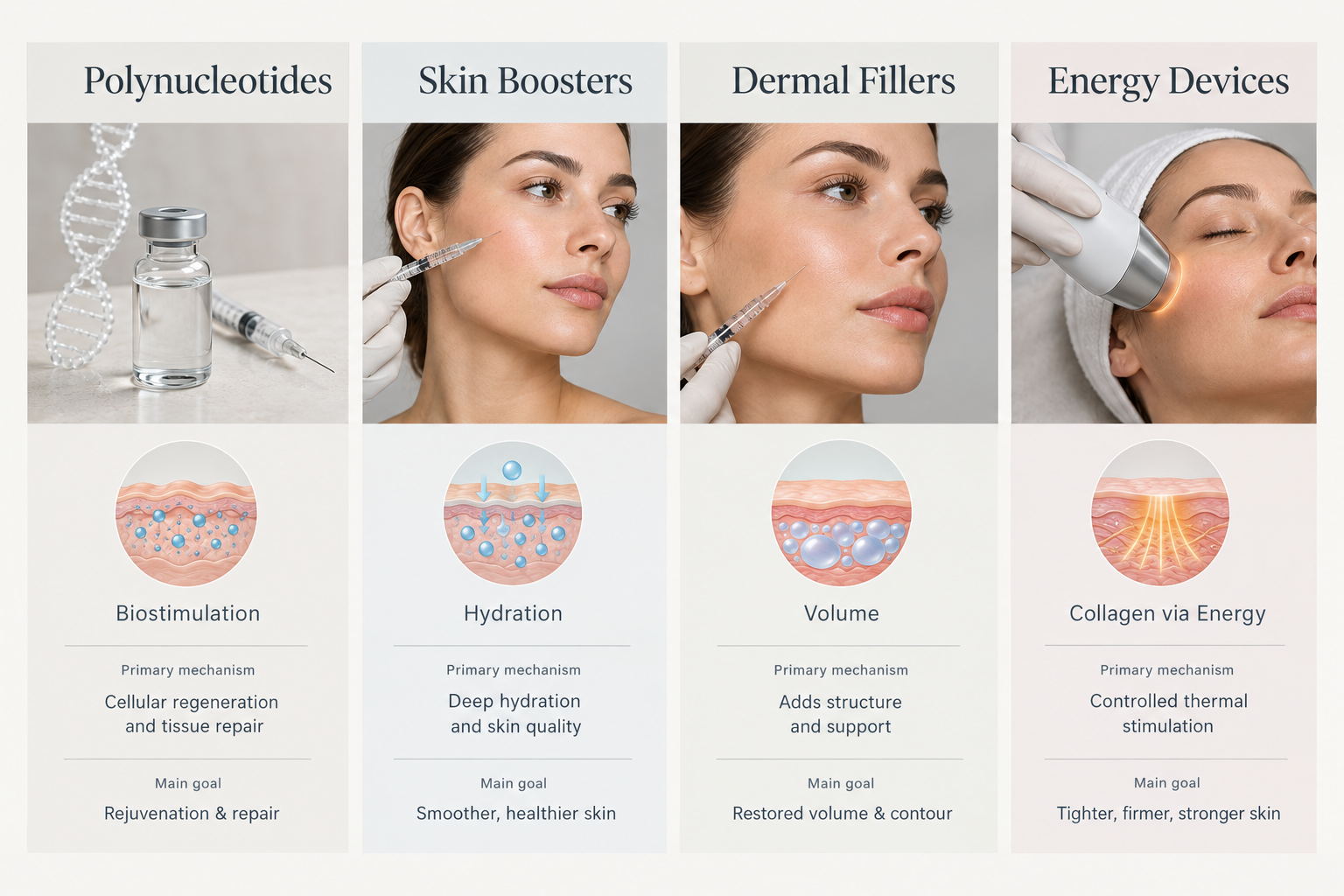
Injectable hyaluronic acid skin boosters such as Profhilo, Juvederm Volite, or Restylane Skinboosters work primarily by deeply hydrating the skin and stimulating collagen production through a different mechanism. They are well-established treatments with a strong evidence base for improving skin hydration and laxity, and may be preferred for patients whose primary concern is hydration and mild laxity rather than cellular repair.
Dermal fillers using cross-linked hyaluronic acid are appropriate when volume restoration or structural support is the primary goal, which polynucleotides injections cannot provide.
Botulinum toxin injections remain the standard of care for dynamic wrinkles caused by repeated muscle movement, an area where polynucleotides have no direct effect.
Energy-based skin treatments such as radiofrequency microneedling, laser resurfacing, and ultrasound-based devices stimulate collagen production through thermal or mechanical energy and may be suitable for patients seeking skin tightening or resurfacing alongside or instead of injectable biostimulators.
Chemical peels and medical-grade topical treatments including retinoids, vitamin C, and growth factor serums can support skin renewal and may complement or, in milder cases, partially substitute for injectable treatments depending on the degree of concern.
The most appropriate treatment or combination of treatments depends on individual skin assessment, goals, medical history, and budget, and should be determined through a thorough consultation with a qualified practitioner.
Frequently Asked Questions
Are polynucleotides injections the same as dermal fillers?
No. Polynucleotides injections and dermal fillers work through fundamentally different mechanisms. Dermal fillers, most commonly made from cross-linked hyaluronic acid, add physical volume to the skin or underlying tissue. Polynucleotides injections do not add volume; instead, they aim to stimulate the skin’s own repair and collagen-producing processes. The two treatments address different concerns and are sometimes used together as part of a combined approach.
Is the treatment painful?
Most patients describe polynucleotides injections as mildly uncomfortable rather than significantly painful. The sensation is typically a series of small pinpricks with brief stinging. Topical anaesthetic cream is usually applied before treatment to reduce discomfort, and the periorbital area tends to be more sensitive than other sites. Individual pain tolerance varies.
How soon will I see results?
Because polynucleotides work by stimulating biological processes rather than producing an immediate physical change, results develop gradually. Most patients begin to notice improvements in skin texture and hydration within two to four weeks of starting treatment, with more visible changes typically appearing after completing a course of two to four sessions. Patience and realistic expectations are important.
Can polynucleotides injections be combined with other treatments?
In many cases, yes. Polynucleotides injections are often used alongside other aesthetic treatments such as dermal fillers, botulinum toxin, or energy-based devices as part of a broader skin rejuvenation plan. The timing and sequencing of combined treatments should be planned carefully by a qualified practitioner to optimise safety and outcomes.
Are polynucleotides injections safe for all skin types?
Polynucleotides injections have been used across a range of skin types, and the treatment does not carry the same risk of post-inflammatory hyperpigmentation associated with some energy-based treatments. However, suitability depends on individual medical history, skin condition, and the presence of any contraindications. A thorough consultation with a qualified practitioner is necessary to assess individual suitability.
What is the difference between PDRN and polynucleotides?
PDRN (polydeoxyribonucleotide) is a specific type of polynucleotide with a particular molecular weight range. In clinical and commercial contexts, the terms are sometimes used interchangeably, though technically PDRN refers to shorter-chain fragments while polynucleotides can encompass a broader range of chain lengths. Different branded products may use different molecular weight profiles, which may influence their behaviour in tissue, though comparative clinical evidence between specific formulations is limited.
How long do the results last?
Results from a completed course of polynucleotides injections may last approximately six to twelve months in many patients, though this varies considerably depending on age, skin condition, lifestyle, and the number of sessions completed. Maintenance treatments are generally recommended to sustain improvements over time, as the biostimulation effect is not permanent and the skin continues to age.
Is Polynucleotides Skin Repair the Right Treatment for Your Skin Goals?
Polynucleotides injections represent a genuinely different approach to skin rejuvenation compared to volumising fillers or muscle-relaxing injectables. By working with the skin’s own biological repair mechanisms, the treatment may offer gradual improvements in skin quality, hydration, fine lines, and elasticity for suitable patients. The evidence base is growing, and clinical experience across multiple treatment areas is accumulating, though larger and more robust studies are still needed to fully characterise outcomes across different patient groups.
The treatment is most likely to be relevant for patients whose primary concern is skin quality rather than volume or structural change, and who are prepared for a course of sessions and realistic, gradual results. It is not a universal solution, and the most appropriate approach depends on an honest assessment of individual skin concerns, goals, and medical history.
If you are considering polynucleotides injections, a consultation with a qualified and experienced aesthetic practitioner is the essential first step. A thorough assessment will help determine whether this treatment is appropriate for your specific concerns, whether it should be combined with other approaches, and what realistic outcomes you might expect based on your individual skin condition.
