
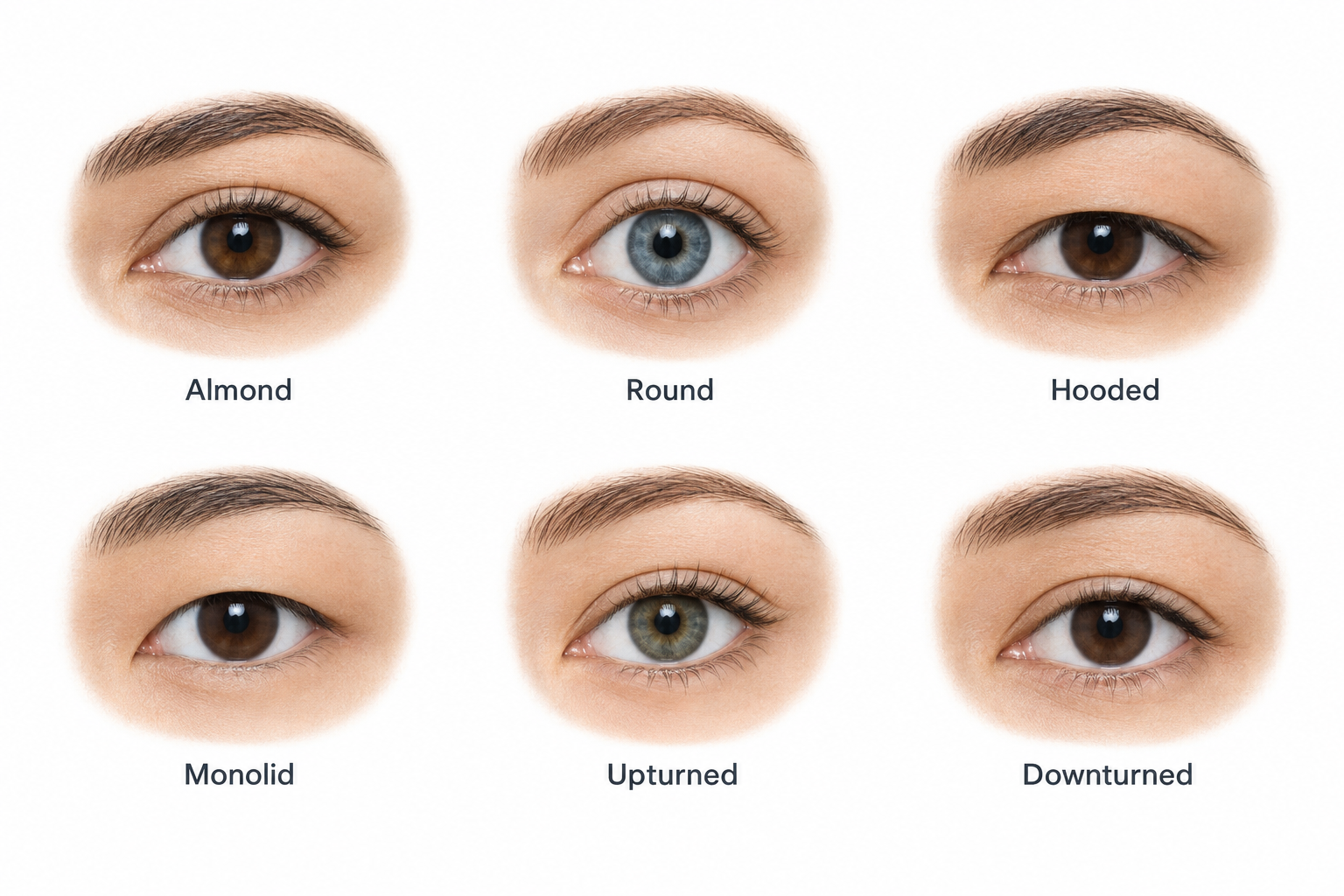

Understanding the different types of eyes is more than a beauty exercise — it provides a practical framework for makeup application, eyewear selection, and recognising how your periorbital anatomy changes with age. Eye shape is determined by several anatomical factors, including the presence or absence of an eyelid crease, the angle of the outer corner, the depth of the eye socket, and the spacing between the eyes. This guide explains each major eye shape clearly, provides a step-by-step identification method, and addresses the nuances that most guides overlook, including combination eye shapes, age-related changes, and the emerging terminology used in appearance communities.
Key Takeaways
- Eye shape is defined by multiple anatomical features — crease visibility, canthal tilt, orbital depth, and eye spacing — rather than a single characteristic.
- Most people have a primary shape combined with at least one placement modifier, such as deep-set or wide-set, making combination eye shapes the norm rather than the exception.
- Almond-shaped eyes are generally considered the most common eye shape globally, though significant variation exists across ethnicities.
- Eye shape can change gradually with age due to canthal tendon laxity, periorbital fat deflation, and reduced skin elasticity.
- A simple mirror test using natural light can help most people identify their eye shape accurately within a few minutes.
What Determines Your Eye Shape?
Eye shape is governed by the anatomy of the periorbital region — the structures surrounding the eye socket. The key variables include the palpebral fissure (the opening between the upper and lower eyelids), the presence and height of the eyelid crease, the angle formed at the lateral canthus (outer corner) relative to the medial canthus (inner corner), the prominence of the brow bone, and the depth of the orbital socket. Together, these features produce the visible shape of the eye as seen from the front.
Genetics plays the dominant role. The supratarsal crease — the fold that creates a visible platform on the upper eyelid — is present in most people of European and African descent but absent or less defined in many people of East Asian descent, producing what is commonly called a monolid or single eyelid. Orbital rim geometry, periorbital fat distribution, and brow bone prominence also vary significantly across ethnic backgrounds, contributing to the wide diversity of eye shapes seen globally. These differences are anatomical variations, not hierarchical categories, and each shape has its own aesthetic qualities and practical considerations.
Age introduces additional changes. The canthal tendon — the fibrous tissue anchoring the outer corner of the eye — gradually loses tension over time, which can shift a previously neutral or positive canthal tilt toward a more downturned appearance. Periorbital fat deflation and reduced skin elasticity can cause the upper eyelid to descend, sometimes converting a previously open almond shape into a more hooded appearance. Understanding these mechanisms helps explain why eye shape is not entirely fixed throughout life.
How to Identify Your Eye Shape: The Mirror Test
The mirror test is a straightforward self-assessment method that requires only a well-lit mirror and a few minutes. Natural, even lighting — ideally daylight — produces the most accurate result. Avoid harsh overhead lighting, which can cast shadows that distort the appearance of the eyelid crease and orbital depth. Follow these steps in sequence.
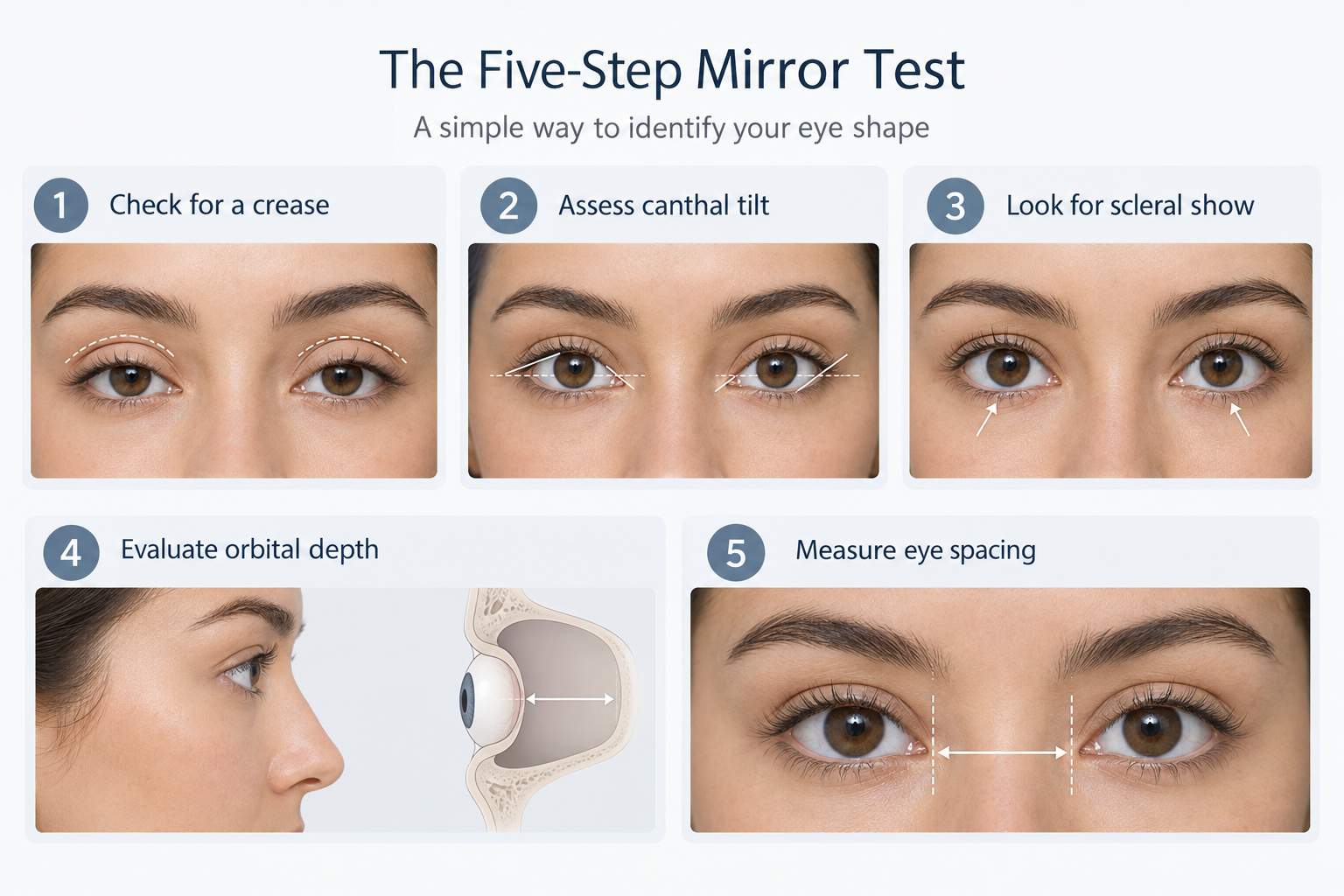
- Check for a visible crease. Look straight ahead and examine your upper eyelid. If you can see a distinct fold running parallel to the lash line, you have a crease. If the upper lid appears smooth and uninterrupted from lash line to brow, you likely have a monolid or a very low, hidden crease.
- Assess the canthal tilt. Draw an imaginary horizontal line connecting the inner corners of both eyes. Now observe where your outer corner sits relative to that line. If the outer corner sits above the line, you have a positive canthal tilt (upturned). If it sits on the line, the tilt is neutral. If it falls below the line, you have a negative canthal tilt (downturned).
- Look for scleral show. Scleral show refers to the white of the eye — the sclera — being visible above or below the iris when looking straight ahead. Visible white below the iris can indicate protruding or round eyes. Minimal scleral show with the iris touching both upper and lower lids is more typical of almond or deep-set shapes.
- Evaluate orbital depth. Turn slightly to the side and observe whether your eyeball appears to sit forward relative to the brow bone, or recessed behind it. Eyes that appear to sit back within the socket are deep-set; eyes that project forward are protruding or prominent.
- Measure eye spacing. A widely used rule of thumb is the one-eye-width rule: the gap between your two eyes should roughly equal the width of one eye. A narrower gap suggests close-set eyes; a wider gap suggests wide-set eyes.
Working through these five checks in order will allow most people to identify both their primary eye shape and any relevant placement modifiers. If your results seem to fit two descriptions equally well, you likely have a combination eye shape — a topic addressed in its own section below.
Eye Shape Chart: The Major Types at a Glance
| Eye Shape | Key Identifier | Crease | Canthal Tilt | Scleral Show |
|---|---|---|---|---|
| Almond | Tapered ends, iris touches both lids | Visible | Neutral to slightly positive | Minimal |
| Round | Circular appearance, visible white below iris | Visible | Neutral | Below iris |
| Hooded | Crease hidden by overhanging skin | Hidden | Neutral to negative | Minimal |
| Monolid | No visible crease, flat lid surface | Absent | Variable | Minimal |
| Upturned | Outer corner higher than inner corner | Visible | Positive | Variable |
| Downturned | Outer corner lower than inner corner | Visible | Negative | Variable |
| Deep-set | Eye recessed behind prominent brow bone | Visible | Variable | Minimal |
| Protruding | Eyeball projects forward from orbital rim | Visible | Variable | Above and below iris |
| Close-set | Gap between eyes narrower than one eye width | Variable | Variable | Variable |
| Wide-set | Gap between eyes wider than one eye width | Variable | Variable | Variable |
The Main Types of Eyes Explained
Almond-Shaped Eyes
Almond-shaped eyes are widely regarded as the most common eye shape globally. The defining feature is a palpebral fissure that tapers to a point at both the inner and outer corners, resembling the outline of an almond. When looking straight ahead, the iris touches both the upper and lower eyelid, meaning no scleral show is visible above or below the coloured part of the eye. The canthal tilt is typically neutral to mildly positive. A visible eyelid crease is present, providing a natural eyelid platform. Because almond eyes are considered a balanced reference shape, most standard makeup techniques are designed with this shape in mind, making adaptation relatively straightforward.
Round Eyes
Round eyes have a more circular palpebral aperture. The key distinguishing feature is that the iris does not fully touch the upper or lower lid when looking straight ahead, producing visible scleral show — white visible below the iris is particularly characteristic. The outer corner is less tapered than in almond eyes, giving the eye a more open, wide appearance. Round eyes often convey an alert or youthful quality. The canthal tilt is generally neutral. Makeup strategies for round eyes typically aim to elongate the shape using liner extended beyond the outer corner.
Hooded Eyes
Hooded eyes are characterised by a fold of skin that descends from the brow bone and covers part or all of the eyelid crease when the eyes are open. The crease is present but hidden, which reduces the visible eyelid platform. Hooding can be a natural anatomical feature present from youth, or it can develop gradually with age as the brow descends and skin elasticity decreases. Hooded eyes are common across all ethnicities and are not a medical concern unless the skin descends far enough to affect the visual field. From a makeup perspective, standard eyeshadow placement above the crease may not be visible when the eyes are open, requiring adjusted blending techniques.
Monolid Eyes
A monolid — also called a single eyelid — is characterised by the absence of a visible supratarsal crease. The upper eyelid surface appears smooth and continuous from the lash line to the brow, without a fold dividing it. Monolids are most prevalent among people of East Asian descent, though they occur across other ethnic groups as well. The absence of a crease means there is no natural eyelid platform to guide shadow placement, which requires different application techniques compared to creased lids. The term double eyelid refers to the presence of a crease, while single eyelid refers to its absence — both are normal anatomical variants.
Upturned Eyes
Upturned eyes — sometimes called cat-eye or fox-eye shaped — have a positive canthal tilt, meaning the outer corner of the eye sits higher than the inner corner. This upward angle at the lateral canthus gives the eye a lifted, elongated appearance. The shape is associated with a youthful and alert aesthetic in many cultural contexts. Upturned eyes are often combined with an almond or slightly round base shape. Winged eyeliner applied along the natural upward angle of the outer corner tends to complement this shape effectively.
Downturned Eyes
Downturned eyes have a negative canthal tilt: the outer corner sits lower than the inner corner, producing a gentle downward slope at the lateral canthus. This can give the eyes a softer or more melancholic appearance. Downturning may be a natural feature or may develop with age as the canthal tendon loses tension. Makeup techniques for downturned eyes typically focus on lifting the outer corner visually — for example, by extending liner upward rather than following the natural downward angle, and by placing highlight at the outer corner of the lower lash line.
Deep-Set Eyes
Deep-set eyes sit further back within the orbital socket, positioned behind a prominent brow bone. When viewed from the side, the brow bone projects forward relative to the eyeball. This creates a naturally shadowed appearance on the upper lid and can make the brow bone appear more pronounced. Deep-set eyes are a placement modifier rather than a standalone shape — they are frequently combined with almond or round base shapes. The term hunter eyes, which has gained traction in online appearance communities, typically refers to deep-set eyes combined with a positive canthal tilt and a compact palpebral aperture, producing a focused, intense appearance.
Protruding Eyes
Protruding eyes — also called prominent eyes — sit forward relative to the orbital rim, making the eyeball appear to project outward. This produces visible scleral show both above and below the iris and gives the eyelid a rounded, convex appearance. Protruding eyes can be a natural anatomical feature, but significant protrusion can occasionally be associated with thyroid eye disease or other orbital conditions, so any sudden or progressive change in eye prominence warrants medical assessment. From an aesthetic standpoint, matte eyeshadow applied across the lid can reduce the appearance of projection.
Close-Set and Wide-Set Eyes
Close-set eyes have an intercanthal distance — the gap between the inner corners — that is narrower than the width of one eye. Wide-set eyes have a gap that is wider than one eye width. These are placement modifiers that describe eye spacing rather than the shape of the palpebral fissure itself, and they are almost always combined with one of the primary shapes described above. Eye spacing affects eyewear selection significantly: people with close-set eyes generally benefit from frames with a thin or low bridge to avoid pushing the optical centres too far apart, while those with wide-set eyes may find that bolder bridge designs help balance facial proportions.
Combination Eye Shapes
Most people do not fit neatly into a single category. Combination eye shapes occur when a primary shape — such as almond or round — is present alongside one or more placement modifiers or secondary characteristics. Common combinations include hooded almond eyes (a tapered shape with a descending skin fold), deep-set upturned eyes (recessed position with a positive canthal tilt), and monolid close-set eyes. Identifying the combination rather than forcing a single label produces more accurate and useful guidance for makeup, eyewear, and aesthetic consultations.
To identify a combination, complete the mirror test for each characteristic independently. First determine the base shape using crease visibility and scleral show, then assess canthal tilt, then evaluate orbital depth and eye spacing. Each assessment answers a separate question, and the answers can be combined. For example, a person might correctly describe their eyes as round, deep-set, and slightly close-set — three separate characteristics that together define their unique periorbital anatomy.
How Eye Shape Changes with Age
Eye shape is not entirely static. Several age-related anatomical changes can alter the appearance of the periorbital region over time. Laxity of the lateral canthal tendon — the fibrous structure that anchors the outer corner of the eye — can gradually shift a neutral canthal tilt toward a downturned appearance. This is one reason why eyes that appeared almond-shaped or upturned in youth may develop a softer, more downturned quality in later decades.
Periorbital fat deflation reduces the volume of the fat pads surrounding the eye socket, which can cause the upper eyelid to appear more hollow and the brow to descend. This descent of soft tissue is a primary driver of acquired hooding — the development of a hooded appearance in people whose eyes were not hooded earlier in life. Reduced skin elasticity compounds this effect by allowing the skin to fold more readily over the eyelid crease. Understanding these mechanisms is useful context for anyone considering aesthetic treatments targeting the periorbital region, as the underlying anatomical change — rather than the surface appearance alone — guides appropriate treatment selection.
Eyewear Selection by Eye Shape
Most eyewear guides focus on face shape, but eye shape is an equally relevant factor in frame selection. For hooded eyes, frames with a heavy top bar can visually compress the already-limited eyelid platform; lightweight metal frames or rimless styles tend to be more flattering. For monolid eyes, thin acetate or metal frames avoid adding visual weight to a lid that already has a flat surface. For deep-set eyes, frames that sit slightly forward on the face — rather than pressing close to the brow — can reduce the shadowed appearance created by the prominent brow bone.
For protruding eyes, frames with a deeper lens height can help balance the forward projection of the eye. For close-set eyes, a thin bridge and frames with detailing toward the outer edge draw the eye outward, creating the impression of greater spacing. For wide-set eyes, a more prominent bridge and frames with inner detailing help balance the wider intercanthal distance. These are general principles rather than rigid rules, and individual facial proportions, prescription requirements, and personal preference all influence the final choice.
Canthal Tilt: What It Means and Why It Matters
Canthal tilt describes the angle formed between the medial canthus (inner corner) and the lateral canthus (outer corner) of the eye. A positive canthal tilt means the outer corner sits higher than the inner corner; a neutral tilt means they are level; a negative tilt means the outer corner sits lower. Canthal tilt is one of the most discussed features in both clinical aesthetics and online appearance communities because it significantly influences the perceived expression and youthfulness of the eyes.
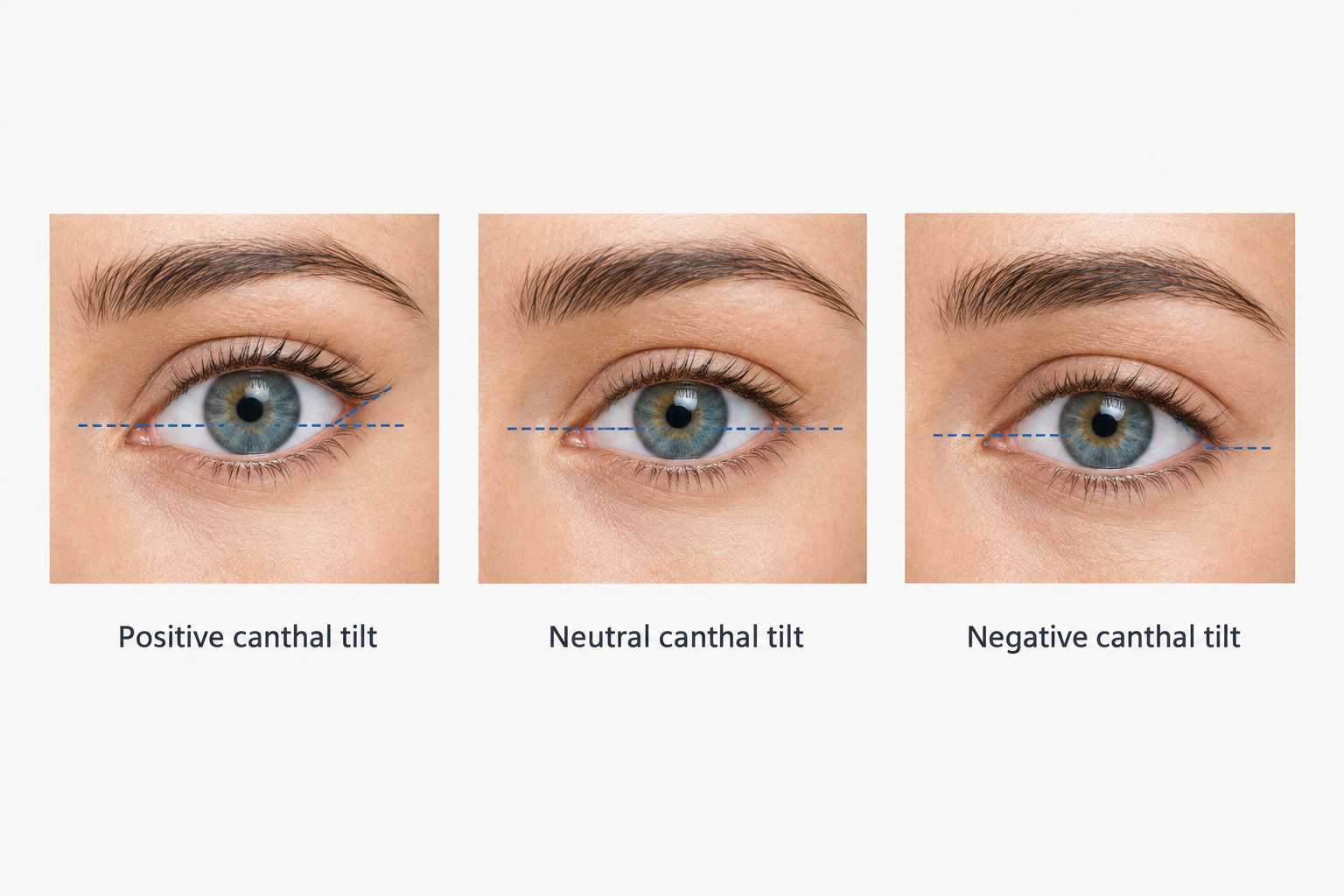
Research in facial attractiveness has associated a mild positive canthal tilt with perceptions of alertness and youth, though cultural standards vary and individual preference is wide. In clinical aesthetics, canthal tilt is a relevant consideration when planning treatments such as brow lifting, upper eyelid procedures, or lateral canthoplasty. For the purposes of self-identification, canthal tilt is best assessed using the imaginary horizontal line method described in the mirror test section above.
A Note on Genetics, Ethnicity, and Eye Shape
Eye shape varies substantially across ethnic groups due to differences in orbital rim geometry, periorbital fat distribution, brow bone prominence, and the genetic factors governing supratarsal crease formation. The monolid is most prevalent among people of East Asian descent, where the absence of a supratarsal crease is a common and normal anatomical feature. Positive canthal tilt and a compact palpebral fissure are also more frequently observed in East Asian periorbital anatomy. People of African descent often have a wider palpebral aperture and more prominent orbital rims. People of European descent show wide variation in crease height, orbital depth, and canthal tilt.
These differences are anatomical variations shaped by genetics and population history. No eye shape is inherently superior, and the framing of any shape as a deviation from a norm is both scientifically inaccurate and culturally reductive. In clinical and aesthetic contexts, the goal of any periorbital assessment is to understand an individual's anatomy clearly — not to measure it against an idealized standard.
Frequently Asked Questions
What is the most common eye shape?
Almond-shaped eyes are generally cited as the most common eye shape globally. The almond shape — with its tapered corners, visible crease, and minimal scleral show — is the reference point for most standard makeup and aesthetic guidance. However, prevalence varies significantly by ethnicity and region, and monolid eyes are the most common shape among people of East Asian descent.
Can I have more than one eye shape?
Yes. Most people have a combination eye shape — a primary shape such as almond or round combined with one or more placement modifiers such as deep-set, hooded, close-set, or wide-set. Identifying each characteristic separately using the mirror test gives a more accurate and useful description than trying to fit into a single category.
Do eye shapes differ between men and women?
The same anatomical shapes occur in both men and women. However, average differences in brow bone prominence, orbital depth, and brow position mean that deep-set and hooded appearances are somewhat more common in men due to greater brow bone projection. The practical implications — for eyewear selection and grooming — follow the same shape-based principles regardless of gender.
What is a hooded eye and is it a medical concern?
A hooded eye has a fold of skin that descends from the brow bone and covers part of the eyelid crease. It is usually a normal anatomical feature or a gradual age-related change. It becomes a medical concern only if the descending skin significantly obstructs the visual field, in which case a clinical assessment by an ophthalmologist or oculoplastic surgeon is appropriate.
What does canthal tilt mean?
Canthal tilt describes the angle of the outer corner of the eye relative to the inner corner. A positive canthal tilt means the outer corner sits higher, producing an upturned appearance. A negative canthal tilt means the outer corner sits lower, producing a downturned appearance. A neutral tilt means both corners are level. Canthal tilt is assessed by drawing an imaginary horizontal line between the inner corners and observing where the outer corners fall.
Can eye shape change over time?
Yes. Age-related changes including canthal tendon laxity, periorbital fat deflation, and reduced skin elasticity can gradually alter the appearance of the eyes. A previously upturned or almond shape may develop a more downturned or hooded quality over time. These changes are normal and occur at different rates depending on genetics, sun exposure, and other individual factors.
Are there tools to identify eye shape from a photo?
Several AI-based applications now offer eye shape identification from photographs. These tools analyse the palpebral fissure geometry, canthal tilt, and crease visibility from a frontal image. Results can be a useful starting point, though accuracy depends on image quality, lighting, and the sophistication of the algorithm. The manual mirror test remains a reliable and accessible method for most people.
Using Your Eye Shape as a Practical Starting Point
Identifying your eye shape accurately — including any combination characteristics — provides a useful foundation for decisions about makeup technique, eyewear selection, and aesthetic consultations. Rather than following generic advice, understanding whether your eyes are hooded, deep-set, upturned, or close-set allows you to apply guidance that is actually relevant to your anatomy. The mirror test described in this guide is sufficient for most people to reach a clear identification within a few minutes.
If you are considering aesthetic treatments that address the periorbital region — such as brow lifting, upper eyelid procedures, or injectable treatments — a thorough understanding of your eye shape and the anatomical factors driving any concerns you have will help you have a more informed conversation with a qualified practitioner. A clinical assessment remains essential before any treatment, as the appropriate approach depends on individual anatomy, the underlying cause of any concern, and your specific goals. Eye shape identification is the starting point, not the endpoint, of that process.
