
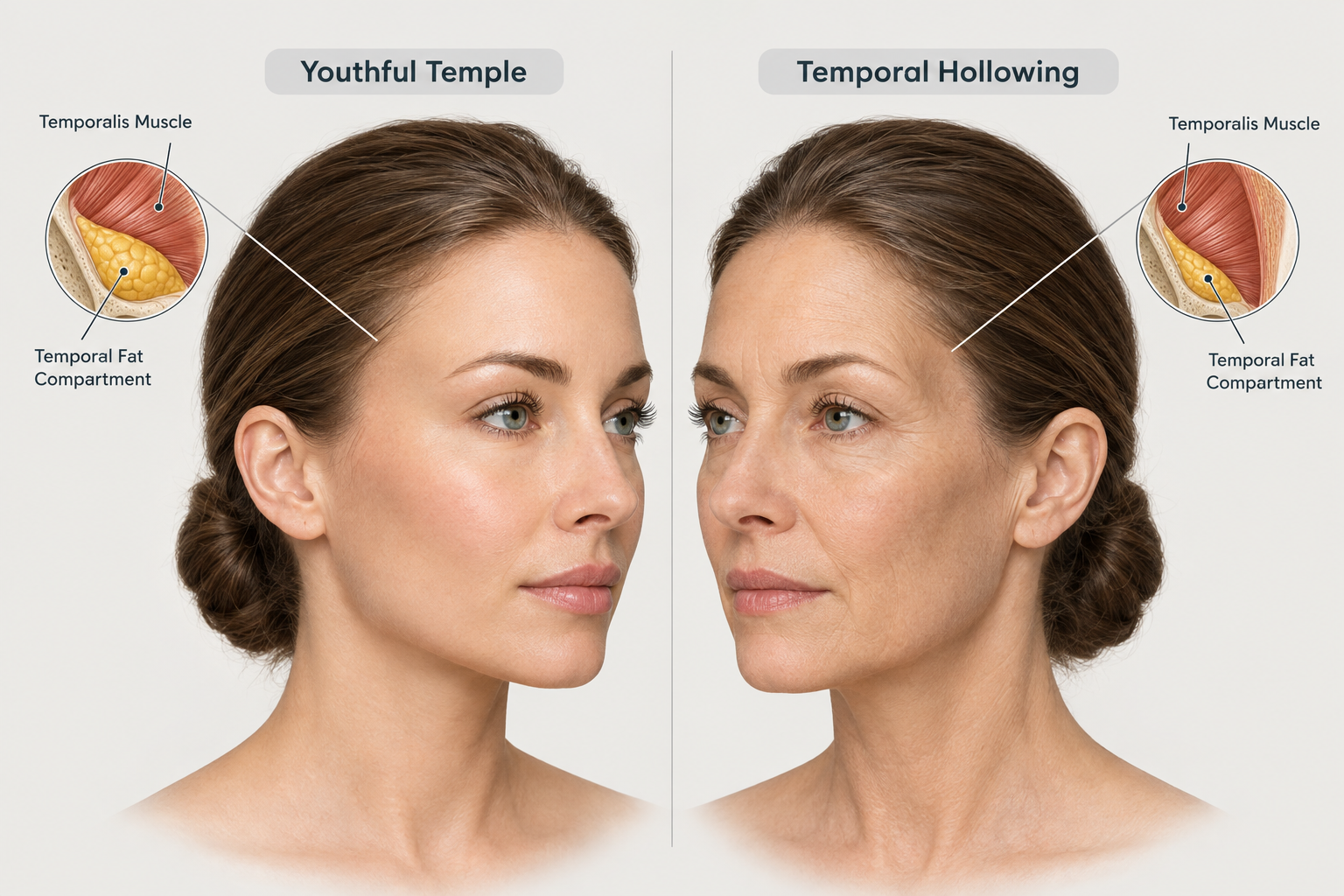

The temples are one of the first areas of the face to lose volume with age, yet they are frequently overlooked in aesthetic consultations. As fat pads thin and bone resorbs over time, the sides of the forehead can develop a hollow or concave appearance that alters the overall shape of the face, contributes to brow descent, and makes the upper face look gaunt even when other areas appear relatively youthful. Temple filler treatment uses injectable dermal filler to restore this lost volume, rebalance facial proportions, and support surrounding structures. This article explains how temple volumisation works, what the treatment involves, realistic outcomes, relevant risks, and the factors that determine whether it may be appropriate for you.
Key Takeaways
- Temple hollowing is a normal part of facial ageing caused by fat loss, muscle thinning, and bone resorption in the temporal region.
- Dermal fillers — most commonly hyaluronic acid — can restore volume to the temples and improve upper facial contour, though results vary between individuals.
- The temporal region contains important vascular structures, making practitioner experience and anatomical knowledge essential for safe treatment.
- Results typically last between 12 and 24 months depending on the filler used, the volume placed, and individual metabolism.
- A thorough consultation and clinical assessment are necessary to determine suitability and to plan treatment appropriately.
Why the Temples Lose Volume
Temporal volume loss is driven by several overlapping processes that occur gradually from the mid-thirties onwards. The temporal fat compartments — both superficial and deep — reduce in size as adipose tissue is resorbed. The temporalis muscle, which runs beneath the temporal fascia and is responsible for jaw movement, also thins over time. Underlying bone in the temporal fossa undergoes resorption, reducing the structural support that previously maintained a smooth, convex contour. The combined effect is a progressive inward deflection of the skin and soft tissue in the area between the lateral brow and the hairline.
This hollowing has consequences beyond the temples themselves. As the lateral brow loses its underlying support, it can descend, contributing to a tired or heavy appearance around the eyes. The transition between the forehead and the cheek can become more angular, and the overall shape of the face may shift from the fuller, rounder proportions associated with youth towards a more skeletal silhouette. Weight loss, certain medical conditions, and genetic factors can accelerate or exaggerate this process in some individuals.
What Temple Filler Treatment Involves
Temple filler treatment involves injecting a dermal filler product into the temporal region to restore lost volume and re-establish a smoother, more convex contour. The procedure is performed in a clinical setting by a trained aesthetic practitioner. Before any filler is placed, a detailed consultation should take place to assess the degree of hollowing, the patient's facial anatomy, their medical history, and their aesthetic goals.
During the appointment, the skin is cleaned and a topical anaesthetic cream may be applied to reduce discomfort. Many filler products also contain lidocaine, a local anaesthetic, within the formulation, which helps manage sensation during injection. The filler may be placed using a needle or a blunt-tipped cannula, depending on the practitioner's technique and the specific anatomy of the area. A cannula approach is often preferred in the temporal region because it may reduce the risk of inadvertent vascular injury, though both techniques require precise anatomical knowledge.
The amount of filler used varies considerably between individuals. Some patients require only a small volume to achieve a subtle improvement, while others with more pronounced hollowing may need a larger amount, sometimes treated across more than one session. The practitioner will typically massage and assess the area during treatment to ensure even distribution and a natural result.
Which Fillers Are Used for Temple Volumisation
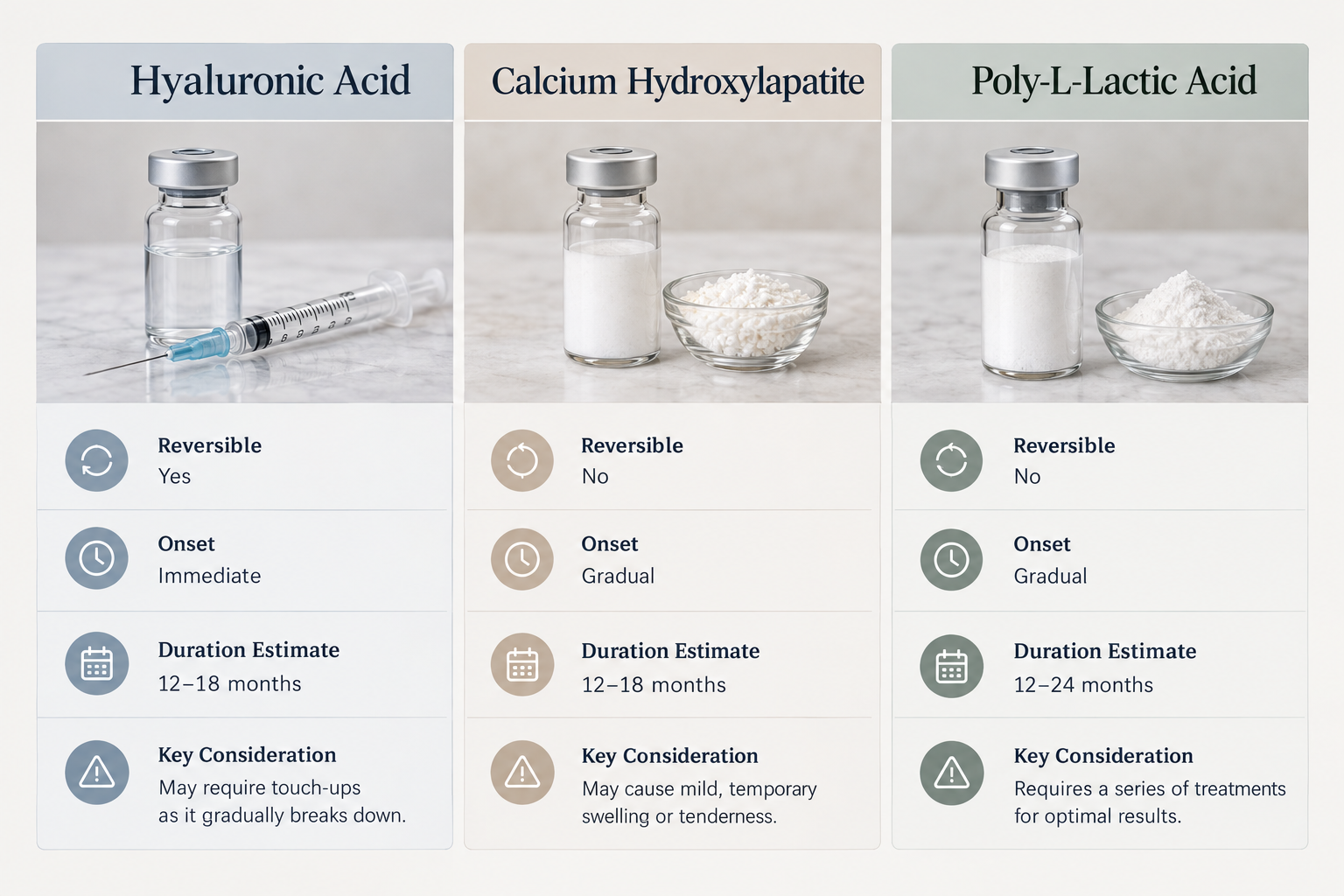
Hyaluronic acid (HA) fillers are the most commonly used products for temple volumisation. Hyaluronic acid is a naturally occurring substance found in connective tissue, and HA fillers are manufactured as a cross-linked gel that can be injected to add volume and structure. Products used in the temples are generally thicker, more cohesive formulations designed to provide lift and projection rather than superficial hydration. The reversibility of HA fillers — they can be dissolved using an enzyme called hyaluronidase if needed — is considered an important safety advantage, particularly in a vascular area such as the temples.
Calcium hydroxylapatite (CaHA) fillers, such as Radiesse, are also used in the temporal region by some practitioners. These products have a thicker consistency and may stimulate collagen production over time, potentially offering longer-lasting results. However, CaHA fillers are not reversible with hyaluronidase, which is a relevant consideration in an area with significant vascular anatomy.
Poly-L-lactic acid (PLLA) is another option used for gradual volumisation. PLLA works as a biostimulator, encouraging the body to produce its own collagen rather than providing immediate volume. Results develop over several weeks and multiple sessions are typically required. Like CaHA, PLLA is not reversible.
The choice of filler product should be guided by the practitioner based on the degree of volume loss, the patient's anatomy, their treatment history, and the desired outcome. No single product is universally superior for temple treatment.
Facial Anatomy and Safety Considerations
The temporal region is anatomically complex and contains structures that make careful technique essential. The superficial temporal artery and its branches run through this area, and the middle temporal vein is located in a relatively consistent position within the temporal fat compartment. Inadvertent injection into a blood vessel — a complication known as intravascular injection — can cause serious adverse events including skin necrosis or, in rare cases, vision changes if filler migrates towards the ophthalmic circulation.
These risks do not mean that temple filler is inherently unsafe, but they do mean that the treatment should only be performed by practitioners with a thorough understanding of facial vascular anatomy and the skills to manage complications if they arise. Practitioners should have access to hyaluronidase when using HA fillers and should be trained in the recognition and management of vascular occlusion. Patients should ask about their practitioner's qualifications, training, and experience with this specific treatment area before proceeding.
Aspiration technique, injection depth, and the use of a cannula versus a needle are all factors that practitioners consider when planning temple filler treatment. The evidence on which approach definitively reduces vascular risk is still developing, and clinical judgement remains central to safe practice.
Expected Results and How Long They Last
The primary goal of temple filler treatment is to restore a smoother, more convex contour to the lateral forehead and reduce the appearance of hollowing. When performed appropriately, the result can improve the overall balance of the upper face, soften the transition between the forehead and cheek, and provide subtle support to the lateral brow. Some patients also notice that the face looks less gaunt or fatigued following treatment.
Results are generally visible immediately after treatment, though some initial swelling is normal and the final appearance typically settles within one to two weeks. Mild bruising is common and usually resolves within a similar timeframe. The improvement in contour should look natural rather than overfilled when the correct volume is used for the individual's anatomy.
How long temple filler lasts depends on several factors, including the type of filler used, the volume placed, the depth of injection, and the individual's metabolism. Hyaluronic acid fillers in the temples typically last between 12 and 18 months, though some patients report results persisting for up to 24 months. Thicker, more cohesive HA products and biostimulators such as PLLA may offer longer duration. Individual variation is significant, and results cannot be guaranteed for any specific timeframe. Maintenance treatment is generally required to sustain the improvement over time.
Potential Risks and Side Effects
All injectable treatments carry risks, and temple filler is no exception. Understanding these risks is an important part of making an informed decision about treatment.
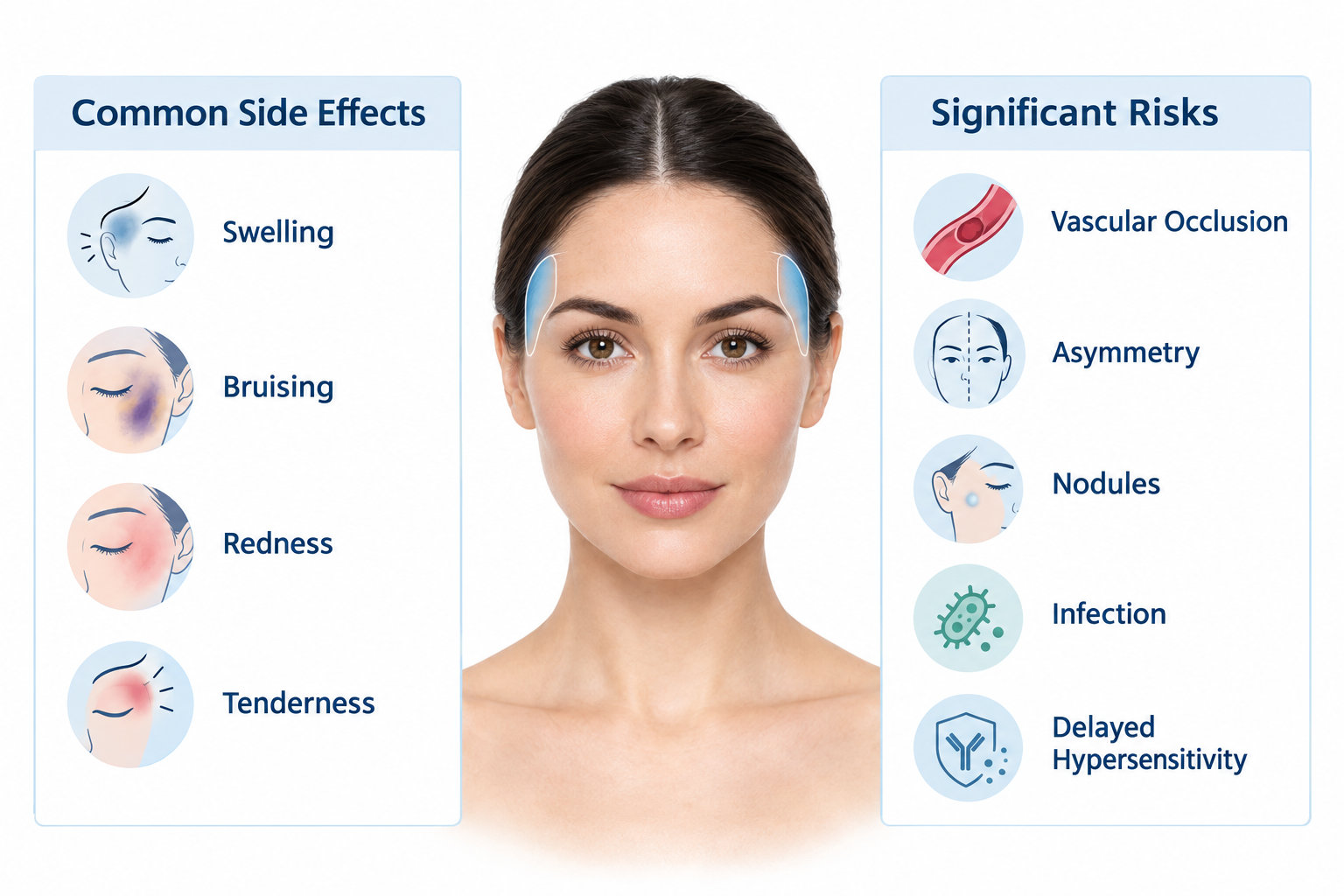
Common side effects include temporary swelling, bruising, redness, and tenderness at the injection site. These typically resolve within a few days to two weeks and are considered a normal response to injection rather than a complication.
Less common but more significant risks include:
- Vascular occlusion: Accidental injection into or compression of a blood vessel can restrict blood flow to surrounding tissue. In the temporal region, this can cause skin changes, pain, or in rare cases more serious consequences. Prompt recognition and treatment with hyaluronidase (for HA fillers) is essential.
- Asymmetry: Uneven placement or differing degrees of volume loss on each side can result in asymmetry. This may require correction with additional filler or, for HA products, partial dissolution.
- Nodules or irregularities: Filler placed too superficially or in an area with thin tissue may be visible or palpable beneath the skin.
- Infection: Although uncommon with proper technique and sterile products, infection is a risk with any injectable procedure.
- Delayed hypersensitivity: Inflammatory reactions to filler can occur weeks or months after treatment, though these are relatively rare with modern HA products.
- Tyndall effect: Superficial placement of HA filler can cause a bluish discolouration visible through the skin, though this is more commonly associated with under-eye treatment than the temples.
Patients should be given clear information about how to recognise warning signs after treatment and how to contact their practitioner if they have concerns. Any significant pain, skin colour changes, or visual disturbance following temple filler should be treated as a medical emergency.
Who May Be Suitable for Temple Filler
Temple filler may be worth discussing with a qualified practitioner if you have noticed hollowing or a concave appearance in the lateral forehead area that concerns you, and if you are in generally good health. Suitable candidates are typically adults who have experienced age-related volume loss in the temporal region, though younger individuals with naturally hollow temples may also be considered.
A clinical assessment is necessary to determine whether temple filler is appropriate for a specific individual. Factors that a practitioner will consider include the degree and pattern of volume loss, the quality and thickness of the overlying skin, the patient's vascular anatomy, their treatment history, and their aesthetic goals. Temple filler is often considered as part of a broader facial rejuvenation plan rather than in isolation, since restoring volume to one area of the face can influence the appearance of adjacent structures.
Who May Not Be Suitable
Temple filler may not be appropriate for everyone. Factors that may affect suitability include:
- Pregnancy or breastfeeding — injectable aesthetic treatments are generally avoided during these periods.
- Active infection, inflammation, or skin disease in or near the treatment area.
- Known allergy to filler components, including lidocaine if present in the formulation.
- Certain bleeding disorders or use of anticoagulant medications, which may increase bruising risk.
- Autoimmune conditions or immunosuppressive therapy — these may affect healing and infection risk.
- Unrealistic expectations about the degree of improvement achievable with filler alone.
- Previous significant filler treatment in the area that has not fully resolved.
This list is not exhaustive. A thorough medical history and clinical assessment by a qualified practitioner are the appropriate way to determine individual suitability.
Temple Filler as Part of a Facial Rejuvenation Plan
Temple volumisation is rarely considered in isolation by experienced practitioners. The face ages as a whole, and volume loss in the temples often occurs alongside changes in the cheeks, midface, jawline, and under-eye area. Addressing the temples without considering adjacent structures can sometimes produce a result that looks unbalanced or draws attention to other areas of volume loss.
Many patients who seek temple filler treatment also benefit from cheek filler, midface volumisation, or treatment of the brow area. Botulinum toxin injections to the lateral brow or forehead may complement the effect of temple filler by relaxing muscles that contribute to brow descent. Skin quality treatments such as radiofrequency, ultrasound-based tightening, or biostimulatory injectables may address skin laxity that filler alone cannot correct.
A practitioner who takes a whole-face approach and discusses the relationship between different areas of volume loss is likely to produce a more harmonious and natural-looking outcome than one who treats the temples in isolation. Patients should feel comfortable asking how temple treatment fits into their overall facial assessment.
Alternatives to Temple Filler
For patients who are not suitable for or do not wish to pursue injectable filler, several alternatives may be worth discussing:
- Biostimulatory injectables: Products such as PLLA or polynucleotides stimulate the body's own collagen production and may improve tissue quality and subtle volume over time, though the degree of volumisation is generally less immediate and less pronounced than with HA filler.
- Fat transfer: Autologous fat grafting involves harvesting fat from another area of the body and injecting it into the temples. This is a surgical procedure with a longer recovery period, but results may be longer-lasting. Outcomes are variable and some resorption of transferred fat is expected.
- Surgical temporal lift: For patients with significant skin laxity in addition to volume loss, a surgical approach may be more appropriate. This is a more involved procedure with greater downtime and risks.
- Radiofrequency or ultrasound skin tightening: These energy-based treatments can improve skin laxity and stimulate collagen but do not replace lost volume. They may be useful as a complementary treatment.
- Accepting natural ageing: Not all patients wish to pursue treatment, and this is a valid choice. Understanding the nature of temporal volume loss can help patients make an informed decision about whether intervention aligns with their personal goals.
Frequently Asked Questions
Is temple filler painful?
Most patients describe the procedure as mildly uncomfortable rather than significantly painful. Topical anaesthetic cream is typically applied before treatment, and many filler products contain lidocaine within the formulation to reduce discomfort during injection. The level of sensation varies between individuals and depends on the technique used.
How much filler is needed for the temples?
The volume required varies considerably depending on the degree of hollowing and the individual's anatomy. Some patients achieve a satisfactory result with a relatively small amount of filler, while others with more pronounced volume loss may require a larger volume, sometimes treated across more than one session. Your practitioner should discuss the likely volume needed during your consultation.
Can temple filler lift the brows?
Restoring volume to the temples can provide some support to the lateral brow and may reduce the appearance of brow descent that is partly caused by loss of underlying structure. However, temple filler is not a substitute for brow lift procedures and the degree of brow elevation achievable through volumisation alone is modest. Patients with significant brow ptosis may require additional treatments.
Will temple filler look natural?
When the appropriate volume is used for the individual's anatomy and the filler is placed correctly, temple filler should produce a natural-looking improvement in contour rather than an obviously treated appearance. Overfilling is a risk if too much product is placed, which is why conservative treatment with the option to add more at a follow-up appointment is often a sensible approach.
How soon can I return to normal activities after temple filler?
Most patients are able to return to their usual daily activities shortly after treatment. Strenuous exercise, significant heat exposure such as saunas or hot baths, and alcohol are generally advised against for 24 to 48 hours following treatment to minimise swelling and bruising. Any specific aftercare instructions from your practitioner should be followed.
Can temple filler be reversed?
Hyaluronic acid temple filler can be partially or fully dissolved using hyaluronidase, an enzyme that breaks down HA. This is an important safety advantage in the event of a complication or an unsatisfactory result. Calcium hydroxylapatite and poly-L-lactic acid fillers are not reversible in the same way, which is a relevant consideration when choosing a product.
How do I find a qualified practitioner for temple filler?
Temple filler should be performed by a practitioner with appropriate medical qualifications, training in facial anatomy, and specific experience with injectable treatments in the temporal region. Relevant professional backgrounds include medicine, dentistry, and nursing with specialist aesthetic training. Checking registration with a relevant regulatory or professional body, reviewing before-and-after examples, and attending a thorough consultation before committing to treatment are all reasonable steps.
Is Temple Filler the Right Choice for Your Facial Concerns?
Temple filler can be an effective way to address age-related volume loss in the lateral forehead, restore a more balanced upper facial contour, and reduce the gaunt appearance that temporal hollowing can create. The treatment is well-established within aesthetic medicine, and hyaluronic acid fillers offer the practical advantage of reversibility in an anatomically sensitive area. Results are generally visible immediately, tend to last between one and two years, and can be maintained with periodic top-up treatment.
At the same time, the temporal region presents genuine anatomical complexity, and the risks associated with vascular structures in this area mean that practitioner selection and clinical expertise are not secondary considerations. The degree of improvement achievable with filler depends on the individual's anatomy, the extent of volume loss, and whether other age-related changes — such as skin laxity or brow descent — require additional approaches. Filler alone may not fully address all concerns, and a whole-face assessment is often more informative than focusing on a single area.
If you are considering temple filler, a consultation with a qualified and experienced aesthetic practitioner is the appropriate starting point. A thorough assessment of your facial anatomy, a clear discussion of realistic outcomes, and an honest conversation about the risks and alternatives will help you decide whether this treatment is a suitable option for your individual goals.
