
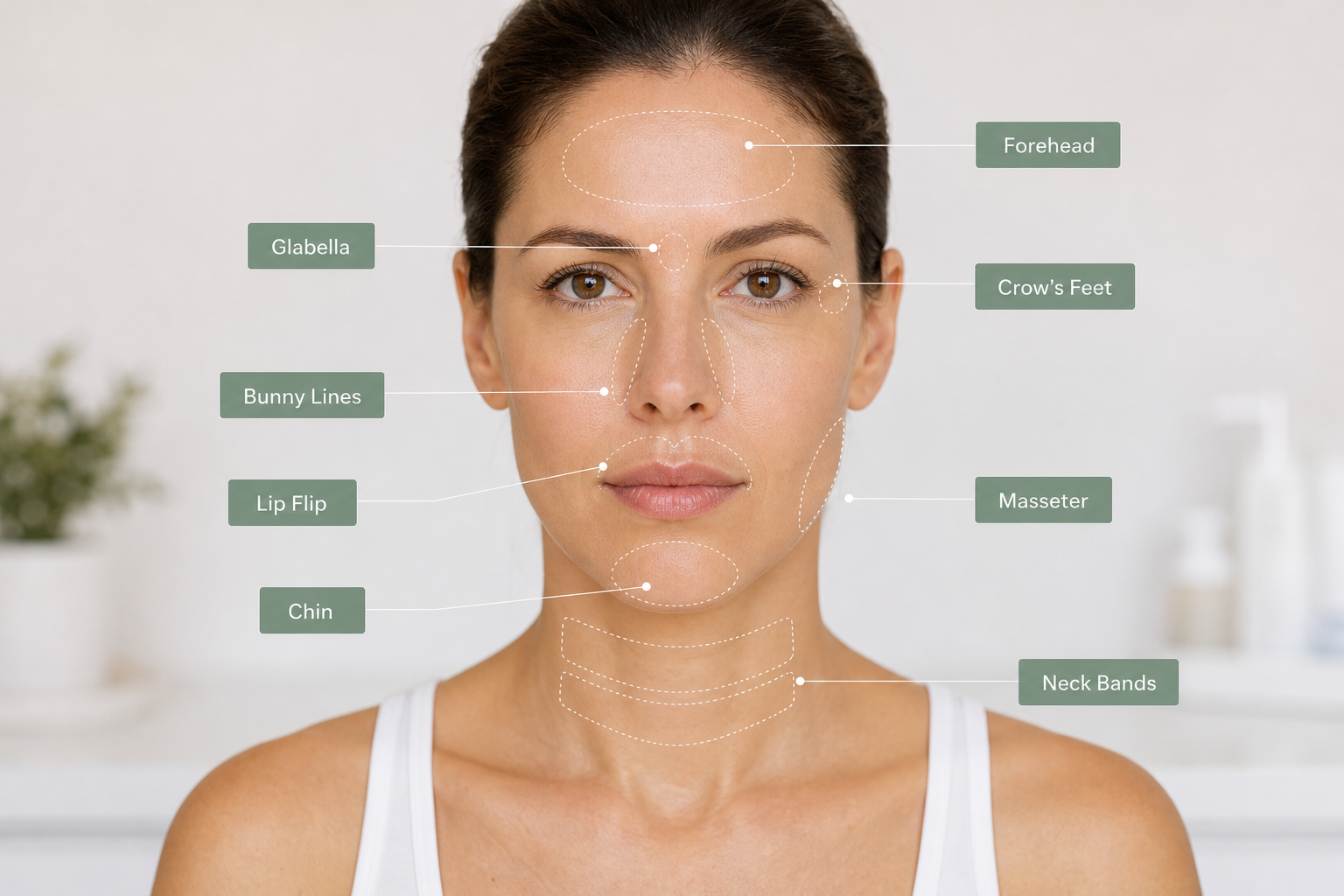

Botulinum toxin injections can address a wide range of concerns across the face and neck, but not every zone responds in the same way or carries the same risk profile. Understanding which facial Botox areas are available, what each treatment can realistically achieve, and where caution is warranted helps you arrive at a consultation with informed expectations rather than assumptions shaped by social media.
Key Takeaways
- Botulinum toxin works by temporarily relaxing specific facial muscles, making it most effective for dynamic wrinkles — lines that form through repeated movement — rather than deep static creases already present at rest.
- Three areas carry formal FDA-approved cosmetic indications: forehead lines, glabellar lines (the “11s”), and crow’s feet. All other facial zones are treated as off-label use, which is legal and common in clinical practice but worth understanding before treatment.
- Results, longevity, and the number of units of Botox required vary meaningfully by zone, by individual facial anatomy, and by the injector’s technique.
- Some zones — particularly the lower face and neck — require precise placement to avoid unwanted effects; injector skill and knowledge of facial anatomy are critical in these areas.
- Botox cannot fully erase deep static lines, replace lost volume, or lift significantly lax tissue; a qualified practitioner can advise when a complementary treatment such as dermal filler may be more appropriate.
How Botulinum Toxin Works Across the Face
Botulinum toxin type A temporarily blocks the nerve signals that cause specific muscles to contract. When a targeted muscle relaxes, the overlying skin smooths because the repetitive folding motion that creates dynamic wrinkles is reduced. The effect is not permanent; nerve signalling gradually recovers over weeks to months, which is why maintenance treatments are needed. The duration and degree of relaxation depend on the muscle’s size and activity level, the dose administered, and how an individual metabolises the product — all of which vary by zone and by person.
A useful way to think about treatment planning is through a Botox face map: a mental or physical diagram of the face divided into upper, mid, and lower zones, each with distinct muscles, movement patterns, and risk considerations. Treating one zone can influence adjacent muscles, so an experienced injector plans the full picture rather than addressing each area in isolation.
Upper Face Botox Areas
Forehead Lines
Horizontal forehead lines are among the most commonly treated concerns and represent one of the three FDA-approved cosmetic indications for botulinum toxin. These lines form through repeated contraction of the frontalis muscle, the broad muscle responsible for raising the eyebrows. Relaxing the frontalis smooths the horizontal creases that appear when you raise your brows or express surprise.
The frontalis also plays a role in holding the brow in its natural position, which is why dosing here requires careful judgement. Over-treating the frontalis — particularly in patients who already have some brow heaviness — can cause the brow to drop, a complication known as brow ptosis. A skilled injector will assess brow position before treatment and may deliberately leave some frontalis activity to maintain natural brow elevation. This is also why a non-surgical brow lift effect can sometimes be achieved by selectively relaxing the muscles that pull the brow downward while preserving those that lift it.
Forehead Botox typically lasts three to four months in most patients. Deep static lines that are visible even when the face is completely at rest may soften but are unlikely to disappear with Botox alone; a combination approach with skin-quality treatments or filler may be discussed in those cases.
Glabellar Lines (Frown Lines / “11s”)
Glabellar lines — the vertical creases between the eyebrows — are the most studied cosmetic indication for botulinum toxin and carry FDA approval. These lines develop through repeated contraction of the corrugator supercilii and procerus muscles, which draw the brows together and downward during concentration, squinting, or negative emotion. Over time, the skin folds repeatedly in the same place, and the lines can become visible even at rest.
Treatment of the glabellar complex typically softens the “angry” or “tired” appearance associated with deep frown lines. Because the corrugator and procerus muscles are relatively small and well-defined, this area is generally considered one of the more predictable zones to treat. Results usually last three to four months, though patients who treat consistently over time often find that the lines become less pronounced between sessions as the muscles gradually reduce in activity.
Crow’s Feet
Crow’s feet — the radiating lines at the outer corners of the eyes — form through contraction of the orbicularis oculi, the circular muscle surrounding the eye. Smiling, squinting, and general facial expression all activate this muscle repeatedly throughout the day, making crow’s feet one of the earliest dynamic wrinkles to appear. This area also holds FDA-approved status for botulinum toxin treatment.
Treatment softens the fan-shaped lines visible when smiling or squinting. Most patients find this one of the more satisfying areas to treat because the improvement is noticeable without altering the natural appearance of the eye. Longevity is typically three to four months. It is worth noting that the under-eye area is a separate and more complex concern; Botox has very limited application there and is not a standard treatment for under-eye hollowness, pigmentation, or puffiness, which usually require different approaches.
Mid-Face Botox Areas
Bunny Lines
Bunny lines are the diagonal or horizontal creases that appear on the sides of the nose when scrunching or laughing. They result from contraction of the nasalis muscle and are often more noticeable in patients who have had forehead or glabellar treatment, as the face may compensate by using adjacent muscles more actively. Treating bunny lines is considered off-label use and typically requires only a small number of units. Results generally last two to three months.
Nasal Tip Lift
A subtle lift of the nasal tip can sometimes be achieved by relaxing the depressor septi nasi muscle, which pulls the tip downward during animation. This is a highly technique-dependent, off-label application that requires precise anatomical knowledge. The effect is modest and best suited to patients whose nasal tip drops noticeably when they smile. It is not a substitute for surgical rhinoplasty and is not appropriate for all nasal concerns.
Gummy Smile Correction
A gummy smile — where a significant amount of upper gum is visible when smiling — can sometimes be reduced by relaxing the levator labii superioris alaeque nasi muscle, which elevates the upper lip. This off-label application requires careful dosing; too much relaxation can flatten the smile or affect lip movement. When performed by an experienced injector, results can look natural and typically last two to four months.
Lower Face Botox Areas
Lip Flip
The lip flip involves placing small amounts of botulinum toxin into the orbicularis oris muscle just above the upper lip border. Rather than adding volume, the lip flip causes the upper lip to roll slightly outward, creating the appearance of a fuller lip without filler. It can also help reduce the visibility of perioral lines — the fine vertical lines sometimes called smoker’s lines — by gently relaxing the muscle responsible for pursing the lip.
The lip flip is one of the shorter-lasting applications, typically wearing off within six to eight weeks. This is because the orbicularis oris is a highly active muscle used constantly in speaking, eating, and expression. Patients should be aware that over-treatment in this area can temporarily affect the ability to use a straw, whistle, or form certain sounds, so conservative dosing is important.
Marionette Lines and Downturned Mouth Corners
The depressor anguli oris (DAO) muscle pulls the corners of the mouth downward, contributing to a sad or stern resting expression and to marionette lines — the creases that run from the mouth corners toward the chin. Relaxing the DAO can allow the mouth corners to sit in a more neutral or slightly elevated position. This is an off-label application that requires careful placement to avoid affecting the muscles responsible for smiling.
It is important to set realistic expectations here: Botox can soften the downward pull and improve the resting expression, but deep marionette lines with significant skin laxity often benefit more from dermal filler or a combination approach. Botox alone is unlikely to fully address pronounced marionette lines.
Chin Dimpling
Chin dimpling — sometimes described as an “orange peel” texture on the chin — results from overactivity of the mentalis muscle. Relaxing the mentalis smooths the irregular surface and can also reduce the appearance of a chin that appears to strain or bunch when the lips are closed. This is a well-tolerated off-label application with results typically lasting three to four months.
Masseter Botox (Jaw Slimming and Bruxism)
Masseter Botox involves injecting botulinum toxin into the masseter muscles — the large chewing muscles at the sides of the jaw. This serves two purposes: cosmetically, it can slim a wide or square lower face over time as the muscle gradually reduces in bulk; therapeutically, it can reduce jaw clenching and teeth grinding (bruxism), which may help with associated headaches and tooth wear.
The masseter is a large, powerful muscle, and higher unit counts are typically required compared with most facial zones. Results for jaw slimming tend to develop gradually over six to eight weeks as the muscle atrophies with reduced use, and longevity is often longer than other areas — sometimes five to six months or more with repeated treatments. Patients with significant masseter hypertrophy may need two or three treatment cycles before the full slimming effect becomes apparent.
Neck Botox: Platysmal Bands and the Nefertiti Lift
Platysmal bands are the vertical cords that become visible in the neck as the platysma muscle — a thin, broad muscle covering the front of the neck — loses elasticity and begins to separate with age. Injecting botulinum toxin along these bands relaxes the downward pull of the platysma, which can soften the cords and contribute to a more defined jawline. This technique is sometimes called the Nefertiti lift when injections are also placed along the lower jawline to counteract the platysma’s downward traction on the overlying skin.
Neck treatment requires a thorough understanding of the anatomy because the platysma lies close to important structures. Results are generally more subtle than upper face treatment and typically last three to four months. Patients with significant skin laxity or deep neck banding may find that Botox provides only modest improvement and that other modalities — such as radiofrequency skin tightening or surgical options — offer more meaningful correction.
FDA-Approved vs. Off-Label Botox Areas
| Zone | FDA Cosmetic Status | Typical Longevity | Key Consideration |
|---|---|---|---|
| Forehead lines | FDA-approved | 3–4 months | Risk of brow ptosis if overdosed |
| Glabellar lines (“11s”) | FDA-approved | 3–4 months | Most studied cosmetic indication |
| Crow’s feet | FDA-approved | 3–4 months | Orbicularis oculi; natural results achievable |
| Bunny lines | Off-label | 2–3 months | Small dose; may increase after other upper face treatment |
| Gummy smile | Off-label | 2–4 months | Technique-sensitive; affects smile dynamics |
| Lip flip / perioral lines | Off-label | 6–8 weeks | Short duration; functional effects possible if overdosed |
| Marionette lines / DAO | Off-label | 3–4 months | Often combined with filler for best results |
| Chin dimpling | Off-label | 3–4 months | Mentalis muscle; well tolerated |
| Masseter / jaw slimming | Off-label | 5–6+ months | Gradual slimming; higher unit count needed |
| Platysmal bands / neck | Off-label | 3–4 months | Subtle results; anatomy awareness critical |
Zone Interaction Effects: Why Treatment Planning Matters
One aspect of facial Botox that is rarely discussed in patient-facing guides is how treating one zone can influence neighbouring muscles. The frontalis and the muscles of the glabellar complex work in opposition: the frontalis lifts the brow while the corrugators and procerus pull it down and inward. If the frontalis is heavily relaxed without addressing the depressors, the brow may drop. Conversely, treating the glabellar complex without considering the frontalis can sometimes cause the brow to arch unexpectedly as the frontalis compensates.
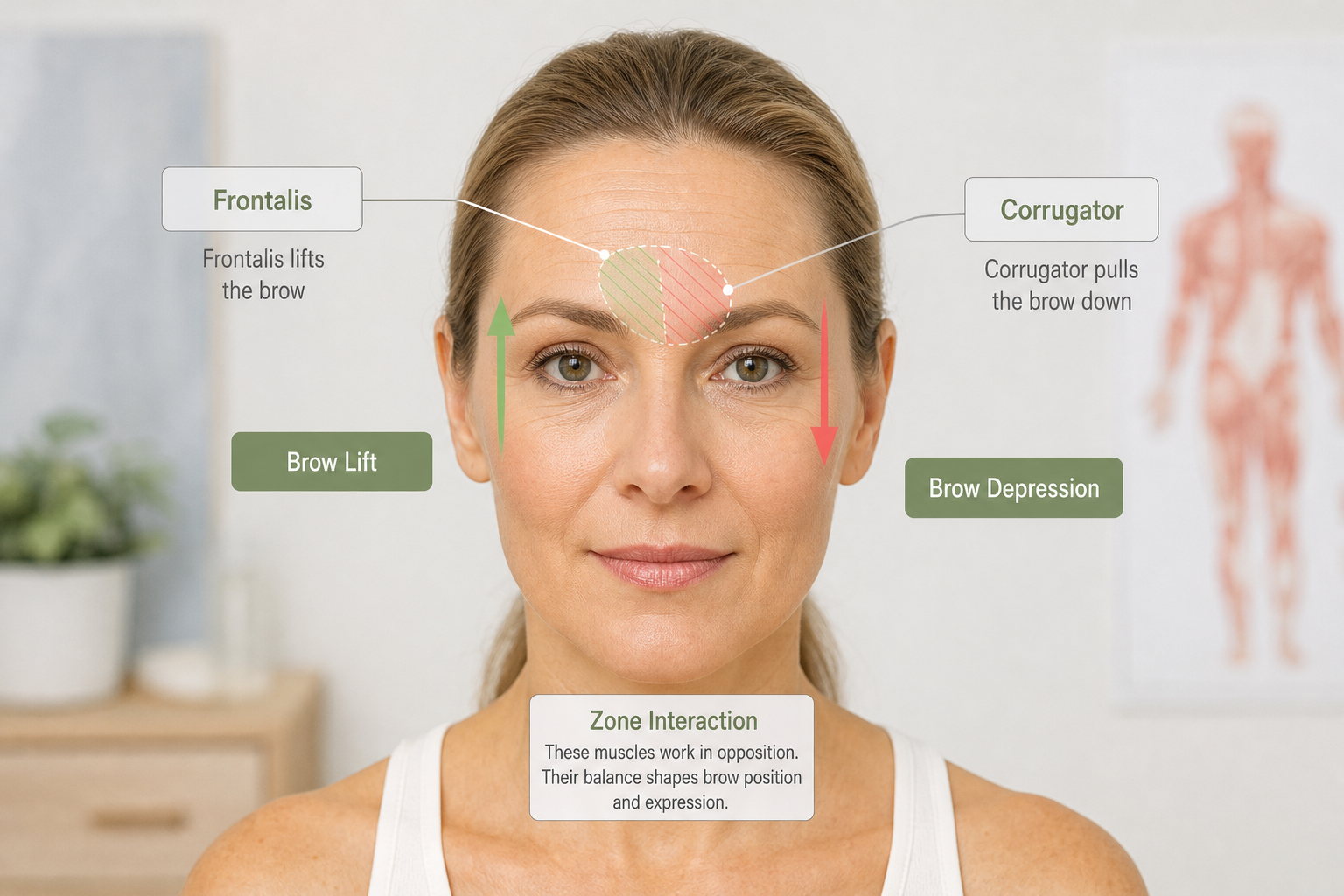
Similarly, treating the DAO to lift downturned mouth corners can occasionally increase activity in adjacent muscles if the balance of forces around the mouth is not considered. An experienced injector uses knowledge of facial anatomy to anticipate these interactions and plan a treatment that achieves a harmonious, natural-looking result rather than addressing each zone as if it existed independently.
Gender Differences in Facial Botox Treatment
Men typically have greater facial muscle mass than women, particularly in the frontalis, glabellar complex, and masseter. This generally means that higher unit counts may be needed to achieve equivalent relaxation. Male aesthetic goals also tend to differ: many men prefer to maintain some visible forehead movement and a stronger brow position rather than a fully smooth forehead, which influences how an injector approaches dosing and placement. A practitioner experienced in treating male patients will adjust both the unit count and the injection pattern accordingly rather than applying a standard female treatment template.
Preventive Botox: Which Zones Benefit Most from Early Treatment
Preventive or “prejuvenation” Botox refers to starting treatment before lines become static — visible at rest rather than only during movement. The zones that benefit most from early intervention are those subject to the highest frequency of repetitive movement: the glabellar complex, crow’s feet, and forehead. Treating these areas before deep static lines develop means the skin never repeatedly folds in the same place to the same degree, which may slow the formation of permanent creases.

The lower face and neck are generally less prioritised for preventive treatment in younger patients, as these areas tend to show significant change later and the risk-benefit calculation is different. Treatment frequency for preventive purposes is typically the same as for established lines — every three to four months — though some practitioners discuss spacing treatments slightly further apart once the muscle has adapted over time.
Combining Multiple Zones in One Session
Treating several facial Botox areas in a single appointment is common and generally safe when performed by a qualified injector who manages the total unit count thoughtfully. There is no universal upper limit on units per session that applies to every patient, but experienced practitioners are mindful of cumulative dose, particularly when treating both the face and neck. Treating multiple zones at once allows the injector to consider the full balance of the face and plan for zone interactions rather than addressing areas piecemeal across separate visits.
Patients new to botulinum toxin treatment may benefit from starting with one or two zones to understand how their face responds before expanding to additional areas. This approach also makes it easier to identify which zone is responsible for any unexpected outcome.
Risks, Limitations, and Zones That Require Extra Caution
Every facial zone carries some degree of risk, but certain areas are more technically demanding. The forehead carries a risk of brow ptosis if the frontalis is over-relaxed. The periorbital area requires care to avoid affecting the muscles that control eyelid position. The lower face — particularly the DAO, orbicularis oris, and muscles around the mouth — requires precise placement to avoid affecting speech, eating, or smile symmetry. The neck requires awareness of nearby structures and is generally considered a more advanced treatment area.
Common side effects across all zones include temporary bruising, swelling, and mild tenderness at injection sites. Headache is occasionally reported after forehead or glabellar treatment. Asymmetry can occur and may require a small corrective dose at a follow-up appointment. The “frozen” appearance associated with Botox in popular culture is typically the result of excessive dosing rather than an inherent property of the treatment; conservative dosing by a skilled injector generally produces natural-looking results.
Botox is not suitable during pregnancy or breastfeeding, and patients with certain neuromuscular conditions, relevant allergies, or active infection at the planned injection site should discuss their history fully with a practitioner before proceeding.
Frequently Asked Questions
Can Botox treat static wrinkles — lines visible at rest?
Botulinum toxin is most effective for dynamic wrinkles caused by muscle movement. Static lines that are visible when the face is completely relaxed may soften with treatment over time, particularly if they are mild to moderate, but deep static creases are unlikely to disappear with Botox alone. Dermal fillers, skin resurfacing, or other modalities may be more appropriate for established static lines.
How long do results last in each area?
Longevity varies by zone. The upper face (forehead, glabella, crow’s feet) typically lasts three to four months. The lip flip wears off faster — often six to eight weeks — because the orbicularis oris is highly active. Masseter Botox tends to last longer, sometimes five to six months or more with repeated treatments, as the muscle gradually reduces in bulk. Individual metabolism, muscle activity, and dose all influence how long results last in any given area.
How many units of Botox does each area need?
Unit requirements vary by zone, muscle size, and individual anatomy. Providing exact figures is not appropriate here because dosing should be determined by a qualified practitioner during a clinical assessment. Men generally require more units than women in most zones due to greater muscle mass. Your injector will discuss a personalised plan at consultation.
Is off-label Botox treatment safe?
Off-label use of botulinum toxin is legal and widely practised in aesthetic medicine. Many of the most popular facial Botox areas — including the masseter, lip flip, and chin — are off-label applications. Safety depends primarily on injector qualification, anatomical knowledge, and appropriate patient selection rather than on whether the indication is formally approved.
Can multiple areas be treated in one session?
Yes, treating several zones in a single appointment is common. An experienced injector will consider the total dose and the interaction between zones to achieve a balanced result. Patients new to treatment may prefer to start with fewer areas to understand their individual response before expanding to additional zones.
When will I see results after treatment?
Botulinum toxin does not work immediately. Most patients begin to notice muscle relaxation within three to five days, with the full effect typically visible at around ten to fourteen days. A follow-up appointment is often offered at two weeks to assess the result and make any minor adjustments.
Planning Your Facial Botox Treatment: What to Consider First
The range of treatable facial Botox areas is broader than many patients realise, spanning from the forehead to the neck and covering concerns from deep frown lines to jaw tension. The three FDA-approved cosmetic zones — forehead lines, glabellar lines, and crow’s feet — are the most evidence-supported starting points, particularly for first-time patients. Lower face and neck treatments offer meaningful results but are more technique-dependent and carry a different risk profile, making injector experience especially important in those areas.
Before any treatment, a thorough consultation should include an assessment of your facial anatomy, muscle activity, skin quality, and aesthetic goals. A qualified practitioner will also discuss realistic outcomes for your specific concerns, including whether Botox alone is likely to achieve what you are hoping for or whether a complementary approach — such as dermal filler for volume loss or a skin-quality treatment for surface texture — would better serve your goals. Arriving at that conversation with a clear understanding of which zones interest you and what each can realistically achieve puts you in a much stronger position to make an informed decision.
