
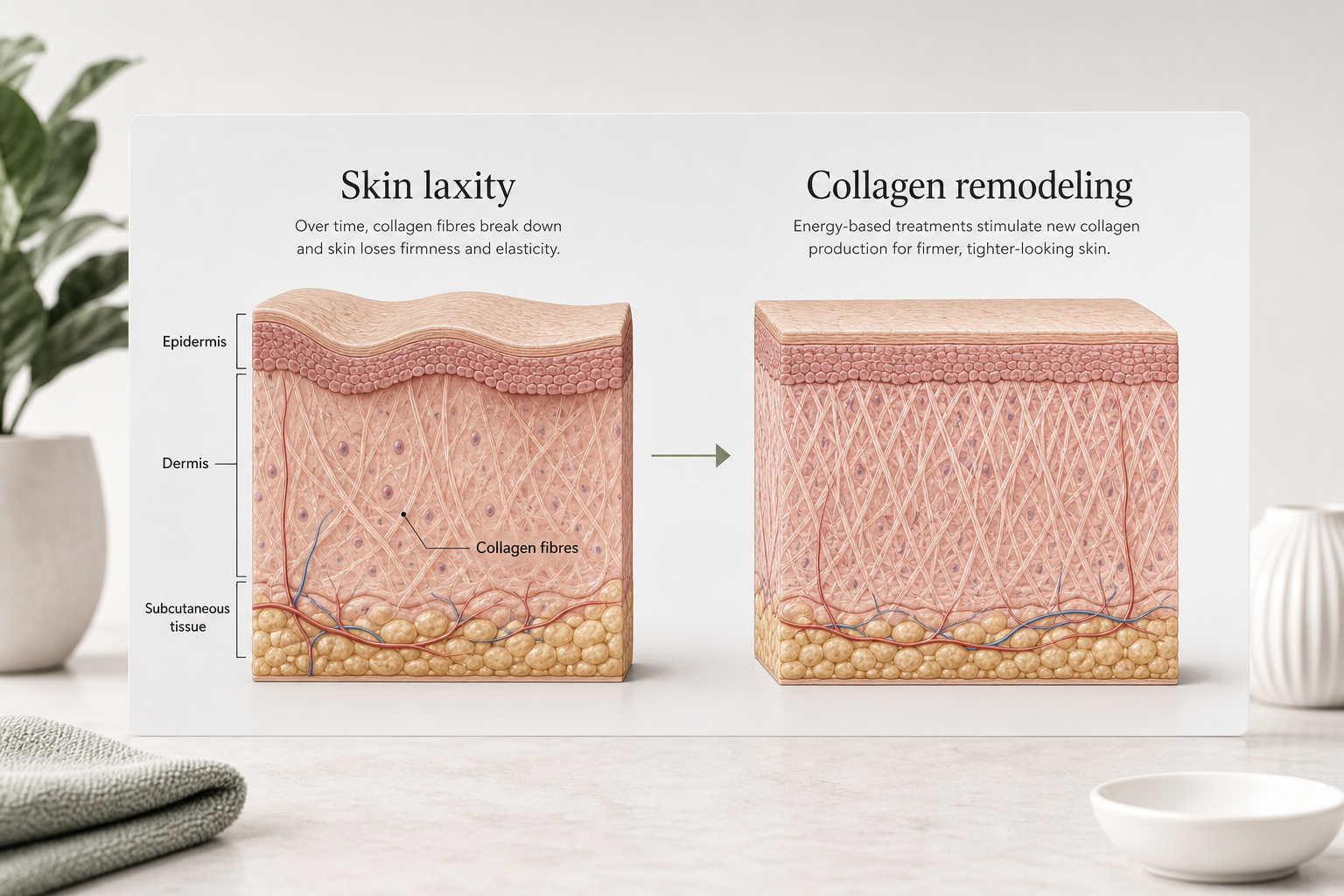

Loose or crepey skin on the thighs is one of the most common aesthetic concerns among adults, yet many people are reluctant to consider a surgical thigh lift due to the recovery time, scarring, and cost involved. Non-surgical thigh tightening offers a range of energy-based and injectable treatments that can improve skin firmness and texture with minimal downtime — though understanding what these treatments can and cannot achieve is essential before booking a consultation.
Key Takeaways
- Non-surgical thigh tightening works best for mild to moderate skin laxity; significant excess skin typically requires a surgical approach.
- Treatments such as radiofrequency, HIFU, RF microneedling, and injectable biostimulators work by stimulating collagen remodeling over weeks to months.
- Most people need a series of sessions, and results are gradual and natural-looking rather than dramatic.
- Combining clinical treatments with strength training and good nutrition can support and extend results.
- Choosing a qualified, experienced provider is one of the most important factors in achieving a safe and satisfying outcome.
Why Thigh Skin Becomes Loose
Skin laxity on the thighs develops for several overlapping reasons. As the body ages, it produces less collagen and elastin — the structural proteins that keep skin firm and resilient. This natural decline accelerates after the mid-thirties and becomes more noticeable on areas like the inner thigh, where skin is thinner and subject to friction. Significant weight loss, whether through diet, exercise, or bariatric surgery, can leave behind excess skin that has lost its ability to retract, particularly when the weight loss is rapid. Pregnancy, genetics, prolonged sun exposure, smoking, and muscle atrophy all contribute further to reduced skin elasticity and the development of crepey skin texture.
Understanding the underlying cause matters because it influences which treatments are likely to help. Skin that has lost collagen due to aging responds differently to energy-based skin tightening than skin that is genuinely redundant following massive weight loss. A thorough clinical assessment helps determine whether non-surgical options are appropriate or whether a surgical thigh lift — known as thighplasty — would produce more meaningful results.
Non-Surgical vs. Surgical Thigh Tightening: An Honest Comparison
Before exploring individual treatments, it is worth understanding where non-surgical options sit relative to surgery. The table below summarises the key differences to help set realistic expectations.
| Factor | Non-Surgical Thigh Tightening | Surgical Thigh Lift (Thighplasty) |
|---|---|---|
| Mechanism | Collagen stimulation, skin contraction, fat reduction | Physical removal of excess skin and fat |
| Ideal candidate | Mild to moderate skin laxity, stable weight | Moderate to severe laxity, significant excess skin |
| Downtime | Minimal to none (most treatments) | 2–6 weeks depending on extent |
| Scarring | None (scarless thigh lift approach) | Permanent scars, typically in groin or inner thigh |
| Results onset | Gradual over 4–12 weeks; full results at 3–6 months | Visible immediately; final results at 3–6 months |
| Results duration | 6 months to 2 years; maintenance sessions required | Long-lasting, though aging continues |
| Sessions required | Typically 2–6 sessions per treatment course | Usually a single procedure |
| Approximate cost | £500–£4,000+ per session depending on technology | £7,000–£12,000 or more |
| Risk profile | Low; temporary redness, swelling, mild discomfort | Higher; anaesthesia, infection, scarring, nerve risk |
Non-surgical approaches are not a replacement for surgery when there is substantial excess skin. However, for people with mild to moderate sagging who want gradual, natural-looking results without scars or significant recovery, they represent a clinically meaningful option.
Non-Surgical Thigh Tightening Treatments Explained
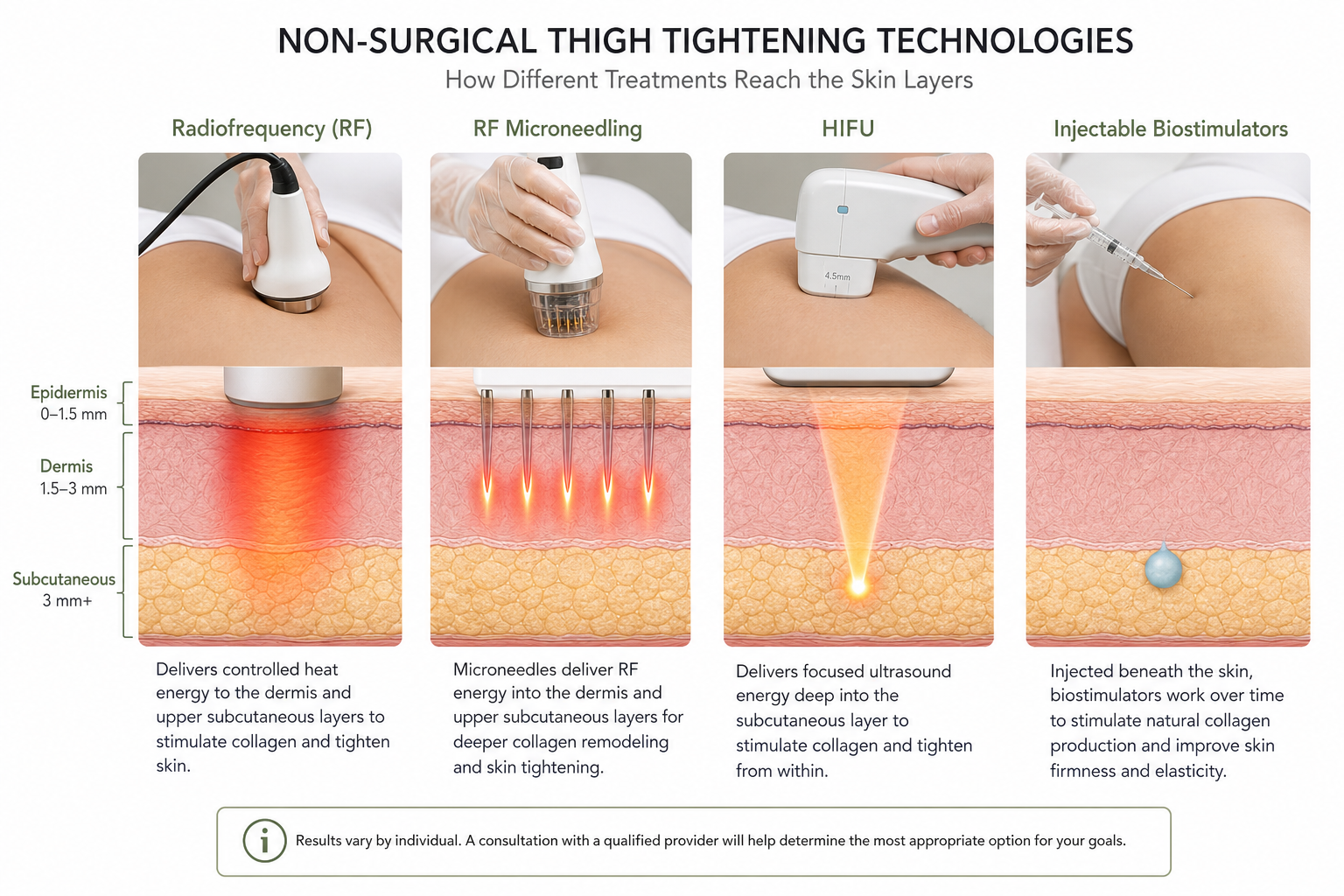
Several distinct technologies are used for non-surgical thigh tightening, each working through a different mechanism. Providers often combine more than one approach to address both skin quality and body contouring in the same treatment plan.
Radiofrequency (RF) Skin Tightening
Radiofrequency energy heats the deeper layers of the skin and the underlying tissue, triggering collagen contraction and stimulating new collagen production over the following weeks. Devices such as Thermage deliver monopolar radiofrequency energy in a single session, making them convenient for patients who prefer a one-and-done approach, though results develop gradually over three to six months. RF treatments are well-suited to the outer thigh and front of the thigh, where skin tends to be thicker. Mild warmth and temporary redness are the most common side effects; significant downtime is not typically required.
RF Microneedling
RF microneedling devices such as Morpheus8 and Opus Plasma combine the collagen-stimulating effects of microneedling with the deeper heating of radiofrequency energy. Fine needles create controlled micro-injuries in the skin while simultaneously delivering radiofrequency energy at a precise depth. This dual mechanism makes RF microneedling particularly effective for crepey skin texture and mild to moderate laxity on the inner thigh, where skin is thinner and more delicate. A course of two to four sessions is typically recommended, spaced four to six weeks apart. Some temporary redness, swelling, and pinpoint marks are expected in the days following treatment, but most people return to normal activities within a few days.
High-Intensity Focused Ultrasound (HIFU)
HIFU treatments, including Ultherapy and Sofwave, use focused ultrasound energy to heat tissue at a specific depth beneath the skin surface without affecting the overlying skin. This stimulates collagen remodeling and gradual skin tightening over two to three months. HIFU is particularly useful for lifting and firming rather than purely tightening surface texture, and it can reach deeper tissue layers than surface-level RF treatments. The inner thigh and the area just below the buttock crease are common treatment zones. Discomfort during the procedure can be moderate, and some providers offer topical anaesthetic or oral pain relief. Results from a single session may last up to twelve months, though individual response varies considerably.
Injectable Biostimulators: Sculptra
Sculptra (poly-L-lactic acid) is an injectable collagen-stimulating treatment that works differently from energy-based devices. When injected into the thigh area, Sculptra microspheres gradually stimulate the body’s own collagen production over several months, improving skin thickness, firmness, and texture from within. It is particularly useful for diffuse skin laxity and crepey texture across larger areas, and it can complement energy-based treatments well. A typical course involves two to three sessions spaced six to eight weeks apart, with results developing over three to six months and potentially lasting up to two years. Sculptra is a minimally invasive option — it involves injections rather than a device applied to the skin surface — and carries the usual risks associated with injectable treatments, including bruising, swelling, and, rarely, nodule formation if not administered correctly.
Thread Lifts
Dissolvable PDO (polydioxanone) threads can be inserted beneath the skin of the thigh to provide a mechanical lifting effect while also stimulating collagen production as they dissolve. Thread lifts for the thighs are a minimally invasive option that involves small entry points rather than incisions, making them a form of scarless thigh lift. Results are typically visible more quickly than with energy-based treatments, but the lifting effect is modest and most suitable for mild laxity. Threads dissolve over several months, and the collagen stimulation they trigger may extend results beyond the thread’s physical presence. Bruising and swelling are common in the first week.
Laser Body Contouring
Non-ablative laser treatments such as SculpSure use laser energy to heat and disrupt subcutaneous fat cells while also delivering some degree of skin tightening through thermal stimulation. SculpSure is primarily a fat reduction treatment rather than a dedicated skin tightening device, so it is most appropriate when both excess fat and mild skin laxity are present on the outer thigh. Results from fat reduction appear gradually over six to twelve weeks as the body clears treated fat cells. Laser body contouring is generally not the first choice when skin tightening is the primary concern.
Minimally Invasive Options: BodyTite and Renuvion
BodyTite and Renuvion occupy a middle ground between non-invasive treatments and surgery. BodyTite uses radiofrequency-assisted lipolysis delivered through a small cannula inserted beneath the skin, simultaneously reducing fat and tightening the overlying skin with greater precision than surface-level RF devices. Renuvion uses helium plasma and radiofrequency energy delivered subcutaneously to cause significant collagen contraction. Both require small incisions and local or general anaesthesia, and both carry a higher risk profile than fully non-invasive treatments. However, they can produce more substantial skin tightening than surface devices, making them worth discussing for patients who fall between the ideal non-surgical candidate and someone who needs a full thighplasty.
Inner Thigh vs. Outer Thigh: Does the Zone Matter?
Most discussions of thigh tightening treat the thigh as a single area, but the inner thigh and outer thigh present different clinical challenges. The inner thigh has thinner, more delicate skin that is prone to friction and tends to show laxity earlier. RF microneedling with devices like Morpheus8 is frequently chosen for inner thigh tightening because it can be calibrated to shallower depths appropriate for thinner skin. HIFU is also used in this area. The outer thigh and saddlebag region often involve a combination of subcutaneous fat and skin laxity, making treatments that address both — such as BodyTite or a combination of SculpSure with RF — more appropriate. The front of the thigh, where crepey skin texture is common, responds well to surface RF and RF microneedling. Discussing the specific zones of concern with a provider helps ensure the right technology is selected for each area.
Combination Treatment Protocols
In clinical practice, providers frequently combine treatments to address multiple aspects of thigh skin quality simultaneously. A common protocol pairs RF microneedling (to improve skin texture and surface laxity) with Sculptra injections (to rebuild collagen volume from within), delivering complementary mechanisms that may produce better outcomes than either treatment alone. Another approach combines BodyTite for deeper tissue tightening with Morpheus8 for surface skin quality refinement. When fat reduction is also a goal, CoolSculpting (cryolipolysis) or SculpSure may be incorporated alongside a skin tightening treatment, since fat reduction alone does not tighten skin and may in some cases make laxity more visible. Combination protocols typically require more sessions and a higher overall investment, but they allow a more comprehensive approach to body contouring of the thigh area.
Who Is a Good Candidate for Non-Surgical Thigh Tightening?
Non-surgical thigh tightening is most likely to produce satisfying results in people who meet the following criteria:

- Mild to moderate skin laxity — not significant excess skin that hangs or folds
- Stable body weight for at least three to six months
- Good overall health with no active skin infections or inflammatory conditions in the treatment area
- Realistic expectations about gradual, natural-looking improvement rather than dramatic transformation
- Willingness to complete a course of sessions and attend maintenance sessions as recommended
- No implanted electronic devices (relevant for RF treatments) or other contraindications specific to the chosen technology
People who have lost a significant amount of weight — whether through lifestyle changes or bariatric surgery — often have more substantial skin redundancy than non-surgical treatments can meaningfully address. In these cases, a frank conversation with a board-certified plastic surgeon about the realistic limits of non-surgical options is important. Minimally invasive options like BodyTite may bridge the gap for some patients, but those with large amounts of excess skin are generally better served by thighplasty.
Age, skin type, and the degree of sun damage also influence likely outcomes. Younger skin with better baseline elasticity tends to respond more readily to collagen-stimulating treatments. Heavily sun-damaged or very thin skin may show more modest improvement. A qualified provider can assess these factors during a consultation and give a more personalised indication of what to expect.
What Results Can You Realistically Expect?
Non-surgical thigh tightening produces gradual, progressive improvement rather than an immediate visible change. Most energy-based treatments work by triggering the body’s own collagen remodeling process, which takes time. A general timeline looks like this:
- Immediately after treatment: Mild redness, warmth, or swelling in the treated area — this is normal and typically resolves within hours to a few days depending on the treatment.
- Weeks 4–8: Early collagen remodeling begins; some patients notice subtle improvements in skin texture and firmness.
- Months 3–6: The most significant visible improvement typically occurs during this period as new collagen matures and skin continues to tighten.
- Beyond 6 months: Results plateau; maintenance sessions help sustain the improvement.
It is important to understand that non-surgical treatments improve skin quality and firmness — they do not remove skin. The degree of improvement is proportional to the degree of laxity: someone with mild crepey texture may see a noticeable difference, while someone with moderate sagging may see a meaningful but less dramatic change. Comparing non-surgical results to surgical thighplasty outcomes is not realistic; the two approaches operate at fundamentally different levels of intervention.
How Long Do Results Last and What Maintenance Is Needed?
Results from non-surgical thigh tightening are not permanent. The body continues to age, and the collagen stimulated by treatment will gradually break down over time. Most patients find that results from a course of RF or HIFU treatments last between six months and two years, depending on the technology used, the number of sessions completed, and individual factors such as age and lifestyle. Sculptra results may last up to two years in some patients.
A realistic long-term maintenance plan typically involves completing an initial treatment course (usually two to six sessions), followed by annual or biannual maintenance sessions to sustain collagen levels. Combining clinical treatments with consistent strength training — which builds the underlying muscle that supports skin — and a collagen-supporting diet rich in protein, vitamin C, and zinc can help extend and enhance results. Sun protection is also important, as UV exposure accelerates collagen breakdown and counteracts the benefits of treatment.
Supporting Non-Surgical Treatments with Lifestyle Habits
Clinical treatments and lifestyle habits are most effective when they work together rather than in isolation. Strength training exercises that target the thigh muscles — including squats, lunges, leg presses, and side leg raises — build the muscular foundation beneath the skin, which can improve the overall appearance of the thigh area and support skin tightening results. Adequate protein intake supports collagen synthesis, and staying well hydrated helps maintain skin plumpness and elasticity. Dry brushing and firming massage may improve circulation and temporarily improve skin texture, though their effect on true skin laxity is modest. Compression garments can provide temporary support and comfort, particularly after minimally invasive procedures. None of these lifestyle measures alone will produce the same degree of improvement as clinical collagen-stimulating treatments, but they meaningfully complement and extend professional results.
How to Choose a Provider
The provider’s skill and experience are among the most important factors in achieving a safe and effective outcome from non-surgical thigh tightening. When evaluating a clinic or practitioner, consider the following:
- Look for a provider with specific training and experience in energy-based skin tightening and body contouring — not just general aesthetics.
- Ask to see before-and-after photographs of thigh tightening cases specifically, not just facial treatments.
- A reputable provider will conduct a thorough assessment, discuss realistic expectations, and tell you honestly if surgery would serve you better.
- Be cautious of clinics that promise dramatic results in a single session or guarantee outcomes — no ethical provider can guarantee individual results.
- Confirm that the device being used is a recognised, regulated technology and that the practitioner is trained in its use for the body area being treated.
- Ask about the full cost of a treatment course, not just a single session, so you can plan accurately.
Frequently Asked Questions
Can non-surgical treatments completely eliminate loose thigh skin?
Non-surgical thigh tightening can meaningfully improve mild to moderate skin laxity, but it cannot remove excess skin. If there is significant skin redundancy — for example, after major weight loss — a surgical thigh lift is likely to produce more satisfying results. A clinical assessment will help clarify which category applies to you.
How many sessions will I need?
The number of sessions depends on the treatment chosen and the degree of laxity being addressed. Most energy-based treatments require two to four sessions for an initial course, while Sculptra typically involves two to three injection appointments. Some devices, such as Thermage, are designed to be used in a single session. Your provider will recommend a protocol based on your individual assessment.
Is non-surgical thigh tightening painful?
Discomfort varies by treatment. Surface RF treatments are generally well tolerated with a warming sensation. RF microneedling involves the sensation of fine needles and heat, which most patients describe as moderately uncomfortable; topical anaesthetic is usually applied beforehand. HIFU can cause more noticeable discomfort during the procedure, particularly over bony areas. Minimally invasive options like BodyTite involve local anaesthesia. Most patients find the discomfort manageable, but discussing pain management options with your provider beforehand is sensible.
Can I combine thigh tightening with fat reduction?
Yes, and this is often clinically appropriate when both excess fat and skin laxity are present. Treatments such as CoolSculpting or SculpSure can reduce subcutaneous fat, while RF or HIFU addresses skin quality. It is important to note that fat reduction alone does not tighten skin and may occasionally make laxity more visible if skin quality is not also addressed. A provider experienced in body contouring can design a combined protocol.
How soon after significant weight loss can I have thigh tightening treatments?
Most providers recommend waiting until your weight has been stable for at least three to six months before undergoing non-surgical thigh tightening. Ongoing weight fluctuation can affect results and may alter the degree of laxity present. If you have lost a large amount of weight, it is worth having an honest conversation about whether non-surgical options are realistic or whether a surgical consultation would be more appropriate.
Are there any risks or side effects I should know about?
Non-surgical treatments carry a lower risk profile than surgery, but they are not without potential side effects. Common temporary effects include redness, swelling, mild bruising, and warmth in the treated area. RF microneedling may cause pinpoint marks that resolve within a few days. Rare but possible risks include burns, changes in skin pigmentation, or uneven results, particularly if treatment is performed by an inexperienced provider or on an unsuitable candidate. Minimally invasive options like BodyTite carry additional risks associated with the use of a cannula and anaesthesia. A thorough consultation should cover all relevant risks for the specific treatment being considered.
Is Non-Surgical Thigh Tightening the Right Approach for You?
Non-surgical thigh tightening is a genuinely useful option for people with mild to moderate skin laxity who want to improve skin firmness and texture without surgery, scarring, or significant recovery time. Energy-based treatments, injectable biostimulators, and minimally invasive devices can all stimulate meaningful collagen remodeling and produce gradual, natural-looking results — provided expectations are calibrated to what these treatments can realistically achieve.
The honest limitation is that non-surgical approaches cannot replicate the results of thighplasty when there is true excess skin. For post-weight-loss patients or those with more advanced laxity, a surgical consultation may ultimately be the more practical path. For everyone else, a well-designed treatment course combined with consistent lifestyle habits offers a meaningful improvement in skin quality and confidence — without the commitment of surgery.
If you are considering non-surgical thigh tightening, the most useful first step is a consultation with a qualified, experienced provider who can assess your skin, discuss your goals honestly, and recommend a treatment plan — or refer you to a surgeon if that would serve you better.
