
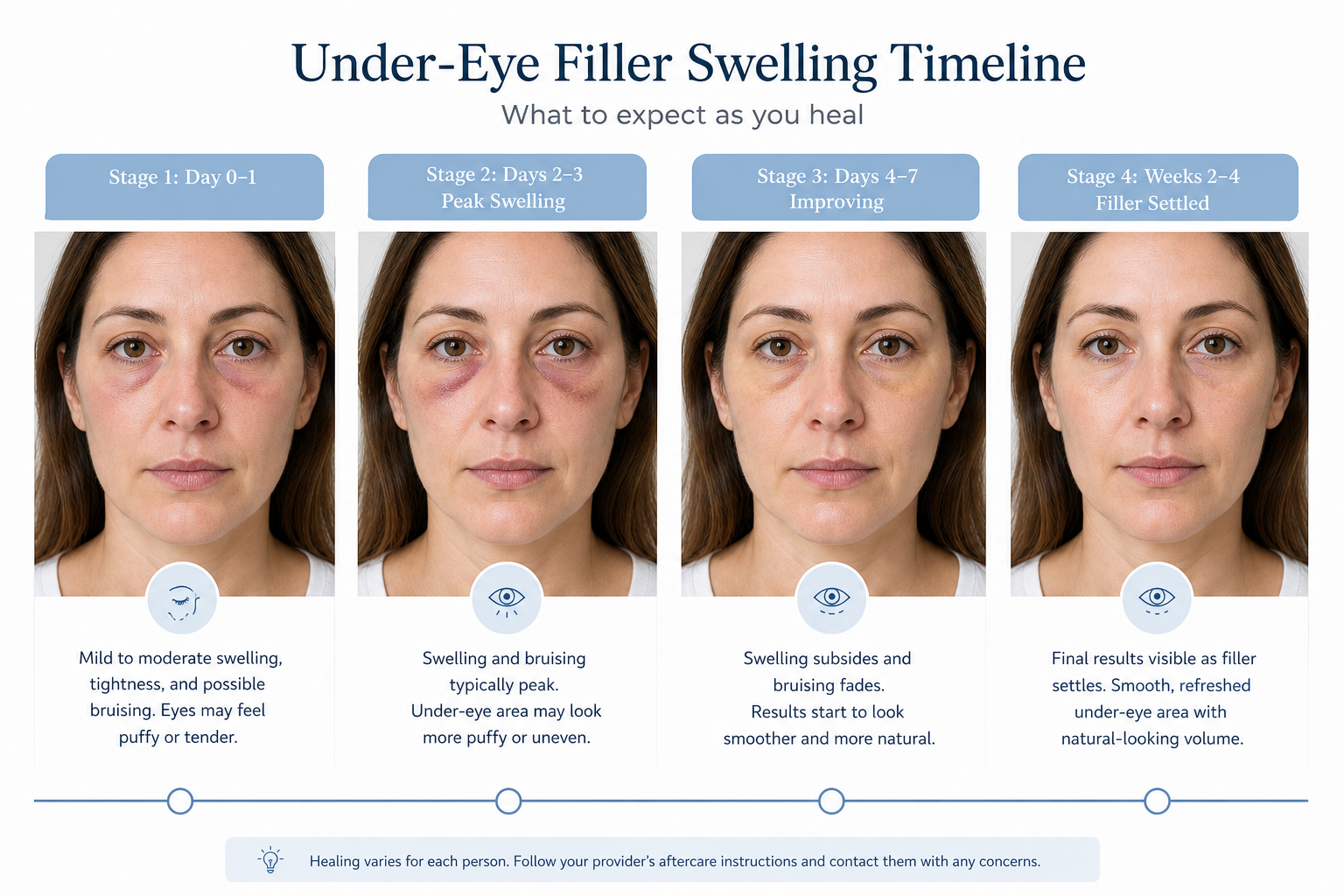

Swelling after under eye filler is one of the most common concerns patients have in the days following treatment. Understanding the under eye filler swelling stages — what is happening biologically, what you will see each day, and when the final result becomes visible — can make the recovery period significantly less stressful. This guide provides a detailed day-by-day timeline, explains the mechanisms behind each stage, and outlines what is normal versus what warrants a call to your injector.
Key Takeaways
- Swelling after under eye filler typically follows four predictable stages, with peak swelling occurring between 48 and 72 hours after treatment.
- Hyaluronic acid filler attracts water through osmotic pressure, which is the primary driver of early swelling — not just the injection trauma itself.
- Most visible swelling resolves within 7 to 10 days, but filler fully settles and integrates with surrounding tissue over 2 to 4 weeks.
- Asymmetric swelling, morning puffiness, and temporary lumpiness are common and usually resolve without intervention.
- Certain signs — including skin discoloration, worsening pain after day three, or vision changes — require prompt contact with your injector.
Why the Under-Eye Area Swells More Than Other Injection Sites
The skin beneath the eye is among the thinnest on the entire face, measuring roughly 0.5 mm in some areas compared to 2 mm elsewhere. This thin skin sits over a network of small blood vessels, the orbicularis oculi muscle, and a relatively loose connective tissue layer that allows fluid to accumulate easily. When hyaluronic acid filler is injected into the tear trough — the hollow that runs from the inner corner of the eye toward the cheek — the body mounts an immediate inflammatory response to the needle trauma. Simultaneously, the hyaluronic acid gel begins binding water through osmotic pressure, drawing fluid into the treated area. These two processes together explain why under-eye swelling can appear disproportionately dramatic compared to filler placed in the lips or cheeks.
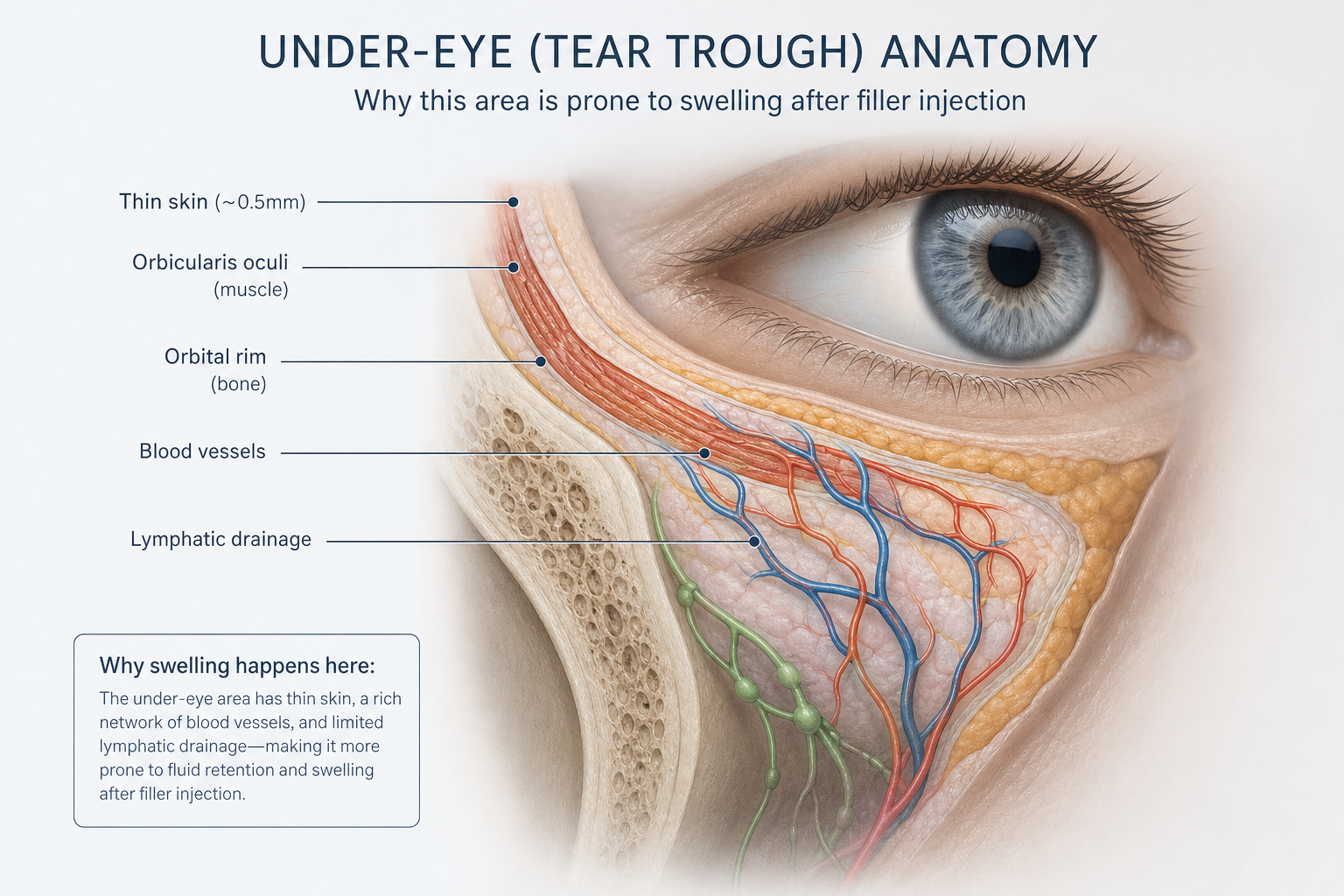
The lymphatic system in the periorbital region is also relatively sparse, meaning fluid that accumulates around the orbital rim drains more slowly than in areas with denser lymphatic networks. This is why tear trough filler swelling stages tend to last longer than swelling after, for example, lip filler, and why the recovery timeline requires patience rather than alarm.
The Four Under Eye Filler Swelling Stages: A Day-by-Day Timeline
Most patients move through four broadly predictable stages after tear trough filler. The exact timing varies depending on the volume injected, the filler product used, individual anatomy, and aftercare compliance, but the sequence below reflects the typical recovery pattern.
Stage 1 — Immediate Trauma Response (Day 0 to Day 1)
Within minutes of the injections, the under-eye area begins to swell as the body initiates its inflammatory cascade. Histamine and other inflammatory mediators are released in response to needle trauma, causing local blood vessels to dilate and become more permeable. Fluid leaks from these vessels into the surrounding tissue, producing visible puffiness that can appear within the first hour. Bruising may also develop at this stage, ranging from a faint pink tinge to a more noticeable purple mark depending on whether a small blood vessel was nicked during injection.
On day one, the area typically looks overfilled, puffy, and uneven. This is not a reflection of the final result. The filler itself has not yet begun to integrate with the surrounding tissue, and the inflammatory swelling is masking the actual volume placed. Patients are often surprised by how different — and sometimes worse — the area looks compared to immediately after the procedure. This is entirely expected. Applying a cold compress gently to the area (never pressing directly on the injection site) and keeping the head elevated can help limit the extent of early swelling.
Stage 2 — Peak Swelling (Days 2 to 3)
Peak swelling typically occurs between 48 and 72 hours after treatment. This is the stage that most patients find most distressing, and it is the point at which the water-binding action of hyaluronic acid filler is at its most pronounced. Hyaluronic acid is a naturally hydrophilic molecule — it attracts and holds water — and the cross-linked HA gel used in fillers such as Restylane and Juvederm continues drawing fluid into the treated area for the first two to three days. The degree of swelling at this stage is influenced by the specific filler product: more highly cross-linked formulations tend to attract more water and produce more pronounced swelling than softer, less cross-linked options.
Bruising, if present, is usually most visible at this stage and may appear purple, blue, or dark red. The under-eye area may look puffy enough to partially close the eye in some cases, particularly if a larger volume was injected or if the patient is prone to swelling. Morning swelling is often worse than evening swelling at this stage because fluid redistributes during sleep when the body is horizontal and the lymphatic system is less active. Gravity assists drainage when upright, so swelling typically reduces slightly throughout the day. Continuing to sleep with the head elevated on an extra pillow can help reduce this morning puffiness.
Stage 3 — Visible Improvement (Days 4 to 7)
From around day four onward, the inflammatory response begins to subside and the lymphatic system starts clearing the excess fluid more efficiently. Swelling visibly reduces during this stage, and bruising — if present — begins transitioning from purple or blue toward yellow-green as the blood pigment breaks down. Most patients feel comfortable returning to work or social activities by days five to seven, though some residual puffiness and faint bruising may still be visible under certain lighting conditions.
The filler is beginning to integrate with the surrounding tissue during this stage, but it has not yet fully settled. The area may still look slightly uneven or asymmetric, and small lumps or firmness under the skin are common. These are usually the filler itself, which softens and blends with tissue over the following weeks. Gentle massage is sometimes recommended by injectors at this stage, but patients should follow their specific practitioner’s guidance rather than massaging without instruction, as technique matters in this delicate area.
Stage 4 — Filler Settles and Final Result Emerges (Weeks 2 to 4)
By the end of the second week, the majority of swelling has resolved for most patients. The filler continues to settle and integrate with the surrounding tissue throughout weeks two to four, and the final result becomes progressively clearer during this period. Residual puffiness that persists beyond two weeks is usually minor and may only be noticeable to the patient themselves rather than to others.
The two-to-four week mark is also the appropriate time to assess whether a touch-up or top-up appointment is needed. Assessing results before this point is misleading because residual swelling can make the area appear more filled than it actually is once everything has settled. Booking a review appointment too early risks over-correction. Most experienced injectors recommend waiting a minimum of two weeks — and ideally four — before making any decisions about additional volume.
Day-by-Day Recovery Summary
| Timeframe | What You Typically See | What to Do |
|---|---|---|
| Day 0–1 | Immediate puffiness, possible bruising, overfilled appearance | Cold compress, head elevation, avoid alcohol and exercise |
| Days 2–3 | Peak swelling, bruising most visible, worse in the morning | Continue cold compress, sleep elevated, avoid heat and NSAIDs |
| Days 4–7 | Swelling reducing, bruising yellowing, area softening | Resume gentle activity, use arnica or bromelain if advised |
| Weeks 2–4 | Residual puffiness clearing, filler settles, final result visible | Assess results, book review if needed, avoid further treatment until settled |
Normal vs. Abnormal Swelling: What to Watch For
Distinguishing between expected post-procedure swelling and a sign of a complication is important. The table below outlines the key differences between normal swelling and signs that warrant professional assessment.
| Feature | Normal Swelling | Potentially Abnormal — Contact Your Injector |
|---|---|---|
| Onset | Immediate to within a few hours | New or worsening swelling after day 3–4 |
| Appearance | Diffuse puffiness, pink or purple bruising | White or grey skin patches, blue-grey discoloration (Tyndall effect) |
| Pain | Mild tenderness at injection site | Increasing pain, throbbing, or pain out of proportion |
| Symmetry | Mild asymmetry common and expected | Marked asymmetry that worsens after day 3 |
| Skin color | Normal skin tone with bruising | Blanching (white patches), mottled or dusky skin |
| Vision | Unaffected | Any change in vision — seek emergency care immediately |
The Tyndall effect is a specific complication where filler placed too superficially creates a blue-grey discoloration visible through the thin under-eye skin. It is not a swelling issue but can be mistaken for bruising. Unlike bruising, it does not resolve on its own and typically requires treatment with hyaluronidase — an enzyme that dissolves hyaluronic acid filler — to correct. If a blue-grey tint persists beyond two weeks, it is worth discussing with your injector.
Why Is One Eye More Swollen Than the Other?
Asymmetric swelling after under eye filler is extremely common and rarely indicates a problem. Several factors contribute to one side appearing more swollen than the other. The two sides of the face are naturally asymmetric, meaning the tear trough depth, orbital bone structure, and tissue thickness differ between eyes. Injectors often place slightly different volumes on each side to account for this, which can result in different swelling responses. The dominant sleeping side also plays a role: patients who sleep on their right side will typically experience more pronounced swelling on the right eye due to increased fluid pooling on that side overnight. Additionally, if one injection required more passes of the needle — for example, to treat a deeper hollow — that side may experience a stronger inflammatory response.
Asymmetric swelling almost always equalizes as the recovery progresses. If one eye remains noticeably more swollen than the other beyond two weeks, or if the asymmetry is accompanied by pain or skin changes, contact your injector for assessment.
How Filler Type Affects the Swelling Response
Not all hyaluronic acid fillers behave identically in the tear trough. The degree of cross-linking — the chemical process that determines how firm and long-lasting the gel is — directly influences how much water the filler attracts. More highly cross-linked fillers, such as those designed for structural support in the mid-face, attract more water and tend to produce more pronounced swelling when used under the eyes. Softer, less cross-linked formulations specifically designed for delicate areas, such as certain Restylane variants, generally produce less swelling and integrate more naturally with the thin periorbital tissue.
The volume injected also matters. Larger volumes require more injection passes, create more tissue trauma, and introduce more HA gel — all of which increase the swelling response. This is one reason why experienced injectors often prefer a conservative approach in the tear trough, treating in smaller increments and reviewing results after full settling rather than placing a large volume in a single session.
Aftercare to Reduce Swelling and Support Recovery
Appropriate aftercare can meaningfully reduce the severity and duration of swelling after tear trough filler, though it cannot eliminate the inflammatory response entirely.
- Cold compress: Apply a clean cold compress or chilled gel mask gently to the area for 10 to 15 minutes at a time during the first 24 to 48 hours. Avoid applying ice directly to the skin. Do not press firmly on the injection sites.
- Head elevation: Sleep with your head elevated on an extra pillow for the first three to five nights. This reduces fluid pooling around the orbital area overnight and helps limit morning swelling.
- Avoid alcohol and caffeine: Both promote vasodilation and fluid retention, which can worsen swelling. Avoid them for at least 24 to 48 hours after treatment.
- Avoid blood-thinning medications and NSAIDs: Ibuprofen, aspirin, and similar medications increase bruising risk. Avoid them unless medically necessary, and discuss any essential medications with your injector before treatment.
- Avoid strenuous exercise: Increased heart rate and blood pressure can worsen bruising and swelling. Most injectors recommend avoiding vigorous exercise for 24 to 48 hours.
- Avoid heat: Saunas, steam rooms, hot yoga, and very hot showers can increase vasodilation and worsen swelling. Avoid these for at least 48 hours.
- Arnica and bromelain: Some patients find arnica gel or bromelain supplements helpful for reducing bruising. Evidence for these is limited but they are generally considered low-risk when used as directed. Discuss with your injector before using.
- Reduce sodium intake: High sodium intake promotes water retention throughout the body, which can contribute to facial puffiness. Reducing salt in the diet during the first week may help.

Delayed Swelling: What Can Happen Weeks or Months Later
A small proportion of patients experience delayed-onset swelling that appears weeks or months after under eye filler, rather than in the immediate post-procedure period. This late-onset swelling can have several causes. Malar edema — fluid accumulation in the mid-cheek area — is one recognized complication of tear trough filler, occurring when filler placed near the orbital rim disrupts local lymphatic drainage pathways. It can appear as a persistent puffiness below the eye that is worse in the morning and improves throughout the day, and it may not respond to the same aftercare measures that help with acute post-procedure swelling.
Filler migration is another cause of delayed changes in the under-eye area. Over time, filler can shift from its original placement position, sometimes moving inferiorly toward the cheek or medially toward the nose. Migrated filler may create a visible lump or fullness in an unexpected location. Unlike acute swelling, migrated filler does not reduce with cold compresses or time, and it does not follow the typical day-by-day timeline of post-procedure recovery. If a new lump or fullness appears weeks or months after treatment, or if the area looks different from how it appeared at the four-week settled stage, this warrants assessment by your injector. Hyaluronidase can dissolve hyaluronic acid filler if migration or malar edema is confirmed, though multiple treatment sessions may be required.
Delayed inflammatory reactions, including granulomas or biofilm-related swelling, are rare but documented. These typically present as firm nodules or recurrent swelling episodes and require specialist assessment.
When Concurrent Botox May Affect Swelling Duration
Patients who receive botulinum toxin injections in the same session as under eye filler — for example, to treat crow’s feet or lower eyelid lines — may experience slightly prolonged swelling. The orbicularis oculi muscle acts as a natural pump that assists lymphatic drainage around the eye. When botulinum toxin reduces the activity of this muscle, the pumping action that helps clear fluid from the periorbital area is diminished, potentially slowing the resolution of post-filler swelling. This interaction is clinically documented and is worth discussing with your injector if you are planning combined treatments, particularly if you have a history of pronounced swelling after injectables.
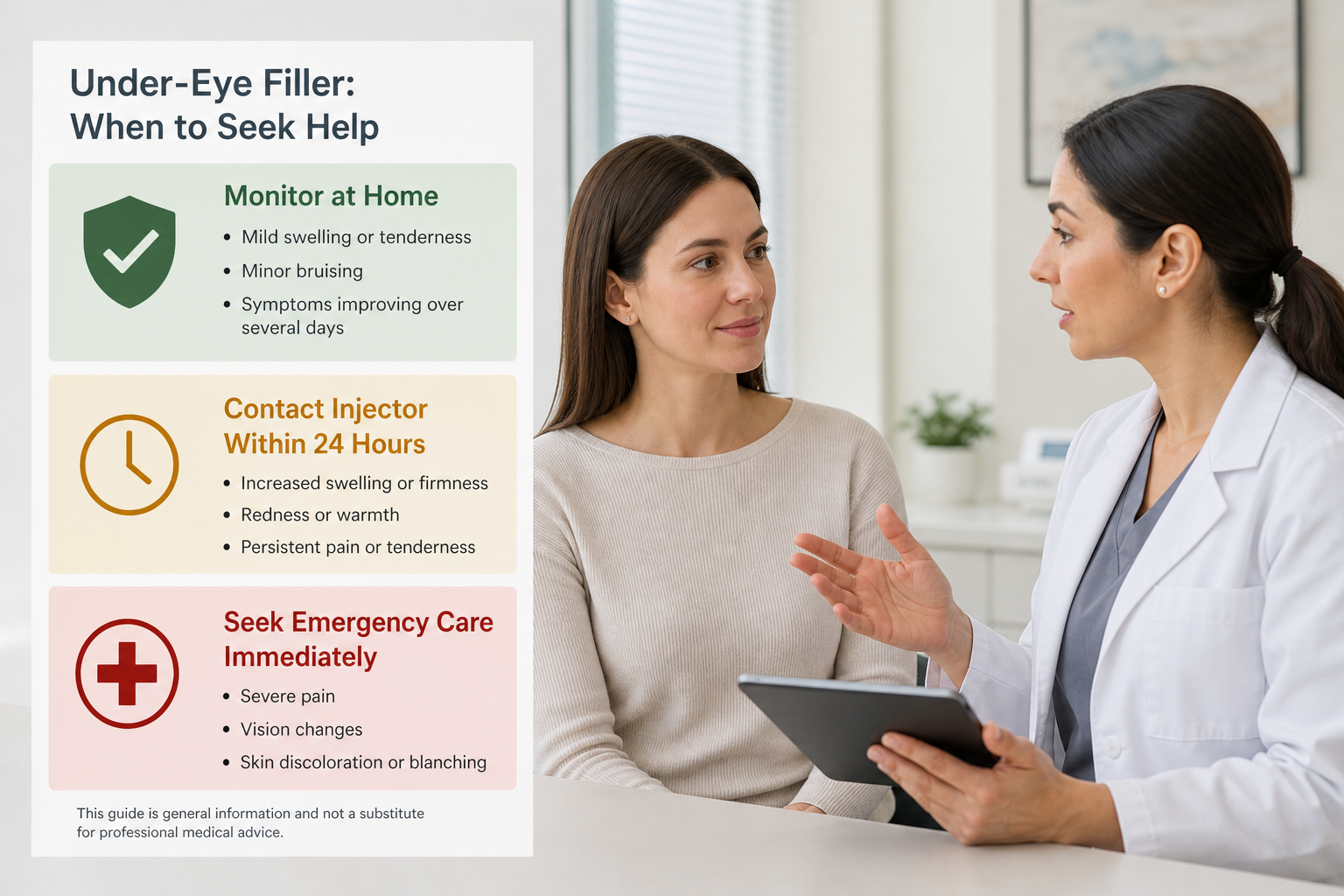
When to Contact Your Injector — A Tiered Guide
Most post-procedure swelling resolves without any intervention, but certain signs require professional assessment at different levels of urgency.
- Monitor at home: Mild asymmetric swelling, morning puffiness worse than evening puffiness, small firm lumps under the skin, bruising progressing through normal color changes (purple to yellow-green), and mild tenderness at injection sites are all expected and do not require urgent contact.
- Contact your injector within 24 hours: Swelling that is worsening after day three rather than improving, a blue-grey discoloration that does not look like bruising (possible Tyndall effect), new lumps appearing after the first week, or skin that appears unusually pale or mottled at the injection site.
- Seek emergency care immediately: Any change in vision, severe or rapidly worsening pain, skin that turns white and does not return to normal color, or signs of vascular compromise such as blanching followed by dusky discoloration. These signs, though rare, may indicate vascular occlusion — a serious complication requiring immediate medical attention.
Frequently Asked Questions
When can I judge my under eye filler results?
The final result becomes visible once the filler has fully settled and residual swelling has resolved, which typically takes two to four weeks. Assessing results before this point — particularly in the first week — is unreliable because swelling can make the area appear more filled than it will look once everything has integrated. Most injectors recommend a review appointment at the four-week mark.
Why is my swelling worse in the morning?
When you lie flat during sleep, gravity no longer assists lymphatic drainage from the periorbital area. Fluid that accumulates overnight cannot drain as efficiently as it does when you are upright. The lymphatic system is also less active during sleep. The result is that morning swelling is typically more pronounced than evening swelling, particularly in the first three to five days after treatment. Sleeping with your head elevated helps reduce this effect.
Will lumps under the skin go away on their own?
Small firm areas or lumps felt under the skin in the first one to two weeks are usually the filler itself, which has not yet fully integrated with the surrounding tissue. These typically soften and become undetectable as the filler settles over two to four weeks. Lumps that persist beyond four weeks, appear after the initial settling period, or are visible rather than just palpable should be assessed by your injector.
Is it swelling or filler migration?
Post-procedure swelling follows a predictable timeline: it peaks at 48 to 72 hours and progressively reduces over the following days and weeks. Filler migration, by contrast, typically appears as a new fullness or lump that develops after the initial swelling has resolved — often weeks or months later — in a location that does not correspond to where the filler was originally placed. Migration does not respond to cold compresses or reduce with time the way swelling does.
Can I wear makeup to cover bruising?
Most injectors advise avoiding makeup on the treated area for the first 12 to 24 hours to reduce infection risk. After this period, a color-correcting concealer (peach or orange tones neutralize purple bruising) can be applied gently. Avoid pressing or rubbing the under-eye area when applying or removing makeup during the first week.
How long does social downtime typically last?
Most patients feel socially presentable by days five to seven, when the majority of visible swelling and bruising has reduced. Some patients with minimal bruising and swelling return to normal activities within two to three days. Planning treatment at least one week before an important event is generally advisable; two weeks provides a more comfortable margin.
What if my swelling has not improved after two weeks?
Persistent swelling beyond two weeks that is not improving may indicate malar edema, filler migration, or a delayed inflammatory reaction rather than normal post-procedure recovery. Contact your injector for an in-person assessment. Hyaluronidase may be considered if the swelling is confirmed to be related to the filler placement.
What to Expect as Your Under Eye Filler Settles
Understanding the under eye filler swelling stages helps set realistic expectations and reduces unnecessary anxiety during recovery. The process is predictable for most patients: an immediate inflammatory response, peak swelling at 48 to 72 hours, progressive improvement through the first week, and full settling of the filler over two to four weeks. The final result — a smoother, more rested appearance in the tear trough — only becomes fully visible once this process is complete.
If you are concerned about your recovery at any point, contacting your injector is always appropriate. Experienced practitioners expect follow-up questions and would rather assess a concern that turns out to be normal than have a patient manage a genuine complication at home. A review appointment at two to four weeks allows your injector to assess the settled result, address any residual concerns, and discuss whether a touch-up is appropriate. Choosing a qualified, experienced injector who uses a suitable hyaluronic acid filler product for the delicate periorbital area remains the most important factor in achieving a good outcome with manageable recovery.
