
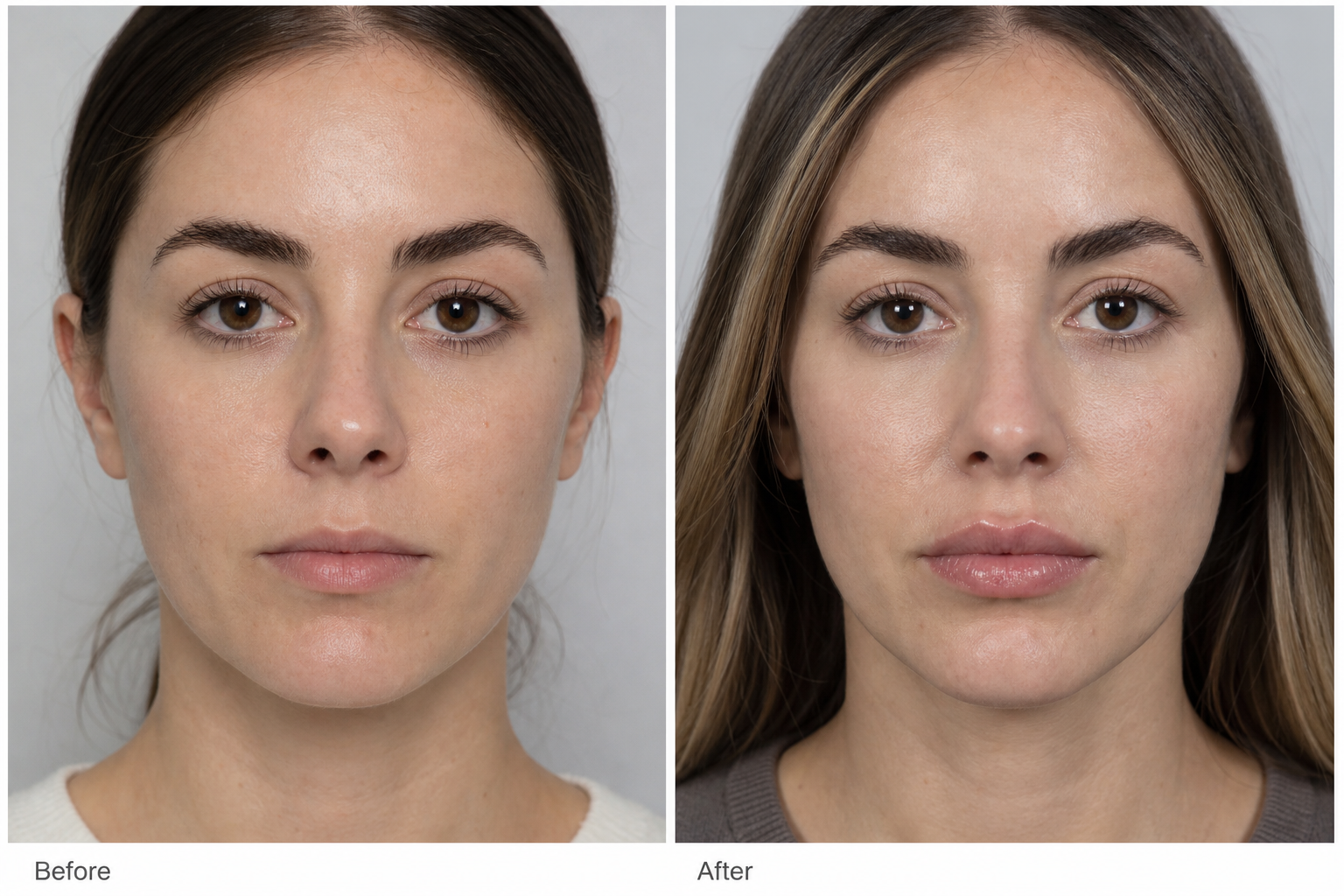

Natural lip filler before and after photos can look dramatically different depending on the injector, the product used, the volume chosen, and how long ago the treatment was performed. For most patients, the goal is not a dramatic transformation but a subtle enhancement — lips that look like a better, more defined version of their own. This guide explains what genuinely natural-looking results involve, how to evaluate before-and-after photos critically, what the recovery timeline looks like, and how to reduce the risk of an overdone outcome.
Key Takeaways
- Natural-looking lip filler enhances shape, symmetry, and volume without altering how the lips move or making them appear artificially inflated.
- Hyaluronic acid filler is the clinical standard for lip augmentation because it integrates softly with lip tissue and is reversible with hyaluronidase if needed.
- Conservative dosing — typically 0.5ml to 1ml — produces the most natural results for most patients; higher volumes carry a greater risk of an overdone look.
- Swelling peaks in the first two to three days and can make results appear more dramatic than the final outcome; the two-week mark is when settled results become visible.
- Injector skill, product selection, and technique matter more than any single factor in determining whether results look natural.
What Does Natural Lip Filler Before and After Actually Look Like?
A natural result is defined by what it does not show as much as what it does. After a well-executed treatment, the lips should appear slightly fuller, more defined along the vermillion border, and better proportioned relative to the rest of the face — but there should be no visible lumps, no obvious injection points, no filler migration beyond the natural lip border, and no loss of natural lip movement. At rest and in animation — talking, smiling, laughing — the lips should move freely and look like they belong to the person’s face.
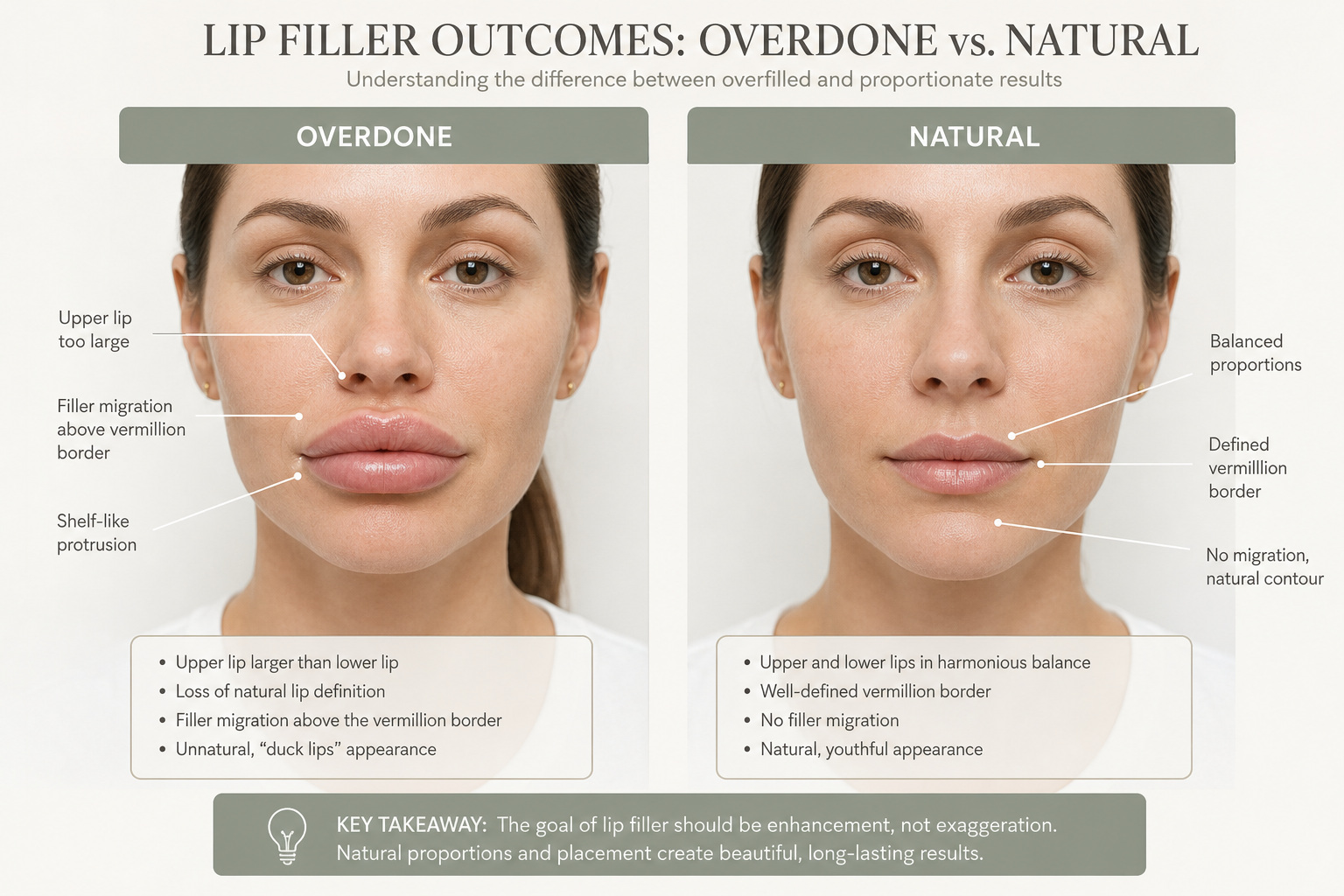
The most common visual changes in a natural before-and-after comparison include improved cupid’s bow definition on the upper lip, a softer and more even vermillion border, a modest increase in lip projection, and better lip symmetry between the left and right sides. In patients with age-related volume loss, the result may also include a subtle softening of fine perioral lines around the mouth. What natural lip filler does not look like is a shelf-like protrusion, an upper lip that is larger than the lower, or lips that appear stiff or immobile.
How Much Filler Gives a Natural Result?
Volume is one of the most important variables in achieving a natural outcome. The right amount depends on the patient’s starting lip size, their facial proportions, and their personal goals — but general guidelines help set realistic expectations.
| Volume | Typical Result | Best Suited For | Risk Level |
|---|---|---|---|
| 0.5ml | Subtle hydration, soft border definition, minimal volume increase | First-time patients, thin lips, maintenance top-ups | Lowest |
| 1.0ml | Noticeable fullness, improved symmetry, clearer cupid’s bow | Most patients seeking visible but natural enhancement | Low to moderate |
| 1.5ml | Fuller, more prominent lips; shape becomes more dramatic | Patients with naturally fuller lips wanting more volume | Moderate |
| 2ml+ | Significant augmentation; higher risk of unnatural appearance | Rarely appropriate for a natural look; staged approach preferred | Higher |
For patients with naturally thin lips, starting with 0.5ml and building gradually over multiple appointments — a gradual enhancement approach — significantly reduces the risk of an overdone result. Attempting to achieve a large volume increase in a single session on thin lips is one of the most common causes of the duck lips appearance that most patients are trying to avoid.
Upper and lower lip ratio also matters. Aesthetically, the lower lip is naturally fuller than the upper, with a commonly referenced proportion of approximately 1:1.6 (upper to lower). Overfilling the upper lip beyond the lower lip’s volume is a key contributor to an unnatural outcome. A skilled injector will assess these proportions before treatment and plan the distribution of filler accordingly.
Filler Products Used for Natural-Looking Results
Hyaluronic acid filler is the established clinical standard for lip augmentation. Hyaluronic acid is a substance found naturally in the body, and when formulated as a soft injectable gel, it integrates with lip tissue in a way that allows for natural movement and expression. It is also reversible — an enzyme called hyaluronidase can dissolve hyaluronic acid filler if a patient is unhappy with their results or if a complication arises, which makes it a reassuring option for first-time patients.
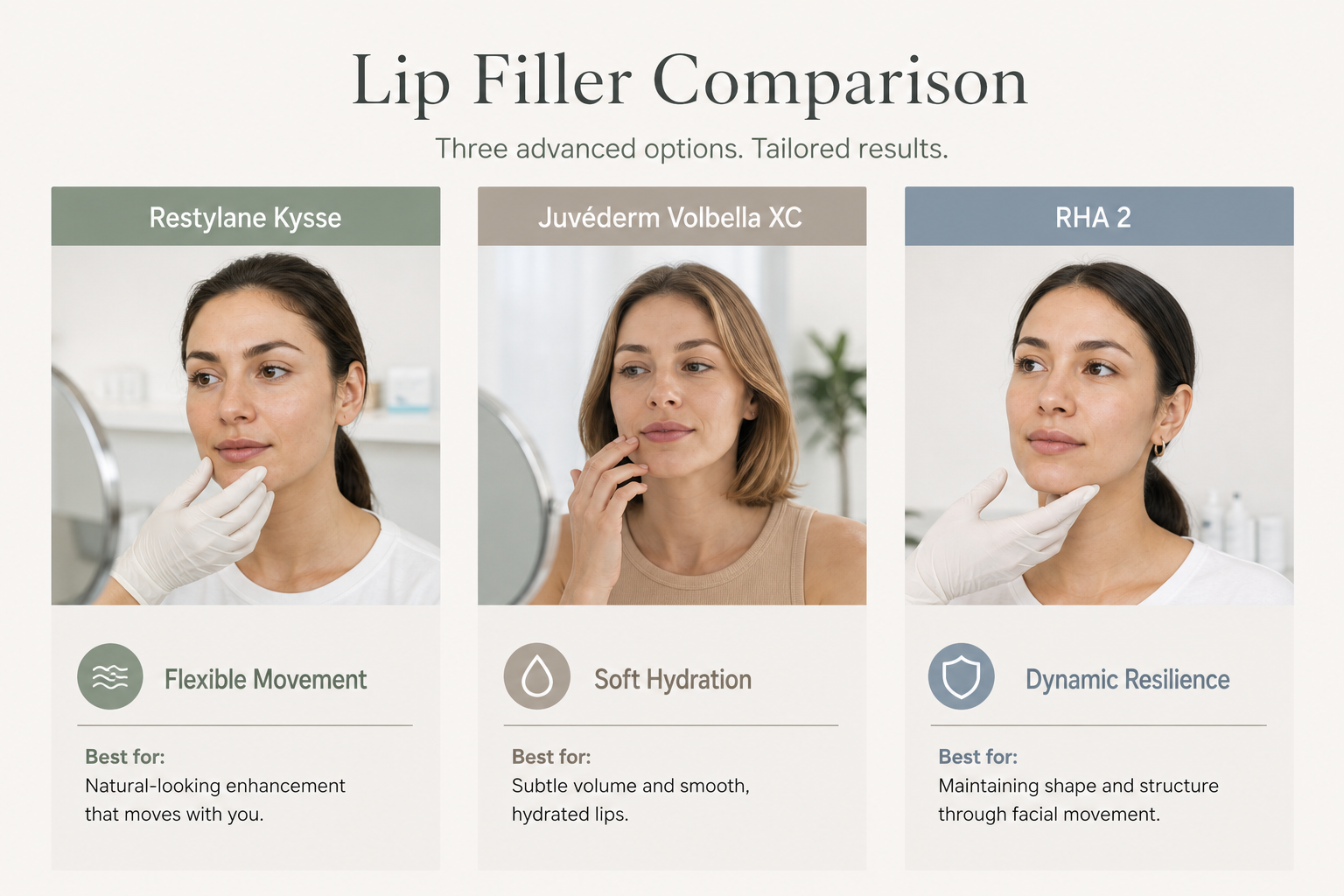
Not all hyaluronic acid fillers behave identically in the lips. Product viscosity — how thick or fluid the gel is — affects how it moves within the tissue and how natural the result feels. Products commonly used for natural lip results include Restylane Kysse, which is formulated with a flexible cross-linking technology designed to move with the lips during expression; Juvéderm Volbella XC, a softer, lower-viscosity product suited to subtle hydration and fine border definition; and RHA 2, a resilient hyaluronic acid filler designed to adapt to dynamic facial movement. The choice of product should be matched to the patient’s lip anatomy, the specific goals of treatment, and the injector’s clinical experience with each formulation.
Injection Techniques That Support Natural Results
The technique used to place filler is as important as the product itself. Several approaches are used by experienced injectors to achieve natural-looking lip augmentation, and many practitioners combine more than one method within a single treatment.
The microdroplet technique involves placing very small, precise amounts of filler at multiple points across the lip. This distributes volume evenly, reduces the risk of lumps or irregularities, and allows the injector to build shape gradually with fine control. It is particularly well-suited to patients seeking subtle enhancement or those with thin lips where precision is critical.
The Russian lip technique uses vertical injections directed toward the base of the lip to create height and projection rather than outward volume. The result tends to be a more defined, heart-shaped lip with a prominent cupid’s bow and a lifted appearance, while keeping the filler within the natural lip border. This technique requires significant anatomical knowledge and is not appropriate for every patient.
The cannula method uses a blunt-tipped flexible tube rather than a sharp needle. Because a cannula can be threaded through the tissue from a single entry point, it reduces bruising and trauma, and some injectors find it easier to distribute filler smoothly along the vermillion border. It is not universally preferred, and the choice between needle and cannula depends on the injector’s training and the specific area being treated.
Vermillion border tracing — placing filler precisely along the lip’s outer edge — defines the lip border and improves cupid’s bow definition without adding bulk to the body of the lip. This technique is often used alone for patients who want definition rather than volume, or in combination with body filler for a more complete result.
The Recovery Timeline: What to Expect Day by Day
One of the most important things to understand about natural lip filler before and after is that the immediate result is not the final result. Swelling is a normal and expected part of the process, and it can make the lips appear significantly more dramatic in the first few days than they will look once the filler settles.
- Day 0–1: Lips will be swollen, possibly bruised, and may feel numb or tender. The result will look more exaggerated than the final outcome. Some patients experience asymmetry at this stage due to uneven swelling.
- Days 2–3: Swelling typically peaks. Lips may look overfilled or uneven. This is normal and does not reflect the final result. Bruising, if present, is usually most visible at this point.
- Days 4–7: Swelling begins to subside noticeably. The shape starts to normalize and the lips begin to feel softer. Most patients feel comfortable returning to social activities by the end of this period.
- Days 10–14: The two-week mark is when most patients see results that closely represent the final outcome. Filler has integrated with the surrounding tissue, swelling has largely resolved, and the true shape and volume are visible.
- 4 weeks: The fully settled result. Any residual swelling has resolved and the filler has adapted to the lip’s natural movement patterns. This is the appropriate time to assess whether a touch-up is needed.
Common aftercare advice includes avoiding intense heat (saunas, steam rooms, hot yoga) for approximately two weeks, avoiding vigorous massage of the lips, and not scheduling dental appointments or facials immediately after treatment. These precautions help reduce the risk of filler migration and support even integration. Patients should follow the specific aftercare guidance provided by their own practitioner.
Natural Lip Movement: An Underappreciated Quality Signal
Most discussions of natural lip filler results focus on static appearance — how the lips look in a photograph. But how the lips move is an equally important quality signal that is often overlooked. Natural-looking lip filler should not restrict movement or create a stiff, immobile appearance when the patient talks, smiles, or laughs.
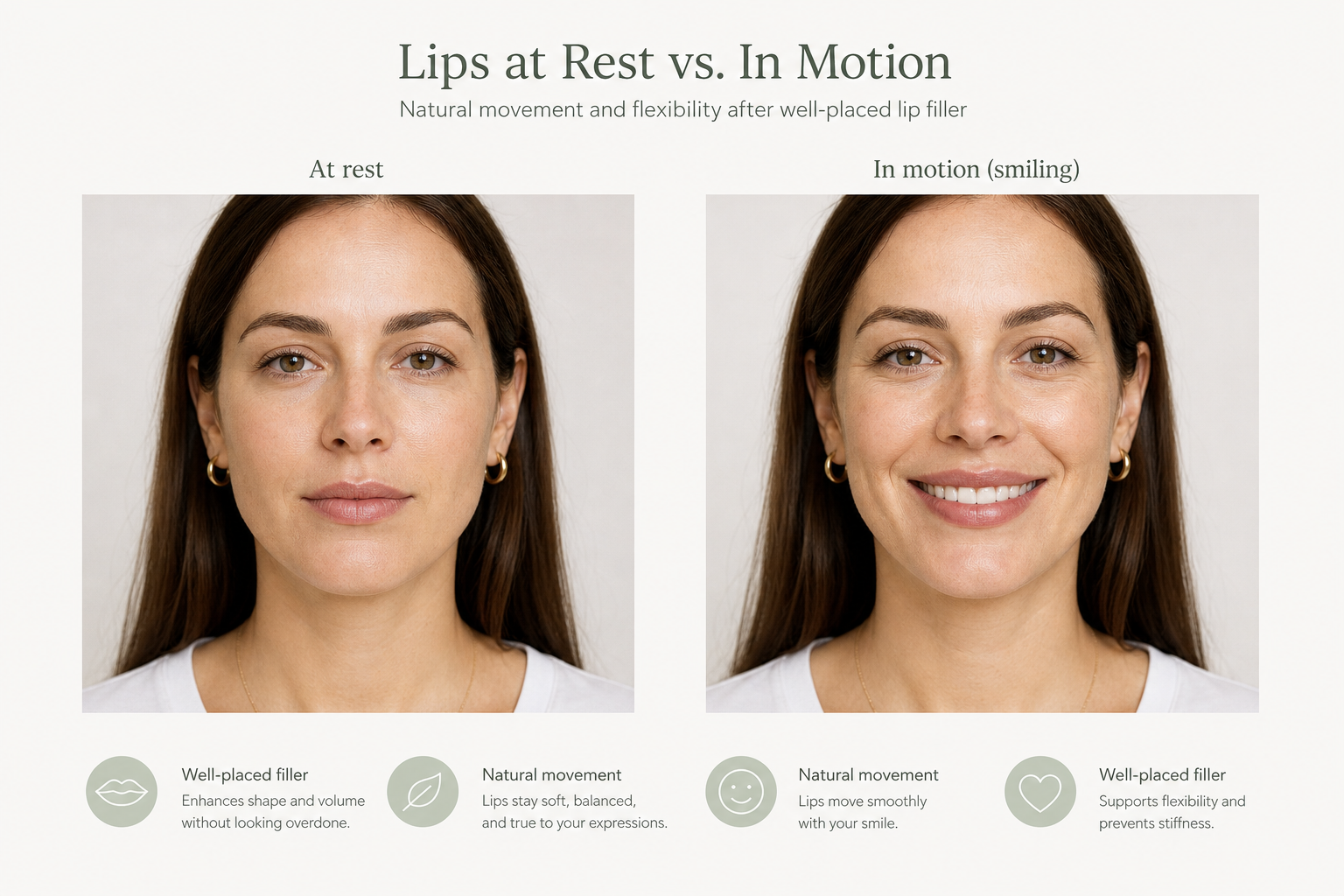
Overfilled lips, or lips treated with a product that is too viscous for the anatomy, can appear normal in a still image but look unnatural in motion — a distinction that matters significantly in real life. When evaluating an injector’s portfolio, it is worth asking whether video examples of healed results are available, not just static photographs. A lip that moves naturally at rest and in animation is the hallmark of well-placed, appropriately dosed filler matched to the right product for that patient’s tissue.
Younger Lips vs. Mature Lips: Different Goals, Different Results
Natural lip filler before and after results look different depending on the patient’s age and the underlying reason for treatment. Younger patients typically seek augmentation — adding volume and definition to lips that are naturally thin or asymmetric. For this group, the priority is shape and proportion: improving the cupid’s bow, defining the vermillion border, and creating balanced upper and lower lip volume without making the lips look artificially large.
Mature patients often have different concerns. With age, the lips lose volume, the vermillion border becomes less defined, the philtral columns (the ridges between the nose and upper lip) flatten, and fine perioral lines develop around the mouth. For these patients, the goal of lip filler is often restoration rather than augmentation — returning the lips to a proportion and definition that reflects a younger version of themselves rather than creating a new shape. The before-and-after comparison for a mature patient may show less dramatic volume change but a meaningful improvement in lip definition, perioral line softening, and overall facial balance. These are distinct treatment goals that require different planning and technique.
How to Evaluate Before-and-After Photos Critically
Before-and-after photographs are one of the most useful tools for assessing an injector’s skill, but they require critical evaluation. Not all portfolio images are equally informative, and some can be misleading.
- Check the timing: Immediate post-treatment photos taken the same day show swollen results, not final outcomes. Look for photos labelled as taken at two weeks or later.
- Check the lighting: Consistent lighting between the before and after image is important. Dramatic changes in lighting angle or intensity can make lips appear more or less full than they are.
- Check for editing: Heavy filtering or retouching on after photos is a warning sign. Unedited, natural-light photographs of healed results are the most reliable.
- Check lip movement: If video content is available, assess how the lips move in animation, not just at rest.
- Check proportions: Does the upper lip remain smaller than or equal to the lower lip? Is the result in proportion with the patient’s face, or does it look disproportionate?
- Check for migration: Filler that has spread beyond the natural lip border creates a blurred or puffy appearance above the upper lip. This is a sign of overfilling or poor technique.
- Look for variety: A portfolio showing natural results across different starting lip shapes and ages demonstrates broader skill than a portfolio of similar patients.
How to Avoid Duck Lips and Overdone Results
The overdone look — sometimes called duck lips — is the outcome most patients are trying to avoid. It is characterized by an upper lip that protrudes forward or is disproportionately larger than the lower lip, a loss of the natural lip border, visible filler migration above the vermillion border, and lips that appear stiff or shelf-like. Understanding what causes this outcome helps patients make better decisions before treatment.
The most common causes include overfilling (using more volume than the anatomy can accommodate naturally), prioritizing size over shape, overcorrecting the upper lip relative to the lower, and using a product with viscosity that is too high for the lip tissue. Repeated treatments without allowing previous filler to fully settle or dissolve can also cause gradual accumulation that leads to an unnatural appearance over time.
Conservative dosing is the most reliable preventive strategy. Choosing shape before size — deciding on the desired lip contour first and then adding only the volume needed to achieve it — produces more natural outcomes than simply requesting maximum fullness. A staged treatment plan, where volume is built gradually across multiple appointments, gives both the patient and the injector the opportunity to assess results at each stage and adjust accordingly.
Filler Reversibility: What Happens If You Are Not Happy
One of the most reassuring aspects of hyaluronic acid lip filler is that it is reversible. If a patient is unhappy with their results — whether due to asymmetry, excessive volume, migration, or simply a change of preference — hyaluronidase can be injected to dissolve the filler. Hyaluronidase is an enzyme that breaks down hyaluronic acid, and it works relatively quickly, with most of the filler dissolving within 24 to 48 hours of treatment.
Dissolution is not always a perfect reset — the lips may appear slightly irregular immediately after dissolving, and some patients choose to wait a few weeks before reassessing or retreating. However, the option to reverse the result provides meaningful reassurance for first-time patients who are uncertain about committing to a permanent change. It is worth discussing this option explicitly during the consultation, including the clinic’s policy on correction appointments and any associated costs.
If a patient simply wants to wait rather than dissolve, hyaluronic acid filler naturally breaks down over time. Lip filler longevity varies depending on the product used, the patient’s metabolism, lifestyle factors, and the volume placed, but most patients find that results last approximately six to twelve months before a maintenance appointment is needed.
Choosing the Right Injector for Natural Results
The single most important factor in achieving natural-looking lip filler results is the skill and philosophy of the injector. Technical knowledge of lip anatomy, experience with multiple injection techniques, and a conservative dosing approach are more predictive of a natural outcome than any specific product or device.
When selecting an injector, consider the following:
- Medical credentials and training: Lip filler should be performed by a qualified medical professional with specific training in facial anatomy and injectable treatments. Credentials vary by country, so it is worth verifying that the practitioner holds appropriate qualifications and is registered with a relevant regulatory body.
- Portfolio of healed results: Ask to see before-and-after photographs of healed results (not same-day photos) across a range of patients. Look for consistency, natural proportions, and evidence of subtle enhancement rather than dramatic transformation.
- Consultation quality: A skilled injector will assess your lip anatomy at rest and in motion, discuss your goals honestly, and be willing to recommend a conservative starting point or decline treatment if it is not appropriate. An injector who agrees to any volume without assessment is a warning sign.
- Willingness to discuss risks: A responsible practitioner will explain the risks of treatment — including bruising, swelling, asymmetry, and the small but serious risk of vascular complications — before proceeding.
- Philosophy on gradual enhancement: Injectors who advocate for staged treatment and conservative dosing are more likely to produce natural results than those who encourage maximum volume in a single session.
Frequently Asked Questions
How long does it take to see the final result after lip filler?
Most patients see results that closely represent the final outcome at the two-week mark, once swelling has resolved and the filler has integrated with the surrounding tissue. A full four weeks is generally recommended before assessing whether a touch-up is needed, as residual swelling can persist beyond the first two weeks in some patients.
Will 0.5ml of lip filler look natural?
For most patients, 0.5ml produces a subtle enhancement — soft border definition, mild hydration, and a slight improvement in lip symmetry — rather than a dramatic volume increase. It is a common starting point for first-time patients and those with naturally thin lips, and it carries the lowest risk of an overdone appearance.
Can lip filler look completely natural on thin lips?
Yes, but thin-lipped patients require particular care. Starting with a conservative volume (0.5ml), using a low-viscosity product, and building gradually over multiple appointments significantly reduces the risk of an unnatural result. Attempting a large volume increase in a single session on thin lips is one of the most common causes of disproportionate outcomes.
How do I know if my injector is experienced enough?
Ask to see a portfolio of healed results across different patients, not just immediate post-treatment photographs. A thorough consultation that includes an assessment of your lip anatomy, an honest discussion of realistic outcomes, and a willingness to recommend a conservative approach are all positive indicators of an experienced injector.
Is lip filler painful?
Most lip filler products contain lidocaine, a local anaesthetic, which reduces discomfort during injection. A topical numbing cream is also commonly applied before treatment. Most patients describe the sensation as mild to moderate discomfort rather than significant pain, though individual tolerance varies.
What is the difference between a lip flip and lip filler?
A lip flip uses a small amount of botulinum toxin injected into the muscle above the upper lip to cause it to relax and roll slightly outward, creating the appearance of a fuller upper lip without adding volume. Lip filler adds physical volume using a hyaluronic acid gel. Some patients benefit from a combination of both approaches, particularly those who want upper lip definition without significant volume increase.
How long does lip filler last?
Lip filler longevity varies between patients and depends on the product used, the volume placed, and individual factors such as metabolism and lifestyle. Most patients find that results last approximately six to twelve months before a maintenance appointment is needed. The lips are a high-movement area, which means filler tends to break down more quickly here than in less dynamic facial areas.
Is Lip Filler the Right Choice for Your Goals?
Natural lip filler before and after results are achievable for most patients when the right product, volume, and technique are matched to the individual’s anatomy and goals. The key variables — injector skill, conservative dosing, appropriate product selection, and a gradual enhancement approach — are within a patient’s control through careful research and consultation before committing to treatment.
Lip filler is not suitable for everyone. Patients who are pregnant or breastfeeding, have active infections near the treatment area, or have certain autoimmune or bleeding conditions may not be appropriate candidates. A thorough consultation with a qualified medical professional is the appropriate starting point for anyone considering treatment.
For patients whose primary concern is perioral lines rather than volume, alternative treatments such as skin-quality injectables, resurfacing procedures, or botulinum toxin for dynamic lines may be worth discussing alongside or instead of filler. For those seeking volume restoration after significant age-related loss, a combination approach may produce more balanced results than filler alone.
If you are considering lip filler, booking a consultation with a qualified, experienced injector — one who will assess your anatomy honestly, show you a portfolio of healed results, and recommend a conservative starting point — is the most reliable way to determine whether treatment is appropriate for your goals and what realistic results may look like for you specifically.
