

One of the most common questions before a lip filler appointment is simply: how much do I actually need? The honest answer depends on your starting lip anatomy, your aesthetic goals, and whether you have had filler before. Most patients receive between 0.5 mL and 1 mL of hyaluronic acid filler per session, but understanding what those amounts look like in practice — and what factors influence the right choice — can help you have a much more productive conversation with your injector.
Key Takeaways
- Most patients start with 0.5 mL (half a syringe) or 1 mL (a full syringe) of hyaluronic acid filler per session.
- The right amount depends on your natural lip anatomy, age-related changes, prior filler history, and desired outcome.
- A conservative, gradual approach reduces the risk of overfilling and helps achieve natural-looking results.
- Hyaluronic acid lip fillers are reversible, which makes starting with less a lower-risk strategy for first-time patients.
- A qualified, experienced injector will assess your individual lip anatomy before recommending a volume — no single amount suits everyone.
What Is a Syringe of Lip Filler, and How Much Is That Really?
Lip filler is measured in millilitres (mL), and one standard syringe contains 1 mL of product — equivalent to roughly one-fifth of a teaspoon. That is a very small amount of fluid, which is why the difference between 0.5 mL and 1 mL can be surprisingly subtle in practice. To put it another way, a full syringe of hyaluronic acid filler is approximately the volume of a few drops of water. The gel-like consistency of cross-linked HA filler means it integrates into lip tissue rather than sitting on top of it, which is why even modest volumes can produce a visible but natural-looking change.
Hyaluronic acid filler is the most widely used material for lip augmentation because it is biocompatible, gradually broken down by the body, and — importantly — reversible. If a patient is unhappy with the result, an enzyme called hyaluronidase can dissolve the filler. This reversibility makes HA filler a sensible choice for anyone trying lip augmentation for the first time.
0.5 mL vs. 1 mL Lip Filler: What Each Amount Typically Achieves
The most practical way to understand lip filler dosage is to compare what a half syringe and a full syringe typically deliver for different patients and goals.
| Amount | Typical Effect | Best Suited To | Key Considerations |
|---|---|---|---|
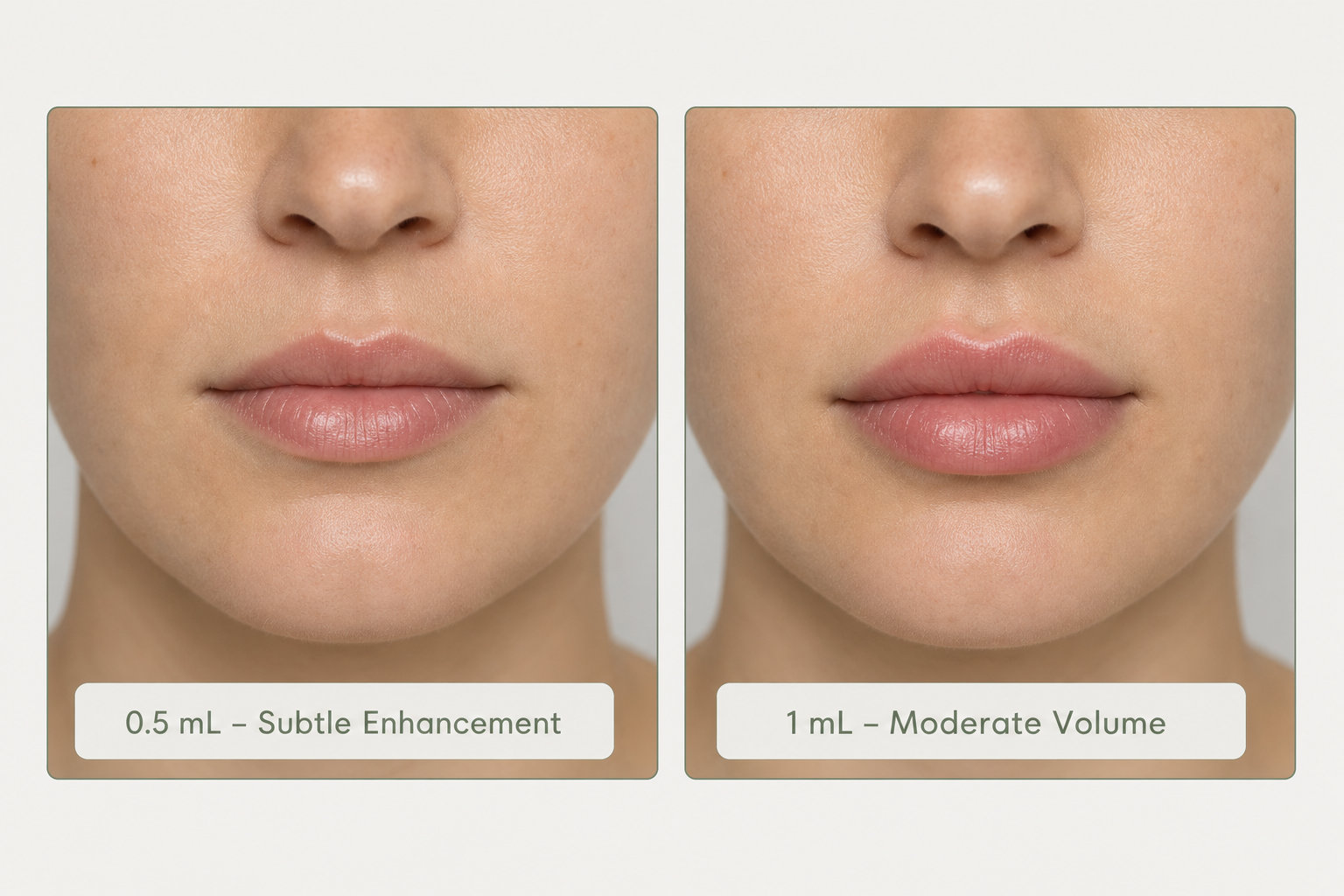
| 0.5 mL (half syringe) | Subtle hydration, mild definition, slight volume increase | First-time patients, those wanting a natural look, patients with medium or fuller lips | Conservative starting point; easy to build on; lower risk of overfilling |
| 1 mL (full syringe) | Noticeable volume increase, improved Cupid’s bow definition, enhanced lip projection | Patients with naturally thin lips, those wanting moderate enhancement, repeat patients | Still achievable as a natural result with skilled technique; most common single-session amount |
| 1.5–2 mL (multiple syringes) | Significant volume, dramatic change in lip shape and projection | Patients with significant age-related volume loss, those seeking a fuller aesthetic | Usually achieved across staged appointments rather than in one session; higher risk of migration if rushed |
It is worth noting that FDA-cleared dosing guidance for some HA lip filler products permits up to 1.5 mL per lip per session, with a perioral maximum of up to 6 mL. In practice, most experienced injectors work well within these limits and rarely approach the upper end in a single appointment, particularly for new patients.
Goal-Based Dosage: Matching Volume to Your Desired Outcome
Rather than choosing an amount based on what sounds right, it helps to think about what you actually want to achieve. Different aesthetic goals correspond to different volume ranges.
| Aesthetic Goal | Typical Volume Range | What to Expect |
|---|---|---|
| Subtle hydration and smoothness | 0.5 mL | Lips look healthier and slightly more defined; change is noticeable up close but not dramatic |
| Moderate plump and definition | 0.5–1 mL | Visible increase in volume; improved vermilion border and Cupid’s bow; natural-looking results |
| Fuller, more projected lips | 1–1.5 mL | Clear enhancement; noticeable change in lip shape and projection; may require staged appointments |
| Significant augmentation or correction of age-related thinning | 1.5–2 mL across sessions | Substantial volume restoration; typically achieved gradually over multiple visits |
Patients who want a dramatic result are generally better served by a gradual approach across two or more appointments rather than receiving a large volume in a single session. This allows the tissue to adapt, reduces the risk of filler migration, and gives both patient and injector the opportunity to assess the result before adding more product.
How Lip Anatomy Affects the Amount You Need
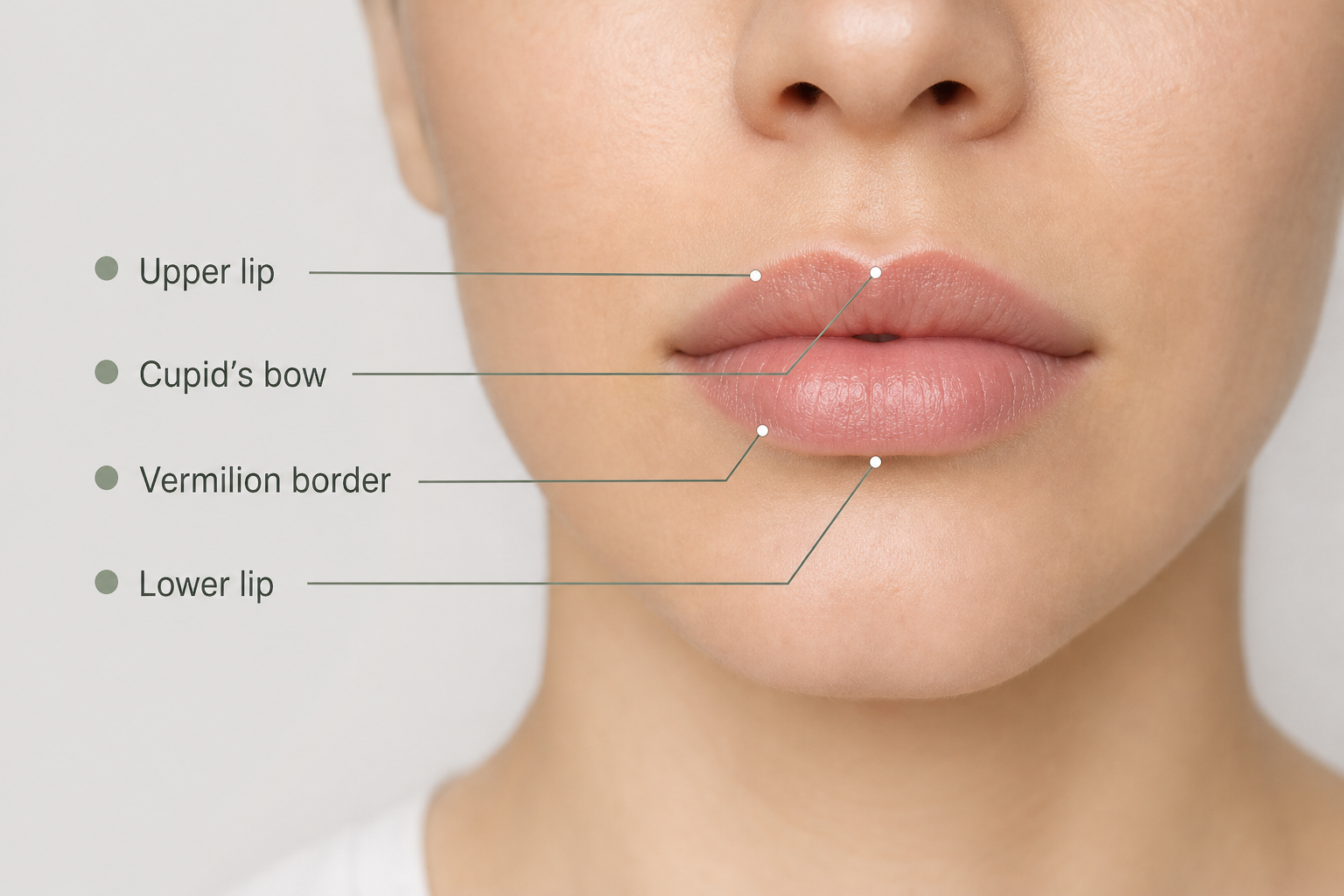
Lip anatomy varies considerably between individuals, and this is one of the most important factors in determining the appropriate starting volume. An experienced injector will assess the natural size and shape of your upper and lower lips, the definition of your vermilion border, the prominence of your Cupid’s bow, and the overall balance of your lips relative to your face before recommending a volume.
Upper-to-Lower Lip Ratio
A commonly referenced anatomical guideline is the upper-to-lower lip ratio. Research suggests that a ratio of approximately 1:1.5 or 1:1.6 (upper to lower) is associated with an aesthetically balanced appearance, though individual preferences and facial proportions vary. When planning how to distribute filler across a 1 mL syringe, for example, an injector might place 0.4 mL in the upper lip and 0.6 mL in the lower lip to respect this natural relationship. Placing too much volume in the upper lip relative to the lower can create a disproportionate or unnatural appearance — one of the contributing factors to the so-called duck lips outcome that most patients want to avoid.
Lip Type and Starting Volume
Patients with naturally thin lips typically require more product to achieve a noticeable result compared to those who already have medium or fuller lips. Someone with very thin lips may find that 0.5 mL produces only a subtle change, while a patient with medium lips might find the same amount delivers exactly the enhancement they wanted. The table below offers a general starting-point guide, though individual assessment always takes priority.
| Natural Lip Type | Suggested Starting Volume | Notes |
|---|---|---|
| Thin lips | 1 mL | May need staged appointments to reach desired fullness without overfilling |
| Medium lips | 0.5–1 mL | Half a syringe often sufficient for subtle enhancement; full syringe for moderate change |
| Fuller lips | 0.5 mL or less | Small amounts for definition or hydration; volume augmentation rarely needed |
Factors That Influence How Much Lip Filler You May Need
Beyond lip anatomy and aesthetic goals, several other factors affect the appropriate dosage for any individual patient.
First-Time vs. Repeat Patient
For first-time lip filler patients, conservative dosing is almost always the recommended approach. Starting with 0.5 mL allows you to see how your lips respond to the product, how much swelling you experience, and whether the result aligns with your expectations before committing to more. Many first-time patients are pleasantly surprised by how much a half syringe achieves. Repeat patients who already have some residual filler in their lips may need less product to maintain their result, or may choose to build gradually toward a fuller look over several sessions.
Age and Age-Related Volume Loss
Lip anatomy changes with age. The upper lip tends to elongate and flatten, the vermilion border becomes less defined, and the overall volume of the lips decreases as collagen production slows. Patients in their forties, fifties, and beyond who are seeking perioral rejuvenation rather than augmentation may benefit from a different approach to volume distribution compared to younger patients seeking enhancement. In these cases, filler may be used to restore lost structure and definition rather than simply to add volume, and the amount needed will depend on the degree of age-related change present.
Prior Filler History and Residual Volume
Patients who have had lip filler before may retain some residual hyaluronic acid in their lip tissue, particularly if they are returning within six to twelve months of their last treatment. An injector will assess how much product remains before recommending a top-up volume. Repeat treatments often last longer than the first — some evidence suggests that subsequent sessions may maintain results for 20 to 40 percent longer — which can also influence how frequently patients return and how much they need at each visit.
Metabolism and Tissue Characteristics
Individual metabolism affects how quickly the body breaks down hyaluronic acid filler. Patients with faster metabolisms may find their results fade more quickly, while those with slower metabolisms may retain volume for longer. Tissue elasticity also plays a role: lips with good elasticity tend to respond well to smaller volumes, while lips with reduced tissue quality may require more product to achieve a comparable result.
Filler Formulation
Not all hyaluronic acid fillers behave identically. Products such as Juvederm Ultra XC, Juvederm Volbella, Restylane, Restylane Silk, and RHA (resilient hyaluronic acid) formulations have different degrees of cross-linking, which affects their firmness, longevity, and how they integrate into lip tissue. Softer, less cross-linked formulations are generally preferred for the lips because they move naturally with facial expressions. The choice of product can influence how much volume is needed to achieve a given result.
Lip Filler Shapes and Their Volume Requirements
Lip augmentation is not simply about adding volume — the placement and distribution of filler determines the shape of the result. Different aesthetic styles require different approaches to volume distribution, and some shapes require more product than others. A patient wanting enhanced Cupid’s bow definition with minimal overall volume increase may need less filler than someone seeking increased lip projection or a more rounded lower lip. Discussing the specific shape you want to achieve, rather than just a volume number, helps your injector plan the treatment more precisely.
Common shape goals include enhanced Cupid’s bow definition, increased lip height (particularly in the upper lip), improved vermilion border clarity, greater lower lip fullness, and overall symmetry correction. Each of these goals places filler in slightly different anatomical locations and may require different volumes in the upper versus lower lip.
When More Filler Is Not the Answer
One of the most important things to understand about lip augmentation is that there is an anatomical limit to how much filler any set of lips can comfortably hold. Exceeding this limit does not produce better results — it produces distortion. Signs that a patient may be approaching or beyond their anatomical limit include lips that appear stiff or immobile, filler migration beyond the vermilion border into the surrounding skin, a disproportionate upper lip that overhangs the lower, or a duck lips appearance caused by excessive forward projection.
These outcomes are not simply aesthetic preferences — they are signals that the tissue is under strain. An experienced injector will recognise when adding more product would worsen rather than improve the result, and will advise accordingly. If you feel your lips no longer look natural but you are being encouraged to add more filler, seeking a second opinion from a qualified practitioner is a reasonable step. Hyaluronidase can dissolve accumulated HA filler if correction is needed.
How Long Do Lip Fillers Last, and When Should You Top Up?
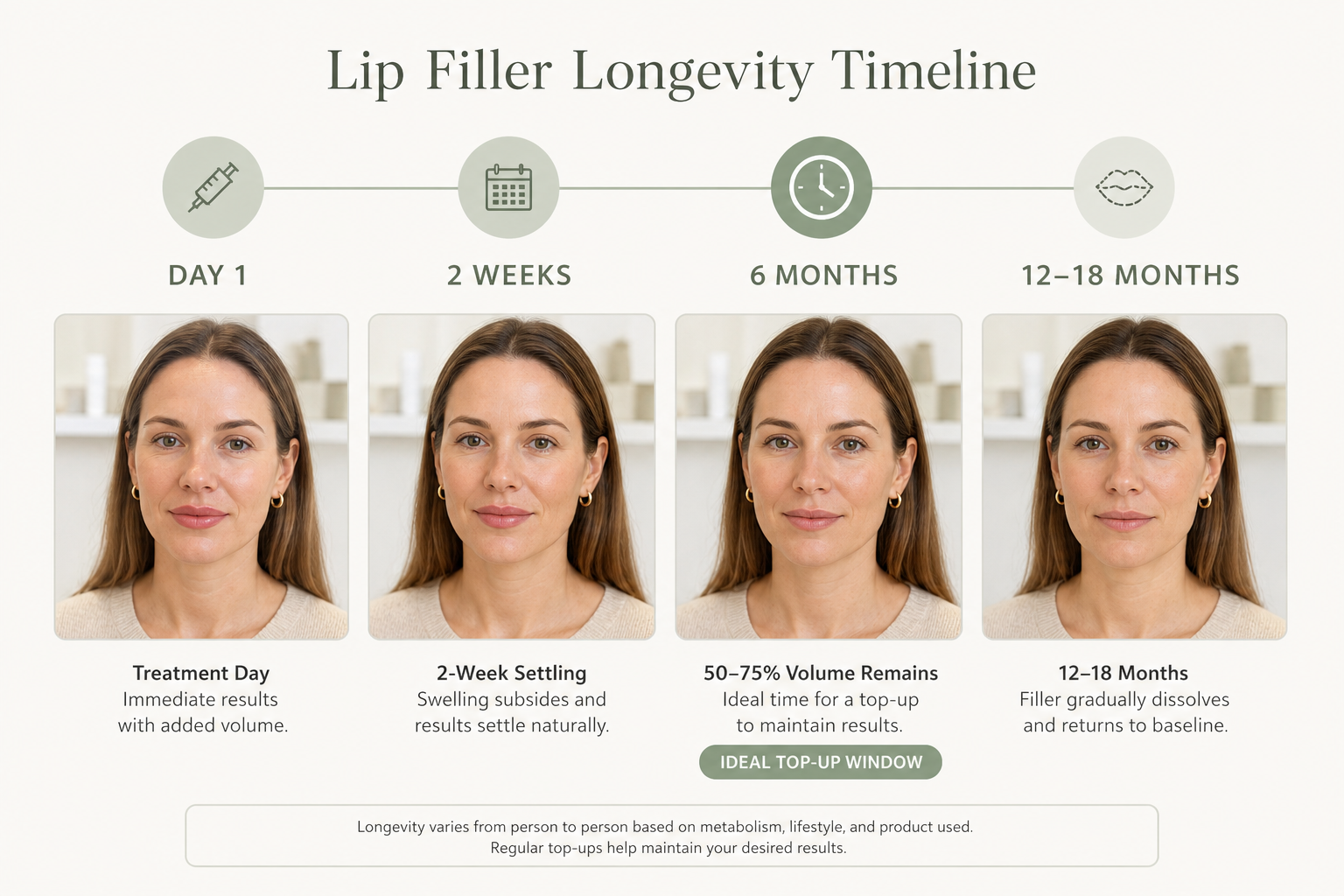
Hyaluronic acid lip fillers typically last between six and twelve months, though some patients retain results for up to eighteen months depending on the product used, their metabolism, and the volume placed. The lips are a high-movement area, which means filler tends to break down more quickly here than in less mobile facial regions.
A useful rule of thumb for touch-up timing is to return when approximately 50 to 75 percent of your original volume remains, rather than waiting until the filler has fully dissolved. Maintaining some residual product means less filler is needed at each appointment to restore the result, and the cumulative benefit of repeat treatments means results may last progressively longer over time. Most patients settle into a touch-up schedule of every six to twelve months.
It is also worth understanding cumulative volume. A patient who receives 1 mL per session and returns twice a year may accumulate 2 mL or more of product in their lips over time if residual filler is not fully dissolved between appointments. This is not inherently problematic, but it is a reason to have an honest conversation with your injector about total accumulated volume and whether it remains appropriate for your anatomy.
The Two-Week Follow-Up: Why It Matters for Dosing
Most clinics recommend a follow-up appointment approximately two weeks after lip filler treatment. This timing is deliberate: it takes around ten to fourteen days for post-treatment swelling to fully resolve and for the filler to settle into its final position. Assessing the result before this point can be misleading, as lips often appear fuller immediately after treatment than they will once swelling subsides.
The two-week check-up is the appropriate moment to decide whether a top-up is needed. If a patient received 0.5 mL and the settled result is less than they hoped for, a small additional amount can be added at this point. This staged approach — starting conservatively and topping up if needed — is far preferable to placing too much product in a single session and then needing correction.
Myth vs. Fact: Common Misconceptions About Lip Filler Amounts
- Myth: More filler always means better value. Fact: Placing more product than your anatomy can support increases the risk of migration, distortion, and an unnatural appearance. Starting conservatively and building gradually is more cost-effective in the long run because it avoids the need for corrective treatment.
- Myth: 1 mL always looks overdone. Fact: In the hands of an experienced injector, 1 mL of hyaluronic acid filler can produce entirely natural-looking results, particularly for patients with thin lips or significant age-related volume loss.
- Myth: You need the same amount every time. Fact: The amount needed at each appointment depends on how much residual filler remains, how your lips have changed, and whether your aesthetic goals have evolved.
- Myth: Duck lips are caused by using too much filler. Fact: Duck lips are more often the result of poor placement — specifically, placing too much product in the upper lip or too close to the surface — rather than total volume alone. Technique matters as much as quantity.

Frequently Asked Questions
Is 0.5 mL enough for a first-time lip filler patient?
For many first-time patients, 0.5 mL is a sensible starting point. It delivers a subtle but visible enhancement, allows you to assess how your lips respond, and leaves room to add more at a follow-up if needed. Patients with very thin lips may find that 0.5 mL produces only a modest change and may prefer to start with a full syringe after discussing this with their injector.
Can 1 mL of lip filler look natural?
Yes. One millilitre of hyaluronic acid filler can produce entirely natural-looking results when placed by a skilled injector who respects your natural lip anatomy and proportions. The outcome depends far more on technique and product placement than on the volume used.
How is a 1 mL syringe typically divided between the upper and lower lip?
A common approach is to place approximately 0.4 mL in the upper lip and 0.6 mL in the lower lip, reflecting the natural upper-to-lower lip ratio. However, this varies depending on the patient’s anatomy, the specific shape goals, and whether asymmetry correction is needed. Your injector will determine the most appropriate distribution for your individual lips.
How long does lip filler last?
Most patients find that hyaluronic acid lip filler lasts between six and twelve months. Some products and patients may retain results for up to eighteen months. Repeat treatments often last longer than the first, and maintaining a regular touch-up schedule can help sustain results with smaller amounts of product over time.
What happens if I get too much lip filler?
If too much filler is placed, or if the result is not what you hoped for, hyaluronidase can be used to dissolve hyaluronic acid filler. This is one of the key safety advantages of HA-based products. Correction should be performed by a qualified practitioner, and it is advisable to wait several weeks after dissolution before considering retreatment.
Does lip filler hurt?
Most lip filler treatments involve the application of a topical numbing cream before the procedure, and many HA filler products also contain lidocaine to reduce discomfort during injection. Some patients experience mild stinging or pressure during treatment, but significant pain is uncommon. Swelling and tenderness in the days following treatment are normal and typically resolve within one to two weeks.
How do I avoid the duck lips look?
The duck lips appearance is most commonly caused by excessive volume in the upper lip, poor product placement, or filler placed too superficially. Choosing an experienced injector who takes a conservative approach, respects your natural lip anatomy, and uses an appropriate filler formulation significantly reduces this risk. Starting with a smaller amount and building gradually is also protective.
Choosing the Right Amount for Your Lips
There is no universal answer to how much lip filler you need, because the right amount is specific to your anatomy, your goals, and your treatment history. What is consistent across patients is that a conservative, gradual approach — starting with 0.5 mL or 1 mL and building from there if needed — produces the most reliable, natural-looking results with the lowest risk of complications. Staged appointments allow both you and your injector to assess the result at each stage and make informed decisions about whether to add more product.
Before any treatment, a thorough consultation with a qualified, experienced injector is essential. A good injector will assess your lip anatomy, discuss your aesthetic goals honestly, explain what different volumes are likely to achieve for your specific lips, and recommend a starting point that prioritises your safety and the integrity of your natural features. If you are considering lip augmentation for the first time, approaching it as a gradual process rather than a single transformation is likely to leave you with results you are genuinely happy with.
