
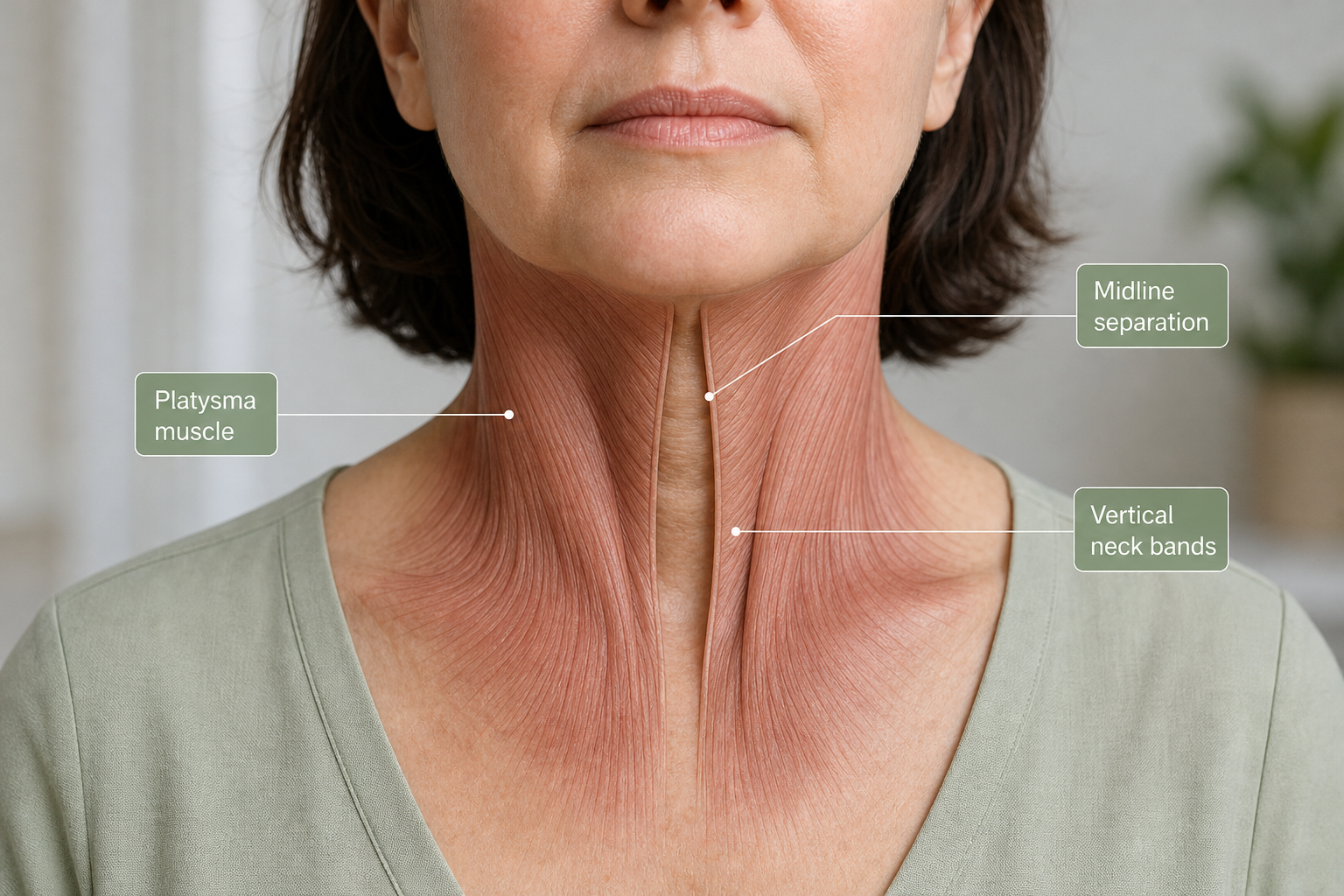

Platysmal neck bands — those vertical cords that run down the front of the neck — are one of the most common concerns patients raise when discussing cervical aging. They can appear gradually over years or seem to emerge quite suddenly, and understanding why they form is the first step toward making an informed decision about whether and how to address them.
Key Takeaways
- Platysmal bands form when the platysma muscle — a broad, thin sheet of muscle covering the front of the neck — separates at the midline and becomes more prominent beneath thinning skin.
- Both active muscle contraction and progressive skin laxity contribute to their appearance, though research increasingly points to muscle activity as the primary driver.
- Age of onset varies: dynamic bands often become noticeable in the 40s, while static bands visible at rest tend to emerge in the mid-50s or later — though genetics and low body fat can push onset earlier.
- Accelerating factors include UV exposure, smoking, rapid weight loss, and genetic predisposition — all of which affect either the muscle or the overlying skin.
- Platysmal bands are not simply loose skin, and neck exercises alone are unlikely to resolve them once they are established.
What Is the Platysma Muscle?
The platysma is a broad, thin sheet of muscle that sits just beneath the skin of the anterior neck, extending from the upper chest and collarbone up to the jawline and lower face. Unlike most muscles, it lies within the subcutaneous layer — directly under the skin — rather than deep within the body. This superficial position is precisely what makes it so visible when it changes with age or activity.
The platysma functions primarily as a depressor muscle: it pulls the corners of the mouth downward and tenses the skin of the neck during strong facial expressions such as grimacing, straining, or speaking forcefully. Because it connects to the lower facial muscles, the platysma activates during a wide range of everyday facial animations — not just deliberate neck movements. This is why some people notice their neck cords becoming more visible when they talk, laugh, or clench their jaw.
Along the midline of the neck, the left and right sides of the platysma meet — or, in many people, do not fully meet. The degree to which the medial edges of the muscle interdigitate at the midline varies considerably between individuals, and this anatomical variation plays a significant role in who develops prominent platysmal bands and when.
The Primary Cause: Midline Separation and Muscle Change
The most fundamental cause of visible platysmal bands is midline separation — a process in which the inner borders of the left and right platysma muscles gradually pull apart, creating two distinct vertical ridges beneath the skin. In younger individuals with good skin thickness and adequate subcutaneous fat, even some degree of muscle separation may not be visible at the surface. As the overlying skin thins and loses volume with age, however, the separated muscle edges become increasingly apparent.
Research published in peer-reviewed literature has highlighted an important nuance here: platysmal band prominence is not simply a passive consequence of skin sagging over a static structure. The muscle itself undergoes change. With age, the platysma can develop what clinicians describe as a hyperfunctional pattern — the muscle becomes overactive or tonically contracted, pulling its medial edges further apart and creating more defined vertical cords. This distinction matters clinically because it helps explain why treatments targeting muscle activity, such as botulinum toxin injections, can be effective even when skin laxity is relatively mild.
The interplay between muscle separation, muscle hyperfunction, and skin laxity means that platysmal bands are genuinely multifactorial. No single cause explains every case, and the relative contribution of each factor varies between patients.
How Aging Drives Platysmal Band Formation
Natural aging is the single most consistent driver of platysmal band development. Several age-related changes converge to make the neck progressively more vulnerable over time.
Loss of Collagen and Elastin
Collagen and elastin are the structural proteins that give skin its firmness and resilience. From the mid-20s onward, collagen production declines gradually, and the quality of existing collagen fibres deteriorates. Elastin — which allows skin to spring back after stretching — also degrades with age. In the neck, this loss of collagen and elastin is particularly consequential because neck skin is naturally thinner than facial skin, contains less subcutaneous fat, and is rarely protected with SPF in the way that facial skin often is. The result is that neck skin thins and loses elasticity faster than many patients expect, reducing its ability to conceal the underlying muscle structure.
Reduction in Subcutaneous Fat
A thin layer of subcutaneous fat normally sits between the skin and the platysma, providing a cushioning effect that softens the appearance of the underlying muscle. As this fat layer diminishes with age — or is lost more rapidly through significant weight loss — the platysma becomes more visible through the overlying skin. In patients with naturally low body fat or those who have lost weight quickly, this effect can be pronounced even at a relatively young age.
Progressive Muscle Change
Beyond the skin, the platysma muscle itself changes structurally over decades. The medial edges that once approximated at the midline gradually separate further, and the muscle may develop a more prominent, ropey quality. These changes are part of the broader pattern of cervical aging and tend to progress steadily from the 40s onward, becoming more marked in the 50s and 60s.
Dynamic Bands vs. Static Bands: An Important Distinction
Not all platysmal bands behave the same way, and understanding the difference between dynamic and static bands is useful both for setting realistic expectations and for understanding which treatments may be appropriate.
| Feature | Dynamic Bands | Static Bands |
|---|---|---|
| Visibility | Appear during muscle contraction; less visible at rest | Visible at rest, worsen with contraction |
| Typical age of onset | Often first noticed in the 40s | More common from mid-50s onward |
| Primary driver | Active muscle contraction and hyperfunction | Muscle separation combined with significant skin laxity |
| Skin laxity | Mild to moderate | Moderate to significant |
| Treatment implications | May respond well to botulinum toxin (neuromodulators) | May require surgical or combined approaches |
Dynamic bands are driven primarily by muscle contraction. They become visible when the platysma activates — during speaking, grimacing, or straining — and may be barely noticeable when the face is relaxed. These bands typically emerge earlier in life, often in the 40s, and are more amenable to treatment with botulinum toxin injections, which temporarily reduce muscle activity.
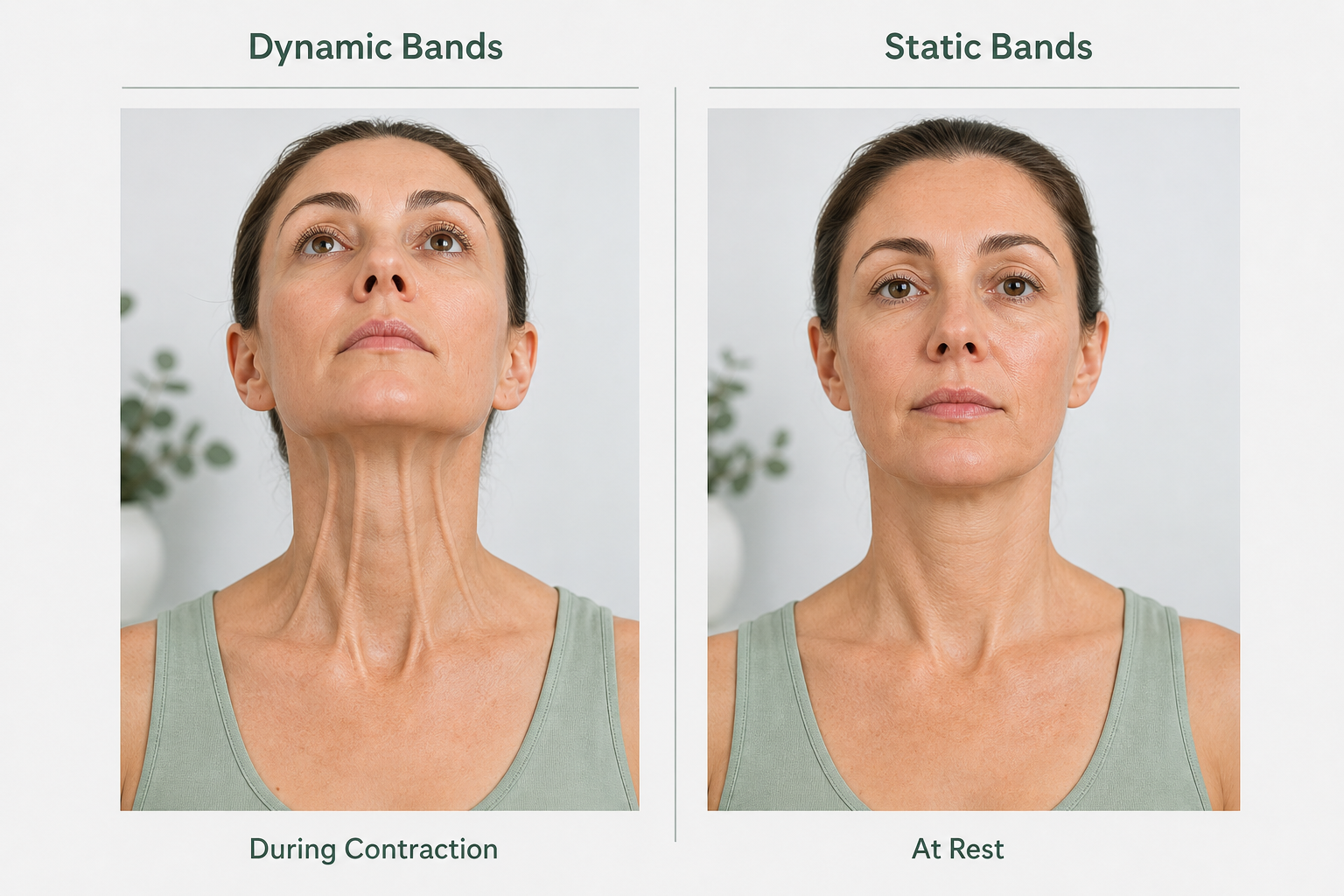
Static bands, by contrast, are visible even when the neck is completely at rest. They reflect a more advanced stage of platysmal change, where midline separation is significant and the overlying skin no longer has sufficient thickness or elasticity to conceal the muscle edges. Static bands tend to develop from the mid-50s onward, though patients with a strong genetic predisposition, very low body fat, or significant cumulative sun damage may develop them earlier. Surgical options such as platysmaplasty or a neck lift are more commonly considered for static bands, as neuromodulators alone may provide only partial improvement at this stage.
Contributing and Accelerating Factors
While age-related muscle and skin changes are the foundation of platysmal band development, several additional factors can accelerate the process or cause bands to appear earlier than they otherwise would.
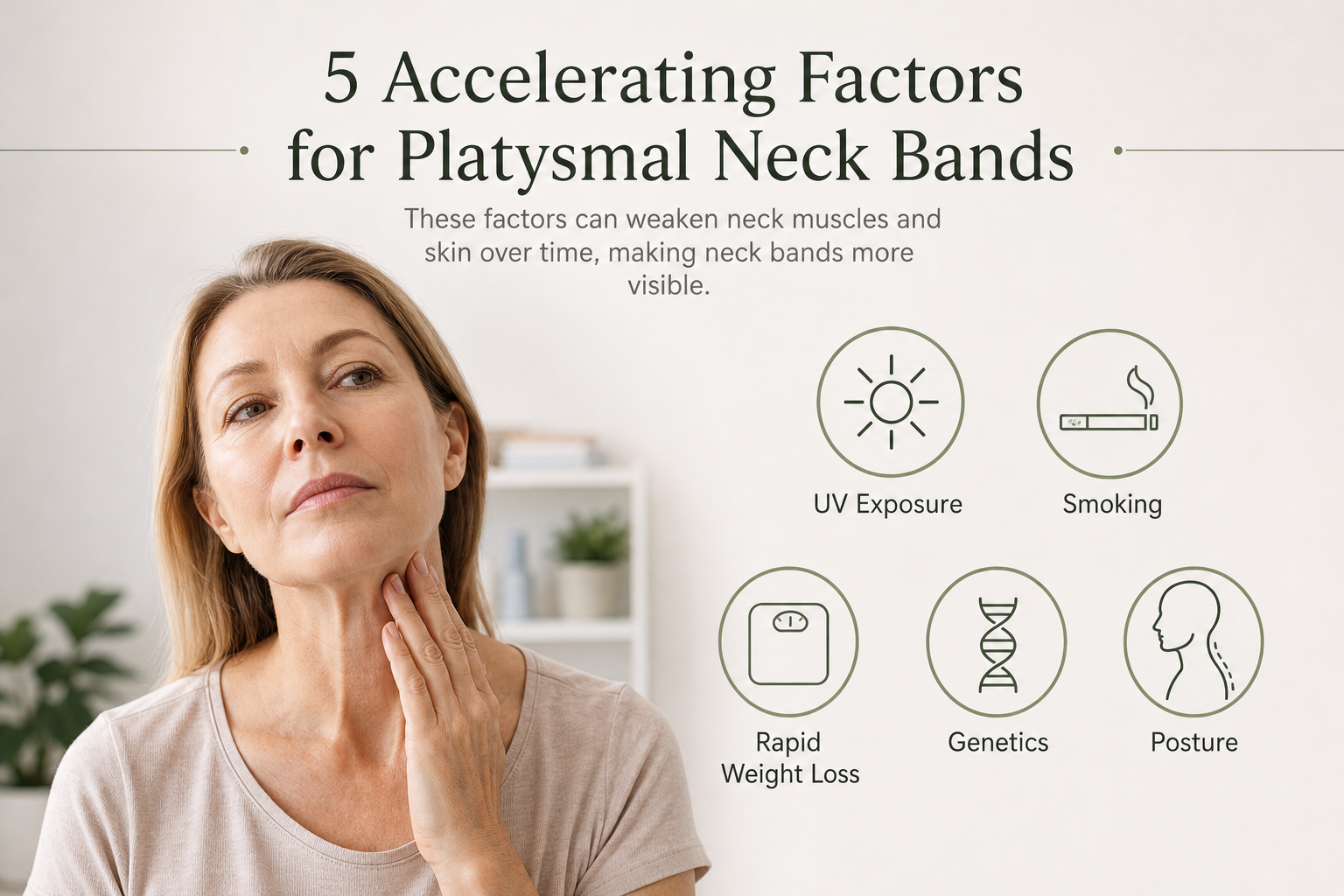
Genetic Predisposition
Genetics plays a meaningful role in determining both the anatomy of the platysma and the rate at which skin ages. Some individuals inherit a platysma with medial edges that are naturally less well-connected at the midline, making separation more likely at an earlier age. Others may have a hereditary tendency toward thinner skin or reduced collagen production. A genetic predisposition to prominent platysmal bands is one reason why some patients in their 30s develop noticeable neck cords despite otherwise healthy lifestyle habits.
UV Exposure and Sun Damage
Chronic UV exposure accelerates the breakdown of collagen and elastin in the skin, compounding the natural age-related decline. The neck is particularly vulnerable because it is frequently exposed to sunlight but is often overlooked when applying sun protection. Over years and decades, cumulative UV damage thins the skin of the neck significantly, reducing its ability to conceal the platysma beneath. Patients who have spent considerable time outdoors without neck sun protection often show more advanced skin laxity in the neck relative to their age.
Rapid Weight Loss
Significant or rapid weight loss — whether through dietary changes, bariatric surgery, or GLP-1 receptor agonist medications such as semaglutide (Ozempic) or tirzepatide (Mounjaro) — can unmask platysmal bands that were previously concealed by subcutaneous fat. When the fat layer beneath the neck skin diminishes quickly, the skin may not have sufficient time or elasticity to contract around the reduced volume, leaving it loose over the underlying muscle. This is an increasingly recognised pattern as GLP-1 medications become more widely used, and it can affect patients who are relatively young and who may not have expected to develop visible neck cords at this stage of life.
Smoking
Smoking impairs collagen synthesis through several mechanisms, including the generation of free radicals that degrade collagen fibres and the reduction of blood flow to the skin. Over time, this accelerates skin thinning and loss of elasticity in the neck, making the platysma more visible at an earlier age. Patients who smoke tend to show more pronounced skin laxity relative to their chronological age, which can contribute to earlier or more severe platysmal band formation.
Posture and Repetitive Neck Movements
The relationship between posture and platysmal bands is frequently misunderstood. Looking down at a phone or screen — sometimes called “tech neck” — does not directly cause platysmal bands to form. However, repeated neck flexion and the associated muscle activity may emphasise existing bands or make them more noticeable in individuals who are already predisposed. The platysma is activated during many neck and facial movements, so habitual patterns of movement can influence how prominently bands appear during activity, even if they are not the root cause of the underlying anatomical change.
Why the Neck Is Uniquely Vulnerable
Several anatomical features make the neck disproportionately susceptible to the changes that produce platysmal bands, compared with other areas of the face and body.
Neck skin is naturally thinner than facial skin and contains less subcutaneous fat, providing a thinner buffer between the surface and the underlying muscle. It is also subject to constant movement — turning, flexing, and extending throughout the day — which places ongoing mechanical stress on the skin and its structural proteins. Despite this, the neck is frequently neglected in skincare routines and sun protection habits, meaning it accumulates UV damage without the benefit of the protective measures many people apply to their faces.
The platysma’s unique position as a superficial muscle — lying directly beneath the skin rather than deep within the body — means that even modest changes in muscle tone, muscle separation, or overlying skin thickness translate directly into visible surface changes. This combination of thin skin, high movement, UV neglect, and a superficially positioned muscle makes the neck one of the earliest and most visibly affected areas during the aging process.
Common Misconceptions About Platysmal Bands
Several persistent myths about platysmal bands are worth addressing directly, as they influence the decisions patients make about prevention and treatment.
“Platysmal bands are just loose skin.” This is a common but inaccurate simplification. While skin laxity contributes to their visibility, the primary structure responsible for platysmal bands is the platysma muscle itself — specifically its separation at the midline and its activity pattern. Treatments that address only the skin surface are unlikely to resolve established bands.
“Neck exercises will fix them.” Strengthening or stretching the neck muscles does not reverse midline separation or reduce the hyperfunction of a platysma that has already developed prominent bands. In some cases, exercises that repeatedly activate the platysma may even make dynamic bands more noticeable during activity. Exercise has general health benefits but is not an evidence-based treatment for established platysmal bands.
“Only older people develop them.” While platysmal bands are more common and more severe in older patients, they can appear in individuals in their 30s — particularly those with a strong genetic predisposition, naturally low body fat, significant UV exposure history, or rapid weight loss. Age of onset varies considerably between individuals.
“They will go away on their own.” Platysmal bands are a structural change in the muscle and overlying skin. Without intervention, they tend to become more prominent over time rather than resolving spontaneously.
When Do Platysmal Bands Typically Appear?
The age of onset for platysmal bands varies depending on the interplay of genetic, anatomical, and lifestyle factors. As a general pattern, dynamic bands — those that appear during muscle contraction — are often first noticed in the early to mid-40s. At this stage, the skin has thinned enough that the platysma becomes visible during facial animation, even if it remains relatively inconspicuous at rest.
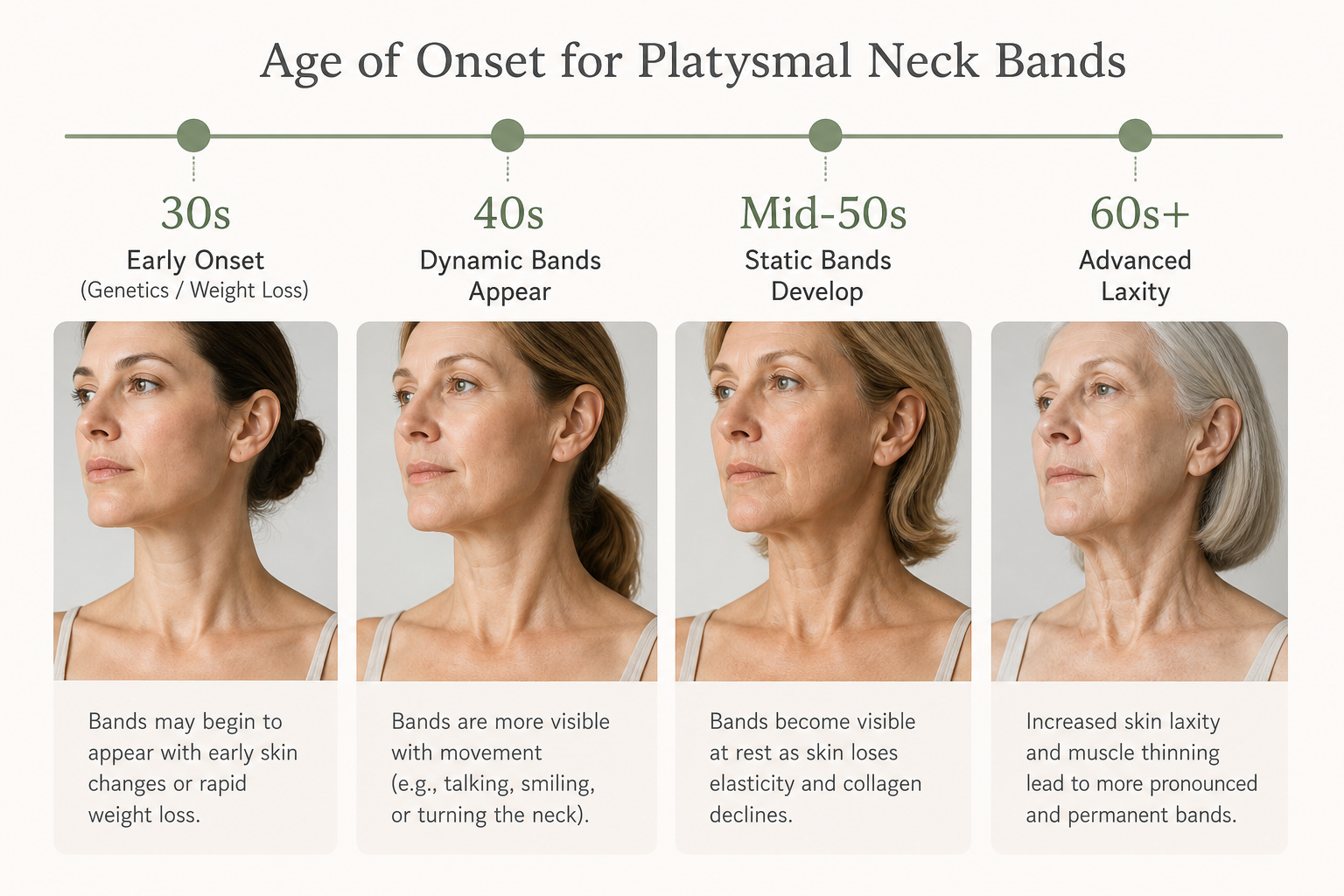
Static bands, which are visible without any muscle activation, tend to emerge from the mid-50s onward as midline separation becomes more pronounced and skin laxity increases. However, patients with a strong family history of prominent neck bands, those who have experienced significant weight fluctuation, or those with a history of heavy sun exposure may notice static bands considerably earlier. Conversely, patients with naturally thicker neck skin and good skin quality may not develop noticeable bands until their 60s or beyond.
Understanding this timeline helps set realistic expectations: early intervention — when bands are still primarily dynamic — generally offers a wider range of non-surgical options and may produce more satisfying results than waiting until bands are fully static and skin laxity is advanced.
Frequently Asked Questions
Can platysmal bands appear in my 30s?
Yes, though it is less common. Patients with a strong genetic predisposition, naturally low body fat, significant UV damage, or those who have experienced rapid weight loss may develop noticeable platysmal bands in their 30s. Early-onset bands are more likely to be dynamic — visible during muscle contraction — rather than static.
Does losing weight cause neck bands to appear?
Significant or rapid weight loss can unmask platysmal bands that were previously concealed by subcutaneous fat beneath the neck skin. This is increasingly observed in patients using GLP-1 medications for weight management. The bands themselves are not created by weight loss, but the reduction in the fat layer that previously softened their appearance makes them more visible.
Are platysmal bands the same as a “turkey neck”?
The term “turkey neck” is a colloquial description that can refer to several overlapping concerns, including loose neck skin, jowling, and platysmal bands. Platysmal bands specifically refer to the vertical cords created by the platysma muscle, whereas turkey neck more broadly describes the overall appearance of an aging neck. The two often coexist but are not identical, and they may require different treatment approaches.
Will sun protection help prevent platysmal bands?
Applying broad-spectrum SPF to the neck consistently may help slow the skin thinning and collagen loss that make platysmal bands more visible over time. Sun protection does not prevent the underlying muscle changes, but preserving skin quality can delay the point at which muscle separation becomes apparent at the surface.
Do platysmal bands affect only the appearance, or do they cause symptoms?
Platysmal bands are primarily an aesthetic concern. They do not typically cause pain or functional problems. Some patients report mild discomfort or awareness of neck tension, but this is not a consistent feature and should be assessed by a qualified practitioner if it is a concern.
What treatments are available for platysmal bands?
Treatment options depend on whether bands are dynamic or static and on the degree of associated skin laxity. Botulinum toxin injections (sometimes called the Nefertiti lift when used in the neck) can reduce the activity of a hyperfunctional platysma and soften dynamic bands. For more advanced static bands with significant skin laxity, surgical options such as platysmaplasty or a neck lift may be considered. Energy-based devices and radiofrequency treatments may support skin tightening as part of a combined approach. A qualified practitioner can assess which options are appropriate based on individual anatomy and goals.
Understanding Your Neck Bands Before Seeking Treatment
Platysmal neck bands develop through a combination of muscle anatomy, progressive age-related change, and individual factors that vary considerably from person to person. The platysma muscle’s superficial position, its tendency to separate at the midline over time, and the natural thinning of the overlying skin create the conditions for vertical neck cords to emerge — a process that can be accelerated by UV exposure, smoking, rapid weight loss, or genetic predisposition.
Recognising whether bands are primarily dynamic or static, and understanding which contributing factors apply to your own situation, provides a more useful foundation for a consultation than simply knowing that bands exist. A practitioner experienced in neck anatomy can assess the relative contribution of muscle activity and skin laxity, identify the most appropriate treatment pathway, and set realistic expectations about what non-surgical and surgical options can achieve. If platysmal bands are a concern, a clinical assessment is the most reliable next step toward understanding your options.
