

The term non-comedogenic appears on countless skincare and makeup products, yet most people have only a vague sense of what it actually means. Understanding the definition properly — and its real-world limitations — can make a meaningful difference in how you choose products, particularly if you have acne-prone, oily, or combination skin.
Key Takeaways
- Non-comedogenic means a product or ingredient is formulated to avoid blocking pores and triggering comedones (blackheads and whiteheads).
- The term is not regulated by the FDA, so there is no standardised test a product must pass before using the label.
- The 0–5 comedogenic scale provides useful guidance on individual ingredients, but it has important limitations related to ingredient concentration and real-world formulation.
- Oily, combination, and acne-prone skin types benefit most, but non-comedogenic products can be appropriate for all skin types.
- Patch testing remains the most reliable way to assess whether a specific product suits your individual skin.
What Does Non-Comedogenic Mean?
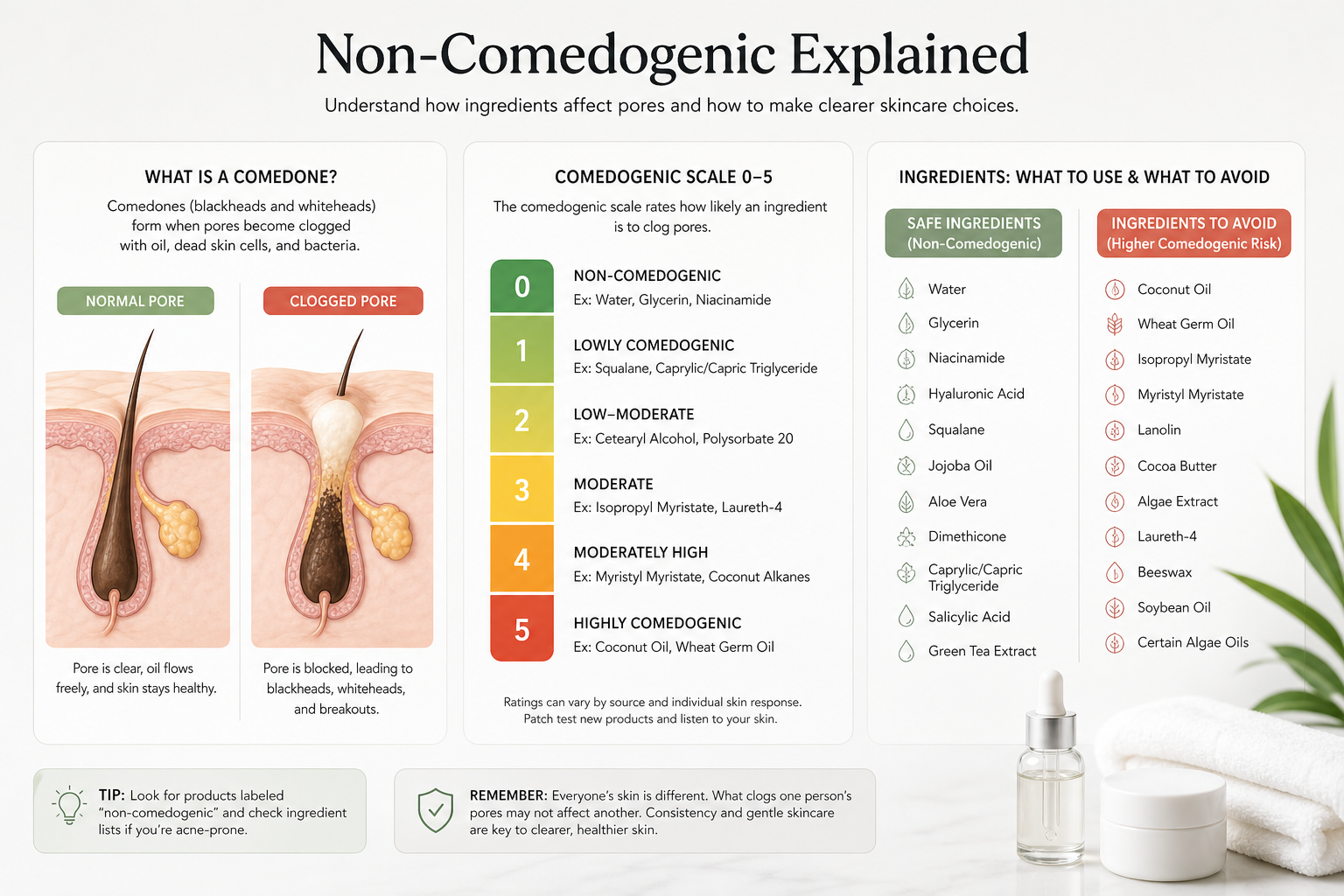
The word comedogenic derives from comedone, the clinical term for a clogged hair follicle. A comedone forms when excess sebum, dead skin cells, and debris accumulate inside a follicle, creating either an open comedone (blackhead) or a closed comedone (whitehead). Open comedones appear dark because melanin in the trapped material oxidises when exposed to air — not because of dirt. Closed comedones remain beneath the skin surface and appear as small flesh-coloured or white bumps. Adding the prefix non- simply negates the term: a non-comedogenic product is one that is formulated to avoid causing this type of pore blockage.
The concept gained clinical significance in 1972 when dermatologists Albert Kligman and Otto Mills described a condition they called acne cosmetica — a mild but persistent form of acne triggered specifically by cosmetic ingredients. Their research demonstrated that certain ingredients in everyday skincare and makeup products could independently cause comedones, even in people who did not otherwise have acne. This discovery prompted the cosmetic industry to begin evaluating ingredients for their comedogenic potential and to develop formulations designed to minimise pore-clogging effects.
The Comedogenic Rating Scale Explained
Following the work of Kligman and Mills, researcher James Fulton developed a more systematic approach to measuring comedogenicity in the 1980s. The result was the 0–5 comedogenic scale, which assigns each ingredient a numerical rating based on its likelihood of clogging pores.
| Rating | Meaning | Example Ingredients |
|---|---|---|
| 0 | Non-comedogenic — will not clog pores | Glycerin, niacinamide, hyaluronic acid |
| 1 | Slightly comedogenic — very low risk | Squalane, jojoba oil, rosehip seed oil |
| 2 | Moderately low risk — generally tolerated | Argan oil, grapeseed oil, dimethicone |
| 3 | Moderate risk — may cause breakouts in sensitive skin | Shea butter, cetyl alcohol |
| 4 | Fairly high risk — likely to clog pores | Cocoa butter, isopropyl myristate |
| 5 | Highly comedogenic — strong pore-clogging potential | Coconut oil, wheat germ oil, lanolin |
Ingredients rated 0–2 are generally considered non-comedogenic or low-risk. Those rated 3 may be problematic for acne-prone or sensitive skin. Ratings of 4–5 indicate a meaningful risk of triggering breakouts and are typically avoided in products marketed to acne-prone users.

Why the Scale Has Important Limitations
The original comedogenicity ratings were generated using the rabbit ear assay (REA) — a method in which ingredients were applied to the inner ear canal of rabbits, an area with a high density of follicles that responds readily to comedogenic stimuli. While the rabbit ear assay provided a reproducible starting point, it has significant limitations when applied to real-world human skincare.
The most important limitation is ingredient concentration. Ingredients in the original studies were often tested at full, undiluted concentration — a scenario that rarely reflects how they appear in a finished product. For example, acetylated lanolin alcohol tested at 100% concentration may score 4–5 on the scale, yet at a 2.5% concentration within a formulation it may behave quite differently. A rating generated at full concentration does not automatically predict how an ingredient will perform when it constitutes a small fraction of a complex formula.
A second limitation is the combination effect. Even when every individual ingredient in a product scores 0–2 on the comedogenic scale, the finished formulation can still be comedogenic due to the way ingredients interact with one another. This means that checking individual ingredient ratings is useful but not a guarantee that the complete product will be pore-safe for every user. The American Academy of Dermatology acknowledges that comedogenicity testing has not been fully standardised, and results can vary between testing methods and laboratories.
Is Non-Comedogenic Regulated by the FDA?
In the United States, the term non-comedogenic is not regulated by the FDA. There is no legal definition, no mandatory testing protocol, and no requirement for a product to meet any specific standard before a manufacturer can print the label. The same situation applies in most other countries — the term is essentially a marketing claim rather than a certified classification.
This does not mean the label is meaningless. Reputable manufacturers typically conduct internal testing and formulate products with low-rated ingredients when they use the term. However, it does mean that two products both labelled non-comedogenic may have been evaluated very differently, and neither has been independently verified by a regulatory body. Reading the ingredient list remains more informative than relying on the label alone.
Non-Comedogenic vs. Oil-Free: An Important Distinction
These two terms are frequently confused, but they describe different things. An oil-free product contains no plant oils or mineral oils in its formulation. A non-comedogenic product is formulated to avoid clogging pores — but it may still contain certain oils that have a low comedogenicity rating, such as squalane or jojoba oil.
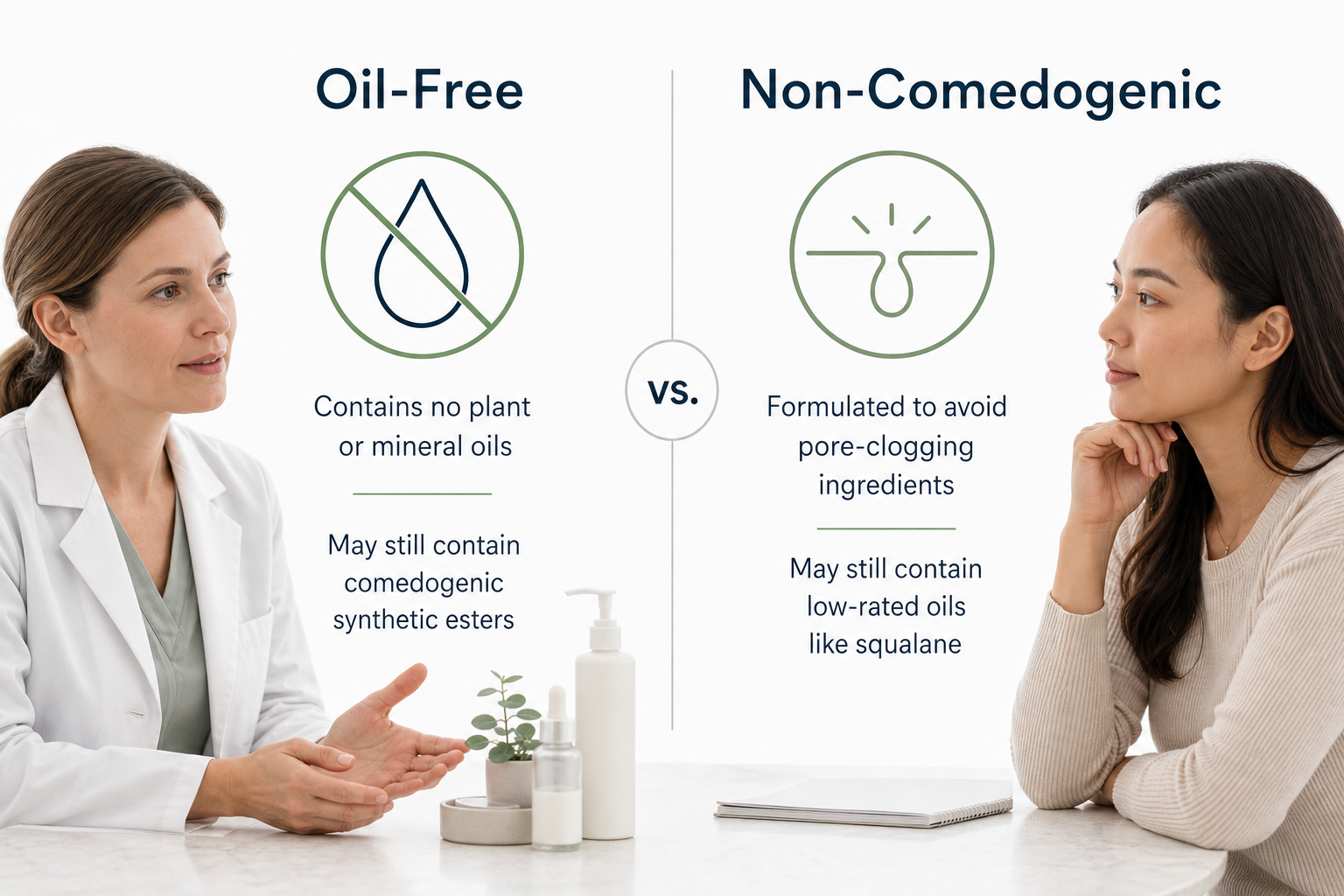
Conversely, an oil-free product is not automatically non-comedogenic. Some synthetic ingredients used in oil-free formulations — such as isopropyl myristate or isopropyl palmitate — are among the most comedogenic substances on the scale, despite containing no traditional oil. Similarly, the term non-acnegenic is sometimes used interchangeably with non-comedogenic, but it is equally unregulated and carries the same caveats. When evaluating a product for acne-prone skin, checking the full ingredient list is more reliable than relying on either label.
Ingredients That Are Non-Comedogenic
Several well-studied ingredients consistently score 0–1 on the comedogenic scale and are widely considered safe for acne-prone and oily skin types. These include:
- Humectants: Glycerin, hyaluronic acid, and sodium hyaluronate draw moisture into the skin without adding occlusive weight. As humectants, they hydrate without contributing to pore blockage.
- Actives: Niacinamide, vitamin C, salicylic acid, benzoyl peroxide, panthenol, and allantoin are all considered non-comedogenic and are frequently used in formulations targeting acne-prone skin.
- Lightweight oils: Squalane (rated 0–1), jojoba oil (rated 2), rosehip seed oil (rated 1), grapeseed oil (rated 1–2), and argan oil (rated 0–1) are generally well tolerated even by oily skin types.
- Silicones: Dimethicone and similar silicones sit on the skin surface rather than penetrating follicles, and they generally rate 1–2 on the comedogenic scale.
- Skin barrier ingredients: Ceramides, aloe vera, witch hazel, and rose water support the skin barrier without significant comedogenic risk.
Ingredients With Higher Comedogenic Ratings to Be Aware Of
Certain ingredients appear frequently in skincare and cosmetic products but carry a meaningful risk of triggering comedones in susceptible individuals. The following rate 3–5 on the comedogenic scale and are worth identifying on an ingredient list if you have acne-prone or oily skin:
- Coconut oil — rated 4–5; one of the most commonly cited pore-clogging ingredients despite its popularity in natural skincare
- Cocoa butter — rated 4; frequently used in body products and some facial moisturisers
- Wheat germ oil — rated 5; highly comedogenic
- Lanolin — rated 4–5; an emollient derived from wool that can cause acne cosmetica in sensitive individuals
- Isopropyl myristate and isopropyl palmitate — rated 4–5; synthetic esters used to improve texture that are strongly associated with pore blockage
- Ethylhexyl palmitate, butyl stearate, decyl oleate, myristyl myristate — rated 3–5; a group of synthetic esters commonly found in foundations, primers, and sunscreens
- D&C red dyes and coal tar derivatives — rated 4–5; found in some cosmetic pigments
It is worth noting that these ratings reflect testing at high concentrations. A small amount of cocoa butter in a body lotion used on the arms is unlikely to cause facial breakouts. The concern is greatest with leave-on products applied directly to the face, such as moisturisers, foundations, primers, and sunscreens, where prolonged skin contact increases the likelihood of follicular plugging.
Which Skin Types Benefit Most?
Non-comedogenic formulations are most commonly associated with oily and acne-prone skin, but they can be appropriate across all skin types.
| Skin Type | Why Non-Comedogenic Matters | Recommended Product Types |
|---|---|---|
| Oily skin | Excess sebum overproduction already increases comedone risk; adding pore-clogging ingredients compounds the problem | Lightweight gel moisturisers, oil-free SPF, water-based serums |
| Combination skin | T-zone is prone to blackheads and enlarged pores; non-comedogenic products help manage oilier areas without drying others | Lightweight lotions, non-comedogenic toners, balanced SPF |
| Acne-prone skin | Comedones are a primary feature of acne; avoiding pore-clogging ingredients reduces one controllable trigger | Non-comedogenic cleansers, serums with niacinamide or salicylic acid, mineral SPF |
| Sensitive skin | Lighter, simpler formulations reduce irritation risk alongside comedone risk | Fragrance-free, minimal-ingredient moisturisers and SPF |
| Dry skin | Non-comedogenic does not mean non-moisturising; rich humectants and ceramide-based creams can hydrate without clogging pores | Ceramide-rich creams, hyaluronic acid serums, squalane-based oils |
A common misconception is that non-comedogenic products are too light or drying for dry skin. In practice, many deeply hydrating ingredients — including glycerin, hyaluronic acid, ceramides, and squalane — score 0–1 on the comedogenic scale. Dry skin types can achieve meaningful hydration without relying on highly comedogenic occlusives such as coconut oil or cocoa butter.
Non-Comedogenic Sunscreen and Makeup
Sunscreen and makeup are two product categories where comedogenicity is particularly relevant, because both are leave-on products applied to the face daily. Many conventional sunscreens use synthetic esters such as ethylhexyl palmitate or octyl palmitate as texture agents — both of which carry moderate to high comedogenicity ratings. For acne-prone skin, mineral sunscreens containing zinc oxide or titanium dioxide are generally better tolerated, as these active ingredients themselves are non-comedogenic. Checking the inactive ingredients list is still important, as the base formulation can still contain pore-clogging components.
For makeup, foundations, primers, and concealers are the most relevant categories. Products labelled non-comedogenic and formulated without isopropyl myristate, isopropyl palmitate, or D&C red dyes are preferable for acne-prone users. Powder-based formulations tend to be less occlusive than heavy cream foundations, though individual response varies. Removing makeup thoroughly each evening is equally important — even a non-comedogenic foundation can contribute to pore blockage if left on overnight.
How to Read an Ingredient Label for Comedogenicity
Ingredient lists on cosmetic products follow a standardised order: ingredients are listed from highest to lowest concentration. This means the first five to ten ingredients make up the bulk of the formula and have the greatest influence on how the product behaves on skin. A highly comedogenic ingredient appearing near the top of the list is more likely to cause problems than the same ingredient listed near the bottom, where it may be present only in trace amounts.
A practical approach for acne-prone skin is to scan the first ten ingredients for any rated 4–5 on the comedogenic scale. If a problematic ingredient appears in the lower half of the list, the risk is lower but not zero — particularly for individuals with very reactive skin. Free online ingredient checkers can cross-reference a product’s full ingredient list against comedogenicity databases, though these tools use the same imperfect rating data and should be treated as a guide rather than a definitive verdict.
How to Patch Test a New Product
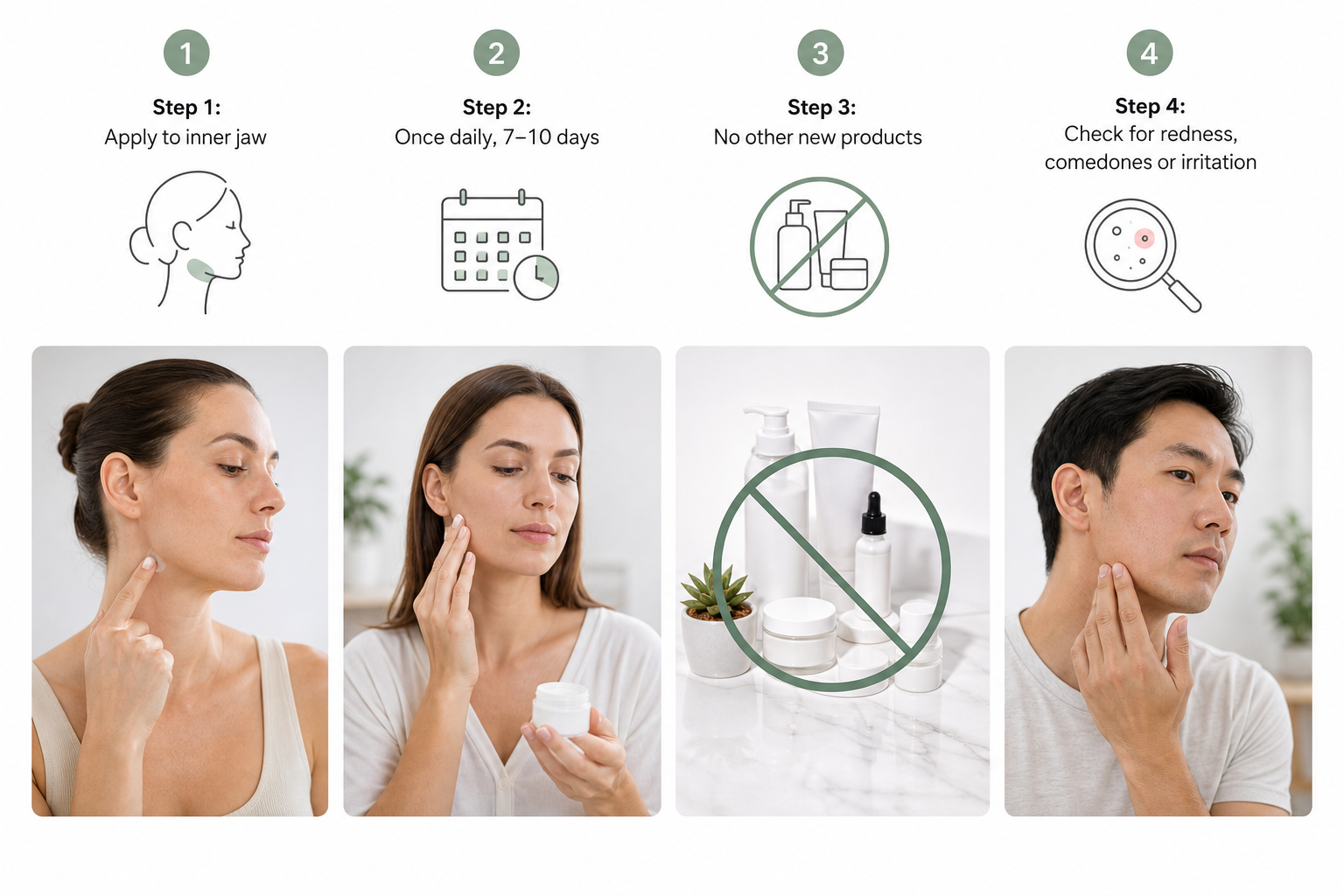
Because individual skin response varies considerably — and because the comedogenic scale does not perfectly predict real-world outcomes — patch testing is the most reliable personal method for assessing a new product. To patch test effectively, apply a small amount of the product to a discreet area of skin that is representative of where you intend to use it. For facial products, the inner jaw or the area just below the ear is commonly used. Apply the product once daily for seven to ten days without using other new products simultaneously. If comedones, redness, or irritation develop within that period, the product is likely unsuitable for your skin regardless of its label claims. If no reaction occurs, the product is more likely to be tolerated when used as directed.
Patch testing is particularly important for leave-on products such as moisturisers, SPF, and primers, which have prolonged contact with the skin. Rinse-off products such as cleansers carry a lower comedogenic risk because contact time is brief.
Non-Comedogenic and Fungal Acne: A Separate Concern
One nuance that is frequently overlooked is the distinction between comedogenic acne and fungal acne (also called Malassezia folliculitis). Fungal acne is caused by an overgrowth of Malassezia yeast within hair follicles and produces small, uniform, itchy papules that can resemble comedonal acne. Crucially, non-comedogenic does not mean fungal-acne safe. Several non-comedogenic ingredients — including certain fatty acids, fermented ingredients, and some oils — can feed Malassezia and worsen fungal acne. If you suspect fungal acne rather than conventional comedonal acne, a dermatological assessment is advisable before selecting products based on comedogenicity ratings alone.
Frequently Asked Questions
Is coconut oil non-comedogenic?
No. Coconut oil rates 4–5 on the comedogenic scale and is one of the most frequently cited pore-clogging ingredients. It is generally not recommended for acne-prone or oily facial skin, though it may be better tolerated on the body where follicle density is lower.
Is glycerin non-comedogenic?
Yes. Glycerin is a humectant that rates 0 on the comedogenic scale. It draws moisture into the skin without contributing to pore blockage and is widely used in formulations for acne-prone and sensitive skin.
Is jojoba oil non-comedogenic?
Jojoba oil rates approximately 2 on the comedogenic scale, placing it in the low-risk category. It is technically a liquid wax rather than an oil and is generally well tolerated by most skin types, including oily and combination skin.
Is shea butter non-comedogenic?
Shea butter rates 0–3 depending on the source and grade. Refined shea butter tends to rate lower than unrefined. It is generally considered moderate risk for acne-prone facial skin and is more commonly used in body products.
Can a product labelled non-comedogenic still cause breakouts?
Yes. Because the term is unregulated and individual skin response varies, a product labelled non-comedogenic can still cause breakouts in some users. The combination effect — where individually low-rated ingredients interact to create a more comedogenic formula — is one reason this can occur. Patch testing before full use is always advisable.
Does non-comedogenic mean the same as acne-safe?
Not exactly. Non-comedogenic specifically refers to the potential to clog pores and form comedones. Acne has multiple contributing factors including bacterial activity, inflammation, hormonal influences, and sebum overproduction. A non-comedogenic product reduces one potential trigger but does not address all causes of acne. The term non-acnegenic is sometimes used to imply broader acne safety, but it carries the same regulatory limitations.
Are non-comedogenic products suitable for dry skin?
Yes. Many highly effective moisturising ingredients — including hyaluronic acid, ceramides, glycerin, and squalane — are non-comedogenic. Dry skin does not require comedogenic occlusives to achieve adequate hydration, and non-comedogenic formulations can be both deeply moisturising and pore-safe.
Choosing Non-Comedogenic Products: What to Keep in Mind
Non-comedogenic labelling is a useful starting point when selecting skincare products, particularly for oily, combination, and acne-prone skin types. Understanding the term’s meaning — and its limitations — allows you to make more informed decisions than simply trusting a label. The 0–5 comedogenic scale provides practical guidance on individual ingredients, but the absence of FDA regulation, the concentration caveat, and the combination effect mean that no rating system can fully predict how a finished product will behave on your specific skin.
Reading ingredient lists, prioritising leave-on products with low-rated ingredients, and patch testing new additions to your skincare routine are the most reliable practical steps available. If you experience persistent breakouts, comedones, or skin congestion despite using products labelled non-comedogenic, a consultation with a dermatologist or qualified aesthetic practitioner can help identify whether product ingredients, skin type factors, hormonal influences, or other causes are contributing — and guide you toward a more targeted approach.
