

Hair botox has become one of the most popular smoothing and conditioning treatments available in salons, but the price varies considerably depending on where you go, what your hair is like, and which formula is used. Understanding the factors that affect hair botox cost before you book can help you compare quotes accurately, avoid unexpected charges, and decide whether the investment makes sense for your hair goals.
Key Takeaways
- Salon hair botox typically costs between $80 and $450 or more per session, with price driven primarily by hair length, thickness, salon location, and formula quality.
- At-home hair botox kits are available for $30 to $100, but professional application generally produces more consistent and longer-lasting results.
- Results last approximately 2 to 4 months depending on hair type, aftercare, and the formula used, which affects the true long-term cost.
- Hair botox is not the same as injectable botulinum toxin — it is a deep conditioning treatment that uses ingredients such as collagen, keratin, hyaluronic acid, and amino acids to smooth and repair the hair shaft.
- Comparing the cost per month rather than the cost per session gives a more accurate picture of value, especially when comparing hair botox vs. keratin treatment.
What Is Hair Botox and Why Does It Cost What It Does?
Hair botox is a deep conditioning treatment designed to repair damaged hair fibers, reduce frizz, and restore smoothness and shine. Despite the name, it contains no botulinum toxin. The term refers to the filling and plumping effect the formula has on the hair shaft, similar in concept to how injectable botox fills lines in skin. Professional formulas typically contain a blend of ingredients such as collagen, keratin, hyaluronic acid, caviar oil, amino acids, vitamin B5, and vitamin E, which work together to seal the cuticle and temporarily restore the hair’s structure.
Because hair botox is a professional service that requires skilled application, heat processing, and a significant amount of product — particularly for longer or thicker hair — the cost reflects both the materials and the time involved. Unlike a simple conditioning mask, a full salon treatment can take anywhere from 60 to 180 minutes depending on hair density and length, which directly influences what salons charge.
Average Hair Botox Price by Hair Length
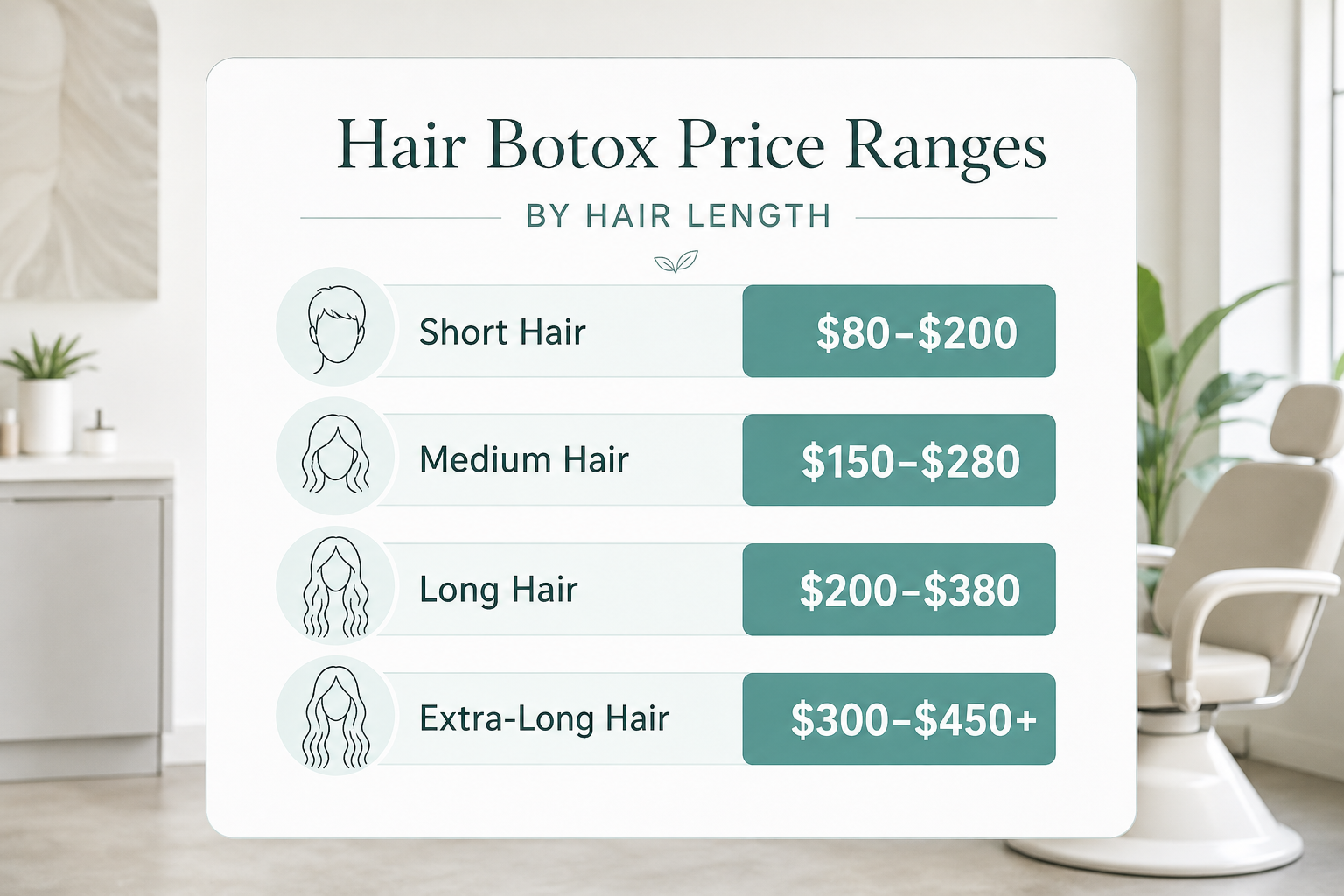
Hair length and thickness are the most consistent pricing factors across salons. Longer and denser hair requires more product and more application time, both of which increase the cost per session. The following ranges reflect typical US salon pricing, though regional variation is significant.
| Hair Length | Approximate Salon Price (US) | Approximate Session Time |
|---|---|---|
| Short (above chin) | $80 – $200 | 60 – 90 minutes |
| Medium (chin to shoulder) | $150 – $280 | 90 – 120 minutes |
| Long (below shoulder) | $200 – $380 | 120 – 150 minutes |
| Extra-long or very thick | $300 – $450+ | 150 – 180 minutes |
These figures represent standalone treatment prices and do not include add-on services such as a blowout, haircut, or color. Hair density matters as much as length — someone with fine, shoulder-length hair may pay considerably less than someone with thick, coarse hair of the same length, because the amount of product required differs substantially.
Factors That Affect Hair Botox Cost
Several distinct variables influence what a salon charges for hair botox. Understanding each one helps explain why two salons in the same city can quote very different prices for what appears to be the same service.
Hair Length and Thickness
As shown in the table above, hair length and thickness are the primary drivers of cost. Hair density — the number of individual strands per square centimetre — determines how much product is needed to saturate the hair fully. A client with fine, short hair may require a fraction of the product used on a client with thick, long hair, and salons price accordingly. Hair porosity also plays a role: highly porous or damaged hair, such as bleached or chemically processed hair, may absorb product unevenly and sometimes requires additional product or a preparatory step, which can add to the overall cost.
Salon Location and Reputation
Salon location and reputation are significant pricing factors. A luxury salon in Manhattan or Miami’s South Beach will typically charge considerably more than a mid-market salon in a smaller city, even when using comparable formulas. Overhead costs — rent, staffing, and the general cost of doing business — are passed on to clients. In major US cities such as New York and Miami, full treatments at premium salons can reach $400 to $500 or more. In mid-size US cities, the same service may cost $150 to $250. Internationally, pricing varies even more widely: salons in Turkey, for example, may charge $50 to $150 per session, which has made hair treatments part of the broader medical and beauty tourism market in that region.
Stylist Expertise
Stylist expertise is reflected in the price at most salons. A master stylist or a technician who specializes in smoothing and conditioning services will generally charge more than a junior stylist. This is not simply a prestige premium — experienced stylists are more likely to assess hair condition accurately, apply the formula evenly, and achieve consistent results. For clients with color-treated, bleached, or significantly damaged hair, working with a stylist who understands how different hair conditions respond to the treatment can meaningfully affect the outcome.
Formula and Product Quality
The quality of the formula used is one of the most underexplored factors in hair botox pricing. Professional-grade formulas from established brands — such as Nutree, Felps, or similar Brazilian botox product lines — contain higher concentrations of active ingredients and are typically formaldehyde-free, which is an important safety consideration. Budget formulas may use lower concentrations of conditioning agents or rely on ingredients that produce a shorter-lasting result. Premium formula quality is reflected in the price: salons using high-end, professional-grade products will charge more, but the results may last longer and feel more consistent. When comparing quotes, it is worth asking which brand and formula the salon uses, as this can explain significant price differences between providers.
Add-On Services
Many salons offer hair botox as part of a broader service package. A standalone treatment is the most affordable option, but clients often add a professional blowout, a haircut, or a colour service at the same appointment. Each add-on increases the total cost. A blowout alone can add $40 to $80, while a cut or colour service will add more. Some salons bundle these services at a slight discount compared to booking them separately, so it is worth asking about package pricing if you plan to combine treatments.
Salon Hair Botox vs. At-Home DIY Kits
At-home hair botox kits are widely available through online retailers and some salon suppliers, typically priced between $30 and $100. They offer a more accessible entry point for clients who want to try the treatment without the salon cost. However, the results and experience differ from a professional service in several meaningful ways.
| Factor | Salon Hair Botox | At-Home Hair Botox Kit |
|---|---|---|
| Typical cost | $80 – $450+ | $30 – $100 |
| Formula quality | Professional-grade | Variable; often lower concentration |
| Application | Trained stylist | Self-applied |
| Results duration | 2 – 4 months (up to 5 – 6 with good aftercare) | Typically 4 – 8 weeks |
| Consistency | Generally more even | Depends on technique |
| Best for | Significant frizz, damaged hair, longer-lasting results | Maintenance, mild frizz, budget-conscious clients |
At-home kits also vary in quality. Budget kits priced under $40 tend to contain lower concentrations of active ingredients and may produce modest results. Mid-range kits ($40 to $70) often include a more complete ingredient profile. Professional-grade at-home kits ($70 to $100) may use formulas closer to salon quality, though application without professional equipment — particularly a high-heat flat iron — can limit how well the formula bonds to the hair shaft. For clients with severely damaged, colour-treated, or very thick hair, a professional salon treatment is generally more likely to deliver the expected outcome.
Hair Botox vs. Keratin Treatment: Cost Comparison
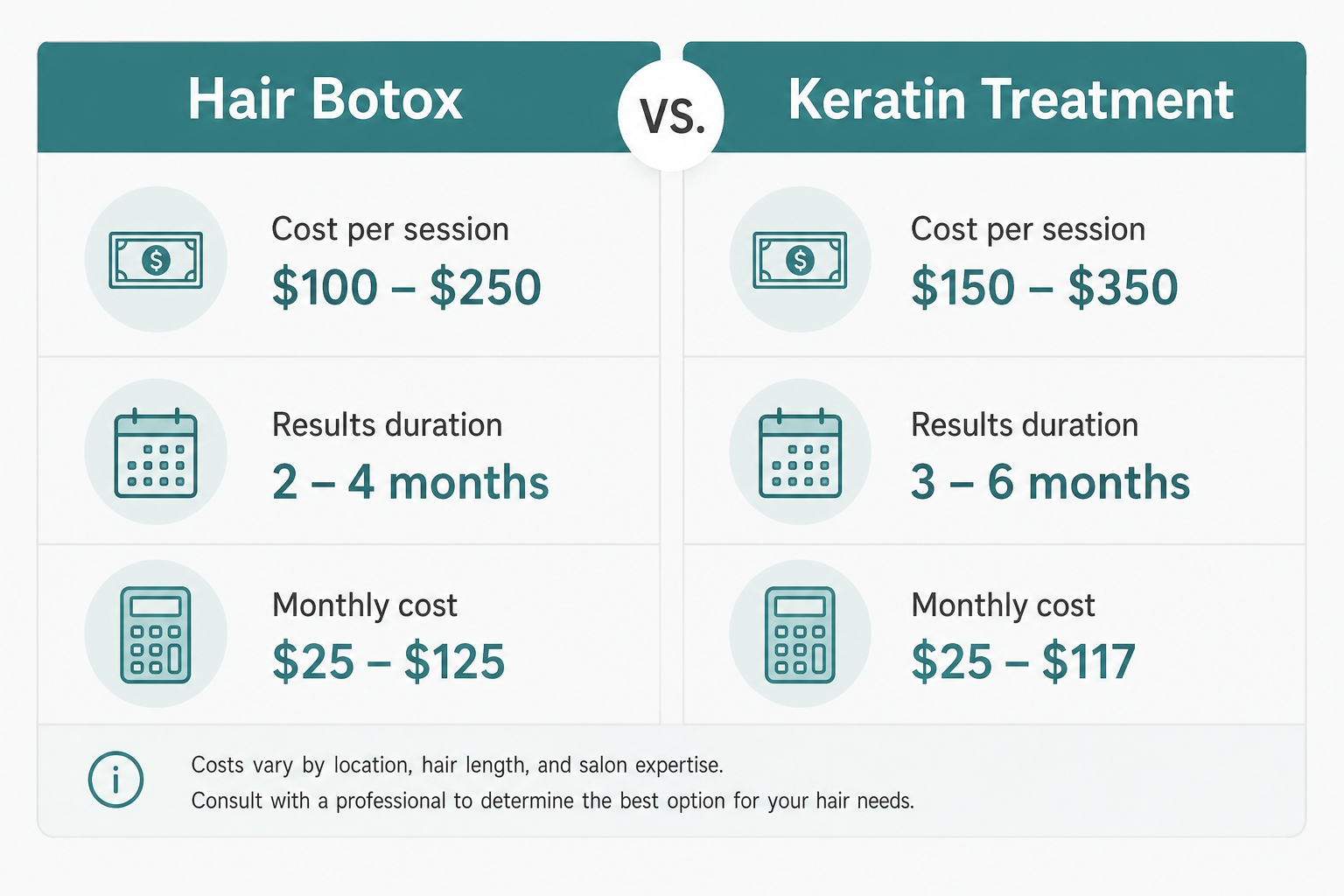
Hair botox and keratin treatment are often compared because both target frizz and improve smoothness, but they work differently and carry different price points and longevity profiles. Understanding the distinction helps when evaluating which service offers better value for a specific hair concern.
| Characteristic | Hair Botox | Keratin Treatment |
|---|---|---|
| Primary mechanism | Deep conditioning; fills and seals hair shaft | Coats hair with keratin protein; may relax curl pattern |
| Typical salon cost (US) | $80 – $450+ | $200 – $800+ |
| Results duration | 2 – 4 months | 3 – 6 months |
| Formaldehyde-free options | Widely available | Available but less universal |
| Effect on curl pattern | Minimal to none | Can relax or loosen curls |
| Best suited for | Frizz, dryness, damage repair, maintaining curl | Frizz reduction, straightening, curl relaxation |
| Approximate monthly cost | $40 – $150/month | $50 – $200/month |
The cost-per-month framing is a more useful comparison tool than the cost per session alone. A hair botox treatment at $150 lasting 10 weeks works out to approximately $60 per month. A keratin treatment at $300 lasting 5 months works out to approximately $60 per month as well — making them comparable in ongoing cost despite the difference in upfront price. However, if a keratin treatment costs $500 and lasts 4 months, the monthly cost rises to around $125, which may make hair botox the more economical choice depending on the salon and formula used. Calculating cost over time rather than per appointment gives a clearer picture of long-term value.
The True Total Cost of Hair Botox
The quoted salon price is rarely the complete picture. Several additional costs can affect the true total cost of a hair botox treatment, and these are worth factoring in before comparing providers.
- Consultation fee: Some salons charge a separate consultation fee, particularly for first-time clients or those with significantly damaged hair. This may or may not be deducted from the treatment cost.
- Pre-treatment clarifying shampoo: Many salons require a clarifying shampoo before treatment to remove product build-up. This may be included in the service or charged separately.
- Blowout add-on: A professional blowout is often recommended or required after the treatment to seal the formula with heat. If not included in the quoted price, this adds $40 to $80 or more.
- Aftercare products: Maintaining results requires a sulfate-free shampoo and, ideally, a compatible deep conditioning mask. Switching to sulfate-free products is a recurring cost that extends the life of the treatment.
- Gratuity: Standard salon tipping (15 to 20 percent) is not always factored into quoted prices but is a real cost of the appointment.
- Touch-up sessions: Some clients book a touch-up session between full treatments to maintain smoothness, particularly if results begin to fade before the next scheduled appointment.
Adding these elements together can increase the effective cost of a session by $50 to $150 beyond the headline price. Asking for a full breakdown before booking helps avoid surprises.
Pricing Red Flags and How to Evaluate Deals
Heavily discounted hair botox offers — particularly through group-buying platforms — can be tempting, but they carry some risks worth considering. Salons offering treatments at unusually low prices may be using lower-quality formulas, applying less product than the hair requires, or cutting the session time in ways that affect results. A formaldehyde-free formula from a reputable brand costs the salon more than a budget alternative, and that cost is reflected in the service price. If a quote seems significantly below the typical range for your area and hair type, it is reasonable to ask which formula is being used and whether the price includes a blowout.
Tiered pricing structures — where salons list a starting price and then adjust based on hair length, density, and add-ons — are standard and transparent. A salon that quotes a flat price regardless of hair type may be applying a one-size-fits-all approach that does not account for the amount of product your hair actually needs. Transparent, itemized pricing is generally a better sign than an unusually low flat rate.
Seasonal Pricing and Ways to Reduce Cost
Some salons offer promotional pricing during quieter periods, loyalty discounts for returning clients, or package deals that bundle multiple sessions at a reduced per-session rate. If you plan to maintain hair botox treatments regularly, asking about a package or loyalty programme can reduce the ongoing cost meaningfully. First-time client discounts are also common at salons that want to introduce new clients to the service.
Booking during off-peak hours or days — typically mid-week mornings — may also give you access to lower rates at some salons, as demand is lower and stylists have more availability. It is worth asking directly rather than assuming the listed price is fixed.
How Long Results Last and What Affects Longevity
Results from a professional salon hair botox treatment typically last 2 to 4 months, though some clients report results lasting up to 5 or 6 months with careful aftercare. Several factors influence how long the effects persist, and understanding them helps assess the real value of the treatment.
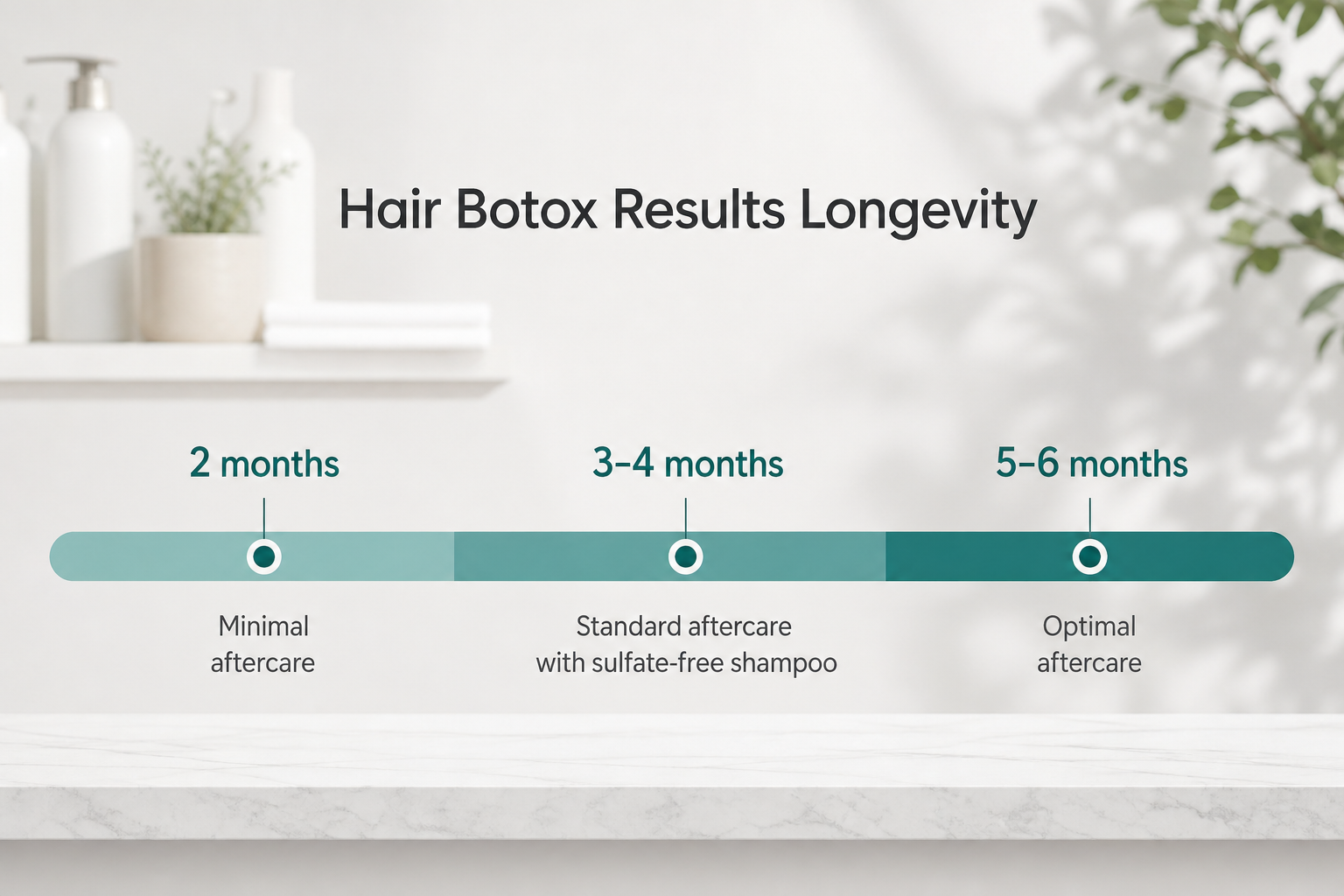
- Aftercare compliance: Using a sulfate-free shampoo is the single most important aftercare step. Sulfates strip the formula from the hair shaft more quickly, shortening results. Avoiding washing for 48 hours immediately after treatment also allows the formula to bond fully.
- Hair porosity: Highly porous hair — common in bleached or frequently heat-styled hair — may absorb the formula unevenly and release it more quickly, leading to shorter-lasting results.
- Formula quality: Premium formula quality is associated with longer-lasting results. Professional-grade formulas with higher concentrations of active ingredients tend to bond more effectively to the hair shaft than budget alternatives.
- Frequency of washing: Clients who wash their hair daily will generally see results fade more quickly than those who wash every two to three days.
- Heat styling: Regular heat styling without adequate protection can accelerate the breakdown of the treatment.
Frequently Asked Questions
How much does hair botox cost for short hair?
For short hair — typically defined as above chin length — salon hair botox generally costs between $80 and $200 in the US, depending on the salon’s location, the formula used, and whether a blowout is included. Short hair requires less product and less application time, making it the most affordable option.
Does hair length really affect the price that much?
Yes, hair length and thickness are the most consistent pricing factors across salons. Extra-long or very thick hair can require two to three times the amount of product used for short hair, and the session takes significantly longer. This is why the price difference between short and long hair can be $200 or more at the same salon.
Is hair botox the same as a keratin treatment?
No. Hair botox is a deep conditioning treatment that fills and seals the hair shaft using ingredients such as collagen, hyaluronic acid, and amino acids. Keratin treatment coats the hair with keratin protein and can relax or loosen the curl pattern. Hair botox generally does not alter curl structure, while keratin treatments often do. The two treatments also differ in cost, duration, and the chemical processes involved.
How often do I need to repeat the treatment?
Most clients repeat hair botox every 2 to 4 months, depending on how long results last for their hair type and how well they maintain aftercare. Some clients with very porous or damaged hair may need more frequent touch-up sessions, while those with less porous hair and careful aftercare may extend the interval to 5 or 6 months.
Are at-home hair botox kits worth buying?
At-home kits can be a cost-effective option for clients with mild frizz or those maintaining results between salon visits. However, they typically use lower concentrations of active ingredients and are applied without professional equipment, which can limit how evenly the formula bonds. For significant frizz, damaged hair, or longer-lasting results, a professional salon treatment is generally more effective.
What aftercare products do I need, and do they add to the cost?
A sulfate-free shampoo is essential for maintaining results and is a recurring cost. Some salons sell compatible aftercare products, while others recommend specific brands available at retail. A quality sulfate-free shampoo typically costs $15 to $40 per bottle. Deep conditioning masks compatible with the treatment can also help extend results and add a modest ongoing cost.
Why do prices vary so much between salons?
Price variation reflects differences in salon location and overhead, stylist expertise, the brand and quality of formula used, and whether add-on services are included. A salon in a high-cost city using a premium formaldehyde-free formula applied by an experienced stylist will reasonably charge more than a budget salon using a lower-grade product. Comparing quotes should include asking about the specific formula and what is included in the price.
Is Hair Botox Worth the Cost for Your Hair Goals?
Whether hair botox represents good value depends on your hair type, your goals, and how you weigh the cost against the results. For clients with frizzy, dry, or mildly damaged hair who want smoother, shinier hair without altering their curl pattern, the treatment can deliver meaningful improvement for a reasonable ongoing cost — particularly when calculated on a per-month basis rather than per session. The formaldehyde-free nature of most modern formulas also makes it a more accessible option for clients who have concerns about chemical exposure.
For clients with severely damaged or very thick hair, the cost per session will be higher, and results may be shorter-lived without careful aftercare. In these cases, discussing whether a different treatment — such as a professional keratin treatment or a targeted repair programme — might offer better value is worth exploring with a qualified stylist. A consultation before committing to a full treatment allows a stylist to assess your hair condition, recommend the most appropriate formula, and give you an accurate, itemized quote that reflects the true total cost rather than a starting price.
