
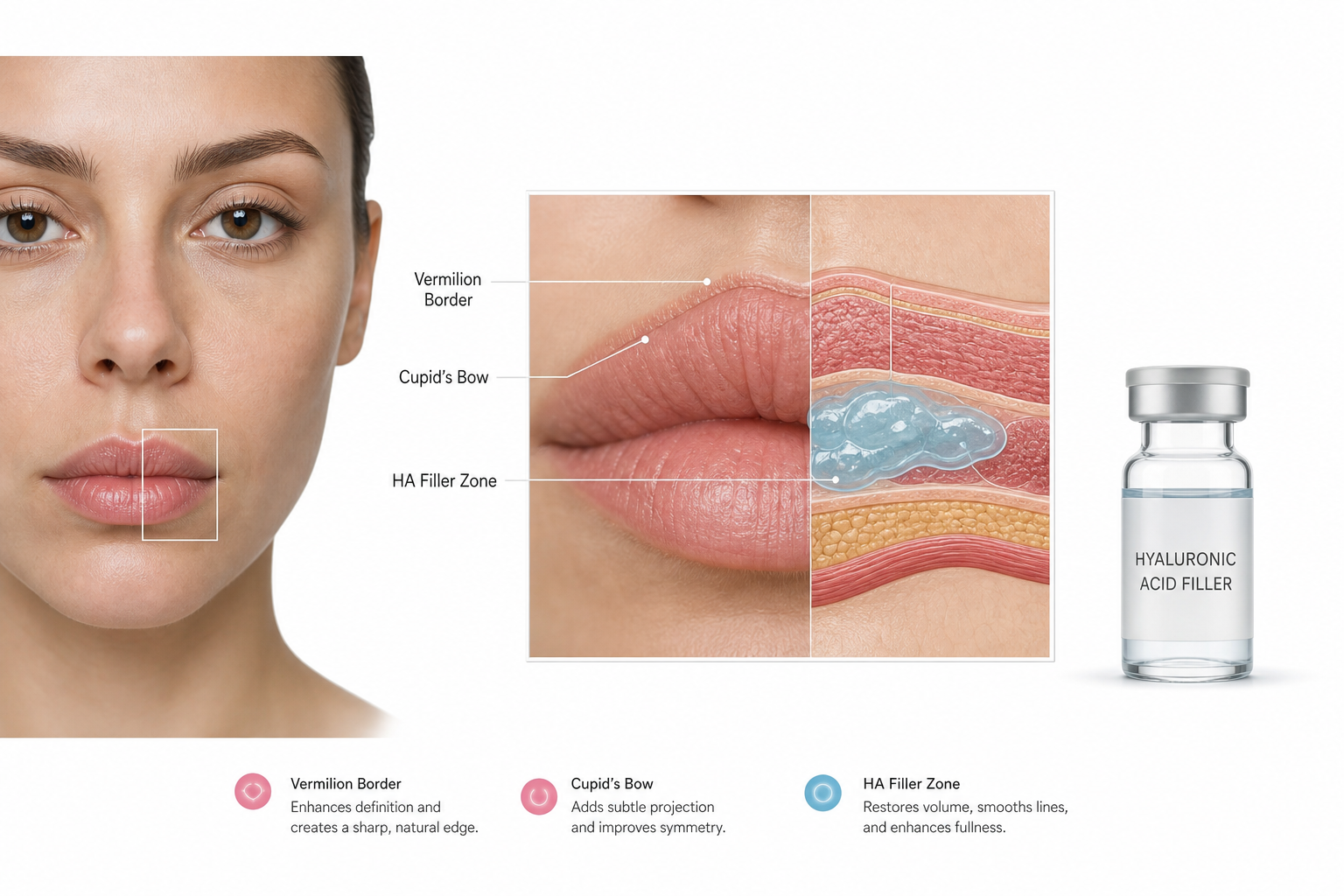

Most patients need a lip filler top-up every 6 to 12 months, though the exact timing depends on the product used, how quickly your body metabolizes hyaluronic acid, and how much volume you want to maintain. Understanding what drives that variation helps you plan a realistic maintenance schedule, avoid unnecessary overfilling, and get the most from each appointment.
Key Takeaways
- The standard lip filler top-up interval is 6 to 12 months for most hyaluronic acid fillers, with 6 to 9 months being the most common sweet spot for active patients.
- First-time patients often metabolize filler faster than repeat patients, sometimes noticing significant volume loss within 4 to 6 months of their initial treatment.
- Repeated maintenance sessions can extend the time between top-ups over the long term due to cumulative collagen stimulation and residual filler acting as a scaffold.
- Proactive maintenance — booking before filler fully dissolves — generally produces more consistent results than waiting until lips return to baseline.
- Lifestyle factors including smoking, intense exercise, UV exposure, and high stress levels can all accelerate how quickly filler breaks down.
How Long Do Lip Fillers Actually Last?
Hyaluronic acid filler — the most widely used type for lip augmentation — does not disappear overnight. It filler dissolves gradually as the body’s natural enzyme hyaluronidase breaks down the HA gel over time. The rate at which this happens varies considerably between individuals, but most clinical experience places the effective duration of standard HA lip fillers between 6 and 12 months. Some patients retain noticeable volume for up to 15 months; others notice significant volume loss within 4 to 5 months, particularly after a first treatment.
The product itself matters too. Different formulations are engineered with varying degrees of cross-linking — the chemical bonds that give the gel its structure and resistance to breakdown. Softer, less cross-linked products such as Juvéderm Volbella XC or Restylane Silk tend to last 6 to 9 months in the lips. More robust formulations like Restylane Kysse or Juvéderm Ultra XC typically last 6 to 12 months. The RHA Collection, designed to move with facial expression, may maintain results for 12 to 15 months in some patients. Non-HA options such as Radiesse are occasionally used off-label for lip enhancement and may last 12 to 18 months, though they are not reversible with hyaluronidase and are used far less frequently in this area.
Lip Filler Longevity by Product Type
| Product | Typical Duration in Lips | Reversible with Hyaluronidase |
|---|---|---|
| Juvéderm Ultra XC | 6–12 months | Yes |
| Juvéderm Volbella XC | Up to 12 months | Yes |
| Restylane Kysse | 6–12 months | Yes |
| Restylane Silk | 6–9 months | Yes |
| RHA Collection | 12–15 months | Yes |
| Radiesse (off-label) | 12–18 months | No |
Why Lips Break Down Filler Faster Than Other Areas
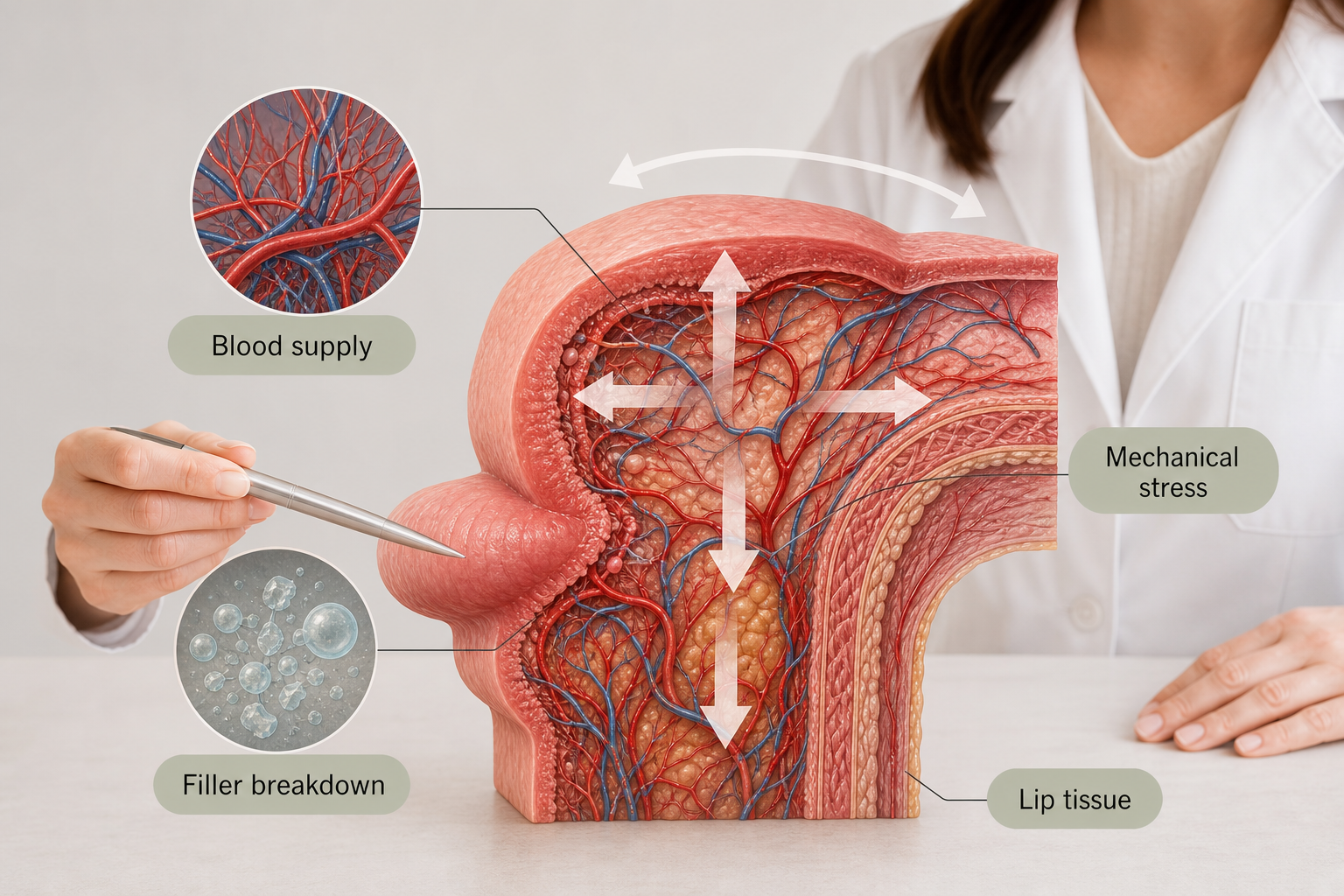
The lips have a particularly rich blood supply compared to areas like the cheeks or jawline. Greater vascular activity means the body’s enzymes reach the filler more readily, accelerating the breakdown process. Lips are also one of the most mechanically active areas of the face — constant movement from talking, eating, smiling, and pursing creates ongoing mechanical stress that physically degrades the filler gel over time. This combination of high vascularity and constant lip movement is the primary reason lip filler longevity is shorter than filler placed in less mobile areas such as the temples or cheeks.
Factors That Affect How Often You Need a Top-Up
Lip filler longevity is not fixed. Several patient-specific and lifestyle factors influence how quickly the product is metabolized, which in turn determines how frequently a maintenance session is needed.

Metabolism Rate
Individuals with a naturally faster metabolic rate tend to break down hyaluronic acid filler more quickly. This is one reason why some patients return at four months with minimal remaining volume while others still have good definition at ten months. There is no reliable way to predict your individual metabolism rate before treatment, though your response to a first treatment gives a useful baseline for planning future appointments.
Amount of Filler Injected
A larger initial volume generally supports longer-lasting results. A 0.5 mL treatment — often recommended for first-time patients seeking a subtle, natural-looking result — may dissolve more noticeably within 4 to 6 months. A 1 mL treatment provides more initial volume and may maintain visible results for closer to 9 to 12 months. This does not mean more is always better; overfilling carries its own risks including migration and an unnatural appearance. The appropriate volume should always be guided by your anatomy and aesthetic goals, not simply by a desire for longer duration.
Injection Depth and Technique
Where the filler is placed within the lip tissue affects how long it lasts. Product injected deeper into the submucosal layer tends to be more protected from surface mechanical stress and may last slightly longer than product placed more superficially. A qualified injector will select the appropriate depth based on the desired outcome — definition of the vermilion border and Cupid’s bow typically requires precise superficial placement, while central volume enhancement may use deeper injection points.
Lifestyle Factors
Several lifestyle habits can meaningfully shorten the interval between top-ups. Smoking accelerates tissue breakdown and impairs circulation, reducing both filler longevity and overall skin quality. Intense cardiovascular exercise increases metabolic rate and body temperature, which may speed up filler degradation — particularly in the days immediately following treatment. Prolonged UV exposure and frequent sauna or steam room use generate heat that can break down the HA gel more rapidly. Chronic stress elevates cortisol levels, and elevated cortisol is associated with faster breakdown of hyaluronic acid in the tissues. Staying well hydrated, by contrast, supports HA retention since hyaluronic acid binds water molecules as part of its structure.
First-Time vs. Repeat Patient Status
First-time patients consistently metabolize lip filler faster than those who have maintained a regular schedule. This is partly because there is no residual filler already present in the tissue, and partly because the lip tissue has not yet begun to respond to repeated HA stimulation. Many first-time patients find their results last only 4 to 6 months before noticeable volume loss occurs. With each subsequent maintenance session, the interval before significant volume loss tends to extend — a pattern explained by the cumulative effect of repeated treatment.
The Cumulative Effect: Why Consistent Maintenance Pays Off
One of the most clinically meaningful but underexplained aspects of lip filler maintenance is the cumulative effect of repeated sessions. Each time hyaluronic acid filler is injected, it does more than simply add volume. HA stimulates fibroblast activity in the surrounding tissue, encouraging collagen production over time. Additionally, residual filler from previous sessions creates a filler scaffold — a structural foundation within the lip tissue that new product can integrate with more effectively.
The practical result is that patients who maintain a consistent lip filler top-up schedule over one to two years often find they need smaller top-up volumes to achieve the same result, and that their results last progressively longer between appointments. A patient who initially needed 1 mL every 5 months may find that after two years of consistent maintenance, 0.5 mL every 8 to 9 months maintains their desired look. This cumulative longevity is a compelling reason to approach lip filler as an ongoing maintenance treatment rather than a one-off procedure.

Two Schedules: New Patient vs. Established Patient
A useful way to think about lip filler timing is to separate the approach for first-time patients from the approach for those already on a maintenance schedule, as the two situations have meaningfully different considerations.
First-Time Patient Roadmap
For a first-time patient, the recommended approach typically follows three stages. The initial treatment establishes a baseline — usually 0.5 to 1 mL depending on the starting point and desired outcome. A review appointment at 2 to 4 weeks allows the swelling and bruising to fully settle and gives both patient and injector a clear picture of the final result. If additional volume or refinement is needed, a conservative touch-up can be performed at this stage. The first maintenance session is then typically scheduled at 4 to 6 months, earlier than the standard interval, because first-time patients metabolize filler more quickly and the tissue has not yet developed the collagen support that comes with repeated treatment.
Established Patient Roadmap
For a patient who has been maintaining lip filler for a year or more, the standard maintenance interval of 6 to 9 months is usually appropriate. Proactive maintenance — booking before the filler has fully dissolved rather than waiting until lips return to baseline — is generally recommended. Returning with some residual filler still present means the injector is working with an existing structure rather than starting from scratch, which typically produces more predictable results and may require a smaller volume of product.
Signs It May Be Time for a Top-Up
Rather than relying solely on a fixed calendar interval, it is worth knowing the physical signs that suggest your lip filler is approaching the end of its effective duration. These signs indicate that the filler has metabolized to a point where a maintenance session would restore your desired result.
- Noticeable volume loss: Lips appear thinner or flatter than your maintained look, particularly in the central body of the lip.
- Loss of vermilion border definition: The edge between the lip and surrounding skin becomes less crisp, and the lip appears to blend into the skin rather than having a defined outline.
- Cupid’s bow softening: The characteristic double curve of the upper lip loses its definition and appears flattened.
- Return of asymmetry: Any asymmetry that was corrected in previous sessions begins to reappear as filler breaks down unevenly.
- Vertical lip lines returning: Fine vertical lines above the lip, sometimes called lipstick lines, may reappear as the filler that was supporting the surrounding tissue dissolves.
- Reduced central fullness: The lips feel less plump when pressed together and the profile view shows less projection than your maintained result.
What Happens If You Wait Too Long Between Top-Ups?
Waiting until lip filler has fully dissolved before booking a maintenance session is not medically harmful — hyaluronic acid filler breaks down completely and safely, and lips return gradually to their natural baseline. There is no evidence that HA lip filler causes permanent changes to lip tissue when used appropriately. However, allowing filler to fully dissolve before returning does have practical disadvantages. The injector is effectively starting from scratch, which may require a larger volume of product to achieve the same result, potentially increasing cost and the likelihood of post-treatment swelling. The transition back to baseline can also be more noticeable than the gradual, managed reduction that comes with proactive maintenance.
If you decide to stop lip filler entirely, the process is straightforward with HA products. Volume reduces gradually over the months following your last treatment, and lips return to their natural shape without any permanent alteration. This is one of the reasons hyaluronic acid filler remains the preferred choice for lip augmentation — the process is reversible both naturally over time and immediately using hyaluronidase if needed.
Can You Get a Top-Up Too Soon?
Yes. Returning for a top-up before the swelling from a previous treatment has fully resolved — typically within the first two to four weeks — risks overfilling, because the injector cannot accurately assess the true result. Repeated top-ups at very short intervals also carry a cumulative risk of excessive volume, which can lead to an unnatural appearance, migration of product beyond the lip border, and increased pressure within the lip tissue. Most qualified injectors recommend a minimum of four weeks between any two lip filler sessions, and the standard guidance is to wait until the result has fully settled before assessing whether additional product is needed. If you feel your result is insufficient immediately after treatment, discuss this at your review appointment rather than booking an additional session independently.
Planning Around Events: Timing Your Top-Up Strategically
If you are planning a top-up before a specific event such as a wedding, holiday, or photoshoot, timing matters. Lip filler typically causes some degree of swelling and occasionally bruising in the first few days after treatment. The lips may appear larger than the intended final result during this period, and the product continues to settle and integrate with the tissue over the following two weeks. For this reason, booking a top-up at least three to four weeks before an important event is generally advisable. This allows sufficient time for swelling to resolve, the result to settle, and any minor adjustments to be made at a review appointment if needed. Booking the day before an event is not recommended.
How to Support Lip Filler Longevity
While no aftercare routine can prevent filler from eventually metabolizing, certain habits may help extend the interval between maintenance sessions and protect the quality of your results.
- Apply an SPF lip balm daily to protect the lip area from UV exposure, which can degrade hyaluronic acid in the tissue.
- Stay well hydrated, as hyaluronic acid binds water and adequate hydration supports the gel’s structure.
- Avoid smoking, which impairs circulation and accelerates tissue breakdown.
- Avoid intense cardio exercise and excessive heat exposure — including saunas and steam rooms — for at least one to two weeks after treatment.
- Manage stress where possible; chronically elevated cortisol levels are associated with faster breakdown of HA in the tissues.
- Follow your practitioner’s specific aftercare instructions, which may include avoiding certain foods, temperatures, or activities in the days immediately after treatment.
Budget-Aware Scheduling: Smaller Top-Ups vs. Larger Refills
The frequency and volume of your top-ups have a direct relationship with cost, and it is worth thinking about this practically when planning your maintenance schedule. Two broad approaches exist. The first is a proactive, smaller-volume approach: returning every 6 to 9 months with 0.5 mL to maintain existing volume before significant loss occurs. This tends to produce more consistent results and may cost less per session, though sessions are more frequent. The second is a reactive, larger-volume approach: waiting until filler has largely dissolved and then restoring with a full 1 mL or more. This means fewer appointments per year but potentially higher cost per session and a less consistent appearance between treatments.
For most patients, the proactive approach aligns better with both aesthetic goals and long-term cost efficiency, particularly once the cumulative effect of repeated sessions begins to extend natural longevity. Discussing your budget openly with your injector allows them to recommend a schedule that balances your aesthetic goals with practical financial planning.
Frequently Asked Questions
How often should a first-time patient get lip filler?
First-time patients typically need their first maintenance session sooner than established patients — often at 4 to 6 months rather than the standard 6 to 9 months. This is because the tissue has no residual filler or collagen support from previous sessions, so the product metabolizes more quickly. After the first year of consistent treatment, the interval usually extends naturally.
Does lip filler last longer with repeated treatments?
For many patients, yes. Repeated hyaluronic acid filler sessions stimulate collagen production and leave residual filler that acts as a scaffold for new product. Over time, this cumulative effect means results may last progressively longer and smaller top-up volumes may be sufficient to maintain the same appearance.
Is it safe to get lip filler every 6 months?
For most patients, a 6-month maintenance interval is considered safe when treatment is performed by a qualified injector using an appropriate volume. The key safety consideration is avoiding overfilling — if significant residual filler is still present at 6 months, adding a full syringe may not be appropriate. A skilled practitioner will assess the current state of the lips before deciding on the volume needed.
What happens if I stop getting lip filler?
If you stop treatment, hyaluronic acid filler breaks down naturally and completely over the months following your last session. Lips return gradually to their natural baseline shape and volume. There is no evidence that appropriate use of HA lip filler causes permanent changes to lip tissue, and the process can be accelerated if needed using hyaluronidase.
Can I get a top-up if I still have filler from a previous session?
Yes, and this is actually the preferred approach for proactive maintenance. Returning with some residual filler still present allows the injector to work with an existing structure, often producing more predictable results with a smaller volume of new product. The injector will assess how much filler remains and adjust the top-up volume accordingly.
How long before an event should I book a lip filler appointment?
A minimum of three to four weeks before an important event is generally recommended. This allows time for swelling to resolve, the result to settle fully, and a review appointment to take place if any refinement is needed. Avoid booking lip filler within one week of a significant event.
Does the amount of filler affect how long it lasts?
To some extent, yes. A larger initial volume provides more product for the body to metabolize, which can extend the period before noticeable volume loss occurs. However, the appropriate amount should always be determined by your anatomy and aesthetic goals rather than by a desire for longer duration alone. Overfilling to extend longevity carries risks including migration and an unnatural result.
Planning a Lip Filler Schedule That Works for You
The right lip filler top-up schedule is not a single fixed interval — it is a personalized plan shaped by the product used, your individual metabolism, your aesthetic goals, and practical factors like budget and lifestyle. For most patients, a maintenance session every 6 to 9 months strikes the right balance between consistent results and manageable frequency. First-time patients should expect to return sooner and may find that their schedule naturally extends as the cumulative effect of repeated treatment builds over time.
Proactive maintenance — returning before filler fully dissolves rather than waiting until lips return to baseline — generally produces more consistent, natural-looking results and may reduce the volume needed at each session. Paying attention to the physical signs of volume loss, protecting your results with sensible aftercare including daily SPF lip balm, and discussing your schedule openly with a qualified injector are the most practical steps toward a maintenance plan that supports your long-term aesthetic goals. If you are unsure where to start, a consultation with an experienced practitioner will allow them to assess your current lip anatomy and recommend a schedule tailored to your specific situation.
