
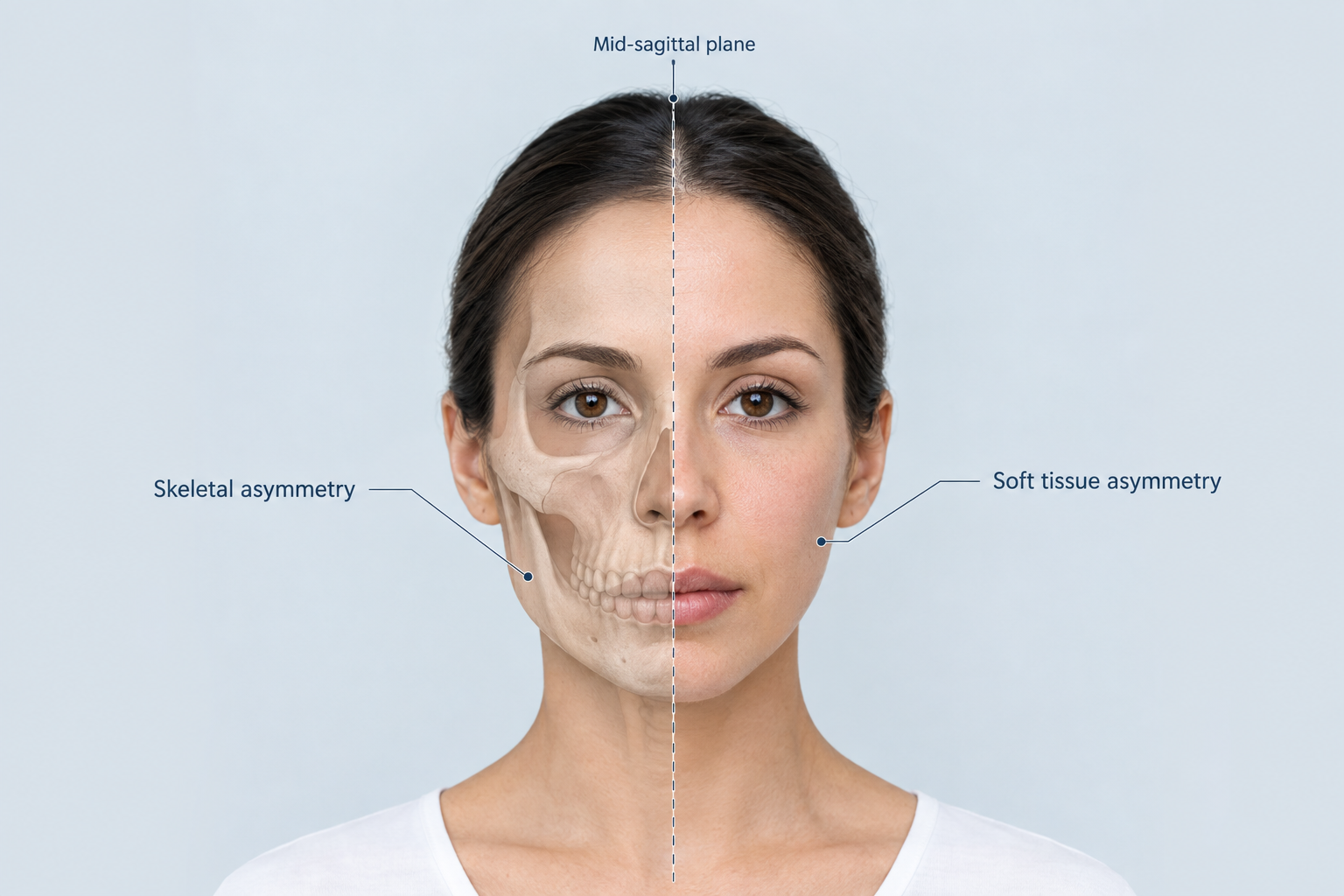

Almost every face is asymmetrical to some degree — the left and right sides rarely mirror each other perfectly, and research consistently shows this is a normal anatomical variation rather than a flaw. What matters clinically is the type of asymmetry, how pronounced it is, whether it has appeared suddenly, and whether it is causing functional problems. This guide explains the main causes of an asymmetrical face, how to assess severity, which warning signs require prompt medical attention, and what treatment options — from lifestyle adjustments to surgical correction — may be appropriate depending on the underlying cause.
Key Takeaways
- Mild facial asymmetry is nearly universal and is generally considered a normal anatomical variation requiring no treatment.
- Sudden facial drooping or weakness on one side of the face can indicate a stroke or Bell's palsy and requires immediate medical assessment.
- The most appropriate treatment depends on whether the asymmetry is skeletal, soft tissue, or neuromuscular in origin — these categories respond to very different interventions.
- Non-surgical options such as dermal fillers and botulinum toxin injections can address mild to moderate soft tissue asymmetry without surgery.
- Cameras and close-range selfies can exaggerate the appearance of asymmetry due to wide-angle lens distortion — your face may look more balanced in real life than in photographs.
What Is an Asymmetrical Face?
Facial asymmetry refers to a measurable or visible difference between the left and right sides of the face when divided along the mid-sagittal plane — an imaginary vertical line running from the forehead through the nose and chin. In a perfectly symmetrical face, each half would be a mirror image of the other. In practice, no human face achieves this, and studies examining large populations consistently find that some degree of asymmetry is present in virtually everyone. The question is not whether asymmetry exists, but how significant it is and what is causing it.
Clinicians generally distinguish between three types of facial asymmetry: skeletal asymmetry, which involves differences in bone structure such as the jaw, cheekbones, or orbital rims; soft tissue asymmetry, which involves differences in fat distribution, muscle bulk, or skin quality; and neuromuscular asymmetry, which results from unequal muscle activity or nerve function on each side. This distinction matters because each type responds to different treatments — a skeletal discrepancy cannot be corrected with dermal fillers alone, and a neuromuscular imbalance may require a very different approach from a volume deficit.
How Severe Is Your Asymmetry? A Practical Self-Assessment
A useful starting point is a front-on photograph taken at eye level in neutral lighting, with your head straight and your expression relaxed. Avoid close-range selfies for this purpose — the wide-angle lens in most smartphone cameras distorts facial proportions and can make asymmetry appear significantly worse than it is in person. A photo taken from about one metre away with a standard lens gives a more accurate representation.
Clinicians often use millimetre measurements to classify asymmetry severity. The following framework, based on published clinical literature, provides a general reference:
| Category | Approximate Difference | Typical Perception |
|---|---|---|
| Minimal | Less than 3 mm | Not noticeable to most observers; within normal variation |
| Mild | 3–5 mm | May be noticed on close inspection; rarely causes concern |
| Moderate | 5–10 mm | Visible in photographs and conversation; may affect confidence |
| Significant | Greater than 10 mm | Clearly visible; may have functional implications; specialist assessment advisable |
It is worth noting that research comparing clinician and layperson perception of asymmetry has found that untrained observers often do not notice differences that clinicians can measure. Mild asymmetry that feels prominent to you may be genuinely imperceptible to others. Conversely, if asymmetry is causing you functional difficulty — such as problems chewing, speaking, or closing one eye — that warrants professional assessment regardless of its visual severity.
When to Worry: Warning Signs That Need Urgent Attention
Most facial asymmetry is long-standing, stable, and benign. However, asymmetry that appears suddenly or changes rapidly can signal a serious medical condition. The following symptoms require prompt — and in some cases emergency — medical assessment.

- Sudden facial drooping on one side, particularly if accompanied by arm weakness, slurred speech, or confusion — these are classic signs of a stroke and require an immediate emergency response.
- Rapid-onset facial weakness or paralysis affecting the forehead, eye, or mouth on one side, which may indicate Bell's palsy or another form of facial nerve damage.
- Inability to close one eye fully, which can lead to corneal damage if untreated.
- Numbness, tingling, or pain affecting one side of the face, particularly if new or worsening.
- Difficulty swallowing or speaking that has developed recently.
- Jaw pain, clicking, or limited mouth opening that is progressive, which may indicate temporomandibular joint (TMJ) disorder requiring dental or maxillofacial assessment.
- Severe headache, vision changes, or facial swelling alongside new asymmetry.
Long-standing asymmetry that has been present since childhood or has changed only very gradually over years is far less likely to represent an acute medical problem. If you are uncertain whether your asymmetry is new or old, photographs from previous years can be a helpful reference.
What Causes an Asymmetrical Face?
Facial asymmetry has many possible causes, and in most people more than one factor contributes. Understanding the underlying cause is essential before considering any treatment, because the appropriate intervention depends entirely on what is driving the asymmetry.
Genetics and Congenital Conditions
Genetic factors influence bone structure, fat distribution, and muscle development, meaning that some degree of inherited asymmetry is common. More pronounced congenital asymmetry can result from conditions such as hemifacial microsomia — a developmental condition in which one side of the face, including the ear, jaw, and surrounding soft tissue, is underdeveloped. Other congenital causes include cleft lip and palate, craniosynostosis (premature fusion of skull bones), and unicoronal synostosis. These conditions typically present from birth and usually require specialist multidisciplinary management.
Aging and Age-Related Volume Loss
Aging is one of the most common causes of increasing asymmetry in adults. The face does not age uniformly — fat pads in different regions descend and deflate at different rates, collagen loss is uneven, and skin laxity develops more prominently on one side in many people, often influenced by habitual sleeping position or sun exposure. This age-related volume loss can cause one cheek to appear flatter, one eye to appear more hollow, or one side of the jawline to appear less defined than the other. Because these changes are gradual, many people do not notice them until they compare photographs taken years apart.
Neurological Causes: Bell's Palsy and Stroke
Bell's palsy is a condition in which the facial nerve on one side becomes inflamed, causing temporary weakness or paralysis of the muscles on that side of the face. It typically develops over hours to days and can cause drooping of the mouth, inability to close the eye, and altered facial expression. Most cases resolve within weeks to months, though some people are left with residual asymmetry. Stroke can cause similar-looking facial drooping but is distinguished by its sudden onset and the presence of other neurological symptoms. Any sudden facial asymmetry should be treated as a potential emergency until a stroke has been ruled out.
Jaw Misalignment and TMJ Disorder
The jaw is a significant contributor to facial shape, and jaw misalignment — whether from malocclusion, missing teeth, uneven bite, or bruxism (teeth grinding) — can alter the apparent symmetry of the lower face. The temporomandibular joint (TMJ) connects the lower jaw to the skull, and TMJ disorder can cause one side of the jaw to develop differently over time, particularly if the joint is chronically overloaded. Research has found that TMJ disorder is present in a substantial proportion of patients presenting with mandibulofacial asymmetry, suggesting that dental and jaw health should be assessed when lower-face asymmetry is a concern.
Lifestyle Habits
Habitual behaviours can contribute to soft tissue asymmetry over time, though their individual effect is generally modest. Sleeping position is a commonly cited factor — consistently sleeping on one side may compress facial tissues and, over many years, contribute to subtle differences in skin quality or fat distribution. Chewing on one side of the mouth habitually can lead to greater masseter muscle development on that side, making the jaw appear wider or more prominent. Resting the face on one hand, poor posture, and chronic head tilt can also play a role. Addressing these habits is unlikely to reverse established asymmetry but may help prevent it from worsening.
Facial Trauma and Injury
Fractures of the nose, cheekbones, or jaw can alter bone structure and, if not treated promptly or optimally, may result in lasting asymmetry. Scarring from injuries or surgery can also affect soft tissue distribution. A history of facial trauma is an important factor to discuss with any clinician considering treatment, as it may influence both the cause of the asymmetry and the suitability of different interventions.
Rare Progressive Conditions
Parry-Romberg syndrome, also known as progressive hemifacial atrophy, is a rare condition in which the skin, fat, and sometimes bone on one side of the face gradually shrink over time. It typically begins in childhood or early adulthood and progresses over several years before stabilising. Management usually involves reconstructive surgery or fat grafting once the condition has stabilised. Torticollis (abnormal neck muscle tension causing head tilt) and certain spinal conditions can also contribute to facial asymmetry through postural mechanisms.
Why Does My Face Look More Asymmetrical in Photos?
Smartphone cameras — particularly in selfie mode — use wide-angle lenses at close range, which introduces perspective distortion. Features closest to the lens appear proportionally larger, and the curvature of the lens exaggerates differences between the two sides of the face. Studies on photographic distortion have shown that faces photographed at close range appear measurably less symmetrical than the same faces photographed from a greater distance with a standard lens. If your asymmetry seems pronounced in selfies but less noticeable in mirrors or in person, lens distortion is likely a significant contributor. For a more accurate self-assessment, use a camera held at arm's length or further, at eye level, in even lighting.
Non-Surgical Treatments for Facial Asymmetry
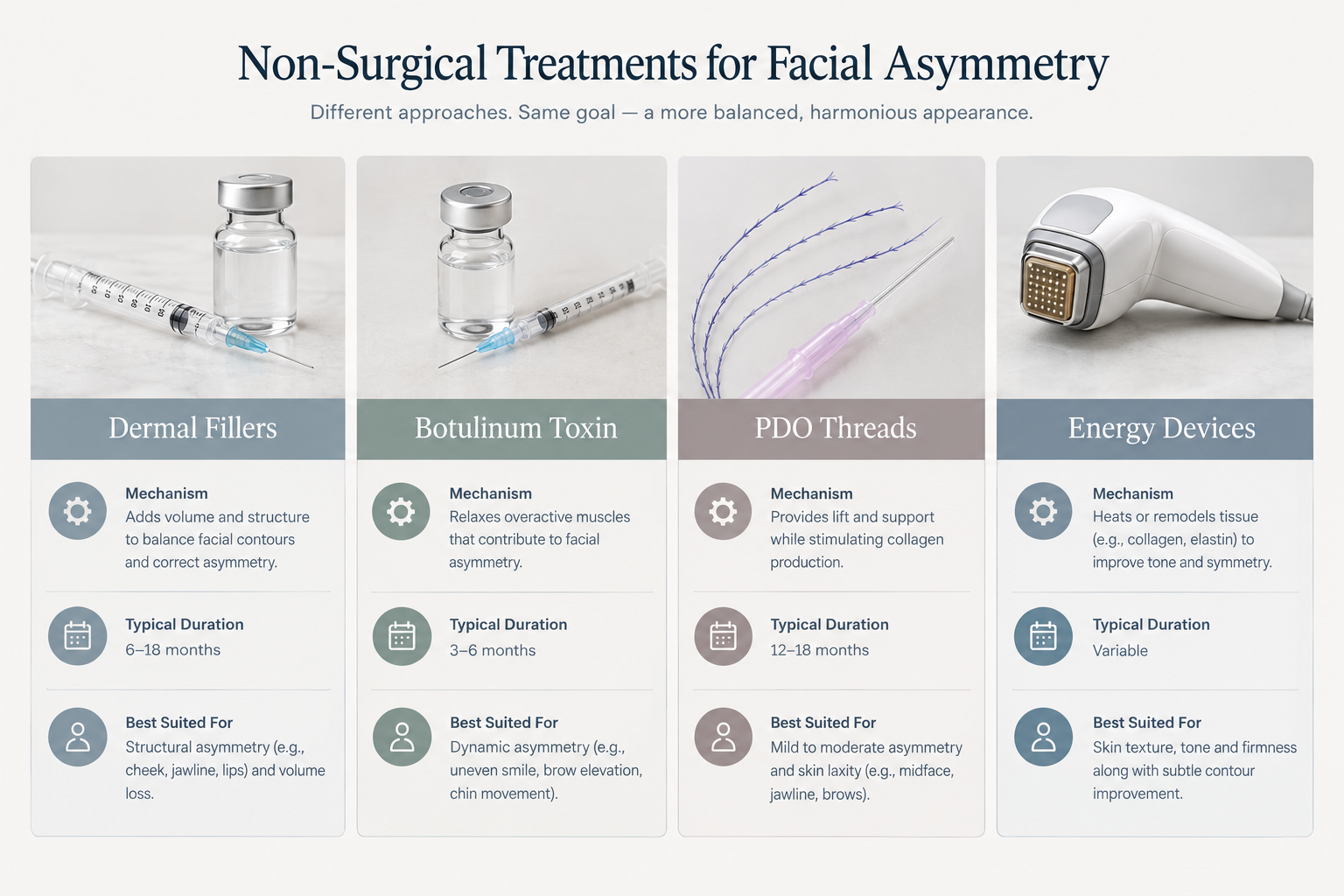
Non-surgical options are appropriate for mild to moderate soft tissue asymmetry and can produce meaningful improvements without the recovery time associated with surgery. The right approach depends on the specific nature of the asymmetry — volume deficit, muscle imbalance, or skin laxity — and a thorough clinical assessment is necessary before any treatment is planned.
Dermal Fillers
Dermal fillers, most commonly based on hyaluronic acid, can add volume to areas that appear deflated or smaller on one side — such as a flatter cheek, a less defined jawline, or a thinner lip. By selectively adding volume to the less prominent side, an experienced injector can reduce the visible difference between the two sides of the face. Results are temporary, typically lasting between six and eighteen months depending on the product used and the treatment area, and the procedure carries risks including bruising, swelling, asymmetry from the treatment itself, and, in rare cases, vascular complications. Hyaluronic acid fillers have the advantage of being reversible with an enzyme called hyaluronidase if the result is unsatisfactory or a complication occurs.
Botulinum Toxin Injections
Botulinum toxin (commonly known by brand names such as Botox) can address neuromuscular asymmetry by reducing activity in an overactive muscle on one side. A common example is masseter asymmetry — if one masseter muscle is significantly larger than the other due to habitual chewing on one side or bruxism, targeted injections can reduce its bulk over several months, making the jawline appear more balanced. Botulinum toxin can also be used to address eyebrow asymmetry or uneven forehead lines. Effects are temporary, usually lasting three to six months, and repeat treatments are needed to maintain results.
PDO Thread Lifting
Polydioxanone (PDO) thread lifting involves inserting dissolvable threads beneath the skin to lift and reposition soft tissue. Threads may be used to address mild asymmetry in cheek or brow position, though results are generally more subtle than surgical lifting and longevity is limited to approximately twelve to eighteen months. Thread lifting is best suited to patients with mild laxity rather than significant structural asymmetry.
Energy-Based Devices
Radiofrequency, focused ultrasound, and laser treatments can improve skin quality and stimulate collagen production, which may help with mild asymmetry related to uneven skin laxity. These technologies are generally more effective for overall skin tightening than for correcting structural differences between the two sides of the face, and results are gradual and variable.
Surgical Options for Facial Asymmetry
Surgical correction is generally considered when asymmetry is significant, skeletal in origin, or has not responded adequately to non-surgical approaches. Surgical options carry greater risks and longer recovery periods but can produce more durable and structurally meaningful results.
Orthognathic Surgery
Orthognathic surgery — also called jaw surgery — repositions the upper jaw (maxilla), lower jaw (mandible), or both to correct skeletal jaw misalignment. It is typically performed by an oral and maxillofacial surgeon, often in conjunction with orthodontic treatment before and after the procedure. Recovery involves several weeks of dietary restriction and swelling, and full results may take six to twelve months to become apparent as swelling resolves. Orthognathic surgery is appropriate for significant skeletal asymmetry affecting jaw position, bite, and facial balance.
Rhinoplasty
The nose sits at the centre of the face and has a disproportionate influence on perceived facial symmetry. Rhinoplasty can address a deviated septum, an asymmetrical nasal tip, or uneven nostrils. It may be performed as an open or closed procedure depending on the degree of correction required. Recovery typically involves bruising and swelling for two to four weeks, with final results taking up to a year to fully emerge.
Chin Augmentation and Genioplasty
Chin asymmetry can be addressed with a chin implant or with a sliding genioplasty, in which the chin bone is surgically repositioned. The choice between these approaches depends on the nature of the asymmetry — implants add volume and projection, while genioplasty can correct both projection and lateral deviation. Both procedures are typically performed under general anaesthesia with a recovery period of one to three weeks.
Cheek Implants and Fat Transfer
Cheek implants can add structural volume to a flatter side of the face, while fat transfer (fat grafting) uses the patient's own fat, harvested from elsewhere on the body, to restore volume asymmetry. Fat transfer results are less predictable than implants because a proportion of the transferred fat is reabsorbed, but the approach avoids the use of synthetic materials and can produce natural-feeling results.
Facelift and Blepharoplasty
A facelift can address asymmetry related to uneven skin laxity and soft tissue descent in the mid and lower face, while blepharoplasty (eyelid surgery) can correct asymmetry in upper or lower eyelid position. These procedures are generally most appropriate for patients in whom aging-related changes are the primary driver of asymmetry.
Facial Exercises: What the Evidence Actually Shows
Facial exercises are widely promoted as a way to improve facial symmetry, but the evidence supporting their use for this purpose is limited and should be interpreted carefully. The strongest evidence for facial exercises relates to rehabilitation following Bell's palsy — structured neuromuscular retraining exercises, ideally guided by a physiotherapist or specialist, can help restore more symmetrical muscle function during recovery from facial nerve palsy. Outside of this context, the evidence that exercises meaningfully correct structural or soft tissue asymmetry in otherwise healthy individuals is not well established.
One important caution: if one side of the face is already stronger or more active than the other, exercising both sides equally — or overworking the stronger side — can potentially worsen rather than improve asymmetry. If you are considering facial exercises for asymmetry, particularly following any neurological event, guidance from a qualified practitioner is advisable rather than following generic online routines.
Lifestyle and Home Approaches
While lifestyle changes are unlikely to correct established asymmetry, some habits may help prevent it from worsening. Switching to back sleeping or using a cervical pillow can reduce chronic compression of one side of the face. Consciously distributing chewing more evenly between both sides of the mouth may help prevent further masseter muscle imbalance. Maintaining good posture and avoiding habitual head tilt can reduce postural contributions to asymmetry. Sun protection is relevant because cumulative UV exposure can accelerate uneven collagen loss, particularly on the side of the face more exposed during driving or outdoor activities.
Makeup techniques — specifically contouring and highlighting — can create the visual impression of greater symmetry without any medical intervention. Applying a slightly deeper contour shade to the more prominent side and a lighter highlight to the less prominent side can reduce the perceived difference. Eyebrow shaping is particularly effective, as eyebrow asymmetry is one of the most noticeable features of an asymmetrical face and can be addressed with careful grooming or tinting.
The Psychology of Facial Asymmetry
Research into the relationship between facial symmetry and attractiveness has produced some nuanced findings worth knowing. While moderate symmetry is generally associated with positive aesthetic perception, studies have shown that artificially symmetrised faces — created by mirroring one half of the face — are often rated as less attractive and less natural-looking than the original asymmetrical face. This suggests that mild asymmetry contributes to the individuality and character of a face rather than detracting from it.
The concept of fluctuating asymmetry — small random deviations from perfect symmetry — has been studied as a potential signal of developmental stability and health, though the relationship is complex and the practical significance for individual faces is limited. What is more consistently supported is that mild asymmetry is rarely noticed by others to the degree that the person experiencing it perceives it. If concern about facial asymmetry is causing significant distress or preoccupation disproportionate to the objective degree of asymmetry, it may be worth discussing this with a healthcare professional, as body dysmorphic disorder can present in this way and requires a different approach from cosmetic treatment.
Frequently Asked Questions
Is it normal to have an asymmetrical face?
Yes. Virtually all faces have some degree of asymmetry, and mild differences between the left and right sides are considered a normal anatomical variation. Studies consistently show that perfect bilateral symmetry does not exist in human faces, and minimal asymmetry is not a medical concern.
Can facial asymmetry get worse with age?
It can. Age-related changes — including fat pad descent, uneven volume loss, and skin laxity — often develop at different rates on each side of the face, meaning that asymmetry may become more noticeable over time. Lifestyle factors such as sleeping position and sun exposure can also contribute to this progression.
When should I see a doctor about facial asymmetry?
Seek urgent medical attention if asymmetry appears suddenly, particularly if accompanied by weakness, numbness, difficulty speaking or swallowing, or arm weakness — these may indicate a stroke or Bell's palsy. For long-standing or gradually changing asymmetry, a GP, dermatologist, or maxillofacial specialist can help identify the cause and appropriate management.
Can dermal fillers fix an asymmetrical face?
Dermal fillers can meaningfully reduce the appearance of soft tissue asymmetry — for example, by adding volume to a flatter cheek or a thinner lip on one side. They are not appropriate for skeletal asymmetry and cannot correct structural bone differences. Results are temporary and require maintenance, and treatment should be performed by a qualified and experienced injector.
Why does my face look more asymmetrical in selfies than in the mirror?
Smartphone cameras in selfie mode use wide-angle lenses at close range, which distorts facial proportions and exaggerates differences between the two sides. The mirror image you see is also a reversed version of your face, which can feel unfamiliar. A photograph taken from a greater distance with a standard lens gives a more accurate representation of how others see your face.
Do facial exercises improve facial symmetry?
The evidence is strongest for facial exercises used in Bell's palsy rehabilitation, where structured neuromuscular retraining can support recovery of more symmetrical muscle function. For general facial asymmetry in otherwise healthy individuals, the evidence is limited, and exercising the stronger side without guidance can potentially worsen imbalance.
What is the difference between soft tissue and skeletal asymmetry?
Skeletal asymmetry involves differences in bone structure — such as jaw position, cheekbone prominence, or orbital rim height — and typically requires surgical correction for significant improvement. Soft tissue asymmetry involves differences in fat, muscle, or skin and may respond to non-surgical treatments such as dermal fillers or botulinum toxin. Identifying which type is present is an essential first step in planning any treatment.
Deciding Whether to Seek Treatment for Facial Asymmetry
For most people, mild facial asymmetry requires no treatment — it is a normal feature of human faces and is rarely as noticeable to others as it feels from the inside. If asymmetry is causing genuine distress, functional difficulty, or has changed noticeably over a short period, a clinical assessment is a sensible first step. A qualified practitioner can identify whether the asymmetry is skeletal, soft tissue, or neuromuscular in origin, which determines whether non-surgical options such as dermal fillers or botulinum toxin are appropriate, or whether a referral for orthodontic, dental, or surgical assessment would be more suitable.
Non-surgical treatments can produce meaningful improvements for the right candidate, but they work within the limits of what soft tissue correction can achieve — they cannot reposition bones or restore nerve function. Surgical options offer more durable structural correction but carry greater risks and recovery demands. Any decision about treatment should be made after a thorough consultation with a practitioner who has assessed your specific anatomy, understood your goals, and discussed realistic outcomes alongside the relevant risks and alternatives. If you are considering treatment primarily because of how your face appears in selfies, it is worth first establishing whether photographic distortion is contributing to your perception before pursuing any intervention.
