


A chin dimple can be a defining facial feature — sometimes inherited, sometimes developing gradually over time, and occasionally appearing where none existed before. Understanding why a chin dimple forms requires looking at three distinct mechanisms: the way the lower jaw develops before birth, the genetics that influence bone structure, and the soft-tissue changes driven by muscle activity and ageing. This article explains each cause clearly, addresses common myths, and outlines when treatment may be worth discussing with a qualified practitioner.
Key Takeaways
- A chin dimple can be structural (bone-based) or soft-tissue-based (muscle-driven or age-related) — these are different conditions with different causes.
- The classic cleft chin results from incomplete fusion of the two halves of the lower jaw during fetal development, influenced by genetics.
- Overactivity of the mentalis muscle can create an orange peel or pebble chin texture that is distinct from a true cleft chin.
- Collagen loss, skin laxity, and volume reduction with age can cause a chin dimple to appear or worsen in people who had smooth chins when younger.
- Modern genetics research suggests cleft chin is a polygenic trait with variable penetrance, not a simple dominant gene — the old textbook explanation is an oversimplification.
What Is a Chin Dimple?
The term chin dimple is used loosely to describe any visible indentation, cleft, or textural irregularity on the chin. In clinical and anatomical terms, however, there are meaningful differences between a true cleft chin and other forms of chin dimpling. A cleft chin — sometimes called a butt chin or chin fissure — refers specifically to a midline groove or Y-shaped indentation that reflects an underlying bony or soft-tissue gap at the front of the lower jaw. By contrast, a dimpled or pebbled chin surface caused by muscle overactivity or skin laxity does not involve the bone at all. Distinguishing between these two types matters because the causes, natural history, and treatment options differ considerably.
Colloquially, a prominent cleft chin is also called a booty chin, and it has been associated with numerous celebrities including Kirk Douglas, John Travolta, Ben Affleck, and Sandra Bullock. Cultural attitudes toward the feature have varied widely — Persian poetry historically described a deep chin well as a mark of beauty, while some ancient Chinese traditions linked it to royalty. These associations are cultural rather than medical, and the feature carries no inherent health significance in the vast majority of people.
The Two Main Types of Chin Dimple
Before exploring causes in detail, it is useful to understand the two broad categories of chin dimple, because they arise through entirely different mechanisms.

- Structural (bone-based) cleft chin: A midline groove caused by incomplete fusion of the mandibular symphysis during fetal development. The underlying bone retains a notch or bifid shape, and the overlying soft tissue follows that contour. This type is largely determined before birth and is strongly influenced by genetics.
- Soft-tissue chin dimpling: A textural change — often described as orange peel, pebble chin, or cobblestone skin — caused by overactivity of the mentalis muscle, age-related volume loss, or both. The bone is typically normal; the dimpling reflects changes in the muscle, fat, and skin layers above it.
Many people have elements of both: a mild underlying bony asymmetry that becomes more visible as soft-tissue support diminishes with age. Understanding which type is present helps determine whether a feature is congenital, acquired, or a combination.
Cause 1: Incomplete Jaw Fusion During Fetal Development
The most well-established cause of a structural cleft chin is incomplete fusion of the two halves of the lower jaw during early pregnancy. During weeks four to eight of gestation, the developing face forms from several tissue segments that migrate toward the midline and fuse together. The lower jaw — the mandible — forms from two separate bony processes that meet and join at the front at a point called the mandibular symphysis.
In most people, this fusion is complete, leaving a smooth midline. In others, the fusion is partial or leaves a residual notch in the bone. The soft tissue overlying this notch — skin, subcutaneous fat, and the attachment of the mentalis muscle — follows the bony contour, producing the visible groove or cleft. The depth of the resulting chin dimple depends on how pronounced the bony notch is and how much soft tissue covers it. A deeper notch with thinner overlying tissue produces a more visible cleft; a shallow notch with fuller soft tissue may be barely perceptible.
This embryological explanation is supported by imaging studies showing that individuals with a visible cleft chin often have a corresponding bifid or notched mandibular symphysis on X-ray or CT scan. The process is part of normal craniofacial morphogenesis, and an incomplete fusion at this site does not indicate a developmental problem — it is simply a variation in the degree of midline closure.
Cause 2: Genetics — More Complex Than a Single Dominant Gene
Genetics plays a central role in determining whether a person develops a structural cleft chin, but the inheritance pattern is more nuanced than older textbooks suggest. For decades, cleft chin was cited in genetics courses as a classic example of an autosomal dominant trait — meaning that inheriting one copy of the relevant allele from either parent was sufficient to produce the feature. While this explanation captures part of the picture, it is an oversimplification.
More recent research indicates that cleft chin is better described as a polygenic trait — one influenced by multiple genes rather than a single dominant allele. A genome-wide association study identified a genetic marker, rs11684042 on chromosome 2, as significantly associated with cleft chin, but this marker alone does not determine the outcome. The MTHFR gene (specifically the C677T polymorphism) has also been implicated in midline facial development, though its precise contribution to chin morphology is still being studied.
The concept of variable penetrance is important here. Even among people who carry the relevant genetic variants, the feature does not always appear — or may appear in a mild form that is barely noticeable. This explains why two parents without a visible cleft chin can have a child with one, and why the feature can skip generations or vary considerably in depth between siblings. Modifier genes, the interaction between multiple genetic variants, and environmental factors during fetal development all contribute to the final outcome.
The practical implication is that a family history of cleft chin increases the likelihood of the feature, but does not guarantee it. Conversely, the absence of a family history does not rule it out. Genetic counselling is not typically sought for this feature, as it is a normal anatomical variation rather than a medical condition.
Cause 3: The Mentalis Muscle and Soft-Tissue Dimpling
Not all chin dimpling is structural. The mentalis muscle — a paired muscle that sits in the soft tissue of the chin and is responsible for raising the lower lip and wrinkling the chin skin — is a significant contributor to acquired chin dimpling. When the mentalis muscle is overactive or hyperactive, its repeated contractions pull on the overlying dermis, creating a characteristic textured appearance on the chin surface.
This muscle hyperactivity produces what clinicians describe as peau d'orange (French for orange peel skin), a pebble chin, or a cobblestone texture. Unlike a true cleft chin, this type of dimpling is not a single midline groove but rather a diffuse pattern of small indentations across the chin pad. It may be present at rest in people with significant mentalis overactivity, or it may only appear during facial expressions such as speaking, chewing, or pursing the lips.
The mentalis muscle's fibres insert directly into the dermis of the chin, which is why its contractions have such a visible effect on skin texture. In people with thinner skin or reduced subcutaneous fat, even moderate muscle activity can produce noticeable dimpling. The labiomental crease — the horizontal groove between the lower lip and the chin — can also become more pronounced when the mentalis is overactive, contributing to an aged or strained appearance of the lower face.
Mentalis hyperactivity can be a primary finding or can develop as a compensatory response. For example, people with a recessed chin or reduced chin projection sometimes habitually contract the mentalis to bring the lower lip forward, which over time increases the muscle's resting tone and worsens the dimpling effect.
Cause 4: Ageing, Collagen Loss, and Volume Reduction
A chin dimple that appears or worsens in adulthood — particularly in people who had a smooth chin when younger — is most commonly explained by the structural changes that accompany facial ageing. Several overlapping processes contribute to this.
Collagen loss is a central factor. Collagen fibres in the dermis provide structural support and help the skin maintain a smooth surface over the underlying muscle and fat. From the mid-twenties onward, collagen production gradually declines and existing fibres become less organised. As the dermis thins and loses elasticity, the attachments between the skin and the mentalis muscle become relatively more prominent, making any underlying muscle activity or bony irregularity more visible at the surface.
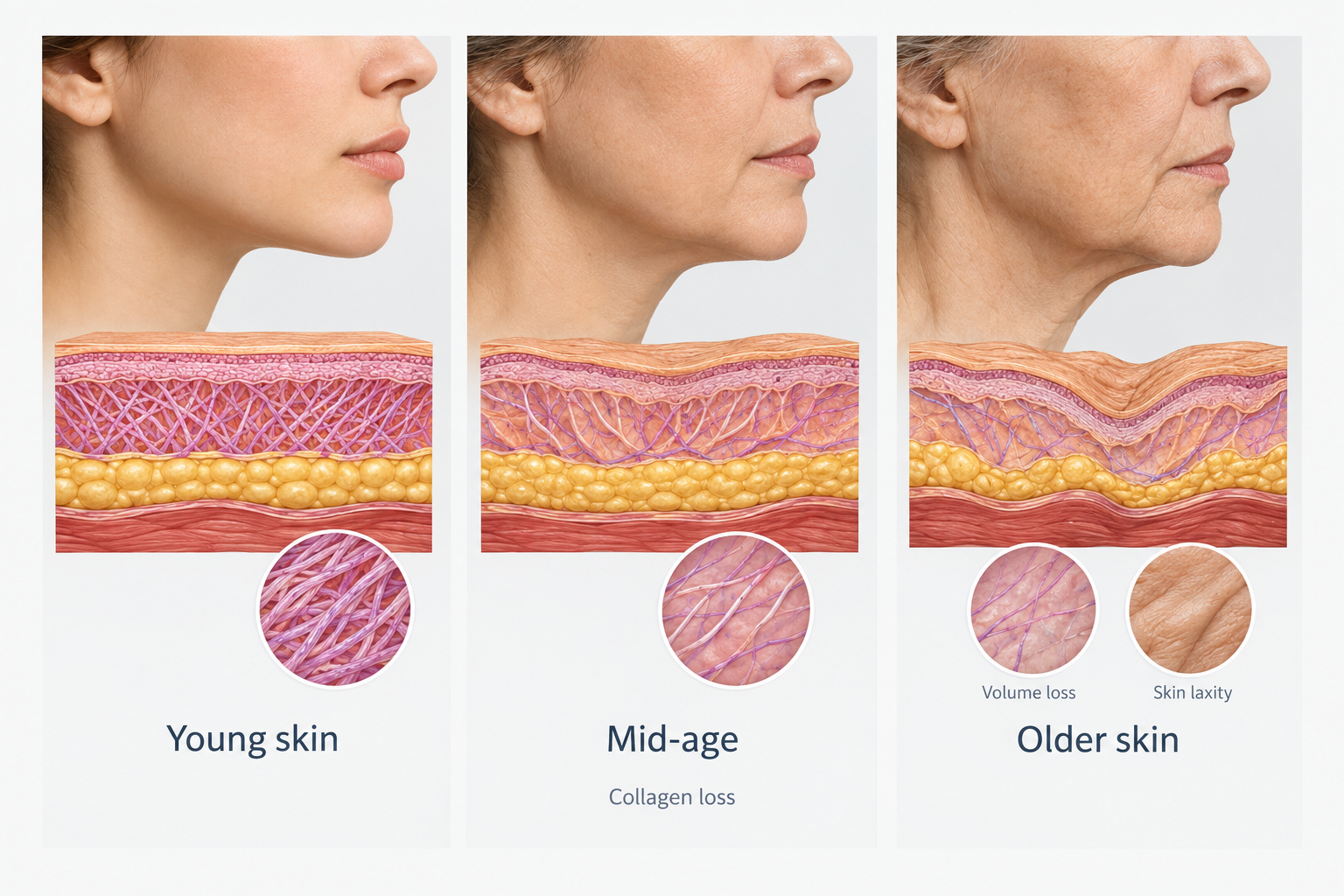
Skin laxity compounds this effect. Looser skin is less able to resist the pulling forces of muscle contractions, so the same degree of mentalis activity that was imperceptible in younger skin may produce visible dimpling in older skin. This is why chin dimpling often becomes more noticeable from the forties onward, even in people who have never had a structural cleft.
Volume loss in the chin and lower face also plays a role. The subcutaneous fat pads that give the chin a smooth, rounded contour gradually reduce with age, and bone resorption at the mandible can alter the underlying support structure. As facial fat diminishes and the chin loses projection, the skin sits closer to the muscle, and any textural irregularity becomes more apparent. Body weight fluctuations can influence this process — significant weight loss can accelerate the reduction in facial fat, making existing dimpling more visible.
The combined effect of collagen loss, skin laxity, and volume reduction means that facial morphology changes in ways that can reveal or exaggerate a chin dimple that was previously subtle or absent. This is an important distinction from the congenital cleft chin, which is present from birth and reflects bone structure rather than soft-tissue ageing.
Sex Differences in Chin Dimple Visibility
Cleft chins and chin dimpling are generally more visible and more commonly reported in men than in women. Several factors contribute to this difference. Male jaw development, influenced by testosterone during puberty, tends to produce a more prominent, squarer mandible with less overlying soft tissue. A bony notch at the mandibular symphysis is therefore more likely to be visible through thinner overlying tissue in a male jaw than in a female jaw with more subcutaneous fat and softer contours.
Bone density and jaw projection also differ between sexes on average, with male chins typically having greater forward projection. A more prominent chin with less soft-tissue padding means that any midline variation in bone shape is more readily apparent. In women, fuller facial fat distribution and softer jaw angles tend to obscure mild bony irregularities, though the feature certainly occurs in women and can be equally prominent.
When a Chin Dimple May Warrant Medical Attention
In the overwhelming majority of cases, a chin dimple — whether structural or soft-tissue-based — is a normal anatomical variation with no medical significance. However, in rare circumstances, midline facial clefts or unusual chin morphology can be associated with broader craniofacial syndromes. Conditions such as Branchiooculofacial syndrome and Saethre-Chotzen syndrome can involve midline facial features alongside other clinical findings including ear, eye, or limb abnormalities.
A chin dimple in isolation, without any other unusual features, is not a cause for concern. If a chin cleft or midline facial irregularity is identified in a newborn alongside other structural differences, or if an adult notices a new midline change accompanied by other symptoms, a clinical assessment is appropriate. For the vast majority of people reading this article, a chin dimple is simply a feature of their facial anatomy.
Myth-Busting: Personality, Dominance, and the Single-Gene Story
Two persistent myths surround chin dimples and are worth addressing directly. The first is the claim that cleft chin is a straightforward autosomal dominant trait — a single gene that either is or is not present. As discussed above, this is an oversimplification. The feature is better understood as a polygenic trait with variable penetrance, meaning that multiple genetic factors interact to produce the outcome, and carrying the relevant variants does not guarantee the feature will appear.
The second myth concerns personality. Various popular sources claim that people with cleft chins share particular personality traits — ambition, stubbornness, or charisma are commonly cited. There is no credible scientific evidence supporting any link between chin morphology and personality. These associations are cultural narratives, not biological findings, and should be understood as such.
Treatment Options for Chin Dimpling
Whether treatment is appropriate depends entirely on the type of chin dimple, its cause, and the individual's goals. Many people are entirely comfortable with their chin dimple and have no interest in changing it. For those who find the feature bothersome — particularly acquired soft-tissue dimpling — several options may be worth discussing with a qualified aesthetic practitioner.
Botulinum Toxin (Botox) for Mentalis Hyperactivity
For chin dimpling caused by muscle hyperactivity of the mentalis, botulinum toxin injections — commonly referred to by the brand name Botox — can reduce the muscle's activity and smooth the peau d'orange texture. By temporarily relaxing the mentalis, the repeated pulling on the overlying dermis is reduced, allowing the skin surface to appear smoother. Results typically last three to six months, after which repeat treatment is needed to maintain the effect. This approach addresses the muscle-driven component of chin dimpling but does not alter bone structure.
Dermal Filler for Volume and Contour
Hyaluronic acid dermal filler can be used to add volume to the chin area, improving chin projection and smoothing the appearance of a cleft or dimple by filling the soft-tissue deficit above it. Filler does not change the underlying bone but can reduce the visual depth of a cleft chin or improve the contour of a chin affected by age-related volume loss. Results are temporary, typically lasting twelve to eighteen months depending on the product used and individual factors.
Surgical Options
For a deep structural cleft chin where non-surgical options are insufficient, surgical approaches such as mentoplasty or genioplasty can alter the underlying bone or soft tissue more permanently. These procedures carry greater risks and recovery time than injectable treatments and are typically considered only when the feature causes significant distress and non-surgical options have been explored. A consultation with a maxillofacial or plastic surgeon would be appropriate for anyone considering this route.
It is also worth noting that some people seek the opposite — dimple creation surgery or procedures to add a chin dimple where none exists. This reflects the range of aesthetic preferences around this feature.
Frequently Asked Questions
Is a chin dimple always genetic?
A structural cleft chin has a strong genetic component, but soft-tissue chin dimpling caused by mentalis muscle activity or ageing is not primarily genetic. Even for structural cleft chins, the inheritance is polygenic with variable penetrance, meaning genetics increases the likelihood but does not determine the outcome with certainty.
Can two parents without a chin dimple have a child with one?
Yes. Because cleft chin is a polygenic trait with variable penetrance, parents who carry relevant genetic variants without expressing the feature visibly can pass those variants to a child who does express it. This is why the feature can appear to skip generations.
Can a chin dimple appear for the first time in adulthood?
Yes. Soft-tissue chin dimpling caused by mentalis muscle overactivity or age-related collagen loss and volume reduction can develop or become more noticeable in adulthood, even in people who had a smooth chin when younger. This type of dimpling is acquired rather than congenital.
Is a chin dimple more common in men?
Cleft chins and chin dimpling tend to be more visible in men due to differences in jaw development, bone density, and the amount of overlying soft tissue. The feature occurs in both sexes but is more frequently reported and more prominent in males on average.
Does a chin dimple have any health implications?
In the vast majority of cases, a chin dimple is a normal anatomical variation with no health implications. Rarely, midline facial clefts occurring alongside other structural differences may be associated with craniofacial syndromes, but a chin dimple in isolation does not indicate a medical problem.
Can chin dimpling be treated without surgery?
Yes. Botulinum toxin injections can reduce mentalis muscle hyperactivity and smooth peau d'orange texture, while dermal filler can improve volume and contour. These are non-surgical options suitable for many people with soft-tissue chin dimpling. A structural bone-based cleft chin is more difficult to address non-surgically, though filler can reduce its visual depth.
Is the pebble chin texture the same as a cleft chin?
No. A pebble chin or cobblestone texture is caused by mentalis muscle overactivity pulling on the dermis and is a soft-tissue finding. A cleft chin is a midline groove reflecting incomplete fusion of the mandibular symphysis. They can coexist but have different causes and respond to different treatments.
Understanding Your Chin Dimple and Whether to Act on It
A chin dimple is rarely a medical concern, but understanding its cause can help clarify whether it is likely to change over time and whether any intervention makes sense. A structural cleft chin rooted in incomplete mandibular symphysis fusion and genetic factors is a stable feature that reflects your bone structure. Soft-tissue dimpling driven by mentalis muscle hyperactivity or age-related collagen loss and skin laxity is more dynamic — it may worsen gradually and is more amenable to non-surgical treatment.
If you are bothered by chin dimpling — particularly the orange peel or pebble chin texture associated with muscle activity — a consultation with a qualified aesthetic practitioner can help identify the underlying cause and discuss whether botulinum toxin, dermal filler, or another approach may be appropriate for your specific anatomy and goals. If the feature does not concern you, no action is needed. A chin dimple, in all its forms, is a normal part of human facial variation.
