
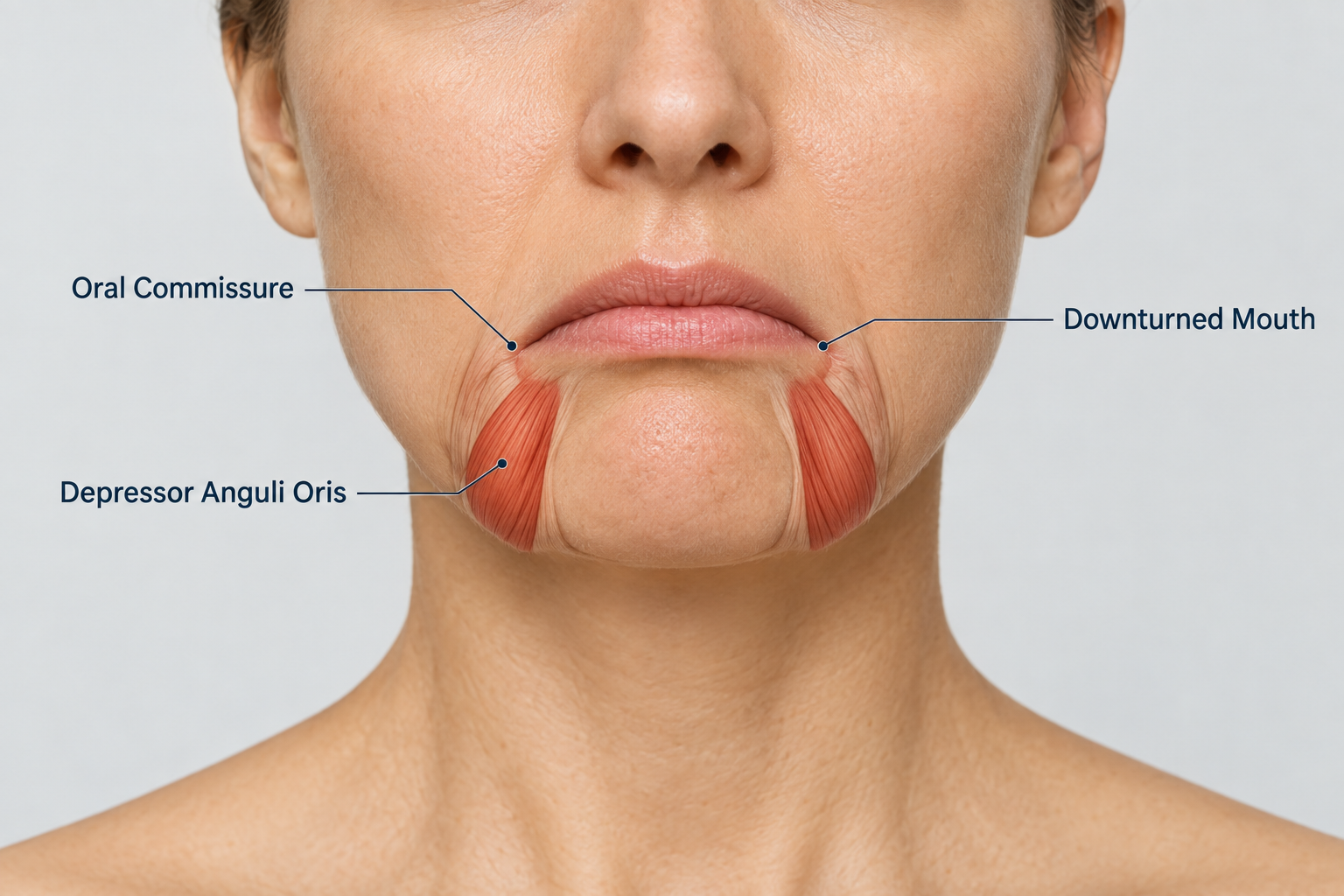

A downturned mouth — where the corners of the lips curve downward at rest — is one of the more common aesthetic concerns that brings patients to a consultation. For many people, the appearance creates an unintentionally sad or stern expression even when they feel entirely neutral, and this can become more pronounced with age. Several non-surgical and minimally invasive treatments may help lift or soften the corners of the mouth, though the right approach depends on the underlying cause, the degree of change present, and individual anatomy. This article explains what causes a downturned mouth, which treatments are available, what realistic results look like, and what to consider before booking a consultation.
Key Takeaways
- A downturned mouth can result from muscle activity, volume loss, skin laxity, or a combination of these factors — and the cause influences which treatment may be most appropriate.
- Botulinum toxin injections targeting the depressor anguli oris muscle are a commonly used first-line option for mild to moderate cases, with results typically lasting three to four months.
- Dermal fillers placed at the oral commissures or along the jawline may help restore lost volume and support the corners of the mouth.
- Combination approaches are often used in practice, as a single treatment may not address all contributing factors.
- Results vary between individuals, and a thorough clinical assessment is essential before any treatment is undertaken.
What Causes a Downturned Mouth?
Understanding the anatomy behind a downturned mouth is important because it directly affects which treatment options are likely to be useful. The corners of the mouth — known as the oral commissures — are held in position by a balance of muscles that pull upward and downward. The depressor anguli oris (DAO) is a triangular muscle that runs from the lower jaw to the corner of the mouth and pulls the commissures downward. When this muscle is relatively overactive, or when the muscles that lift the corners weaken with age, the net effect is a downward pull at rest.
Age-related changes also play a significant role. As the face loses collagen, subcutaneous fat, and bone density over time, structural support around the lower face diminishes. Volume loss in the cheeks and mid-face can cause the overlying tissue to descend, contributing to the appearance of marionette lines — the vertical creases that run from the corners of the mouth toward the chin — and a more pronounced downward turn at the commissures. Skin laxity along the jawline and lower face can compound this effect.
In younger patients, a downturned mouth may be primarily a result of DAO muscle dominance rather than volume loss, making muscle-relaxing treatments a more straightforward option. In older patients, a combination of muscle activity, volume depletion, and tissue descent is more common, and a multi-modal approach may be needed. Genetic factors also influence the natural resting position of the mouth corners, meaning some individuals notice this concern from an early age.
Botulinum Toxin for Downturned Mouth Corners
Botulinum toxin injections — delivered under brand names such as Botox, Dysport, or Azzalure depending on the clinic and country — are among the most frequently used treatments for a downturned mouth caused by DAO overactivity. The treatment works by temporarily reducing the pulling force of the depressor anguli oris muscle, allowing the muscles that elevate the mouth corners to act with less opposition. The result, when successful, is a subtle upward shift in the resting position of the oral commissures.
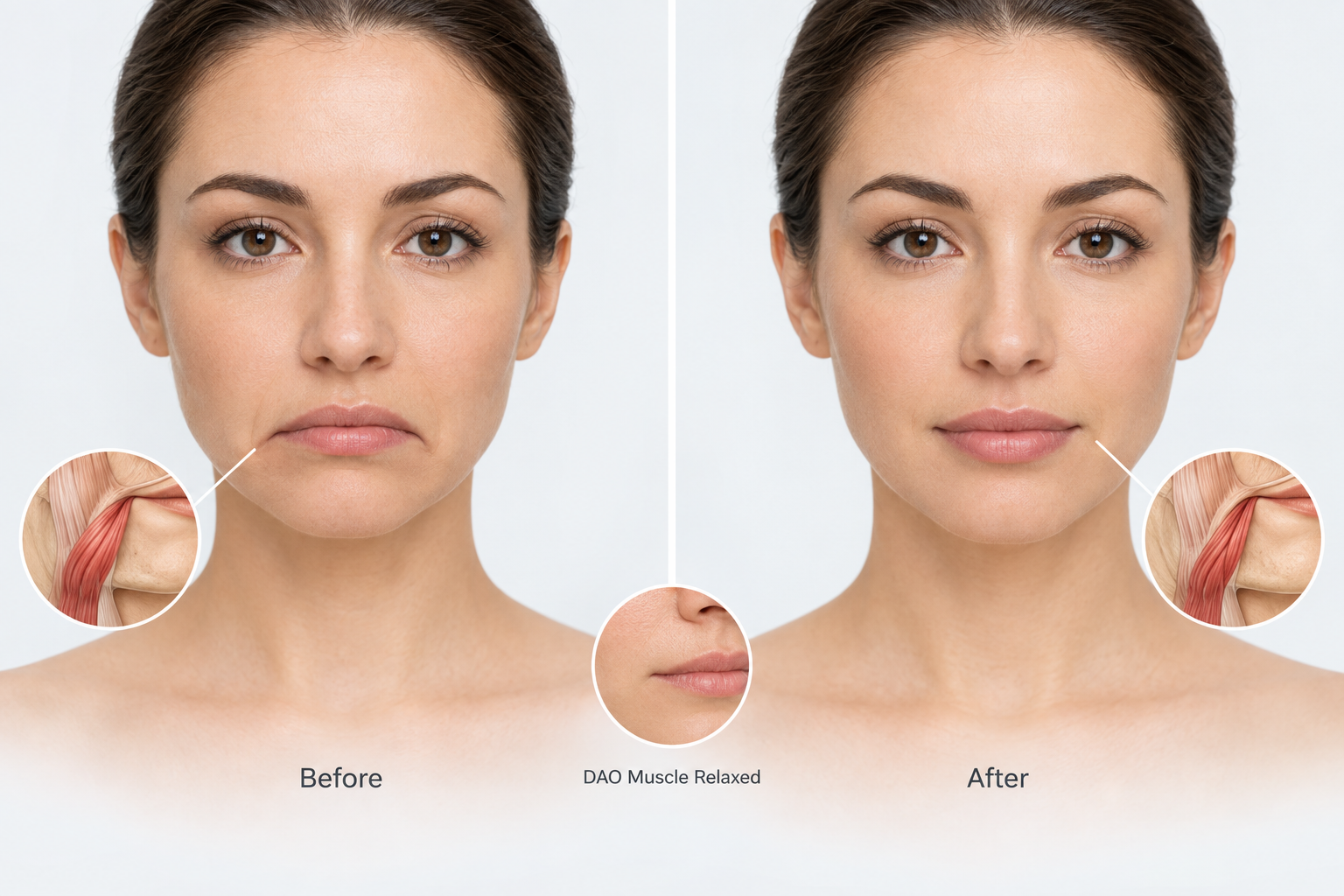
The treatment is typically quick, involving a small number of precisely placed injections into the DAO on each side of the lower face. Because the anatomy in this area is complex and several important muscles are in close proximity, accurate placement is essential. Injections that are too high, too deep, or incorrectly positioned can affect the muscles responsible for lip movement and smile symmetry. This is why the treatment should only be performed by a qualified and experienced practitioner with a thorough understanding of lower facial anatomy.
Results from botulinum toxin treatment for the oral commissures generally become visible within a few days to two weeks and typically last approximately three to four months, though individual response varies. Some patients find that with repeated treatments over time, they require less frequent top-ups, though this is not guaranteed. The treatment does not address volume loss or skin laxity, so patients with significant structural changes may see only partial improvement from botulinum toxin alone.
Common side effects include temporary bruising, swelling, or tenderness at the injection sites. More significant but less common risks include asymmetry, unintended weakness of adjacent muscles affecting smile or lip movement, and — rarely — spread of effect beyond the intended area. These effects are generally temporary but should be discussed in detail during a pre-treatment consultation.
Dermal Fillers for the Oral Commissures
Dermal fillers — most commonly hyaluronic acid-based products — can be used to address volume loss and provide structural support around the corners of the mouth. Hyaluronic acid is a naturally occurring substance in the body, and injectable forms are used to restore lost volume, improve contour, and provide a degree of lift to the oral commissures.
Filler placement for a downturned mouth may target several areas depending on the individual assessment. Small amounts of filler placed directly at the commissures can help support the corner of the lip and reduce the depth of any downward fold. Filler along the marionette lines may soften the vertical creases that contribute to the overall appearance of a turned-down mouth. In some cases, addressing volume loss in the mid-face or along the jawline is also part of the treatment plan, as restoring structural support higher in the face can have a positive effect on the lower face.
Results from hyaluronic acid fillers are typically visible immediately, though some initial swelling is expected. The final result becomes clearer once swelling resolves, usually within one to two weeks. Duration varies depending on the product used, the area treated, and individual metabolism, but results in the perioral area commonly last between six and twelve months. Hyaluronic acid fillers have the advantage of being reversible using an enzyme called hyaluronidase, which can dissolve the product if the result is unsatisfactory or if a complication occurs.
Risks associated with perioral filler include bruising, swelling, asymmetry, lumpiness, and — in rare but serious cases — vascular occlusion, where filler inadvertently enters or compresses a blood vessel. The perioral region has a complex vascular supply, and treatment in this area carries a higher risk profile than some other facial zones. Choosing a practitioner with appropriate training, experience, and access to hyaluronidase for emergency use is particularly important when considering filler near the mouth.
Combination Approaches
In clinical practice, a downturned mouth is frequently addressed using a combination of treatments rather than a single modality. Botulinum toxin may be used to reduce the downward pull of the DAO muscle, while dermal filler addresses volume loss and supports the commissures structurally. These two approaches target different contributing factors and can complement each other when the patient’s anatomy and goals make a combined approach appropriate.
Some practitioners also incorporate treatment of the mentalis muscle — the muscle at the chin — as part of a lower face assessment. Overactivity of the mentalis can contribute to chin dimpling and may influence the overall appearance of the lower face, including the mouth area. Addressing the mentalis with botulinum toxin is sometimes included in a broader lower face treatment plan, though this depends on individual assessment.
Thread lifts — minimally invasive procedures that use dissolvable sutures to mechanically lift soft tissue — are occasionally discussed as an option for patients with more significant tissue descent. However, the evidence base for thread lifts in the perioral area is more limited than for injectables, results can be variable, and the risk profile differs. Thread lifts are generally considered when non-injectable options have been insufficient or when the degree of laxity is beyond what injectables can reasonably address.
What to Expect During and After Treatment
A consultation before any treatment for a downturned mouth should involve a detailed assessment of the lower face, including the resting position of the mouth corners, the degree of muscle activity, the presence and extent of volume loss, skin quality, and the patient’s overall facial anatomy. Photographs are typically taken for reference. The practitioner should explain which factors are contributing to the concern, which treatment options may be appropriate, realistic expectations, and the relevant risks.
Botulinum toxin appointments for the oral commissures are generally brief. A topical anaesthetic is not always required, as the injections involve a small number of fine needle insertions. Some mild discomfort, redness, or swelling at the injection sites is normal and usually resolves within a few hours to a day. Patients are typically advised to avoid strenuous exercise, alcohol, and lying flat for a short period after treatment, though specific aftercare instructions vary by clinic and practitioner.
Dermal filler appointments in the perioral area may take slightly longer, particularly if multiple areas are being treated. A topical anaesthetic cream is commonly applied beforehand, and many filler products also contain lidocaine to improve comfort during injection. Swelling and bruising are more common with filler than with botulinum toxin in this area, and patients should be prepared for the possibility of visible bruising for several days. Strenuous activity and significant pressure on the treated area are generally avoided for a short period after treatment.
Results from botulinum toxin become visible gradually over the first one to two weeks. Filler results are visible immediately but settle over one to two weeks as swelling resolves. A review appointment is often recommended two to four weeks after treatment to assess the outcome and determine whether any refinement is needed.
How Long Do Results Last?
The longevity of results depends on the treatment used, the individual patient, and the area treated. Botulinum toxin for the depressor anguli oris typically lasts three to four months before the muscle gradually regains its activity and a top-up treatment is needed to maintain the effect. Some patients report that with consistent treatment over time, the muscle becomes less dominant and results may last slightly longer, though this varies and is not a guaranteed outcome.
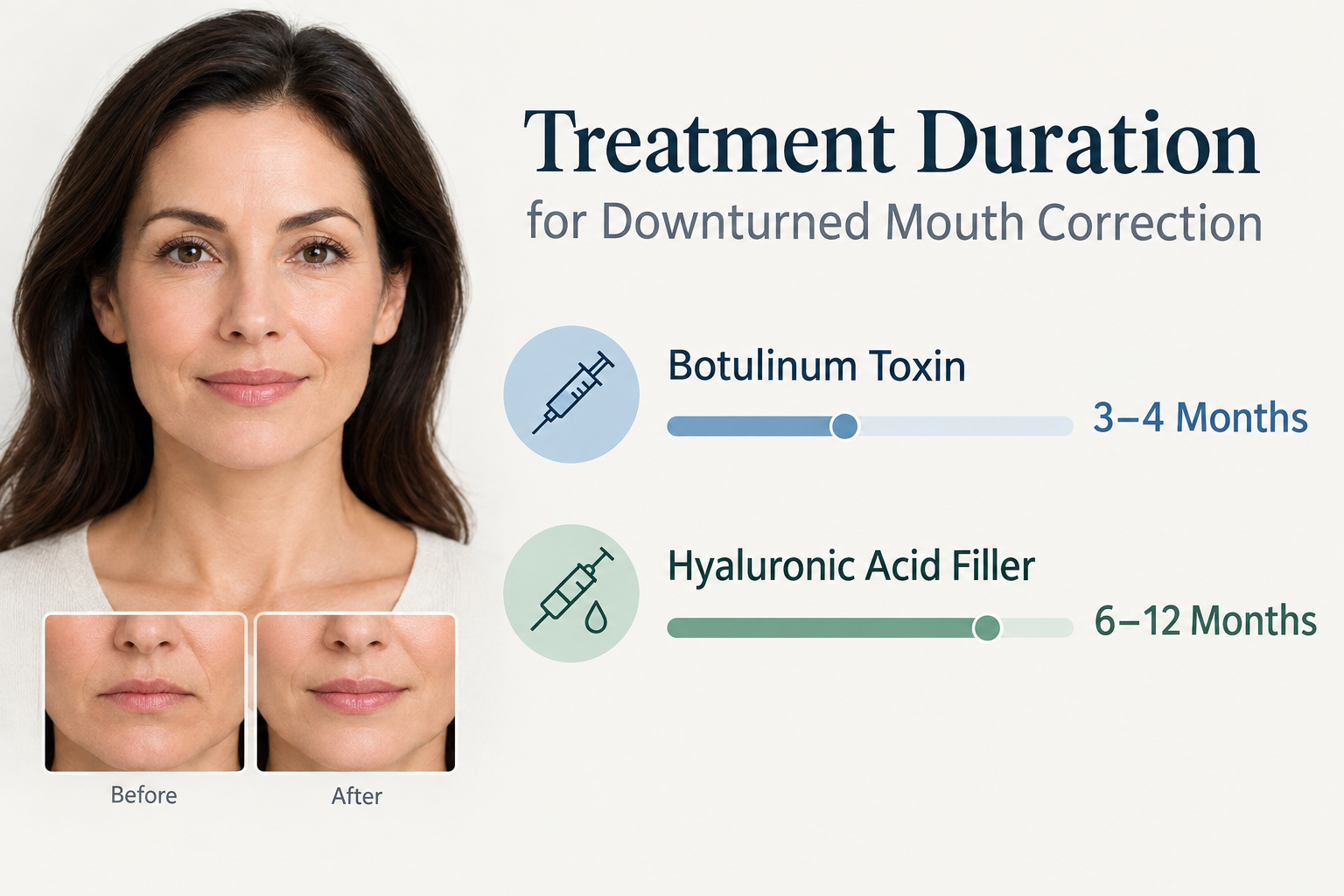
Hyaluronic acid filler in the perioral area generally lasts between six and twelve months, with some variation depending on the specific product, the volume used, and how quickly an individual metabolises the filler. The perioral area is relatively mobile due to speaking, eating, and facial expression, which can contribute to filler breaking down more quickly than in less dynamic areas of the face. Maintenance treatments are typically needed to sustain the result over time.
Patients considering treatment for a downturned mouth should factor in the ongoing nature of maintenance when making their decision. Non-surgical treatments in this area are not permanent, and the cost and commitment of repeat appointments should be considered alongside the initial treatment.
Who May Be Suitable for Treatment?
Patients who may be suitable for non-surgical downturned mouth correction include those who are bothered by the resting appearance of their mouth corners, have realistic expectations about the degree of improvement achievable, and are in good general health without contraindications to the proposed treatment. Mild to moderate cases — particularly those where DAO overactivity is a primary factor — tend to respond well to botulinum toxin. Patients with volume loss contributing to the appearance may benefit from filler, either alone or in combination.
Certain factors may affect suitability or require additional consideration. These include pregnancy or breastfeeding, active skin infection or inflammation in the treatment area, known allergy to any component of the proposed treatment, certain neurological conditions, and a history of previous procedures in the area. Patients taking blood-thinning medications may have a higher risk of bruising. A full medical history should be taken at consultation to identify any relevant factors.
Patients with significant skin laxity, substantial tissue descent, or very deep marionette lines may find that non-surgical treatments provide only limited improvement, and a discussion about surgical options — such as a corner lip lift or lower face lift — may be appropriate. A qualified practitioner should be honest about the realistic limits of non-surgical correction and refer patients for surgical assessment when this is in their best interest.
Surgical Alternatives: Corner Lip Lift
For patients who want a more permanent solution or whose degree of downturning is beyond what injectables can adequately address, a corner lip lift — also known as a commissuroplasty — is a surgical option. This procedure involves removing a small amount of skin at the corners of the mouth to mechanically lift the commissures into a more upward position. The results are longer-lasting than injectable treatments, though the procedure carries the risks associated with any surgical intervention, including scarring, asymmetry, and the need for recovery time.
A corner lip lift is typically performed under local anaesthetic as a day procedure. Scarring is generally small and positioned at the corner of the mouth where it may be less visible, but the quality of scarring varies between individuals. Patients considering this option should consult with a qualified surgeon experienced in perioral procedures and should have a thorough discussion about expected outcomes, risks, and recovery before proceeding.
Frequently Asked Questions
Can botulinum toxin alone fix a downturned mouth?
Botulinum toxin targeting the depressor anguli oris muscle can be effective for mild to moderate downturning where muscle overactivity is the primary cause. However, if volume loss, marionette lines, or skin laxity are also contributing, botulinum toxin alone may provide only partial improvement. A combined approach with dermal filler is often more appropriate in these cases, and a clinical assessment is needed to determine the best plan for each individual.
Is treatment for a downturned mouth painful?
Most patients find botulinum toxin injections in the lower face to be mildly uncomfortable rather than significantly painful. Dermal filler injections in the perioral area can be more uncomfortable, though topical anaesthetic cream and filler products containing lidocaine help to reduce discomfort. Individual pain tolerance varies, and practitioners can discuss comfort management options at consultation.
How soon will I see results?
Dermal filler results are visible immediately, though swelling means the final outcome is better assessed after one to two weeks. Botulinum toxin results develop gradually and are typically visible within five to fourteen days of treatment. A review appointment two to four weeks after treatment allows the practitioner to assess the result and make any refinements if needed.
Are there risks specific to the perioral area?
The lower face and perioral region have a complex anatomy with important muscles responsible for speech, eating, and expression, as well as a detailed vascular supply. Botulinum toxin placed incorrectly can affect smile symmetry or lip movement. Filler in this area carries a risk of vascular complications, which — while rare — can be serious. Choosing a practitioner with specific experience in lower face treatments and access to appropriate emergency measures is important.
How many treatments will I need?
This depends on the treatment chosen and the individual response. Botulinum toxin typically requires repeat treatment every three to four months to maintain the effect. Filler may last six to twelve months before a top-up is needed. Some patients choose to have a single treatment and reassess, while others prefer ongoing maintenance. There is no universal schedule, and the practitioner should discuss realistic expectations at consultation.
Can a downturned mouth be corrected permanently without surgery?
Non-surgical treatments for a downturned mouth are not permanent. Botulinum toxin and hyaluronic acid fillers both require ongoing maintenance to sustain results. A corner lip lift surgery offers longer-lasting correction but carries its own risks and recovery requirements. Patients seeking a more permanent outcome should discuss surgical options with a qualified surgeon.
Making an Informed Decision About Downturned Mouth Treatment
Downturned mouth correction is a nuanced area of aesthetic medicine because the concern can arise from several different anatomical factors — muscle activity, volume loss, skin laxity, or a combination — and the most appropriate treatment depends on which of these is most relevant for each individual. Botulinum toxin and dermal fillers are the most commonly used non-surgical options, and both have a reasonable evidence base for use in the perioral area when performed by appropriately trained practitioners. Results are temporary and require maintenance, and the degree of improvement achievable non-surgically has limits, particularly in cases with significant structural change.
Before proceeding with any treatment, a thorough consultation with a qualified and experienced practitioner is essential. This should include an honest discussion of what is causing the downturned appearance, which treatments may help, what realistic improvement looks like, the relevant risks, and what alternatives exist if non-surgical options are unlikely to meet the patient’s goals. Patients who approach treatment with clear, realistic expectations and a good understanding of the process are generally better placed to make a decision that is right for them.
