
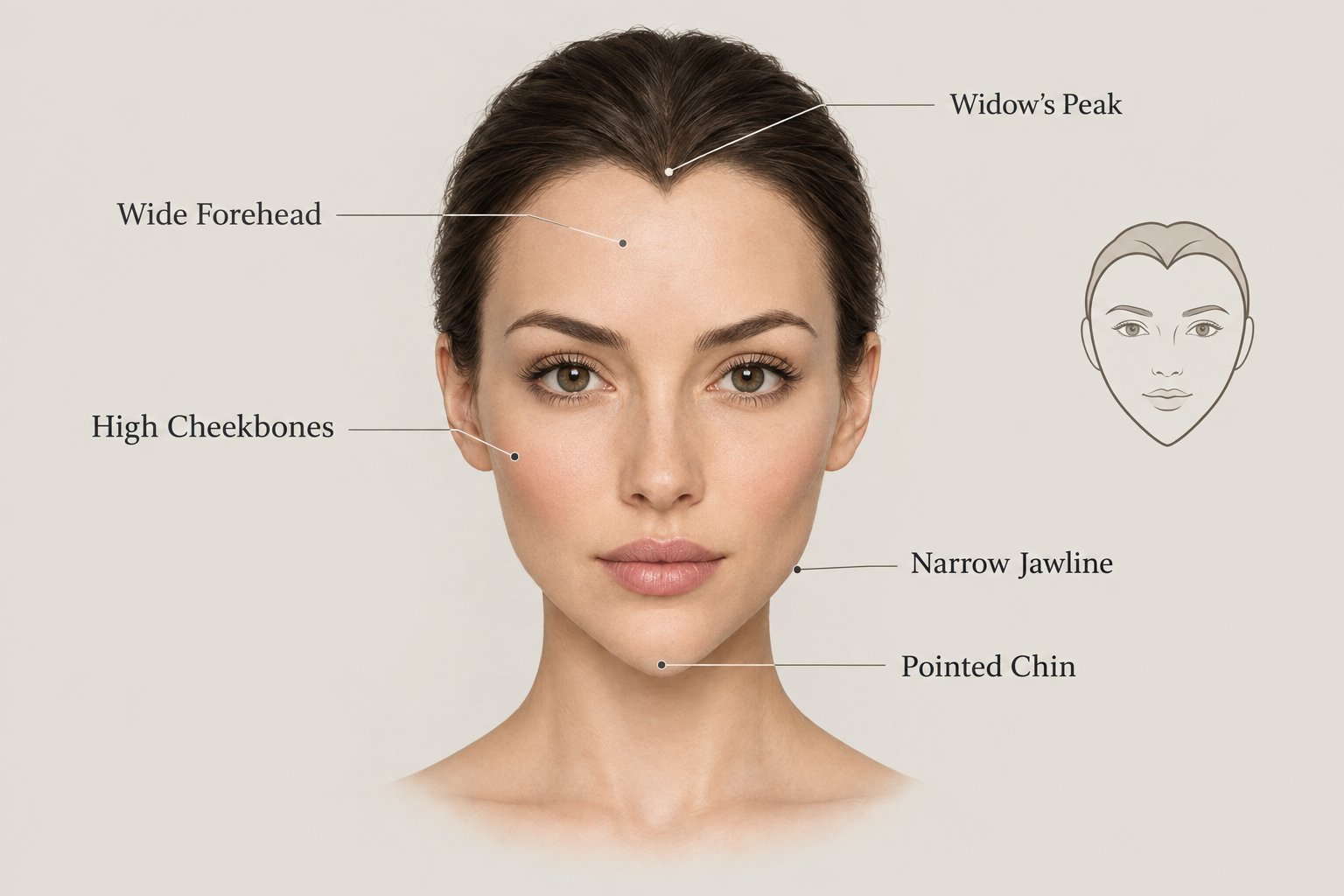

A heart-shaped face is one of the most recognisable face shapes in aesthetic medicine and beauty, defined by a distinctive combination of a wide forehead, prominent cheekbones, and a tapered lower face that narrows to a pointed chin. Understanding whether you have this face shape — and what it means for your appearance — can inform everything from hairstyle choices and makeup application to eyewear selection and, for some, aesthetic treatment planning.
Key Takeaways
- The heart-shaped face is characterised by a wide forehead, high cheekbones, a narrow jawline, and a pointed chin — creating an inverted triangle silhouette.
- A widow's peak hairline is a common but not universal feature; the face shape can be confirmed by measuring forehead, cheekbone, and jaw width.
- Styling strategies for this face shape focus on balancing proportions — adding visual weight to the lower face while softening the upper face.
- Heart-shaped faces in men share the same structural features but may benefit from different styling approaches, including beard shaping.
- Non-surgical aesthetic treatments such as dermal fillers can be used to address proportion concerns, though clinical assessment is always required before any procedure.
What Is a Heart-Shaped Face?
The heart-shaped face takes its name from the resemblance to an inverted heart — broad at the top and narrowing to a soft point at the chin. In anatomical terms, the defining characteristic is that the forehead width is the widest measurement of the face, followed closely by the cheekbones, with the jawline being noticeably narrower. The chin itself is typically pointed or gently V-shaped rather than rounded or square. This overall silhouette is sometimes described as an inverted triangle, and it is the combination of these proportions — not any single feature in isolation — that defines the shape.
The heart-shaped face is considered relatively common. Some facial geometry research suggests it accounts for roughly 19% of face shapes in studied populations, though prevalence estimates vary depending on the methodology used. It is frequently cited as one of the more aesthetically admired face shapes due to its association with prominent cheekbones and a youthful appearance, though beauty standards are subjective and culturally variable.
Key Features of a Heart-Shaped Face
Several structural characteristics define the heart-shaped face. Not every individual will display all of them equally, but the overall pattern of proportions is what matters most.
- Wide forehead: The forehead is the broadest part of the face and is typically noticeably wider than the jaw. This is the single most consistent defining feature.
- High cheekbones: The zygomatic bones (cheekbones) are prominent and sit high on the face, contributing to the face's width in the mid-zone and creating a naturally sculpted appearance.
- Narrow jawline: The jaw tapers significantly from the cheekbones downward, creating a tapered lower face with little angular definition at the jaw corners.
- Pointed chin: The chin is typically narrow and comes to a gentle point or a soft V-shape, rather than being rounded or broad.
- Widow's peak: Many people with this face shape have a widow's peak — a V-shaped point in the hairline at the centre of the forehead — though this is not present in everyone.
- Inverted triangle silhouette: When viewed as a whole, the face creates a clear inverted triangle shape, widest at the forehead and narrowing toward the chin.
The overall effect of these features is a face that appears broader in the upper half and more delicate in the lower half. This distribution of bone structure gives the heart-shaped face its characteristic look — often described as feminine and youthful, though these descriptors are not universal and the shape appears in people of all genders.
How to Identify a Heart-Shaped Face Accurately
Many guides suggest simply looking in a mirror, but a more reliable method involves taking a few basic measurements. Pull your hair back fully so that your hairline and jaw are clearly visible, then use a flexible tape measure or ruler to record the following four dimensions.
- Forehead width: Measure horizontally across the widest point of your forehead, typically about halfway between your hairline and your eyebrows.
- Cheekbone width: Measure across the widest point of your cheekbones, from the outer corner of one eye to the outer corner of the other, following the curve of the face.
- Jaw width: Measure across the widest point of your jaw, just below the ears.
- Face length: Measure from the centre of your hairline to the tip of your chin.
For a heart-shaped face, the forehead measurement will typically be the largest, followed closely by the cheekbones. The jaw measurement will be noticeably smaller than both. If your cheekbones are the widest measurement and your forehead is narrower, you may have a diamond face shape instead. If all measurements are relatively similar, an oval or round shape may be more accurate.
A Simple Self-Check
If you prefer a quick visual assessment rather than measurements, use this checklist as a starting point. A heart-shaped face typically shows most of the following:
- Your forehead appears wider than your jaw when you look straight into a mirror.
- Your chin comes to a noticeable point rather than being rounded or flat.
- Your cheekbones are visible and prominent.
- Your face appears to narrow significantly below the cheekbones.
- You may have a widow's peak at your hairline.
Heart vs. Diamond Face Shape: Understanding the Difference
The heart vs. diamond face shape distinction is one of the most common sources of confusion, because both shapes share a pointed chin and prominent cheekbones. The key difference lies in the forehead. In a heart-shaped face, the forehead is the widest part of the face. In a diamond face shape, the forehead is narrow — often similar in width to the jaw — and the cheekbones are the widest point, creating a different overall silhouette. The diamond shape also tends to have a longer, more angular appearance overall, while the heart shape is typically broader and softer in the upper face.
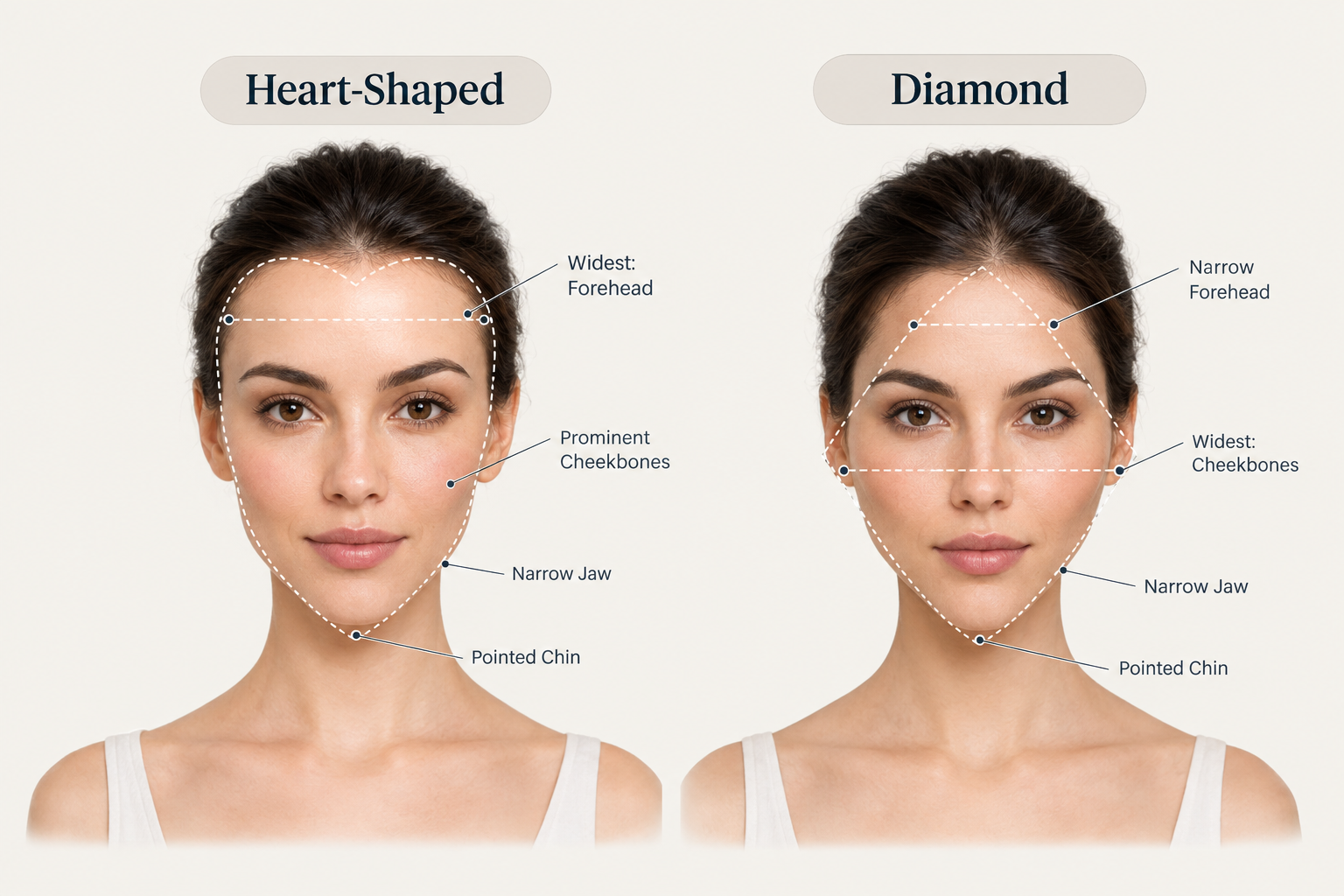
A secondary difference is the hairline. The widow's peak is more strongly associated with the heart-shaped face, while diamond faces often have a narrower, higher hairline without the characteristic V-shaped dip. If you are uncertain between the two, the forehead-to-cheekbone ratio is the most reliable distinguishing measurement: if your forehead is clearly wider than your cheekbones, the heart shape is more likely.
Heart-Shaped Face in Men
The heart-shaped face appears in men as well as women, though it is discussed less frequently in styling guides. Male heart-shaped faces share the same structural features — a wide forehead, high cheekbones, narrow jawline, and pointed chin — but the overall appearance may differ due to differences in bone density, facial hair, and skin texture. Male celebrity heart-shaped face examples include Bradley Cooper, Chris Hemsworth, Harry Styles, Timothée Chalamet, and Ryan Gosling, all of whom display the characteristic broad upper face and tapered lower face.
For men with this face shape, styling strategies focus on adding visual weight to the lower face. A well-groomed beard that is fuller at the chin and jaw can help balance proportions effectively. Men's haircuts that avoid excessive volume at the crown — such as textured crops, side parts, or styles with length at the sides — tend to complement the face shape well. Browline or aviator glasses frames can also help balance the wider forehead without drawing further attention to it.
Hairstyles That Work Well for Heart-Shaped Faces
The primary goal when choosing hairstyles for a heart-shaped face is balancing proportions — specifically, reducing visual weight at the forehead and adding fullness or width at the jaw and chin level. This does not mean every style must follow strict rules, but understanding the principle helps in making choices that feel harmonious.

Styles That Tend to Complement This Face Shape
- Side-swept bangs: These soften the wide forehead by breaking its horizontal line without adding volume at the top. Side-swept bangs are one of the most consistently recommended options for this face shape.
- Curtain bangs: A softer, centre-parted fringe that frames the face gently and reduces the visual impact of a broad forehead.
- Chin-length bob or lob: A bob that ends at or just below the chin adds width at the jaw level, helping to balance the narrower lower face.
- Face-framing layers: Layers that begin at or below the chin add movement and width where the face is narrowest, creating a more balanced silhouette.
- Beachy waves with volume at the ends: Waves that widen toward the bottom of the hair add visual weight at jaw level, complementing the tapered lower face.
Styles to Approach with Caution
- Styles with significant volume at the crown or top of the head can emphasise the already-wide forehead.
- Very short pixie cuts without any fringe may draw attention to the forehead width, though this depends on individual features and personal preference.
- High, tight updos that expose the full forehead can accentuate the upper face width.
Makeup Techniques for Heart-Shaped Faces
Makeup contouring and highlighting can be used to optically adjust the appearance of facial proportions. For a heart-shaped face, the general approach involves softening the width of the forehead and adding definition or warmth to the lower face.
Contouring and Highlighting
Contouring the temples — applying a matte bronzer or contour shade along the outer edges of the forehead — reduces the apparent width of the upper face. A light application of bronzer along the hairline can also help the forehead appear less prominent. Highlighting the centre of the forehead draws the eye inward rather than outward, which can further reduce the impression of width.
For the lower face, a light highlighter applied to the chin can add the impression of length and fullness, which helps balance the pointed chin. Blush applied to the apples of the cheeks — rather than swept strongly upward — keeps the focus on the mid-face without further emphasising the upper face width.
Eyebrow Shaping
Eyebrow shape has a meaningful impact on how the forehead reads. For heart-shaped faces, a medium-arch brow — neither too flat nor too dramatically arched — tends to work well. A very high arch can draw the eye upward and emphasise the forehead, while a flat brow can make the forehead appear even wider. A softly curved, medium-arch brow helps frame the eyes without adding visual weight to the upper face.
Glasses and Eyewear for Heart-Shaped Faces
Choosing glasses frames for a heart-shaped face follows the same principle of balancing proportions. The goal is to avoid adding width or visual weight to the already-broad upper face, while drawing attention toward the lower face.
Frame Styles That Tend to Work Well
- Bottom-heavy frames: Frames that are wider or more prominent at the bottom than the top — such as certain aviator or D-frame styles — draw the eye downward and help balance the wider forehead.
- Oval frames: Soft, rounded oval frames complement the curved features of the heart-shaped face without adding angular width at the top.
- Rimless or semi-rimless frames: These minimise the visual impact of the frame itself, reducing the risk of adding width to the upper face.
- Light-coloured or thin frames: These tend to be less visually dominant and work well for those who want a subtle look.
Frame Styles to Approach with Caution
- Wide, top-heavy frames — such as thick browline glasses or very wide rectangular frames — can emphasise the forehead width.
- Oversized frames that extend beyond the width of the face at the top may add unwanted visual weight to the upper face.
Accessories and Jewellery
Earring choice is an often-overlooked element of styling for face shape. For a heart-shaped face, drop earrings and chandelier earrings are particularly well-suited because they draw the eye downward toward the jaw and neck, adding visual length and width to the lower face. Statement earrings with width at the bottom — rather than at the top — follow the same logic as bottom-heavy glasses frames. Stud earrings and small hoops are also flattering, as they do not add width at the level of the already-broad cheekbones. Very wide, top-heavy earring styles may draw attention to the upper face width.
Aging and the Heart-Shaped Face
The heart-shaped face changes over time in ways that are worth understanding, particularly for those considering aesthetic treatments. The prominent cheekbones that define this face shape in youth are supported by subcutaneous fat and collagen. As these naturally diminish with age, the cheeks can appear flatter and the skin may begin to descend toward the lower face, altering the characteristic proportions. The pointed chin, already a defining feature, may appear sharper as surrounding soft tissue volume reduces. The result can be a face that appears more angular or gaunt than in earlier years.
Non-surgical treatments such as dermal fillers may be used to restore volume to the mid-face or to soften the appearance of a very sharp chin, helping to maintain the balanced proportions associated with a youthful heart-shaped face. However, these treatments carry risks and are not appropriate for everyone. A thorough clinical assessment by a qualified practitioner is essential before considering any injectable treatment, and results vary between individuals.
Celebrity Heart-Shaped Face Examples
Celebrity heart-shaped face examples are frequently cited in styling guides because they provide a useful visual reference for the shape's defining features. Among women, Reese Witherspoon is perhaps the most commonly referenced example, with a notably wide forehead, high cheekbones, and a pointed chin. Other frequently cited examples include Scarlett Johansson, Zendaya, Dua Lipa, Kerry Washington, and Kourtney Kardashian. Among men, Bradley Cooper, Chris Hemsworth, Harry Styles, and Timothée Chalamet are often noted for displaying the characteristic broad upper face and tapered lower face associated with this shape.
It is worth noting that celebrity examples are illustrative rather than definitive. Individual faces rarely conform perfectly to a single category, and many people have hybrid or transitional face shapes that share features of two or more types.
Hybrid and Transitional Face Shapes
Not every face fits neatly into a single category. Heart-oval and heart-diamond hybrid shapes are relatively common and represent a genuine source of confusion for many people. A heart-oval hybrid typically has the wide forehead and pointed chin of the heart shape, but with softer, more balanced proportions overall — the jaw is not as dramatically narrow, and the face length is greater relative to its width. A heart-diamond hybrid shares the prominent cheekbones and pointed chin but has a narrower forehead than a classic heart shape, making the cheekbones the true widest point.
If your measurements suggest you fall between two categories, it is more useful to focus on your individual features — the width of your forehead relative to your jaw, the prominence of your cheekbones, the shape of your chin — rather than trying to assign a single label. Styling advice based on your specific proportions will be more practical than advice based on a category that may not fully apply.
Frequently Asked Questions
Is a heart-shaped face rare?
The heart-shaped face is not considered rare. Some facial geometry studies suggest it accounts for approximately 19% of face shapes in studied populations, making it one of the more common face shape categories. However, prevalence estimates vary depending on the measurement methodology used, and many people have hybrid shapes that do not fit neatly into a single category.
What is the difference between a heart-shaped face and an oval face?
An oval face has relatively balanced proportions throughout — the forehead, cheekbones, and jaw are similar in width, with the face being slightly longer than it is wide and the jaw gently rounded. A heart-shaped face has a noticeably wider forehead, more prominent cheekbones, a narrower jaw, and a pointed chin. The inverted triangle silhouette of the heart shape is the key distinguishing feature.
Can you change your face shape?
The underlying bone structure of the face is determined by genetics and cannot be changed without surgical intervention. However, the apparent proportions of the face can be adjusted optically through hairstyling, makeup contouring, eyewear choice, and accessories. Non-surgical aesthetic treatments such as dermal fillers can alter the soft tissue volume of specific areas — such as the chin or cheeks — which may subtly change how the face shape appears, though results vary and clinical assessment is required.
Do all heart-shaped faces have a widow's peak?
No. A widow's peak — the V-shaped point in the centre of the hairline — is commonly associated with the heart-shaped face but is not a universal feature. Many people with a heart-shaped face have a straight or gently curved hairline. The widow's peak is one possible characteristic, not a requirement for the face shape classification.
What hairstyle should men with a heart-shaped face avoid?
Men with a heart-shaped face generally benefit from avoiding styles with significant volume at the crown or top of the head, as this can emphasise the already-wide forehead. Very short styles that leave the forehead fully exposed without any fringe or textural element may also accentuate the upper face width. Styles with some length or texture at the sides, or a beard that adds fullness at the jaw, tend to be more flattering for this face shape.
Are dermal fillers suitable for heart-shaped face concerns?
Dermal fillers may be used to address specific concerns related to the heart-shaped face — such as restoring cheek volume lost with age or softening a very sharp chin — but they are not appropriate for everyone. Suitability depends on individual anatomy, medical history, and treatment goals. A qualified aesthetic practitioner should assess each patient individually before recommending any injectable treatment.
Working With Your Heart-Shaped Face: Practical Next Steps
Understanding your face shape is a practical starting point for making more informed choices about hairstyles, makeup, eyewear, and accessories. The heart-shaped face — with its wide forehead, high cheekbones, narrow jawline, and pointed chin — has a distinctive inverted triangle silhouette that responds well to styling strategies focused on balancing proportions and adding visual weight to the lower face.
For most people, the most impactful changes come from hairstyle and makeup choices rather than any clinical intervention. Side-swept bangs, face-framing layers, bottom-heavy glasses frames, and drop earrings are all accessible, low-commitment ways to complement this face shape. If you are considering aesthetic treatments to address changes in facial proportions over time — such as volume loss in the cheeks or changes to the chin — a consultation with a qualified aesthetic practitioner is the appropriate first step. A practitioner can assess your individual anatomy, discuss realistic outcomes, and help you understand which options, if any, may be suitable for your specific concerns.
