


Dermal filler longevity varies considerably depending on where it is placed, which product is used, and how an individual's body metabolises the material. Most hyaluronic acid fillers last somewhere between six months and two years, but that range masks meaningful differences between treatment areas. Understanding what to expect from each area can help you plan maintenance appointments more realistically and have a more informed conversation with your practitioner before treatment.
Key Takeaways
- Filler duration depends on the treatment area, product type, volume used, and individual metabolism — there is no single answer that applies to everyone.
- High-movement areas such as the lips tend to break down filler faster than lower-movement areas such as the temples or jawline.
- Hyaluronic acid fillers are the most widely used type and can be dissolved with hyaluronidase if needed, which is an important safety consideration.
- Repeated treatments over time may extend the interval between top-ups in some patients, though this varies.
- A qualified practitioner should assess your anatomy, skin quality, and goals before recommending a product or treatment plan.
What Are Dermal Fillers and How Do They Work?
Dermal fillers are injectable substances used to restore volume, smooth lines, define contours, or improve skin hydration. The most commonly used fillers contain hyaluronic acid (HA), a naturally occurring sugar molecule found in skin and connective tissue. HA fillers work by attracting and retaining water within the tissue, creating a volumising or smoothing effect depending on the product's thickness and the depth of injection. Other filler types include calcium hydroxylapatite, poly-L-lactic acid, and polymethylmethacrylate, each with different mechanisms and longevity profiles.
Hyaluronic acid fillers are gradually broken down by the body's own enzymes over time. The rate at which this happens depends on the product's cross-linking density — a manufacturing process that determines how tightly the HA molecules are bonded together. More heavily cross-linked products tend to last longer but may feel firmer. Thinner, less cross-linked products are typically used in delicate areas such as under the eyes, where a softer result is needed. This relationship between product formulation and treatment area is one of the key reasons filler longevity differs so much from one location to another.
Why Filler Duration Varies Between Areas
Several factors influence how quickly filler breaks down in any given area. Muscle movement is one of the most significant. Areas that experience repeated contraction — such as the lips during speaking and eating, or the cheeks during smiling — expose the filler to mechanical stress that accelerates breakdown. Areas with less movement, such as the temples or the back of the jaw, tend to retain filler for longer because the product is not being repeatedly compressed and stretched.

Blood supply also plays a role. Areas with a richer vascular network may metabolise filler more quickly because the enzymes responsible for HA breakdown are delivered more efficiently through the bloodstream. Skin thickness matters too: thinner skin, such as that found under the eyes, requires a lighter product placed more superficially, and these products are often less cross-linked and therefore shorter-lived. Deeper structural areas, such as the chin or jawline, can accommodate denser products that resist breakdown for longer.
Individual metabolism is another variable that practitioners cannot fully predict in advance. Some patients consistently find that their filler lasts toward the shorter end of the expected range, while others retain results for longer. Factors such as exercise intensity, sun exposure, and smoking may influence breakdown rate, though the evidence on these specific variables is not definitive. A practitioner can give a more personalised estimate based on how a patient has responded to previous treatments.
Filler Longevity by Treatment Area
Lips
Lip filler is one of the most popular injectable treatments, and it is also one of the shortest-lasting. Most patients find that lip filler lasts approximately six to twelve months, with many experiencing noticeable reduction by the eight-month mark. The lips are in near-constant motion — speaking, eating, drinking, and facial expression all contribute to mechanical breakdown of the product. The skin of the lips is also thin and highly vascular, which further accelerates metabolism.
Product choice matters significantly in this area. Practitioners typically select softer, more flexible HA formulations for the lips to maintain natural movement and avoid a stiff appearance. These products, while better suited to the area, tend to break down faster than the denser fillers used elsewhere. Patients who want to maintain lip volume consistently should plan for appointments roughly every six to nine months, though this varies between individuals.
Nasolabial Folds
The nasolabial folds — the lines running from the sides of the nose to the corners of the mouth — are a common treatment area for volume restoration and line softening. Filler placed here typically lasts between nine and eighteen months. This area experiences moderate movement during facial expression, but the folds themselves are relatively deep, allowing practitioners to use a denser, more cross-linked product that resists breakdown more effectively than lip filler.
Results in this area can appear quite natural when the correct volume is used, and many patients find that the interval between treatments gradually extends after several sessions, possibly because repeated filler placement stimulates some collagen production in the surrounding tissue. This is not guaranteed, and the primary mechanism of effect remains the filler itself rather than any long-term structural change.
Cheeks and Mid-Face
Cheek filler, used to restore volume loss in the mid-face or enhance cheekbone definition, tends to last longer than lip or nasolabial filler. Most patients can expect results to last between twelve and twenty-four months, with some products and patients reaching the upper end of that range. The cheeks are a relatively low-movement area compared to the lips, and practitioners can place denser, more robust products at a deeper level — often on or just above the cheekbone — where they are less subject to surface-level breakdown.
Volume restoration in the mid-face can also have a lifting effect on adjacent areas, which means that cheek filler sometimes reduces the appearance of nasolabial folds and jowling without treating those areas directly. This structural benefit is one reason cheek filler is often prioritised in a treatment plan before addressing lower-face concerns.
Under-Eye Area (Tear Troughs)
Tear trough filler, used to address hollowness or shadowing under the eyes, is one of the more technically demanding filler treatments and has a nuanced longevity profile. The product used in this area is typically a very soft, lightly cross-linked HA filler placed carefully beneath the skin to avoid visible lumps or the Tyndall effect — a bluish discolouration that can occur if filler is placed too superficially in thin-skinned areas.
Because a lighter product is required, tear trough filler often lasts between nine and twelve months, though some patients report results persisting for longer. It is important to note that not all under-eye concerns are caused by volume loss. Dark circles may result from pigmentation, visible blood vessels, skin laxity, or a combination of factors, and filler addresses only the hollowness component. A thorough assessment by a qualified practitioner is essential before proceeding with tear trough treatment, as this area carries a higher risk of complications than many other filler sites.
Jawline and Chin
Jawline and chin filler has become increasingly popular for facial contouring and definition. These areas are well-suited to longer-lasting results because practitioners can use firm, highly cross-linked products placed at depth along the bone. Most patients find that jawline and chin filler lasts between twelve and twenty-four months, and in some cases results may persist beyond this range depending on the product used and individual metabolism.
The chin and jawline experience relatively little soft-tissue movement compared to the lips or cheeks, which contributes to the extended duration. Patients seeking a more defined lower face or improved facial proportions may find that this area offers good value in terms of longevity relative to the number of appointments required to maintain results.
Temples
Temple hollowing is a common sign of age-related volume loss that is often overlooked. Filler placed in the temples to restore fullness and reduce a skeletal appearance tends to last between twelve and twenty-four months. The temples are a low-movement area, and the products used here are typically placed at depth, which supports longer retention. Some practitioners use calcium hydroxylapatite in this area, which may offer slightly extended duration compared to HA fillers, though product selection depends on individual anatomy and practitioner preference.
Nose (Non-Surgical Rhinoplasty)
Non-surgical rhinoplasty uses filler to adjust the appearance of the nose — smoothing bumps, lifting the tip, or improving symmetry — without surgery. Filler in this area typically lasts between six and twelve months, though some patients report longer duration. The nose is a relatively low-movement area, but the skin is thin and the anatomy complex, which means practitioners must use products carefully and conservatively. Non-surgical rhinoplasty carries specific risks related to the nose's vascular anatomy, and this procedure should only be performed by practitioners with advanced training in this area.
Hands
Hand rejuvenation with filler addresses volume loss that makes tendons and veins more prominent with age. Filler in the hands typically lasts between six and twelve months. The hands are subject to frequent movement and washing, and the skin is thin, which contributes to a shorter duration compared to facial areas. HA fillers and calcium hydroxylapatite are both used in this area, with the latter sometimes offering slightly longer results.
Filler Longevity at a Glance
| Treatment Area | Typical Duration | Key Factors Affecting Longevity |
|---|---|---|
| Lips | 6–12 months | High movement, thin skin, softer product required |
| Nasolabial folds | 9–18 months | Moderate movement, deeper placement possible |
| Cheeks / mid-face | 12–24 months | Low movement, deep placement, denser product |
| Under eyes (tear trough) | 9–12 months | Thin skin, light product required, delicate anatomy |
| Jawline and chin | 12–24 months | Low movement, deep placement, firm product |
| Temples | 12–24 months | Low movement, deep placement |
| Nose (non-surgical) | 6–12 months | Thin skin, conservative volumes used |
| Hands | 6–12 months | Frequent movement, thin skin |
Does Filler Type Affect How Long It Lasts?
Yes, the type of filler used has a direct influence on longevity. Hyaluronic acid fillers are the most widely used and come in a range of formulations from different manufacturers, each with different cross-linking technologies and viscosities. Thicker, more cross-linked HA products — often described as having higher G-prime or elastic modulus — are more resistant to deformation and enzymatic breakdown, making them suitable for structural areas such as the chin and jawline where longer duration is desirable. Softer HA products with lower cross-linking are used in areas requiring natural movement or delicate placement, but they break down more quickly.
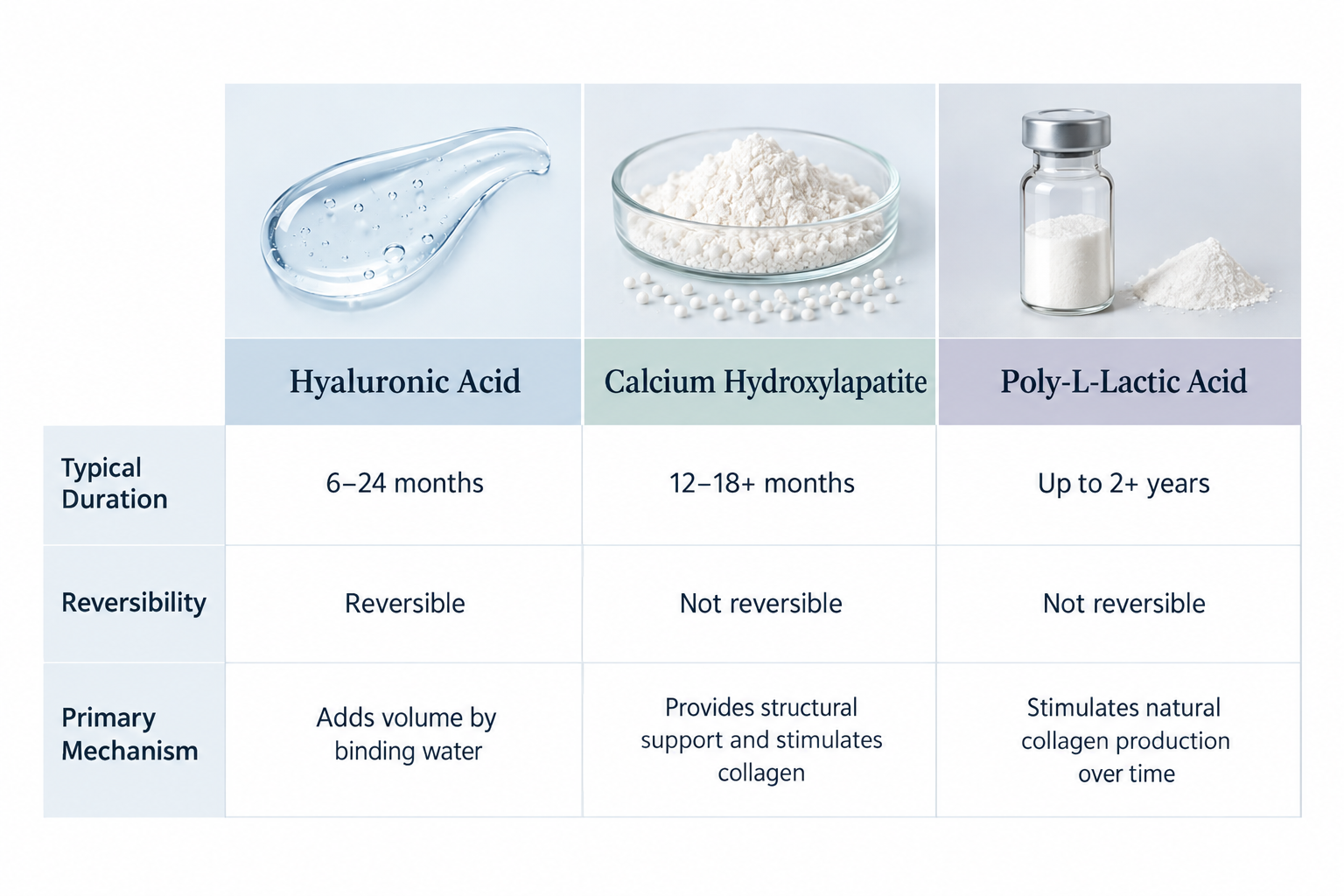
Calcium hydroxylapatite fillers, such as Radiesse, work partly by stimulating collagen production in addition to providing immediate volume. These products may last twelve to eighteen months or longer in some areas and are not reversible with hyaluronidase, which is an important consideration when assessing risk. Poly-L-lactic acid, such as Sculptra, works primarily as a collagen stimulator rather than a direct volumiser, with results developing gradually over several months and potentially lasting up to two years or more. Polymethylmethacrylate fillers are considered semi-permanent and are used much less frequently due to the irreversible nature of their effects.
For most patients considering filler for the first time, hyaluronic acid products are generally recommended because they offer predictable results and can be dissolved with hyaluronidase if a correction is needed. This reversibility is a meaningful safety advantage that non-HA fillers do not share.
Risks, Side Effects, and Important Safety Considerations
Dermal filler treatment carries risks that patients should understand before proceeding. Common side effects include temporary swelling, bruising, redness, and tenderness at the injection site. These typically resolve within a few days to two weeks depending on the area and the individual. Lip filler tends to cause more noticeable swelling than other areas, and patients should be prepared for the treated area to look more pronounced immediately after the appointment than the final settled result.
More serious complications, though less common, include infection, nodule formation, migration of filler, and vascular occlusion — a situation where filler inadvertently enters or compresses a blood vessel, potentially restricting blood flow to surrounding tissue. Vascular occlusion is a medical emergency that requires immediate treatment with hyaluronidase. The risk is higher in certain anatomical areas, including the nose, glabella (between the brows), and nasolabial fold region, where blood vessels follow predictable but sometimes variable paths. This is one reason why practitioner training, anatomical knowledge, and access to hyaluronidase are essential safety requirements.
Patients should disclose their full medical history before treatment, including any blood-thinning medications, autoimmune conditions, history of cold sores (relevant for lip filler), allergies, and previous filler treatments. Filler is generally not recommended during pregnancy or breastfeeding. Anyone with an active skin infection or inflammation in the treatment area should postpone treatment until the condition has resolved.
What Happens When Filler Wears Off?
As hyaluronic acid filler is gradually broken down by the body, the treated area returns toward its pre-treatment appearance. This process is usually gradual rather than sudden, which means patients often notice a slow reduction in volume or definition over several months rather than an abrupt change. In most cases, the area does not look worse than it did before treatment once the filler has fully metabolised, though individual experience varies.
Some patients worry that repeated filler use will cause the skin to stretch or sag when the product breaks down. Current evidence does not strongly support this concern for patients receiving appropriate volumes at sensible intervals, but it is a reasonable question to raise with a practitioner, particularly for patients considering large volumes or very frequent treatments. Overfilling — using more product than the anatomy can accommodate naturally — carries a greater risk of distortion and should be avoided.
Alternatives to Dermal Fillers
Dermal fillers are not the only option for addressing volume loss, lines, or facial contour concerns. Botulinum toxin injections (such as Botox or Dysport) work by relaxing muscles rather than adding volume, making them more appropriate for dynamic lines caused by muscle movement than for volume restoration. The two treatments are often used together in a complementary way.
Collagen-stimulating treatments such as microneedling with radiofrequency, ultrasound-based skin tightening, and poly-L-lactic acid injections aim to improve skin quality and stimulate the body's own collagen production over time. These approaches may be more suitable for patients whose primary concern is skin laxity or texture rather than volume loss. Surgical options such as fat transfer or facelift surgery offer longer-lasting structural changes but involve greater downtime, cost, and procedural risk.
The most appropriate approach depends on the specific concern, the degree of change desired, the patient's anatomy, and their tolerance for downtime and maintenance. A qualified practitioner can help identify which option or combination of options is most likely to achieve a realistic outcome.
Frequently Asked Questions
Can I make my filler last longer?
There is no reliably proven method to significantly extend filler longevity, but some general measures may help. Protecting the skin from UV exposure with SPF, avoiding smoking, staying well hydrated, and maintaining a stable weight may support overall skin health. Some practitioners suggest that avoiding intense heat — such as saunas or very hot exercise — in the days immediately after treatment may reduce early breakdown, though evidence for this is limited. Ultimately, individual metabolism is the dominant factor.
Does filler look natural as it wears off?
In most cases, yes. Hyaluronic acid filler breaks down gradually, so the transition back toward the pre-treatment appearance is usually slow and subtle. Patients rarely experience a sudden or dramatic change. Scheduling a review appointment with your practitioner before the filler has fully worn off allows for a top-up that maintains continuity of result.
Is it safe to keep getting filler repeatedly over the years?
Long-term repeated filler use is common, and many patients maintain treatments over several years without significant problems. However, cumulative filler placement carries its own considerations, including the risk of product accumulation in certain areas, changes in tissue behaviour over time, and the importance of periodic reassessment of the treatment plan. A practitioner should review the overall approach at each appointment rather than simply repeating the same treatment indefinitely.
What is the difference between filler and anti-wrinkle injections for lines?
Filler adds volume to smooth lines or restore fullness, while botulinum toxin injections reduce muscle activity to soften lines caused by repeated facial movement. Filler is generally more appropriate for static lines — those visible at rest — and for volume loss, while botulinum toxin is better suited to dynamic lines that appear or deepen during expression. Many patients benefit from both treatments used together.
Can filler be removed if I am unhappy with the result?
Hyaluronic acid filler can be dissolved using an enzyme called hyaluronidase, which breaks down HA relatively quickly. This is one of the key advantages of HA fillers over non-reversible alternatives. Dissolution is not always complete in a single session, and the process itself carries a small risk of side effects, but it provides an important safety option. Non-HA fillers such as calcium hydroxylapatite and poly-L-lactic acid cannot be dissolved in the same way.
Why does my filler seem to last less time than my friend's?
Individual variation in filler longevity is real and not fully predictable. Differences in metabolism, lifestyle, the specific product used, the volume injected, the treatment area, and the depth of placement all contribute. It is also worth noting that perceived duration can be influenced by how gradually the change occurs — some patients notice the reduction earlier than others even when the actual breakdown rate is similar.
Planning Your Filler Maintenance Realistically
Understanding how long filler lasts in each area allows for more realistic treatment planning. Patients who treat multiple areas simultaneously — for example, lips and cheeks — should be aware that these areas will likely need refreshing at different intervals, meaning maintenance appointments may not always align neatly. Discussing a longer-term treatment plan with your practitioner, rather than approaching each appointment in isolation, can help manage expectations, costs, and the overall aesthetic outcome more effectively.
It is also worth considering that filler longevity is not the only measure of a good result. A smaller volume of well-placed filler that looks natural and suits your anatomy may be more valuable than a larger volume that lasts slightly longer but appears overdone. The goal of any filler treatment should be a result that looks appropriate for your face, not simply one that persists for as long as possible. If you are considering dermal filler for the first time or reviewing your current treatment plan, a consultation with a qualified and experienced practitioner is the most reliable starting point for understanding what is realistic for your specific concerns and anatomy.
