


Chin filler typically lasts between 12 and 24 months, though the exact duration depends on the type of filler used, where it is placed, and a range of individual factors including metabolism and lifestyle. Understanding what influences chin filler longevity helps you plan maintenance realistically and protect your results for as long as possible.
Key Takeaways
- Most hyaluronic acid chin fillers last 12–18 months; denser or collagen-stimulating fillers can last up to 2 years or longer.
- Individual metabolism, injection depth, placement zone, and lifestyle habits all meaningfully affect how long results last.
- Filler placed at the chin tip tends to last longer than filler placed along the mental crease or jawline, where more movement occurs.
- Repeat treatments may extend subsequent results due to cumulative collagen stimulation.
- Scheduling a maintenance top-up before filler fully dissolves preserves results more consistently than waiting for visible fading.
How Long Does Chin Filler Last by Filler Type?
Chin filler longevity varies considerably depending on the product used. Different fillers are made from different materials, have different densities, and behave differently once injected into tissue. The table below summarises typical durations for the most commonly used filler categories in non-surgical chin augmentation.
| Filler Type | Common Brands | Typical Duration |
|---|---|---|
| Hyaluronic acid (HA) | Juvéderm Voluma, Restylane Lyft, Restylane Defyne, Teosyal Ultra Deep | 12–18 months |
| Calcium hydroxylapatite (CaHA) | Radiesse | 12–24 months |
| Poly-L-Lactic Acid (PLLA) | Sculptra | Up to 2 years or longer |
| Autologous fat grafting | N/A (patient's own fat) | Semi-permanent (variable) |
Hyaluronic acid chin filler is the most widely used option for non-surgical chin augmentation. HA is a naturally occurring sugar molecule that attracts water, creating volume and definition. Because the body gradually breaks down hyaluronic acid over time, results are temporary and reversible. Thicker, more cohesive HA formulations — such as those designed specifically for deep structural placement — tend to last toward the upper end of the 12–18 month range because they resist filler breakdown more effectively than lighter, more fluid products.
Calcium hydroxylapatite, sold under the brand name Radiesse, is a denser filler that also stimulates collagen production in the surrounding tissue. This dual mechanism — immediate volume plus gradual collagen stimulation — means results can persist for 12 to 24 months. Radiesse is not reversible with hyaluronidase, which is an important consideration for patients who may want the option to adjust or dissolve their results.
Poly-L-Lactic Acid (Sculptra) works differently again. Rather than adding immediate volume, Sculptra stimulates the body's own collagen production progressively over several months. Results develop gradually and can last up to two years or beyond, though multiple treatment sessions are usually required to achieve the desired outcome. Sculptra is best suited to patients who are comfortable with a staged approach and a longer timeline before seeing full results.
What Affects Chin Filler Longevity?
Several interconnected factors determine how long chin filler results last for any individual patient. No two people metabolise filler at exactly the same rate, and the same product can behave quite differently depending on where and how it is placed.

Individual Metabolism
Individual metabolism is one of the most significant variables in chin filler longevity. Patients with a faster metabolic rate tend to break down dermal filler more quickly than those with a slower metabolism. Younger patients — particularly those under 30 — often metabolise hyaluronic acid filler within 9 to 12 months, while patients over 40 with a naturally slower metabolism may find results persist for 15 to 24 months from the same product. This is not a flaw in the treatment; it simply reflects normal biological variation and is worth discussing with your practitioner when setting realistic expectations.
Injection Depth and Placement Zone
Injection depth and placement have a direct impact on how long chin filler lasts. Filler placed at the periosteal level — meaning directly on or very close to the bone — is subject to less mechanical movement than filler placed more superficially in soft tissue. This deeper placement is standard practice for structural chin augmentation and is one reason chin filler generally outlasts filler in higher-movement areas such as the lips.
Placement zone within the chin also matters in a way that is rarely explained to patients. Filler placed at the chin tip, which is the most static point of the lower face, tends to last longer than filler placed along the mental crease or at the jawline angles, where muscle movement and soft tissue dynamics create more mechanical stress on the product. Patients seeking definition specifically at the chin tip may therefore enjoy longer-lasting results than those requiring correction along the jawline or crease.
Filler Density and Cohesivity
Not all hyaluronic acid fillers are identical. Products vary in their cross-linking density — the degree to which the HA molecules are chemically bonded together — which determines how firm, cohesive, and resistant to breakdown the filler is. A highly cohesive, dense filler placed deep in the chin resists enzymatic degradation more effectively than a softer, more fluid product. This is why practitioners select specific formulations for structural chin work rather than using the same product they might choose for lip enhancement or fine line treatment.
Volume of Filler Used
The amount of filler injected influences how long visible results last, though not always in the way patients expect. A larger initial volume may provide a longer period of visible improvement simply because there is more product to break down before results fade noticeably. However, overfilling the chin does not proportionally extend longevity and can create an unnatural appearance or accelerate uneven filler breakdown. The appropriate volume is determined by the patient's anatomy and aesthetic goals, not by a desire to extend duration.
Lifestyle Factors
Several lifestyle habits can meaningfully shorten chin filler longevity. Smoking impairs circulation and accelerates tissue breakdown, and patients who smoke regularly may notice their results fading noticeably sooner than non-smokers — some estimates suggest a reduction of 20 to 30 percent in effective duration, though individual variation is significant. Frequent high-intensity exercise increases metabolic rate and circulation, which can accelerate filler breakdown; patients who train intensively every day may find results last two to four months less than those with a more moderate exercise routine. Chronic sun exposure and UV damage degrade both the filler and the surrounding collagen matrix, while excess alcohol consumption and chronic stress can also contribute to faster breakdown. Staying well hydrated supports the water-attracting properties of hyaluronic acid filler and may help maintain volume.
Injector Skill and Technique
The experience and precision of the practitioner performing the treatment affects both the quality and the longevity of results. An experienced injector will select the appropriate product for the patient's anatomy, place it at the correct depth, and distribute volume evenly to create a natural, balanced result. Poor technique — including superficial placement, incorrect product selection, or uneven distribution — can lead to faster or uneven filler breakdown, asymmetry, and results that fade sooner than expected. Choosing a qualified, experienced practitioner is therefore not only a safety consideration but also a practical factor in getting the most from your treatment.
The Compounding Effect of Repeat Treatments
One aspect of chin filler longevity that is often overlooked is the cumulative benefit of repeat treatments. Hyaluronic acid fillers, and particularly collagen-stimulating products such as calcium hydroxylapatite and Poly-L-Lactic Acid (Sculptra), encourage the body to produce new collagen in the treated area over time. After several rounds of treatment, some patients find that subsequent results last longer than their first, because the improved collagen framework in the tissue provides additional structural support. This does not mean filler becomes permanent — it will still break down — but the progressive collagen stimulation from repeat treatments can meaningfully extend the effective duration of each subsequent session for some patients.
How Long Does Chin Filler Take to Settle?
The final result from chin filler is not immediately visible on the day of treatment. Understanding the settling period helps patients interpret what they see in the days and weeks after their appointment.
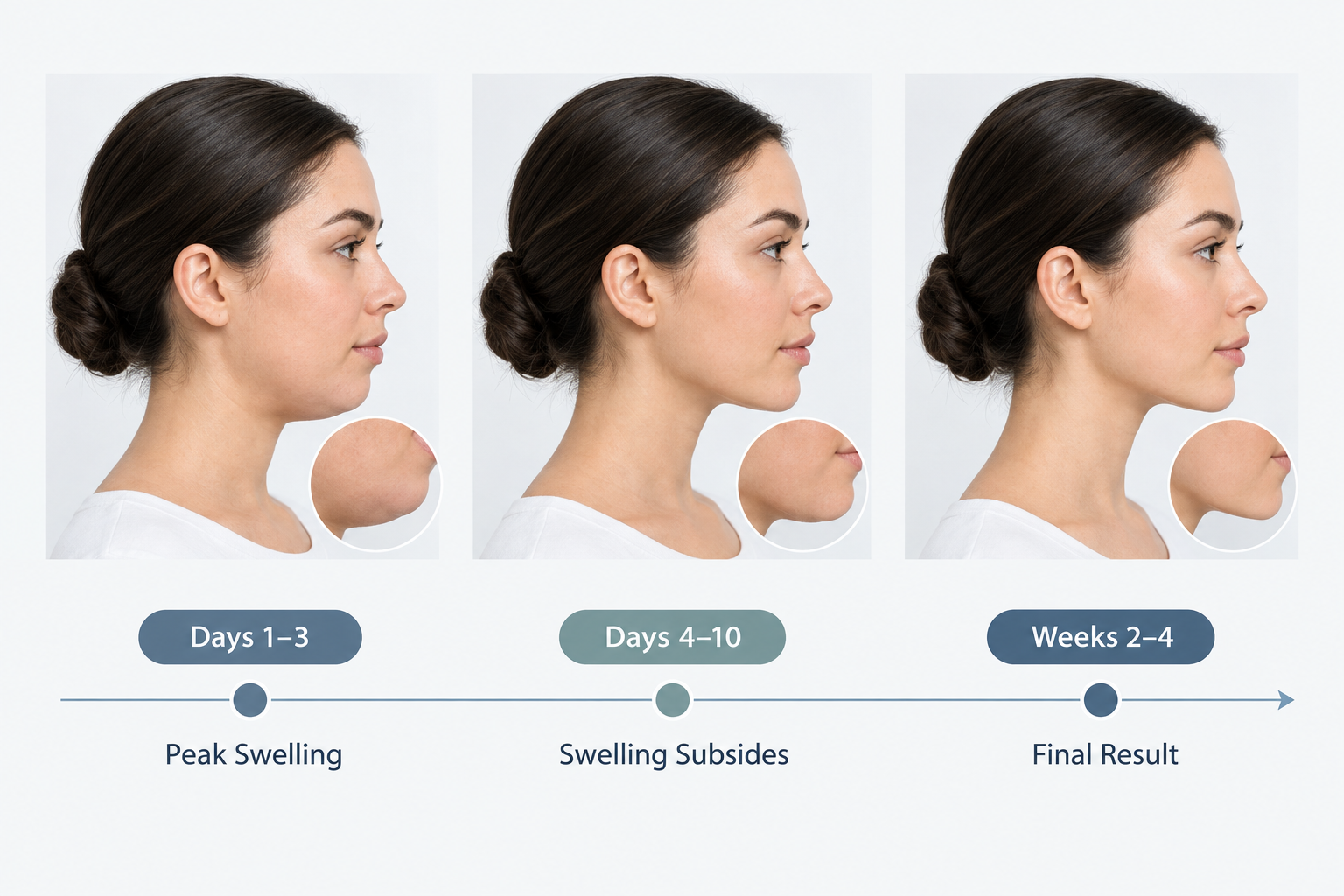
- Days 1–3: Swelling is typically at its peak. The chin may appear larger or slightly asymmetrical. Some bruising is common. The treated area may feel firm or tender.
- Days 4–10: Swelling begins to subside. Bruising fades. The shape starts to become more representative of the final result, though some puffiness may remain.
- Weeks 2–4: The filler settles fully into the tissue. The final contour, projection, and definition become visible. Any residual asymmetry that was present at day one should have resolved; if it has not, this is the appropriate time to contact your practitioner.
Most practitioners recommend waiting at least four weeks before assessing the final result or considering any adjustments. Evaluating the outcome too early — while swelling is still present — can lead to unnecessary concern or premature top-up treatments.
Signs Your Chin Filler Is Wearing Off
Chin filler does not disappear all at once. Filler breakdown is a gradual process, and the signs that results are fading tend to appear slowly over several months. Common signs chin filler is wearing off include a reduction in chin projection, a softening of the lower face contour, and a less defined jawline. Patients may notice that the chin appears to have receded slightly or that the facial harmony and balance they achieved after treatment is beginning to diminish. In some cases, volume loss may appear slightly uneven, as filler does not always break down at a perfectly uniform rate across the treated area. If you notice any sudden or unexpected changes in shape rather than a gradual softening, it is worth consulting your practitioner.
How to Make Chin Filler Last Longer
While no aftercare routine can stop filler from eventually breaking down, certain habits can help protect your results and extend the effective duration of treatment.
- Avoid touching or massaging the treated area for at least one to two weeks after treatment. Mechanical pressure can displace filler before it has fully integrated into the tissue.
- Avoid heat exposure — including saunas, steam rooms, hot baths, and tanning beds — for the first week. Heat increases circulation and can accelerate early filler breakdown.
- Avoid strenuous exercise for 24 to 48 hours after treatment to reduce swelling and minimise early metabolic stress on the filler.
- Sleep on your back and avoid sustained pressure on the chin area during the first two weeks.
- Use SPF daily. Protecting the skin from UV exposure helps preserve both the filler and the surrounding collagen.
- Stay well hydrated. Adequate hydration supports the water-retaining properties of hyaluronic acid filler.
- Avoid smoking and limit alcohol where possible, as both can accelerate tissue breakdown and reduce the effective duration of results.
- Schedule maintenance proactively. Booking a top-up appointment before the filler has fully dissolved — rather than waiting until results have completely faded — allows the practitioner to maintain continuity of result with a smaller volume of product. This approach tends to produce more consistent outcomes than reactive treatment after full dissolution.
Common Misconceptions About Chin Filler Duration
Several widely held beliefs about chin filler longevity are either inaccurate or oversimplified, and they can lead to unrealistic expectations or poor decisions.
"More filler means longer-lasting results." This is not reliably true. Using a larger volume than the anatomy requires does not proportionally extend duration and can create an unnatural appearance. The appropriate amount is determined by the patient's goals and facial structure, not by a desire to delay the next appointment.
"Chin filler needs topping up every few months." This is a common misconception, likely carried over from experience with lip filler, which is placed in a high-movement area and typically lasts six to nine months. Chin filler, placed deeper and in a more static zone, generally lasts considerably longer. Most patients require maintenance once every 12 to 18 months rather than every few months.
"Filler wears off evenly and uniformly." In practice, filler breakdown is not always perfectly uniform. Different areas of the chin may lose volume at slightly different rates depending on local tissue dynamics, movement patterns, and the distribution of the original product. This is why results sometimes appear to soften unevenly rather than fading symmetrically.
Chin Filler vs Chin Implant: Longevity and Trade-Offs
For patients considering longer-term chin enhancement, it is worth understanding how chin filler compares to a surgical chin implant in terms of longevity, commitment, and practical implications.
| Factor | Chin Filler | Chin Implant |
|---|---|---|
| Longevity | 12–24 months (maintenance required) | Permanent (surgical revision possible) |
| Procedure type | Non-surgical injection | Surgical procedure under anaesthesia |
| Downtime | Minimal (24–48 hours) | 1–2 weeks or more |
| Reversibility | HA fillers reversible with hyaluronidase | Requires further surgery to remove or adjust |
| Adjustability | Volume and shape can be refined | Fixed once healed |
| Cumulative cost | Ongoing maintenance cost over years | Higher upfront cost; no ongoing maintenance |
| Suitable for | Mild to moderate projection; trialling a look | Significant structural change; long-term commitment |
One practical use of chin filler that is often underappreciated is its value as a preview before committing to surgery. Because hyaluronic acid chin filler is reversible with hyaluronidase — an enzyme that dissolves HA — patients can trial a specific chin shape and projection before deciding whether a permanent implant is right for them. This approach allows for informed decision-making without surgical commitment. Patients who find they are happy with the filler result may choose to continue with maintenance treatments indefinitely; those who want a permanent solution can proceed to surgery with a clearer sense of their preferred outcome.
From a cost perspective, the cumulative expense of maintenance chin filler over five years can approach or exceed the one-time cost of a surgical implant, depending on the volume required and local pricing. This is a practical consideration worth discussing with your practitioner when planning long-term treatment.
Frequently Asked Questions
Does chin filler last longer than lip filler?
Yes, in most cases. Lip filler is placed in a highly mobile area subject to constant movement from speaking, eating, and facial expression, and typically lasts six to nine months. Chin filler is placed deeper and in a more static zone, which is why it generally lasts 12 to 18 months or longer depending on the product used.
Is chin filler permanent?
No. All currently available injectable chin fillers are temporary. Hyaluronic acid fillers are gradually broken down by the body over months. Even longer-lasting options such as calcium hydroxylapatite and Poly-L-Lactic Acid eventually degrade, though they may persist for up to two years or more. Surgical chin implants are the only permanent option for chin augmentation.
Can chin filler migrate?
Migration — where filler moves away from the intended placement area — is uncommon when chin filler is performed by an experienced practitioner using an appropriate product and technique. Denser, more cohesive fillers placed at the correct depth are less prone to migration than lighter products placed superficially. Avoiding pressure and massage on the treated area in the first two weeks also reduces this risk.
Can chin filler be dissolved if I am unhappy with the result?
Hyaluronic acid chin filler can be dissolved using hyaluronidase, an enzyme that breaks down HA. This makes HA fillers a reversible option, which is one reason they are often preferred for patients who are new to chin augmentation or who want flexibility. Calcium hydroxylapatite (Radiesse) and Poly-L-Lactic Acid (Sculptra) are not reversible with hyaluronidase, so this distinction is worth discussing with your practitioner before treatment.
Do results last longer after repeat treatments?
For some patients, yes. Collagen stimulation from repeat filler treatments — particularly with products such as Radiesse and Sculptra — can build a supportive collagen framework over time, which may help subsequent results last a little longer. This effect is gradual and varies between individuals, but it is one reason practitioners sometimes observe that patients who have maintained regular treatment cycles require less product over time to achieve the same result.
When should I book a top-up appointment?
Most practitioners recommend scheduling a maintenance appointment when you notice the early signs of fading — such as a slight reduction in chin projection or softening of the contour — rather than waiting until results have fully dissolved. Proactive top-up treatment typically requires less product and produces a more consistent result than starting from scratch after complete filler breakdown.
Planning Your Chin Filler Treatment Realistically
Chin filler longevity sits in a range rather than a fixed number, and the factors that influence duration — filler type, metabolism, placement, lifestyle, and practitioner technique — interact differently for every patient. A realistic expectation for most people is 12 to 18 months from a hyaluronic acid chin filler, with longer results possible from denser or collagen-stimulating products and in patients with slower metabolic rates. Understanding these variables before treatment helps you plan maintenance sensibly, make informed choices about product selection, and avoid disappointment if your results differ from a friend's experience with the same procedure.
If you are considering chin filler for the first time, a consultation with a qualified and experienced practitioner is the appropriate starting point. A thorough assessment of your facial anatomy, skin quality, and aesthetic goals will guide product selection, volume, and placement — all of which directly affect how long your results last and how natural they appear. If you are weighing chin filler against a surgical implant, that same consultation can help you understand the long-term cost, commitment, and suitability of each option for your specific situation.
