
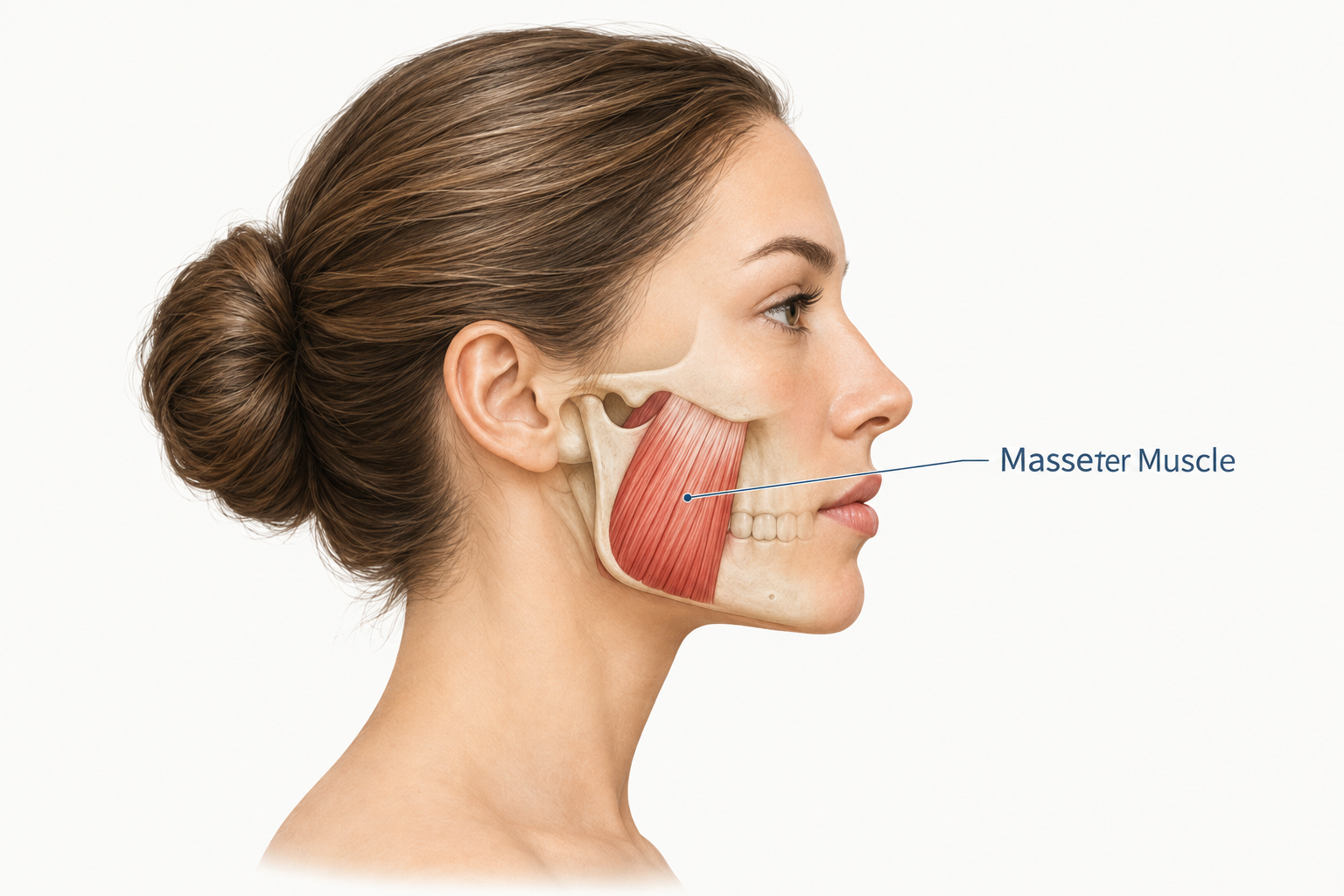

Masseter Botox is one of the more versatile uses of botulinum toxin, applied not to smooth wrinkles but to reduce the size and activity of the masseter muscle — the large jaw muscle responsible for chewing. Patients typically seek this treatment to soften a wide or square jawline, relieve jaw tension, or reduce teeth grinding. Understanding how long masseter Botox works, when results become visible, and what influences their duration helps set realistic expectations before committing to treatment.
Key Takeaways
- Masseter Botox results typically become noticeable within two to four weeks, with the most visible jaw slimming effect often appearing at around four to six weeks as the muscle gradually reduces in bulk.
- The functional effects — reduced jaw tension and teeth grinding — may be felt sooner, sometimes within one to two weeks of treatment.
- Results generally last between three and six months, though individual variation is significant and some patients maintain effects for longer with repeated treatments.
- Factors such as masseter muscle size, chewing habits, individual metabolism, and the dose used all influence how long the effects last.
- Repeated treatments over time may lead to longer-lasting results as the muscle gradually atrophies with reduced use.
What Is Masseter Botox and How Does It Work?
Botulinum toxin type A — marketed under brand names including Botox, Dysport, and others — works by temporarily blocking the nerve signals that cause a muscle to contract. When injected into the masseter muscle, it reduces the force and frequency of muscle contractions. Over time, a muscle that is less active tends to reduce in volume, a process known as disuse atrophy. This is the mechanism behind the jaw-slimming effect that many patients seek.
The masseter is a paired muscle located on either side of the jaw, running from the cheekbone down to the lower jaw. It is one of the primary muscles of mastication — meaning it plays a central role in chewing. In some individuals, this muscle is naturally larger, either due to genetics, habitual teeth clenching (bruxism), or a combination of both. A hypertrophied masseter can create a wider, more angular lower face, which some patients wish to soften. Botulinum toxin treatment for masseter hypertrophy addresses this by reducing muscle activity rather than removing tissue.
It is important to understand that masseter Botox does not alter bone structure. The change in facial shape comes from a reduction in muscle bulk, not from any effect on the jaw bone itself. This distinction matters when setting expectations, particularly for patients whose wide jawline is primarily skeletal rather than muscular in origin.
When Does Masseter Botox Start Working?
The onset of masseter Botox follows a predictable general pattern, though the timeline differs depending on whether you are measuring functional effects or visible aesthetic changes.

Functional Onset: Jaw Tension and Teeth Grinding
Patients who receive masseter Botox for bruxism or jaw tension — including symptoms such as jaw pain, headaches related to clenching, and morning soreness — often notice a reduction in these symptoms within one to two weeks of treatment. This relatively early response reflects the fact that the neuromuscular blockade begins taking effect as the toxin binds to nerve terminals and reduces the intensity of involuntary muscle contractions. The jaw may feel less tight, and the force of clenching typically diminishes before any visible change in jaw shape becomes apparent.
Aesthetic Onset: Jaw Slimming
The visible slimming of the jawline takes longer to appear. Because the aesthetic result depends on the masseter muscle gradually reducing in size — rather than simply relaxing — patients generally need to wait four to six weeks before the full effect becomes visible. Some patients notice a subtle softening of the jaw contour from around two to three weeks, but the most significant change in facial shape typically emerges between weeks four and eight. Practitioners often recommend a review appointment at around four to six weeks to assess the result and determine whether any additional treatment is appropriate.
This delayed aesthetic onset is one of the most commonly misunderstood aspects of masseter Botox. Patients who expect an immediate change in jaw shape may feel the treatment has not worked when, in fact, the muscle simply has not yet had sufficient time to reduce in volume. Patience is an important part of the process.
How Long Do Masseter Botox Results Last?
For most patients, the effects of masseter Botox last between three and six months. This is a broad range, and individual results vary considerably. Several factors influence where a particular patient falls within this range.
Factors That Affect Duration
Masseter muscle size and activity: Patients with a larger or more active masseter — for example, those who clench or grind their teeth heavily — may find that the effects wear off more quickly. A highly active muscle may metabolise the effects of botulinum toxin faster than a less active one, requiring more frequent retreatment to maintain results.

Dose administered: The amount of botulinum toxin used influences both the depth of effect and its duration. A higher dose generally produces a longer-lasting result, though the appropriate dose depends on the individual’s muscle size, anatomy, and treatment goals. Dose decisions should be made by a qualified practitioner following a clinical assessment — this is not a situation where more is automatically better, as excessive doses carry their own risks.
Individual metabolism: People metabolise botulinum toxin at different rates. Some individuals consistently find that their results last at the shorter end of the typical range, while others maintain effects for six months or beyond. This variation is not fully predictable in advance, though a patient’s history with previous botulinum toxin treatments can provide useful guidance.
Chewing habits and diet: Patients who regularly chew hard foods, use chewing gum frequently, or clench their jaw during sleep may find that the masseter muscle remains more active, potentially shortening the duration of effect. Reducing these habits where possible may help extend results.
Cumulative treatment history: One of the more clinically interesting aspects of masseter Botox is that repeated treatments over time may produce progressively longer-lasting results. As the masseter undergoes repeated periods of reduced activity, the muscle can atrophy more substantially. Some patients who have undergone several treatment cycles report that their results last longer with each subsequent session, and that they require less frequent retreatment over time. This is not guaranteed, but it is a pattern observed in clinical practice and supported by the general principle of disuse atrophy.
What Happens During a Masseter Botox Appointment?
A masseter Botox appointment is typically brief, often taking around fifteen to thirty minutes including consultation time. The practitioner will assess the size and symmetry of the masseter muscles, discuss the patient’s goals — whether primarily aesthetic, functional, or both — and determine an appropriate treatment plan.
The injections are administered directly into the masseter muscle on each side of the jaw. Most patients describe the sensation as a mild pinch or pressure. Topical anaesthetic cream is not always necessary but may be offered. There is no requirement for sedation or significant preparation.
After the injections, patients can generally return to normal activities immediately. There is no significant downtime associated with masseter Botox. Some patients experience mild tenderness, swelling, or bruising at the injection sites, but these effects are typically short-lived and resolve within a few days.
Recovery and Aftercare
The recovery period following masseter Botox is minimal compared to surgical alternatives. Most practitioners advise patients to avoid vigorous exercise for the remainder of the day of treatment, to refrain from massaging or applying pressure to the treated area for a short period, and to avoid lying face-down immediately after the appointment. Specific aftercare instructions vary between practitioners and should be followed as provided.
Patients are generally advised to avoid very hard or chewy foods in the days immediately following treatment, not because the treatment is fragile, but because excessive jaw activity in the early period may theoretically influence how the toxin settles. This is a precautionary recommendation rather than a strict clinical requirement, and guidance varies between practitioners.
It is worth noting that masseter Botox does not impair normal chewing function in the vast majority of patients when administered at appropriate doses. The goal is to reduce excessive muscle activity, not to eliminate the muscle’s function entirely. Patients should be able to eat normally, though some report a temporary mild change in chewing sensation as the treatment takes effect.
Risks and Limitations of Masseter Botox
Masseter Botox is generally considered a well-tolerated procedure when performed by a qualified and experienced practitioner, but it is not without risks. Patients should be aware of the following before proceeding.
- Asymmetry: If the masseter muscles respond differently on each side — which can occur due to natural anatomical variation or differences in injection technique — the result may be uneven. This is usually correctable at a follow-up appointment.
- Smile changes: The masseter is located close to muscles involved in facial expression. In some cases, botulinum toxin may diffuse to adjacent muscles, temporarily affecting the smile or causing a subtle change in facial movement. This is generally temporary and resolves as the treatment wears off.
- Bruising and swelling: These are common minor side effects that typically resolve within a few days.
- Temporary jaw weakness: Some patients notice a mild reduction in chewing strength, particularly with hard foods. This is usually temporary and not functionally significant at appropriate doses.
- Insufficient effect: In patients with very large or dense masseter muscles, a single treatment session may not produce the desired degree of slimming. Additional treatment or a higher dose at a subsequent session may be required.
- Results are temporary: Masseter Botox does not produce permanent results. Ongoing maintenance treatments are required to sustain the effect.
Serious complications are uncommon but possible. A thorough consultation with a qualified medical professional is essential before treatment. Patients should disclose their full medical history, including any neuromuscular conditions, medications, pregnancy or breastfeeding status, and previous reactions to botulinum toxin products.
Who May Be Suitable for Masseter Botox?
Masseter Botox may be worth discussing with a qualified practitioner if you have one or more of the following:
- A visibly wide or square lower face that you believe is related to muscle bulk rather than bone structure
- Diagnosed or suspected bruxism (teeth grinding or jaw clenching), particularly if it is causing jaw pain, headaches, or dental wear
- Jaw tension or temporomandibular joint (TMJ) discomfort related to muscle overactivity
- A desire for a non-surgical approach to facial contouring
Masseter Botox is less likely to produce significant aesthetic results in patients whose wide jawline is primarily due to bone structure rather than muscle hypertrophy. A clinical assessment — which may include palpating the masseter to assess its size and activity — helps determine whether the treatment is likely to be effective for a given individual.
Alternatives to Masseter Botox
For patients who are not suitable for masseter Botox, or who are exploring their options, several alternatives exist depending on the underlying concern.
For jaw slimming: Surgical options such as masseter muscle reduction surgery or jaw angle reduction (mandibular angle reduction) offer more permanent results but carry significantly greater risks, longer recovery times, and higher costs. These are typically considered only when non-surgical options have been exhausted or when the concern is primarily skeletal. For patients with a mild concern, facial contouring techniques using dermal fillers in other areas — such as the chin — may create the visual impression of a slimmer jawline without directly treating the masseter.
For bruxism: Dental splints or night guards are a common first-line approach to managing teeth grinding and protecting dental surfaces. They do not reduce muscle bulk but can reduce the impact of clenching on the teeth. Stress management, physiotherapy, and cognitive behavioural approaches may also be recommended depending on the underlying cause. Masseter Botox and dental splints are not mutually exclusive and are sometimes used together.
For jaw pain and TMJ symptoms: Physiotherapy, occlusal splints, anti-inflammatory medications, and in some cases, other injection therapies may be appropriate. Patients with significant TMJ dysfunction should seek assessment from a dental or maxillofacial specialist in addition to any aesthetic consultation.
How Many Treatments Are Typically Needed?
For patients seeking jaw slimming, most practitioners recommend an initial course of two to three treatments spaced approximately three to four months apart. This approach allows the masseter to undergo progressive atrophy with each treatment cycle, potentially producing a more sustained result over time. After the initial course, maintenance treatments are typically required every four to six months, though this varies between individuals.
For patients treating bruxism or jaw tension, the treatment frequency is similarly guided by how long the functional effects last for that individual. Some patients find that their symptoms return before the aesthetic effect fades, while others find the reverse. A practitioner experienced in both the aesthetic and functional applications of masseter Botox can help tailor a treatment schedule to the patient’s specific needs.
Frequently Asked Questions
How soon will I see results after masseter Botox?
Functional improvements such as reduced jaw tension or less intense teeth grinding may be noticeable within one to two weeks. Visible jaw slimming typically becomes apparent between four and six weeks after treatment, as the masseter muscle gradually reduces in bulk. The full aesthetic result is usually assessed at around six weeks.
Does masseter Botox wear off suddenly?
No. The effects of masseter Botox fade gradually rather than stopping abruptly. As the botulinum toxin is metabolised, nerve signals to the masseter slowly return to their previous level, and the muscle gradually regains its activity and, over time, its original size. Most patients notice the effects beginning to diminish before they have fully resolved, which gives time to plan a maintenance appointment.
Can masseter Botox permanently slim the jaw?
Masseter Botox does not produce permanent results in most patients. However, repeated treatments over several years may lead to a degree of lasting muscle reduction in some individuals, as the masseter undergoes prolonged periods of reduced activity. The extent of any lasting change varies between patients and cannot be guaranteed. Ongoing maintenance is generally required to sustain the effect.
Will masseter Botox affect my ability to chew?
At appropriate doses, masseter Botox should not significantly impair normal chewing function. Some patients notice a mild temporary reduction in chewing strength, particularly with very hard foods, but this is generally not functionally limiting. If chewing difficulty is significant or prolonged, it should be discussed with the treating practitioner.
Is masseter Botox the same as regular facial Botox?
The active ingredient — botulinum toxin type A — is the same, but the application differs. Facial Botox for wrinkles targets small superficial muscles to reduce dynamic lines. Masseter Botox targets a large, deep muscle of mastication to reduce its bulk and activity. The doses used for masseter treatment are typically higher than those used for standard facial wrinkle treatment, reflecting the size and strength of the masseter muscle.
How do I know if my wide jaw is muscle or bone?
A qualified practitioner can assess this during a consultation by palpating the masseter while you clench your jaw. If the muscle visibly bulges or feels significantly enlarged when clenched, muscle hypertrophy is likely contributing to the jaw width. If the jaw appears wide even when the masseter is relaxed and the bone structure is prominent, the concern may be primarily skeletal, in which case masseter Botox is less likely to produce a significant aesthetic change.
What happens if I stop having masseter Botox treatments?
If maintenance treatments are discontinued, the masseter muscle will gradually return to its previous level of activity and, over time, its original size. The jaw will not become wider than it was before treatment began. The timeline for full return varies between individuals but typically occurs over several months.
Planning Masseter Botox: What to Consider Before Your Consultation
Masseter Botox can be an effective non-surgical option for patients with genuine masseter hypertrophy, whether the primary concern is jaw shape, teeth grinding, or jaw tension. The treatment has a well-established mechanism, a manageable side effect profile when performed by a qualified practitioner, and a realistic duration of effect that most patients find acceptable with planned maintenance.
The most important step before proceeding is a thorough consultation with a medically qualified and experienced practitioner who can assess whether the masseter is genuinely contributing to your concern, discuss realistic outcomes for your specific anatomy, and explain the dose, schedule, and risks relevant to your situation. Results vary between individuals, and no treatment can guarantee a specific outcome. Patients whose jaw width is primarily skeletal in origin are unlikely to see significant aesthetic improvement from masseter Botox alone and may benefit from a broader discussion of their options.
If you are considering masseter Botox for bruxism or jaw pain, it is also worth discussing your symptoms with a dentist or relevant specialist, as these conditions often benefit from a combined approach rather than a single treatment in isolation. A well-informed patient who understands both the potential benefits and the limitations of masseter Botox is in the best position to make a decision that aligns with their goals and expectations.
