

A well-defined jawline is one of the most commonly requested aesthetic goals, yet the path to achieving it depends heavily on individual anatomy, skin quality, and the underlying cause of a soft or undefined jaw contour. Whether the concern is excess submental fat, skin laxity, loss of bone projection, or simply genetics, different factors call for different approaches. This article explains the realistic options available, from daily habits to clinical treatments, so you can make an informed decision before seeking a professional consultation.
Key Takeaways
- A defined jawline can be influenced by body composition, skin laxity, bone structure, and soft tissue volume, so identifying the primary cause matters before choosing any approach.
- Lifestyle changes such as reducing overall body fat and improving posture can modestly improve jaw definition, but they cannot alter bone structure or significantly tighten loose skin.
- Non-surgical clinical treatments including botulinum toxin, dermal fillers, fat-dissolving injections, and skin-tightening devices may each address different aspects of jaw definition.
- Results from non-surgical treatments are typically temporary and vary between individuals; realistic expectations and a qualified clinical assessment are essential.
- Surgical options such as chin implants or neck liposuction offer more permanent structural changes but carry greater risks and recovery demands.
Why Jaw Definition Varies Between People
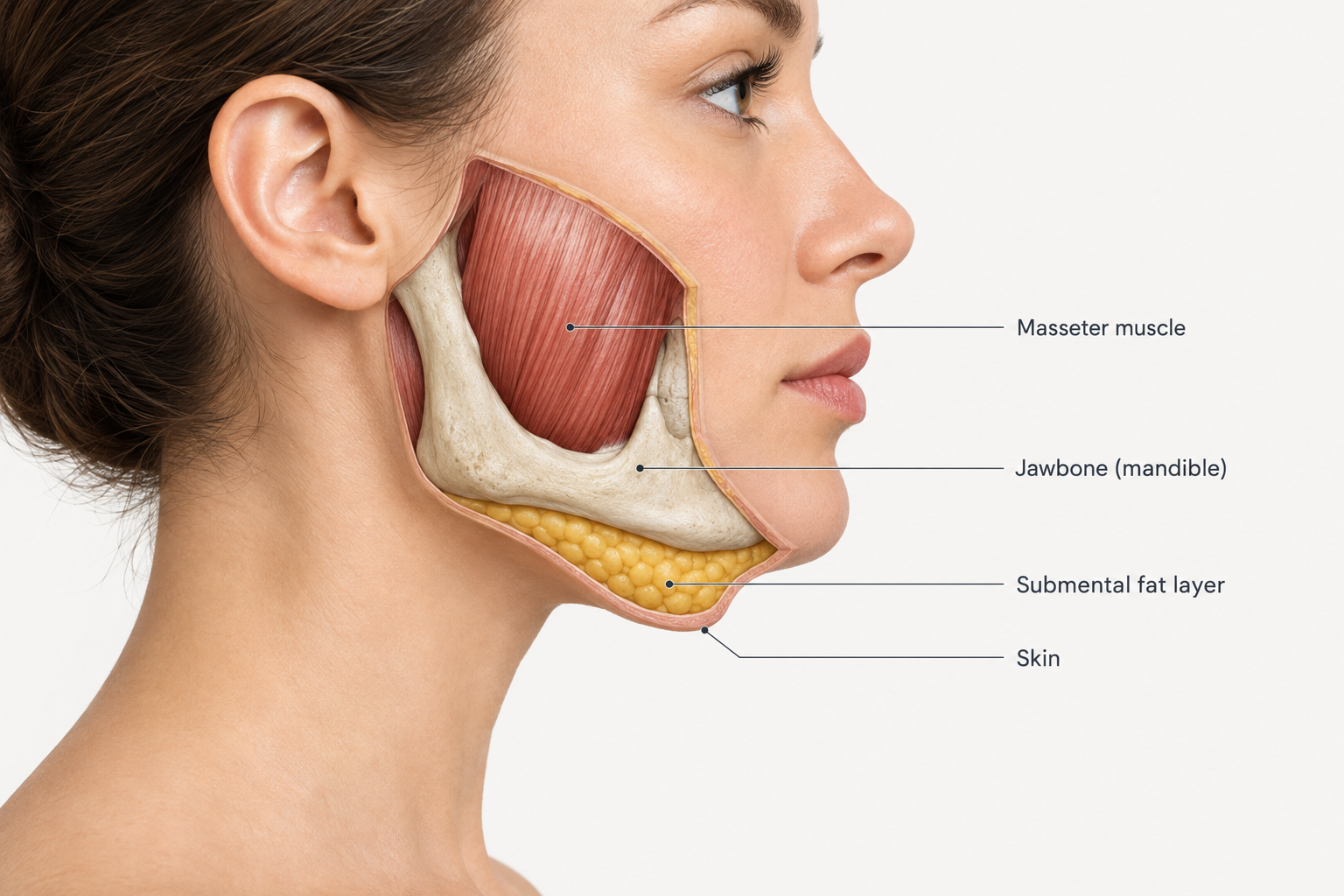
The appearance of the jawline is shaped by several overlapping factors. Bone structure determines the underlying framework, including the prominence of the chin and the angle of the mandible. Overlying this framework is a layer of soft tissue, including fat compartments, muscle, and skin. When any of these elements changes, the perceived sharpness of the jaw changes with it. Genetics play a significant role, which is why some people naturally have a more angular jaw while others have a softer, rounder lower face regardless of their weight or fitness level.
Age also contributes meaningfully. As collagen and elastin production slows over time, skin gradually loses its ability to remain taut against the underlying structures. Fat redistribution and mild bone resorption in the lower face can further blur the jawline contour. Understanding which of these factors is most relevant to your own situation is the first step toward choosing an approach that is likely to be useful.
Lifestyle Habits That May Support Jaw Definition
Before considering any clinical treatment, it is worth understanding what lifestyle changes can and cannot realistically achieve. Reducing overall body fat through a sustainable calorie deficit and regular exercise can decrease the volume of submental fat, the fat pad beneath the chin that often softens the jaw contour. This is one of the most meaningful non-clinical steps available, though the degree of improvement depends on individual fat distribution patterns, which are largely genetic.
Staying well hydrated and limiting high-sodium foods may reduce facial puffiness caused by fluid retention, which can temporarily sharpen facial contours. Improving posture, particularly reducing forward head posture, can also make the neck and jaw area appear more defined by changing the angle at which the soft tissues sit. These are modest effects rather than dramatic transformations, but they are low-risk and support general health.
Facial exercises are frequently discussed in this context. Some small studies suggest that regular facial muscle exercises may modestly improve muscle tone and facial appearance over time, but the evidence base is limited and results are unlikely to be comparable to clinical interventions for most people. Chewing firmer foods is sometimes suggested to strengthen the masseter muscles, though this approach is not clinically validated as a jaw-defining strategy and may not be appropriate for people with jaw joint concerns.
Non-Surgical Clinical Options for a More Defined Jawline
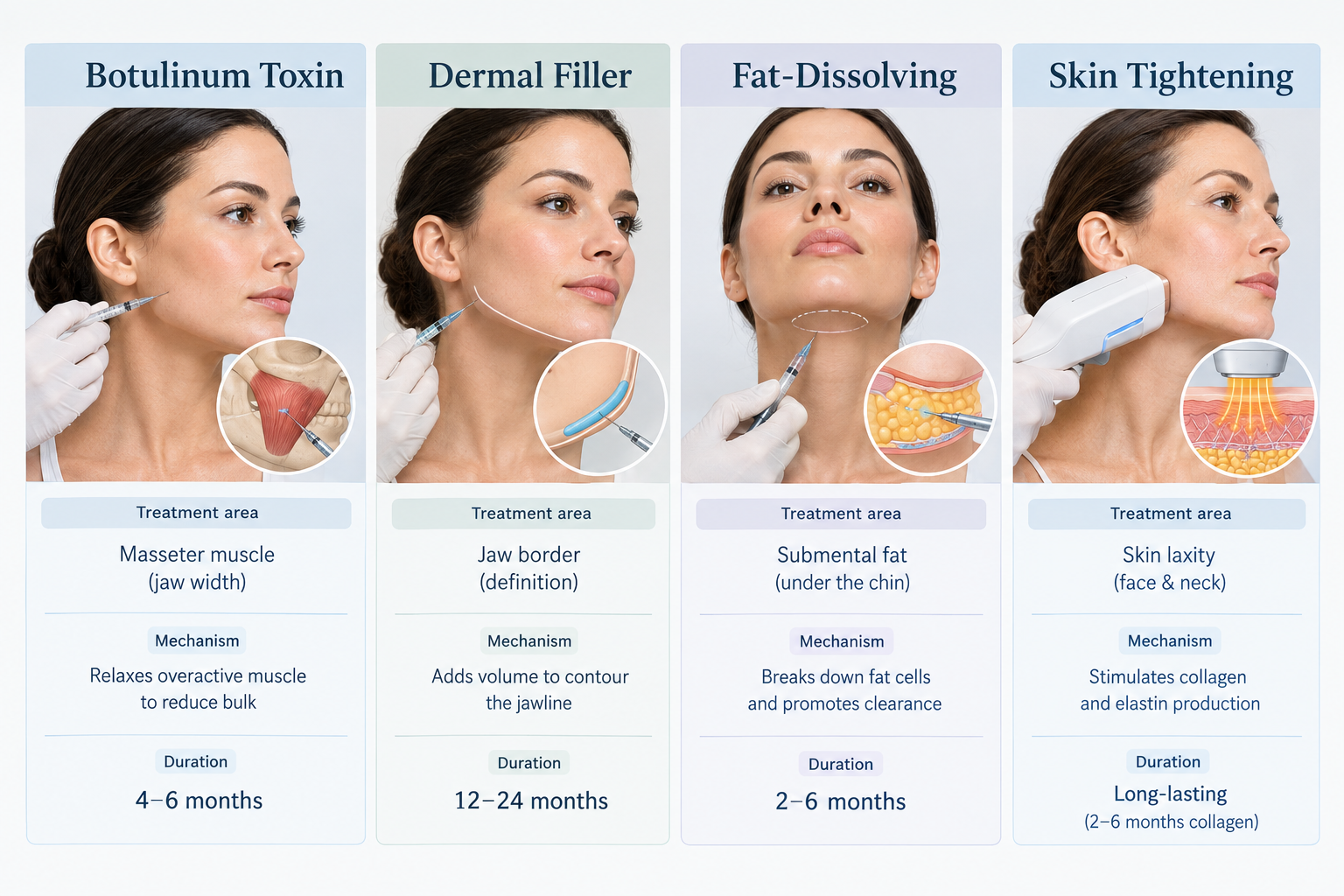
Several non-surgical treatments are used in aesthetic medicine to address different aspects of jaw definition. Each works through a distinct mechanism and is suited to a different underlying concern. A qualified practitioner will assess which option, or combination of options, is appropriate based on your anatomy and goals.
Botulinum Toxin for Jaw Slimming
Botulinum toxin injections into the masseter muscles, the large chewing muscles at the sides of the jaw, can reduce their bulk over time. When the masseter is enlarged, either due to genetics or habitual teeth grinding (bruxism), it can create a wide, square lower face. Botulinum toxin temporarily relaxes the muscle, which gradually reduces in size with repeated treatments. The result is a narrower, more tapered lower face rather than a sharper jaw angle per se, but for people whose jaw width is the primary concern, this approach may be appropriate.
Results from masseter botulinum toxin typically become noticeable over four to six weeks as the muscle gradually reduces in volume, and they generally last between four and six months before the muscle begins to regain its size. Multiple sessions are usually needed to achieve and maintain the effect. Side effects may include temporary difficulty chewing very hard foods, asymmetry, or bruising at the injection site. A thorough assessment is important because masseter reduction is not appropriate for everyone, particularly those who already have a narrow lower face.
Dermal Fillers for Jawline Contouring
Hyaluronic acid dermal fillers can be injected along the jawline to add structural definition, improve the jaw angle, or extend the apparent length of the jaw. This approach is particularly relevant when the concern is a lack of projection or angularity rather than excess fat or skin laxity. Filler placed strategically along the mandibular border can create a more sculpted appearance and improve the transition between the jaw and neck.
Chin filler is often used alongside jawline filler to improve overall lower face balance, as a recessed chin can make the jaw appear less defined even when the jaw itself is structurally adequate. Results from hyaluronic acid jawline filler are typically visible immediately and may last between twelve and twenty-four months depending on the product used, the volume placed, and individual metabolism. Risks include bruising, swelling, asymmetry, and in rare cases vascular complications, which is why treatment should only be performed by a trained and experienced practitioner. Hyaluronic acid fillers can be dissolved with hyaluronidase if needed, which is an important safety consideration.
Fat-Dissolving Injections for Submental Fat
Submental fat, the fat beneath the chin sometimes called a double chin, is a common reason why the jawline appears soft or undefined. Fat-dissolving injections containing deoxycholic acid or phosphatidylcholine-based formulations can be used to reduce this localized fat deposit. Deoxycholic acid disrupts the fat cell membrane, causing the cells to break down and be gradually cleared by the body over several weeks.
A course of two to four treatment sessions is typically required, spaced several weeks apart, to achieve a meaningful reduction. Swelling, bruising, and temporary numbness in the treated area are common after each session and can be significant for several days. The results, once achieved, are generally long-lasting because the treated fat cells are permanently destroyed, though weight gain can cause remaining fat cells to enlarge. Fat-dissolving injections address submental fat specifically and will not tighten loose skin or alter bone structure, so they are most suitable for people with good skin elasticity and a localized fat concern rather than generalized skin laxity.
Skin-Tightening Treatments
When skin laxity along the jaw and neck is the primary concern, energy-based devices may be considered. Technologies including radiofrequency, high-intensity focused ultrasound (HIFU), and radiofrequency microneedling work by stimulating collagen production in the deeper layers of the skin and soft tissue, which can gradually improve skin firmness and reduce the appearance of jowling over time.
These treatments are generally better suited to mild to moderate skin laxity rather than significant sagging. Results develop gradually over two to six months as new collagen forms, and the degree of improvement varies considerably between individuals depending on age, skin quality, and the severity of laxity. Multiple sessions may be required, and maintenance treatments are often recommended. Side effects are generally mild and may include temporary redness, swelling, or tingling, though more significant adverse effects are possible and depend on the specific device and settings used. These treatments do not remove fat or add structural volume, so they address a different aspect of jaw definition than fillers or fat-dissolving injections.
Polynucleotides and Skin Quality
Polynucleotide injections, which use purified DNA fragments to stimulate tissue regeneration and improve skin quality, are increasingly used in the lower face and neck area. While polynucleotides are not a primary jawline-defining treatment, they may improve skin hydration, texture, and elasticity in the jaw and neck region, which can complement other treatments. Evidence for polynucleotides in aesthetic medicine is still developing, and they are generally considered a skin quality treatment rather than a contouring intervention.
Surgical Options for Jawline Definition
For people seeking more significant or permanent structural changes, surgical options exist and may be worth discussing with a plastic or maxillofacial surgeon. Chin implants can add projection and improve lower face balance. Jaw implants can widen or define the mandibular angle. Neck liposuction can remove submental and neck fat more comprehensively than injectable fat-dissolving treatments. A lower face and neck lift addresses significant skin laxity and jowling that non-surgical treatments cannot adequately correct.
Surgical procedures carry greater risks than non-surgical options, including anaesthetic risks, infection, scarring, nerve injury, implant-related complications, and longer recovery periods. They are generally considered when non-surgical approaches are insufficient for the degree of change desired or when the underlying concern, such as significant bone deficiency or substantial skin excess, is not amenable to non-surgical correction. A surgical consultation with a qualified specialist is necessary to assess suitability and discuss realistic outcomes.
Combining Treatments for Jawline Definition
In clinical practice, a combination approach is often more effective than any single treatment for achieving a defined jawline. For example, a practitioner might recommend fat-dissolving injections to reduce submental fat, dermal filler to add structural definition along the mandibular border, and a skin-tightening treatment to address mild laxity, all tailored to the individual's anatomy. Masseter botulinum toxin might be added if jaw width is also a concern.
Combination treatment plans require careful sequencing and a thorough understanding of facial anatomy. They also carry cumulative costs and a greater overall treatment burden. A qualified aesthetic practitioner will assess whether a combined approach is appropriate and will prioritize treatments based on the most significant contributing factors to the individual's concern.
Who May Be Suitable for Clinical Jawline Treatments
Suitability for any clinical jawline treatment depends on a range of individual factors. Generally, candidates are adults in good general health who have realistic expectations about what non-surgical treatments can achieve. Specific suitability considerations include:

- The primary cause of reduced jaw definition, whether fat, skin laxity, bone structure, or muscle bulk, as this determines which treatment is relevant.
- Skin quality and elasticity, which affects the likely response to skin-tightening treatments and the suitability of fat-dissolving injections.
- Medical history, including any bleeding disorders, autoimmune conditions, or history of keloid scarring.
- Current medications, particularly blood thinners, which may increase bruising risk.
- Pregnancy or breastfeeding, during which most aesthetic treatments are not recommended.
- Previous treatments in the area, including prior filler, which may affect planning and safety.
- Jaw joint conditions such as temporomandibular joint disorder, which may affect suitability for masseter botulinum toxin.
A thorough consultation with a qualified practitioner is essential before proceeding with any treatment. This should include a detailed medical history, an assessment of facial anatomy, and an honest discussion of realistic outcomes and alternatives.
Risks and Limitations to Understand Before Treatment
All clinical treatments carry risks, and jawline treatments are no exception. Common risks across injectable treatments include bruising, swelling, asymmetry, and infection. Dermal filler carries the additional risk of vascular occlusion, a rare but serious complication in which filler inadvertently enters or compresses a blood vessel, potentially affecting tissue perfusion. This risk underscores the importance of choosing a practitioner with appropriate training in facial anatomy and emergency management.
Non-surgical treatments generally produce more modest results than surgical alternatives, and results are temporary, requiring ongoing maintenance to sustain. Individual response varies considerably, and not everyone achieves the degree of definition they hope for. It is important to approach these treatments with realistic expectations rather than expecting a dramatic or permanent transformation from a single session.
The aesthetic medicine industry is not uniformly regulated in all countries, and the qualifications of practitioners vary widely. Seeking treatment from a medically qualified and appropriately trained practitioner, ideally one who can manage complications if they arise, significantly reduces risk.
Frequently Asked Questions
Can exercise alone give me a more defined jawline?
Exercise can reduce overall body fat, which may decrease submental fat and modestly improve jaw definition. However, exercise cannot change bone structure, tighten significantly loose skin, or reduce masseter muscle bulk. The degree of improvement from exercise alone depends on how much of the concern is related to body fat versus other factors such as genetics or skin laxity.
How long does jawline filler last?
Hyaluronic acid jawline filler typically lasts between twelve and twenty-four months, though this varies depending on the specific product used, the volume injected, the individual's metabolism, and the area treated. Maintenance appointments are usually needed to sustain the result. Filler can be dissolved with hyaluronidase if the result is unsatisfactory or if a complication occurs.
Is masseter botulinum toxin painful?
Most people find masseter botulinum toxin injections tolerable. The masseter is a thick muscle, and the injections are typically brief. Some practitioners apply a topical anaesthetic cream beforehand to reduce discomfort. Mild soreness at the injection site may persist for a day or two after treatment.
How many sessions of fat-dissolving injections are needed for the chin area?
Most people require between two and four treatment sessions spaced four to six weeks apart to achieve a meaningful reduction in submental fat. The exact number depends on the volume of fat present and the individual's response to treatment. Significant swelling after each session is normal and should be expected.
Can skin-tightening treatments replace a surgical neck lift?
Non-surgical skin-tightening treatments such as HIFU or radiofrequency are generally suitable for mild to moderate skin laxity. They are unlikely to produce results comparable to a surgical neck lift for people with significant skin excess or pronounced jowling. A qualified practitioner can assess whether non-surgical treatment is likely to provide a meaningful improvement for your specific degree of laxity.
At what age should I consider jawline treatments?
There is no single correct age. Some people in their twenties seek masseter reduction or chin filler for structural reasons, while others in their forties or fifties address age-related changes such as jowling or submental fat accumulation. The relevant factor is the nature of the concern and whether a treatment is appropriate for the individual's anatomy and health, not age alone.
Are jawline treatments permanent?
Most non-surgical jawline treatments are not permanent. Botulinum toxin effects typically last four to six months. Hyaluronic acid filler lasts one to two years. Fat-dissolving injections produce longer-lasting fat reduction, but weight gain can affect the result. Surgical options such as implants or liposuction offer more durable changes but are not entirely without the possibility of change over time due to ageing.
Deciding on the Right Approach for Your Jawline Goals
Getting a more defined jawline is achievable for many people, but the most appropriate path depends entirely on what is causing the softness or lack of definition in the first place. Lifestyle changes are a sensible starting point and carry no clinical risk, but they have clear limits. Non-surgical clinical treatments can address specific concerns such as submental fat, lack of structural projection, masseter bulk, or mild skin laxity, and they can be combined thoughtfully for a more comprehensive result. Surgical options remain available for those whose concerns exceed what non-surgical approaches can realistically address.
The most important step before any treatment is a thorough consultation with a qualified and experienced practitioner who can assess your anatomy honestly, explain which options are relevant to your specific situation, and set realistic expectations. A practitioner who takes time to understand your goals and explains both the benefits and the limitations of each option is far more likely to help you achieve a result you are satisfied with than one who offers a one-size-fits-all solution. If you are considering any of the treatments discussed here, seeking a consultation with a medically qualified aesthetic practitioner is a sensible next step.
