
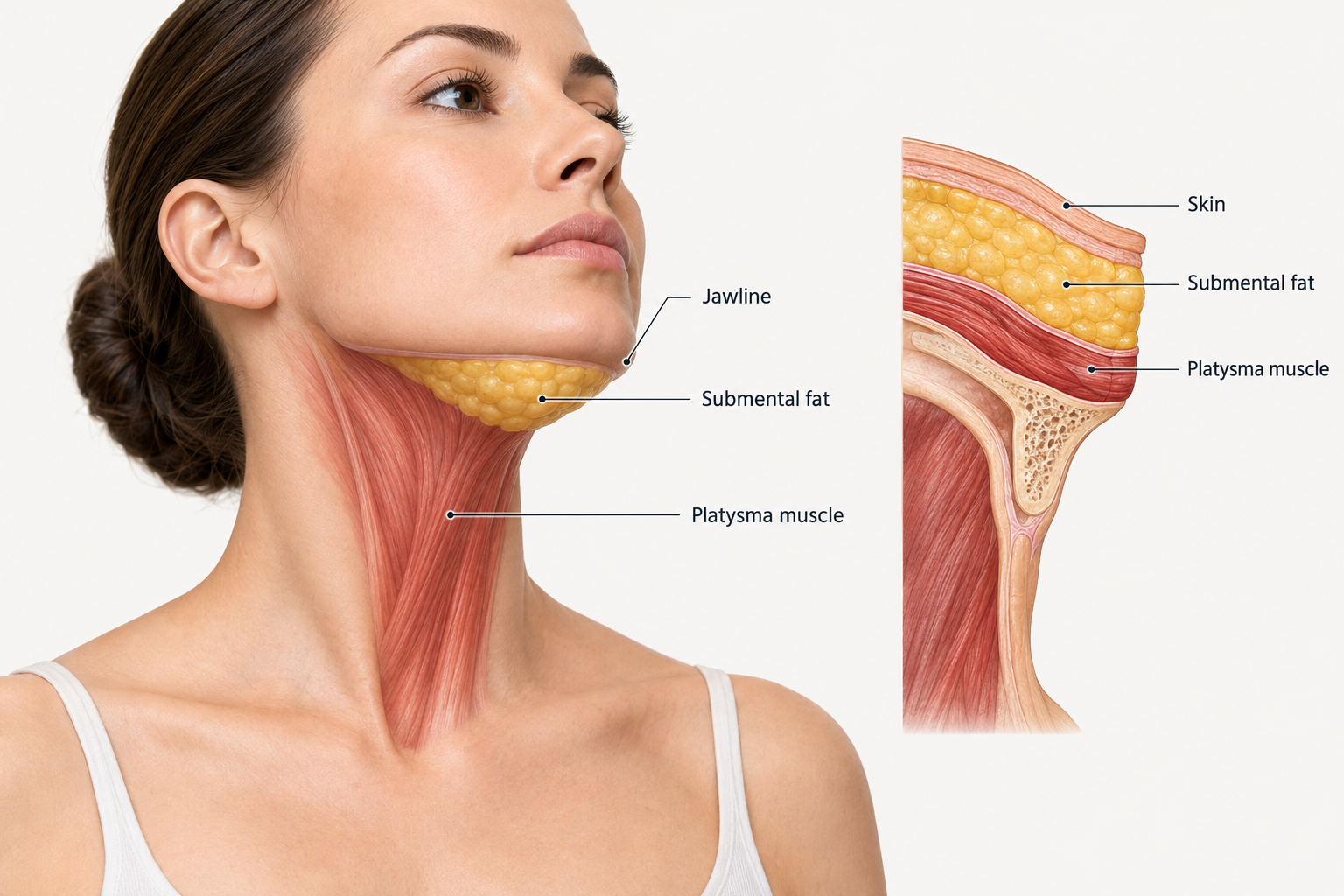

Neck fat — whether it appears as a double chin, submental fullness, or general thickness around the throat — is one of the most common aesthetic concerns patients raise in clinic. It can be frustrating precisely because it often resists the usual approaches: people lose weight elsewhere but find the neck stubbornly unchanged. This guide explains why neck fat forms, what you can realistically do about it through lifestyle changes, and when professional treatment may be worth considering.
Key Takeaways
- Neck fat is usually subcutaneous fat beneath the chin and jaw, but puffiness from water retention can mimic it and responds quickly to dietary changes.
- Spot reduction — burning fat from one specific area through targeted exercise — is not supported by strong evidence; overall body fat reduction is the primary driver of neck fat loss.
- Targeted neck exercises tone the platysma and surrounding muscles, improving definition, but they do not directly burn local fat.
- Non-surgical treatments such as deoxycholic acid injections (Kybella) and cryolipolysis (CoolSculpting) can reduce submental fat, but results vary and multiple sessions are usually required.
- Persistent or rapidly growing neck fat should be assessed by a doctor to rule out thyroid dysfunction, Cushing's syndrome, or medication side effects before pursuing cosmetic treatment.
Why Does Neck Fat Form?
Understanding the cause of neck fat matters because the right approach depends on what is actually driving it. Several distinct factors can contribute, and they sometimes overlap.
Overall Weight Gain and Body Composition
The most common cause is general weight gain. As overall body fat percentage rises, fat accumulates across the body — including beneath the chin and around the neck. Genetics largely determine where fat is stored first and lost last, which is why some people develop submental fullness even at a relatively healthy weight while others carry significant body fat without noticeable neck changes. There is no way to override this genetic fat distribution pattern through exercise alone.
Aging, Collagen Loss, and Skin Laxity
As the body ages, collagen production slows and skin elasticity declines. The skin beneath the chin and along the jawline becomes less firm, which can make even a modest amount of subcutaneous fat appear more prominent. Skin laxity is a separate issue from fat volume — a treatment that reduces fat without addressing loose skin may produce a less defined result than expected, which is why a thorough clinical assessment matters before choosing any intervention.
Forward Head Posture and Tech Neck
Poor posture — particularly the forward head posture associated with prolonged screen use, sometimes called tech neck — compresses the soft tissue beneath the chin and can make the neck appear significantly fuller than it actually is. Correcting posture by drawing the chin back, straightening the spine, and lifting the chest can produce an immediate visual improvement in neck definition without any fat loss at all. This is one of the most underappreciated quick wins for people concerned about their neck appearance.
Water Retention and Sodium Intake
Puffiness around the face and neck caused by water retention is frequently mistaken for true subcutaneous fat. High sodium intake, poor sleep, alcohol consumption, and hormonal fluctuations can all cause temporary fluid retention that adds visible fullness to the neck and jaw area. Unlike actual fat, this type of puffiness can resolve within days when sodium intake is reduced, hydration is improved, and sleep quality is addressed. Distinguishing between water retention and genuine fat accumulation is important before pursuing any treatment.
Hormonal Changes and Medical Causes
Hormonal shifts — including those associated with menopause, thyroid dysfunction, elevated cortisol, and insulin resistance — can alter fat distribution and promote accumulation in the upper body and neck region. Women going through menopause often notice fat redistributing toward the face, neck, and abdomen. A specific pattern of fat accumulation at the back of the neck, sometimes called a buffalo hump, can be associated with Cushing's syndrome or prolonged corticosteroid use and warrants medical evaluation rather than cosmetic treatment. If neck fat has appeared or grown rapidly, or is accompanied by other symptoms, a GP assessment should come before any aesthetic intervention.
The Spot Reduction Myth — and What the Evidence Actually Shows
The idea that exercising a specific body part burns fat in that area — known as spot reduction — is not supported by the current body of evidence. When the body burns fat for energy, it draws from fat stores systemically; the location of the exercise does not determine where fat is mobilized. This means that performing neck and chin exercises will not directly reduce the fat layer beneath the chin, regardless of how consistently they are done.
That said, the picture is not entirely black and white. Some research suggests that regional blood flow and lipolytic activity may be modestly elevated near actively contracting muscles, but the effect is too small to produce meaningful localized fat loss in practice. The practical conclusion is straightforward: neck exercises are valuable for toning the platysma muscle and improving muscular definition, but they need to be combined with a consistent calorie deficit and overall fat loss to produce visible changes in neck fat volume.
Targeted Neck Exercises: What They Can and Cannot Do
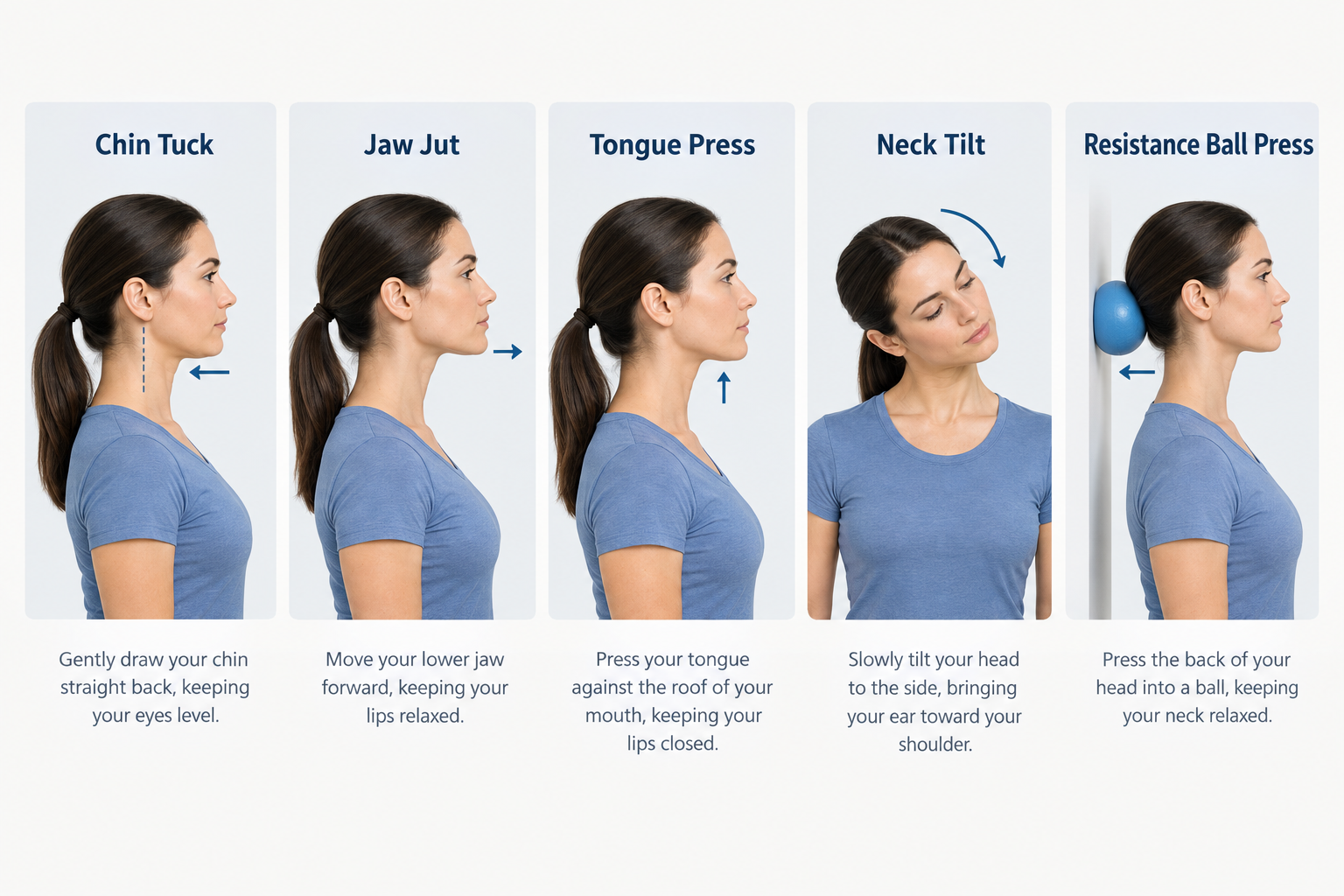
Neck exercises strengthen and tone the platysma, sternocleidomastoid, and surrounding muscles. A more toned muscular foundation can improve the appearance of the neck and jawline definition, even before significant fat loss occurs. The following exercises are commonly recommended and are generally safe for most adults, though anyone with neck pain, cervical spine problems, or recent injury should seek medical clearance first.
Chin Tuck
Sit or stand with your spine straight. Gently draw your chin straight back — as if making a double chin deliberately — without tilting your head up or down. Hold for three to five seconds, then release. Repeat ten times. This exercise targets the deep neck flexors and also helps counteract forward head posture.
Jaw Jut and Chin Lift
Tilt your head back slowly until you are looking at the ceiling. Push your lower jaw forward until you feel a stretch along the front of the neck and beneath the chin. Hold for five to ten seconds, then return to neutral. Perform eight to ten repetitions. Avoid forcing the head into extreme extension, particularly if you have any history of neck problems.
Tongue Press
Press your tongue firmly against the roof of your mouth. Then tilt your chin down toward your chest while keeping the tongue pressed upward. You should feel engagement in the muscles beneath the chin. Hold for three seconds and repeat ten times. This exercise targets the suprahyoid muscles that run beneath the jaw.
Neck Tilts and Rotations
Slowly tilt your head to one side, bringing your ear toward your shoulder without raising the shoulder. Hold for five seconds, then repeat on the other side. Follow with slow, controlled neck rotations — turning the head from side to side through a comfortable range. These movements engage the sternocleidomastoid and trapezius muscles and help maintain neck mobility alongside strengthening work.
Resistance Ball Press
Place a small soft ball or folded towel beneath your chin. Press your chin down firmly against the resistance for three seconds, then release. Repeat fifteen times. This provides direct resistance training for the platysma and submental muscles and is a useful progression once basic exercises feel easy.
Safety note: Stop any neck exercise immediately if you experience dizziness, sharp pain, tingling, or numbness. Perform all movements slowly and within a comfortable range. Avoid rapid or forceful movements, particularly into end-range extension.
Diet and Nutrition for Neck Fat Reduction
Because overall fat loss is the primary mechanism for reducing neck fat, diet plays a central role. A consistent calorie deficit — typically around 300 to 500 calories below daily energy expenditure — creates the conditions for gradual, sustainable fat loss across the body, including the neck region over time.
Foods That Support Fat Loss
- Lean protein (chicken, fish, eggs, tofu, legumes) — supports muscle retention during a calorie deficit and promotes satiety.
- Fibre-rich vegetables and whole grains — slow digestion, stabilise blood sugar, and reduce overall calorie intake naturally.
- Healthy fats (avocado, nuts, olive oil) — support hormonal balance and reduce inflammation when consumed in appropriate portions.
- Water — adequate hydration supports metabolism and can reduce water retention that contributes to facial and neck puffiness.
Foods and Habits to Reduce
- High-sodium foods — processed meats, canned foods, fast food, and salty snacks promote water retention and temporary neck and facial puffiness.
- Refined carbohydrates and sugary beverages — contribute to calorie surplus and blood sugar spikes that promote fat storage.
- Alcohol — calorie-dense, promotes water retention, disrupts sleep, and elevates cortisol.
- Ultra-processed foods — typically high in calories, sodium, and refined fats with low nutritional value.
Reducing sodium intake specifically can produce a noticeable reduction in neck and facial puffiness within a few days, which is worth doing early to establish a clearer baseline before assessing whether true fat reduction is needed.
Cardiovascular Exercise, Strength Training, and Lifestyle
Cardiovascular exercise — whether steady-state cardio such as brisk walking, cycling, or swimming, or higher-intensity formats such as HIIT — increases total energy expenditure and supports the calorie deficit needed for overall body fat reduction. There is no single superior cardio format for neck fat specifically; the most effective approach is whichever one a person will sustain consistently over weeks and months.
Resistance training preserves and builds lean muscle mass during a calorie deficit, which helps maintain metabolic rate and improves body composition over time. A combination of cardiovascular exercise and resistance training generally produces better fat loss outcomes than either approach alone.
Sleep, Stress, and Cortisol
Poor sleep quality and chronic stress both elevate cortisol, a hormone that promotes fat storage — particularly in the upper body and abdominal region. Consistently achieving seven to nine hours of sleep per night and managing stress through appropriate means (exercise, mindfulness, reducing workload where possible) supports healthy cortisol levels and reduces one of the less obvious drivers of fat accumulation around the neck and face.
Posture Correction
Actively working on posture — keeping the spine straight, shoulders back and down, and the chin level rather than jutting forward — can make the neck appear visibly slimmer almost immediately. Over time, improved posture also reduces the compression of soft tissue beneath the chin that forward head posture creates. Simple reminders such as adjusting screen height, using a supportive chair, and performing regular chin tucks throughout the day can make a meaningful difference.
Non-Surgical Treatment Options for Neck Fat
When lifestyle changes produce insufficient results, or when submental fat is primarily genetic and resistant to diet and exercise, several non-surgical treatment options may be appropriate. These are best discussed with a qualified aesthetic practitioner or doctor who can assess the specific anatomy, skin quality, and realistic expectations.
Deoxycholic Acid Injections (Kybella)
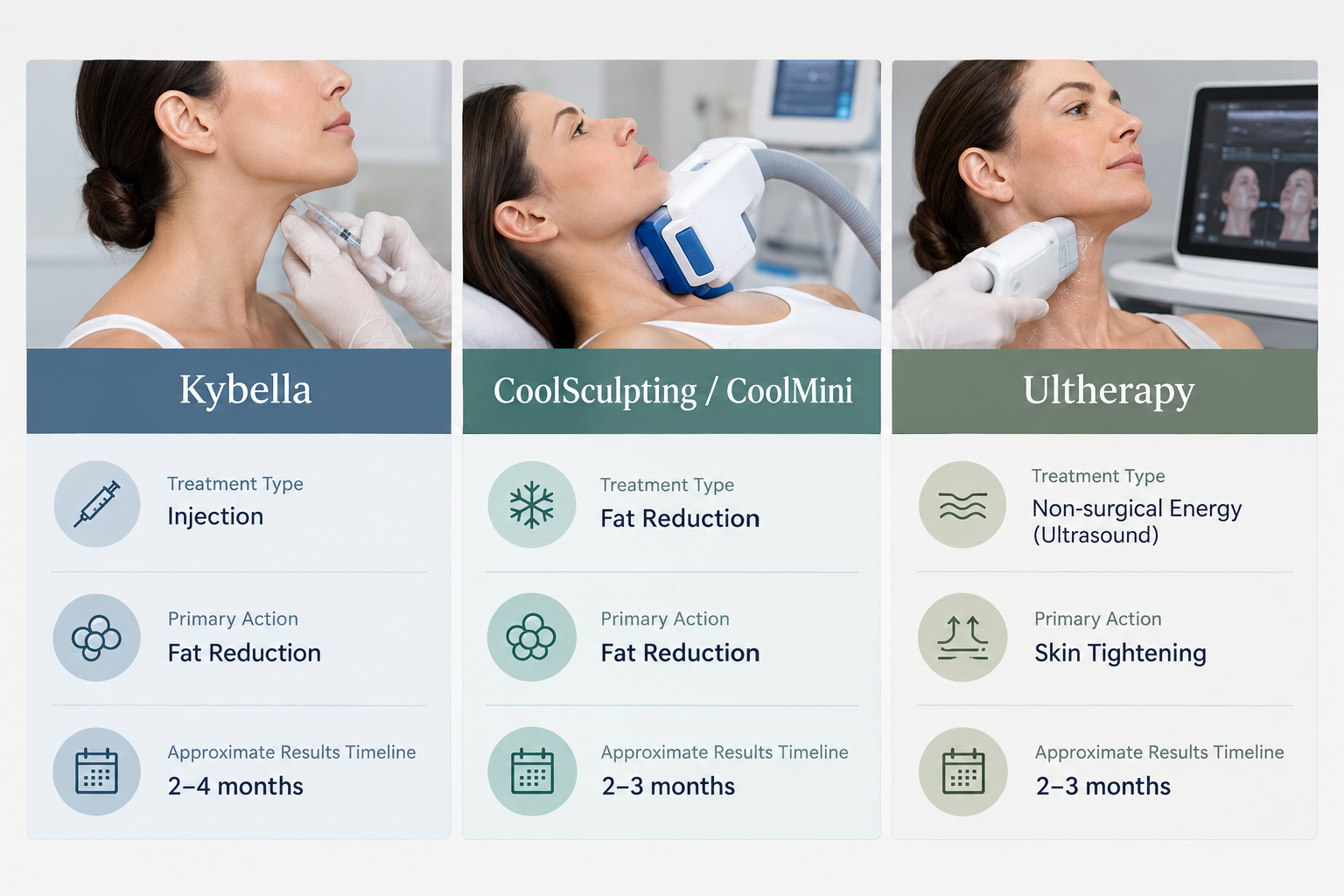
Kybella contains deoxycholic acid, a naturally occurring molecule that disrupts and destroys fat cell membranes. When injected into submental fat, it causes permanent destruction of fat cells in the treated area. The treatment is administered in a series of sessions — typically two to four, spaced at least four weeks apart — and results develop gradually over several months as the body clears the destroyed fat cells. Common side effects include swelling, bruising, numbness, and temporary firmness beneath the chin. Swelling can be significant after each session. Kybella is not suitable for people with infection in the treatment area, certain anatomical considerations, or those who are pregnant or breastfeeding. A thorough consultation is essential to assess suitability.
CoolSculpting and CoolMini
CoolSculpting uses controlled cooling (cryolipolysis) to freeze and gradually eliminate subcutaneous fat cells without damaging the overlying skin. The CoolMini applicator is specifically designed for the smaller contours of the submental area. Results typically become visible over two to three months as the body processes the treated fat cells, and some patients require more than one session. Side effects include temporary redness, bruising, numbness, and sensitivity. A rare but recognised complication called paradoxical adipose hyperplasia — where the treated area enlarges rather than reduces — has been reported and should be discussed during consultation.
Ultherapy (Micro-Focused Ultrasound)
Ultherapy uses micro-focused ultrasound energy to stimulate collagen production in the deeper layers of the skin and underlying tissue. It is primarily a skin-tightening treatment rather than a fat reduction treatment, making it more appropriate for patients whose main concern is skin laxity rather than excess fat volume. It may be used alongside fat reduction treatments to address both concerns. Results develop gradually over two to three months and vary between individuals.
Realistic Expectations and Timelines
| Approach | Typical Visible Results Timeline | Sessions Required | Key Limitation |
|---|---|---|---|
| Diet and cardio | 4–8 weeks of consistency | Ongoing lifestyle | Genetics determine fat loss order |
| Neck exercises | 4–8 weeks for muscle tone | Daily or near-daily | Do not directly burn local fat |
| Deoxycholic acid (Kybella) | 2–4 months after final session | 2–4 sessions | Swelling; not suitable for all |
| CoolSculpting / CoolMini | 2–3 months per session | 1–2 sessions typically | Rare paradoxical hyperplasia risk |
| Ultherapy | 2–3 months | 1–2 sessions | Tightening only, not fat reduction |
| Neck liposuction | Weeks to months (post-swelling) | Single procedure | Surgical risks; recovery required |
Surgical Options for Neck Fat
For patients with significant submental fat volume, pronounced skin laxity, or those who have not achieved satisfactory results with non-surgical approaches, surgical options may be considered. Neck liposuction — also called submental liposuction — removes fat through small incisions using a cannula and can produce more dramatic and immediate contouring than non-surgical treatments. It is typically performed under local anaesthesia with sedation or general anaesthesia, involves a recovery period of one to two weeks for most patients, and carries the standard risks associated with surgical procedures including infection, scarring, asymmetry, and changes in skin sensation.
A neck lift (platysmaplasty or submentoplasty) addresses both excess fat and skin laxity by tightening the platysma muscle and removing redundant skin. This is a more involved surgical procedure with a longer recovery but can produce results that non-surgical treatments cannot replicate, particularly in patients with significant loose skin. Surgical options should always be discussed with a qualified plastic or cosmetic surgeon who can assess anatomy and provide realistic expectations.
When to See a Doctor First
Most neck fat is benign and related to weight, genetics, or aging. However, certain presentations warrant medical assessment before pursuing any cosmetic treatment. See a GP if neck fat has appeared or grown rapidly without a clear dietary cause, if it is accompanied by fatigue, weight gain elsewhere, cold intolerance, or changes in mood (possible thyroid dysfunction), if there is a pronounced fat pad at the back of the neck combined with weight gain, easy bruising, or stretch marks (possible Cushing's syndrome), or if you are taking corticosteroid medications long-term, which can cause fat redistribution. Addressing an underlying medical cause will always be more effective than cosmetic treatment alone.
Frequently Asked Questions
Can I lose neck fat without losing weight overall?
It is unlikely for most people. Because the body determines where fat is mobilised based on genetics and hormones rather than which muscles are being exercised, meaningful neck fat reduction generally requires overall body fat reduction. Non-surgical treatments such as deoxycholic acid injections or cryolipolysis can reduce submental fat locally without requiring significant weight loss, which makes them relevant for people who are at a healthy weight but carry genetically determined fat beneath the chin.
How long does it take to see results from diet and exercise?
With a consistent calorie deficit and regular cardiovascular exercise, most people begin to notice changes in body composition within four to eight weeks, though the neck may not be the first area to respond. Genetics influence the order in which fat is lost from different areas, so patience and consistency are essential. Visible results timeline varies considerably between individuals.
Do neck exercises actually work for reducing a double chin?
Neck exercises tone the platysma and surrounding muscles, which can improve jawline definition and the overall appearance of the neck. However, they do not directly burn the subcutaneous fat responsible for a double chin. They are a useful complement to overall fat loss efforts rather than a standalone solution for submental fat reduction.
Is the fat at the back of my neck different from a double chin?
Yes. Fat at the back of the neck — sometimes called a buffalo hump — is anatomically and clinically distinct from submental fat beneath the chin. A buffalo hump can be associated with Cushing's syndrome, prolonged corticosteroid use, or certain metabolic conditions and should be evaluated by a doctor rather than treated cosmetically without investigation.
Are non-surgical neck fat treatments permanent?
Treatments that destroy fat cells — such as deoxycholic acid injections and cryolipolysis — produce results that can be long-lasting, because destroyed fat cells do not regenerate. However, remaining fat cells can still enlarge with weight gain, so maintaining a stable weight is important for preserving results. Skin-tightening treatments such as Ultherapy stimulate collagen production, but the natural aging process continues, and maintenance treatments may be needed over time.
Is there a difference between how men and women accumulate neck fat?
There are general tendencies. Men are more likely to accumulate fat in the upper body, including the neck and abdomen, even at moderate weight gain. Women tend to store fat in the hips and thighs during reproductive years, but after menopause, fat distribution often shifts toward the upper body, face, and neck. These patterns are influenced by hormones and genetics and vary considerably between individuals.
Does chewing gum help reduce neck or jaw fat?
Chewing gum exercises the masseter muscles of the jaw and may contribute modestly to jaw muscle tone over time. It does not burn meaningful amounts of fat locally and should not be relied upon as a fat reduction strategy. Excessive gum chewing can also contribute to jaw joint discomfort in some people.
Choosing the Right Approach for Your Neck Fat Concerns
Reducing neck fat is rarely a single-step process, and the most effective approach depends on what is actually causing it. For most people, the foundation is a consistent calorie deficit, regular cardiovascular and resistance exercise, improved posture, and reduced sodium intake — changes that address the underlying drivers of fat accumulation and water retention. Targeted neck exercises add muscular tone and definition but work best as a complement to overall fat loss rather than a replacement for it.
When lifestyle changes have been genuinely consistent but submental fat persists — particularly when it appears to be genetic — non-surgical treatment options such as deoxycholic acid injections or cryolipolysis may be worth discussing with a qualified practitioner. These treatments can reduce localised submental fat without surgery, though they require multiple sessions, carry their own side effect profiles, and are not appropriate for everyone. Patients with significant skin laxity alongside fat may find that a combination approach, or a surgical consultation, produces more satisfying results than fat reduction alone.
If you are considering any professional treatment for neck fat, a thorough consultation with a qualified aesthetic doctor or practitioner is the appropriate starting point. A good consultation will assess your anatomy, skin quality, medical history, and realistic expectations before recommending any specific intervention — and will help you avoid investing in a treatment that is not well matched to your actual concern.
