


Smile lines — clinically known as nasolabial folds — are the creases that run from the sides of the nose down to the corners of the mouth. They deepen naturally with age, and while they are a normal part of facial anatomy, many people seek ways to soften or reduce them. This guide covers the full range of options, from evidence-supported skincare ingredients to injectable and energy-based treatments, so you can understand what each approach can and cannot realistically achieve before speaking with a qualified practitioner.
Key Takeaways
- Nasolabial folds form through a combination of collagen loss, facial volume loss, and repetitive facial movement — no single cause means no single fix.
- Topical ingredients such as retinoids and vitamin C can slow progression but are unlikely to significantly reduce established deep lines on their own.
- Dermal fillers, particularly hyaluronic acid filler, are currently the most widely used non-surgical treatment for moderate to deep smile lines, with results typically lasting 9–18 months.
- Combination approaches — for example, fillers alongside radiofrequency microneedling — often produce more balanced results than any single treatment.
- Realistic expectations matter: treatment can soften lines meaningfully, but complete elimination is rarely achievable or appropriate.
What Are Smile Lines and Why Do They Form?
Nasolabial folds are natural anatomical features present from birth, but they become more prominent over time. The fold itself is created by a fibromuscular structure anchoring the skin to deeper facial tissue. As the face ages, several overlapping processes cause this crease to deepen. Collagen production declines from the mid-twenties onward, reducing the skin's structural support. Elastin fibres weaken, causing a gradual loss of skin elasticity. Subcutaneous fat in the cheeks diminishes and descends, removing the volume that once kept the midface lifted. Gravity compounds this descent, and the skin above the fold begins to drape rather than sit taut.
Repetitive facial expressions — smiling, laughing, talking — etch dynamic movement into the skin over decades. Initially these are dynamic lines, visible only during expression. Over time, as collagen and elastin decline, they become static lines that remain visible even at rest. Sun exposure accelerates this process through photoaging, breaking down collagen and elastin faster than the skin can replace them. Smoking, dehydration, rapid weight fluctuation, and genetics all influence how early and how deeply nasolabial folds develop.
Which Treatments Can Actually Help?
The appropriate treatment depends on the depth of the fold, the underlying cause, and the patient's goals. A useful way to think about options is as a treatment ladder, moving from lower-intensity approaches suitable for mild lines to more involved procedures for deeper folds.
Topical Skincare: What It Can and Cannot Do
Topical treatments are most effective as prevention and for maintaining results achieved through clinical procedures. Retinoids — including over-the-counter retinol and prescription tretinoin — are the most evidence-supported topical ingredients for stimulating collagen production and improving skin texture. Regular use over several months may produce a modest softening of fine lines, but retinoids are unlikely to significantly reduce established moderate or deep nasolabial folds. They remain a valuable part of any long-term skin health strategy.
Vitamin C serum supports collagen synthesis and provides antioxidant protection against photoaging. Peptide serums may offer mild collagen-stimulating effects, though the evidence for specific peptide formulations is less robust than for retinoids. Hyaluronic acid-based moisturisers improve surface hydration and can temporarily plump the skin's appearance, but they do not replace lost volume in the deeper tissue layers. Broad-spectrum sunscreen with an SPF of 30 or higher is arguably the most important daily habit for slowing the progression of smile lines, as UV damage is one of the primary drivers of premature collagen breakdown.
Facial Exercises
Facial exercises and face yoga are frequently suggested as natural remedies for smile lines. The theory is that strengthening the underlying muscles may provide some lift to the overlying skin. Evidence supporting facial exercises as a meaningful treatment for nasolabial folds is limited, and some practitioners caution that repetitive muscle contraction could theoretically reinforce dynamic creasing over time. Facial exercises are unlikely to cause harm, but patients should not expect significant fold reduction from this approach alone.
Dermal Fillers: The Most Common Non-Surgical Treatment
Dermal fillers are the most widely used non-surgical treatment for smile lines and are considered the standard of care for moderate to deep nasolabial folds. Hyaluronic acid filler — available under brand names including Juvéderm, Restylane, and Belotero — works by adding volume directly beneath the fold, lifting the crease from below. Results are visible immediately after treatment and typically last between 9 and 18 months depending on the product used, the volume injected, and individual metabolism.
Calcium hydroxylapatite fillers, such as Radiesse, provide both immediate volume and a degree of collagen stimulation, with results that may last 12–18 months. Poly-L-lactic acid (PLLA) products such as Sculptra work differently: they act as biostimulators, gradually triggering the body's own collagen production over several months rather than providing immediate volume. Sculptra typically requires a series of sessions and produces results that may last up to two years. The choice between filler types depends on the degree of volume loss, the patient's anatomy, and the injector's clinical assessment.
Hyaluronic acid fillers carry an important safety advantage: they can be dissolved with hyaluronidase if the result is unsatisfactory or if a complication occurs. This reversibility makes HA fillers a preferred starting point for many patients. Risks associated with dermal fillers include bruising, swelling, asymmetry, nodule formation, and — in rare but serious cases — vascular occlusion. Treatment should only be performed by a board-certified provider or qualified injector with appropriate training in facial anatomy and complication management.
Botulinum Toxin for Smile Lines
Botulinum toxin (commonly known by the brand name Botox) is less commonly used as a primary treatment for nasolabial folds than dermal fillers, because smile lines are largely caused by volume loss and skin laxity rather than muscle overactivity alone. However, botulinum toxin may be used in specific cases — for example, to relax the levator labii muscles that contribute to fold depth during expression, or to address perioral lines around the mouth. It is often used as part of a combination approach rather than as a standalone treatment for this area. Results typically last three to four months.
Energy-Based and Collagen-Stimulating Treatments
Several in-clinic technologies address smile lines by stimulating collagen production and improving skin tightening rather than adding volume directly.
Microneedling (collagen induction therapy) uses fine needles to create controlled micro-injuries in the skin, triggering a healing response that increases collagen and elastin production. A course of three to six sessions is typically recommended, with gradual improvement over several months. Microneedling is better suited to improving skin quality and mild surface lines than to correcting significant volume loss.
Radiofrequency microneedling — delivered by devices such as Morpheus8, Potenza, and Secret RF — combines microneedling with radiofrequency energy to heat the deeper dermis and stimulate more substantial collagen remodelling. This approach may produce more noticeable skin tightening than standard microneedling and can be useful for patients with mild to moderate skin laxity alongside their nasolabial folds.
Ultherapy and HIFU (high-intensity focused ultrasound) deliver focused ultrasound energy to the deeper structural layers of the skin, stimulating collagen production and providing a degree of lift. Results develop gradually over two to three months and may last 12–18 months. Ultherapy is generally better suited to skin laxity and mild sagging than to deep static folds.
Laser skin resurfacing — including fractional CO2 and erbium lasers — removes damaged outer skin layers and stimulates collagen remodelling. Laser treatments can improve skin texture, fine lines, and mild nasolabial folds, but they involve more downtime than most other non-surgical options and are less effective for deep volume-related folds.
Chemical peels, including TCA peels, improve surface skin quality and may soften fine perioral lines, but they do not address the underlying volume loss that drives deeper nasolabial folds.
PDO thread lifts use dissolvable threads inserted beneath the skin to mechanically lift tissue and stimulate collagen production. Threads may provide a modest lift to the cheek and nasolabial area, with results lasting approximately 12–18 months. They are generally considered most appropriate for mild to moderate laxity and are often combined with fillers for a more comprehensive result.
Surgical Options
For patients with significant skin laxity, deep nasolabial folds, and descended facial fat, surgical options may produce more durable results than non-surgical treatments. A mini facelift or full facelift repositions the underlying facial tissues and removes excess skin, addressing the structural causes of deep folds rather than simply filling them. Fat grafting (lipofilling) transfers the patient's own fat to restore lost facial volume, with results that may be long-lasting once the transferred fat establishes a blood supply. Surgical options involve anaesthesia, recovery time, and greater procedural risk, and are typically considered when non-surgical approaches are no longer sufficient.
Matching Treatment to Severity
Choosing the right approach depends on how pronounced the nasolabial folds are. The following framework reflects general clinical thinking, though individual assessment by a qualified practitioner is always necessary.
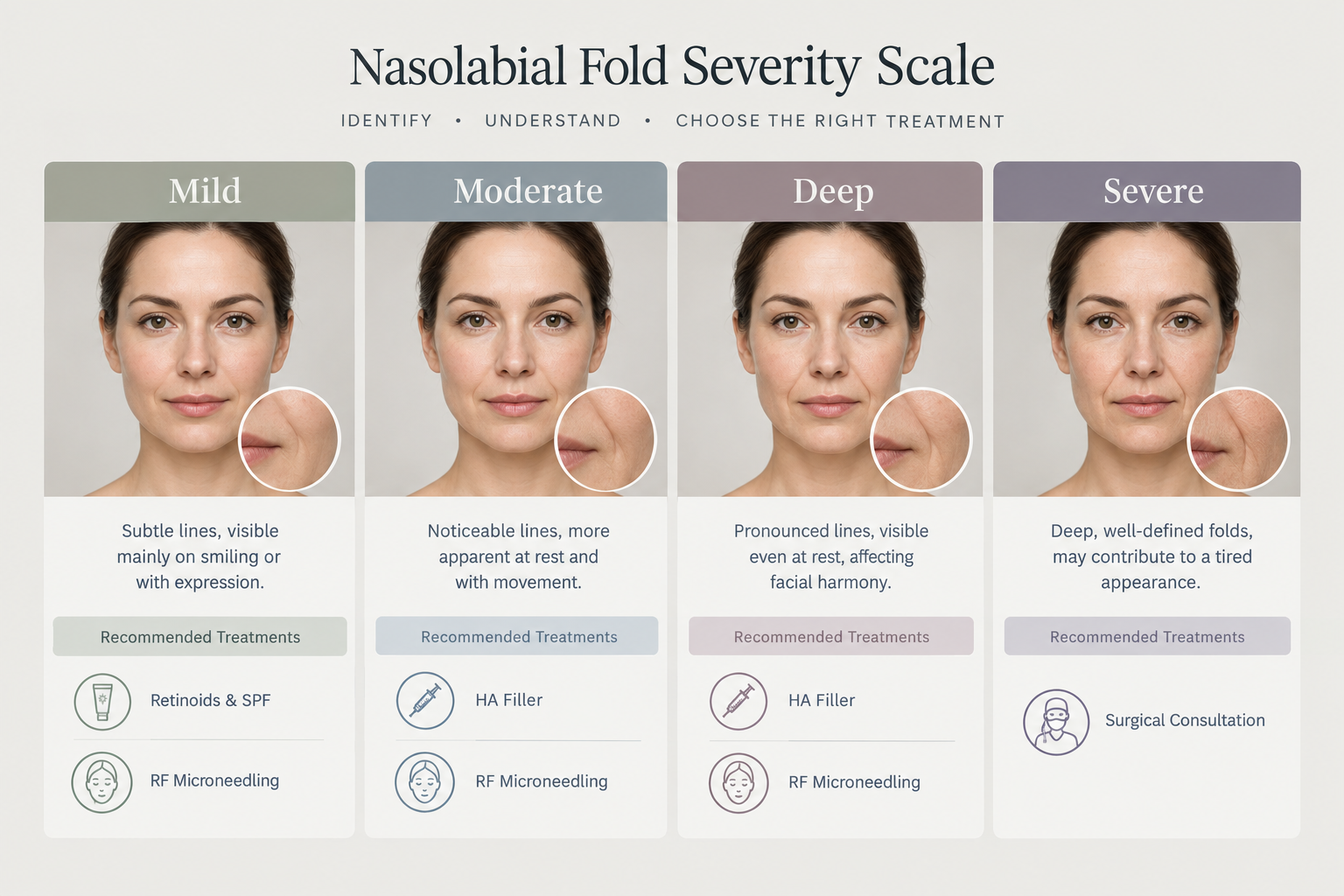
| Severity | Description | Commonly Considered Treatments |
|---|---|---|
| Mild | Visible mainly during expression; minimal at rest | Retinoids, SPF, vitamin C, skin boosters, light microneedling |
| Moderate | Visible at rest; moderate depth | Hyaluronic acid filler, RF microneedling, Ultherapy, PDO threads |
| Deep | Prominent at rest; significant fold depth | HA or Radiesse filler, Sculptra series, combination approaches |
| Severe / with laxity | Deep folds with significant skin sagging | Combination non-surgical or surgical consultation (facelift, fat grafting) |
The Case for Combination Treatment
One of the most clinically meaningful insights that is often underrepresented in patient-facing information is that combining treatments frequently produces better outcomes than any single approach. For example, a patient with moderate nasolabial folds and mild skin laxity might benefit from hyaluronic acid filler to restore volume in the fold itself, combined with radiofrequency microneedling to improve the surrounding skin quality and tighten the overlying tissue. This addresses both the structural volume deficit and the skin quality component simultaneously.
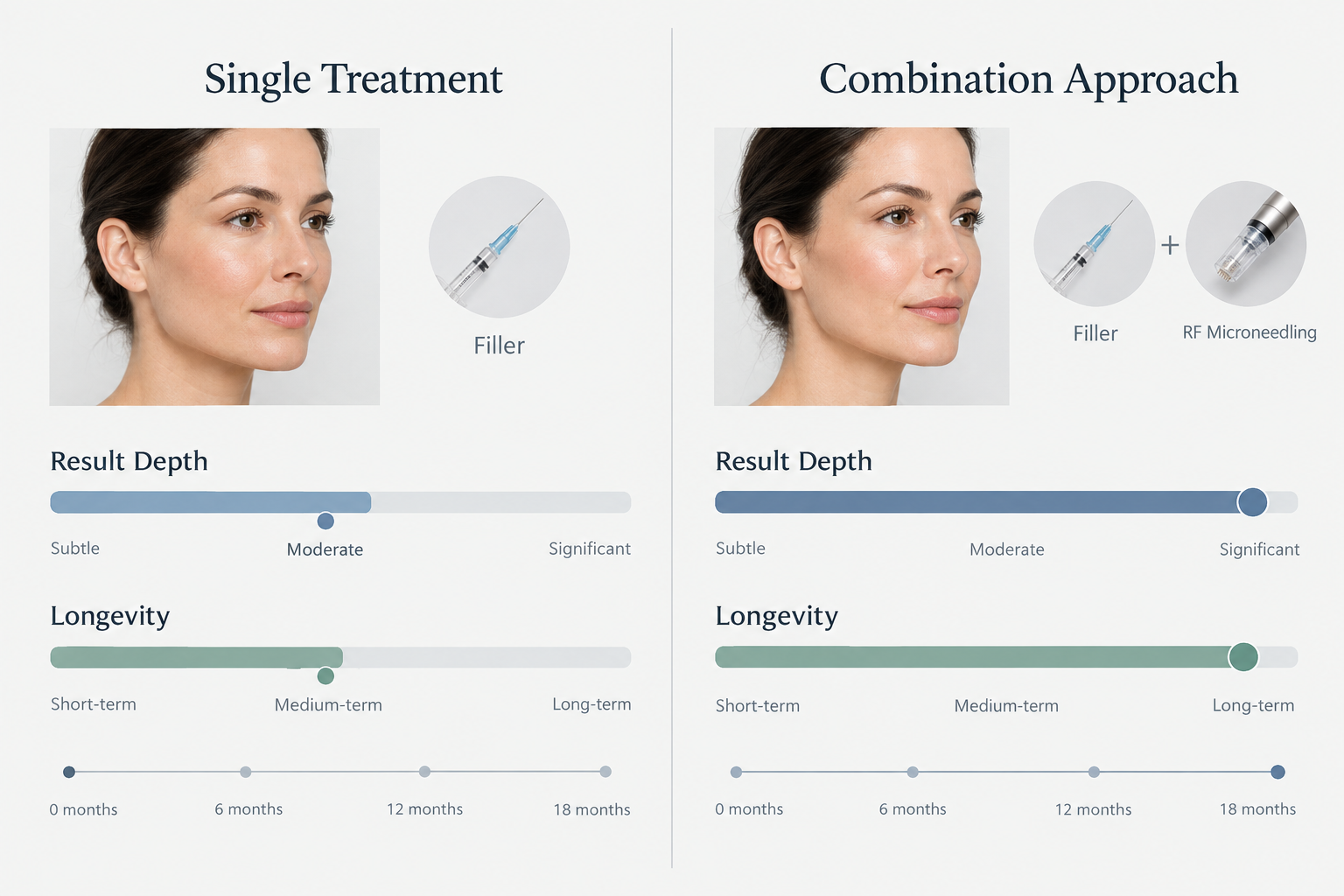
Similarly, a patient with deeper folds and early cheek descent might combine a biostimulator such as Sculptra — to gradually rebuild collagen in the midface — with a course of RF microneedling for skin tightening. The combination approach requires careful planning by an experienced injector and may involve staged treatments over several months, but it can produce more natural-looking results than high-volume filler placement alone. Discussing combination strategies during a thorough consultation is worthwhile for anyone with moderate to significant concerns.
Maintaining Results Over Time
Most non-surgical treatments for smile lines are not permanent. Hyaluronic acid fillers typically require touch-up appointments every 9 to 18 months to maintain the result. Proactive maintenance — returning for a smaller top-up volume before the filler has fully metabolised — is generally more cost-effective and produces more consistent results than waiting until the fold has fully returned and starting again from scratch. RF microneedling and energy-based treatments may benefit from annual maintenance sessions to sustain collagen remodelling.
A useful way to consider the cost of filler treatment is to spread it across the months of benefit it provides. A treatment costing £800–£1,200 that lasts 12 months represents approximately £70–£100 per month of maintained improvement — a framing that many patients find helpful when weighing the investment against other options.
Who May Not Be Suitable for Injectable Treatments
Not everyone is an appropriate candidate for dermal fillers or botulinum toxin. Contraindications and cautions include pregnancy and breastfeeding, active skin infection or inflammation in the treatment area, certain autoimmune conditions, use of blood-thinning medications (which increase bruising risk), known allergy to filler components, and a history of severe allergic reactions. Patients with certain neurological conditions may not be suitable for botulinum toxin. A thorough medical history review before any injectable treatment is essential, and a reputable board-certified provider will always conduct this assessment before proceeding.
How to Prevent Smile Lines from Deepening
Prevention is most effective when started early. Daily application of broad-spectrum sunscreen is the single most impactful habit for slowing photoaging-related collagen breakdown. Incorporating a retinoid into an evening skincare routine from the mid-twenties onward supports ongoing collagen production before significant loss has occurred. Staying well hydrated, maintaining a stable weight, avoiding smoking, and eating an antioxidant-rich diet all contribute to slower skin ageing.
Sleep position is a less-discussed but relevant factor. Sleeping consistently on one side can compress the face and reinforce creasing over time. Sleeping on the back or using a silk or satin pillowcase — which creates less friction against the skin — may help reduce this mechanical contribution to line formation. These are small habits, but they compound meaningfully over years.
Frequently Asked Questions
Can smile lines go away on their own?
Mild dynamic smile lines that appear only during expression may become less noticeable with improved hydration and skin quality, but established static nasolabial folds visible at rest do not resolve without treatment. The structural changes — collagen loss, fat descent, skin laxity — do not reverse naturally.
Why are my smile lines so deep at a relatively young age?
Genetics play a significant role in how early and how deeply nasolabial folds develop. Sun exposure, smoking, significant weight loss, and naturally thinner facial fat can all cause deeper folds to appear earlier than average. Some people have a naturally more prominent nasolabial fold structure regardless of age.
Why do my smile lines look darker or discoloured?
Shadowing from the fold depth itself is the most common reason nasolabial folds appear darker. The crease creates a shadow that reads as a darker line, particularly in certain lighting. In some cases, post-inflammatory pigmentation or uneven melanin distribution in the skin can contribute. A dermatologist or aesthetic practitioner can assess whether the appearance is structural or pigmentary and recommend the appropriate approach.
How long do fillers for smile lines last?
Hyaluronic acid fillers in the nasolabial area typically last 9 to 18 months, depending on the specific product, the volume used, and individual metabolism. Calcium hydroxylapatite fillers may last 12 to 18 months. Poly-L-lactic acid biostimulators can produce results lasting up to two years following a course of sessions.
Can filler be reversed if I don't like the result?
Hyaluronic acid fillers can be dissolved using an enzyme called hyaluronidase, which breaks down the filler material relatively quickly. This reversibility is one reason HA fillers are often recommended for patients new to injectable treatment. Non-HA fillers such as Radiesse and Sculptra are not reversible in the same way, which is an important consideration when choosing a product.
At what age should I start treating smile lines?
There is no universal answer. Preventive skincare — retinoids, SPF, antioxidants — is appropriate from the mid-twenties. Topical treatments may be sufficient through the thirties for many people. Injectable or energy-based treatments are typically considered when lines become static and visible at rest, which varies considerably between individuals. The right time to start is when the concern is affecting quality of life and a qualified practitioner confirms that treatment is appropriate.
Choosing the Right Approach for Your Smile Lines
Smile lines are one of the most common aesthetic concerns, and the range of available treatments means there is usually a suitable option for most severity levels and budgets. Topical skincare with retinoids and broad-spectrum sunscreen forms the foundation of any long-term strategy. For mild lines, this may be sufficient alongside energy-based treatments. For moderate to deep nasolabial folds, dermal fillers — particularly hyaluronic acid filler — remain the most effective and well-evidenced non-surgical option, with the added reassurance of reversibility. Combination approaches that address both volume and skin quality tend to produce the most balanced, natural-looking results.
What treatment cannot do is equally important to understand. No non-surgical treatment eliminates deep nasolabial folds entirely, and results require ongoing maintenance. Surgical options offer more durable correction for significant laxity but carry greater procedural risk and recovery time. The best starting point is a thorough consultation with a board-certified provider who can assess your anatomy, discuss realistic outcomes, and recommend a treatment plan matched to your specific concerns and goals.
