
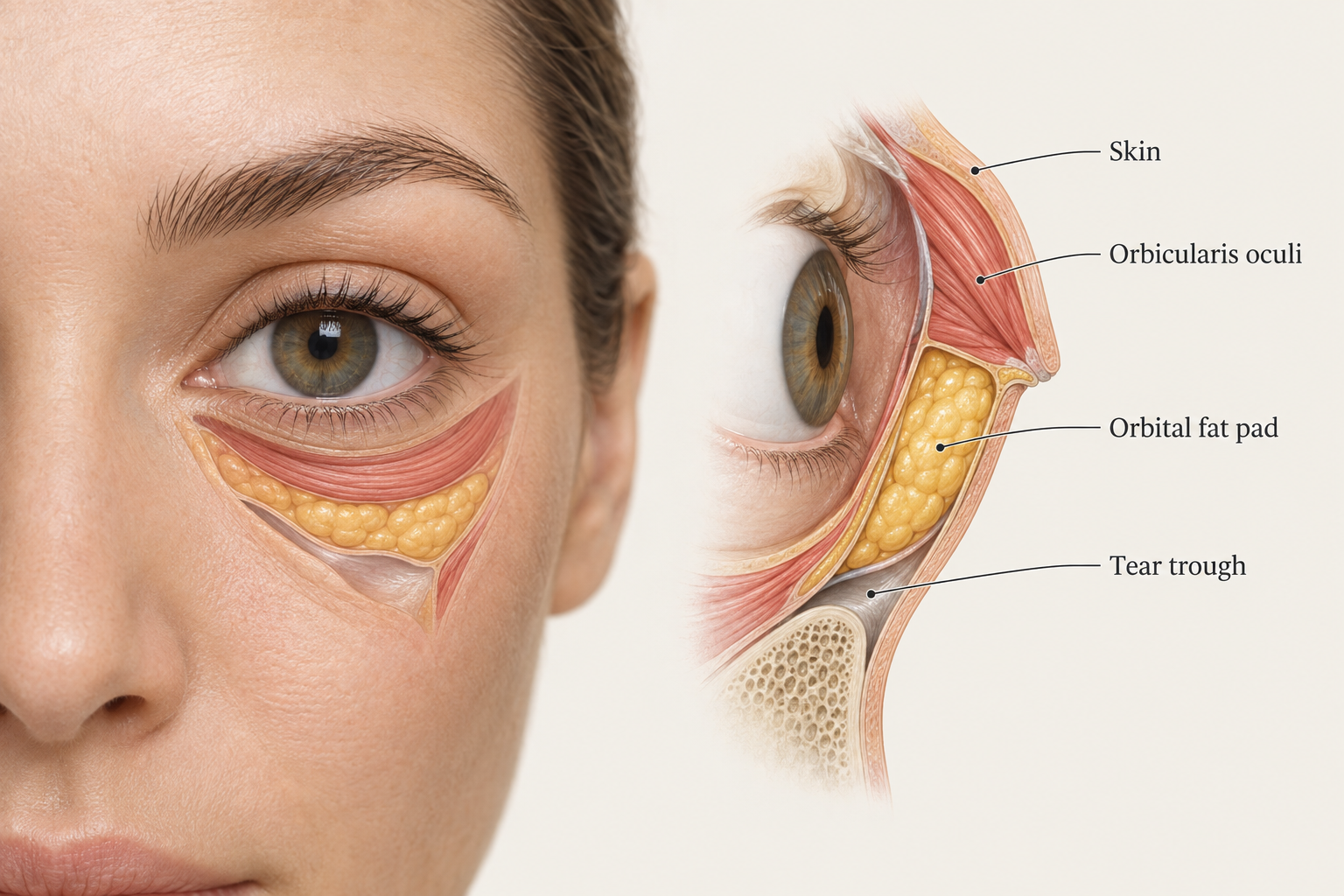

Tired-looking eyes are one of the most common aesthetic concerns brought to clinic consultations, yet the term covers several distinct problems — hollowness, dark circles, puffiness, fine lines, and skin laxity — each with different causes and different solutions. Understanding which issue is actually driving the appearance of fatigue is the most important step before choosing any treatment, because a product or procedure that works well for one cause may do very little for another.
Key Takeaways
- Tired-looking eyes are rarely caused by a single factor; hollowness, pigmentation, vascular visibility, puffiness, and skin quality each require a different approach.
- Non-surgical options — including dermal fillers, botulinum toxin, polynucleotides, and topical retinoids — can produce meaningful improvements, though results vary and maintenance is usually required.
- No single treatment corrects every under-eye concern; a thorough clinical assessment is essential before committing to any procedure.
- Lifestyle factors such as sleep, hydration, and sun protection remain relevant alongside any clinical treatment.
- Surgical options such as blepharoplasty may be more appropriate when significant skin excess or fat herniation is present.
Why Eyes Look Tired: Understanding the Causes
The under-eye area is anatomically complex, and the appearance of tiredness usually reflects changes in several overlapping structures rather than one isolated problem. Volume loss in the mid-face and under-eye fat compartments creates a hollow trough — often called a tear trough deformity — that casts a shadow and makes the eye socket appear sunken. This is one of the most common contributors to a fatigued appearance and tends to become more pronounced with age as facial fat redistributes and bone remodels.
Dark circles are frequently misunderstood. They can result from true pigmentation in the skin — more common in people with deeper skin tones — but they can also be caused by the visibility of underlying blood vessels through thin periorbital skin, or by the shadow cast by a hollow tear trough. Each of these mechanisms looks similar to the untrained eye but responds to entirely different treatments. Treating pigmentation with a filler, for example, is unlikely to produce the desired result, and vice versa.
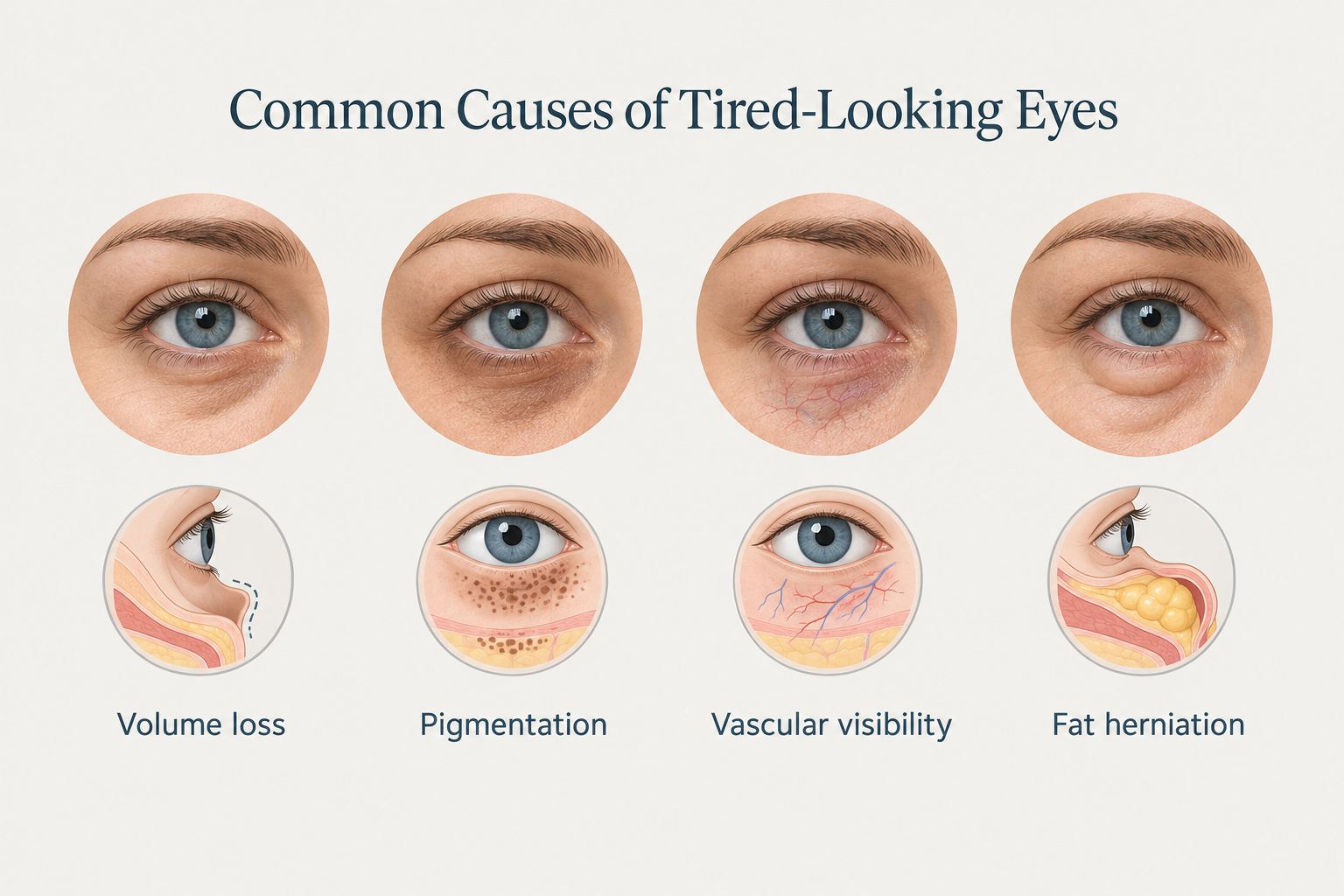
Puffiness or under-eye bags are usually caused by herniation of the orbital fat pads — small cushions of fat that sit behind the eye — through a weakened orbital septum. This is largely structural and genetic, though fluid retention, allergies, and salt intake can temporarily worsen the appearance. Fine lines and crepey skin texture in the under-eye area reflect reduced collagen density, skin thinning, and cumulative sun damage. These concerns are distinct from volume loss and respond better to treatments that target skin quality rather than structure.
Skincare Approaches for Tired-Looking Eyes
Topical skincare cannot restructure anatomy or replace lost volume, but it can meaningfully improve skin quality, reduce the appearance of fine lines, and in some cases lighten pigmentation. Retinoids — vitamin A derivatives — are among the most evidence-supported topical ingredients for stimulating collagen production and improving skin texture around the eyes, though the periorbital skin is thin and sensitive, so lower concentrations and careful introduction are advisable. Consistent use over several months is typically needed before visible improvement becomes apparent.
Vitamin C serums may help reduce melanin production and improve the appearance of pigmented dark circles when used consistently, though evidence for dramatic improvement is limited. Caffeine-containing eye creams are widely marketed for puffiness and are thought to cause temporary vasoconstriction, which may reduce the appearance of vascular dark circles and mild morning puffiness for a few hours. The effect is modest and temporary rather than corrective. Peptide-based eye creams and hyaluronic acid formulations can support skin hydration and may temporarily plump fine lines, but they do not address structural causes of tired eyes.
Sun protection is relevant to every under-eye concern. Ultraviolet exposure accelerates collagen breakdown, worsens pigmentation, and contributes to the skin thinning that makes vascular dark circles more visible. A broad-spectrum SPF applied daily — including around the eye area — is a practical and evidence-supported measure regardless of which other treatments are being considered.
Dermal Fillers for the Tear Trough and Under-Eye Hollowness
Hyaluronic acid dermal filler placed in the tear trough area is one of the most commonly performed non-surgical treatments for hollow, tired-looking eyes. Hyaluronic acid is a naturally occurring substance in the body, and when injected carefully into the tear trough, it can restore lost volume, reduce shadowing, and soften the transition between the lower eyelid and the cheek. Results are typically visible immediately and may last between nine months and two years depending on the product used, the volume placed, and individual metabolism.
Tear trough filler is technically demanding. The under-eye area has a rich vascular supply and the skin is exceptionally thin, which means that incorrect placement, excessive volume, or an unsuitable product can cause visible lumps, a bluish discolouration known as the Tyndall effect, or — in rare but serious cases — vascular complications. For this reason, tear trough filler should only be performed by a practitioner with specific training and experience in periorbital anatomy. A thorough assessment is needed to confirm that hollowness rather than fat herniation or pigmentation is the primary concern, since filler will not improve true under-eye bags and may worsen the appearance if the anatomy is not suitable.
One practical advantage of hyaluronic acid fillers is that they can be dissolved with an enzyme called hyaluronidase if the result is unsatisfactory or a complication occurs. This reversibility is an important safety consideration when treating a sensitive area like the tear trough.
Botulinum Toxin Around the Eyes
Botulinum toxin injections — commonly known by brand names such as Botox, Dysport, or Azzalure — are not typically used to treat dark circles or hollowness directly, but they can address specific contributors to a tired appearance around the eyes. Injecting small amounts of botulinum toxin into the orbicularis oculi muscle — the circular muscle surrounding the eye — can soften crow’s feet, reduce the appearance of fine lines at the outer corners, and in some cases create a subtle lifting effect at the brow tail that opens the eye area.
A technique sometimes called a lower eyelid or infraorbital botulinum toxin injection can relax the lower portion of the orbicularis oculi, which may reduce the appearance of fine lines under the eye and create a slight widening of the visible eye. This technique requires precise placement and carries a risk of temporary lower eyelid weakness if too much product is used or if it migrates, so it is not appropriate for everyone. Botulinum toxin results in this area typically last three to four months before a repeat treatment is needed.
Polynucleotides for Under-Eye Skin Quality
Polynucleotide injections — sometimes referred to by brand names such as Lumi Eyes or PDRN treatments — are a relatively newer option for improving skin quality in the periorbital area. Polynucleotides are fragments of purified DNA, typically derived from salmon or trout sperm, that are injected into the skin to stimulate fibroblast activity, promote collagen synthesis, and improve tissue hydration. In the under-eye area, the goal is to improve skin thickness, texture, and overall quality rather than to add volume.
Clinical evidence for polynucleotide treatments in the periorbital area is still developing, and most available studies are relatively small. Early results suggest that a course of treatments — typically two to four sessions spaced two to four weeks apart — may improve skin quality, reduce the appearance of fine lines, and modestly improve the appearance of dark circles caused by skin thinning and vascular visibility. Polynucleotides are not expected to correct hollowness, structural fat herniation, or deeply pigmented dark circles. They are often used alongside other treatments as part of a combined approach rather than as a standalone solution.
Energy-Based Devices and Skin Tightening
Several energy-based devices are used to address skin laxity, fine lines, and skin quality around the eyes. Radiofrequency treatments deliver controlled heat energy to the deeper layers of the skin, stimulating collagen remodelling and potentially tightening lax lower eyelid skin over a series of sessions. Results are typically gradual, appearing over two to three months as new collagen forms, and are generally more modest than surgical intervention. Radiofrequency may be suitable for patients with mild to moderate skin laxity who are not ready for or interested in surgery.
Laser resurfacing — including fractional laser treatments — can improve skin texture, reduce pigmentation, and stimulate collagen in the periorbital area. Ablative lasers produce more significant results but involve more downtime and a higher risk of side effects including prolonged redness, swelling, and in some cases changes in skin pigmentation. Non-ablative fractional lasers offer a more gradual improvement with less downtime. The suitability of laser treatments around the eyes depends on skin type, the specific concern being addressed, and the device being used; a thorough consultation is essential.
Intense pulsed light (IPL) may be used to target vascular dark circles and pigmentation, though it is generally not suitable for darker skin tones due to the risk of post-inflammatory hyperpigmentation. Microneedling with or without radiofrequency can also improve skin texture and fine lines in the periorbital area, though results in this delicate zone require careful technique and appropriate device settings.
Treating Under-Eye Puffiness and Fat Herniation
True under-eye bags caused by herniated orbital fat are primarily a structural issue and are not reliably corrected by non-surgical treatments. Temporary puffiness related to fluid retention, allergies, or lifestyle factors may respond to simple measures such as sleeping with the head slightly elevated, reducing dietary salt, managing allergies, and applying cool compresses. These measures address temporary swelling rather than structural fat herniation.
For persistent under-eye bags caused by fat herniation, surgical lower blepharoplasty — a procedure in which excess fat and sometimes skin are removed or repositioned — remains the most effective and durable option. Blepharoplasty is performed by ophthalmic or plastic surgeons and involves a recovery period of one to two weeks for most patients, with final results visible after several weeks as swelling resolves. It is not a minor procedure and carries surgical risks including scarring, asymmetry, dry eye, and in rare cases changes to eyelid position. A consultation with a qualified surgeon is needed to assess suitability.
Some practitioners offer non-surgical approaches to under-eye bags using radiofrequency or plasma devices to tighten the skin and reduce the appearance of mild fat herniation, but the evidence for these approaches is more limited and results are generally less predictable than surgery for significant structural bags.
Lifestyle Factors That Affect the Under-Eye Area
Clinical treatments work best when supported by relevant lifestyle habits. Chronic sleep deprivation causes fluid to accumulate in the periorbital tissues and reduces circulation, both of which worsen the appearance of dark circles and puffiness. Most adults require seven to nine hours of sleep per night for normal tissue recovery. Alcohol consumption causes vasodilation and fluid retention, which can temporarily worsen vascular dark circles and puffiness the following morning.
Dehydration affects skin plumpness and can make fine lines and hollowness more apparent. Adequate daily fluid intake supports skin hydration, though it does not replace lost structural volume. Smoking accelerates collagen breakdown and impairs circulation, contributing to skin thinning and a dull, fatigued appearance around the eyes over time. Rubbing the eyes — often related to allergies or contact lens use — can cause repeated trauma to the thin periorbital skin and may worsen pigmentation through post-inflammatory mechanisms.
Choosing the Right Approach: Matching Treatment to Cause
The most important principle when addressing tired-looking eyes is matching the treatment to the underlying cause. A practitioner experienced in periorbital assessment will typically evaluate the following before recommending any intervention: the depth and nature of any hollowness, the cause of dark circles (pigmentation, vascular, or shadow), the presence and degree of fat herniation, the quality and laxity of the skin, and the patient’s overall facial anatomy and medical history.
Combined approaches are common in practice. A patient with both tear trough hollowness and poor skin quality might benefit from hyaluronic acid filler to restore volume alongside a course of polynucleotide injections to improve skin texture. Someone with predominantly vascular dark circles and fine lines might be better served by a combination of topical retinoids, sun protection, and a course of energy-based treatment. There is no universal protocol, and treatments that produce excellent results in one patient may be inappropriate or ineffective in another.
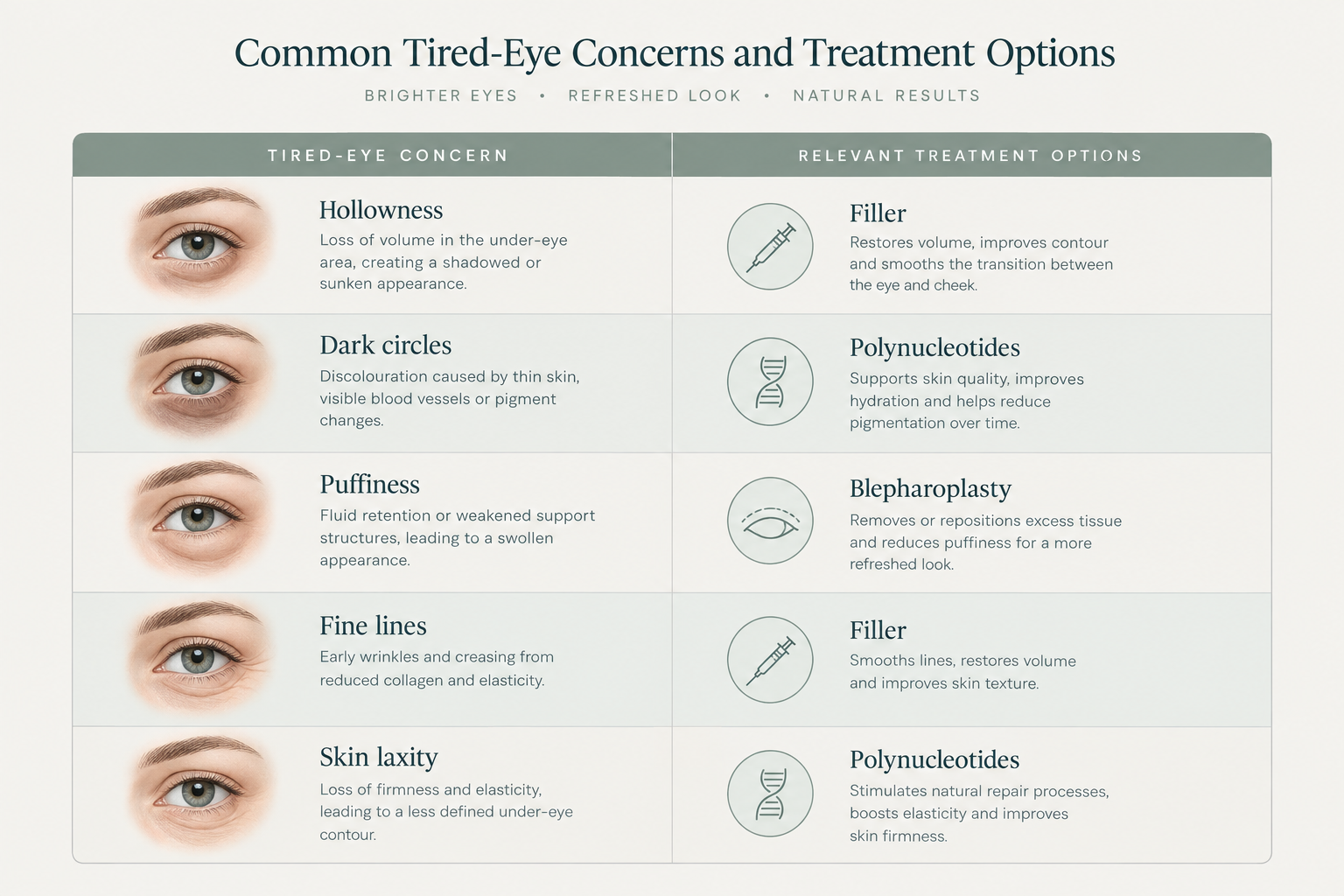
Suitability for specific treatments may be affected by medical history, current medications, skin type, previous procedures in the area, and individual anatomy. Certain conditions — including active skin infections, autoimmune conditions, blood-thinning medications, and pregnancy — may affect which treatments are appropriate. A thorough consultation with a qualified practitioner is the appropriate starting point before any procedure.
Risks and Realistic Expectations
Every treatment option for tired-looking eyes carries potential risks and limitations that should be understood before proceeding. Dermal fillers in the tear trough carry risks including bruising, swelling, lumpiness, the Tyndall effect, and — rarely — vascular occlusion, which is a serious complication requiring immediate treatment. Botulinum toxin around the eyes can cause temporary bruising, asymmetry, or eyelid weakness if not placed correctly. Energy-based treatments can cause temporary redness, swelling, and in some cases burns or pigmentation changes if settings are not appropriate for the patient’s skin type.
Realistic expectations are essential. Non-surgical treatments for tired eyes typically produce improvement rather than transformation, and results are rarely permanent. Most injectable treatments require maintenance every six to eighteen months depending on the product and individual response. Skin quality treatments such as polynucleotides or laser resurfacing may require a course of sessions and ongoing maintenance to sustain results. Patients with significant structural concerns — such as substantial fat herniation or marked skin excess — may find that non-surgical options provide limited benefit and that a surgical consultation is more appropriate.
Frequently Asked Questions
Can eye cream alone get rid of tired-looking eyes?
Eye creams can improve skin hydration, temporarily reduce puffiness, and with consistent use may modestly improve fine lines and pigmentation. They cannot correct structural hollowness, fat herniation, or significant volume loss. For most people, topical products are a useful complement to other approaches rather than a complete solution on their own.
How long does tear trough filler last?
Hyaluronic acid tear trough filler typically lasts between nine months and two years, though this varies depending on the specific product used, the volume placed, and how quickly an individual metabolises the filler. Some patients find that results in the tear trough area last longer than in other facial areas due to lower muscle activity in the region.
Are polynucleotide injections painful under the eyes?
Polynucleotide injections in the periorbital area can cause some discomfort, though topical anaesthetic cream is usually applied before treatment to reduce this. Mild swelling and bruising are common after treatment and typically resolve within a few days. Most patients find the procedure tolerable.
Will botulinum toxin help with dark circles?
Botulinum toxin does not directly treat dark circles caused by pigmentation or vascular visibility. It can soften fine lines and crow’s feet around the eyes and may create a subtle opening of the eye area, which can reduce the overall appearance of tiredness, but it is not a primary treatment for dark circles themselves.
Is surgery the only option for under-eye bags?
For significant under-eye bags caused by herniated orbital fat, lower blepharoplasty is generally the most effective and durable treatment. Mild puffiness related to fluid retention may respond to lifestyle adjustments. Some non-surgical devices may modestly improve the appearance of mild fat herniation, but evidence is more limited and results are less predictable than surgery for structural bags.
How many sessions of polynucleotides are needed for the under-eye area?
Most polynucleotide treatment protocols for the periorbital area involve two to four sessions spaced approximately two to four weeks apart, followed by maintenance treatments every six to twelve months. Individual protocols vary depending on the product used and the practitioner’s assessment of the patient’s skin.
Can tired eyes be improved without any injections?
Yes, depending on the cause. Consistent use of evidence-supported topical ingredients such as retinoids and vitamin C, combined with sun protection, adequate sleep, and hydration, can produce meaningful improvements in skin quality and mild pigmentation over time. Energy-based devices such as radiofrequency or laser treatments offer non-injectable options for skin tightening and texture improvement. However, structural concerns such as hollowness and fat herniation are unlikely to respond significantly to non-injectable approaches.
Making an Informed Decision About Tired Eye Treatments
Tired-looking eyes are a genuinely complex aesthetic concern, and the range of available treatments reflects the fact that no single approach addresses every contributing factor. The most effective outcomes tend to come from an accurate diagnosis of the underlying cause — whether that is volume loss, pigmentation, vascular visibility, skin laxity, or fat herniation — followed by a targeted treatment plan that may combine more than one approach.
Non-surgical options including hyaluronic acid tear trough filler, botulinum toxin, polynucleotide injections, and energy-based skin treatments can each produce meaningful improvements in the right candidate, but they work best when chosen for the right reason and performed by a practitioner with specific experience in periorbital anatomy. Skincare and lifestyle measures remain relevant alongside any clinical treatment and should not be overlooked. For patients with significant structural concerns, a surgical consultation may ultimately provide a more appropriate and durable solution than non-surgical alternatives.
If you are considering treatment for tired-looking eyes, a consultation with a qualified aesthetic practitioner or dermatologist is the appropriate first step. A thorough assessment of your specific anatomy, skin type, and concerns will allow a practitioner to recommend the options most likely to be safe and effective for your individual situation.
