
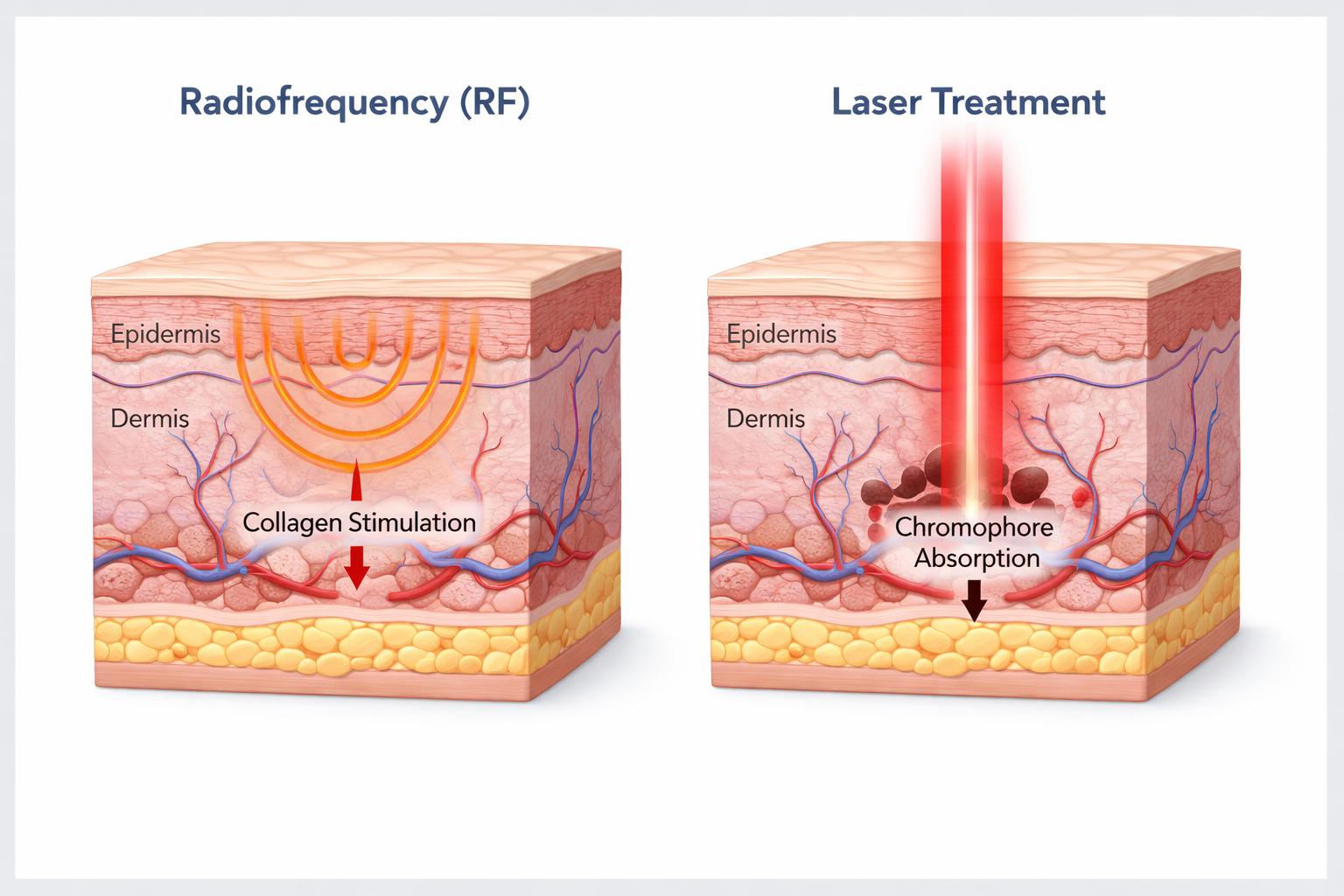

Quick Comparison
| Factor | Radiofrequency (RF) | Laser Treatment |
|---|---|---|
| Mechanism | Radiofrequency energy heats the dermis via electromagnetic waves | Light energy absorbed by chromophores (melanin, water, haemoglobin) |
| Primary target | Deeper dermal and subdermal layers | Epidermis and upper dermis (depth varies by wavelength) |
| Main concerns treated | Skin laxity, sagging skin, wrinkles, body contouring | Pigmentation, sun damage, acne scars, uneven skin tone and texture |
| Skin tone suitability | Generally suitable for all Fitzpatrick skin types | Some lasers carry higher risk for darker skin tones; device-dependent |
| Downtime | Minimal downtime; temporary redness and swelling common | Varies from minimal (non-ablative) to 1–2 weeks (ablative) |
| Results timeline | Gradual over 2–6 months as collagen remodels | Some improvement in weeks; deeper remodelling takes months |
| Longevity | 1–3 years with maintenance sessions | Variable; 1–3 years depending on device and concern |
| Approximate cost per session | £800–£3,000+ depending on area and device | £200–£2,500+ depending on laser type and area |
| Popular devices | Thermage, Morpheus8, ThermiTight | CO2, erbium, Nd:YAG, MOXI, Clear + Brilliant |
What These Treatments Actually Are
RF treatment and laser treatment are often discussed as though they are interchangeable options, but they work through fundamentally different physical principles, reach different tissue depths, and are suited to different skin concerns. Understanding the distinction matters because choosing the wrong modality for a specific goal may produce limited results, while the right choice — or a carefully planned combination — can address concerns more effectively.
Radiofrequency treatment delivers radiofrequency energy into the skin using electromagnetic waves that generate controlled heating within the dermis. This thermal energy stimulates neocollagenesis — the formation of new collagen — and triggers the remodelling of existing collagen and elastin fibres. The result is progressive tightening of loose or sagging skin over several months. RF does not depend on skin pigmentation to work, which makes it a versatile option across a broad range of skin tones.
Laser treatments work differently. They emit focused light at specific wavelengths that are absorbed by target chromophores in the skin — most commonly melanin (responsible for pigmentation) or water (present throughout skin tissue). The absorbed light converts to heat, which destroys or remodels the target tissue. Ablative lasers (such as CO2 and erbium lasers) remove the outer skin layers; non-ablative lasers deliver heat beneath the surface while leaving the epidermis largely intact. Fractional laser technology, used in devices such as MOXI and Clear + Brilliant, creates microscopic treatment zones that accelerate healing while still producing meaningful skin renewal.
How RF Treatment Works in More Detail
When radiofrequency energy passes through skin tissue, it causes the water molecules within the dermis to vibrate rapidly. This molecular friction generates controlled thermal energy that raises tissue temperature — typically targeting a range of approximately 60–70°C within the dermis. At this temperature, existing collagen fibres contract and a wound-healing cascade is initiated, prompting fibroblasts to produce new collagen and elastin over the following weeks and months. This process of dermal remodelling is what produces the gradual skin-tightening effect that RF is known for.
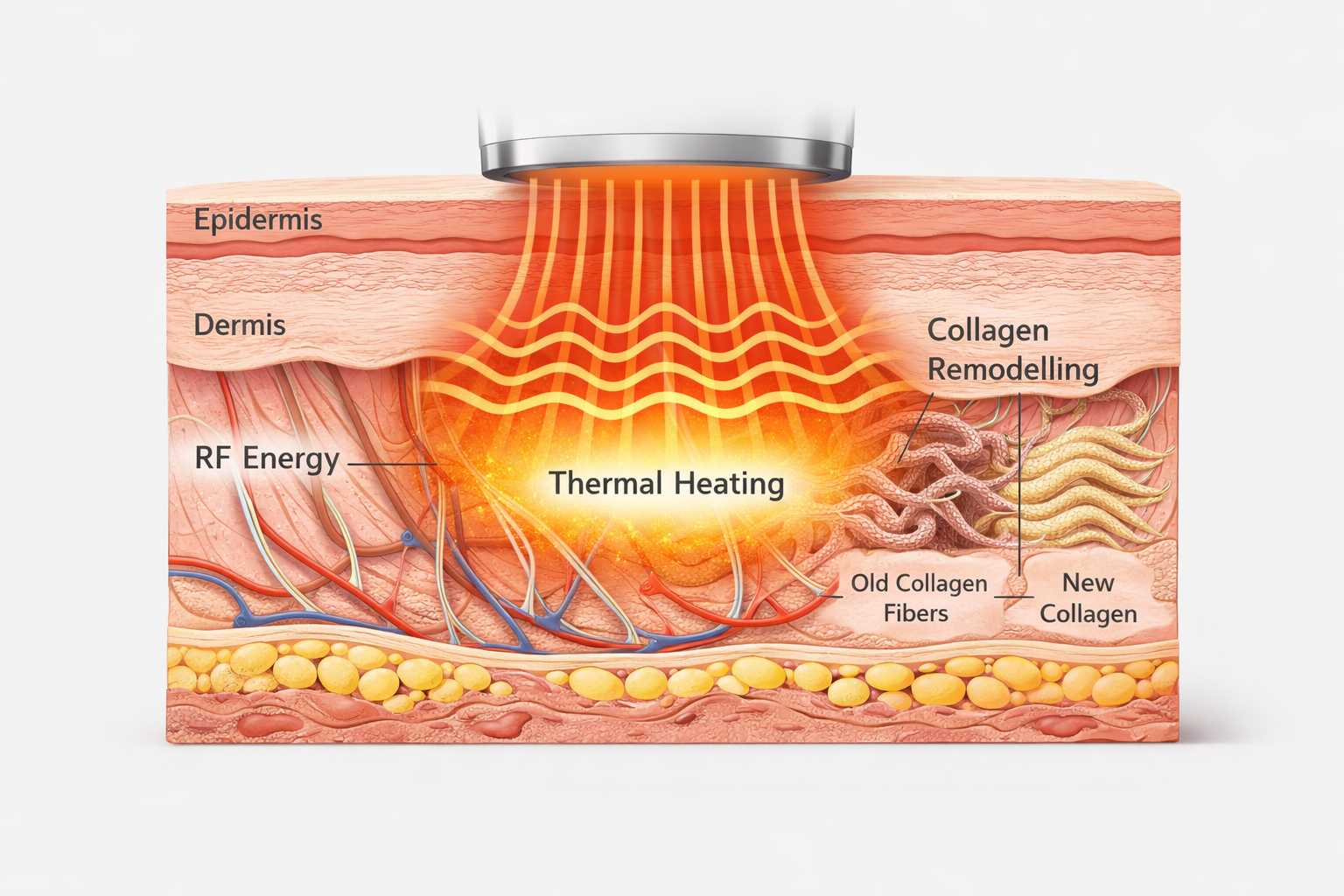
RF devices are categorised by how they deliver energy. Monopolar RF delivers energy deep into tissue using a single electrode, making it effective for deeper tightening (Thermage is a well-known monopolar device). Bipolar and tripolar RF configurations keep energy delivery more superficial and controlled. Fractional RF microneedling — used in devices such as Morpheus8 — combines fine insulated needles with radiofrequency energy, delivering heat precisely into the dermis at a selected depth while minimising surface disruption. This fractional RF microneedling approach bridges the benefits of RF skin tightening and fractional laser-like resurfacing in a single treatment.
Because RF energy targets tissue water rather than melanin, the treatment does not discriminate by skin colour. This is a significant practical advantage: patients with darker skin tones across Fitzpatrick skin types IV through VI can generally undergo RF treatment with a lower risk of the post-inflammatory hyperpigmentation (PIH) that certain laser treatments may trigger in pigment-rich skin. However, operator skill and appropriate device settings remain important safety variables regardless of skin tone.
How Laser Treatment Works in More Detail
Laser devices emit highly focused light at a specific wavelength chosen to match the absorption profile of the intended target in the skin. For pigmentation and sun damage, shorter wavelengths target melanin. For vascular concerns, wavelengths absorbed by haemoglobin are selected. For skin resurfacing and collagen stimulation, wavelengths absorbed by water — such as those used by CO2 and erbium lasers — are used to heat or remove skin layers in a controlled manner.
Ablative lasers such as CO2 and erbium lasers vaporise the surface epidermis and upper dermis, producing significant skin renewal but also requiring a recovery period of one to two weeks or more. They are effective for deeper wrinkles, pronounced acne scars, and significant sun damage, but they carry a higher risk of complications including PIH, particularly in patients with medium to darker skin tones — specifically Fitzpatrick types III to VI — if the device, settings, and operator experience are not appropriate for that skin type.
Non-ablative lasers and fractional devices such as MOXI, Clear + Brilliant, and Nd:YAG lasers cause controlled injury beneath the skin surface without removing the outer layers, resulting in considerably less downtime. Fractional technology divides the laser beam into thousands of microscopic columns, treating only a fraction of the skin surface during each session. This leaves surrounding untreated tissue intact to support faster healing, enabling multiple sessions with progressive improvement and a manageable recovery profile. Non-ablative treatments are generally better tolerated across a wider range of skin tones than fully ablative approaches, though device selection and practitioner expertise remain critical for darker complexions.
What Each Treatment Can and Cannot Address
Where RF Excels
- Skin laxity and sagging skin — RF’s ability to heat the dermis and stimulate collagen and elastin production makes it one of the most effective non-surgical approaches to loose skin on the face, neck, jawline, and body.
- Fine lines and wrinkles — progressive dermal remodelling can soften surface lines over time, particularly where reduced skin firmness is the underlying cause.
- Body contouring — certain RF devices are used on areas such as the abdomen, arms, and thighs to tighten skin following weight changes or as a complement to fat-reduction procedures.
- All skin tones — because radiofrequency energy does not target melanin, it is generally considered safer across the full range of Fitzpatrick skin types compared to many laser options.
Limitations of RF Treatment
- RF does not address pigmentation, sunspots, or vascular lesions — these require light- or laser-based approaches that target the relevant chromophore.
- RF cannot remove unwanted hair or treat tattoos.
- For deep acne scarring or significant textural irregularity, RF alone may produce more modest improvement compared to ablative laser resurfacing.
- Results are gradual — visible changes typically emerge over two to six months, which may not suit those expecting rapid transformation.
- Multiple treatment sessions are usually needed, and maintenance sessions are typically required to sustain the outcome.
Where Laser Excels
- Hyperpigmentation and sun damage — laser treatments targeting melanin can significantly improve uneven skin tone, sunspots, and melasma (though melasma requires careful device selection).
- Acne scars — fractional and ablative lasers have a well-documented evidence base for improving atrophic acne scars.
- Vascular concerns — specific laser wavelengths are used for redness, visible blood vessels, and rosacea-related concerns.
- Skin tone and texture refinement — non-ablative fractional lasers can improve overall skin quality, pore appearance, and surface texture with limited downtime.
Limitations of Laser Treatment
- Ablative lasers carry meaningful downtime and a higher risk profile, including infection, scarring, and PIH in unsuitable candidates.
- Many laser types carry a higher risk of post-inflammatory hyperpigmentation for patients with darker skin tones and must be selected and used carefully by an experienced practitioner.
- Laser does not address deep structural skin laxity as effectively as RF, particularly for significant sagging of the lower face or neck.
RF and Laser Combination Treatment Protocols
A growing body of clinical evidence supports combining RF and laser treatments to achieve results that neither modality produces as effectively alone. Research published in peer-reviewed literature has examined protocols pairing fractional RF microneedling with thulium or non-ablative fractional lasers, finding that the combination approach may improve outcomes for acne scarring and skin texture compared to either treatment in isolation. The rationale is logical: RF addresses the deeper dermal structure and stimulates significant collagen and elastin production, while the laser component targets surface skin tone, texture, and superficial irregularities simultaneously.
A combination treatment protocol typically involves spacing the two modalities across separate sessions or, in some cases, performing them in sequence during the same appointment under appropriate clinical supervision. Such protocols should be planned by a board-certified dermatologist or appropriately qualified cosmetic physician who can assess whether the combination is suitable for the individual’s skin type, concerns, recovery capacity, and treatment goals. Combination approaches tend to carry a higher treatment burden in terms of cost and potential downtime and are not appropriate for every patient.
What to Expect During a Treatment Session
RF Treatment Session
- Consultation and skin assessment — a qualified practitioner evaluates skin laxity, medical history, medications, and treatment goals to confirm suitability.
- Preparation — the skin is cleansed and a topical anaesthetic cream may be applied approximately 30–60 minutes before the session, particularly for RF microneedling.
- Device application — the RF handpiece is moved across the treatment area in a systematic pattern. Patients typically experience a warming or heating sensation. Surface RF treatments may feel like a hot stone massage; RF microneedling involves the sensation of fine needles entering the skin in addition to warmth.
- Treatment duration — a face and neck session typically takes between 30 and 90 minutes depending on the device and area covered.
- Immediate aftermath — redness, mild swelling, and a warm sensation are common and usually resolve within 24–72 hours. RF microneedling may cause more pronounced redness and minor skin sensitivity for several days.
Laser Treatment Session
- Consultation and skin typing — skin tone (Fitzpatrick type), pigmentation concerns, and any history of PIH are assessed to select the appropriate laser device and settings.
- Preparation — topical anaesthetic is commonly applied. Eye protection is worn throughout the procedure.
- Treatment — the laser handpiece is passed over the skin; patients feel a snapping, warming, or stinging sensation depending on the device and energy level used.
- Immediate aftermath — non-ablative procedures typically cause redness and mild swelling that resolves within a few days. Ablative laser treatments may result in significant redness, crusting, oozing, and peeling requiring one to two weeks of careful recovery.
Results Timeline and Longevity
RF treatment produces gradual results because the mechanism depends on natural collagen remodelling, which takes time. Most patients begin to notice visible improvement in skin firmness and skin laxity reduction at approximately two to three months after a session, with optimal results often appearing at four to six months. A course of two to four sessions is typical, though some devices (such as Thermage) are designed for single comprehensive sessions followed by annual maintenance. Results may last one to three years depending on the individual, the device used, the treatment area, and natural ageing progression.
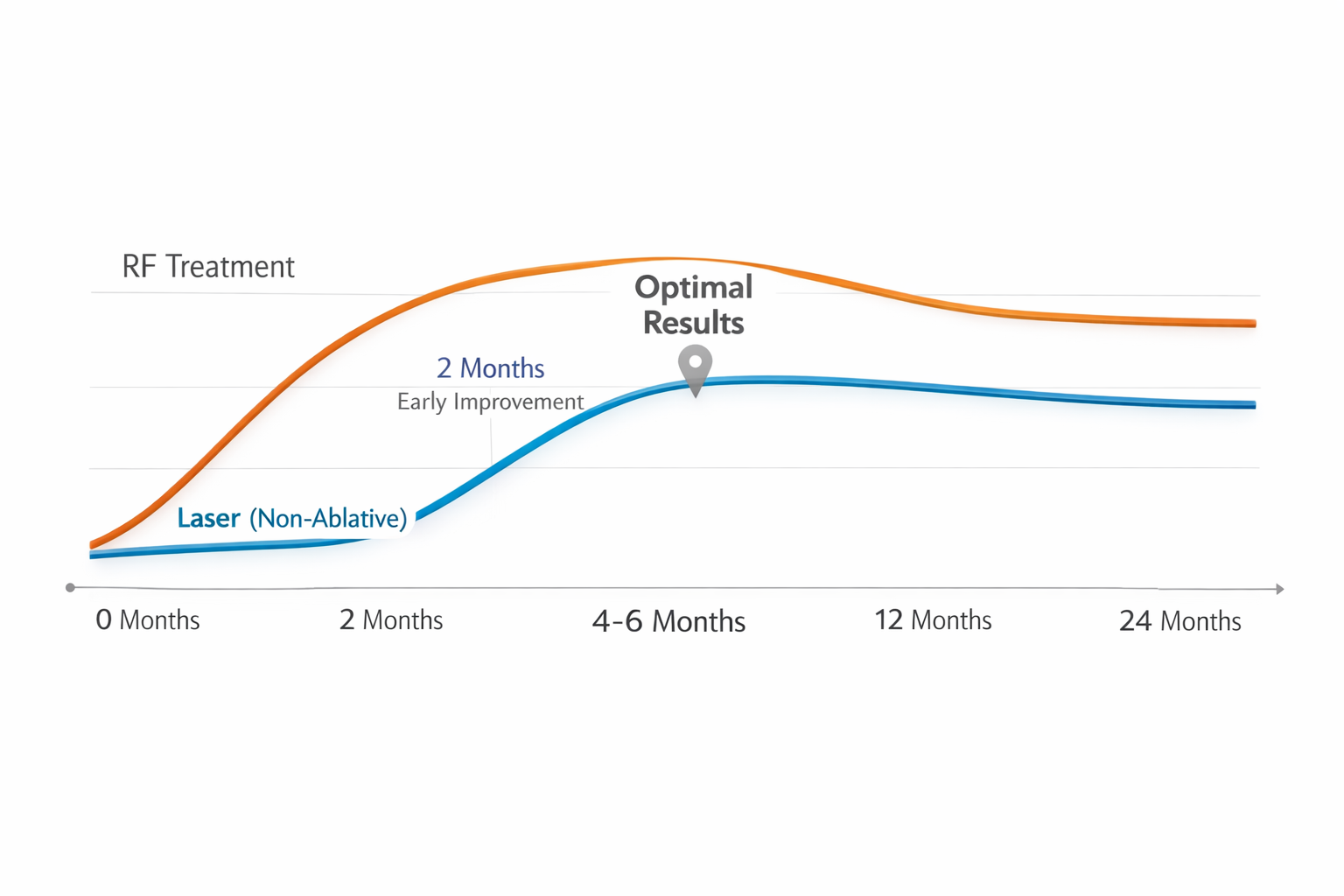
Laser treatment results vary more widely by device type. Non-ablative fractional treatments such as MOXI or Clear + Brilliant may show early improvement in skin tone and texture within two to four weeks after a session, with continued refinement across a course of four to six treatments. Ablative laser resurfacing can produce more immediate visible skin renewal once the recovery period is complete, with results lasting one to three years for the right candidate. Pigmentation concerns may require maintenance treatments as sun exposure and hormonal factors can cause recurrence.
Risks and Side Effects
RF treatment is generally associated with a mild side-effect profile when performed correctly. Common temporary effects include redness, mild swelling or oedema, and a warm sensation in the treated area. In the hands of an inexperienced operator or with incorrect device settings, burns, blistering, and scarring are possible, though uncommon when the treatment is delivered by a trained professional using appropriate equipment. RF microneedling carries a small additional risk of infection and post-procedure downtime compared to surface RF devices.
Laser treatment carries a wider range of potential side effects and risks, which are more pronounced with ablative devices. These include prolonged redness, swelling, crusting, and peeling during recovery; infection; changes in skin pigmentation (either darkening or lightening); and, rarely, scarring. Post-inflammatory hyperpigmentation is the most common adverse effect in patients with medium to darker skin tones undergoing laser treatment, and appropriate device selection, pre-treatment skin preparation, and careful post-treatment care are important risk-reduction measures. Sun avoidance and consistent use of SPF are essential during recovery from any laser procedure.
Who May Be a Suitable Candidate
RF treatment may be suitable for adults with mild to moderate skin laxity, sagging around the jawline, neck, or brow, and those looking for a non-surgical skin tightening option with minimal downtime. Patients with darker skin tones who are concerned about the PIH risk associated with some lasers may find RF a more appropriate primary option. RF is not suitable for patients who are pregnant, have implanted metal devices such as pacemakers or defibrillators in or near the treatment area, or have active skin infections in the area to be treated. As with any treatment, a full medical history review is necessary before proceeding.
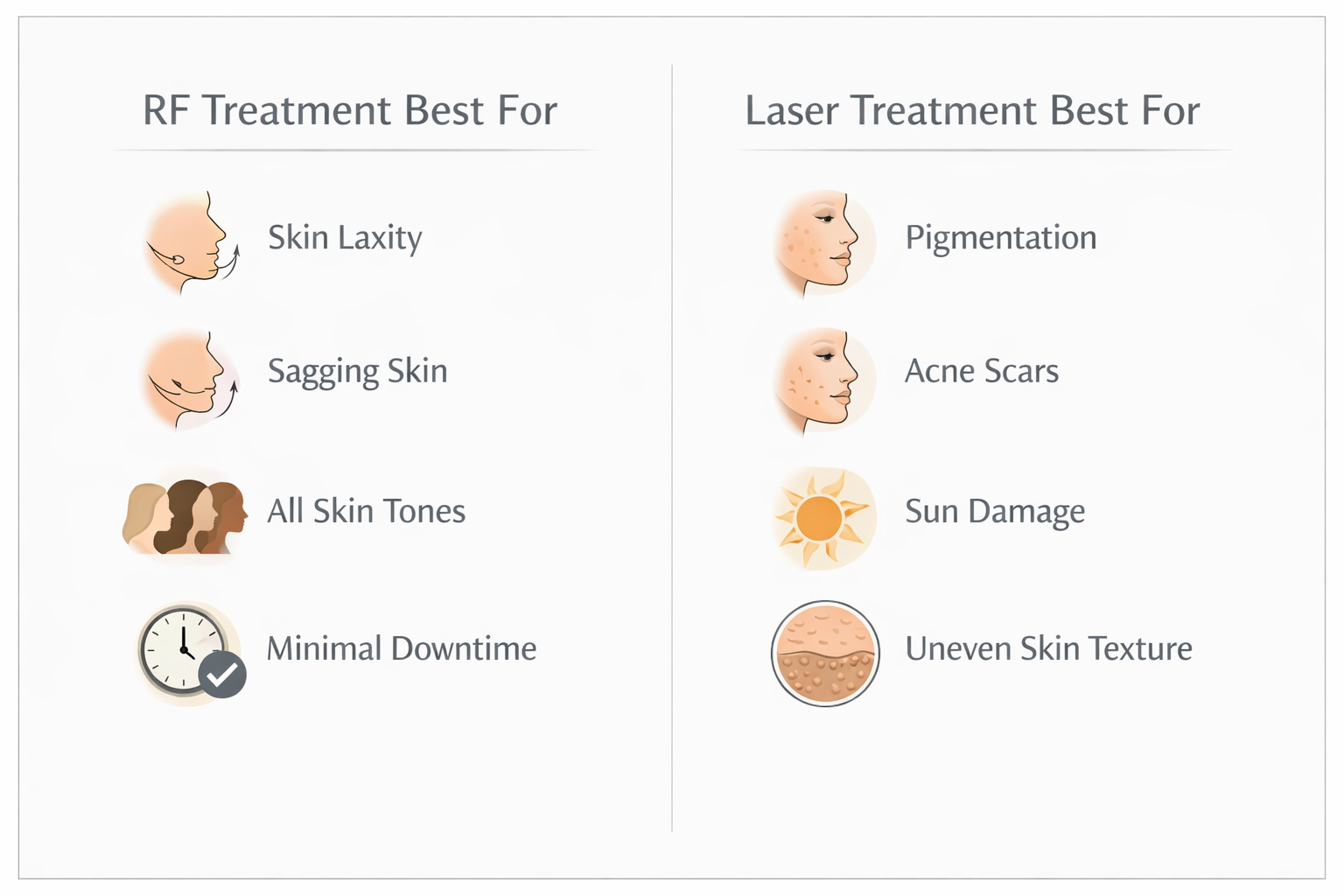
Laser treatment may be better suited to patients whose primary concerns include pigmentation, sun damage, uneven skin tone and texture, or acne scarring. Patients with fair to medium skin tones (Fitzpatrick types I to III) generally tolerate a wider range of laser devices. Patients with darker complexions can safely undergo specific laser treatments — particularly non-ablative options delivered by practitioners experienced in treating diverse skin tones — but device selection is critical. Laser is contraindicated in active infection, certain photosensitive skin conditions, and during pregnancy, and specific devices may have additional contraindications that a qualified practitioner will assess.
Aftercare Guidance
After any RF or laser session, protecting the treated skin is essential to support recovery and maintain results. The following general aftercare principles apply, though specific guidance should always come from the treating practitioner:
- Avoid direct sun exposure for at least two weeks after treatment; apply a broad-spectrum SPF 30 or higher daily.
- Avoid saunas, steam rooms, and vigorous exercise for 48–72 hours immediately after treatment, as heat can worsen inflammation.
- Avoid active skincare ingredients such as retinoids, AHAs, and BHAs during the initial recovery period unless instructed otherwise.
- Keep the skin well-hydrated using a gentle, fragrance-free moisturiser.
- After RF microneedling or ablative laser, avoid applying makeup until the skin barrier has recovered, as advised by the practitioner.
- Report any unexpected prolonged redness, swelling, blistering, or signs of infection to the treating clinic promptly.
Approximate Costs
RF treatment costs vary considerably based on the device, the treatment area, geographic location, and whether a single session or a course is priced. Surface RF treatments for the face may range from approximately £800 to £2,000 per session, while more comprehensive full-face and neck sessions with devices such as Thermage can exceed £3,000. RF microneedling with Morpheus8 typically falls in the £600–£1,500 per session range. Most providers recommend a course of sessions, which increases the overall investment.
Laser treatment costs depend heavily on the type of laser and area treated. Entry-level non-ablative fractional treatments may cost from £200–£500 per session. More sophisticated non-ablative treatments and broader-area sessions can range from £500–£1,500 per session. Ablative CO2 laser resurfacing typically ranges from £1,500–£2,500 or more for a full-face treatment. Neither RF nor laser treatments are typically covered by health insurance when performed for cosmetic purposes, and any clinic offering unrealistically low prices should be approached with appropriate caution regarding practitioner qualifications and equipment quality.
Frequently Asked Questions
Is RF treatment safe for darker skin tones?
RF treatment is generally considered safe for all Fitzpatrick skin types, including darker complexions, because radiofrequency energy targets tissue water and does not interact with melanin. This distinguishes it from certain laser treatments that carry a meaningful risk of post-inflammatory hyperpigmentation in patients with more pigmented skin. A consultation with a qualified practitioner is still recommended to confirm suitability and appropriate device settings.
How many RF or laser sessions are typically needed?
For RF skin tightening, most patients undergo two to four sessions, spaced four to six weeks apart, though some device protocols involve a single comprehensive session followed by annual maintenance. Non-ablative laser courses typically involve four to six sessions. Ablative laser resurfacing may achieve significant results in one session, with maintenance as needed. Individual response varies and the treating practitioner should provide session recommendations based on specific concerns and starting point.
Can RF and laser treatments be combined?
Yes, combining RF and laser treatments is an established approach in aesthetic practice and is supported by emerging clinical evidence. Fractional RF microneedling paired with non-ablative fractional laser can improve outcomes for acne scarring and skin texture. Combination protocols should be designed by an experienced board-certified dermatologist or qualified cosmetic physician and are not appropriate for every patient. They typically require careful scheduling, appropriate recovery time, and a higher overall investment.
Is RF treatment painful?
Surface RF treatment is generally well tolerated. Most patients describe a warming or heating sensation. RF microneedling is more uncomfortable and topical anaesthetic is routinely applied beforehand. Discomfort varies by device, treatment area, and individual sensitivity. Ablative laser treatment requires more robust pain management, which experienced practitioners will plan appropriately.
Is RF treatment safe during pregnancy?
RF treatment is not recommended during pregnancy. The effects of radiofrequency energy on a developing foetus have not been adequately studied, and the precautionary approach taken by most professional guidelines is to avoid elective aesthetic procedures during pregnancy. Women who are pregnant or planning pregnancy should inform their practitioner before any aesthetic treatment.
When will I see results from RF treatment?
Because RF works by stimulating natural collagen and elastin production through dermal remodelling, results are gradual. Most patients notice visible improvement in skin firmness at two to three months, with optimal results commonly apparent at four to six months. Results continue to develop over time as the remodelling process progresses, which is different from the more immediate surface changes some laser treatments can produce.
Choosing Between RF and Laser: What May Suit Your Goals
RF and laser treatments are genuinely complementary technologies rather than direct substitutes. Choosing between them depends on the primary skin concern, skin tone, acceptable downtime, and realistic expectations about results.
If the main concern is skin laxity, sagging, or loss of firmness — particularly around the jawline, lower face, neck, or body — radiofrequency-based treatment, including surface RF or fractional RF microneedling, is likely the more appropriate starting point. RF’s ability to stimulate collagen and elastin production through controlled thermal energy at depth, combined with its broad suitability across all skin tones and its minimal downtime profile, makes it a strong candidate for non-surgical skin tightening without the risks associated with ablative procedures.
If the primary concern is pigmentation, sun damage, uneven skin tone, or acne scarring, laser treatment — particularly non-ablative fractional options — may be more effective. Patients with fair to medium skin tones who are comfortable with a more variable downtime profile, depending on the laser selected, have access to a wider range of laser options.
Some patients may benefit most from a structured combination treatment protocol that addresses both structural laxity and surface quality. This decision should be made in consultation with a board-certified dermatologist or qualified aesthetic practitioner who can assess the skin in person, review relevant medical history, and recommend a treatment plan appropriate to individual goals. Neither RF nor laser is universally superior — the right choice is the one matched to a specific concern, skin type, and treatment context.
