
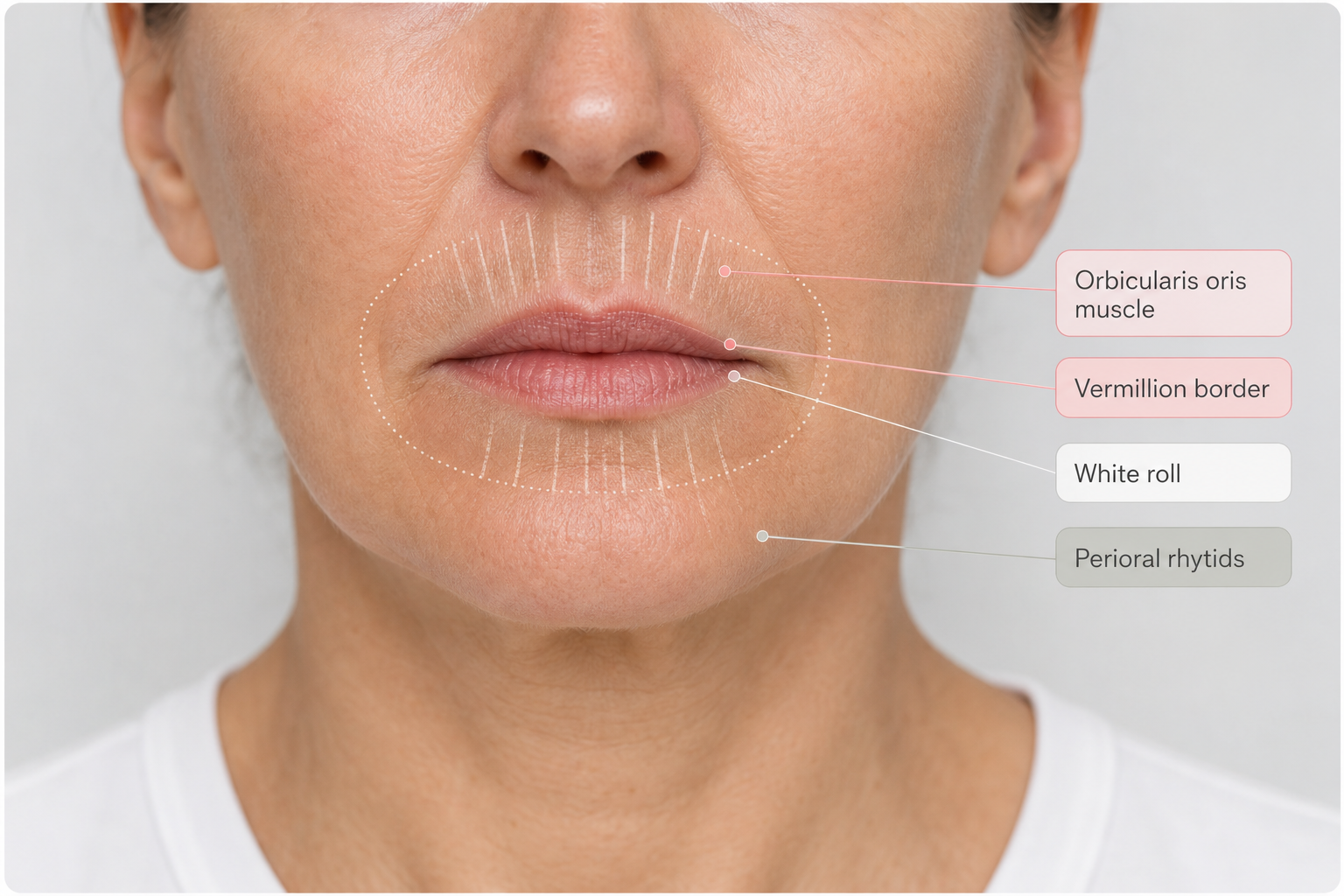

Smokers lines — the fine vertical creases that form above and below the lips — are one of the more challenging areas to treat in aesthetic medicine. Despite the name, these perioral rhytids affect non-smokers too, developing through natural ageing, sun damage, and the repetitive movement of the orbicularis oris muscle. Dermal filler is the most commonly requested treatment, but choosing the right product, understanding realistic outcomes, and knowing when filler alone is insufficient all matter before booking a consultation.
Key Takeaways
- Smokers lines are caused by a combination of muscle movement, collagen loss, and volume depletion — not exclusively by smoking.
- Low-viscosity hyaluronic acid fillers are the preferred injectable option; several products hold FDA approval specifically for perioral lines.
- RHA Redensity is currently the only filler with FDA clearance specifically for dynamic perioral rhytids.
- Filler softens perioral lines rather than eliminating them entirely; deep or heavily etched lines often benefit from a combination treatment approach.
- The perioral area carries specific risks including the Tyndall effect and vascular complications, making practitioner experience critical.
What Are Smokers Lines and Why Do They Form?
Smokers lines — also called lipstick lines, barcode lines, or pucker lines — are the fine vertical lines that radiate outward from the lip edges, crossing the vermillion border and extending into the surrounding skin. Clinically, they are classified as perioral rhytids, and they can appear on the upper lip, lower lip, or both. They are categorised as either dynamic lip lines, which are visible only during movement such as pursing or drinking, or static perioral lines, which remain visible even at rest.
The orbicularis oris muscle encircles the mouth and controls lip movement. Decades of pursing, speaking, and smiling cause this muscle to contract repeatedly, gradually etching lines into the overlying skin. At the same time, age-related collagen loss and elastin degradation reduce the skin’s ability to spring back after movement. Photoaging from cumulative sun exposure accelerates this process. Volume loss in the lips and surrounding tissue removes the structural support that once kept the skin smooth, allowing lines to deepen further. Smoking does worsen the process — both through the repetitive pursing action and through its direct effect on collagen remodelling — but the same lines develop in people who have never smoked.
Understanding whether lines are primarily dynamic or static, mild or deeply etched, and whether volume loss is a contributing factor helps determine which treatment or combination of treatments is most appropriate.
Filler Options for Perioral Lines: Which Products Are Used?
Not all dermal fillers are suitable for the perioral area. The skin above and below the lips is among the thinnest on the face, with a dermis measuring less than one millimetre in some areas. This demands a low-viscosity hyaluronic acid filler — a soft, flexible product that integrates naturally into fine tissue without creating visible lumps or discolouration. Thicker, more cohesive fillers designed for volume augmentation are generally avoided in this zone.
Hyaluronic acid (HA) filler is the standard choice for perioral rejuvenation because it is reversible with hyaluronidase if complications arise or results are unsatisfactory. Several HA products have been evaluated specifically for perioral lines, and a subset carry formal regulatory approval for this indication.
FDA-Approved Products for Perioral Lines
| Product | FDA Indication | Key Characteristic | Typical Duration |
|---|---|---|---|
| RHA Redensity (TEOSYAL RHA® 1) | Dynamic perioral rhytids (FDA-cleared) | Resilient HA; designed to move with facial expression | Up to 12 months |
| Restylane Silk | Lip lines and lip augmentation (FDA-approved) | Fine-particle HA; smooth consistency | 6–12 months |
| Restylane Kysse | Lip augmentation and perioral lines (FDA-approved) | XpresHAn Technology; flexible and natural feel | Up to 12 months |
| Juvéderm Volbella XC | Perioral lines and lip augmentation (FDA-approved) | VYCROSS technology; thin consistency; lidocaine included | Up to 12 months |
| Belotero Balance | Used off-label for perioral lines in many markets | Cohesive polydensified matrix; integrates into superficial dermis | 6–12 months |
RHA Redensity deserves particular attention because it is the only filler specifically FDA-cleared for dynamic perioral rhytids — the lines that appear during movement. Its resilient hyaluronic acid formulation is engineered to flex with facial expression rather than resist it, which is relevant in a high-movement area like the mouth. Clinical trial data (NCT03092219) supported its approval for this specific indication.
Belotero Balance and Belotero Soft are widely used in clinical practice for perioral lines due to their ability to integrate into the superficial dermis without creating the bluish discolouration known as the Tyndall effect, though their regulatory status varies by country. Radiesse, a calcium hydroxylapatite filler, is generally avoided in the perioral area due to its thicker consistency and the difficulty of reversal.
Perioral Line Filler vs. Lip Filler: An Important Distinction
These two treatments are frequently confused, but they serve different purposes. Perioral line filler targets the fine vertical lines in the skin surrounding the lips — the barcode lines above and below the vermillion border. The product is placed superficially within the dermis of the surrounding skin, not inside the lip itself. The goal is to smooth lines and restore subtle definition to the white roll (the pale ridge that borders the lip edge), not to add volume to the lips.
Lip filler, by contrast, is injected into the lip body and vermillion border to increase volume, improve shape, and enhance lip border definition. A patient with thin lips and no perioral lines may benefit from lip augmentation alone. A patient with perioral rhytids but adequate lip volume needs perioral line treatment, not lip filler. Many patients have both concerns, in which case a practitioner may address them in the same session or in a planned sequence, using different products or techniques for each area.
Conflating the two can lead to overfilling of the lips when the actual concern is the surrounding skin — a common source of unnatural-looking results.
How Is Perioral Line Filler Injected?
Superficial dermal placement is the defining technical requirement for perioral line filler. The product must be deposited within the dermis — close enough to the surface to fill the line — without being placed so superficially that it becomes visible through the skin. In the perioral area, where the dermis is exceptionally thin, this margin is narrow.
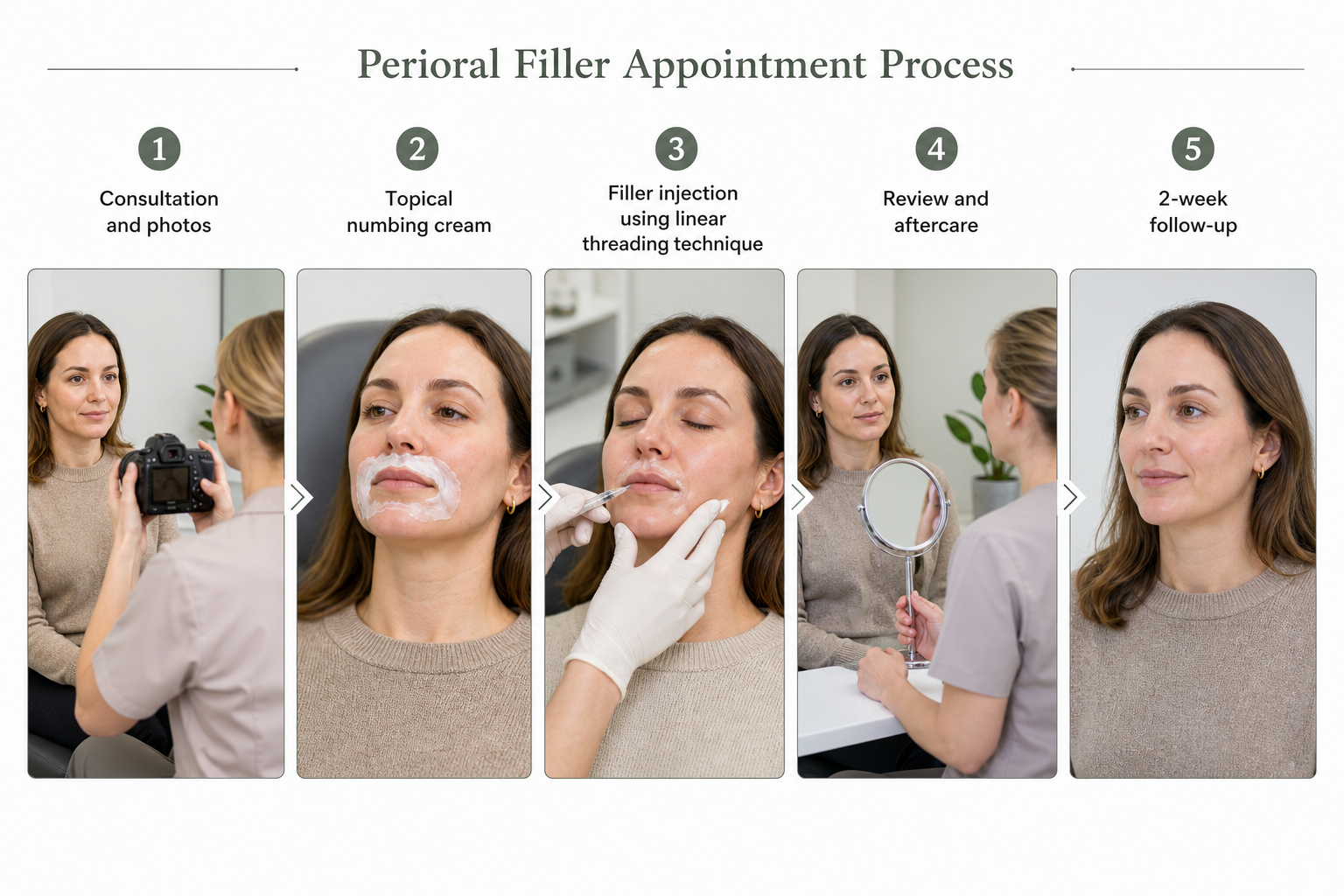
Practitioners typically use one or more of the following techniques depending on line depth and pattern: linear threading, where filler is deposited along the length of a line as the needle is withdrawn; serial puncture, where small amounts are placed at intervals along a line; or a fan technique, where multiple passes radiate from a single entry point. Small volumes are used throughout — this is not an area where generous amounts of product are appropriate.
The white roll and vermillion border may also be lightly reinforced to restore definition that has been lost with age, which can improve the overall appearance of the lip frame without adding bulk to the lips themselves. Most practitioners apply a topical anaesthetic cream before treatment, and many of the approved products contain lidocaine to reduce discomfort during injection.
A typical appointment involves a consultation and photographs, application of topical numbing cream, the injection itself (usually 10–20 minutes), and a brief review before the patient leaves. A follow-up at two weeks allows the practitioner to assess the result and perform any minor touch-up if needed.
Botulinum Toxin for Smokers Lines: The Lip Flip and Orbicularis Relaxation
Botulinum toxin — commonly known by the brand name Botox — plays a useful but carefully limited role in perioral line treatment. Small doses injected into the orbicularis oris muscle reduce the repetitive contractions that deepen dynamic lip lines over time. This approach is sometimes called a lip flip when the toxin is placed at the upper lip border, causing the lip to relax slightly outward and appear fuller without adding volume.
The functional risk of botulinum toxin in this area is worth understanding clearly. The orbicularis oris is not just a cosmetic muscle — it controls the precise movements needed for speech, eating, drinking from a cup, and playing wind instruments. Over-relaxation of this muscle can temporarily impair these functions, causing difficulty with certain sounds, dribbling, or an inability to use a straw. This is why dosing in the perioral area requires particular care, and why botulinum toxin here is typically used in very small amounts as part of a combination treatment approach rather than as a standalone solution for significant lines.
Botulinum toxin is most effective for dynamic lip lines — those that appear during movement — and has limited effect on static perioral lines that are visible at rest. For static lines, filler or resurfacing treatments are generally more appropriate.
Combination Treatment for Perioral Rejuvenation
For moderate to deep perioral rhytids, a single treatment modality rarely achieves the most satisfying outcome. A staged combination treatment approach — addressing different aspects of the problem in sequence — tends to produce more comprehensive and longer-lasting results.
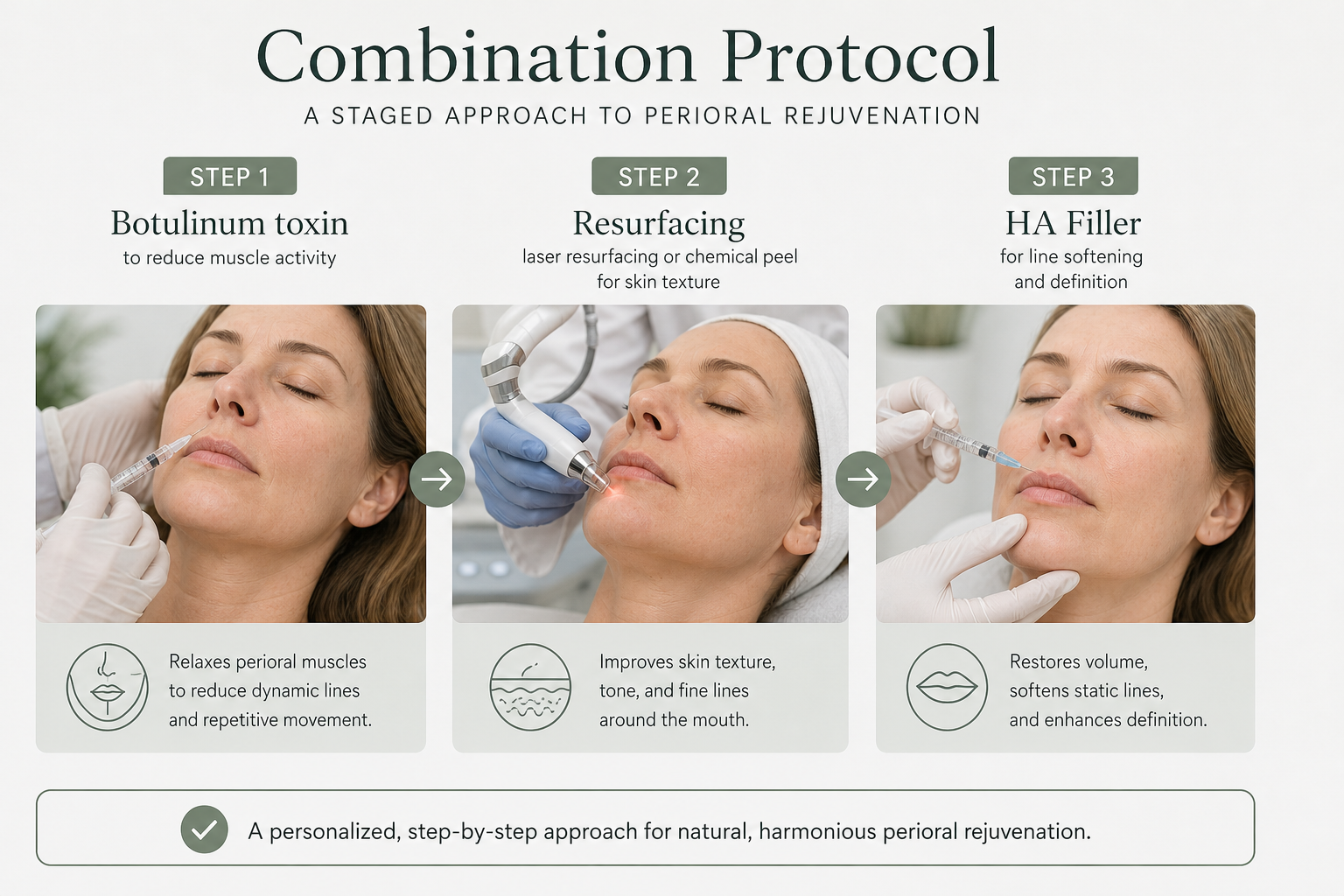
A commonly used protocol works as follows. Botulinum toxin is administered first to reduce dynamic muscle activity, which both softens dynamic lines and helps subsequent treatments last longer by reducing the mechanical forces that break down filler. Resurfacing — using fractional laser, ablative laser resurfacing, or a medium-depth chemical peel — is then used to improve skin texture, stimulate collagen remodelling, and reduce the depth of static perioral lines. Once the skin has healed, filler is placed to address any remaining lines and restore subtle definition to the lip border.
Microneedling and polynucleotides (skin biostimulators) are increasingly used as adjuncts in this area. Polynucleotides support tissue hydration and collagen stimulation without adding volume, making them a useful option for patients who want skin quality improvement without the risk of overfilling. Retinoids used at home between treatments support ongoing collagen remodelling and may slow the recurrence of lines.
The appropriate combination depends on line severity, skin type, downtime tolerance, and budget. A practitioner experienced in perioral rejuvenation can map out a realistic treatment pathway based on individual assessment.
Risks and Limitations of Perioral Line Filler
The perioral area carries specific risks that patients should understand before proceeding. The Tyndall effect — a bluish or greyish discolouration visible through the skin — occurs when filler is placed too superficially in thin skin. The perioral dermis is particularly vulnerable to this complication because of its thinness. Choosing an appropriate product (such as Belotero or RHA Redensity, which are less prone to this effect) and ensuring precise placement reduces but does not eliminate this risk. If the Tyndall effect does occur, hyaluronidase can dissolve the filler and resolve the discolouration.
Other risks include bruising and swelling (common and usually temporary), nodule or lump formation, asymmetry, and filler migration. Vascular occlusion — where filler inadvertently enters or compresses a blood vessel — is rare but serious, and can in extreme cases lead to skin necrosis. This risk underscores the importance of treatment by a qualified and experienced practitioner who understands the vascular anatomy of the perioral region and carries hyaluronidase for emergency use.
Overfilling is a meaningful aesthetic risk in this area. Excessive product around the mouth can create an unnatural appearance, distort the lip frame, and affect facial expression. The goal of perioral line filler is subtle softening, not elimination of all lines.
Filler is also not appropriate in all circumstances. Active cold sores or oral herpes should be treated before any perioral injection, as needling can trigger an outbreak. Certain blood-thinning medications increase bruising risk. Pregnancy and breastfeeding are contraindications. Patients with a history of severe allergic reactions or certain autoimmune conditions should discuss their medical history in detail before treatment.
Realistic Results and Longevity
Perioral line filler softens lines — it does not erase them. Patients with mild to moderate perioral rhytids typically see a meaningful improvement in line depth and lip border definition. Patients with deep, heavily etched static lines may see only partial improvement from filler alone, and are likely to achieve better outcomes with a combination approach that includes resurfacing before filler placement.
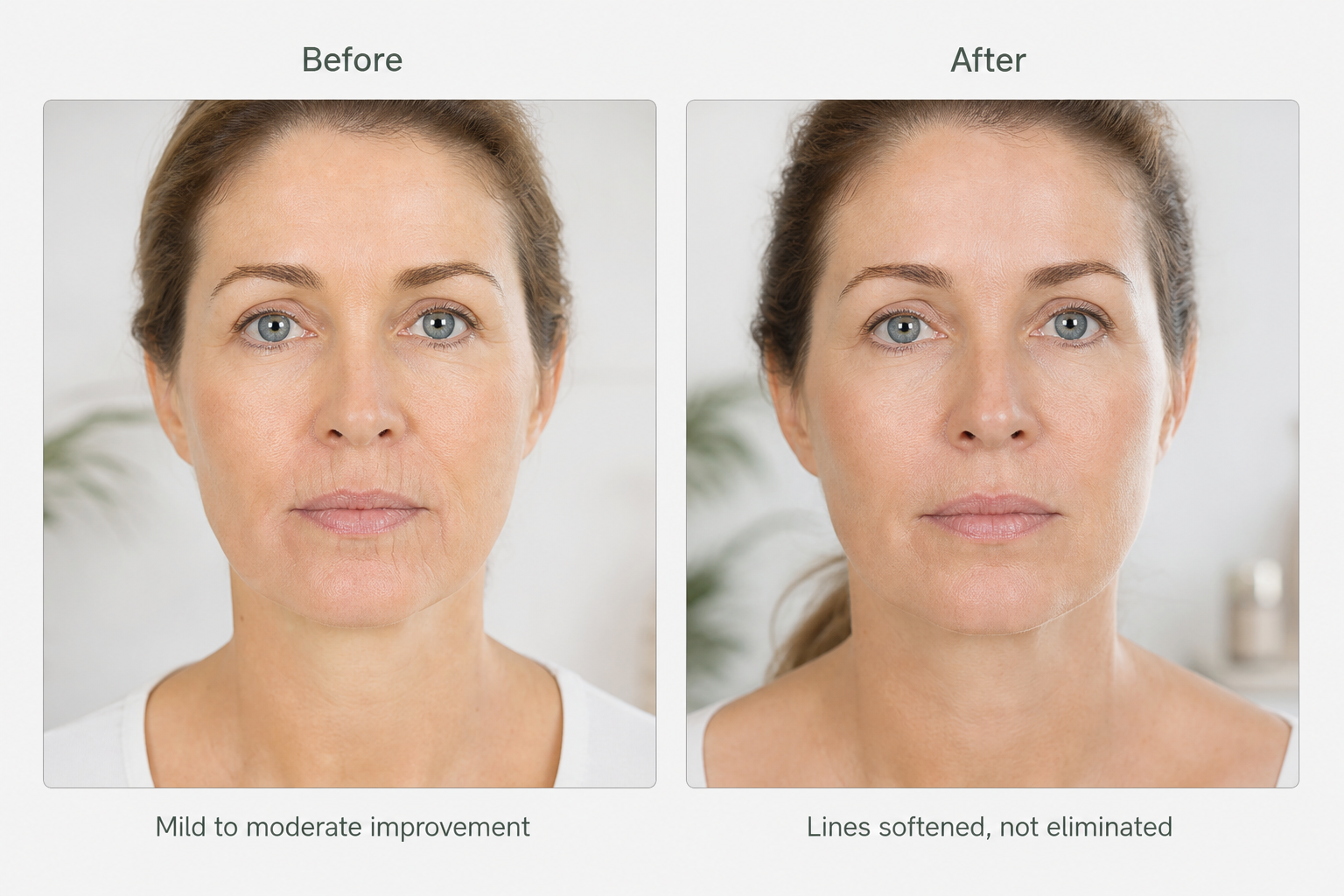
Most HA fillers in this area last between six and twelve months, depending on the product used, the volume placed, individual metabolism, and the degree of muscle activity in the area. RHA Redensity and Juvéderm Volbella XC have both demonstrated results lasting up to twelve months in clinical studies. Belotero products tend toward the shorter end of this range. Maintenance sessions are typically needed once or twice a year to sustain results.
Swelling is expected immediately after treatment and usually resolves within a few days. Final results are generally assessable at two weeks, once swelling has fully settled. A follow-up appointment at this point allows for any minor refinement.
Aftercare Following Perioral Line Filler
Specific aftercare in the days following treatment supports healing and helps protect the result. Avoiding strenuous exercise for 24–48 hours reduces the risk of increased swelling and bruising. Exposure to significant heat — saunas, steam rooms, very hot drinks — should be avoided for the first 24 hours. Excessive lip pursing and pressure on the treated area (such as from a tight face mask) is best minimised in the first few days while the filler settles.
Arnica gel or tablets may help reduce bruising, though evidence for their effectiveness is modest. Patients prone to cold sores may be prescribed antiviral medication by their practitioner as a precaution before perioral injections. Sun protection remains important in the weeks following treatment, particularly if resurfacing has been performed as part of a combination protocol.
Who May Be Suitable — and When Filler Is Not the Right Tool
Perioral line filler may be worth discussing with a qualified practitioner if you have mild to moderate vertical lip lines that bother you at rest or during movement, if you have noticed loss of definition along the lip border, or if you are looking for a non-surgical option with minimal downtime. Both men and women develop perioral rhytids, and the treatment is not limited to any particular age group, though it is most commonly sought from the mid-thirties onward.
Filler alone is less likely to be the right tool if lines are deep and heavily etched into the skin at rest, if significant skin laxity is present in the perioral area, or if the primary concern is skin texture rather than line depth. In these cases, resurfacing with fractional laser or a medium-depth chemical peel may need to precede filler for a meaningful result. A practitioner using a validated assessment tool such as the Static Perioral Lines Assessment Scale (SPLAS) or the Perioral Rhytids Severity Rating Scale (PR-SRS) can help grade line severity and guide treatment selection.
Patients who expect complete elimination of all perioral lines from a single filler treatment are likely to be disappointed. Honest expectation-setting before treatment is an important part of a responsible consultation.
Frequently Asked Questions
Do smokers lines only affect people who smoke?
No. Despite the name, perioral rhytids develop in non-smokers through natural ageing, sun damage, collagen loss, and repetitive orbicularis oris muscle movement. Smoking accelerates the process, but it is not a prerequisite for these lines to form.
Can filler completely remove smokers lines?
Filler softens perioral lines rather than eliminating them entirely. Mild to moderate lines typically show meaningful improvement. Deep, static lines may require a combination of resurfacing and filler for the best outcome, and some residual lines are likely to remain visible.
What is the Tyndall effect and why does it matter in this area?
The Tyndall effect is a bluish or greyish discolouration that occurs when filler is placed too close to the skin surface. The perioral skin is among the thinnest on the face, making this complication a particular concern here. Choosing an appropriate low-viscosity product and ensuring precise placement reduces the risk. Hyaluronidase can dissolve the filler if this occurs.
How is perioral line filler different from lip filler?
Perioral line filler is placed superficially in the skin surrounding the lips to smooth vertical lines and restore lip border definition. Lip filler is injected into the lip body to add volume and shape. They address different concerns and use different techniques, though both may be appropriate for the same patient.
How long does smokers line filler last?
Most hyaluronic acid fillers used in the perioral area last between six and twelve months. Products such as RHA Redensity and Juvéderm Volbella XC have demonstrated results lasting up to twelve months in clinical studies. Individual metabolism, muscle activity, and the volume placed all influence longevity.
Is botulinum toxin or filler better for smokers lines?
They work differently and are often most effective when used together. Botulinum toxin reduces the muscle contractions that cause dynamic lip lines, while filler addresses the lines themselves and restores definition. Botulinum toxin alone has limited effect on static perioral lines visible at rest. A combination treatment approach is frequently recommended for moderate to significant perioral rhytids.
What should I avoid after perioral line filler?
For the first 24–48 hours, avoid strenuous exercise, significant heat exposure, and excessive pressure or pursing of the lips. Swelling typically resolves within a few days, and final results are usually assessable at two weeks. A follow-up appointment at this point allows for any minor refinement if needed.
Deciding Whether Perioral Line Filler Is Right for You
Smokers line filler can be a genuinely effective option for softening perioral rhytids, restoring definition to the lip border, and improving the overall appearance of the mouth area — but realistic expectations matter. The treatment works best for mild to moderate lines in patients who understand that softening, not elimination, is the achievable goal. For deeper lines or more significant skin laxity, a staged combination treatment approach involving resurfacing and possibly botulinum toxin alongside filler is likely to produce a more satisfying outcome.
Product selection matters in this area. The thin perioral skin demands a low-viscosity hyaluronic acid filler placed with precision, and the availability of hyaluronidase for reversal is an important safety consideration. RHA Redensity, Restylane Silk, Restylane Kysse, and Juvéderm Volbella XC all carry formal regulatory approval for perioral lines and represent well-studied options worth discussing with your practitioner.
A thorough consultation with a qualified and experienced aesthetic practitioner — one who can assess line severity, discuss your goals honestly, and recommend an appropriate treatment plan — is the most important first step. If you are considering perioral line treatment, booking a consultation to discuss your specific concerns and candidacy is a reasonable starting point.
