
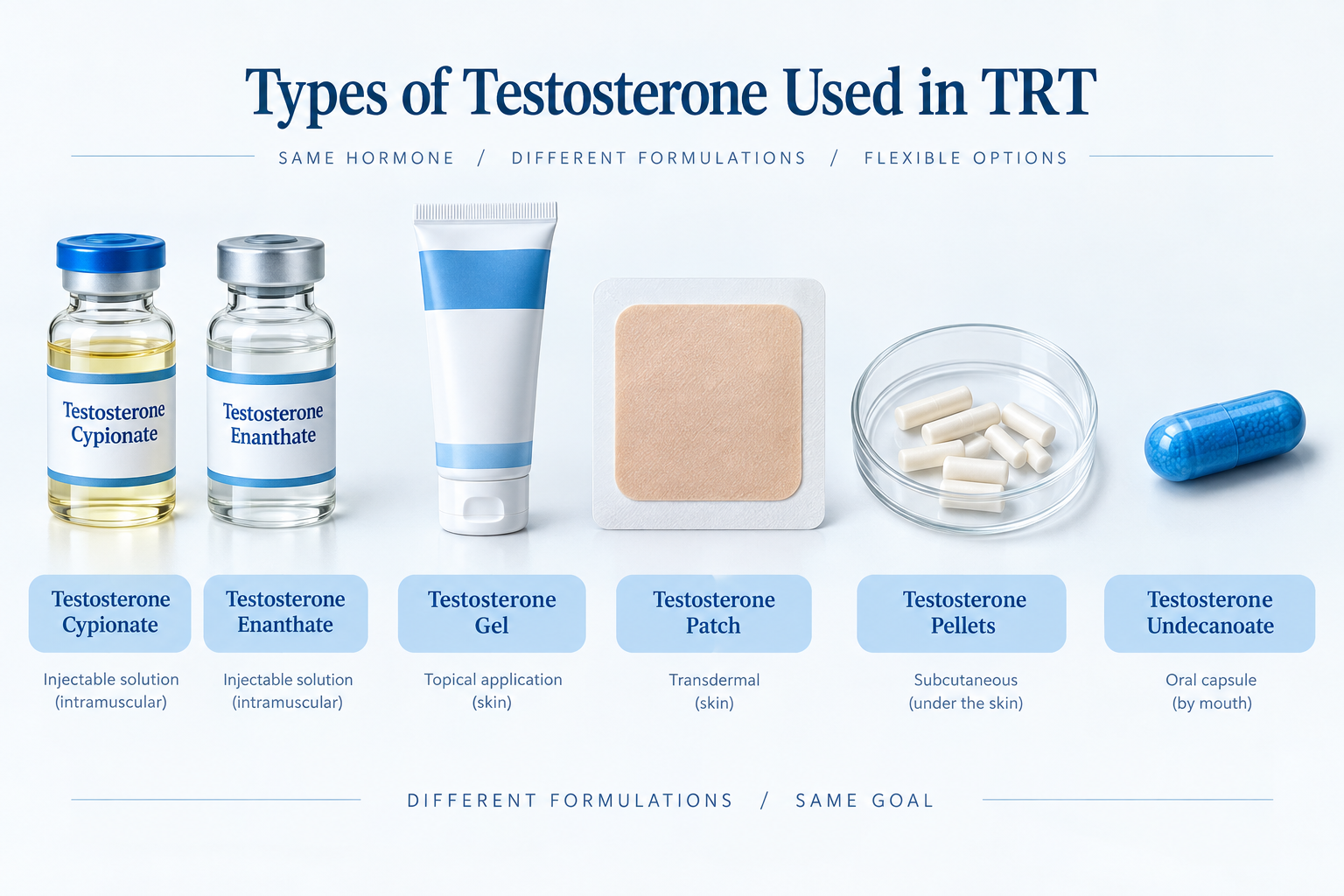

Testosterone replacement therapy (TRT) uses several different forms of testosterone, each with its own delivery method, dosing schedule, and clinical profile. Understanding which type of testosterone is used for TRT — and why one form may be preferred over another — can help you have a more informed conversation with your prescribing clinician before starting treatment.
Key Takeaways
- TRT uses bioidentical or synthetic testosterone in several forms, including injections, gels, patches, pellets, and oral or buccal preparations.
- The most commonly prescribed forms are testosterone cypionate and testosterone enanthate (injectable), and testosterone gel applied to the skin.
- Each delivery method produces different blood level patterns, which affects how stable symptoms feel and how frequently treatment is administered.
- No single form of testosterone is universally superior; the right choice depends on individual health, lifestyle, preferences, and clinical assessment.
- All forms of TRT carry potential risks and require ongoing monitoring by a qualified healthcare provider.
What Is Testosterone Replacement Therapy?
Testosterone replacement therapy is a medically supervised treatment used to restore testosterone levels in people whose bodies produce insufficient amounts of the hormone. Low testosterone — clinically referred to as hypogonadism — can cause symptoms including fatigue, reduced libido, mood changes, loss of muscle mass, increased body fat, and difficulty concentrating. TRT aims to bring testosterone levels back into a physiologically normal range, which may help relieve these symptoms over time.
TRT is not a single product. It is a category of treatment that encompasses multiple testosterone formulations, each delivering the same active hormone through a different route. The testosterone used in TRT is chemically identical to the testosterone the body produces naturally, though it is often attached to an ester compound or suspended in a carrier to control how quickly it is absorbed and how long it remains active in the body.
TRT is prescribed for diagnosed hypogonadism and is not the same as the non-medical use of anabolic steroids. Doses used in TRT are intended to restore normal physiological levels, not to exceed them. A diagnosis based on blood tests and clinical symptoms is required before treatment begins.
The Main Types of Testosterone Used in TRT
Several distinct testosterone formulations are approved and used in clinical practice. They differ in how they are administered, how quickly testosterone enters the bloodstream, how stable blood levels remain between doses, and how frequently treatment must be given. Below is an overview of the principal types.
Testosterone Cypionate (Injectable)
Testosterone cypionate is one of the most widely prescribed injectable forms of testosterone for TRT, particularly in the United States. It is an oil-based injection administered into muscle tissue — typically the gluteal muscle or the thigh — and is usually given every one to two weeks, though some clinicians prescribe more frequent smaller doses to reduce fluctuations in blood levels. After injection, testosterone cypionate is gradually released from the injection site as the ester is cleaved, producing a peak in blood testosterone levels within two to five days, followed by a gradual decline.
The relatively long half-life of testosterone cypionate means that blood levels can vary noticeably between injections when doses are spaced two weeks apart. Some patients report feeling well in the days immediately after injection and less well as levels fall toward the end of the dosing interval. More frequent dosing — for example, weekly or twice-weekly injections — can reduce this peak-and-trough effect and produce more stable hormone levels throughout the cycle.
Testosterone Enanthate (Injectable)
Testosterone enanthate is pharmacologically very similar to testosterone cypionate and is the injectable form more commonly used in Europe and many other countries. It is also an oil-based intramuscular injection with a comparable half-life, typically administered every one to two weeks. The clinical experience and side effect profile of testosterone enanthate closely resemble those of testosterone cypionate, and the two are often considered interchangeable in clinical practice, though they are not identical molecules.
Both testosterone cypionate and testosterone enanthate are cost-effective options and have a long track record of clinical use. Self-injection at home is possible once a patient has been trained by their healthcare provider, which can reduce the burden of clinic visits.
Testosterone Undecanoate (Injectable and Oral)
Testosterone undecanoate is available in two distinct forms: a long-acting injectable preparation and an oral capsule. The injectable form, sold under brand names such as Nebido in many countries, is administered as a deep intramuscular injection every ten to fourteen weeks after an initial loading phase. This extended dosing interval is a practical advantage for patients who prefer infrequent clinic visits, though the injection volume is larger than that of shorter-acting preparations and must typically be given by a healthcare professional rather than self-administered.
The oral form of testosterone undecanoate is absorbed through the lymphatic system rather than the portal circulation, which distinguishes it from older oral testosterone preparations that carried significant liver toxicity concerns. Oral testosterone undecanoate requires twice-daily dosing with a fatty meal to optimize absorption, and blood level stability is generally considered less predictable than with injectable or transdermal forms. It may be a suitable option for patients who prefer to avoid injections and patches, subject to clinical assessment.
Testosterone Gel (Transdermal)
Testosterone gel is applied directly to the skin — usually the shoulders, upper arms, or abdomen — and is absorbed transdermally into the bloodstream. It is one of the most commonly prescribed non-injectable forms of TRT. Daily application produces relatively stable testosterone levels compared with weekly or biweekly injections, which some patients find beneficial for mood and energy consistency.
A meaningful practical consideration with testosterone gel is the risk of transference: testosterone can be transferred to another person through skin-to-skin contact if the application site is not covered or washed before contact. This is particularly important in households with children or pregnant partners, as unintended testosterone exposure carries health risks for both groups. Patients using testosterone gel must follow application and hygiene instructions carefully.
Absorption through the skin varies between individuals, meaning that blood level monitoring is important to confirm that the prescribed dose is achieving the intended therapeutic range. Some patients absorb the gel efficiently; others may require dose adjustments.
Testosterone Patches (Transdermal)
Testosterone patches are applied to the skin once daily and deliver testosterone transdermally over a 24-hour period. Like testosterone gel, patches produce relatively stable daily hormone levels. Skin irritation at the application site is a commonly reported side effect and can limit tolerability for some patients. Patches must be rotated to different skin sites to reduce local reactions.
Patches are less widely used than gels in current clinical practice, partly because of the skin irritation issue and partly because gels offer more flexible dosing. However, patches remain a clinically valid option for patients who prefer a discrete, once-daily application without the transference risk associated with uncovered gel application sites.
Testosterone Pellets (Subcutaneous Implants)
Testosterone pellets are small, solid cylinders of crystalline testosterone that are implanted under the skin — typically in the buttock or hip area — through a minor in-office procedure performed under local anaesthetic. Once implanted, the pellets dissolve slowly and release testosterone steadily over approximately three to six months, after which the procedure must be repeated.
The main advantage of testosterone pellets is the extended dosing interval, which eliminates the need for daily application or regular injections. Blood testosterone levels from pellets tend to be relatively stable, though they cannot be adjusted once implanted. If a patient experiences side effects or requires a dose change, the only option is to wait for the pellets to dissolve. The implantation procedure itself carries a small risk of infection, extrusion, or bleeding at the insertion site.
Buccal Testosterone
Buccal testosterone is a small adhesive tablet applied to the gum above the incisor teeth twice daily. It dissolves slowly and releases testosterone that is absorbed through the mucous membrane of the mouth. This route bypasses first-pass liver metabolism. Buccal testosterone produces reasonably stable blood levels with twice-daily dosing, but gum irritation, altered taste, and discomfort are reported side effects that limit its use in practice. It is a less commonly chosen option but may suit patients for whom other delivery methods are unsuitable.
Comparing TRT Testosterone Types: Key Characteristics
| Type | Route | Dosing Frequency | Blood Level Stability | Self-Administration | Notable Considerations |
|---|---|---|---|---|---|
| Testosterone Cypionate | Intramuscular injection | Every 1–2 weeks (or more frequently) | Moderate; peaks and troughs with longer intervals | Possible with training | Cost-effective; widely available |
| Testosterone Enanthate | Intramuscular injection | Every 1–2 weeks | Moderate; similar to cypionate | Possible with training | Common in Europe; similar profile to cypionate |
| Testosterone Undecanoate (injectable) | Intramuscular injection | Every 10–14 weeks | Good; long-acting | Usually clinic-administered | Large injection volume; infrequent dosing |
| Testosterone Undecanoate (oral) | Oral capsule | Twice daily with food | Variable; food-dependent absorption | Yes | Must be taken with fatty meal; avoids injections |
| Testosterone Gel | Transdermal (skin) | Daily | Good; relatively stable | Yes | Transference risk; variable skin absorption |
| Testosterone Patch | Transdermal (skin) | Daily | Good; relatively stable | Yes | Skin irritation common; site rotation needed |
| Testosterone Pellets | Subcutaneous implant | Every 3–6 months | Good; steady release | No (in-office procedure) | Dose cannot be adjusted once implanted |
| Buccal Testosterone | Buccal (gum) | Twice daily | Moderate | Yes | Gum irritation; less commonly used |
How Blood Level Stability Affects Symptom Experience
One of the most clinically meaningful differences between TRT formulations is how consistently they maintain testosterone levels within the therapeutic range. Testosterone levels that fluctuate significantly — rising sharply after a dose and falling before the next — can produce corresponding changes in energy, mood, libido, and general wellbeing. Some patients on biweekly injections describe feeling noticeably better in the days after injection and noticeably worse toward the end of the dosing interval, a pattern sometimes called the peak-and-trough effect.
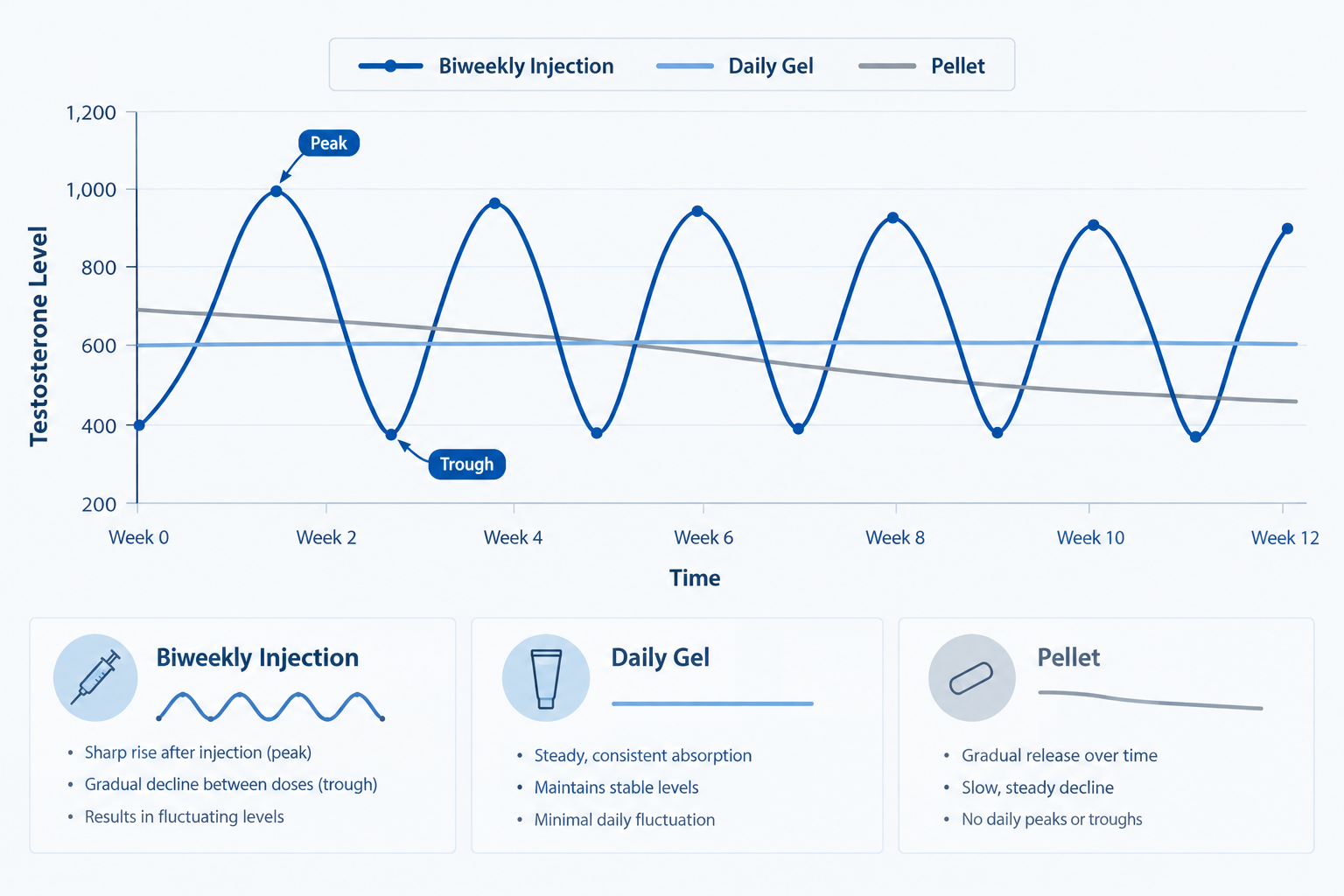
Daily transdermal preparations such as gels and patches, and long-acting options such as pellets or long-interval injectable testosterone undecanoate, tend to produce more consistent blood levels. Whether this translates into a meaningfully better symptom experience varies between individuals. Some patients adapt well to the fluctuation pattern of biweekly injections; others find that more frequent dosing or a different delivery method produces a more stable sense of wellbeing. This is one reason why the choice of TRT formulation is ideally individualized rather than standardized.
Risks and Side Effects Common to All TRT Forms
Regardless of the delivery method, all forms of testosterone replacement therapy share a common set of potential risks and side effects. These arise from the physiological effects of elevated testosterone and its conversion to other hormones, particularly oestradiol (a form of oestrogen) and dihydrotestosterone (DHT).
Commonly reported side effects across TRT formulations include acne, oily skin, increased red blood cell production (erythrocytosis), fluid retention, and changes in mood or libido. Erythrocytosis — an increase in red blood cell count — is a clinically important consideration because it can increase blood viscosity and the theoretical risk of cardiovascular events; haematocrit levels are routinely monitored during TRT. Testosterone therapy suppresses the body’s own production of testosterone and can significantly reduce sperm production, which is an important consideration for men who wish to preserve fertility.
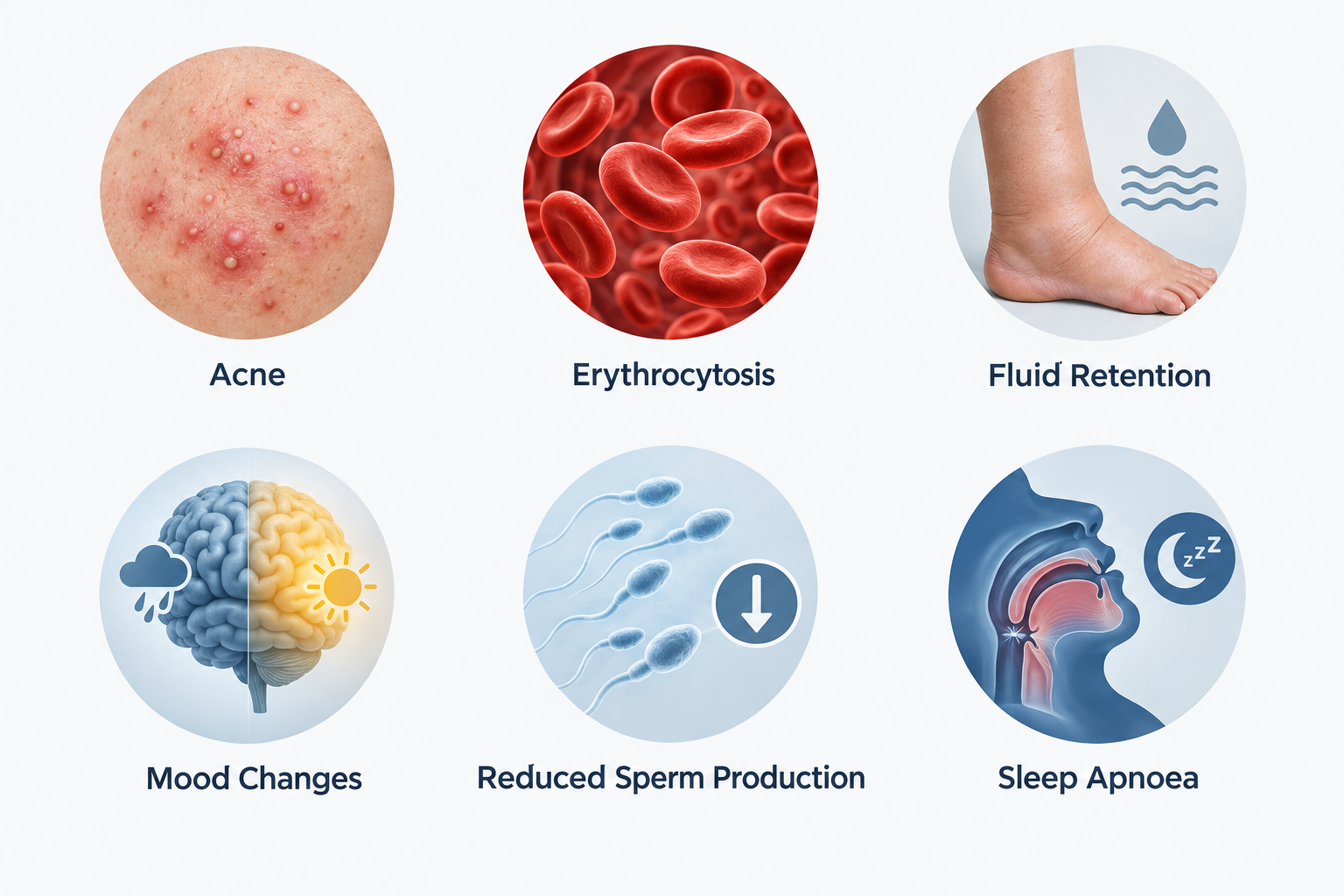
TRT may also cause or worsen sleep apnoea in susceptible individuals. The relationship between TRT and cardiovascular risk has been the subject of ongoing research; current evidence suggests that TRT in appropriately selected patients with confirmed hypogonadism does not appear to substantially increase cardiovascular risk when monitored correctly, but this remains an area of active clinical investigation and individual risk assessment is essential. TRT is generally contraindicated in men with prostate cancer or breast cancer, and prostate health is monitored during treatment.
Delivery-method-specific side effects include injection site reactions with injectables, skin irritation with patches, transference risk with gels, and implant site complications with pellets. These are discussed in the relevant sections above.
Who May Be Suitable for TRT
TRT is indicated for individuals with clinically confirmed hypogonadism — that is, consistently low testosterone levels on blood testing combined with relevant symptoms. A single low testosterone reading is generally not sufficient for diagnosis; levels should be confirmed on at least two separate morning blood tests, as testosterone levels fluctuate naturally throughout the day and are highest in the morning.
Suitability for TRT depends on a thorough clinical assessment that considers overall health, cardiovascular history, prostate health, haematocrit levels, fertility intentions, sleep apnoea history, and current medications. TRT is not appropriate for everyone with low-normal testosterone or non-specific fatigue, and a qualified clinician should evaluate whether symptoms are genuinely attributable to hypogonadism before initiating treatment.
The choice of which testosterone formulation to use is influenced by factors including the patient’s preference for injection versus non-injection methods, dosing frequency tolerance, household composition (particularly relevant for gel transference risk), access to clinic visits, and cost considerations. Some formulations may not be available or licensed in every country, so local prescribing options will also shape the decision.
Monitoring During TRT
Ongoing monitoring is an essential component of safe TRT, regardless of which testosterone formulation is used. Blood tests are typically performed at regular intervals — often at three months after initiation and then every six to twelve months once stable — to assess testosterone levels, haematocrit, liver function, lipid profile, and prostate-specific antigen (PSA) where clinically appropriate. Blood pressure monitoring is also recommended.
Dose adjustments may be needed based on monitoring results and symptom response. The goal is to maintain testosterone levels within the normal physiological range, not to maximize levels. Supraphysiological testosterone levels increase the risk of side effects without providing additional therapeutic benefit and are not the aim of medically supervised TRT.
Alternatives to TRT Worth Discussing with Your Clinician
TRT is not the only approach to managing low testosterone or its associated symptoms. Depending on the underlying cause of low testosterone, other options may be worth discussing with a qualified clinician.
Clomiphene citrate (clomifene) is a selective oestrogen receptor modulator that stimulates the pituitary gland to increase its own production of luteinizing hormone (LH) and follicle-stimulating hormone (FSH), which in turn stimulates testicular testosterone production. Unlike exogenous testosterone, clomifene does not suppress sperm production and may be preferred by men who wish to maintain fertility. It is used off-label for this purpose in some clinical settings.
Human chorionic gonadotropin (hCG) is another option sometimes used alongside or instead of TRT, particularly to preserve testicular function and fertility. Lifestyle factors — including weight management, resistance exercise, adequate sleep, and reduction of alcohol consumption — can also influence testosterone levels and may be recommended as part of a broader approach, particularly in men with borderline low testosterone related to lifestyle factors rather than primary hypogonadism.
Frequently Asked Questions
What is the most commonly prescribed testosterone for TRT?
Testosterone cypionate and testosterone enanthate are among the most frequently prescribed injectable forms, particularly in the United States and Europe respectively. Testosterone gel is the most commonly used non-injectable option in many countries. The most appropriate choice depends on individual clinical factors and patient preference.
Is testosterone gel as effective as testosterone injections for TRT?
Both testosterone gel and injectable testosterone can effectively raise testosterone levels into the normal physiological range when used correctly. The key difference lies in blood level stability, dosing frequency, and practical considerations such as transference risk with gel. Effectiveness for symptom relief depends on achieving adequate and consistent testosterone levels, which both methods can accomplish in suitable patients.
Can TRT affect fertility?
Yes. Exogenous testosterone suppresses the pituitary signals that stimulate sperm production, which can significantly reduce or temporarily halt sperm production during treatment. Men who wish to preserve fertility should discuss this with their clinician before starting TRT, as alternatives such as clomifene or hCG may be more appropriate in some cases.
How long does it take to feel the effects of TRT?
Some patients notice improvements in energy, mood, or libido within a few weeks of starting TRT, while other effects — such as changes in body composition or bone density — may take several months to become apparent. Individual response varies, and it is important to have realistic expectations and maintain regular follow-up with your prescribing clinician.
Is TRT a lifelong treatment?
For most men with primary hypogonadism, TRT is a long-term treatment because the underlying condition does not resolve. In some cases — for example, where low testosterone is related to a reversible cause such as obesity, medication side effects, or a pituitary condition — addressing the underlying cause may allow testosterone levels to recover. Your clinician can advise on the likely duration of treatment based on your specific diagnosis.
Are testosterone pellets better than injections?
Neither pellets nor injections are universally superior. Pellets offer a long dosing interval and stable blood levels but cannot be adjusted once implanted and require a minor procedure. Injections are flexible and adjustable but require more frequent administration. The better option depends on individual lifestyle, preferences, and clinical factors.
Do all forms of TRT carry the same risks?
The systemic risks of TRT — such as erythrocytosis, fertility suppression, and effects on prostate health — are broadly shared across all formulations because they result from elevated testosterone levels rather than the delivery method. However, each formulation also has delivery-specific risks, such as skin irritation with patches, transference risk with gels, and implant site complications with pellets.
Choosing the Right TRT Formulation: What to Discuss with Your Clinician
The question of what testosterone is used for TRT does not have a single answer, because several clinically established formulations are available and each has a distinct profile of advantages and limitations. Testosterone cypionate and testosterone enanthate remain the most widely used injectable options due to their cost-effectiveness, flexibility, and long clinical track record. Testosterone gel offers daily convenience and stable levels but requires careful attention to transference precautions. Long-acting injectable testosterone undecanoate suits patients who prefer infrequent clinic visits. Pellets provide extended dosing but sacrifice dose adjustability. Oral and buccal preparations offer injection-free alternatives for specific patient groups.
The most important step is a thorough clinical assessment with a qualified healthcare provider who can confirm a diagnosis of hypogonadism, review your health history, discuss your lifestyle and preferences, and recommend the formulation most likely to be safe and effective for your individual circumstances. TRT can be a meaningful treatment for men with confirmed low testosterone, but it is not appropriate for everyone and requires ongoing monitoring to remain safe. If you are considering TRT, a consultation with a clinician experienced in hormone health is the appropriate starting point.
