

Key Takeaways
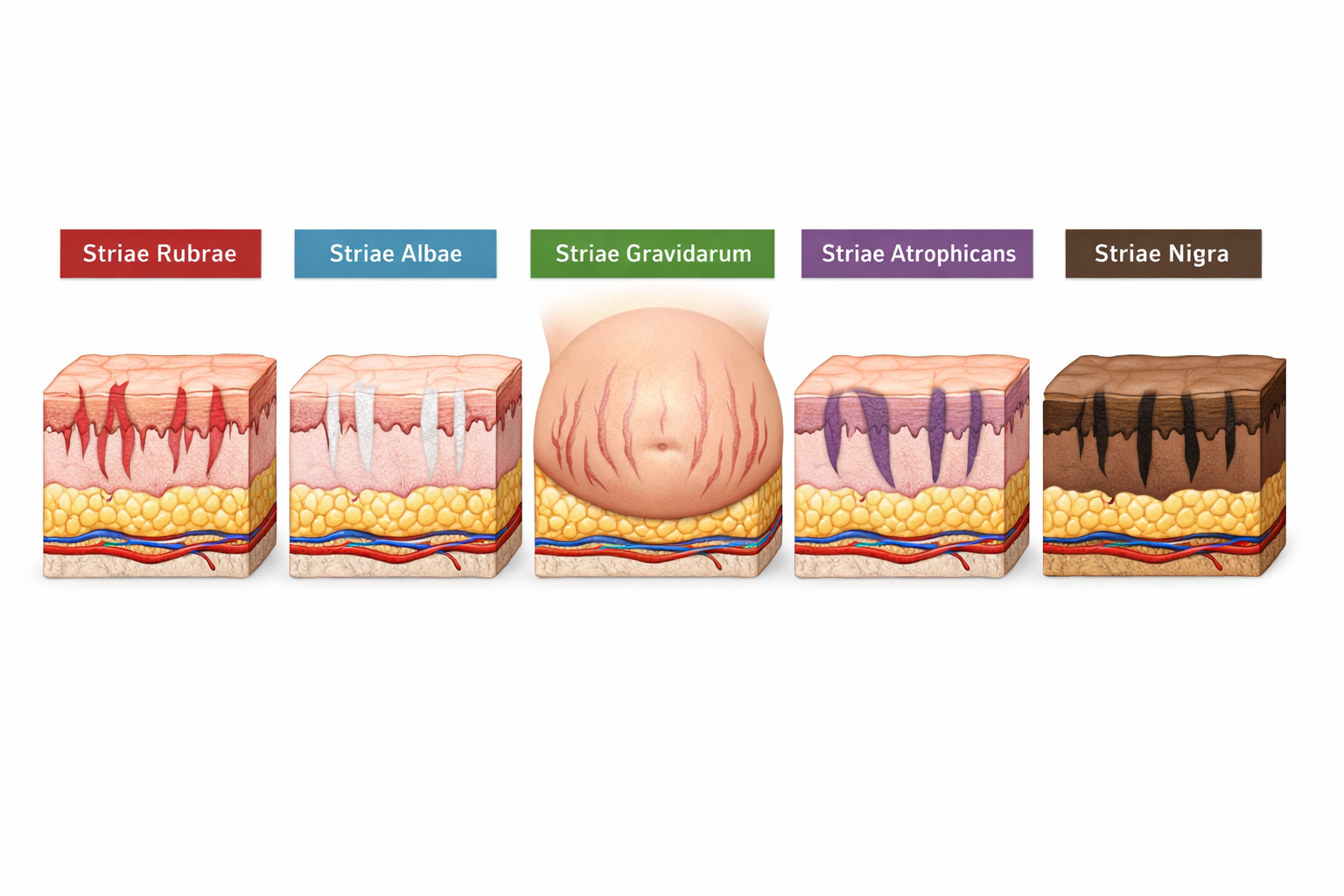
- Stretch marks are classified medically as striae distensae and fall into several distinct types based on colour, stage, and cause.
- Striae rubrae (red or pink marks) respond better to treatment than striae albae (white or silver mature marks), making early intervention important.
- Pregnancy, puberty, rapid weight change, corticosteroid use, and certain medical conditions are the most common underlying causes.
- On darker skin tones, stretch marks may appear dark grey or blue rather than red or white, and are classified separately as striae nigra or striae caerulea.
- No treatment completely removes stretch marks, but clinical options including pulsed dye laser, fractional CO2 laser, and microneedling can meaningfully reduce their appearance.
What Are Stretch Marks?
Stretch marks are a form of dermal scarring that occurs when the skin is stretched faster than its collagen and elastin fibers can accommodate. When mechanical stress exceeds the skin’s elastic capacity, the middle layer of skin — the dermis — tears internally, and the resulting linear scars become visible through the outer skin surface. The medical umbrella term for all stretch marks is striae distensae, from the Latin for stretched stripes.
Stretch marks are extremely common and can affect people of all ages, genders, and body types. Estimates suggest they affect between 50% and 90% of pregnant women, and a significant proportion of adolescents during puberty. They are not harmful to physical health, but many people find them cosmetically distressing and seek treatment.
What makes stretch marks appear differently from person to person depends on several factors: how recently they formed, the underlying cause, the individual’s skin tone, and the specific area of the body affected. Understanding these differences is the first step toward identifying which type you have and what your treatment options may look like.
How Stretch Marks Form: The Biological Mechanism
The skin’s dermis contains a structural network of collagen and elastin fibers that give it strength and flexibility. When skin is stretched rapidly — due to pregnancy, a growth spurt, or significant weight gain — the fibroblast cells responsible for maintaining this network cannot produce new fibers quickly enough to keep pace. The result is small tears within the dermal layer.
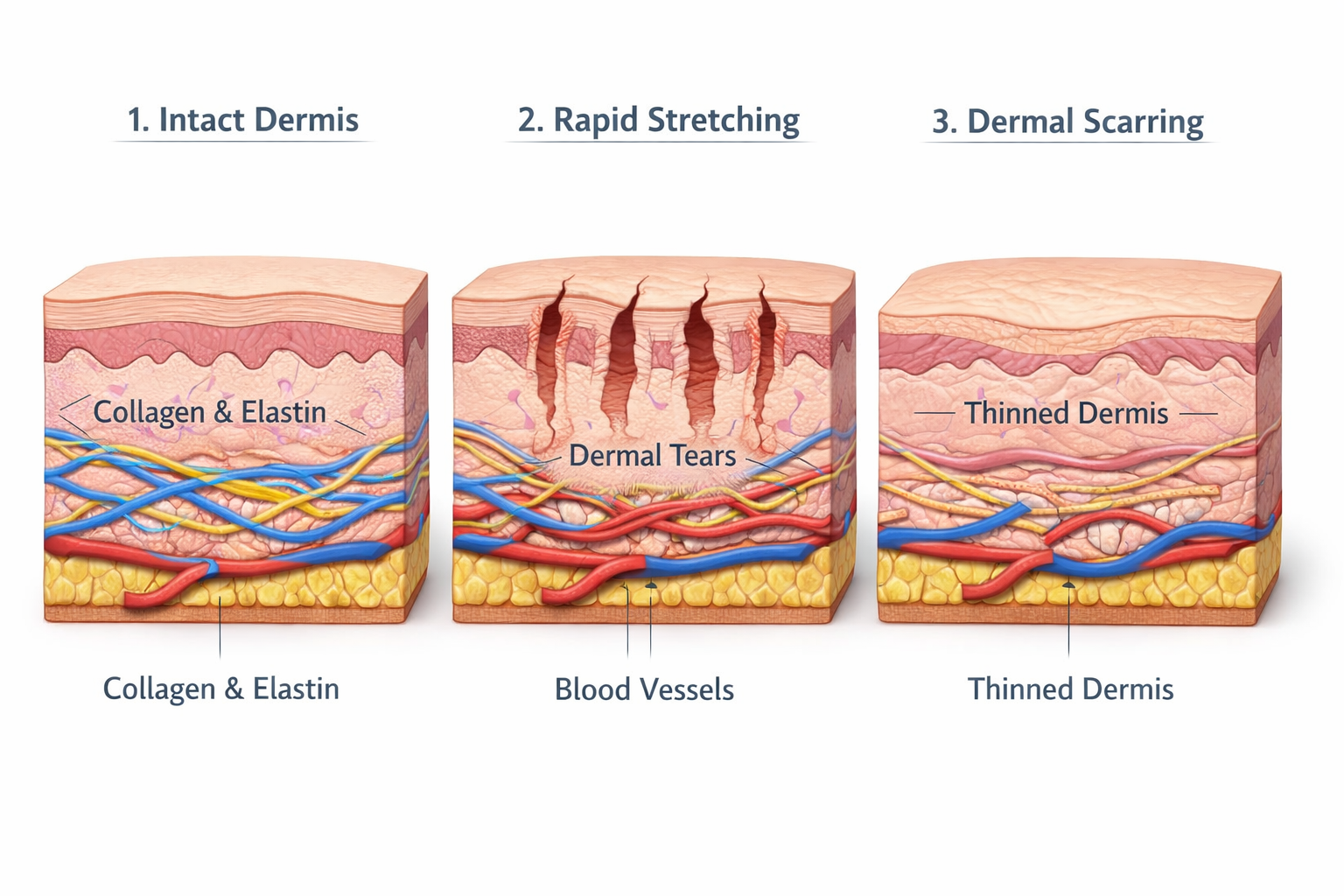
Research also implicates fibrillin microfibrils, structural proteins that anchor the outer skin layer to deeper tissue. Disruption of these microfibrils during rapid skin stretching contributes to the initial weakening of the dermis. Hormonal changes play an additional role: elevated levels of glucocorticoids (stress hormones that rise during pregnancy, puberty, and with corticosteroid use) can suppress collagen synthesis and further reduce skin elasticity, making the dermis more vulnerable to tearing.
In the early, active inflammatory phase, blood vessels are visible through the damaged dermis, giving marks their characteristic red or purple colour. Over time, the inflammation resolves, blood vessels contract, and the marks fade to a paler, more atrophic scar — losing pigment and becoming white or silver as the dermis thins and loses vascularity.
The Main Types of Stretch Marks
Clinicians classify stretch marks by colour and stage, by cause, and occasionally by their appearance on different skin tones. These classifications overlap, but understanding each one helps explain why two people can have very different-looking stretch marks even if the underlying cause is similar.
Striae Rubrae — Red or Pink Stretch Marks
Striae rubrae are newly formed, active stretch marks in their early inflammatory stage. They typically appear red, pink, or purple and may feel slightly raised, itchy, or tender to the touch. The colour comes from the visibility of blood vessels and capillaries through the thinned, disrupted dermis. These marks represent the acute phase of stretch mark development and are the most responsive to treatment, because the skin is still biologically active and capable of collagen remodeling.
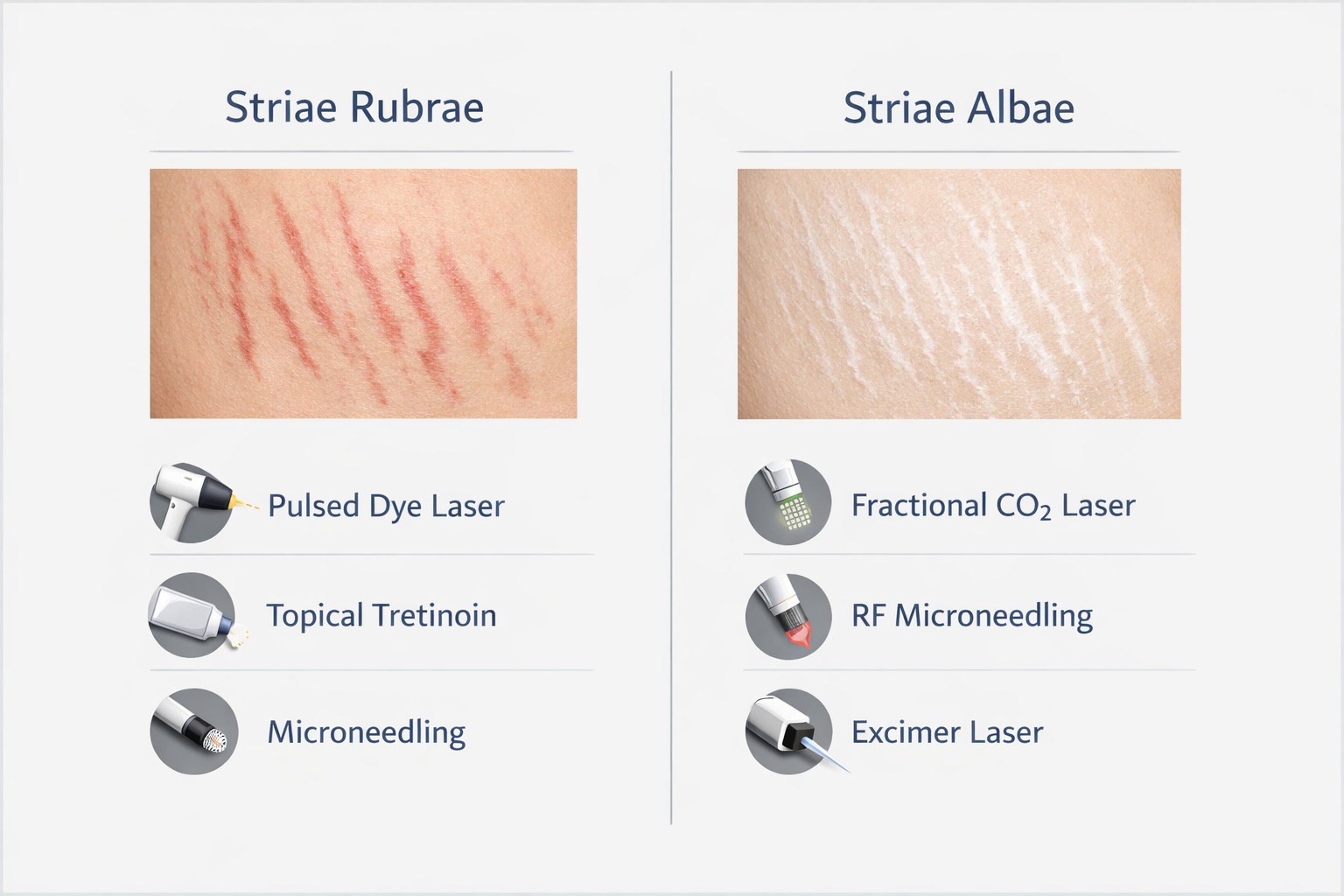
Early intervention during the striae rubrae phase generally yields better outcomes from treatments such as topical tretinoin, pulsed dye laser, and microneedling compared to treating older, established marks. If you notice new stretch marks forming and are concerned about their appearance, this is the stage at which seeking a clinical assessment is most worthwhile.
Striae Albae — White or Silver Stretch Marks
Striae albae are mature stretch marks that have progressed beyond the inflammatory phase. The blood vessels that once gave them colour have contracted, leaving behind pale, white, or silver linear scars that sit slightly below the surrounding skin surface. The affected dermis is thinner and has lost melanin-producing cells, which is why the marks appear hypopigmented. They tend to feel softer than striae rubrae but have a wrinkled or slightly indented texture.
Mature stretch marks are more challenging to treat because the biological activity that makes early marks responsive to intervention has diminished. Fractional CO2 laser, radiofrequency microneedling, and excimer laser are among the clinical approaches that may offer some improvement, though results are more variable and multiple sessions are typically required. Realistic expectations are essential: even optimal treatment can reduce the visibility of striae albae but is unlikely to eliminate them entirely.
Striae Gravidarum — Pregnancy Stretch Marks
Striae gravidarum are stretch marks that develop during pregnancy, most commonly appearing on the abdomen, breasts, hips, thighs, and lower back during the second and third trimesters. They are among the most common types and affect the majority of pregnant women to some degree. Their development is driven by both the rapid physical expansion of the body and the hormonal changes of pregnancy, particularly elevated cortisol and relaxin, which alter connective tissue properties.
Striae gravidarum typically begin as striae rubrae during pregnancy and may fade toward striae albae in the months following delivery. Genetics play a significant role in susceptibility: if a close family member developed prominent pregnancy stretch marks, the likelihood of doing so is higher. Keeping skin well-moisturised during pregnancy may support skin comfort, but the evidence that any topical product can reliably prevent striae gravidarum from forming is limited.
Striae Atrophicans — Steroid-Related and Condition-Associated Stretch Marks
Striae atrophicans is the term used for stretch marks associated with skin atrophy — thinning of the skin caused by prolonged corticosteroid use or by conditions that affect connective tissue. Unlike the other types, striae atrophicans can develop without significant physical stretching of the skin. Instead, the marks arise because corticosteroids suppress fibroblast activity and collagen synthesis, leaving the dermis structurally weakened.
Long-term use of topical steroid creams — particularly on areas such as the inner arms, groin, or thighs — can produce striae atrophicans even when no significant weight change has occurred. The same mechanism underlies stretch marks seen in people with Cushing’s syndrome, a condition of chronic cortisol excess, where wide, violaceous (deep purple-red) stretch marks on the abdomen and flanks are a recognized clinical feature. People with Marfan syndrome and Ehlers-Danlos syndrome, both of which involve connective tissue abnormalities, are also more prone to developing striae atrophicans due to inherently compromised skin architecture.
Striae atrophicans are generally wider and more pronounced than stretch marks from other causes, and because the underlying skin is already structurally thin, they often require particularly careful treatment planning if cosmetic intervention is considered.
Striae Distensae from Puberty and Rapid Growth
During puberty, adolescents commonly develop stretch marks as the body undergoes rapid growth spurts. In adolescent males, marks tend to appear on the lower back, buttocks, and thighs; in adolescent females, they more often develop on the breasts, hips, and thighs. These marks are driven by the combination of rapid physical growth and the hormonal surges of puberty, which simultaneously increase growth rate and alter collagen production.
Bodybuilders and people who rapidly increase muscle mass can develop a similar type of stretch mark — most often across the shoulders, upper arms, and chest — as skin struggles to accommodate the fast increase in underlying muscle volume. These marks share the same underlying biology but are worth distinguishing because the affected area and typical demographic differ from pregnancy or weight-related stretch marks.
Stretch Marks by Skin Tone: Striae Nigra and Striae Caerulea
Most descriptions of stretch marks assume lighter skin tones, where the red-to-white progression of striae rubrae to striae albae is most visible. However, stretch marks present differently on darker skin tones, and these variations have their own clinical classifications that are frequently overlooked.
Striae nigra are dark grey or black stretch marks that can develop on individuals with medium to darker skin tones. Rather than appearing red in the early stage, the marks may take on a darker discolouration relative to the surrounding skin, due to the way higher melanin content interacts with dermal inflammation and post-inflammatory hyperpigmentation.
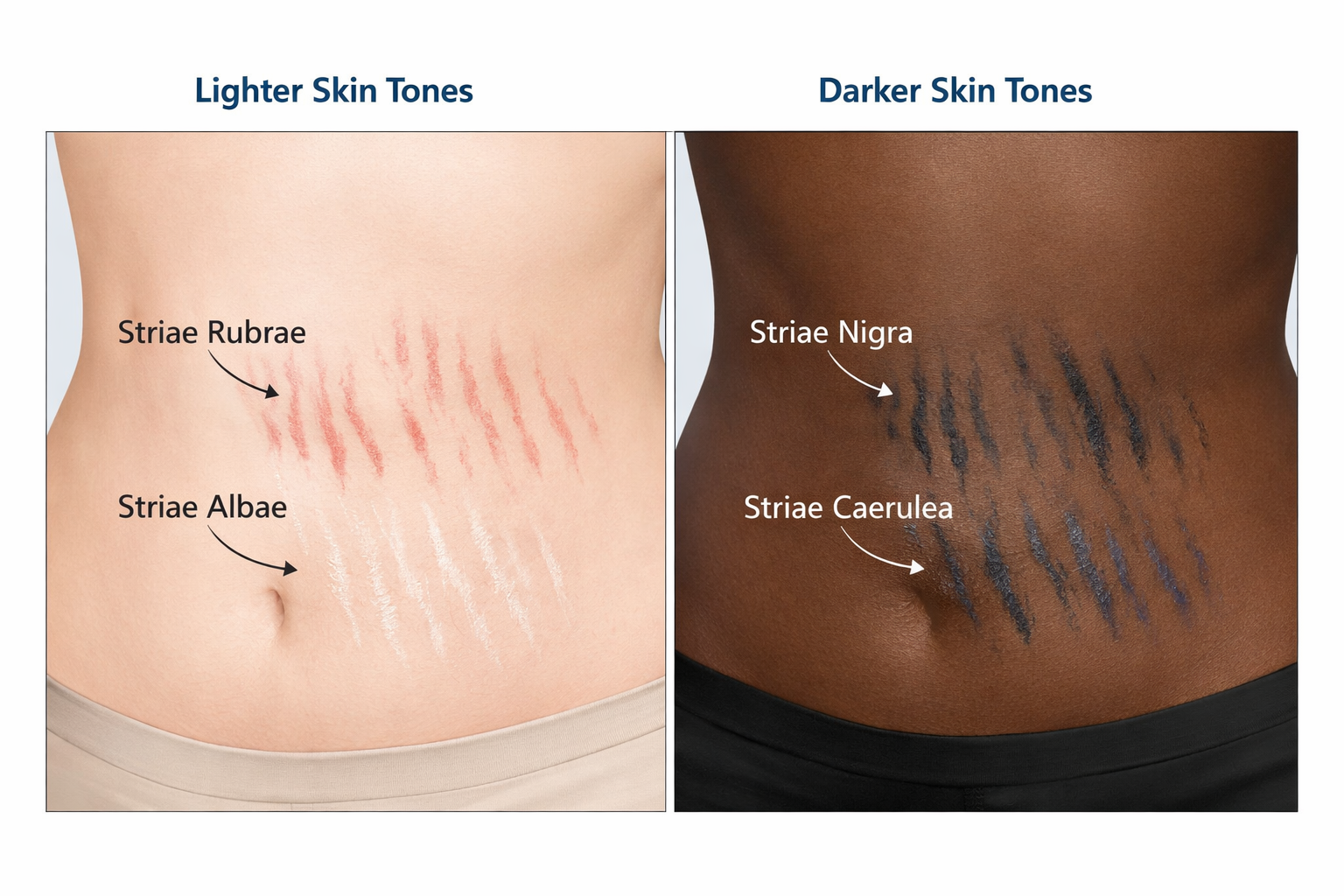
Striae caerulea are dark blue stretch marks that can also appear on darker skin tones, representing a variation in the way vascular changes within the dermis are perceived through higher-melanin skin layers. Both striae nigra and striae caerulea may be less immediately obvious against darker skin but can cause significant cosmetic concern, and their response to treatment can differ from that of lighter-skin presentations. Treatments that carry a risk of post-inflammatory hyperpigmentation — such as certain laser wavelengths — require careful consideration and specialist selection in patients with higher Fitzpatrick skin phototypes.
What Type of Stretch Mark Do I Have? A Simple Guide
If you are uncertain which type of stretch mark you have, the following characteristics can help orient you before a professional assessment:
- Red, pink, or purple, slightly raised or itchy: likely striae rubrae — a newer, active mark in its inflammatory phase.
- White, silver, or pale, with a flat or slightly indented texture: likely striae albae — a mature mark beyond the inflammatory stage.
- Dark grey, black, or dark blue (on medium to dark skin tones): may be striae nigra or striae caerulea — a skin-tone variant of early or mature stretch marks.
- Wide, deep purple-red, appearing without significant weight change: consider striae atrophicans — particularly if you use topical steroids or have a relevant medical condition such as Cushing’s syndrome.
- Appeared during pregnancy, on the abdomen or breasts: striae gravidarum, likely transitioning from rubrae to albae after delivery.
- Appeared during adolescence or after rapid muscle gain: puberty- or bodybuilding-related striae distensae.
A dermatologist or qualified aesthetic practitioner can confirm the type and stage during a clinical assessment and advise on the most appropriate treatment path.
Treatment Options by Stretch Mark Type
No single treatment removes stretch marks completely. The goal of clinical treatment is to reduce their visibility, improve skin texture, and stimulate collagen remodeling within the affected dermis. Treatment responsiveness varies significantly depending on the type and age of the stretch marks.
| Type | Stage | Treatments Likely to Help | Realistic Expectation |
|---|---|---|---|
| Striae rubrae | Active/early | Pulsed dye laser, topical tretinoin, microneedling, chemical peels | Good improvement possible; earlier treatment gives better results |
| Striae albae | Mature/chronic | Fractional CO2 laser, radiofrequency microneedling, excimer laser, microdermabrasion | Moderate improvement; multiple sessions typically needed |
| Striae gravidarum | Varies (rubrae during pregnancy → albae after) | Post-delivery: as per rubrae or albae depending on stage | Improvement likely; some marks may fade naturally over time |
| Striae atrophicans | Often chronic | Fractional laser, microneedling (with caution); address underlying cause first | Variable; underlying skin atrophy limits response |
| Striae nigra/caerulea | Varies | Skin-tone appropriate laser, microneedling; avoid high-risk wavelengths | Specialist assessment essential; hyperpigmentation risk must be managed |
Topical Treatments
Topical tretinoin (a prescription retinoid) has the strongest evidence base among at-home topical options for striae rubrae. It works by stimulating fibroblast activity and collagen production within the dermis, and studies suggest it can reduce the length and width of early stretch marks. It is not suitable during pregnancy or breastfeeding. Hyaluronic acid-based products may improve skin hydration and texture but have more limited evidence for structural stretch mark improvement. Products containing centella asiatica or vitamin C are used in some formulations, though evidence for significant structural change is modest.
Laser and Energy-Based Treatments
Pulsed dye laser targets the vascular component of striae rubrae, reducing redness and stimulating some degree of collagen remodeling. It is generally considered the most effective laser for early, red stretch marks. Fractional CO2 laser creates microscopic treatment zones in the dermis, triggering a controlled healing response and new collagen deposition; it is more commonly used for striae albae, where it can improve texture and reduce hypopigmentation. Excimer laser selectively stimulates melanin production and may help repigment pale stretch marks. Each of these approaches requires multiple sessions and carries potential side effects including redness, swelling, and in higher skin phototypes, a risk of post-inflammatory hyperpigmentation.
Microneedling and Radiofrequency
Microneedling uses fine needles to create controlled micro-injuries in the dermis, stimulating collagen and elastin fiber production. When combined with radiofrequency energy delivery, the treatment can reach deeper dermal layers and may produce more pronounced remodeling. Microneedling is used for both striae rubrae and striae albae, though response rates are generally better for newer marks. It tends to carry a lower risk of pigmentation changes compared to some laser wavelengths, making it a commonly considered option for patients with medium to darker skin tones.
Risk Factors: Who Is More Likely to Develop Stretch Marks?
Stretch marks do not discriminate, but certain factors increase the likelihood of developing them or influence their severity. Genetics is among the most significant: a family history of prominent stretch marks substantially increases individual risk. Hormonal factors play a direct biological role, as elevated glucocorticoid levels reduce the dermis’s structural resilience. Beyond pregnancy and puberty, other risk factors include rapid weight gain or loss, long-term corticosteroid use (topical or systemic), and the connective tissue conditions mentioned earlier.
Skin elasticity and pre-existing skin quality also matter. Younger skin with greater inherent elasticity may develop fewer marks under the same degree of stretching compared to skin that is already less supple. Body location affects risk too: areas that experience the greatest mechanical stress during stretching — the abdomen, thighs, breasts, hips, buttocks, upper arms, and lower back — are the most commonly affected.
Can Stretch Marks Be Prevented?
Prevention depends significantly on the cause. For pregnancy stretch marks, maintaining slow, steady weight gain within recommended guidelines and keeping skin well-moisturised may reduce severity in some women, though evidence for prevention specifically is limited and genetics remains a stronger determinant. For steroid-induced striae atrophicans, using the lowest effective potency of topical corticosteroid for the shortest necessary duration, and avoiding application to high-risk areas such as the groin and inner arms, reduces risk. For puberty-related marks, prevention is largely impractical given that growth rate is not controllable; however, gradual rather than extreme fluctuations in body weight and muscle gain during training programmes may reduce severity.
Frequently Asked Questions
Do stretch marks go away on their own?
Stretch marks do not fully disappear without treatment, but they often fade and become less noticeable over time. Striae rubrae will typically transition to striae albae over several months to years, becoming paler and less visible. They rarely reach a point of being completely undetectable to the naked eye without clinical intervention.
Are red stretch marks easier to treat than white ones?
Yes, generally. Striae rubrae in the active inflammatory phase respond better to treatments such as topical tretinoin and pulsed dye laser because the dermis is still biologically active. Striae albae are more established scars with less vascular activity, making them more resistant to treatment and requiring more sessions to achieve visible improvement.
Can stretch marks appear without significant weight change?
Yes. Striae atrophicans can develop through prolonged corticosteroid use or conditions such as Cushing’s syndrome without notable weight change. Puberty-related marks can also form rapidly during growth spurts independent of changes in body weight.
Are stretch marks dangerous?
Stretch marks are benign and do not pose a risk to physical health. However, wide, purple, rapidly appearing stretch marks — particularly on the abdomen and without an obvious cause such as pregnancy or weight gain — can occasionally be a sign of an underlying hormonal condition such as Cushing’s syndrome, and warrant medical evaluation.
Is laser treatment safe for stretch marks on darker skin?
Some laser treatments carry a meaningful risk of post-inflammatory hyperpigmentation on medium to darker skin tones. Skin-tone-appropriate wavelengths and settings, combined with a specialist experienced in treating higher Fitzpatrick phototypes, are essential. Microneedling is often preferred as a lower-risk alternative in these patients, though any treatment should be preceded by a thorough consultation.
How many treatment sessions will I need?
Most clinical treatments for stretch marks require a course of sessions rather than a single appointment. The number depends on the type and severity of the marks, the treatment chosen, and individual response. Laser and microneedling protocols for stretch marks typically involve three to six sessions spaced several weeks apart, though this varies and should be discussed at consultation.
Understanding Your Stretch Marks Before Choosing a Treatment
Identifying the type of stretch mark you have — its colour, texture, underlying cause, and how long it has been present — is the most practical starting point before exploring treatment. Striae rubrae and striae albae require different approaches, and factors such as skin tone and the involvement of a medical condition like Cushing’s syndrome or long-term steroid use add further nuance that affects both treatment selection and expected outcomes.
The honest reality is that no treatment currently available can fully erase stretch marks. What clinical treatments can do — with appropriate patient selection and realistic expectations — is meaningfully reduce their appearance, improve skin texture, and help marks blend more naturally with the surrounding skin. The earlier treatment is pursued, particularly during the striae rubrae phase, the greater the likelihood of a satisfying outcome.
If you are concerned about stretch marks and want to explore your options, a consultation with a qualified dermatologist or experienced aesthetic practitioner is the most useful next step. A clinical assessment can confirm the type and stage of your marks, identify any contributing factors worth addressing, and help you understand which treatments are most likely to be appropriate for your skin.
