
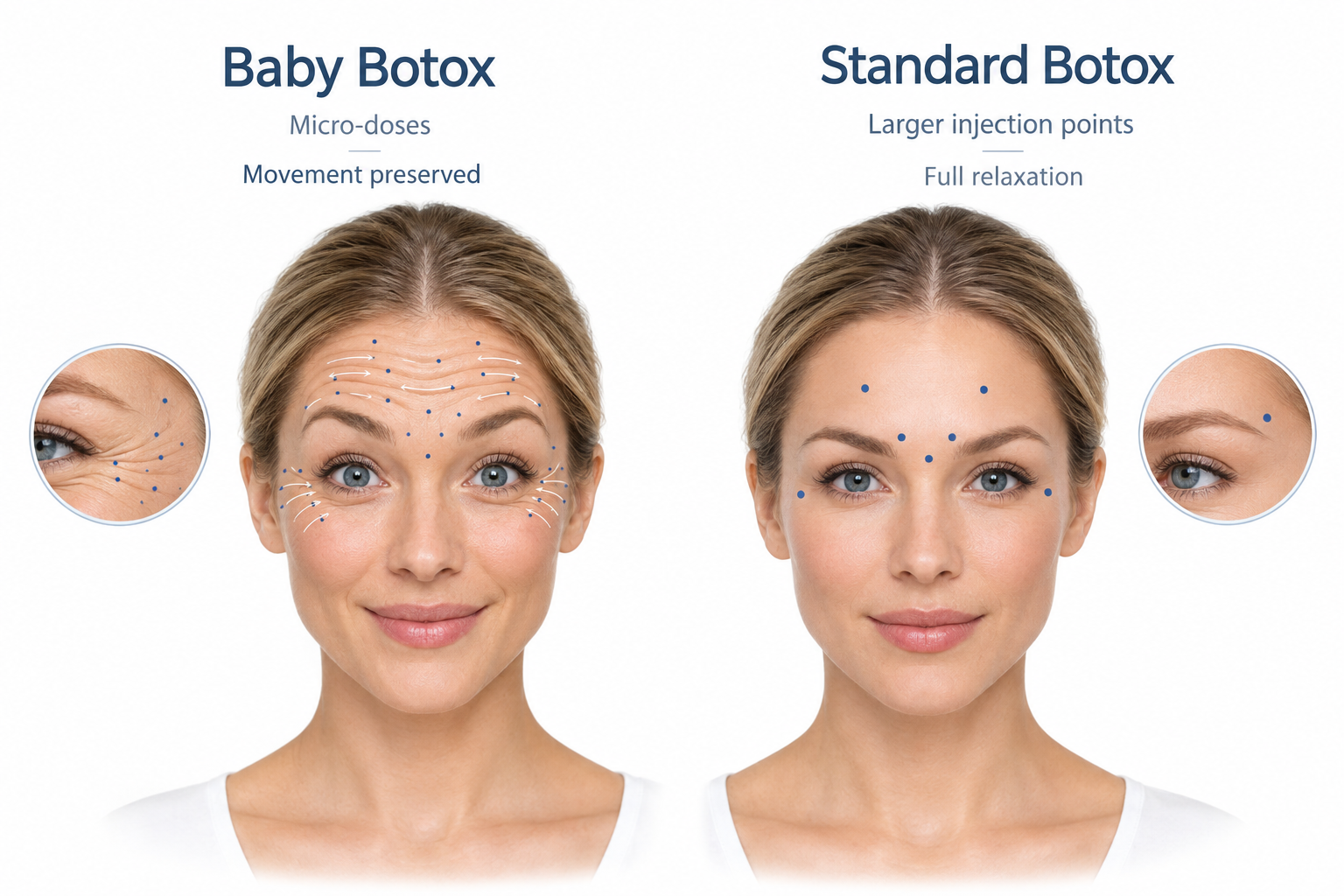

Baby Botox refers to a conservative dosing technique in which smaller amounts of botulinum toxin are injected across more precisely targeted points to soften fine lines and wrinkles while preserving natural facial expressiveness. It is not a different formula or a separate product — it is a treatment philosophy built around the principle that subtle muscle modulation, rather than full muscle relaxation, can deliver a refreshed, not treated appearance. For many patients, particularly those exploring injectables for the first time or those who have previously felt over-treated, this approach offers a meaningful middle ground.
Key Takeaways
- Baby Botox uses micro-doses of the same botulinum toxin neuromodulator used in standard treatment — the difference lies in the technique and dosage, not the product itself.
- Results typically last two to three months, slightly shorter than standard Botox, and may require more frequent touch-up sessions to maintain.
- The approach is well suited to first-time injectable patients, younger adults pursuing prejuvenation, and those who prioritise movement preservation over maximum wrinkle reduction.
- Choosing a practitioner with a thorough understanding of facial muscle anatomy and individual movement patterns is the most important factor in achieving natural-looking results.
- Honest limitations exist: undertreating carries its own risks, and the annual cost may be comparable to or higher than standard Botox when more frequent sessions are factored in.
What Is Baby Botox?
Baby Botox is a technique that uses reduced units of botulinum toxin type A — the same neuromodulator used in conventional treatment — delivered through hyper-localized injections across carefully selected points on the face. Where a standard Botox session for the forehead might use 20 to 35 units, a baby Botox session for the same area might use approximately 10 units or fewer, distributed across a greater number of injection sites. The goal is not to eliminate muscle movement entirely but to reduce the intensity of repeated muscle contractions that, over time, etch dynamic wrinkles into the skin.
The term itself is informal and not a regulated medical designation. Different practitioners may use it slightly differently, but the core conservative dosing philosophy remains consistent: less product, more precision, and a deliberate effort to avoid the "frozen" look that has historically made some patients reluctant to try botulinum toxin treatments at all. The approach has grown in popularity alongside a broader cultural shift toward natural-looking aesthetic results and a growing interest in preventative skincare among younger adults.
How Baby Botox Differs From Standard Botox
| Characteristic | Baby Botox | Standard Botox |
|---|---|---|
| Dosage | Approximately 10 units or fewer per area | Typically 20–35 units per area |
| Injection points | More points, smaller volumes per point | Fewer points, larger volumes per point |
| Muscle effect | Partial relaxation; movement preserved | More complete muscle relaxation |
| Result appearance | Subtle, natural-looking | More pronounced wrinkle reduction |
| Duration | Approximately 2–3 months | Approximately 3–4 months |
| Touch-up frequency | Every 2–3 months (4–6 sessions/year) | Every 3–4 months (3–4 sessions/year) |
| Ideal candidate | First-timers, younger adults, expressive careers | Established dynamic or static wrinkles |
| Per-session cost | Lower (fewer units) | Higher (more units) |
| Annual cost | Potentially comparable due to frequency | Fewer sessions may offset higher per-session cost |
The most clinically meaningful difference between baby Botox and traditional Botox is movement preservation. Standard dosing aims to achieve a more complete relaxation of the target muscle — the frontalis for forehead lines, the corrugator and procerus for frown lines, and the orbicularis oculi for crow's feet. Baby Botox intentionally leaves residual muscle activity, which means patients can still raise their eyebrows, squint expressively, and animate their face naturally. The trade-off is that wrinkle reduction is less complete and results fade more quickly.
The Science Behind Preventative Botox
Understanding why baby Botox can be genuinely useful for younger patients requires a brief look at how dynamic wrinkles become static wrinkles. Dynamic wrinkles — lines that appear when you smile, squint, or frown — are caused by repeated muscle contractions folding the overlying skin. In younger skin, these lines disappear when the face is at rest. Over years of repeated folding, however, the collagen and elastin fibres in the skin begin to break down along those crease lines, and the wrinkles become visible even without muscle movement. At that point, they are classified as static wrinkles, which are considerably harder to treat.
Botulinum toxin works by blocking the release of acetylcholine at the nerve terminal, preventing the signal that would otherwise cause the muscle to contract. By reducing the frequency and intensity of those contractions — even partially, as baby Botox does — the skin experiences less repetitive folding. The concept of prejuvenation is built on this mechanism: intervening before static wrinkles form, rather than attempting to correct them after they have become established. Several practitioners and dermatologists support this rationale, though long-term controlled studies specifically on baby Botox as a preventative strategy remain limited, and individual results will vary based on genetics, sun exposure, skincare habits, and lifestyle factors.
Baby Botox vs. Microtox: An Important Distinction
Baby Botox and microtox (also written micro-tox or microdroplet Botox) are frequently confused, but they are meaningfully different techniques with different goals. Baby Botox involves injecting reduced units of botulinum toxin into the muscle itself — the same intramuscular approach used in standard treatment, simply with a lower dose. The primary aim is partial muscle relaxation to soften fine lines and wrinkles while preserving natural facial movement.
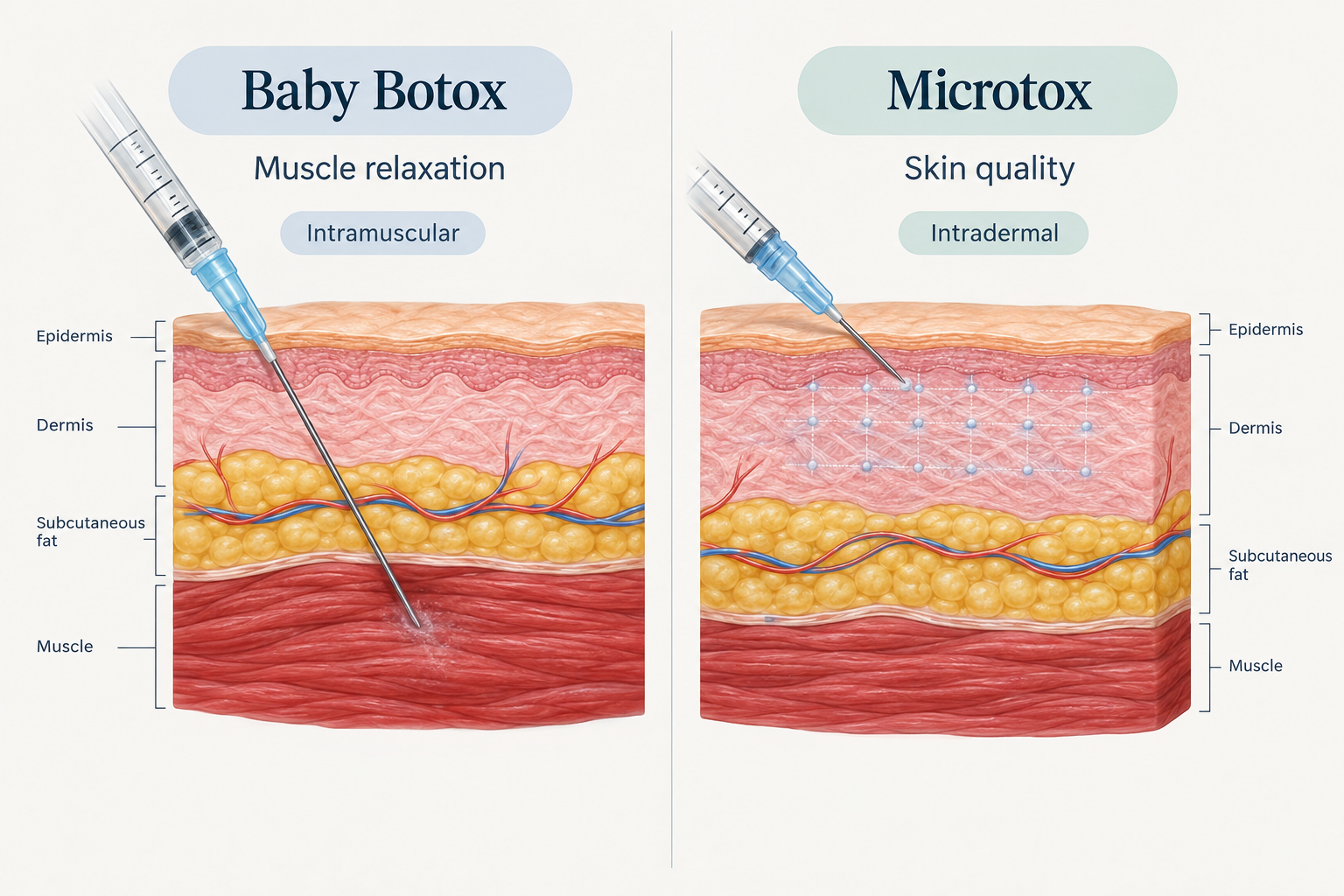
Microtox, by contrast, involves injecting a highly diluted solution of botulinum toxin superficially into the dermis — the skin layer itself — rather than into the underlying muscle. The injections are placed in a grid pattern across a broader surface area. Because the toxin is delivered intradermally at very low concentrations, it does not significantly relax the muscles responsible for facial expression. Instead, it targets the tiny arrector pili muscles, sebaceous glands, and superficial skin structures, with the aim of improving skin texture, reducing pore size, and refining skin quality. Microtox is therefore more of a skin quality improvement technique than a wrinkle-reduction approach. Patients seeking to address fine lines caused by muscle movement should discuss baby Botox; those primarily concerned with skin texture and pore appearance may find microtox more relevant — though both techniques may be combined in some treatment plans.
Treatment Areas Commonly Addressed
Baby Botox can be applied to most of the same areas treated with standard botulinum toxin, though the reduced dosing means it is best suited to areas where partial relaxation is sufficient to achieve the desired result. The most commonly treated areas include the forehead (horizontal lines caused by frontalis muscle activity), the glabella (the frown lines or "11" lines between the brows, caused by the corrugator and procerus muscles), and the crow's feet at the outer corners of the eyes. These three areas account for the majority of baby Botox treatments.
Additional areas where the conservative approach may be appropriate include bunny lines across the bridge of the nose, subtle brow lifting, chin dimpling, and fine lines around the mouth. The neck (platysma bands) can also be treated, though this typically requires more units to achieve a visible result and may be less suited to a baby Botox approach. Masseter reduction for jawline slimming generally requires higher doses and is less commonly performed as a baby Botox treatment. A qualified practitioner will assess which areas are appropriate based on individual facial muscle anatomy and the patient's specific goals.
Who May Be a Suitable Candidate
Baby Botox tends to be most appropriate for adults in their mid-to-late twenties and thirties who are beginning to notice early dynamic wrinkles but have not yet developed deep static lines. It is also a reasonable option for patients who have previously received standard Botox and found the results too pronounced, or for those who are considering their first injectable experience and want to start conservatively. People in expressive careers — actors, teachers, therapists, public speakers, and others whose work depends on communicating through facial expression — often find that baby Botox allows them to soften lines without compromising the animated quality of their face.
Patients with well-established static wrinkles visible at rest may find that baby Botox provides insufficient correction and that standard dosing or a combination approach is more appropriate for their concerns. A thorough consultation with an experienced injector should clarify realistic expectations before any treatment is undertaken.
The following groups should not receive baby Botox or any botulinum toxin treatment:
- Pregnant or breastfeeding individuals
- Those with a known allergy to botulinum toxin or any product ingredient
- Patients with neuromuscular conditions such as myasthenia gravis or Lambert-Eaton syndrome
- Those with active infection or inflammation at the planned injection site
- Patients taking certain medications, including aminoglycoside antibiotics, that may potentiate the effect of botulinum toxin
A full medical history review is essential before treatment. Patients should disclose all medications, supplements, and relevant health conditions at consultation.
The Role of the Injector: Why Technique Matters More Than Dosage
Most discussions of baby Botox focus on the number of units used, but the injector's expertise and treatment philosophy are arguably more important than the dose alone. Achieving natural-looking results with reduced units requires a detailed understanding of facial muscle anatomy — specifically, how individual muscles interact, how they behave at rest versus during animation, and how variations in anatomy between patients affect where and how deeply to place each injection.
A skilled practitioner will typically conduct a movement analysis before injecting, observing how the patient's face moves through a range of expressions rather than applying a standardised injection map. This assessment helps identify which muscles are dominant, where the strongest contractions occur, and which areas require the most conservative approach to avoid unintended effects such as brow drooping or asymmetry. The difference between a result that looks refreshed and one that looks uneven often comes down to this pre-injection assessment rather than the product itself. When researching providers, it is worth asking specifically how they approach facial movement assessment and what their philosophy is around conservative dosing — not simply how many units they use.
What to Expect During the Procedure
A baby Botox appointment typically follows the same general steps as a standard botulinum toxin session, with the session usually completed within 15 to 30 minutes. The process generally involves:
- Consultation and movement analysis: The practitioner reviews your medical history, discusses your goals, and observes your facial expressions at rest and during animation to plan the injection pattern.
- Skin preparation: The treatment area is cleansed and, if requested, a topical numbing cream may be applied and left for 15 to 20 minutes before injection.
- Micro-injections: Using a fine needle, the practitioner delivers small volumes of botulinum toxin across the planned injection points. The number of points is typically higher than in standard treatment, with smaller volumes at each site.
- Post-treatment review: The practitioner checks the treated areas and provides aftercare instructions before the patient leaves.
Most patients describe the sensation as a series of brief, mild pinpricks. Discomfort is generally minimal, and no anaesthesia beyond optional topical numbing is required. There is no meaningful downtime following treatment.
Pre-Treatment Preparation
To reduce the risk of bruising and support the best possible outcome, patients are generally advised to follow a preparation checklist in the days before treatment. Common recommendations include avoiding blood-thinning medications and supplements such as aspirin, ibuprofen, fish oil, vitamin E, and high-dose garlic supplements for approximately one week before treatment (unless prescribed by a doctor, in which case the prescribing physician should be consulted). Alcohol should be avoided for at least 24 hours before the appointment. Patients should arrive with clean skin, free from heavy makeup, and should inform their practitioner of any recent illness, dental work, or vaccinations. Individual clinics may have specific pre-treatment protocols, and patients should follow the guidance provided at their consultation.
Results Timeline and How Long Baby Botox Lasts
Botulinum toxin does not produce immediate visible results. After injection, the toxin binds to the nerve terminals and begins inhibiting acetylcholine release, but the muscle relaxation effect takes several days to become apparent. A typical results timeline looks like this:
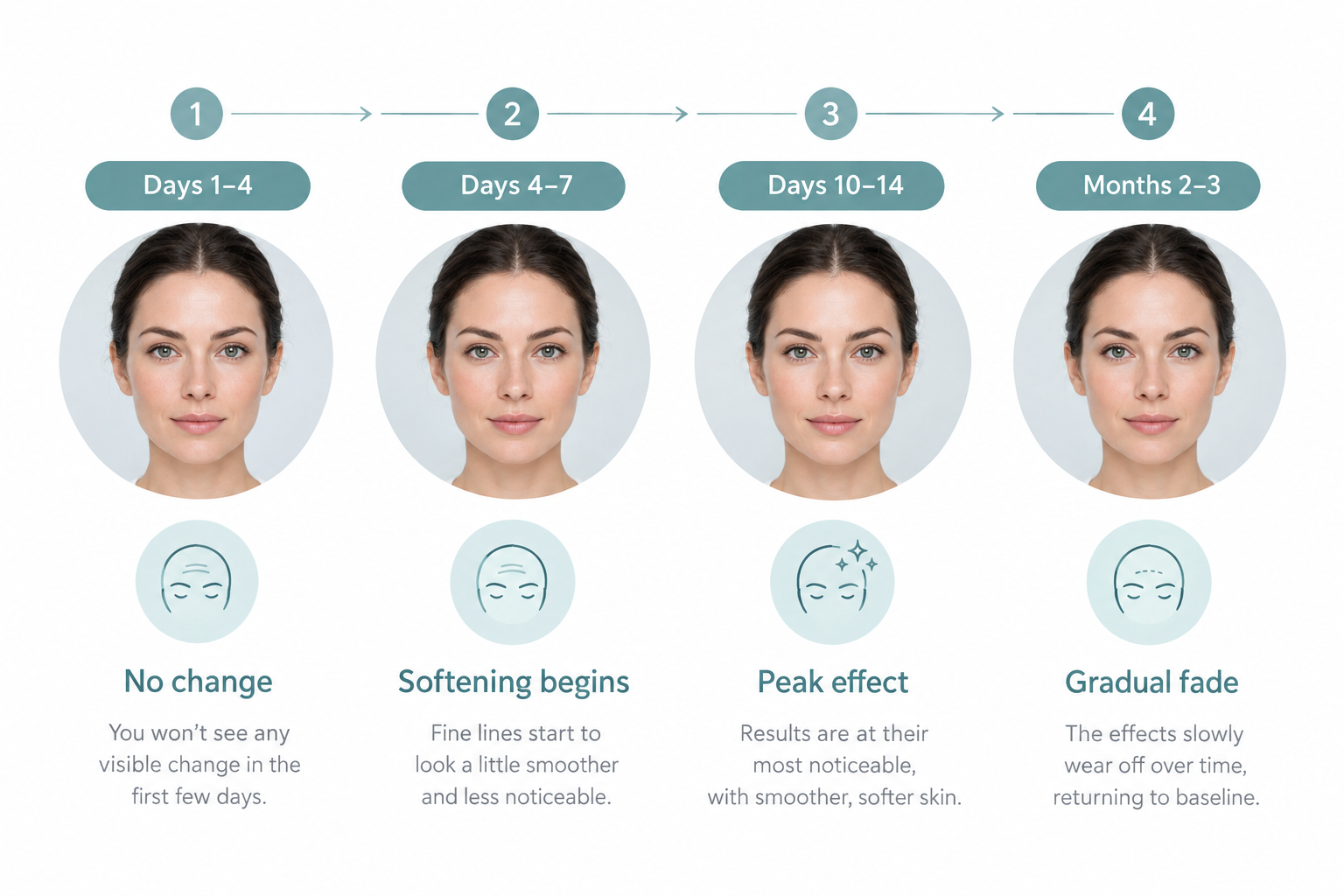
- Days 1–4: No visible change; the toxin is binding at the neuromuscular junction.
- Days 4–7: Subtle softening of movement begins to appear.
- Days 10–14: Peak effect is reached; this is the point at which results are most visible.
- Months 2–3: The effect gradually diminishes as nerve terminals regenerate and muscle activity returns.
Baby Botox results typically last approximately two to three months, compared to three to four months for standard dosing. The shorter duration reflects the lower dose — with fewer units blocking neuromuscular transmission, the muscle recovers its activity more quickly. This means that maintaining results with baby Botox generally requires four to six sessions per year, compared to three to four sessions for standard treatment. Patients should factor this into their planning, as the lower per-session cost of baby Botox may be partially or fully offset by the higher touch-up frequency.
Some practitioners suggest that repeated treatments over time may gradually reduce the strength of habitual muscle contractions — a concept sometimes described as muscle training or muscle memory modification — potentially extending the interval between sessions for some patients. This is a plausible mechanism given what is known about neuromuscular adaptation, but robust long-term clinical data specifically supporting this outcome for baby Botox are limited, and individual responses vary considerably.
Aftercare Guidelines
Post-treatment care for baby Botox follows the same principles as standard botulinum toxin aftercare. Patients are generally advised to avoid rubbing or massaging the treated areas for at least 24 hours, to remain upright and avoid lying face-down for approximately four hours after treatment, and to avoid strenuous exercise for 24 to 48 hours. Alcohol and excessive heat — including saunas, steam rooms, and prolonged sun exposure — should be avoided for the first 24 hours. These precautions are intended to minimise the risk of the toxin migrating to unintended muscle groups, which could cause temporary drooping or asymmetry. Patients should contact their practitioner if they notice any unexpected changes in the days following treatment.
Risks, Side Effects, and Honest Limitations
Baby Botox carries the same category of risks as standard botulinum toxin treatment, though the lower doses may reduce the likelihood of some adverse effects. Common and generally temporary side effects include mild swelling, redness, or bruising at injection sites, and occasional headache in the hours following treatment. These typically resolve within a few days without intervention.
Less common but more significant risks include eyelid drooping (ptosis), brow drooping, and asymmetry between the two sides of the face. These effects are usually temporary and resolve as the toxin wears off, but they can be distressing while present. They are most often associated with toxin migration from the injection site, which underscores the importance of choosing a practitioner with a thorough understanding of facial anatomy and precise injection technique.
An underappreciated risk specific to the baby Botox approach is the consequence of undertreating. When doses are too low to achieve even partial muscle relaxation, patients may experience muscle twitching, uneven results, or asymmetry. Repeated treatments at very low doses that fail to adequately block neuromuscular transmission may also, in theory, contribute to the development of neutralising antibodies against botulinum toxin — a phenomenon known as botulinum toxin resistance — though this is considered rare and is more commonly associated with very frequent treatments at higher doses. Patients and practitioners should be aware that conservative dosing does not mean risk-free dosing, and that finding the right balance requires clinical judgement rather than simply using the smallest possible amount.
Real-world accounts, including that of athlete Simone Biles who publicly described experiencing eyebrow twitching and asymmetry following treatment, illustrate that even well-known individuals can experience side effects. These accounts are a useful reminder that outcomes are not guaranteed and that individual responses to botulinum toxin vary.
Annual Cost Considerations
Baby Botox is priced per unit, with typical per-unit costs ranging from approximately £8 to £20 in the UK and $10 to $25 in the US, depending on the provider and location. A baby Botox session using around 10 units per area will cost less per appointment than a standard session using 20 to 35 units. However, because baby Botox results last approximately two to three months rather than three to four months, patients may need four to six sessions per year rather than three to four. When the annual cost is calculated across all sessions, the total expenditure may be broadly comparable to standard Botox, and in some cases higher. Patients in major metropolitan areas should expect higher per-unit costs. A transparent discussion of annual treatment costs — not just per-session costs — is a reasonable question to raise at consultation.
Combining Baby Botox With Other Treatments
Baby Botox is often most effective as part of a broader approach to skin health rather than as a standalone solution. Combining conservative botulinum toxin treatment with a consistent skincare routine — particularly daily broad-spectrum SPF and evidence-supported actives such as retinoids — addresses both the muscular and environmental contributors to skin ageing. Dermal fillers may be appropriate for patients who also have volume loss or deeper static lines that baby Botox alone cannot address. Skin boosters or polynucleotide treatments may complement the skin quality improvement goals that some patients associate with the microtox variant of the technique. A practitioner who takes a holistic view of facial ageing and can discuss combination approaches is likely to deliver more satisfying long-term outcomes than one focused solely on a single modality.
Frequently Asked Questions
Is baby Botox suitable for someone in their twenties?
Baby Botox may be appropriate for adults in their mid-to-late twenties who are beginning to notice early dynamic wrinkles and are interested in a preventative approach. Suitability depends on individual anatomy, skin condition, and goals, and should be assessed at a thorough consultation rather than assumed based on age alone.
Will I still be able to move my face normally?
Movement preservation is one of the defining goals of the baby Botox approach. Most patients retain the ability to raise their eyebrows, smile, and express themselves naturally. The degree of movement preserved depends on the dose used and individual muscle strength, and results vary between patients.
How does baby Botox compare in cost to standard Botox over a full year?
While each baby Botox session costs less due to fewer units, the shorter duration of results means more sessions per year. The annual cost may be broadly similar to or, in some cases, higher than standard Botox. Discussing the full annual treatment plan and associated costs at consultation is advisable.
Can baby Botox treat deep wrinkles?
Baby Botox is best suited to early dynamic wrinkles and fine lines. Deep static wrinkles — those visible at rest without any muscle movement — are unlikely to be adequately addressed by conservative dosing alone. Standard Botox, dermal fillers, or a combination approach may be more appropriate for established static lines.
How do I find a practitioner who specialises in natural-looking results?
Look for a medically qualified practitioner — a doctor, dentist, or nurse prescriber with specific training in aesthetic injectables — who can demonstrate experience with conservative dosing and who conducts a detailed facial movement assessment before treatment. Asking to see examples of their work and discussing their treatment philosophy at consultation are both reasonable steps.
Is baby Botox the same as preventative Botox?
The terms are related but not identical. Preventative Botox (sometimes called prejuvenation) refers to the goal of starting treatment before static wrinkles develop. Baby Botox refers to the technique of using reduced doses. Many patients pursuing preventative treatment choose the baby Botox approach, but the two concepts describe different aspects — the goal versus the method.
Is Baby Botox the Right Approach for Your Goals?
Baby Botox offers a genuinely useful option for patients who want to soften early fine lines and wrinkles without sacrificing natural facial expressiveness. The conservative dosing philosophy is well matched to first-time injectable patients, younger adults interested in prejuvenation, and those who have previously felt that standard treatment left them looking over-done. The approach is not, however, a universally superior alternative to standard Botox — patients with deeper static wrinkles or those seeking more pronounced and longer-lasting results may find that standard dosing or a combination approach better serves their needs.
The most important variable in any baby Botox outcome is not the number of units used but the skill, experience, and treatment philosophy of the practitioner performing the injections. A thorough movement analysis, an honest discussion of realistic expectations, and a clear plan for maintenance frequency and annual cost are all markers of a considered, patient-centred approach. If you are considering baby Botox, a consultation with a qualified aesthetic practitioner who can assess your individual facial anatomy and goals is the appropriate starting point.
