
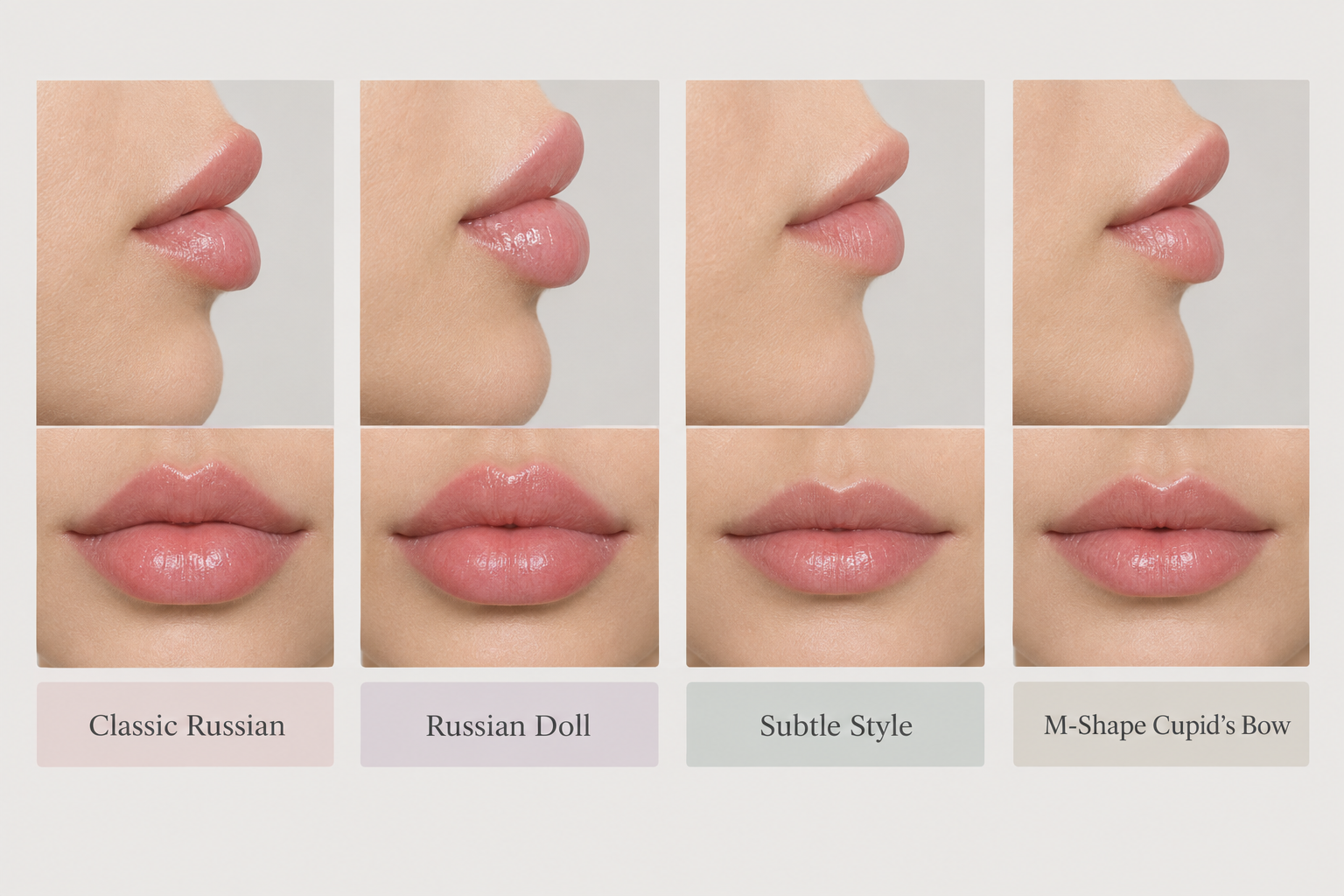

The Russian lip technique has become one of the most requested approaches in aesthetic lip augmentation, but it is not a single fixed method. Several distinct variations exist, each producing a different shape, projection, and overall aesthetic. Understanding the differences between these styles can help you have a more informed conversation with your practitioner and set realistic expectations before your appointment.
Key Takeaways
- The Russian lip technique is an injection method, not a single fixed look — multiple variations exist, each producing different results in terms of shape, height, and projection.
- Classic Russian lips emphasise vertical height and a defined cupid's bow, while other styles such as the Russian doll and Kylie lip prioritise volume, fullness, or a specific silhouette.
- Technique choice depends on your natural lip anatomy, facial proportions, and aesthetic goals — not every style suits every patient.
- All variations carry the same core risks associated with lip filler, including bruising, swelling, asymmetry, and rare but serious vascular complications.
- A thorough consultation with a qualified, experienced practitioner is essential before choosing any Russian lip style.
What Is the Russian Lip Technique?
The Russian lip technique is a specialised approach to lip filler injection that differs from conventional lip augmentation in both the injection method and the aesthetic outcome it produces. In a standard lip filler treatment, hyaluronic acid filler is typically placed along the border and body of the lips to add volume and definition. The Russian technique, by contrast, uses a series of vertical injections placed from the base of the lip upward, depositing filler in a way that lifts the centre of the lip and creates a more pronounced cupid's bow and increased vertical height rather than simply adding forward projection or fullness.
The name references the heart-shaped, doll-like lip aesthetic that became associated with Eastern European beauty trends. The technique requires a precise understanding of lip anatomy and filler behaviour, which is why practitioner skill and experience are particularly important when choosing this approach. The result, when performed well, is a structured, defined lip with a lifted appearance rather than the rounder, fuller look associated with traditional augmentation.
Why There Are Different Styles Within the Russian Technique
The term "Russian lips" is used broadly in aesthetic practice, but it encompasses several distinct variations that differ in their injection points, filler placement depth, the degree of cupid's bow definition, and the balance between vertical height and horizontal volume. Practitioners have adapted and refined the original technique to suit a wider range of patient anatomies and aesthetic preferences, which has led to recognisable sub-styles that are now commonly requested by name.
Understanding these variations matters because the same label can mean different things in different clinics. A patient requesting Russian lips at one clinic may receive a subtly different result than at another, depending on which variation the practitioner uses. Knowing the distinctions helps you communicate your goals more clearly and evaluate whether a practitioner's approach aligns with the outcome you are hoping to achieve.
The Classic Russian Lip Style
The classic Russian lip is the foundational version of the technique. Its defining characteristics are a sharply defined cupid's bow, increased vertical height in the centre of the upper lip, and a relatively flat or less projected profile compared to traditional volume-focused filler. The upper lip is lifted and structured rather than pushed forward, and the philtrum columns — the two ridges running from the nose to the lip — may appear more defined as a result.
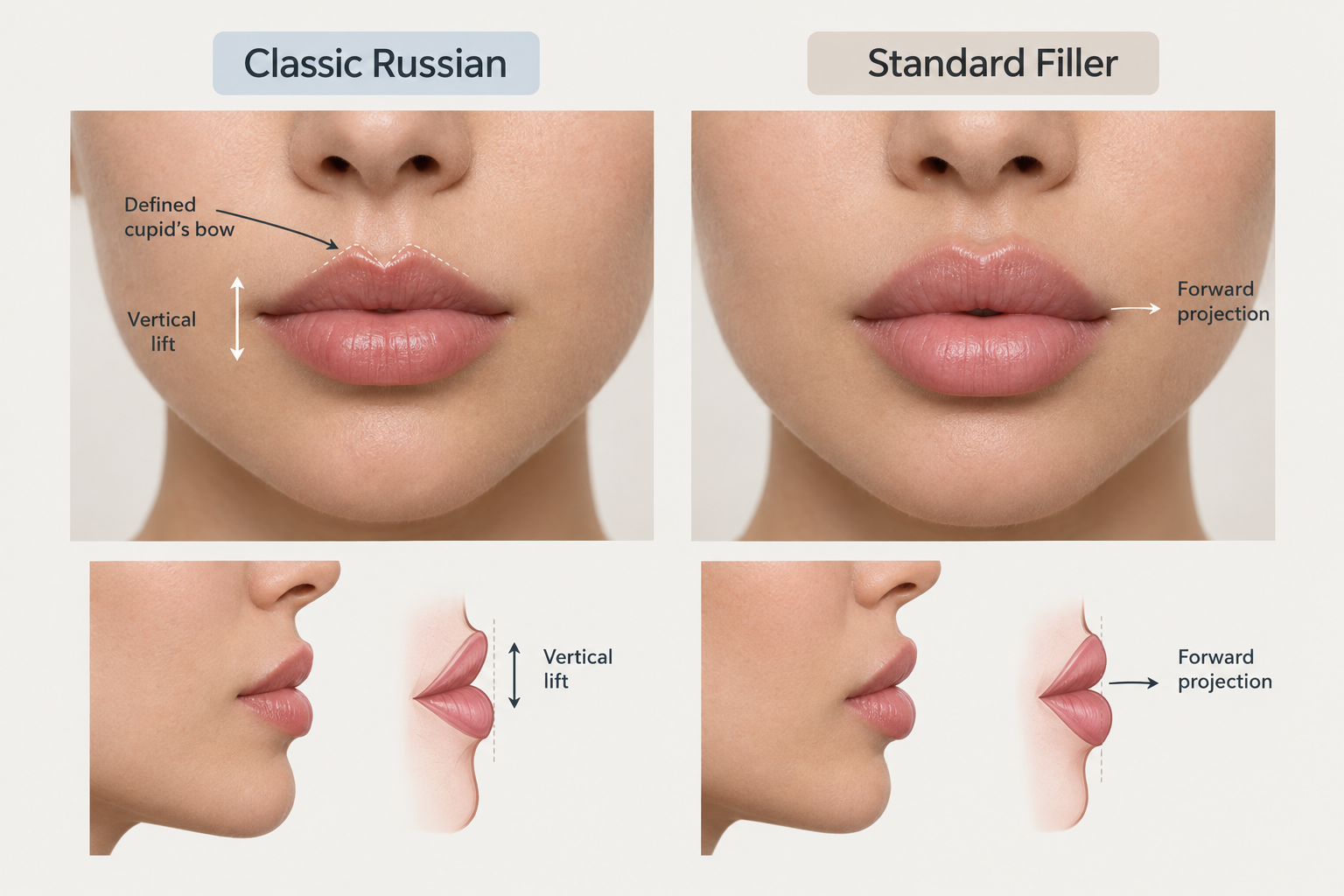
This style tends to suit patients who want a more sculpted, architectural look rather than obvious fullness. It works particularly well for patients who have a naturally flat or thin upper lip with little definition, as the vertical lift creates the impression of a more prominent lip shape without necessarily adding significant volume. The lower lip in the classic Russian style is typically treated more conservatively, maintaining a natural balance with the enhanced upper lip.
One important consideration is that the classic Russian style can look less natural on patients who already have fuller lips or strong natural projection, as the added vertical height without corresponding volume can create a disproportionate appearance. Practitioner assessment of your baseline anatomy is therefore essential before committing to this style.
The Russian Doll Lip Style
The Russian doll lip style builds on the classic technique but incorporates more overall volume alongside the characteristic vertical lift and cupid's bow definition. The result is a fuller, rounder lip that retains the structured, heart-shaped upper lip silhouette but appears softer and more voluminous than the classic version. This style is sometimes described as a hybrid between traditional lip augmentation and the Russian technique.
Patients who want noticeable fullness but also appreciate the defined shape associated with the Russian approach may find the Russian doll style a useful middle ground. Because more filler is typically used compared to the classic style, the treatment may carry a slightly higher risk of visible filler or an unnatural appearance if the product is not placed precisely. The longevity of results may also vary depending on the volume of filler used and the specific hyaluronic acid product selected by the practitioner.
The Kylie Lip Style and Its Relationship to Russian Technique
The Kylie lip style — named after the heavily publicised aesthetic associated with Kylie Jenner — prioritises significant volume and fullness, particularly in the body of both lips, with less emphasis on the sharp cupid's bow definition that characterises the classic Russian approach. Some practitioners incorporate elements of the Russian injection technique when delivering this style, using vertical placement to achieve lift while also adding substantial volume to create the characteristic plump, projected appearance.
It is worth noting that the Kylie lip style is not a strict Russian technique variation in the traditional sense — it is more accurately described as a high-volume lip augmentation that may use Russian-style injection methods in part. Patients requesting this style should be aware that achieving it typically requires a larger amount of filler, which increases the risk of an unnatural result, migration over time, and complications if the filler is not placed correctly. This style may not be appropriate for patients with thinner lips or less lip tissue to support the volume.
The Subtle or Natural Russian Lip Style
Not all patients seeking the Russian technique want a dramatic or immediately visible result. The subtle Russian lip style applies the same vertical injection principles but uses a smaller volume of filler to create a gentle lift and mild cupid's bow enhancement without obvious augmentation. This approach is often chosen by patients who are new to lip filler, who want to enhance their natural lip shape rather than transform it, or who work in professional environments where visible cosmetic treatment may not be desirable.
The subtle variation is also commonly used as a starting point for patients who are uncertain about how much change they want. Because hyaluronic acid fillers are reversible using an enzyme called hyaluronidase, beginning conservatively and building up over subsequent appointments is a safer and more controlled approach than attempting a dramatic result in a single session. Results from a subtle Russian lip treatment may last a similar duration to other styles — typically six to twelve months depending on the filler product used, individual metabolism, and lifestyle factors — but this varies between patients.
The M-Shape or Defined Cupid's Bow Variation
Some practitioners offer a variation specifically focused on creating or enhancing the M-shaped cupid's bow of the upper lip, sometimes called the M-lip or defined cupid's bow technique. This style places particular emphasis on the two peaks of the upper lip and the central dip between them, using precise filler placement to sharpen and lift this area. The overall volume added may be modest, with the primary goal being shape definition rather than size increase.
This variation can be particularly effective for patients whose cupid's bow has become less defined with age, or for those who have a naturally flat or indistinct upper lip border. It is a more targeted approach than the full Russian technique and may require less filler overall. However, achieving a natural-looking defined cupid's bow requires considerable technical precision, as overfilling this area can create an artificial or uneven appearance.
How Practitioners Choose Between Styles
An experienced practitioner will assess several factors before recommending a particular Russian lip style. These include the natural shape and volume of your existing lips, the ratio of your upper to lower lip, the depth of your philtrum, the position of your teeth and jaw, and your overall facial proportions. A style that looks balanced and natural on one patient may appear disproportionate on another with different anatomy.
Your aesthetic goals are equally important. Practitioners will typically ask whether you want a subtle enhancement or a noticeable transformation, whether you prioritise shape definition or volume, and whether you have seen specific results you admire. Bringing reference images to your consultation can be helpful, though it is important to understand that your anatomy may not allow for an exact replication of another person's result. A responsible practitioner will explain what is realistically achievable for your specific lip structure.
What Happens During a Russian Lip Filler Appointment
Regardless of which style is chosen, the general process for a Russian lip filler appointment follows a similar sequence. A topical anaesthetic cream is usually applied to the lips before treatment to reduce discomfort, and many hyaluronic acid fillers also contain lidocaine, a local anaesthetic, within the product itself. The practitioner will then use a fine needle to deliver the filler in a series of small, precise injections, working systematically across the lip to build the desired shape.
The Russian technique typically involves more injection points than a standard lip filler treatment, which can mean slightly more discomfort and a marginally higher risk of bruising. The appointment itself usually takes between thirty and sixty minutes, including preparation and aftercare discussion. Patients are generally advised to avoid strenuous exercise, alcohol, and excessive heat for at least twenty-four to forty-eight hours after treatment, and to avoid pressing or massaging the lips during the initial healing period.
Realistic Results, Longevity, and Maintenance
Swelling is expected after any lip filler treatment and is typically more pronounced in the first twenty-four to seventy-two hours. The final result of a Russian lip treatment may not be fully visible until swelling has resolved, which can take up to two weeks. Some patients find that the initial result appears more dramatic than the settled outcome, while others notice that the shape becomes more refined as swelling reduces.
Hyaluronic acid lip fillers are not permanent. Results from Russian lip techniques generally last between six and twelve months, though this varies depending on the filler product used, the volume injected, individual metabolism, and lifestyle factors such as sun exposure and smoking. Maintenance appointments are typically needed to sustain the result. Over time, with repeated treatments, some patients find that less filler is needed to maintain their preferred appearance, though this is not universal.
Risks and Limitations Across All Russian Lip Styles
All variations of the Russian lip technique carry the same core risks associated with lip filler injections. Common side effects include bruising, swelling, tenderness, and temporary asymmetry, most of which resolve within one to two weeks. Less common but more significant risks include nodule formation, filler migration, prolonged swelling, and infection.
The most serious risk associated with any lip filler treatment is vascular occlusion — a situation where filler inadvertently enters or compresses a blood vessel, potentially restricting blood flow to surrounding tissue. This is a rare but serious complication that requires immediate treatment with hyaluronidase. Choosing a practitioner who is trained to recognise and manage this complication, and who has hyaluronidase available during the appointment, is an important safety consideration regardless of which style you choose.
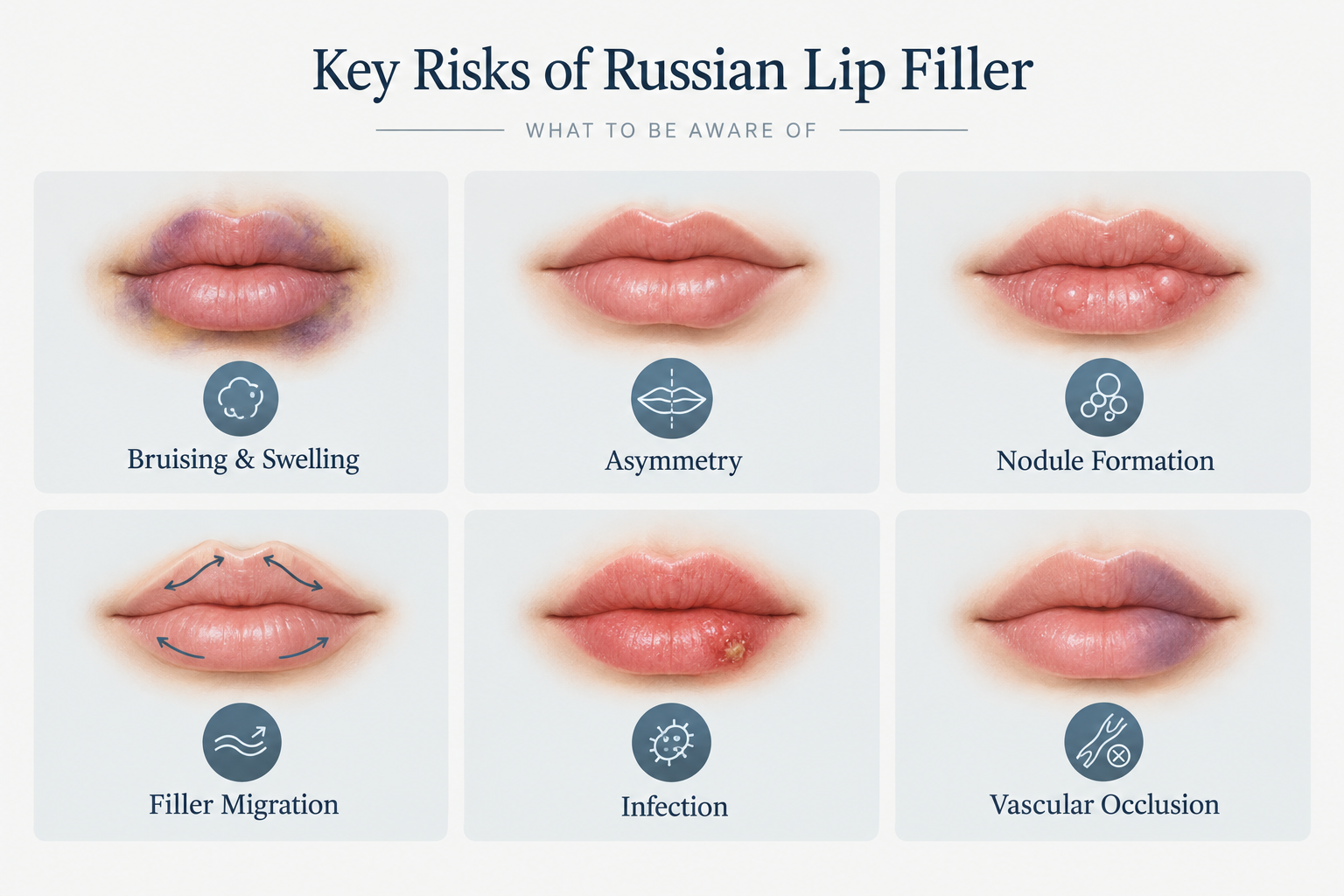
The Russian technique, because it involves more injection points and deeper placement in some variations, may carry a marginally different risk profile compared to superficial border injections. This is another reason why practitioner experience and anatomical knowledge are particularly important for this approach. Patients with a history of cold sores should inform their practitioner before treatment, as lip injections can trigger an outbreak and antiviral medication may be recommended as a precaution.
Who May Be Suitable for Russian Lip Filler Variations
Russian lip technique variations may be suitable for adults who want to enhance the shape, definition, or volume of their lips and who have realistic expectations about what the treatment can achieve. Patients who tend to respond well include those with naturally thin or flat upper lips, those who want a more defined cupid's bow, and those who prefer a structured aesthetic over simple volume addition.
Certain patients may not be suitable for lip filler treatment in general, including those who are pregnant or breastfeeding, those with active infection or inflammation in or around the lips, those with certain autoimmune conditions, and those taking medications that significantly increase bleeding risk. Patients with a history of severe allergic reactions or known hypersensitivity to hyaluronic acid or lidocaine should discuss this with their practitioner before proceeding. A thorough medical history review at consultation is standard practice and helps identify any factors that may affect suitability or require additional precautions.
Alternatives to the Russian Lip Technique
Patients who are interested in lip enhancement but are uncertain about the Russian technique have several alternatives worth discussing with a practitioner. Traditional lip filler using a border and body injection approach remains a widely used method that produces a softer, rounder result with less emphasis on vertical height. Lip flip treatment using botulinum toxin is a non-filler option that relaxes the muscle at the upper lip border, causing the lip to roll slightly outward and appear fuller without adding volume — this is a subtle effect and not suitable for patients wanting significant change.
For patients concerned about the appearance of a thin upper lip due to volume loss associated with ageing, a combination approach using both filler and botulinum toxin may be discussed. Patients who have previously had lip filler and are unhappy with the result may benefit from hyaluronidase treatment to dissolve existing filler before starting fresh with a different technique or style. Each of these alternatives has its own benefits, limitations, and risk profile, and the most appropriate option depends on individual anatomy, goals, and medical history.
Frequently Asked Questions
Can I switch between Russian lip styles at different appointments?
Yes, it is generally possible to try a different style at a subsequent appointment, particularly if your previous filler has been dissolved or has naturally metabolised. Your practitioner will assess your current lip anatomy and the presence of any residual filler before recommending a new approach. Switching styles without dissolving existing filler first can sometimes limit what is achievable, so discussing your goals at each consultation is important.
Will Russian lip filler look natural?
Whether the result looks natural depends on the style chosen, the volume of filler used, your baseline anatomy, and the skill of the practitioner. Subtle and classic Russian styles tend to produce more natural-looking results than high-volume variations. Overfilling any style can lead to an unnatural appearance, which is why conservative treatment and gradual building are generally recommended, especially for first-time patients.
Does the Russian technique hurt more than standard lip filler?
The Russian technique typically involves more injection points than a standard lip filler treatment, which may mean slightly more discomfort during the procedure. Topical anaesthetic and lidocaine-containing fillers help manage pain for most patients. Individual pain tolerance varies, and most patients describe the experience as manageable rather than severely painful.
How much filler is typically used for Russian lip styles?
The volume of filler used varies depending on the style chosen and the patient's existing lip anatomy. Subtle variations may use less than one millilitre, while more voluminous styles such as the Russian doll or Kylie-inspired approach may use one millilitre or more. Your practitioner should discuss the planned volume with you before treatment and explain how it relates to your expected outcome.
Can the Russian lip technique be reversed?
Yes. Because Russian lip filler uses hyaluronic acid, the results can be partially or fully reversed using hyaluronidase, an enzyme that breaks down hyaluronic acid. Reversal is sometimes used when a patient is unhappy with their result or when a complication requires urgent treatment. Hyaluronidase works relatively quickly, though multiple treatments may occasionally be needed to fully dissolve the filler.
Is one Russian lip style better than another?
No single style is universally superior. The most appropriate variation depends on your individual lip anatomy, facial proportions, and aesthetic goals. A style that produces excellent results for one patient may not suit another. This is why a thorough consultation with an experienced practitioner — rather than simply requesting a specific style by name — tends to produce the most satisfying outcomes.
Choosing the Right Russian Lip Style for Your Goals
The different styles of Russian lip filler offer a meaningful range of aesthetic outcomes, from the sharply defined classic cupid's bow to the softer fullness of the Russian doll variation. No single style is right for every patient, and the most important factor in achieving a result you are happy with is a detailed consultation with a practitioner who has genuine experience in the specific technique you are considering.
Before your appointment, think carefully about whether you want a subtle enhancement or a noticeable transformation, whether shape definition or volume is your priority, and whether you have seen results that reflect your goals. Be prepared to discuss your medical history honestly, ask about the practitioner's training and experience with the Russian technique, and ask to see examples of their previous work. A practitioner who takes time to assess your anatomy and explain which style may suit you — rather than simply agreeing to whatever you request — is generally a more reliable choice. If you are new to lip filler, starting conservatively and building gradually over time is a safer approach than attempting a dramatic result in a single session.
